

Over 40% of party wall disputes in England and Wales arise not from genuine disagreements between neighbours, but from procedural errors — missed notice deadlines, incorrectly appointed surveyors, and poorly drafted documents [3]. That single statistic reveals a hard truth: most party wall problems are avoidable. This evergreen guide to party wall awards: resolving disputes and ensuring enforceability cuts through the confusion, offering practical frameworks, real-world case studies, and drafting checklists that protect both building owners and adjoining neighbours throughout the construction process.
Key Takeaways
- A party wall award is a legally binding document that governs how notifiable building work may proceed near or on a shared wall.
- Procedural errors are the leading cause of party wall disputes — correct notice service and surveyor appointment are critical first steps.
- The 2026 RICS 8th Edition guidance has introduced important updates on surveyor jurisdiction, fee structures, and procedural accuracy.
- Awards can be challenged in court, but strict time limits apply, making prompt action essential.
- Proper drafting checklists and a clear understanding of surveyor roles dramatically reduce the risk of costly disputes.
What Is a Party Wall Award and Why Does It Matter
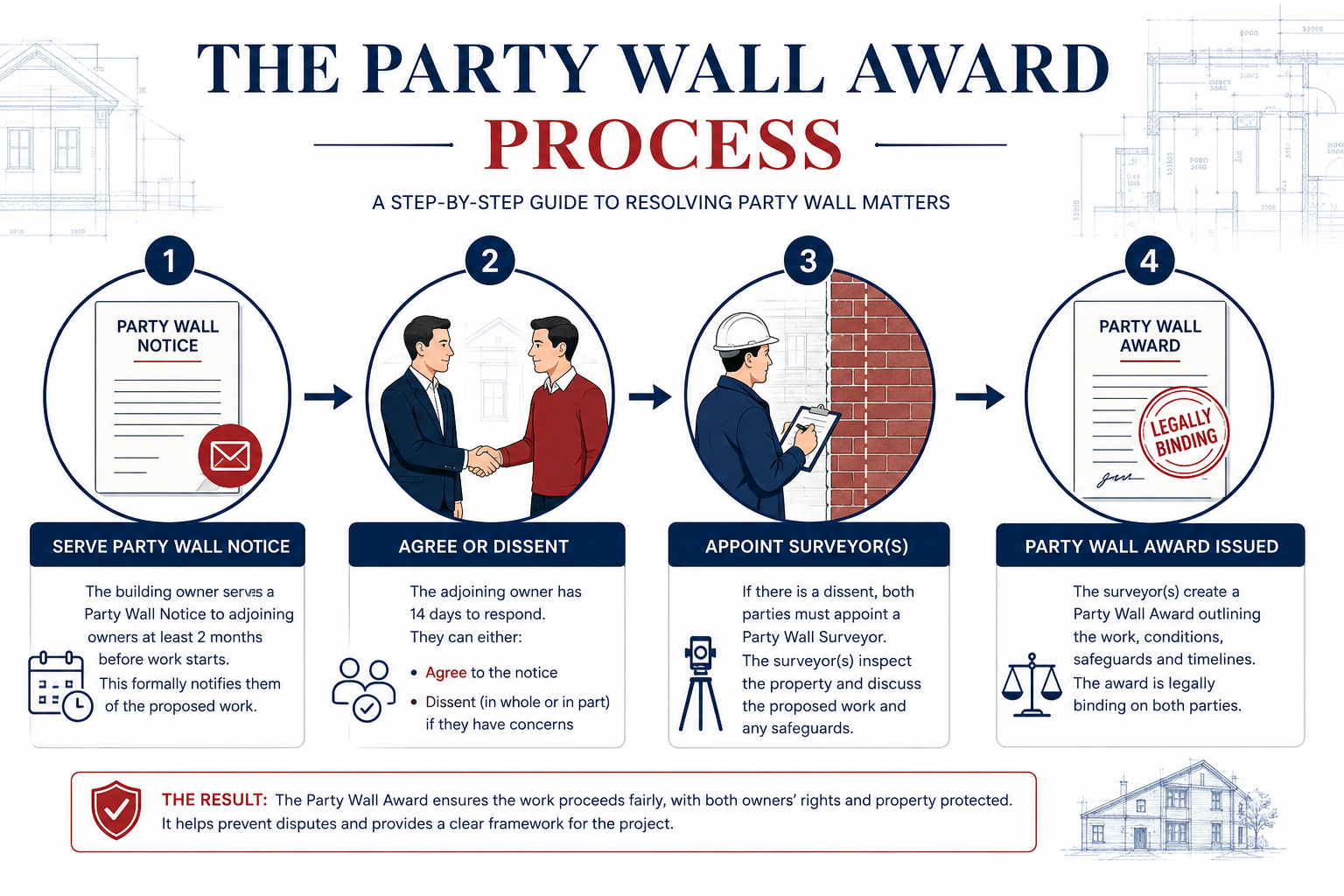
A party wall award — sometimes called a party wall agreement — is a formal, legally binding document produced under the Party Wall etc. Act 1996. It sets out the precise conditions under which building work affecting a shared or boundary wall may be carried out [5]. Understanding the distinction between a notice and an award is essential: a party wall notice is the formal written communication served on an adjoining owner to inform them of proposed works, while the award is the binding outcome that follows if consent is not given or a dispute arises [9].
The award typically covers:
- Scope of works: Exactly what the building owner intends to do
- Working hours: Times during which construction activity is permitted
- Access rights: When and how surveyors or contractors may enter the adjoining property
- Security provisions: Financial security the building owner may need to provide
- Dispute resolution mechanisms: Steps to follow if damage or disagreement arises during works
- Schedule of condition: A record of the adjoining property's pre-works condition
A schedule of condition is particularly important. Without a documented baseline, it becomes very difficult to prove whether damage was caused by the works or existed beforehand.
When Is an Award Required
An award becomes necessary when an adjoining owner either dissents from a notice or fails to respond within the statutory 14-day period, triggering a deemed dispute under the Act [8]. At that point, surveyors must be appointed to resolve the matter and produce the award. In London's active property market, approximately 95% of extension projects now require some form of party wall compliance [2], making this process a near-universal step in residential construction.
"A party wall award is not a bureaucratic hurdle — it is a legal shield protecting both parties from costly, relationship-damaging disputes."
The Legal Framework: Party Wall etc. Act 1996 and 2026 RICS Guidance
The Party Wall etc. Act 1996 remains the cornerstone legislation governing shared walls, boundary structures, and excavation work near neighbouring foundations in England and Wales. It creates a statutory framework that supersedes common law rights in most circumstances, giving surveyors a unique quasi-judicial role.
In 2026, the Royal Institution of Chartered Surveyors (RICS) concluded an eight-week consultation that produced the 8th Edition of party wall practice guidance. This edition addresses three core areas [1]:
| Area | Key Update |
|---|---|
| Surveyor jurisdiction | Clearer limits on what surveyors can and cannot determine |
| Fee structures | Guidance on proportionate and transparent fee charging |
| Procedural accuracy | Stricter requirements for notice content and timing |
One of the most significant clarifications in the 2026 guidance is the reaffirmation that a surveyor's appointment is personal and statutory — meaning it cannot be overridden by client preferences or instructions [1]. This matters enormously in practice: a building owner cannot simply dismiss a surveyor they disagree with, nor can they instruct their surveyor to act in a way that ignores the adjoining owner's legitimate interests.
Surveyor Roles: Agreed, Party, and Third Surveyors
Three surveyor configurations are possible under the Act:
- Agreed surveyor: Both parties appoint a single impartial surveyor. This is the most cost-effective route and works well when the relationship between neighbours is cooperative.
- Party surveyors: Each owner appoints their own surveyor. The two surveyors must act impartially and attempt to agree the award between them.
- Third surveyor: Selected in advance by the two party surveyors, the third surveyor acts as a tiebreaker if the appointed surveyors cannot agree.
For those carrying out works, understanding your obligations as a building owner is the starting point. For those receiving notice, the adjoining owner's position carries its own rights and responsibilities that deserve equal attention.
Common Pitfalls, Case Studies, and How to Avoid Them
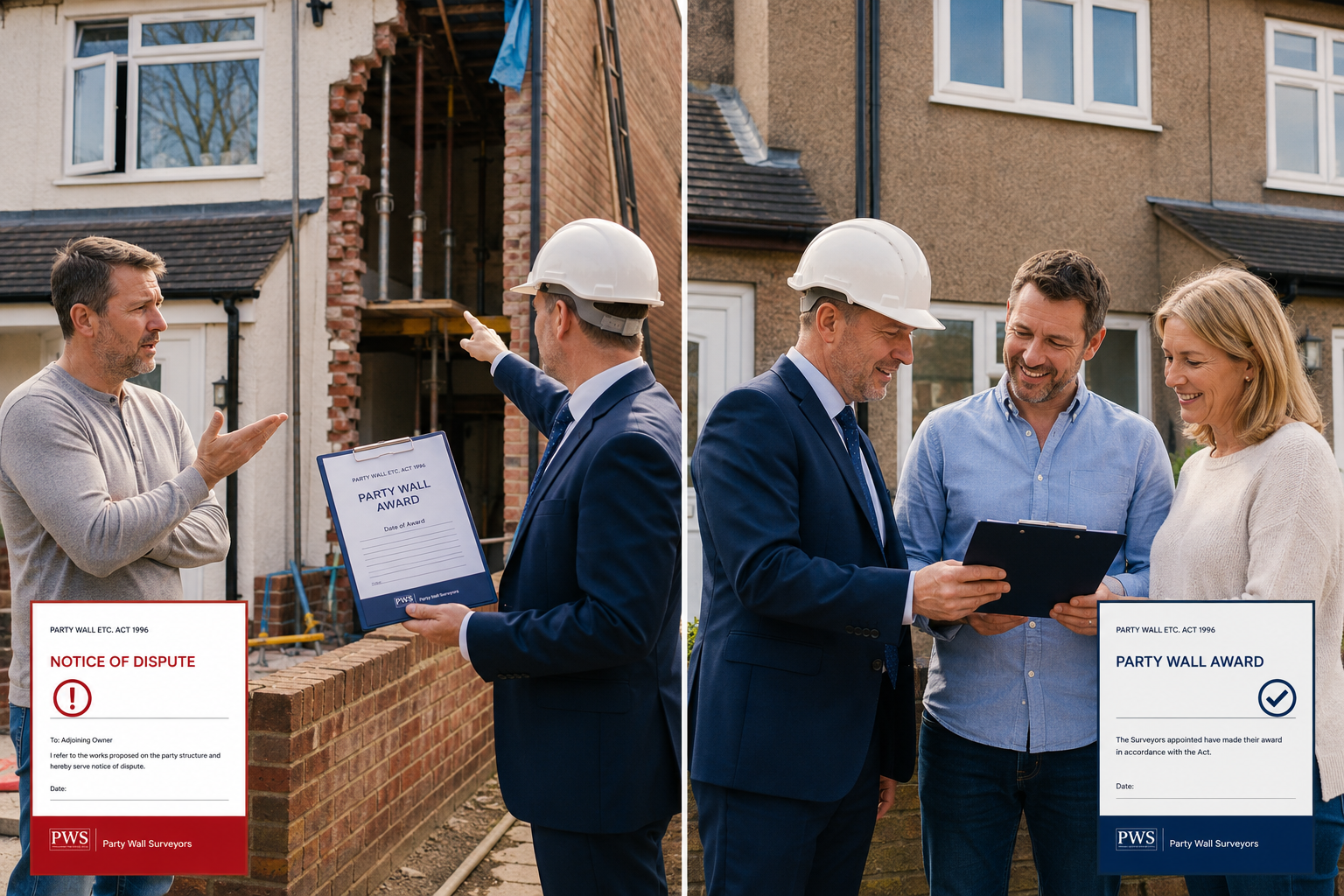
The gap between a well-drafted award and a legally vulnerable one often comes down to avoidable mistakes. The following case studies illustrate the most common failure points.
Case Study 1: The Missed Notice Deadline
A homeowner in South London began excavating foundations for a rear extension without serving the required notice under Section 6 of the Act. The adjoining owner discovered the works, instructed a solicitor, and obtained an injunction halting construction. The building owner faced legal costs exceeding the original surveyor fee many times over, plus a six-week delay.
Lesson: Notices must be served before work begins — not during or after. Section 6 notices for excavation within 3 or 6 metres of a neighbour's foundations require a minimum of one month's notice. Engaging a qualified party wall surveyor in South London early eliminates this risk entirely.
Case Study 2: The Improperly Appointed Surveyor
An adjoining owner in North London appointed a surveyor who had a prior professional relationship with the building owner's contractor. The resulting award was challenged on grounds of apparent bias. The County Court set aside the award, requiring the process to restart from scratch — at significant cost to both parties.
Lesson: Surveyors must be genuinely independent. The 2026 RICS guidance reinforces this, emphasising that the personal and statutory nature of the appointment means impartiality is non-negotiable [1]. Those in North London can find properly vetted professionals through a party wall surveyor in North London.
Case Study 3: The Vague Scope of Works
A party wall award for a loft conversion in East London described the works as "general loft works including structural alterations." When the building owner subsequently installed a steel beam that caused cracking to the adjoining property's plasterwork, the adjoining owner disputed liability. Because the award's scope was too vague to confirm whether the beam installation was included, the dispute escalated to court.
Lesson: Awards must describe the works with precision. Every structural element, material specification, and method statement relevant to the shared wall should be explicitly referenced.
Drafting Checklist for a Robust Party Wall Award
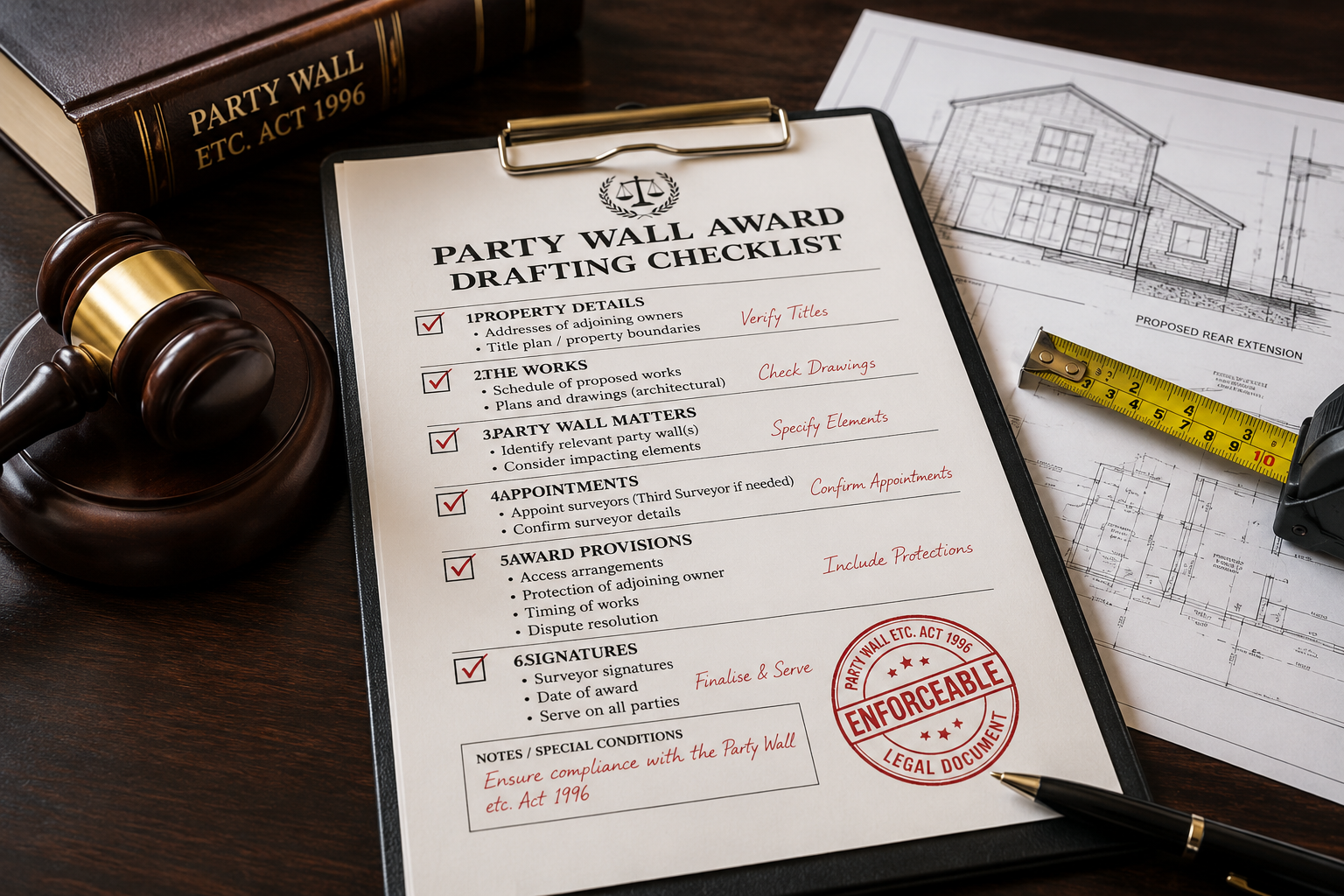
Use this checklist to verify that an award covers all essential bases:
- Full legal description of the building owner's and adjoining owner's properties
- Precise description of all notifiable works, including drawings and specifications
- Confirmed notice service dates and method of service
- Names and contact details of all appointed surveyors
- Agreed working hours and site access arrangements
- Attached schedule of condition with photographs
- Provisions for making good any damage caused
- Security for expenses clause where appropriate
- Method for serving the award on both parties
- Right of appeal notice (14-day window to County Court)
- Third surveyor's details included
For those wanting to understand the full cost implications before committing, reviewing party wall costs and the process provides a clear breakdown of what to expect financially.
Resolving Disputes and Ensuring Enforceability
The enforceability of a party wall award depends on two factors: procedural correctness and substantive completeness. An award that is procedurally sound but substantively vague will be difficult to enforce. Conversely, a detailed award that was produced without proper notice service may be set aside entirely [6].
Grounds for Challenging an Award
Awards can be appealed to the County Court within 14 days of service. The grounds for challenge typically include [6]:
- Jurisdictional error: The surveyors acted outside the scope of the Act
- Procedural irregularity: Notice was not properly served or the appointment process was flawed
- Unreasonableness: The award imposes conditions that are disproportionate or unfair
- Fraud or bad faith: Evidence that a surveyor acted with bias or improper motive
It is worth noting that courts have historically been reluctant to interfere with awards unless the error is clear and material. The 14-day appeal window is strictly enforced, meaning owners who delay lose their right to challenge even if the grounds are valid [6].
Fee Disputes and the 2026 Landscape
Party wall surveyor fees have risen by 8 to 12% since 2024, driven by heightened demand in London's property market [2]. This has created a secondary source of disputes, with some owners contesting fee levels after the fact. The 2026 RICS guidance addresses this directly by requiring surveyors to provide transparent fee estimates at the outset and to justify charges proportionate to the complexity of the works [1].
To manage costs proactively, reviewing guidance on how to keep party wall costs down can help owners budget realistically and avoid unnecessary expenditure.
Enforcing an Award When a Neighbour Refuses to Comply
If a building owner proceeds in breach of an award — for example, working outside agreed hours or failing to make good damage — the adjoining owner has several remedies:
- Injunction: Apply to the court to stop the works
- Damages: Claim compensation for any loss caused by the breach
- Surveyor referral: Refer the matter back to the appointed surveyors for a supplementary award
The Act itself provides enforcement mechanisms, but practical enforcement often requires legal assistance. This is why the quality of the original award matters so much: a well-drafted document leaves little room for ambiguity about what constitutes a breach.
Ensuring Lasting Neighbour Harmony
Beyond the legal mechanics, the best party wall awards are those that never need to be enforced. Surveyors who take the time to explain the process to both parties, facilitate open communication, and draft awards in plain, accessible language tend to produce outcomes that preserve neighbourly relationships rather than damage them.
The party wall act notices guide is a useful starting point for anyone who has received a notice and wants to understand their options before responding.
Conclusion
This evergreen guide to party wall awards: resolving disputes and ensuring enforceability demonstrates that the process, while technical, is entirely manageable with the right preparation. The core principles are consistent regardless of the year: serve notices correctly and on time, appoint independent and qualified surveyors, draft awards with precision, and act promptly if something goes wrong.
Actionable next steps for property owners in 2026:
- Before starting any work near a shared wall or boundary, check whether the Party Wall etc. Act 1996 applies by reviewing the types of party wall works that trigger the notice requirement.
- Serve notices within the correct statutory timeframes — at least two months for party structure notices and one month for line of junction or excavation notices.
- Appoint a surveyor with demonstrable experience and no conflicts of interest, ideally one who is familiar with the 2026 RICS 8th Edition guidance.
- Insist on a schedule of condition being attached to any award before works begin.
- If an award is served on you and you have concerns, seek legal advice immediately — the 14-day appeal window does not wait.
The party wall process exists to protect everyone involved. Used correctly, it is not a source of conflict but a framework for resolving it — permanently and legally.
References
[1] Rics 8th Edition Party Wall Guidance 2026 Implementation Challenges And Surveyor Compliance Strategies – wimbledonsurveyors.com
[2] Party Wall Awards And Fee Structures In 2026 Navigating Increased Demand And Cost Pressures – wimbledonsurveyors.com
[3] Party Wall Awards Explained Surveyor Roles Notice Periods And Dispute Resolution Under 2026 Rics Guidance – wimbledonsurveyors.com
[4] Your Party Wall Rights And Responsibilities – legalclarity.org
[5] Party Wall Award – aylingassociates.com
[6] Can Party Wall Awards Be Challenged The Grounds Time Limits And Practical Steps For Surveyors And Owners – partywallsurveyorlondon.uk
[7] Faqs Party Wall Awards – partywallconsultancy.co.uk
[8] Party Wall Agreement – hoa.org.uk
[9] Difference Between Party Wall Notices And Awards – partywallslimited.com
How Prince Surveyors can help: explore our party wall surveyors or learn about our party wall surveyor costs.