

Nearly one in three quantity surveyor roles across the UK remained unfilled in 2025 — and the ripple effects are still being felt in 2026 across every stage of the party wall process [3]. From delayed schedules of condition to underfunded security deposits, the labour gap is reshaping how chartered surveyors approach award drafting. Drafting Party Wall Awards Under Labour Shortages: Best Practices for Chartered Surveyors in 2026 has therefore become one of the most pressing professional challenges in the built environment sector.
This article sets out clear, actionable guidance for chartered surveyors navigating this difficult landscape — covering updated cost provisions, RICS compliance under the new 8th Edition guidance, and the digital tools that are helping practices maintain quality under pressure.
Key Takeaways 📋
- Labour shortages are causing construction delays that must be anticipated in award drafting through contingency clauses and buffered timelines.
- Security deposits have risen by up to 25% in 2026 due to material cost inflation driven by tariffs on imported steel [1].
- The RICS 8th Edition Party Wall Guidance (April 2026) introduces stricter rules on surveyor independence and award scope [2].
- AI and cloud-based tools are increasingly essential for surveyors managing higher caseloads with fewer support staff [4].
- A well-structured award — including detailed schedules of condition, method statements, and realistic timelines — is the single most effective defence against labour-delay disputes [8].
The Labour Shortage Crisis and Its Impact on Party Wall Awards
Why Construction Delays Are Now a Party Wall Problem
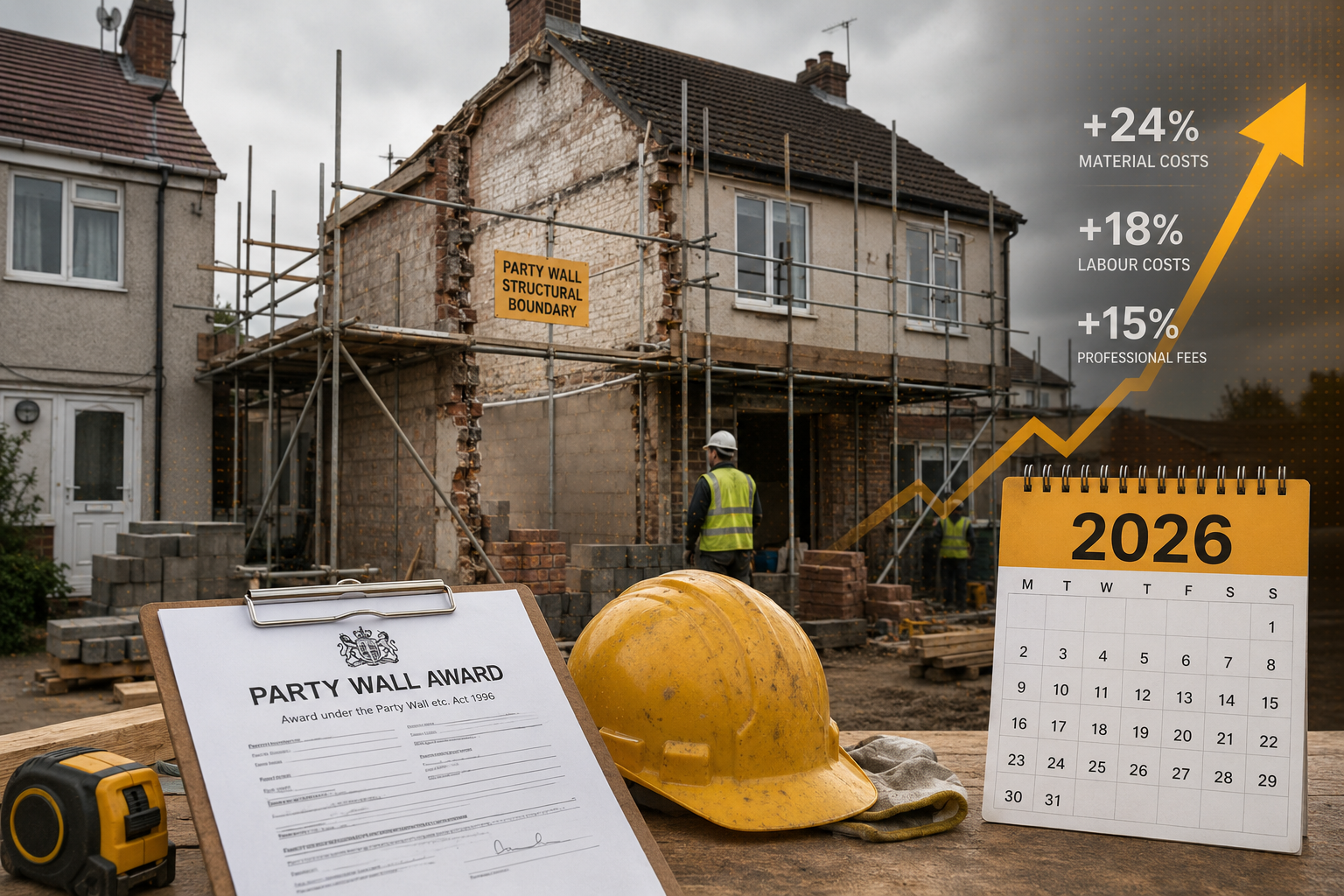
Construction labour shortages are not merely a contractor's headache — they directly affect the enforceability and adequacy of party wall awards. When skilled tradespeople are scarce, projects overrun. When projects overrun, adjoining owners suffer prolonged disruption, and surveyors face pressure to amend awards mid-process or manage escalating disputes.
In 2026, the consequences are measurable:
- Timeline overruns of 20–40% are common on residential extension projects
- Material cost inflation — particularly on imported steel, where tariffs have pushed prices up by 15–25% — has made older cost estimates in awards dangerously inadequate [1]
- Security deposit shortfalls leave adjoining owners exposed if works cause damage and the building owner becomes insolvent or disappears
💬 "An award drafted without accounting for labour market realities is not a protective document — it is a liability waiting to materialise."
For surveyors working across busy urban areas — whether providing party wall services in London or advising on projects in Berkshire or Essex — the challenge is consistent: awards must reflect real-world conditions, not optimistic projections.
Updated Security Deposit Benchmarks for 2026
One of the most concrete changes surveyors must implement is the revision of security deposit figures. The table below reflects current benchmarks:
| Work Type | 2024 Deposit Range | 2026 Deposit Range | % Increase |
|---|---|---|---|
| Single-storey extension | £2,000 – £4,000 | £2,500 – £5,000 | ~25% |
| Loft conversion (party wall) | £3,500 – £6,000 | £4,500 – £7,500 | ~25% |
| Basement excavation | £8,000 – £15,000 | £10,000 – £18,000 | ~20% |
| Structural beam insertion | £1,500 – £3,000 | £2,000 – £4,000 | ~25% |
Sources: [1][6]
These figures must be treated as minimum starting points, not fixed sums. Surveyors should assess each project individually, factoring in:
- The proximity and vulnerability of the adjoining owner's property
- The contractor's financial standing and insurance cover
- The complexity and duration of the proposed works
Adding Timeline Contingency Clauses
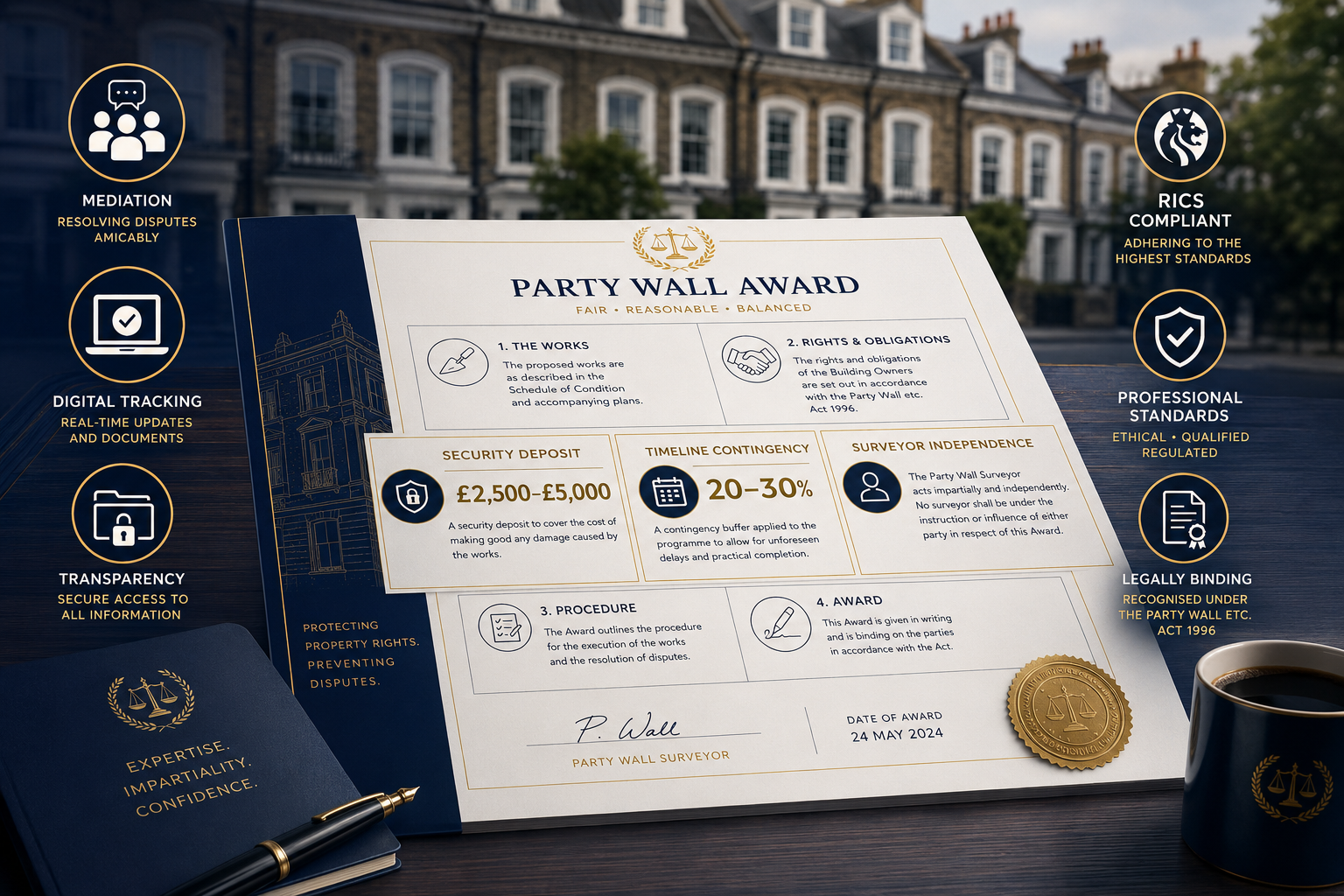
A practical and increasingly standard approach is to build 20–30% timeline buffers into party wall awards [6]. This means that if a contractor estimates 12 weeks for a rear extension, the award should reference a 15–16 week working period before the adjoining owner can trigger a formal complaint about unreasonable delay.
Surveyors should also include:
- ✅ Named contractor provisions — requiring the building owner to notify the surveyor if the original contractor is replaced
- ✅ Restart clauses — specifying what constitutes an unreasonable work stoppage
- ✅ Notification obligations — requiring the building owner to give 48–72 hours' notice before commencing each major phase of work
These clauses give the award teeth without being unnecessarily restrictive. For guidance on what happens when a neighbour refuses to engage with the party wall process, the article on what to do when a neighbour refuses party wall works provides useful context.
RICS 8th Edition Compliance and Award Drafting Standards
What the New RICS Guidance Changes in Practice
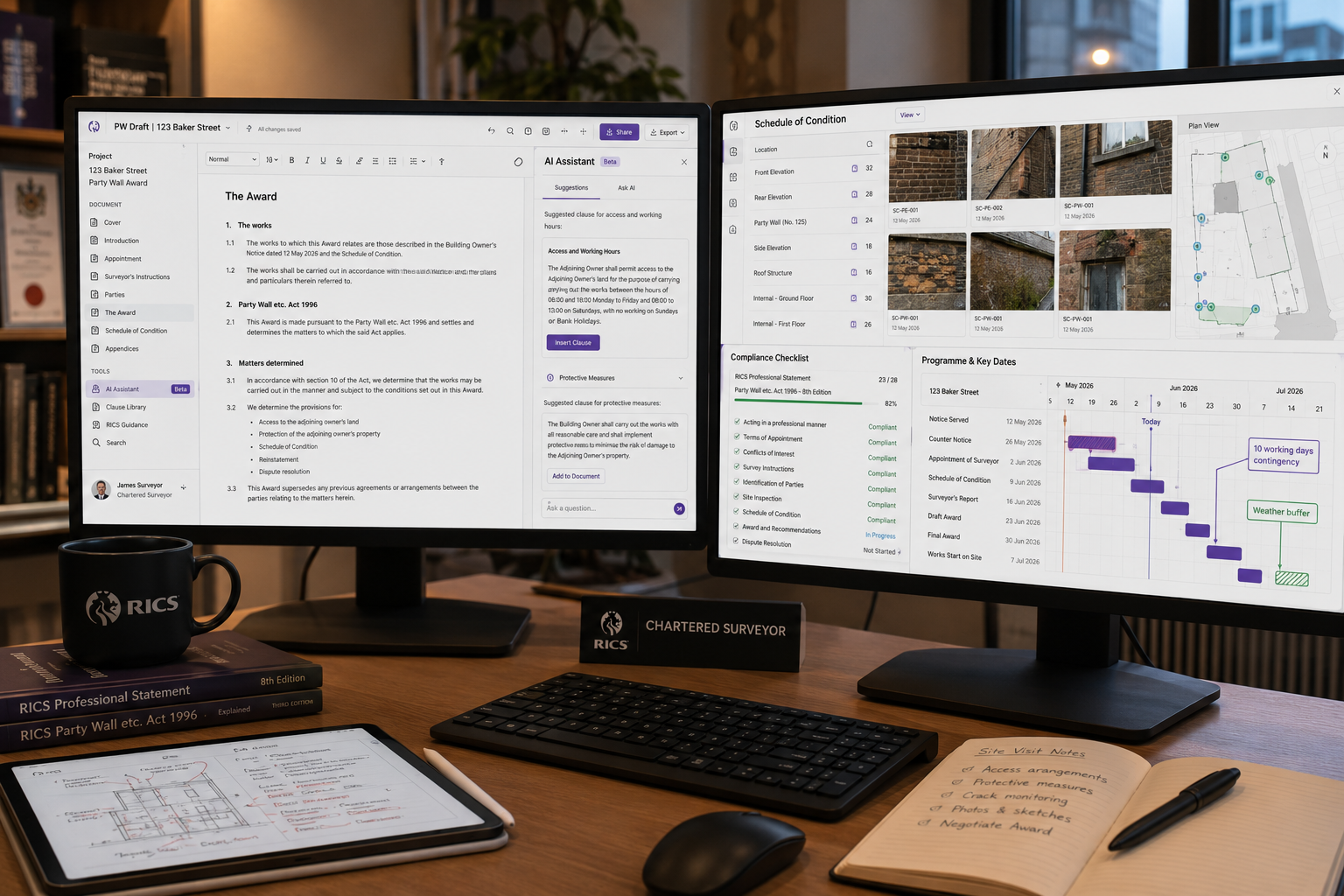
The RICS released its 8th Edition Party Wall Guidance in April 2026, and it represents the most significant update to professional standards in over a decade [2]. For surveyors focused on drafting party wall awards under labour shortages, several provisions are directly relevant.
Key changes include:
-
Surveyor independence is now explicitly statutory — The 8th Edition states clearly that a party wall surveyor's appointment is personal and statutory. Surveyors must not act on client instruction when making decisions within the award [7]. This is particularly important when a building owner pressures a surveyor to minimise security deposits or shorten notice periods.
-
Scope limitation — Awards must be limited strictly to matters covered by valid notices. Including provisions for works not referenced in the original notice is a common error that can render an award void or open to appeal [5].
-
Complex scenarios require peer review — For large-scale developments involving multiple adjoining owners, the 8th Edition recommends specialist support or formal peer review [2]. This is a significant shift toward collaborative professional practice.
-
Clearer guidance on agreed surveyors — The role and limitations of an agreed surveyor are more precisely defined, reducing ambiguity in appointment procedures.
Essential Clauses for a Labour-Shortage-Proof Award
A well-drafted award in 2026 should contain all of the following elements [8][10]:
Structural and Legal Components:
- Full details of the building owner and adjoining owner
- Names and qualifications of all appointed surveyors
- Reference to all valid notices served and acknowledged
- Approved drawings and structural calculations
Operational Safeguards:
- Detailed method statements for each phase of work
- Working hours restrictions (typically 8am–6pm Monday–Friday, 8am–1pm Saturday)
- Dust, noise, and vibration management protocols
- Named emergency contact for the building owner's contractor
Labour-Shortage Specific Additions:
- Contractor substitution notification clause
- Timeline contingency buffer (20–30% above contractor estimate)
- Updated security deposit reflecting 2026 material costs
- Provision for award amendment by agreement if significant delays occur
Schedule of Condition:
- Written descriptions of all pre-existing defects
- Photographic record with timestamps and GPS coordinates where possible
- Specific reference to vulnerable features (cornicing, chimney breasts, ceiling roses)
💬 "The schedule of condition is not a formality — it is the document that determines whether a dispute costs hundreds or tens of thousands of pounds."
Common Drafting Errors to Avoid
The 8th Edition specifically flags the following errors as grounds for award challenge [5]:
| Error | Risk |
|---|---|
| Acting beyond statutory authority | Award may be void |
| Including works not in valid notice | Clause may be struck out on appeal |
| Failing to record surveyor independence | Professional conduct complaint |
| Inadequate schedule of condition | Inability to prove pre-existing vs. new damage |
| Unrealistic timelines | Dispute trigger within weeks of works commencing |
Surveyors handling complex residential projects should also consider the value of a thorough Level 3 Full Building Survey to supplement the schedule of condition, particularly where the adjoining property shows signs of pre-existing structural movement.
Digital Tools and Workflow Strategies for Surveyors in 2026
How Technology Is Closing the Labour Gap
With nearly a third of surveying roles unfilled [3], practices that have not adopted digital tools are struggling to maintain turnaround times. Drafting Party Wall Awards Under Labour Shortages: Best Practices for Chartered Surveyors in 2026 increasingly involves leveraging technology not as a luxury but as a professional necessity.
The most impactful tools currently in use include:
🤖 AI-Assisted Drafting Platforms
- Auto-populate standard clauses based on notice type and work category
- Flag missing elements (e.g., absent method statements or unsigned drawings)
- Cross-reference award scope against valid notices to catch ultra vires provisions [4]
☁️ Cloud Collaboration Software
- Enable real-time co-drafting between appointed surveyors and third surveyors
- Maintain version-controlled audit trails — essential if an award is appealed
- Allow remote schedule of condition reviews using uploaded photographs and video walkthroughs [4]
📱 Mobile Condition Survey Apps
- Timestamped, GPS-tagged photographic records
- Automated report generation with pre-formatted templates
- Instant sharing with all parties upon completion
📊 Project Tracking Dashboards
- Monitor works progress against award timelines
- Send automated alerts when contingency buffers are approaching
- Log all communications between parties for dispute reference
Building Resilient Practices Under Pressure
Beyond technology, surveyors must also address workflow and capacity planning. The following strategies are proving effective across practices in 2026:
-
Pre-award contractor viability checks — Before finalising an award, assess whether the proposed contractor has the workforce to deliver. Request evidence of current staffing levels and subcontractor arrangements [6].
-
Phased award structures — For large or complex projects, consider issuing awards in phases aligned with work stages. This limits exposure if early phases are delayed and reduces the need for wholesale award amendments.
-
Early engagement with adjoining owners — Proactive communication before and during works reduces the likelihood of formal disputes. Many surveyors are now scheduling mid-works check-ins as a standard practice.
-
Apprenticeship and mentoring investment — RICS has expanded apprenticeship pathways specifically to address the skills gap [3]. Practices that invest in junior staff development now are building resilience for 2027 and beyond.
For practices looking to grow their teams, exploring open roles at chartered surveying firms is one practical step toward addressing internal capacity gaps.
Pre-Award Risk Assessment: A Practical Checklist
Before issuing any party wall award in 2026, surveyors should complete the following risk assessment:
- Has the contractor provided a realistic, labour-market-aware timeline?
- Is the security deposit figure aligned with 2026 material cost benchmarks?
- Does the award scope match the valid notices exactly?
- Has a full schedule of condition been completed with photographic evidence?
- Are all method statements sufficiently detailed for the proposed work type?
- Has surveyor independence been clearly documented?
- Are contingency clauses in place for contractor substitution and timeline overrun?
- Has peer review been sought for complex multi-owner scenarios?
Conclusion: Actionable Next Steps for Chartered Surveyors
Drafting Party Wall Awards Under Labour Shortages: Best Practices for Chartered Surveyors in 2026 demands a higher standard of professional preparation than at any point in recent memory. The combination of a depleted labour market, rising material costs, and updated RICS guidance means that awards drafted to pre-2026 standards carry real legal and professional risk.
The path forward is clear:
Immediate actions:
- ✅ Update all standard security deposit figures to reflect 2026 benchmarks
- ✅ Incorporate 20–30% timeline contingency buffers into every award
- ✅ Review all standard clauses against the RICS 8th Edition requirements
- ✅ Adopt at least one AI-assisted drafting or cloud collaboration tool
Medium-term priorities:
- ✅ Develop a pre-award contractor viability assessment protocol
- ✅ Invest in mobile condition survey technology for faster, more accurate records
- ✅ Build peer review into the workflow for complex or multi-owner projects
- ✅ Engage with RICS apprenticeship programmes to address team capacity
The party wall award remains one of the most powerful protective instruments available to both building and adjoining owners. When drafted with precision, foresight, and full compliance with current guidance, it transforms potential conflict into a managed, professional process — even in the most challenging labour market conditions.
For surveyors looking to understand the full scope of party wall rights and obligations before drafting begins, the guide on party wall rights for property owners and the overview of top party wall agreement considerations for renovation projects offer valuable foundational reading.
References
[1] Tariffs And Rising Material Costs Impact On Party Wall Surveyor Fees And Awards In 2026 – partywallsurveyorlondon.uk
[2] Rics 8th Edition Party Wall Guidance 2026 Implementation Challenges And Surveyor Compliance Strategies – wimbledonsurveyors.com
[3] Quantity Surveyor Shortages Impacting Building Survey Firms Rics 2025 Strategies For 2026 Project Delivery – kingstonsurveyors.com
[4] Skill Evolution For Party Wall Surveyors Mastering Ai And Cloud Tools Amid 2026 Labor Shifts – partywallsurveyorlondon.uk
[5] Drafting Bulletproof Party Wall Awards Under New Rics Guidance Clause Essentials For 2026 Works – partywallsurveyorlondon.uk
[6] Resolving Party Wall Disputes From Labor Delays Award Amendments And Mediation In 2026 – partywallsurveyorlondon.uk
[7] Party Wall Awards Explained Surveyor Roles Notice Periods And Dispute Resolution Under 2026 Rics Guidance – wimbledonsurveyors.com
[8] Party Wall Awards London – houricanassociates.com
[9] Party Walls – rics.org
[10] A Guide To Party Walls – mcp.london