


Last updated: July 24, 2026
Quick Answer: Diminution in value claims from party wall works allow an adjoining owner to seek financial compensation when construction by a neighbouring building owner reduces their property's market value. Under the Party Wall etc. Act 1996, the measure of loss is typically the difference between what the property was worth before the works and what it is worth after. A RICS-qualified expert witness provides the valuation evidence courts and party wall surveyors rely on to quantify that loss.
Key Takeaways
- Diminution in value is the legally recognised measure of loss when party wall works reduce a neighbouring property's market value.
- The Party Wall etc. Act 1996 frames compensation as a tort-based remedy, aiming to restore the adjoining owner to the position they would have been in without the damage.
- RICS-accredited valuers use comparable sales analysis, before-and-after valuations, and market sentiment evidence to calculate the loss.
- A schedule of condition prepared before works begin is the single most valuable piece of protective evidence an adjoining owner can hold.
- Not every instance of physical damage automatically produces a measurable diminution; some repairs restore full market value.
- Expert witness reports must comply with Civil Procedure Rules (CPR) Part 35 to be admissible in court proceedings.
- Costs for a specialist diminution valuation typically range from a few hundred to several thousand pounds, depending on complexity.
- Acting quickly after works complete improves the quality of evidence and limits disputes about causation.

What Is Diminution in Value in Party Wall Claims
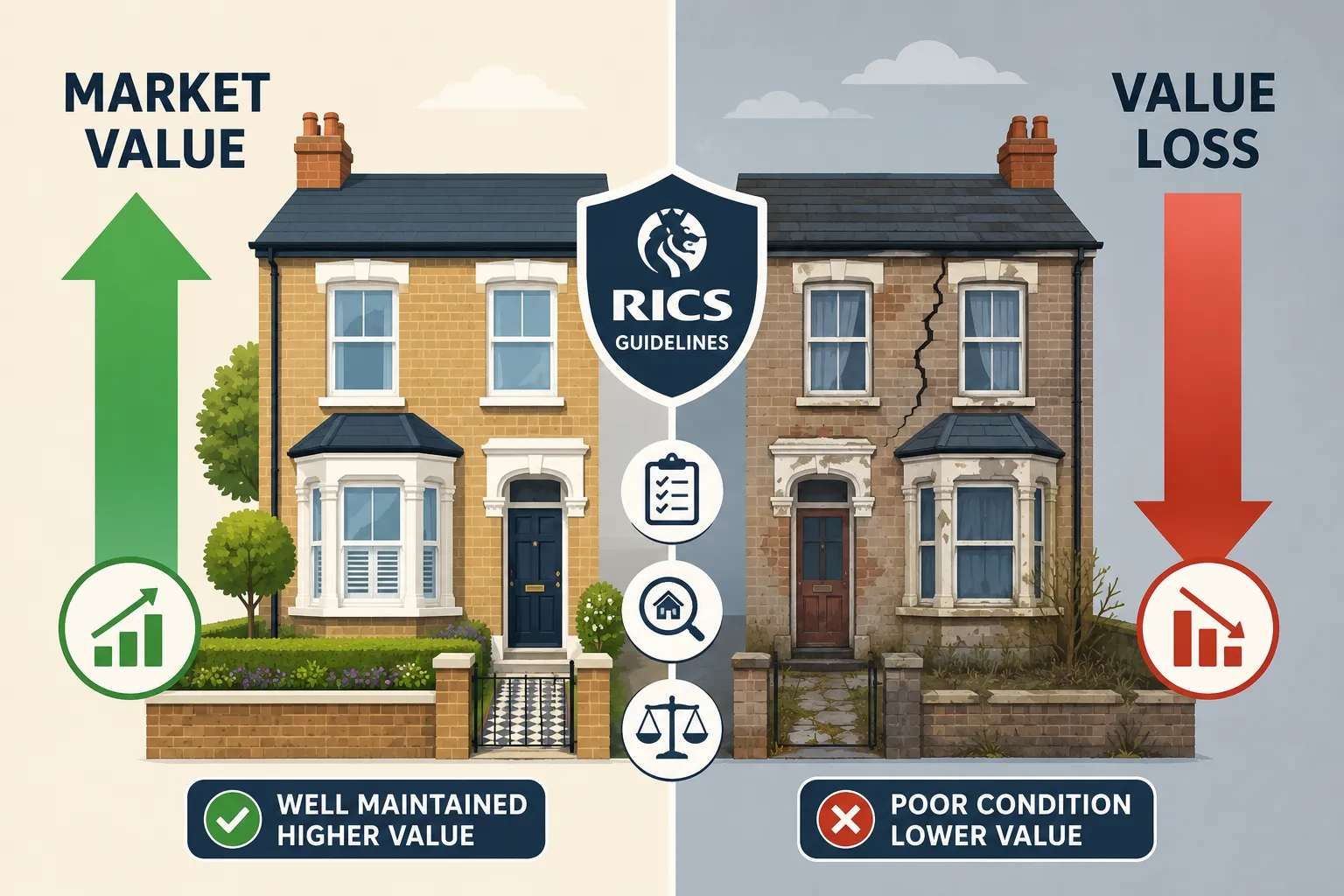
Diminution in value, in the context of party wall works, is the measurable reduction in a property's open market value caused by a neighbouring owner's construction activities. It is distinct from the cost of physical repairs: a property can be fully repaired yet still sell for less than it would have before the works, because buyers may discount for perceived structural risk or a history of damage.
Under the Party Wall etc. Act 1996, an adjoining owner who suffers loss as a result of notifiable works has a statutory right to compensation. The legal principle applied is a tort-based one: the aim is to put the claimant back in the position they would have been in had the wrong not occurred. In practice, that measure is usually taken to be the diminution in the value of the claimant's property, though in some circumstances the cost of reinstatement works may be the appropriate measure instead.
Key distinctions worth understanding:
- Diminution claim: Focuses on market value loss, even after repairs are complete.
- Reinstatement claim: Focuses on the cost to physically repair damage caused.
- Combined claim: Where repairs do not fully restore value, both elements may be claimed together.
For a broader overview of your rights as an adjoining owner, see what are my party wall rights.
Can You Claim Diminution in Value for Party Wall Works
Yes, an adjoining owner can claim diminution in value where party wall works have caused a measurable reduction in their property's market value. The right to compensation is established under Section 7(2) of the Party Wall etc. Act 1996, which states that the building owner shall compensate any adjoining owner for any loss or damage arising from the works.
The claim does not require the adjoining owner to prove negligence. It is a strict liability provision: if the works caused the loss, compensation is owed. However, the claimant must demonstrate:
- That notifiable works were carried out under the Act.
- That the property suffered damage or value loss as a direct consequence.
- That the loss is quantifiable by reference to market evidence.
Common mistake: Many adjoining owners assume that once physical repairs are completed and paid for, no further claim is possible. That is incorrect. A residual diminution claim can survive full repair if the market still discounts the property.
Do All Party Wall Damage Claims Result in Diminution
Not all physical damage from party wall works produces a lasting diminution in market value. Minor, fully repaired cosmetic damage (hairline cracks in plaster, for example) is unlikely to affect what a buyer would pay. A measurable diminution is more likely where:
- Structural damage has occurred to foundations, load-bearing walls, or floors.
- The damage is visible and buyers are likely to commission surveys revealing it.
- The property has a history of party wall disputes that will appear in conveyancing searches or solicitor enquiries.
- Works have altered the physical character of the party wall (for example, reduced thickness or compromised fire separation).
A chartered surveyor assessing the claim will consider whether a hypothetical informed buyer, aware of the damage history, would pay less for the property and by how much.
How Do You Calculate Property Value Loss from Party Wall Work
Calculating property value loss from party wall works requires a before-and-after valuation approach, supported by comparable market evidence. A RICS-registered valuer establishes two figures: the open market value of the property immediately before the works began, and its open market value after the damage occurred (or after repairs, if residual stigma is the issue).
The standard methodology involves:
- Identifying comparable sales of similar properties in the same locality, both undamaged and with comparable defect histories.
- Applying percentage adjustments to reflect the specific nature and severity of the damage.
- Considering market sentiment evidence, such as estate agent commentary or buyer survey data, where direct comparables are scarce.
- Reviewing any pre-works schedule of condition to establish the baseline state of the property.
The difference between the two figures is the diminution. Where the cost of repairs exceeds the diminution, the appropriate measure may shift to reinstatement cost, but only where the claimant can demonstrate a genuine intention to carry out those works.
For context on how property valuations work more broadly, the RICS-accredited property valuation services offered by chartered surveyors cover the full range of methodologies used in these assessments.
RICS Guidelines for Valuation After Party Wall Damage
RICS sets the professional framework for valuation evidence in party wall diminution claims. The RICS guidance note "Party Wall Legislation and Procedure" (7th edition) provides the authoritative reference for how surveyors should handle damage, loss, and compensation under the 1996 Act. Valuations must also comply with the RICS Valuation, Global Standards (the "Red Book"), which governs all formal valuation work by RICS members in the UK.
Key RICS requirements for diminution valuations include:
- Independence: The valuer must act impartially and disclose any conflicts of interest.
- Methodology transparency: The report must explain the basis of valuation, the comparables used, and any adjustments made.
- Market value basis: Valuations should reflect what a willing buyer would pay a willing seller in an arm's-length transaction.
- Proportionality: The depth of analysis should be proportionate to the size of the claim.
"The measure of damages is usually taken to be the diminution in the value of the claimant's property, though claimants must often demonstrate a genuine intention to carry out reinstatement works to recover full repair costs where those exceed the diminution figure."
RICS also expects surveyors acting as expert witnesses to comply with CPR Part 35, which requires that their overriding duty is to the court, not to the party instructing them.
What Does a Party Wall Expert Witness Do
A party wall expert witness is a RICS-qualified professional appointed to provide independent, court-admissible evidence on the valuation or technical aspects of a diminution claim. Their role is distinct from that of a party wall surveyor appointed under the Act: the expert witness's duty is to the tribunal or court, not to the party who instructs them.
In diminution claims, the expert witness typically:
- Inspects the property and reviews all available documentation (schedules of condition, party wall awards, structural reports).
- Prepares a formal valuation report quantifying the loss, with full methodology disclosed.
- Addresses any counter-arguments raised by the building owner's expert.
- Attends hearings or mediation sessions to give oral evidence if required.
- Produces a joint statement with the opposing expert, identifying areas of agreement and disagreement.
For specialist expert witness reports in party wall and property matters, see the expert witness report services available from chartered surveyors with the relevant accreditation.
What Evidence Do You Need for a Diminution Claim
Strong evidence is the foundation of any successful diminution in value claim from party wall works. The quality of evidence directly affects whether a claim succeeds and how much is recovered.
Essential evidence:
- Schedule of condition: A photographic and written record of the property's state before works began. This is the single most important protective document. See party wall schedule of condition for how this is prepared.
- Party wall award: The formal agreement setting out the permitted works, protections, and compensation provisions.
- Post-works survey: A structural or building survey documenting damage after works complete.
- Valuation reports: Before-and-after valuations from a RICS-registered valuer.
- Comparable sales evidence: Recent sales of similar properties in the area, with and without comparable defect histories.
- Expert correspondence: Any written admissions or assessments from the building owner's surveyors.
Edge case: Where no schedule of condition was prepared before works, the adjoining owner faces a much harder evidential task. The burden shifts to demonstrating that the damage did not pre-exist the works, which often requires structural engineering evidence and historical property records.
Party Wall Works Causing Cracks: How Much Value Is Lost
Cracks caused by party wall works are the most common trigger for diminution claims, but the value impact varies considerably depending on the type, location, and severity of cracking.
| Crack Type | Typical Severity | Likely Value Impact |
|---|---|---|
| Hairline plaster cracks | Cosmetic | Negligible after repair |
| Diagonal cracks at door/window reveals | Minor structural | Low to moderate |
| Step-cracking in brickwork | Moderate structural | Moderate |
| Through-wall cracking | Significant | Significant, even post-repair |
| Foundation movement cracks | Severe | High; potential stigma persists |
As a general principle, buyers and mortgage lenders react more strongly to evidence of structural movement than to cosmetic damage. A property with a documented history of foundation cracking linked to neighbouring excavation works may carry a residual discount of several percentage points even after full repair, because future buyers will see the history in survey reports and may negotiate accordingly.
There is no fixed formula. Each case requires a valuer to assess the specific market, property type, and buyer profile. For properties where subsidence or structural movement is a concern, understanding how subsidence affects insurance and value provides useful background.
Party Wall Diminution Claim vs Structural Damage Claim
A diminution claim and a structural damage claim are related but legally distinct. A structural damage claim seeks the cost of repairing physical defects caused by the works. A diminution claim seeks compensation for the reduction in market value, which may persist even after repairs are complete.
Choose a structural damage claim if: The damage is fully repairable, the repair cost is the dominant loss, and the market is likely to treat the property as fully restored once works are done.
Choose a diminution claim if: The property's market value has fallen in a way that repair alone does not address, for example because buyers will always be aware of the damage history through survey reports or conveyancing enquiries.
In many cases, both claims run together. The building owner pays repair costs plus any residual diminution that survives those repairs. The expert witness must be careful to avoid double-counting: if the repair cost already captures the full loss, a separate diminution award would over-compensate the claimant.
When Should You Get a Valuation After Party Wall Work
The right time to commission a diminution valuation is as soon as practicable after the damage is identified, and certainly before any repairs are carried out by the building owner. Acting early preserves evidence and gives the valuer the clearest possible picture of the loss.
Practical timing guidance:
- Before repairs: Instruct a valuer to inspect and report while damage is visible and unrepaired.
- After repairs (if residual stigma is claimed): A second valuation may be needed to show that market value has not fully recovered.
- Within the limitation period: Claims under the Act are subject to standard limitation periods. Taking prompt action avoids arguments that the claim is time-barred.
Delaying valuation until after the building owner's contractors have repaired the damage makes it significantly harder to establish the pre-repair condition and to argue for residual diminution.
How Long Does Diminution Take to Show in Property Value
Diminution from party wall works can show immediately in the market, or it may take time to become apparent, depending on the nature of the damage and market conditions.
- Immediate impact: Where damage is structural and visible, buyers and valuers will discount at the point of any sale or remortgage attempted after the works.
- Delayed impact: Where damage is concealed or repaired quickly, the diminution may only become apparent when the property is marketed and buyers commission surveys that reveal the history.
- Stigma persistence: In some cases, particularly where foundation movement has occurred, the stigma can persist for years, even after full structural repair and professional sign-off.
For the purposes of a claim, the relevant date for measuring diminution is typically the date the damage was caused, not the date of any subsequent sale. A valuer will assess what the market would have paid on that date had the damage been known.
What If Party Wall Work Was Done Properly but the Property Still Lost Value
This is one of the more complex scenarios in diminution claims. If the building owner followed the party wall award, used competent contractors, and caused no physical damage, yet the adjoining owner's property still lost value (for example, because the development next door reduced light, outlook, or amenity), the legal position is more difficult.
The Party Wall etc. Act 1996 does not provide compensation for loss of amenity, light, or outlook in the same way it does for physical damage. Those losses may be actionable under other legal routes (such as a right to light claim or a nuisance action) but fall outside the standard diminution framework under the Act.
Key principle: A diminution claim under the Act requires a causal link between the works and the loss. If the works were carried out properly and caused no physical damage, the claimant faces a high bar to establish that the Act's compensation provisions apply.
Where there is a genuine dispute about whether works were carried out properly, the party wall disputes process and the appointment of surveyors under the Act is the appropriate starting point.
Common Mistakes in Valuation Evidence for Party Wall Claims
Poor valuation evidence is the most common reason diminution claims fail or recover less than expected. These are the errors that most frequently undermine claims:
- No pre-works schedule of condition: Without a baseline record, it is difficult to prove the damage did not pre-exist the works.
- Using an unqualified valuer: Courts and party wall surveyors give little weight to valuations from agents or unaccredited individuals. The valuer must be RICS-registered.
- Conflating repair cost with diminution: These are different measures. Presenting repair invoices as evidence of diminution is a common and costly error.
- Failing to use comparable sales evidence: A valuation that relies on opinion alone, without market comparables, will be challenged and discounted.
- Non-compliant expert reports: Reports that do not follow CPR Part 35 (for court proceedings) or that show apparent bias toward the instructing party will be challenged on admissibility grounds.
- Delaying instruction: Waiting until after repairs are complete, or until the limitation period is close, weakens both the evidence and the negotiating position.
For guidance on what a party wall surveyor does and when you need one, early professional involvement is consistently the most effective risk management step.
How Much Does a Party Wall Valuation Expert Cost
The cost of a specialist diminution valuation for a party wall claim varies with the complexity of the case, the value of the property, and whether the expert is likely to be required to give oral evidence.
Typical cost ranges in 2026:
- Desktop or preliminary valuation review: From around £500 to £1,500, suitable for lower-value or straightforward claims.
- Full RICS-compliant expert witness report: From approximately £1,500 to £5,000 for residential properties, depending on the depth of comparable analysis required.
- High-value or complex cases (commercial property, significant structural damage): Fees can exceed £5,000 to £10,000, particularly where multiple site visits, joint statements, or court attendance are required.
The building owner is generally liable for the reasonable costs of the adjoining owner's surveyor under the Act, but this does not automatically extend to valuation expert costs in all cases. Legal advice on cost recovery is advisable before instructing an expert.
For a broader understanding of surveyor costs in party wall matters, see how much a party wall surveyor costs.
Diminution in Value Claims from Party Wall Works: A Practical Summary
Diminution in value claims from party wall works require a disciplined approach to evidence, a RICS-qualified valuer, and an understanding of the legal framework under the 1996 Act. The core methodology, before-and-after valuation supported by comparable market evidence, is well established, but the quality of the evidence presented determines the outcome in almost every disputed case.
The most effective protection for any adjoining owner is a thorough schedule of condition prepared before works begin, combined with early instruction of a qualified expert if damage occurs. Waiting until the building owner's contractors have repaired the damage, or until a sale is imminent, consistently produces weaker claims and lower recoveries.
Frequently Asked Questions
What is the legal basis for a diminution in value claim under the Party Wall etc. Act 1996?
Section 7(2) of the Party Wall etc. Act 1996 gives an adjoining owner the right to compensation for any loss or damage arising from notifiable works. The measure of that loss is typically the diminution in the open market value of the property, assessed on a tort-based before-and-after basis.
Does a party wall award automatically include a diminution claim?
No. A party wall award sets out the permitted works and protective conditions, but it does not pre-determine the amount of any compensation. If damage occurs and the parties cannot agree on the sum, the matter is determined by the appointed surveyors or, ultimately, by the county court.
Can a buyer claim diminution in value after purchasing a property that was already damaged by party wall works?
Generally, no. The right to compensation under the Act belongs to the adjoining owner at the time the damage occurred. A subsequent buyer may have other remedies (for example, against the seller for non-disclosure), but the statutory claim under the 1996 Act does not transfer automatically on sale.
Is a RICS valuation report always required for a diminution claim?
For any claim that may proceed to court or formal dispute resolution, a RICS-compliant valuation report from a qualified expert is effectively essential. Informal valuations or estate agent opinions carry very little evidential weight in contested proceedings.
How does stigma affect a diminution claim after repairs are complete?
Stigma refers to the market discount that persists after physical repairs because buyers and their surveyors are aware of the damage history. Where stigma can be evidenced through comparable sales or expert market commentary, it forms a valid component of a diminution claim even after full repair.
What happens if the two parties' expert valuers reach different figures?
In court or formal arbitration, the tribunal will weigh the methodology, comparables, and reasoning of each expert. Where the gap is significant, the court may appoint a single joint expert, or it may prefer one report over the other based on the quality of the evidence. A joint statement identifying areas of agreement is usually required before any hearing.
Can diminution in value be claimed for loss of light or outlook caused by party wall works?
Not under the Party Wall etc. Act 1996 alone. Loss of light or outlook may be actionable under a separate right to light claim or nuisance action, but these are distinct legal routes with their own procedures and evidential requirements.
Conclusion
Diminution in value claims from party wall works sit at the intersection of property law, valuation practice, and expert evidence. For UK homeowners, landlords, and property professionals, understanding the RICS methodologies and evidential requirements that underpin these claims is the difference between a successful recovery and an uncompensated loss.
Actionable next steps:
- If works are planned next door, instruct a chartered surveyor to prepare a schedule of condition before they begin.
- If damage has already occurred, commission a post-works building survey immediately and before any repairs are carried out.
- Instruct a RICS-registered valuer with experience in expert witness work to prepare a formal before-and-after valuation report.
- Seek legal advice on whether to pursue the claim through the party wall surveyor process or through the county court, and on cost recovery.
- Do not delay: the quality of evidence deteriorates quickly once repairs are complete and time limits apply.
For a full overview of how party wall procedures work and what protections are available, the party wall services and party wall awards pages provide detailed guidance on each stage of the process.
.div-calc{font-family:Arial,sans-serif;max-width:480px;margin:2rem auto;background:#f8f9fb;border:1px solid #d0d7e2;border-radius:8px;padding:1.5rem}
.div-calc h3{margin:0 0 1rem;color:#1a2e4a;font-size:1.1rem}
.div-calc label{display:block;font-size:.85rem;color:#3a4a5c;margin:.7rem 0 .2rem}
.div-calc input,.div-calc select{width:100%;padding:.45rem .6rem;border:1px solid #b0bbc8;border-radius:5px;font-size:.95rem;box-sizing:border-box}
.div-calc button{margin-top:1rem;width:100%;padding:.6rem;background:#1a2e4a;color:#fff;border:none;border-radius:5px;font-size:1rem;cursor:pointer}
.div-calc button:hover{background:#2a4a7a}
.div-result{margin-top:1rem;padding:.8rem;background:#e8f0fb;border-radius:6px;display:none}
.div-result p{margin:.3rem 0;font-size:.9rem;color:#1a2e4a}
.div-result strong{color:#c0392b}
.div-note{font-size:.75rem;color:#6a7a8c;margin-top:.8rem}
Party Wall Diminution Estimator
Estimated diminution range:
to
This tool provides a rough indicative range only. A formal RICS-compliant before-and-after valuation is required for any legal claim.
function calcDV(){
var pre=parseFloat(document.getElementById(‘dv-pre’).value);
var sev=parseFloat(document.getElementById(‘dv-sev’).value);
var rep=parseFloat(document.getElementById(‘dv-rep’).value);
if(!pre||pre<=0){alert('Please enter a valid property value.');return;}
var pctLow=(sev*0.8*rep).toFixed(1);
var pctHigh=(sev*1.4*rep).toFixed(1);
var low=Math.round(pre*pctLow/100);
var high=Math.round(pre*pctHigh/100);
document.getElementById('dv-low').textContent='£'+low.toLocaleString();
document.getElementById('dv-high').textContent='£'+high.toLocaleString();
document.getElementById('dv-pct').textContent='Approx. '+pctLow+'%, '+pctHigh+'% of pre-works value';
document.getElementById('dv-result').style.display='block';
}
Tags: diminution in value, party wall claims, party wall act, expert witness valuation, RICS methodologies, property value loss, party wall damage, chartered surveyor, before and after valuation, schedule of condition, party wall compensation, property rights