

Last updated: July 24, 2026
Quick Answer: Cross-examination preparation for party wall expert witnesses requires a thorough command of your own report, strict compliance with Civil Procedure Rules Part 35, and a clear understanding of the tactics opposing counsel uses to challenge surveyor testimony. Experts who prepare methodically, reviewing every assumption, practising under pressure, and maintaining impartiality, consistently outperform those who rely on technical knowledge alone. Complex UK cases show that procedural credibility matters as much as technical expertise.
Key Takeaways
- Party wall expert witnesses must comply with CPR Part 35, which requires impartiality and full disclosure of methodology.
- The most common mistakes during cross-examination include overconfidence, inconsistency between the report and oral testimony, and failing to acknowledge limitations.
- Effective preparation involves mock cross-examination sessions, a line-by-line review of your own report, and anticipating challenges to your methodology.
- Deep basement excavation and commercial-to-residential conversion cases are among the most technically demanding, requiring geotechnical data and RICS-compliant analysis.
- An expert witness's duty is to the court, not to the instructing party, courts take this seriously and so should you.
- Challenging the opposing expert's methodology is a legitimate and effective strategy, but it must be grounded in accepted professional standards.
- Costs for party wall expert witnesses in the UK vary widely based on complexity, but most disputes involving litigation will incur fees ranging from a few hundred to several thousand pounds.
- Qualifications matter: RICS membership, practical party wall experience, and familiarity with the Party Wall etc. Act 1996 are baseline requirements for credible testimony.
What Is Cross-Examination and Why Does It Matter for Party Wall Experts
Cross-examination is the stage in legal proceedings where opposing counsel questions a witness about their evidence. For party wall expert witnesses, it is the moment when every assumption in their report, every methodological choice, and every professional opinion is tested under adversarial conditions.
Party wall disputes can reach the County Court, the Upper Tribunal, or specialist adjudication panels. At each level, the quality of expert testimony can determine whether an award is upheld, varied, or set aside. A poorly prepared expert does not just lose credibility, they can actively damage the case of the party who instructed them.
Cross-examination preparation for party wall expert witnesses is therefore not optional. It is a professional obligation that runs parallel to the technical work of producing the report itself.
How Do Party Wall Disputes Work in the UK Legal System
Party wall disputes in the UK are governed primarily by the Party Wall etc. Act 1996. When a building owner proposes works that affect a shared wall, boundary, or excavation near a neighbouring property, they must serve formal notice. If the adjoining owner dissents, surveyors are appointed to produce a party wall award, a binding document that sets out the rights and obligations of both parties.
When awards are appealed or when disputes escalate beyond the surveyor process, the matter moves to court. At that point, the surveyors who produced or reviewed the award may be called as expert witnesses. The court expects them to assist in resolving technical questions impartially, not to advocate for either side.
Key stages where expert evidence becomes relevant:
- Appeal of a party wall award in the County Court
- Injunction proceedings to stop or permit works
- Damages claims for structural harm caused by notifiable works
- Disputes over the scope of works permitted under an award
For a broader overview of how disputes arise and escalate, see this guide to party wall disputes.
What Are the Most Common Mistakes Expert Witnesses Make During Cross-Examination
The most damaging mistakes expert witnesses make are not technical errors, they are preparation failures. Opposing counsel is trained to exploit gaps between what the report says and what the witness says in the box.
The five most common mistakes:
- Inconsistency with the written report. If your oral testimony departs from your report without explanation, credibility collapses immediately. Every sentence in the report must be something you can defend verbally.
- Overstating certainty. Courts respect experts who acknowledge the limits of their opinion. Claiming absolute certainty on contested technical points invites a damaging rebuttal.
- Failing to acknowledge opposing evidence. Ignoring or dismissing the other expert's report without engaging its substance looks partisan, which undermines your duty to the court.
- Poor understanding of methodology. Experts who cannot explain how they reached their conclusions, step by step, are vulnerable to methodological challenges.
- Losing composure under pressure. Aggressive questioning is a deliberate tactic. Reacting defensively or emotionally signals to the judge that the witness may not be reliable.
How Should You Prepare Your Expert Witness Report to Withstand Cross-Examination
A well-structured report is the foundation of effective cross-examination preparation for party wall expert witnesses. The report must comply with CPR Part 35 and Practice Direction 35, which require the expert to state their qualifications, confirm their duty to the court, disclose the facts and instructions they relied on, and distinguish between fact and opinion.
Practical steps for report preparation:
- State your methodology explicitly. Do not assume the reader will infer your approach. Describe the inspection process, the data sources, and the analytical framework used.
- Reference RICS guidance. Where relevant, cite the RICS Surveying Safely guidance, the Party Wall etc. Act 1996, and any applicable professional standards. This anchors your opinion in accepted practice.
- Include a summary of facts agreed with the opposing expert. Courts value joint statements that narrow the issues. Producing one before the hearing demonstrates professionalism and reduces the scope for cross-examination.
- Flag limitations honestly. If access was restricted, if data was incomplete, or if assumptions were necessary, say so clearly. Concealing limitations is far more damaging when they surface during cross-examination.
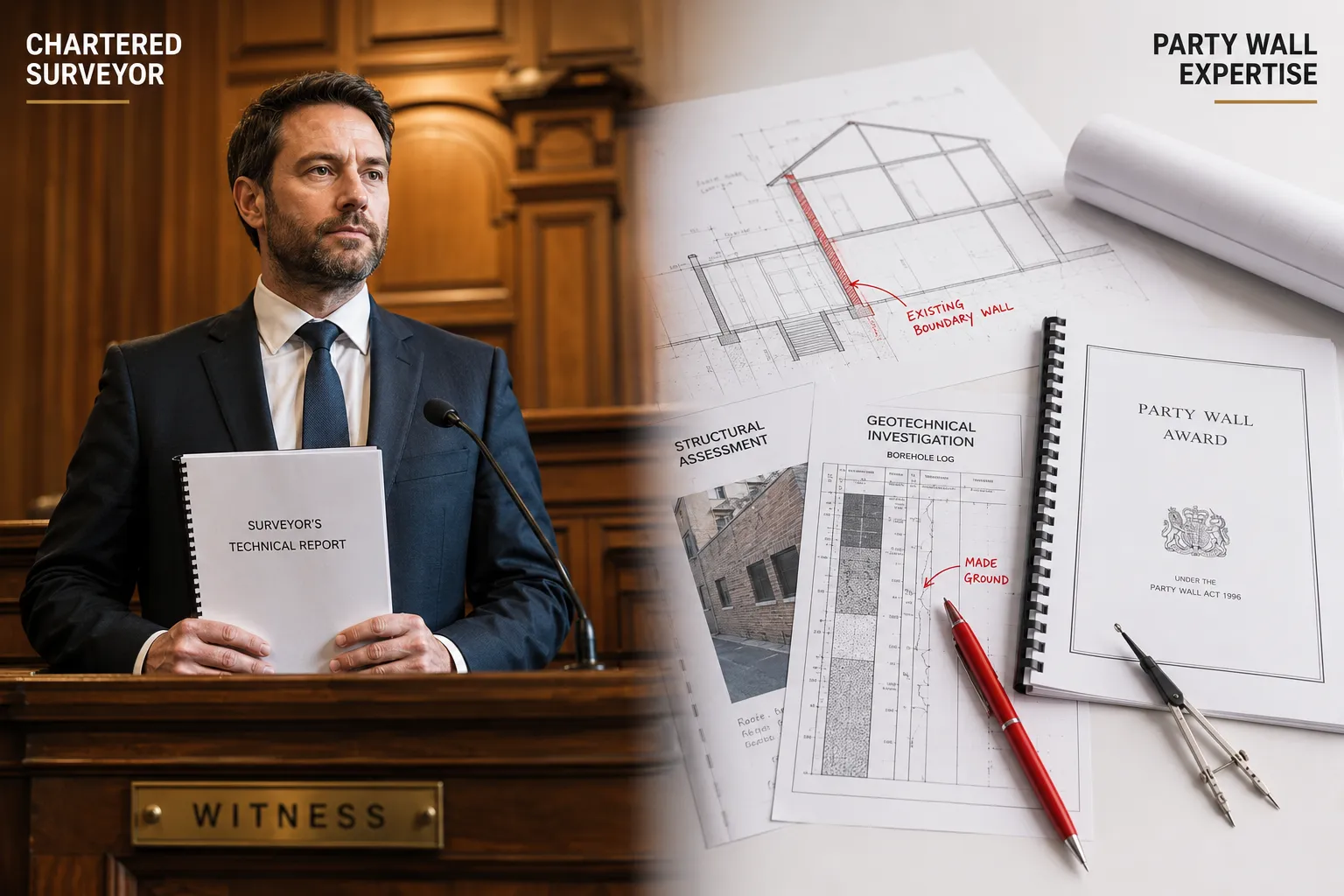
- Use visual aids. Annotated drawings, photographs, and structural diagrams help the court understand complex technical points. They also give you concrete reference points during oral testimony.
For cases involving basement works, where geotechnical data and structural calculations are central, the report must be especially detailed. See our guidance on basement party wall surveying for context on the technical demands these cases involve.
What Are the Differences Between Expert Witness Testimony and Fact Witness Testimony
An expert witness gives opinion evidence, conclusions drawn from specialist knowledge applied to the facts of the case. A fact witness gives evidence only about what they personally observed or did. This distinction is critical in party wall proceedings.
A party wall surveyor who inspected a property before and after works might be called as a fact witness to describe what they saw. The same surveyor, if instructed as an expert, is expected to go further: to interpret the evidence, apply professional standards, and assist the court in understanding technical matters that lie beyond a layperson's knowledge.
The practical difference during cross-examination is significant. A fact witness is questioned about memory and perception. An expert witness is questioned about reasoning, methodology, and professional judgment. This is why preparation for expert testimony is substantially more demanding.
What Happened in the Most Notable UK Party Wall Expert Witness Cases
Several UK cases have shaped how courts assess party wall expert evidence. While individual case citations are beyond the scope of this article, the patterns that emerge from complex disputes are instructive.
Deep basement excavation cases have become a major source of contested expert evidence, particularly in London. Courts have increasingly expected expert witnesses to produce reports incorporating geotechnical data, groundwater analysis, and structural engineering calculations, not just visual inspections. Experts who relied solely on surface observations were found to have insufficient foundations for their opinions.
Commercial-to-residential conversion disputes have raised questions about whether surveyors instructed as experts have adequate familiarity with RICS standards for mixed-use buildings. Courts have been critical of experts who applied residential party wall conventions to commercial structures without acknowledging the different technical context.
Loft conversion and extension cases remain the most common source of party wall disputes. In contested cases, courts have noted that expert witnesses who produced party wall schedule of condition reports before works began were far better placed to give reliable evidence about whether damage was caused by the notifiable works.
The consistent lesson from complex UK cases is that preparation, both in the written report and in anticipation of cross-examination, determines whether expert evidence is accepted or rejected.
How to Handle Aggressive Questioning During Cross-Examination as an Expert
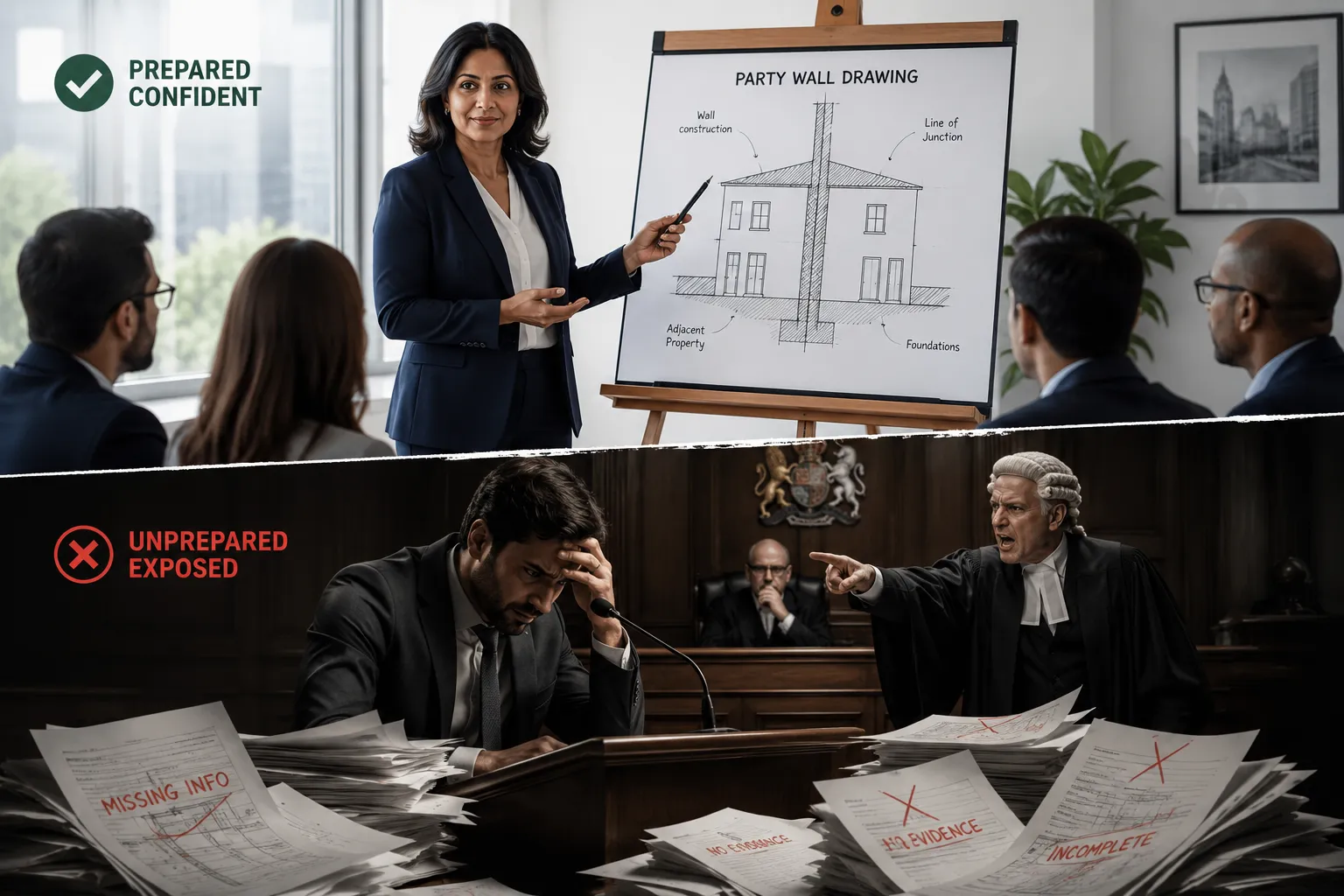
Aggressive questioning is a deliberate technique, not a personal attack. Opposing counsel may repeat questions in different forms, suggest that your conclusions are speculative, or imply that you are an advocate rather than an independent expert. The goal is to provoke a defensive or inconsistent response.
Practical techniques for maintaining composure:
- Pause before answering. A brief pause is not a sign of weakness. It signals that you are considering the question carefully, which is exactly what a court expects.
- Ask for clarification. If a question is ambiguous or compound, it is entirely appropriate to ask the questioner to clarify. This also slows the pace of aggressive questioning.
- Return to your report. If challenged on a specific point, refer directly to the relevant section of your report. This demonstrates consistency and anchors your answer in documented evidence.
- Acknowledge what you do not know. Saying "that falls outside the scope of my instructions" or "I would need to review additional data to answer that reliably" is a strength, not a concession.
- Maintain your duty to the court. If a question attempts to draw you into advocacy, it is acceptable to state: "My duty is to assist the court, and my opinion on that point is as set out in my report."
Training for cross-examination pressure is increasingly common among experienced surveyors. Mock cross-examination sessions, conducted with a barrister or experienced colleague, are one of the most effective preparation tools available.
How Much Does It Cost to Hire a Party Wall Expert Witness in the UK
Costs vary considerably depending on the complexity of the dispute, the seniority of the expert, and the stage at which they are instructed. For straightforward disputes, expert witness fees may range from approximately £1,500 to £5,000 for report preparation and attendance at a hearing. Complex cases, particularly those involving deep excavations, structural damage claims, or multi-party disputes, can involve fees well in excess of £10,000.
These figures are estimates based on typical market rates for RICS-regulated surveyors in 2026. Actual costs depend on the expert's hourly rate, the volume of documents to review, and the number of hearing days.
For context on general party wall surveyor costs, see our detailed breakdown of party wall agreement costs and party wall surveyor fees.
Cost drivers for expert witness instruction:
| Factor | Impact on Cost |
|---|---|
| Case complexity (basement vs. loft) | High |
| Number of hearing days | High |
| Volume of documents to review | Medium |
| Joint statement preparation | Medium |
| Travel and disbursements | Low to medium |
What Qualifications Do You Need to Be a Credible Party Wall Expert Witness
RICS membership (MRICS or FRICS) is the baseline qualification expected by courts in England and Wales for party wall expert witnesses. Beyond that, courts look for demonstrable practical experience in party wall matters, familiarity with the Party Wall etc. Act 1996, and a track record of producing CPR Part 35-compliant reports.
Membership of the Faculty of Party Wall Surveyors or the Pyramus & Thisbe Club signals specialist expertise and is viewed favourably. Completion of expert witness training, such as the RICS Expert Witness Certificate, is increasingly expected in higher-value disputes.
Credibility checklist for party wall expert witnesses:
- RICS qualification (MRICS or FRICS)
- Minimum five years of active party wall practice (estimated industry norm)
- Demonstrable experience with the type of works in dispute (e.g., basement, loft, extension)
- No undisclosed conflicts of interest with either party
- Previous experience giving expert evidence in court or tribunal
- CPR Part 35 compliant report format
How to Avoid Being Discredited During Cross-Examination
The most reliable protection against being discredited is a report that is internally consistent, methodologically transparent, and honest about its limitations. Discrediting an expert witness typically follows one of three paths: attacking their qualifications, exposing bias, or demonstrating that their methodology is flawed or inconsistent with accepted practice.
Avoiding each attack:
- Qualifications challenge: Ensure your CV attached to the report accurately reflects your experience. Do not overstate involvement in cases you reviewed rather than led.
- Bias challenge: Avoid language in the report that reads as advocacy. Phrases like "the building owner's works were entirely reasonable" are opinion dressed as fact. State conclusions neutrally and with reference to the evidence.
- Methodology challenge: Document every step of your analytical process. If you deviated from standard practice, explain why. Courts are not hostile to professional judgment, they are hostile to unexplained departures from accepted standards.
For those new to the expert witness role, our expert witness reports service provides guidance on what courts expect from RICS-qualified surveyors.
What Are the Rules of Evidence for Expert Witnesses in UK Party Wall Cases
Expert witnesses in UK civil proceedings are governed by CPR Part 35 and its associated Practice Direction. The key rules are:
- The expert's overriding duty is to the court, not to the instructing party.
- The report must state that the expert understands and has complied with this duty.
- The expert must disclose the substance of all material instructions received.
- Where there is a range of opinion on a matter, the report must summarise that range and give reasons for the expert's own view.
- Experts for each party are expected to meet, discuss their evidence, and produce a joint statement identifying areas of agreement and disagreement.
Failure to comply with CPR Part 35 can result in the expert's evidence being excluded or given reduced weight. In party wall cases that reach the County Court, judges have been willing to criticise experts publicly for non-compliance, a reputational consequence that extends well beyond the individual case.
How to Challenge the Opposing Expert's Methodology During Cross-Examination
Challenging an opposing expert's methodology is one of the most effective strategies available to the instructing party's legal team, and surveyors who understand this process can assist counsel significantly during preparation.
Effective methodological challenges focus on:
- Data sources: Did the opposing expert rely on desk-based research alone, or did they conduct a physical inspection? Were records obtained from the local authority or structural engineer?
- Assumptions: Are the assumptions stated explicitly? Are they reasonable given the specific site conditions?
- Deviations from RICS guidance: Did the expert follow the relevant RICS professional statements? If not, was the deviation explained?
- Consistency with the schedule of condition: Does the expert's damage assessment align with the pre-works condition report? If no schedule of condition was produced, how does the expert establish causation?
Surveyors instructed as experts can assist legal teams by producing a written critique of the opposing report before the hearing. This document, sometimes called a "shadow report", identifies the specific points most likely to yield under cross-examination.
What Is the Difference Between Party Wall Disputes and Boundary Disputes
Party wall disputes concern works to shared structures or excavations near the boundary, governed by the Party Wall etc. Act 1996. Boundary disputes concern the precise legal line between two properties, governed by land law and resolved through the Land Registry or the courts.
The two can overlap, for example, when a building owner excavates near a boundary and the adjoining owner disputes both the location of the boundary and the adequacy of the party wall notice. In these cases, separate expert evidence on boundary matters (typically from a land surveyor) and party wall matters (from a party wall surveyor) may be required.
Expert witnesses must be clear about the scope of their instructions. Straying into boundary opinions when instructed only on party wall matters is a common error that opposing counsel will exploit.
How Do Surveyors Prepare Differently for Cross-Examination Than Other Experts
Party wall surveyors face a distinctive preparation challenge compared to, say, medical or financial experts. Their evidence often combines legal interpretation (of the Party Wall etc. Act 1996), technical assessment (structural engineering principles), and procedural judgment (whether the correct notices were served and the award was properly made).
This breadth means that cross-examination can shift rapidly between legal, technical, and procedural territory. A surveyor who is confident on structural matters but uncertain about the procedural requirements of the Act is vulnerable to a targeted attack on the procedural dimension.
Surveyor-specific preparation steps:
- Review the entire procedural history of the dispute, not just the technical evidence.
- Confirm that all notices were correctly served and that the award complies with the Act.
- Prepare to explain the difference between a surveyor's statutory function and their role as an expert witness, courts sometimes conflate the two.
- If the award itself is under appeal, understand the grounds of appeal thoroughly and be prepared to justify every decision recorded in the award.
For those wanting to understand the full scope of party wall surveying before engaging an expert, our overview of party wall surveyor services covers the statutory and practical dimensions in detail.
Cross-Examination Preparation Checklist for Party Wall Expert Witnesses
The following checklist consolidates the preparation steps most relevant to complex UK cases:
Before the report is finalised:
- Confirm CPR Part 35 compliance, including the expert declaration
- Document all instructions received and any material provided
- State methodology explicitly, including any deviations from standard practice
- Include a schedule of condition reference where damage is in dispute
- Attach a current CV that accurately reflects relevant experience
After the report is served:
- Attend the experts' meeting and produce a joint statement
- Review the opposing expert's report in detail and identify points of challenge
- Prepare a written note of the key areas of disagreement and your reasoning
- Conduct at least one mock cross-examination session
Immediately before the hearing:
- Re-read your report in full, know every page
- Prepare concise answers to the questions most likely to arise from the joint statement
- Confirm that all exhibits and visual aids are available and clearly labelled
- Brief the instructing solicitor on any new information that has emerged
FAQ: Cross-Examination Preparation for Party Wall Expert Witnesses
What is CPR Part 35 and why does it matter for party wall experts?
CPR Part 35 is the Civil Procedure Rules provision governing expert evidence in English and Welsh civil courts. It requires party wall expert witnesses to declare their overriding duty to the court, disclose their instructions, and produce reports that distinguish fact from opinion. Non-compliance can result in evidence being excluded.
Can a party wall surveyor who produced the award also act as an expert witness?
Yes, but with caution. A surveyor who produced the award may give evidence about their decisions in that capacity. However, if they are also instructed as an independent expert to give opinion evidence, the dual role creates a potential conflict that opposing counsel will exploit. Courts prefer experts who have no prior involvement in the specific dispute.
How long does cross-examination typically last in a party wall case?
In straightforward County Court appeals, cross-examination of a party wall expert may last between one and three hours. In complex cases involving deep excavations, structural damage claims, or multiple experts, it can extend across several days. Preparation time should be proportionate to this.
What should I do if I realise my report contains an error before the hearing?
Notify the instructing solicitor immediately and prepare a supplementary report correcting the error. Attempting to correct the error during oral testimony, without prior disclosure, is far more damaging to credibility than an honest correction made in advance.
Is it acceptable to change my opinion after reading the opposing expert's report?
Yes, provided the change is genuine and based on the opposing expert's evidence or reasoning, not on pressure from the instructing party. Any change of opinion must be disclosed in the joint statement and explained clearly. Courts respect experts who update their views on the basis of new evidence.
What visual aids are most effective in party wall cross-examination?
Annotated structural drawings, photographic schedules of condition, and geotechnical cross-sections are the most commonly used and most effective. They give the court a concrete reference point and allow the expert to demonstrate their reasoning visually rather than relying solely on verbal explanation.
Do I need specialist training to act as a party wall expert witness?
RICS membership and party wall experience are the baseline. The RICS Expert Witness Certificate provides structured training in CPR compliance, report writing, and courtroom conduct. For high-value or technically complex disputes, this qualification is increasingly expected.
Conclusion
Cross-examination preparation for party wall expert witnesses is a discipline that rewards systematic effort. The cases that go wrong, where expert evidence is rejected, awards are overturned, or surveyors face professional criticism, almost always trace back to preparation failures rather than technical incompetence.
Actionable next steps for surveyors and property owners:
- If you are a surveyor considering expert witness work, invest in CPR Part 35 training and conduct at least one mock cross-examination before your first hearing.
- If you are a property owner or landlord involved in a contested party wall dispute, instruct a surveyor with demonstrable expert witness experience, not simply the surveyor who handled the original award.
- Ensure a party wall schedule of condition is produced before any notifiable works begin. This single document is the most effective tool for limiting disputed evidence later.
- For complex cases involving basement excavations or commercial conversions, instruct an expert with geotechnical and structural engineering literacy, not just party wall procedural knowledge.
- Engage a solicitor with construction and property law experience early. The quality of the expert's preparation is significantly enhanced when legal and technical teams work together from the outset.
For further guidance on party wall matters, explore our resources on party wall agreements and the consequences of ignoring the Party Wall Act.
.pw-checker{font-family:Arial,sans-serif;max-width:560px;margin:2em auto;background:#f4f7fb;border:1px solid #c9d6e3;border-radius:8px;padding:20px}
.pw-checker h3{margin:0 0 12px;font-size:1.1em;color:#1a2e4a}
.pw-checker label{display:flex;align-items:flex-start;gap:8px;margin:6px 0;font-size:.92em;color:#2d3a4a;cursor:pointer}
.pw-checker input[type=checkbox]{margin-top:2px;accent-color:#1a5fa8;width:16px;height:16px;flex-shrink:0}
.pw-checker .pw-btn{display:block;width:100%;margin-top:14px;padding:10px;background:#1a5fa8;color:#fff;border:none;border-radius:5px;font-size:1em;cursor:pointer}
.pw-checker .pw-btn:hover{background:#154d8c}
.pw-checker .pw-result{margin-top:12px;padding:10px 14px;border-radius:5px;font-size:.95em;display:none}
.pw-result.ready{background:#e6f4ea;color:#1a5c2a;border:1px solid #a8d5b0}
.pw-result.partial{background:#fff8e1;color:#7a5c00;border:1px solid #f0d070}
.pw-result.notready{background:#fdecea;color:#8b1a1a;border:1px solid #f0a0a0}
.pw-score{font-weight:bold}
Party Wall Expert Witness Readiness Checker
Tick each item you have completed before your hearing.
function pwCheck(){
var items=document.querySelectorAll(‘.pw-item’),checked=0;
items.forEach(function(i){if(i.checked)checked++;});
var res=document.getElementById(‘pw-result’),sc=document.getElementById(‘pw-score’),msg=document.getElementById(‘pw-msg’);
res.className=’pw-result’;res.style.display=’block’;
sc.textContent=checked+’/’+items.length+’ complete. ‘;
if(checked===items.length){res.classList.add(‘ready’);msg.textContent=’You are well prepared for cross-examination.’;}
else if(checked>=5){res.classList.add(‘partial’);msg.textContent=’Good progress, address the remaining items before the hearing.’;}
else{res.classList.add(‘notready’);msg.textContent=’Significant preparation gaps remain. Review unchecked items urgently.’;}
}
Tags: party wall expert witness, cross-examination preparation, party wall disputes, CPR Part 35, RICS expert witness, party wall act 1996, UK property law, party wall surveyor, expert witness report, building owner disputes, party wall award, chartered surveyor