

The median age of a first-time homebuyer has climbed to 40 years old in 2026 [4] — a figure that tells a story of years spent saving, renting, and waiting for the right moment. When that moment finally arrives, the pressure to move quickly can override the instinct to move carefully. In a market where housing inventory remains below historical norms despite a 7.1% year-on-year improvement [7], and where 53% of consumers now believe buying beats renting for the first time since 2023 [5], the temptation to skip or downgrade a building survey is real — and potentially very costly. Condition Surveys for First-Time Buyers in 2026: Spotting Risks in a Momentum-Driven Market is not a niche concern; it is one of the most financially consequential decisions a buyer will make.
Key Takeaways
- A mortgage valuation is not a survey and offers no protection against hidden structural or condition defects.
- RICS Home Survey Level 2 and Level 3 (Building Survey) are the two most relevant options for first-time buyers in 2026, and the right choice depends on the age, type, and condition of the property.
- In a supply-constrained market, sellers hold leverage — but buyers who commission thorough surveys gain the evidence needed to renegotiate or walk away.
- Common defects missed by buyers include damp penetration, roof deterioration, structural movement, and outdated electrical installations.
- Survey costs are modest relative to the financial exposure of purchasing a property with undisclosed defects.
Why the 2026 Market Creates Specific Risks for First-Time Buyers
The housing market in 2026 is not the frenzied seller's market of 2021, but it is not straightforward either. Average 30-year fixed mortgage rates stand at 6.52% [6], down from a 2025 peak of 6.91% but still more than double the sub-3% rates that defined the pandemic era. National home price growth slowed to just 1.4% annually in 2025 [7], and sellers in many areas are now more open to contingencies, repairs, and concessions than they have been in years [8]. On the surface, this looks like a buyer's opportunity.
The complication is supply. Active listings in cities like Chicago fell by more than 20% between 2021 and 2025, while prices rose over 5% per year during the same period [2]. Nationally, inventory remains tight. When a desirable property appears, competition can still be fierce, and buyers — particularly first-timers with no prior purchase experience — can feel pressured to waive or rush inspections to secure an offer.
This is precisely where condition surveys become critical. A property that has been held off the market for years may have accumulated deferred maintenance. Sellers who have been "locked in" to low-rate mortgages [3] and only now reluctantly listing may not have invested in upkeep. The gap between a property's asking price and its true condition can be significant, and only a professional survey will reveal it.
The key risk in 2026 is not overpaying at auction — it is buying a structurally compromised property at a price that leaves no room to fund remedial works.
What Condition Surveys Actually Cover — and What They Do Not
The Mortgage Valuation Trap
One of the most persistent misconceptions among first-time buyers is that a mortgage valuation provides meaningful information about a property's condition. It does not. A mortgage valuation is carried out for the lender, not the buyer, and its sole purpose is to confirm that the property represents adequate security for the loan. It will not identify damp, roof defects, structural movement, or failing drainage. For a full explanation of this distinction, see is a mortgage valuation the same as a survey — understanding this difference could save thousands.
RICS Home Survey Levels Explained
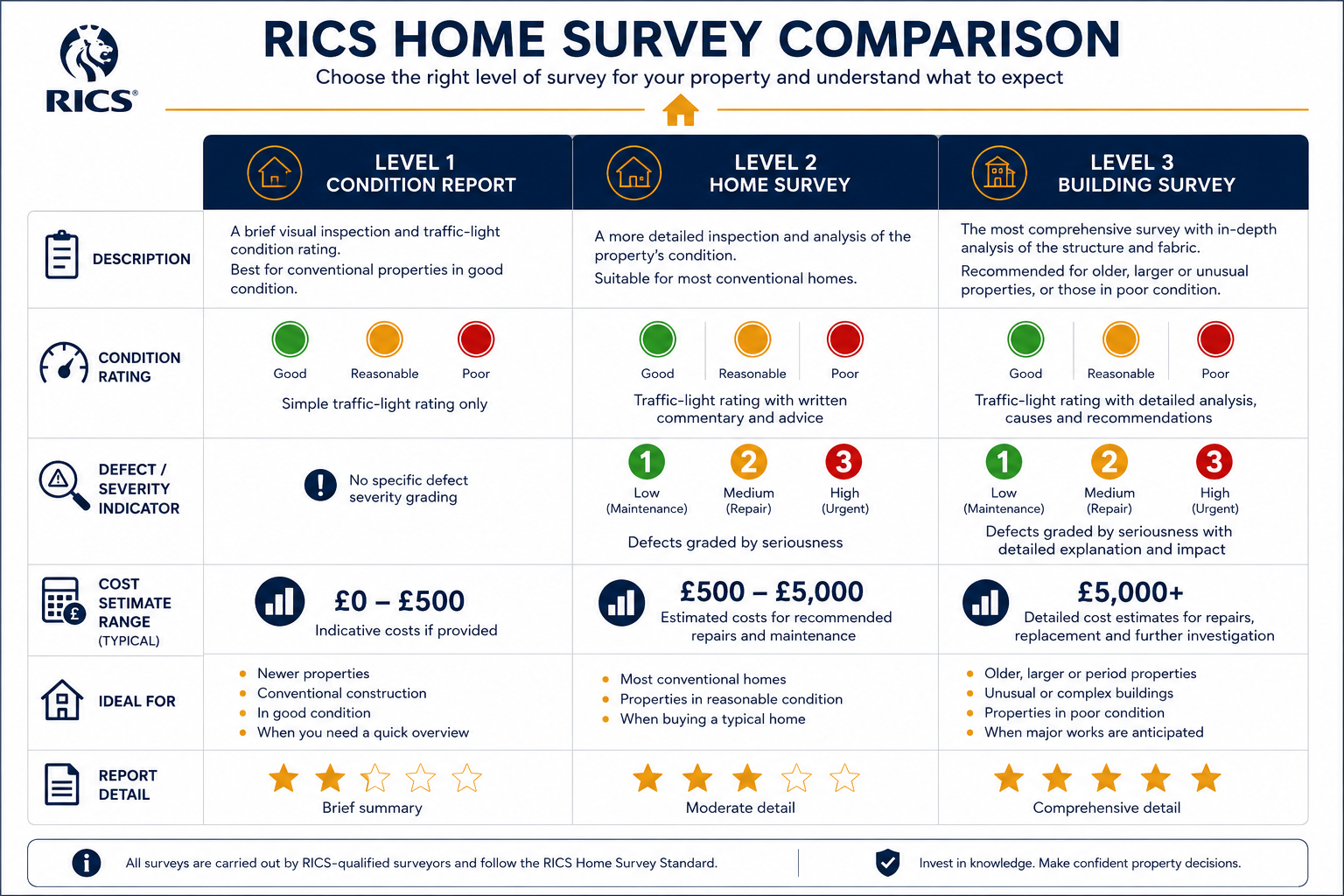
The Royal Institution of Chartered Surveyors (RICS) provides the framework for residential surveys in the UK. There are three levels:
| Survey Level | Best For | What It Covers |
|---|---|---|
| Level 1 (Condition Report) | New-build or recently refurbished homes | Basic condition ratings; no advice on repairs |
| Level 2 (HomeBuyer Report) | Conventional properties in reasonable condition | Condition ratings, defect identification, market valuation option |
| Level 3 (Building Survey) | Older, larger, or unusual properties | Detailed defect analysis, repair recommendations, cost guidance |
For most first-time buyers purchasing a Victorian terrace, an Edwardian semi, or a 1960s flat, a Level 2 RICS Home Survey is the minimum recommended standard. For properties built before 1920, those with visible signs of movement or damp, or any home that has been significantly altered, a full RICS Building Survey is strongly advisable.
A RICS Home Survey provides condition ratings on a traffic-light system — 1 (no repair needed), 2 (repair or replacement needed but not urgent), and 3 (urgent attention required). Any condition 3 rating should trigger further investigation before exchange of contracts.
Spotting the Most Common Defects in a Momentum-Driven Market
When buyers move quickly and sellers are motivated to complete, certain categories of defect are consistently overlooked. Understanding what surveyors look for — and why — helps first-time buyers ask better questions and interpret reports more effectively.
Damp and Moisture Ingress
Damp is the most frequently identified defect in UK residential surveys. It takes three main forms: rising damp (moisture travelling up from the ground), penetrating damp (water entering through walls, roofs, or windows), and condensation (moisture generated internally). Each has a different cause and a different remedy.
Rising damp is often misdiagnosed and can be expensive to treat. Penetrating damp linked to failing pointing, cracked render, or blocked gutters is generally more straightforward to address. A surveyor will use a moisture meter and visual inspection to distinguish between these, but buyers should be aware that some damp issues are only visible during or after wet weather.
For properties where damp is suspected but not confirmed, a specialist damp survey can provide a more granular assessment than a standard condition report.
Roof Condition
Roof repairs and replacements are among the most expensive remedial works a homeowner can face. A full roof replacement on a typical terraced house can run to several thousand pounds, and this cost is rarely reflected in a seller's asking price. A surveyor will inspect the roof covering, ridge tiles, flashings, gutters, and internal roof space where accessible.
For properties where roof access is limited or where there are visible signs of deterioration, a dedicated roof survey provides a more detailed assessment, including drone or specialist inspection where required.
Structural Movement
Not all cracks in a property indicate serious structural problems, but some do. A surveyor will assess crack width, pattern, and location to determine whether movement is historic and stable or active and progressive. Diagonal cracks above door frames, stepped cracks in brickwork, and cracks wider than 5mm at their widest point all warrant closer attention.
Where structural concerns are identified, a structural survey or specialist structural engineering report may be recommended before proceeding. This is not a reason to abandon a purchase — it is a reason to understand the risk fully before committing.
Electrical and Heating Installations
A condition survey will note the age and apparent condition of electrical installations and heating systems but will not test them to the standard of a specialist. Buyers of older properties should budget for an Electrical Installation Condition Report (EICR) in addition to their building survey. Outdated wiring — particularly pre-1960s rubber-insulated cable — can be a fire risk and will need replacement.
Boundary and Title Issues
Survey reports focus on physical condition, but first-time buyers should also be aware of boundary ambiguities. Where a property has shared walls, outbuildings near boundaries, or disputed land, a boundary survey can clarify ownership and prevent post-purchase disputes.
How to Use a Survey Report to Negotiate or Protect Yourself
A survey report is not just a document to file away — it is a negotiating tool. In the current market, where sellers are increasingly open to concessions [8], a well-evidenced survey finding can support a price reduction request, a seller's contribution to repair costs, or a formal retention held in escrow until works are completed.
The process works as follows:
- Receive the survey report and identify all condition 2 and condition 3 items.
- Obtain independent contractor quotes for any significant remedial works.
- Present the findings to the seller's solicitor with a revised offer or a request for a price adjustment.
- If the seller declines to negotiate, reassess whether the property represents value at the agreed price given the known defect costs.
Buyers should never feel obligated to proceed after a survey reveals material defects. The cost of a survey — which is modest relative to the purchase price — is far less than the cost of inheriting a property with undisclosed structural or condition problems.
For a clear overview of the different survey types available and which suits different property types, the guide to comparing different types of survey is a practical starting point.
Condition Surveys for First-Time Buyers in 2026: Choosing the Right Surveyor
Not all surveyors are equal, and the quality of a condition report depends heavily on the experience and diligence of the individual carrying it out. First-time buyers should look for the following:
- RICS accreditation: The surveyor should be a Chartered Surveyor (MRICS or FRICS) registered with the Royal Institution of Chartered Surveyors.
- Local knowledge: A surveyor familiar with the area will understand regional construction methods, common local defects, and planning history.
- Clear reporting: The report should use plain language, condition ratings, and photographs. Vague or heavily caveated reports that recommend specialist investigations for every item without guidance are not helpful.
- Independence: The surveyor should have no commercial relationship with the estate agent, seller, or lender.
For buyers unsure about survey pricing, a survey pricing guide provides a transparent breakdown of typical costs for different survey levels and property types.
A Note on Reform Discussions
RICS has been engaged in ongoing discussions about reforming the Home Survey standards to improve consistency and consumer understanding. While no final changes have been implemented as of mid-2026, buyers should be aware that the Level 2 and Level 3 designations may evolve. The core principle — that a detailed, independent inspection by a qualified surveyor is essential before purchase — remains unchanged regardless of any labelling reform.
The Financial Case for Condition Surveys in 2026
The numbers make a compelling case. A RICS Level 2 survey typically costs between £400 and £700 for a standard residential property. A Level 3 Building Survey may cost between £600 and £1,500 depending on property size and complexity. Against a backdrop of 6.52% mortgage rates [6] and limited room for financial error, these are small sums.
Consider the alternative: a first-time buyer who skips a survey and later discovers that the property has a failing flat roof (£8,000–£15,000 to replace), significant rising damp (£3,000–£8,000 to treat), and outdated wiring (£4,000–£8,000 to rewire) has effectively underpaid for a survey and overpaid for a property by a margin that could take years to recover.
The Road to Housing Act passed in the US in June 2026 [1] signals that policymakers are increasingly aware of the structural barriers facing first-time buyers. But legislative measures take time to filter through to affordability. In the meantime, the most effective protection available to a first-time buyer is a thorough, independent condition survey commissioned before exchange of contracts.
Conclusion: Actionable Steps for First-Time Buyers in 2026
The convergence of renewed buyer sentiment [5], constrained supply [7], and elevated mortgage costs [6] makes 2026 a market where due diligence is more important than speed. Condition Surveys for First-Time Buyers in 2026: Spotting Risks in a Momentum-Driven Market is ultimately about one thing: making an informed decision with complete information before committing to the largest financial transaction most people will ever make.
Actionable next steps for first-time buyers:
- Commission a RICS Level 2 or Level 3 survey as soon as an offer is accepted — do not wait until solicitors are close to exchange.
- Read the full survey report, not just the executive summary. Pay particular attention to condition 3 ratings and any recommendations for specialist investigations.
- Obtain at least two contractor quotes for any significant defect identified before negotiating a price adjustment.
- Do not rely on a mortgage valuation as a substitute for an independent survey.
- If the property is older than 1920, has been substantially altered, or shows visible signs of damp or movement, commission a Level 3 Building Survey rather than a Level 2.
- Use the RICS Home Survey framework to understand what each level of report will and will not cover.
- Budget for specialist follow-up reports — on damp, roofing, or structure — if the condition survey flags concerns in those areas.
A survey is not a cost. It is an investment in certainty.
References
[1] Housing Affordability Senate Trump – axios.com
[2] Chicago Housing Affordability Listings Down Home Prices Up Road To Housing Act – axios.com
[3] Housing Affordability New Normal Homebuyers – morganstanley.com
[4] 2026 Us Housing Market Forecast Will The Market Find Its Footing – spannassociates.com
[5] Bofa Study More Americans Favor Buying Over Renting For The Fir – newsroom.bankofamerica.com
[6] How The Federal Reserve Affects Mortgage Rates – kiplinger.com
[7] Housing Market Predictions – forbes.com
[8] Housing Market Stall Risks And Real Estate Buying Opportunities In 2026 – housing.info
How Prince Surveyors can help: explore our property valuations or learn about our which survey you need.