

As of March 2026, approximately 4,322 residential buildings over 11 metres in England have been identified with unsafe cladding — and only 35% have completed remediation, leaving an estimated 236,000 homes still affected [4]. For anyone buying a flat, that figure is not a background statistic. It is a direct financial and safety risk that can stall a mortgage, inflate service charges, or leave a buyer legally responsible for costs they never anticipated.
Navigating cladding, fire safety and building surveys: what flat buyers in England should ask before exchanging is no longer optional due diligence — it is essential. The post-Grenfell legislative landscape, anchored by the Building Safety Act 2022, has reshaped how buyers, lenders, and surveyors approach flat purchases. This guide sets out a practical checklist covering EWS1 forms, remediation schemes, reserve funds, leaseholder protections, and the role of a qualified building surveyor in assessing external wall and fire-safety risks.
Key Takeaways
- The EWS1 form remains a critical document for flats in buildings with cladding or combustible materials, and many mortgage lenders still require it before approving a loan.
- The Building Safety Act 2022 provides qualifying leaseholders with significant protections against bearing the cost of cladding remediation — but buyers must confirm eligibility before exchanging.
- A Level 3 Building Survey (Full Structural Survey) is the most appropriate survey type for flats in buildings with known or suspected fire-safety concerns.
- Buyers should request fire risk assessments, building insurance details, reserve fund accounts, and evidence of any ongoing remediation works before exchange.
- Unresolved cladding issues can affect mortgageability, resale value, and building insurance premiums — making pre-exchange due diligence non-negotiable.
Understanding the EWS1 Form and Why It Still Matters in 2026
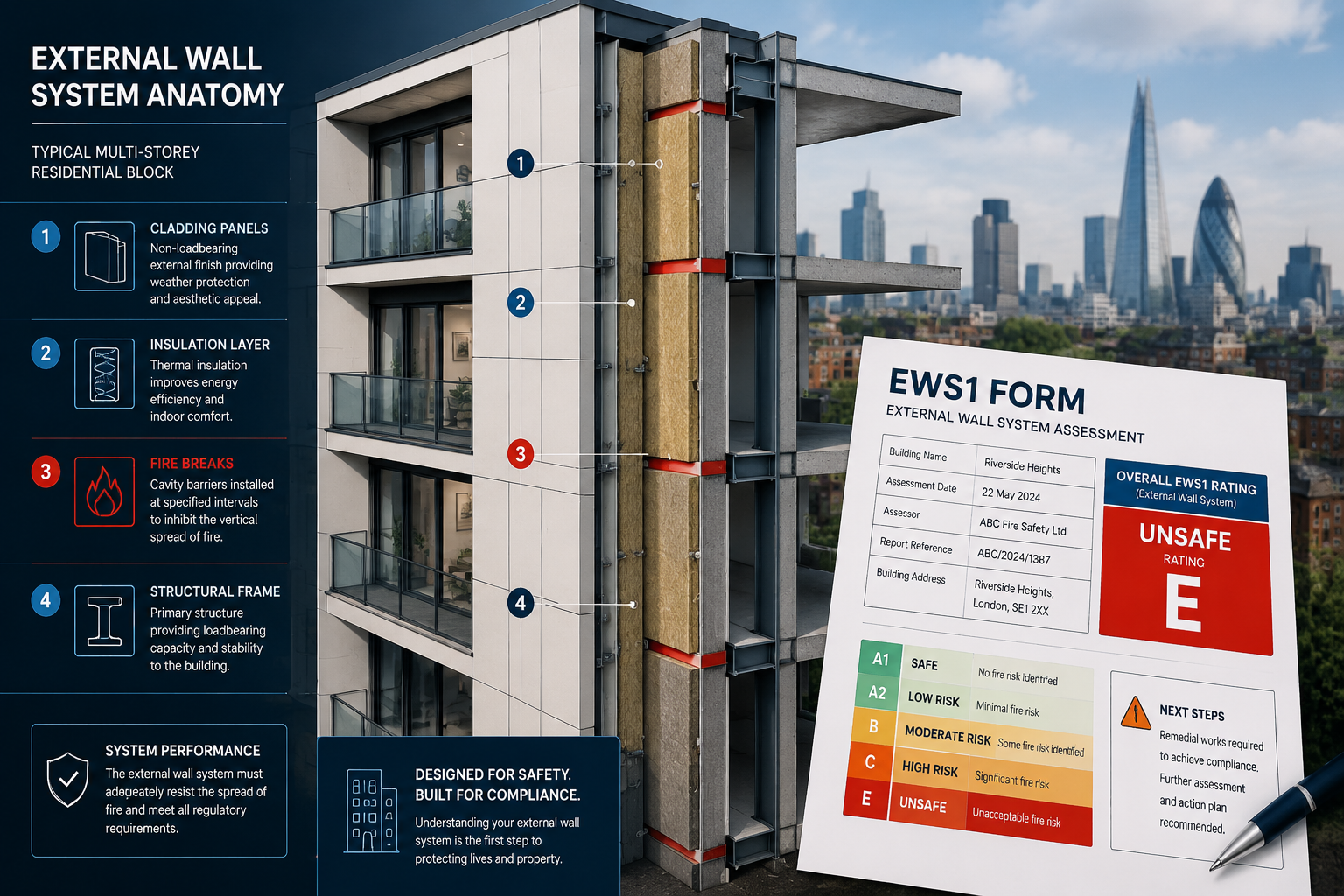
The External Wall System 1 (EWS1) form was introduced in December 2019 as a standardised way for qualified professionals to assess the fire safety of a building's external wall construction. While it is not a legal requirement, it functions as a practical gateway: without it, many mortgage lenders will refuse to lend on affected properties [1].
Who needs an EWS1 form?
The form is typically required for:
- Buildings over 18 metres (roughly six to seven storeys) with any cladding system
- Lower-rise buildings where cladding, balconies, or external wall materials contain combustible components
- Any building where a mortgage lender's valuer flags external wall concerns [1]
The EWS1 form is completed by a qualified fire engineer or chartered surveyor and assigns one of two ratings:
| Rating | Meaning |
|---|---|
| A1 / A2 | No combustible materials present, or risk is sufficiently low — no remediation required |
| B1 / B2 | Combustible materials present; B1 means no remediation needed, B2 means remediation is required |
An EWS1 form is valid for five years and applies to the entire building rather than an individual flat [9]. Buyers should request a copy from the seller or managing agent and check both the rating and the date of issue. A form rated B2 does not necessarily mean a purchase should be abandoned, but it demands careful scrutiny of who is funding remediation and on what timeline.
Key question to ask: Has the building received an EWS1 form, what is its rating, and when does it expire?
The Building Safety Act 2022: Leaseholder Protections Explained
The Building Safety Act 2022 represents the most significant reform to building safety law in England in decades. It established a Building Safety Regulator for higher-risk buildings (those over 18 metres or seven storeys) and introduced a framework of protections for qualifying leaseholders [2].
What protections does the Act provide?
Under the Act, qualifying leaseholders — broadly, those who own a long lease on their main or only home in a building above 11 metres — cannot be required to pay for:
- The removal or replacement of unsafe cladding
- Historical building safety defects where the landlord or developer is responsible
These protections are significant, but they are not automatic for every buyer. Eligibility depends on the leaseholder's circumstances at a specific qualifying date, and protections may not transfer seamlessly to a new buyer in all scenarios. Conveyancing solicitors must verify leaseholder qualification status as part of pre-exchange enquiries.
"The Building Safety Act 2022 does not eliminate financial risk for flat buyers — it redirects it. Buyers who do not confirm their qualifying status before exchange may find themselves outside the protective framework."
The Act also requires building owners and managers of higher-risk buildings to register with the Building Safety Regulator and maintain a safety case demonstrating how risks are being managed. Buyers should ask whether the building is registered and whether a current safety case exists.
For a broader understanding of what to check when purchasing leasehold property, including service charge obligations and ground rent terms, the leasehold property buying checklist provides a useful companion reference.
Cladding, Fire Safety and Building Surveys: What Flat Buyers in England Should Ask Before Exchanging
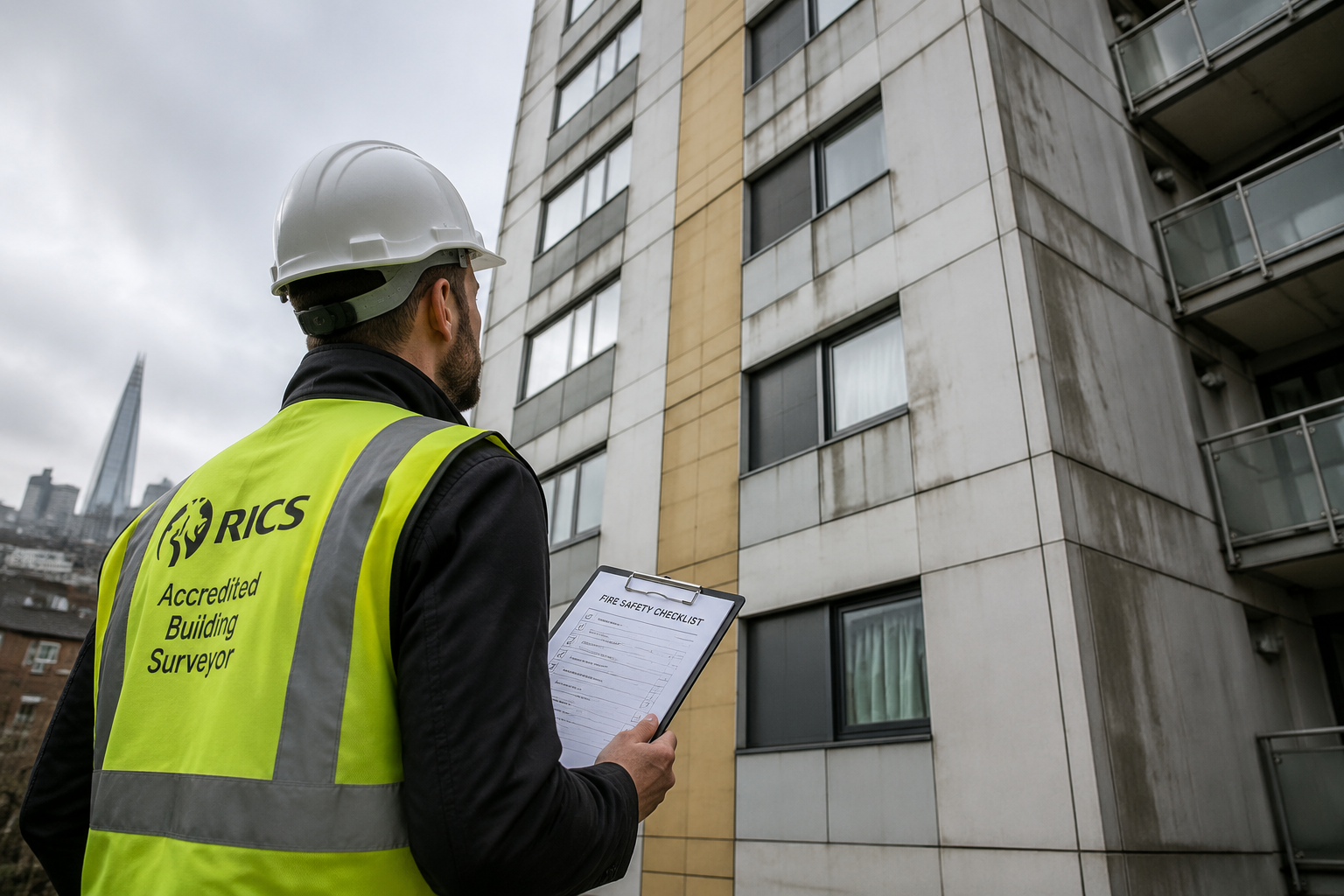
A standard mortgage valuation will not identify cladding defects, fire compartmentation failures, or the presence of combustible insulation behind an external wall. For flat buyers in buildings of any height where fire safety is a concern, a Level 3 Building Survey — formerly known as a Full Structural Survey — is the appropriate choice.
What a Building Survey Should Cover for Flat Buyers
A competent RICS-registered surveyor assessing a flat in a multi-storey block should address the following fire-safety-related areas [5]:
- External wall system identification: What type of cladding or render is present? Is it ACM (aluminium composite material), HPL (high-pressure laminate), or another system?
- Building height and classification: Does the building fall within the higher-risk category under the Building Safety Act 2022?
- EWS1 form status: Is a valid form in place, and what does it say?
- Evidence of remediation works: Has any remediation been carried out, is it ongoing, or is it planned?
- Fire risk assessment: Has a current fire risk assessment been conducted for communal areas and escape routes?
- Compartmentation: Are fire doors, cavity barriers, and fire-stopping measures in adequate condition?
- Building insurance: Is the building currently insured, and has the premium increased significantly due to fire-safety concerns?
Under the Regulatory Reform (Fire Safety) Order 2005 and the Building Safety Act 2022, responsible persons for blocks of flats are legally obligated to carry out fire risk assessments covering all communal areas and escape routes, including fire door inspections [3]. Buyers should request a copy of the most recent fire risk assessment and check whether any outstanding actions remain unresolved.
For buyers who are new to the process, understanding the difference between a Homebuyers Report and a Building Survey helps clarify why a more detailed inspection is warranted for flats with potential fire-safety exposure.
The Pre-Exchange Checklist: Questions Every Flat Buyer Should Ask
The following checklist consolidates the key enquiries that should be resolved before contracts are exchanged:
About the building:
- What is the building's height and number of storeys?
- Is the building registered with the Building Safety Regulator?
- What external wall system materials are present?
- Is there a valid EWS1 form, and what is its rating?
- Has a fire risk assessment been completed within the last 12 months?
- Are all fire risk assessment action points resolved?
About remediation and costs:
- Is any cladding or external wall remediation planned, underway, or completed?
- Who is funding the remediation — developer, government scheme, or leaseholders?
- Is the building enrolled in the Building Safety Fund or a developer remediation scheme?
- What is the current service charge, and has it increased due to fire-safety works?
- What is the level of the reserve (sinking) fund, and is it sufficient?
About insurance and mortgageability:
- Is the building currently insured, and what is the annual premium?
- Has any insurer declined to cover the building or imposed exclusions?
- Has the seller's lender required an EWS1 form, and has one been provided? [1]
About leaseholder protections:
- Does the buyer qualify as a protected leaseholder under the Building Safety Act 2022?
- Has the solicitor confirmed leaseholder protection status in writing?
Remediation Schemes, Reserve Funds, and the Hidden Costs of Fire-Safety Defects
Even where leaseholder protections apply, buyers should not assume that all fire-safety costs are covered. Service charges can increase substantially to fund interim fire-safety measures — such as waking watch patrols, alarm upgrades, or temporary evacuation systems — while longer-term remediation is arranged.
Waking watch costs have been a particular burden for residents in buildings awaiting cladding removal. Although the government introduced a Waking Watch Relief Fund to help buildings transition to common fire alarm systems, not all buildings have accessed it, and costs can run to tens of thousands of pounds per year shared across leaseholders.
Reserve funds (also called sinking funds) are the amounts set aside by a building's management to cover major future repairs. A low or depleted reserve fund in a building with known fire-safety defects is a serious warning sign. Buyers should request at least three years of service charge accounts and ask the managing agent directly about the adequacy of the fund relative to anticipated works.
Building insurance is another area of growing concern. Buildings with unresolved cladding issues may face significantly higher premiums or difficulty obtaining cover altogether [5]. The cost of building insurance is typically passed to leaseholders through the service charge, meaning a sharp premium increase directly affects the affordability of owning the flat.
For buyers considering whether a poor survey result or unresolved fire-safety issues warrant a price renegotiation, the guidance on renegotiating after a building survey sets out a practical approach to using survey findings as a basis for price reduction.

How Cladding, Fire Safety and Building Surveys Affect Mortgageability and Resale
One of the most immediate practical consequences of unresolved fire-safety issues is the impact on mortgage availability. Many lenders continue to require an EWS1 form before approving a mortgage on a flat in an affected building [1]. Without a valid form — or with a B2 rating and no confirmed remediation plan — a buyer may find that their chosen lender withdraws or that the pool of willing lenders is significantly reduced.
This also has direct implications for future resale. A flat that is difficult to mortgage today will be equally difficult to sell in five years. Buyers should consider not only whether they can obtain a mortgage now, but whether a future buyer will face the same obstacles.
Updated guidance and the leaseholder protections introduced by the Building Safety Act 2022 have improved the situation compared to the immediate post-Grenfell period [6]. Developer remediation schemes — where major housebuilders have committed to funding cladding removal on buildings they constructed — have also increased the number of buildings with a clear remediation pathway. However, progress remains slow: with only 35% of identified buildings having completed remediation as of early 2026 [4], buyers of flats in affected buildings should not assume that resolution is imminent.
Specialist fire-safety surveys, such as facade and cladding assessments conducted by qualified engineers, can provide a detailed picture of external wall construction, including cladding type, insulation, fire breaks, and balcony materials [8]. Where an EWS1 form does not yet exist for a building, commissioning such an assessment — or at minimum understanding what materials are present — is a prudent step before exchange [7].
For first-time buyers in particular, the combination of leasehold complexity, fire-safety obligations, and mortgage lender requirements can feel overwhelming. A first-time buyer building survey guide provides a clear starting point for understanding what a survey can and cannot reveal.
Choosing the Right Surveyor for a Fire-Safety-Sensitive Flat Purchase
Not all surveyors have the same level of experience with fire-safety-related building assessments. When selecting a surveyor for a flat in a building with potential cladding or external wall concerns, buyers should look for:
- RICS accreditation and registration
- Experience with multi-storey residential blocks
- Familiarity with EWS1 requirements and the Building Safety Act 2022
- Willingness to comment on external wall system type and building height in the survey report
- Clear reporting on fire risk assessment status and any visible fire-safety deficiencies
A RICS-accredited surveyor will follow professional standards that require them to flag material risks, including those related to fire safety and cladding. However, it is worth noting that a building survey of a flat typically covers the interior of the flat and accessible communal areas — it does not replace a specialist external wall survey or a fire risk assessment. Buyers should treat these as complementary, not interchangeable.
For buyers who want to understand the full range of survey options available, the RICS surveys overview explains the different levels of inspection and what each one includes.
Conclusion: Actionable Steps Before You Exchange on a Flat
Buying a flat in England in 2026 requires a level of fire-safety due diligence that simply did not exist a decade ago. The reforms introduced by the Building Safety Act 2022, combined with the ongoing pace of cladding remediation, mean that buyers who ask the right questions before exchange are in a fundamentally stronger position than those who do not.
Before exchanging contracts on any flat, take the following steps:
- Instruct a RICS-accredited surveyor to carry out a Level 3 Building Survey and request that they specifically address external wall systems, building height, and fire-safety compliance.
- Ask the seller or managing agent for a copy of the current EWS1 form, fire risk assessment, and service charge accounts for the last three years.
- Confirm with your conveyancing solicitor whether you qualify as a protected leaseholder under the Building Safety Act 2022.
- Check whether the building is enrolled in a developer remediation scheme or the Building Safety Fund, and request a timeline for completion.
- Verify that the building is currently insured and obtain details of any recent premium increases.
- Assess the reserve fund balance relative to anticipated fire-safety works.
- Confirm with your mortgage lender whether an EWS1 form is required and whether the current form (if any) satisfies their criteria.
Fire-safety issues are not a reason to avoid buying a flat — but they are a reason to buy with full information. The combination of a thorough building survey, rigorous pre-exchange enquiries, and qualified legal and surveying advice gives buyers the clearest possible picture of what they are purchasing and what obligations they are taking on.
References
[1] Form Ews1 External Wall Fire Review 10157 – samconveyancing.co.uk
[2] Cladding Eswr Form Explained – propertypassport.uk
[3] Fire Risk Assessment Flats – asbestos-surveys.org.uk
[4] Selling A Flat Due To Cladding Issues – propertyrescue.co.uk
[5] First Time Buyer Building Surveys In 2026 Prioritizing Cladding Raac And Affordability Driven Risk Assessment – canterburysurveyors.com
[6] Selling A Flat With Cladding – samconveyancing.co.uk
[7] Ews1 Surveys Assessments – fire-safety-services.co.uk
[8] Cladding Fire Safety Survey – vertexaccess.co.uk
[9] Cladding Ews1 Fire Safety Flat Landlords – propertykiln.co.uk
How Prince Surveyors can help: explore our Level 3 building surveys or learn about our Level 2 vs Level 3 guide.