

Last updated: July 24, 2026
Quick Answer: A chartered surveyor acting as an expert witness provides independent, court-admissible professional opinion on property matters, including building defects, dilapidations, and valuation disputes. Their role differs from an ordinary surveyor in that their primary duty is to the court, not the client who instructs them. In 2026, RICS has tightened accreditation standards and courts are placing greater weight on evidential rigour, making the choice of expert witness more consequential than ever.
Key Takeaways
- Chartered surveyors acting as expert witnesses owe their primary duty to the court or tribunal, not to the party instructing them.
- RICS maintains an accredited expert witness register; only surveyors with specific training and experience should be appointed for litigation.
- Expert witness work covers two broad categories: building defects (structural failures, damp, subsidence) and property valuation disputes (matrimonial, probate, dilapidations, compulsory purchase).
- Expert witness reports must comply with Civil Procedure Rules (CPR) Part 35 in England and Wales, and equivalent rules in Scotland and Northern Ireland.
- Costs for a chartered surveyor expert witness typically range from £1,500 to £10,000 or more depending on case complexity, property type, and hearing involvement.
- Courts in 2026 are scrutinising the independence and methodology of surveyor evidence more closely following recent case decisions.
- A surveyor who originally inspected or valued the property can face credibility challenges as an expert witness due to perceived lack of independence.
- When opposing experts disagree, courts may order a Joint Statement of Areas of Agreement and Disagreement, which often narrows disputes significantly.
What Does a Chartered Surveyor Do as an Expert Witness
A chartered surveyor acting as an expert witness provides independent professional opinion on technical property matters to assist a court, tribunal, or arbitrator in reaching a decision. Unlike a fact witness who describes what they observed, an expert witness is permitted to give opinion evidence based on their specialist knowledge.
In practice, this means the surveyor:
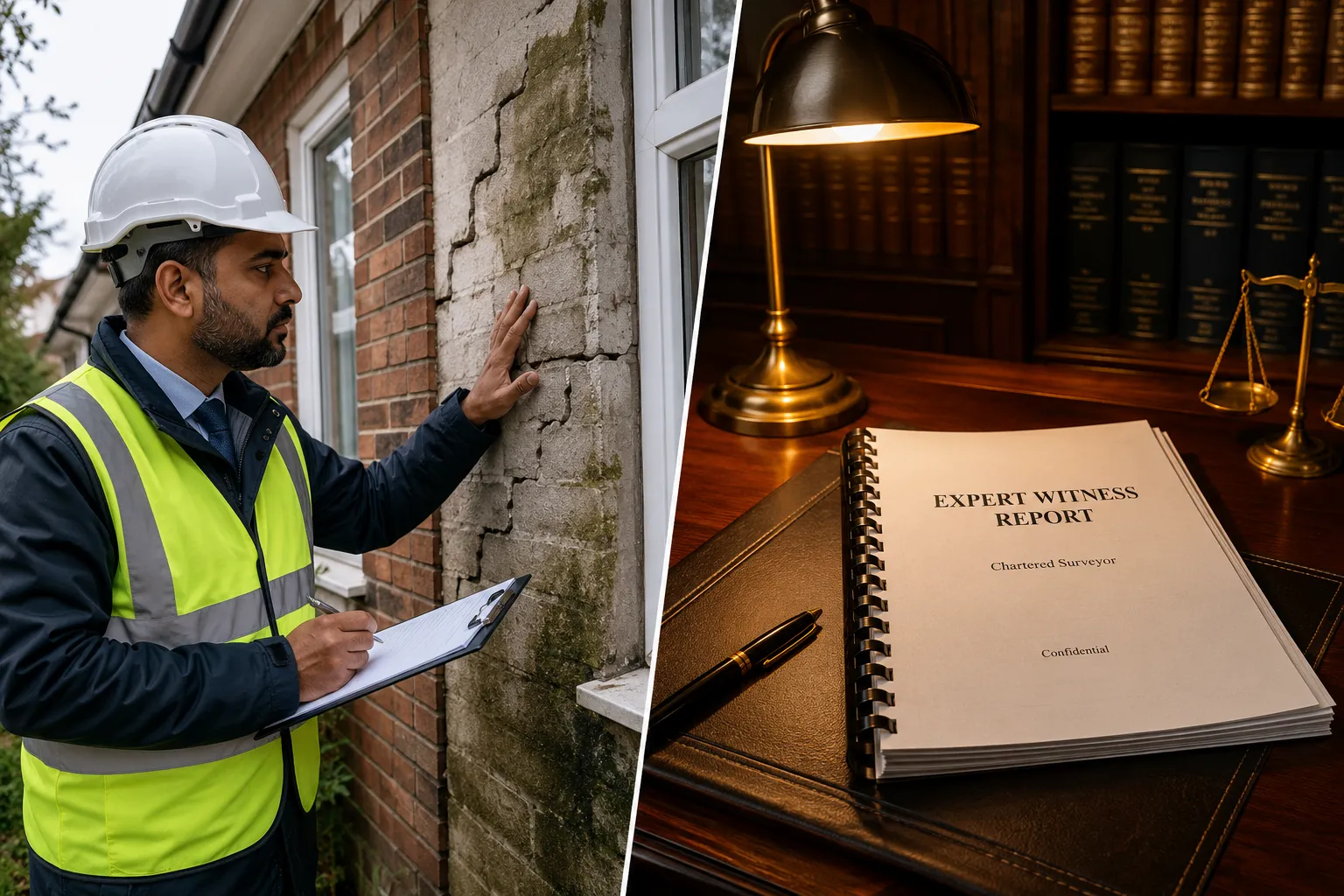
- Inspects the property and gathers technical evidence
- Reviews documents, photographs, maintenance records, and other surveyors' reports
- Prepares a formal expert witness report setting out findings, methodology, and reasoned conclusions
- Attends hearings to give oral evidence and be cross-examined
- Participates in without-prejudice discussions with the opposing expert if directed by the court
The overriding duty is to the court, not to the instructing party. This is not merely procedural: a surveyor who advocates for their client rather than giving balanced opinion risks having their evidence disregarded and may face regulatory consequences from RICS.
For a broader understanding of how chartered surveyors approach technical property analysis, the building defects survey service illustrates the depth of investigation that underpins credible expert opinion.
When Do You Need a Chartered Surveyor as Expert Witness in Court
A chartered surveyor expert witness is needed whenever a legal dispute turns on a technical question about a property's condition, value, or compliance that a judge or arbitrator cannot resolve without specialist help.
Common triggers include:
- Building defect claims: Disputes between homeowners and builders, contractors, or previous owners over structural failures, damp penetration, subsidence, or defective workmanship
- Dilapidations: Commercial lease-end disputes where landlords and tenants disagree on the extent and cost of repairs
- Property valuation disputes: Matrimonial proceedings, probate, capital gains tax challenges, compulsory purchase, or negligent valuation claims
- Party wall disputes: Where the scope or cost of works under the Party Wall etc. Act 1996 is contested
- Housing condition claims: Disrepair claims brought by tenants against landlords, an area where RICS issued a Practice Alert in January 2026 stressing stricter evidential standards
- Insurance reinstatement disagreements: Where the reinstatement cost assessment is disputed following a claim
If a case is likely to proceed to the County Court, High Court, First-tier Tribunal (Property Chamber), or arbitration, appointing a properly qualified expert witness early is advisable. Attempting to convert an ordinary survey report into expert evidence after the fact rarely succeeds.
Chartered Surveyor Expert Witness: Building Defects vs Property Valuation Disputes
These two categories represent the most common types of expert witness work, but they require different skills and methodologies.
| Feature | Building Defects Expert | Property Valuation Expert |
|---|---|---|
| Core skill | Pathology, construction, materials | Market analysis, comparable evidence |
| Typical disputes | Structural failure, damp, subsidence | Matrimonial, probate, dilapidations |
| Key evidence | Inspection findings, test results | Comparable transactions, yield data |
| Relevant RICS guidance | Building surveying professional statements | Valuation Professional Standards (Red Book) |
| Court most commonly used | County Court, TCC | First-tier Tribunal, High Court |
Building defects cases require the surveyor to diagnose the cause of a defect, attribute responsibility, and quantify the cost of remediation. The construction and condition survey approach, combined with knowledge of building regulations compliance, forms the technical backbone of this work. See also the guidance on urgent or dangerous building issues for cases where safety is a live concern.
Valuation disputes require the surveyor to demonstrate that their opinion of value is supported by market evidence and sound methodology. Courts expect Red Book compliance. Valuation expert witnesses must be able to defend their comparable selection and adjustments under cross-examination. Specialist valuation work such as matrimonial valuations and capital gains valuations each carry their own procedural and evidential requirements.
What Qualifications Do Expert Witness Surveyors Need
Not every chartered surveyor is qualified to act as an expert witness. The minimum requirement is RICS membership (MRICS or FRICS), but courts and instructing solicitors increasingly expect more.
Recommended qualifications and experience:
- RICS membership with a relevant specialism (building surveying, valuation, or general practice)
- Completion of RICS-recognised expert witness training (structured courses covering CPR Part 35, report writing, and giving oral evidence)
- Listing on the RICS Expert Witness Register, which was expanded and updated in April 2026
- Demonstrable track record of preparing expert reports and attending hearings
- Current professional indemnity insurance covering expert witness work
The RICS Expert Witness Professional Statement, currently under revision for 2026, sets out the conduct obligations surveyors must meet. Compliance is mandatory for RICS members acting in this capacity.
Can any surveyor be an expert witness, or do they need special training?
Technically, any person with relevant expertise can be appointed as an expert witness, but courts have become significantly more demanding. A surveyor without formal expert witness training who produces a poorly structured report risks having their evidence excluded or given little weight. In 2026, court decisions have repeatedly emphasised the importance of methodology, independence, and adherence to CPR requirements. Special training is not legally mandatory, but it is practically essential for credible expert witness work.
How Much Does a Chartered Surveyor Cost as an Expert Witness
Costs vary considerably depending on the complexity of the case, the property type, and how far the matter proceeds.
Indicative fee ranges (2026):
- Initial report only (straightforward residential defect or valuation): £1,500 to £3,500
- Complex building defect report with testing and specialist input: £4,000 to £8,000
- High-value commercial valuation dispute: £5,000 to £15,000 or more
- Attendance at hearing (per day): £1,000 to £2,500
- Joint expert discussions and statement preparation: £500 to £1,500
These are estimates based on typical market rates and will vary by firm, seniority of the expert, and geographic location. London and the South East generally attract higher fees.
Courts can order the losing party to pay the winning party's expert witness costs, but this is not guaranteed. In lower-value claims, the cost of expert evidence can exceed the amount in dispute, so proportionality is worth considering before instructing an expert.
How Do I Find a Qualified Chartered Surveyor Expert Witness
The most reliable starting point is the RICS Expert Witness Register, which lists members who have declared relevant experience and training. Solicitors and legal professionals also maintain their own panels of trusted experts.
Practical steps:
- Search the RICS Expert Witness Register at rics.org, filtering by specialism (building surveying or valuation) and location
- Ask your solicitor for recommendations from cases they have handled previously
- Check that the surveyor has experience in the specific type of dispute (defects, dilapidations, valuation)
- Request a CV and list of cases in which they have previously given evidence
- Confirm their professional indemnity insurance covers expert witness work
- Discuss their availability and likely fees before formal instruction
For those seeking chartered surveyor services in London or across the South East, verifying RICS registration and expert witness credentials remains the non-negotiable first step.
How Long Does an Expert Witness Survey Report Take
A straightforward expert witness report typically takes three to six weeks from instruction to delivery, assuming prompt access to the property and relevant documents.
Factors that extend this timeline:
- Complex defects requiring specialist testing (e.g., structural engineering input, asbestos surveys, invasive investigation)
- Large commercial properties or portfolios
- Incomplete documentation requiring further requests
- Tight court deadlines that require expedited work (which usually attracts a premium fee)
- Delays in gaining access to the property, particularly in contentious disputes
Courts set directions timetables that specify when expert reports must be exchanged. Missing these deadlines can result in the evidence being excluded, so instructing an expert well in advance of the court deadline is essential. A useful reference point is understanding how long a building survey takes for standard inspection work, though expert witness reports involve additional analysis and legal compliance steps.
How Much Weight Does a Surveyor's Expert Testimony Carry in Disputes
Expert surveyor testimony carries significant weight when it is well-reasoned, independent, and methodologically sound. Courts treat properly qualified expert evidence as a primary tool for resolving technical disputes they cannot decide on lay understanding alone.
However, weight is not automatic. Courts in 2026 have been increasingly willing to reject or discount expert evidence that:
- Shows signs of advocacy for the instructing party rather than objective analysis
- Relies on inadequate inspection or insufficient comparable evidence
- Fails to address the opposing expert's key points
- Does not comply with CPR Part 35 requirements (including the expert's declaration)
"The expert's duty is to the court. An opinion that reads like a submission for the instructing party will be treated as exactly that, and discounted accordingly."
When an expert's evidence is accepted, it can be determinative. In valuation disputes, a well-supported opinion of value from a credible RICS expert has resolved cases where the parties were hundreds of thousands of pounds apart.
What If the Other Side's Surveyor Disagrees With Mine
Disagreement between opposing experts is normal and expected. The legal process has specific mechanisms to manage it.
The standard process:
- Both experts exchange reports as directed by the court
- The court orders a without-prejudice meeting between the experts (a "without prejudice save as to costs" discussion)
- The experts produce a Joint Statement identifying areas of agreement and disagreement, with reasons for any remaining disagreement
- At trial, the judge hears oral evidence from both experts and decides which opinion to prefer, or adopts a position between them
In practice, the joint expert discussion resolves a significant proportion of disputes before trial. Experts often agree on more than their initial reports suggest once they engage directly.
If the gap remains, the court will assess credibility, methodology, and consistency. An expert who concedes reasonable points and maintains only genuinely defensible positions tends to be more persuasive than one who refuses to move at all.
Are Chartered Surveyors Expert Witnesses Admissible in All Courts
Chartered surveyor expert evidence is admissible in virtually all UK courts and tribunals dealing with property matters, but the procedural rules differ by jurisdiction.
- County Court and High Court (England and Wales): CPR Part 35 governs expert evidence. Permission from the court is usually required before expert evidence can be adduced.
- First-tier Tribunal (Property Chamber): Has its own procedural rules but routinely accepts surveyor expert evidence in valuation and leasehold disputes.
- Technology and Construction Court (TCC): Specialist court for building disputes; expert evidence is central to most TCC cases.
- Scottish Courts: Expert evidence is governed by the Civil Procedure Rules in Scotland; RICS membership remains the recognised standard.
- Arbitration and mediation: Expert evidence is generally admissible subject to the arbitrator's or mediator's directions.
One practical limitation: courts can restrict the number of experts each party calls, and may direct that a single joint expert be appointed instead, particularly in lower-value cases.
Can a Surveyor Who Originally Inspected the Property Be an Expert Witness
A surveyor who previously inspected or valued the property can technically be appointed as an expert witness, but this creates a significant independence problem.
The core difficulty is that an expert witness must be, and must be seen to be, independent of the parties and the subject matter. A surveyor defending or explaining their own earlier work is not in an independent position. Courts and opposing parties will challenge their objectivity, and the expert's credibility may be undermined regardless of the quality of their original work.
The practical rule: Appoint a different, independent surveyor as your expert witness. The original surveyor may still give factual evidence about what they observed and did, but a separate expert should provide the independent technical opinion the court requires.
This distinction matters particularly in negligent survey claims, where the original surveyor is often the defendant. In those cases, both sides appoint independent experts to opine on what a competent surveyor should have identified.
Common Mistakes to Avoid When Using a Chartered Surveyor Expert Witness
These are the errors that most frequently undermine expert witness cases in property disputes.
- Instructing too late: Expert reports take time. Leaving instruction until days before the court deadline produces rushed, inadequate reports.
- Choosing a surveyor without expert witness experience: General competence as a surveyor does not translate automatically to courtroom credibility.
- Briefing the expert too heavily: Providing the expert with a one-sided narrative before inspection can compromise their independence and the admissibility of their evidence.
- Ignoring the joint statement process: Treating the without-prejudice meeting as a formality rather than an opportunity to narrow issues wastes costs and court time.
- Using the original inspector as expert: As noted above, this creates independence problems that are difficult to overcome.
- Failing to check CPR compliance: Reports that omit the expert's declaration or fail to address the specific questions put to the expert may be excluded.
For those dealing with construction-related disputes, the construction law advice resource provides useful context on how legal and technical evidence interact.
FAQ: Chartered Surveyors as Expert Witnesses
Q: Does a chartered surveyor expert witness work for me or for the court?
A: Their primary duty is to the court. They are instructed and paid by you, but their obligation is to give honest, independent opinion regardless of which party benefits.
Q: Can I use a chartered surveyor's standard survey report as expert evidence?
A: No. A standard survey report is not formatted or structured to comply with CPR Part 35. A separate expert witness report must be prepared specifically for the proceedings.
Q: What is a Single Joint Expert (SJE)?
A: A Single Joint Expert is appointed by both parties (or directed by the court) to provide one independent report that both sides rely on. SJEs are common in lower-value disputes to control costs.
Q: How do I know if my surveyor is on the RICS Expert Witness Register?
A: Search the RICS online directory at rics.org. The register was expanded in April 2026 and includes members who have declared expert witness experience and training.
Q: What happens if the expert witness makes an error in their report?
A: Errors can be corrected before exchange, but significant errors discovered after exchange or at trial can seriously damage a case. This is why professional indemnity insurance covering expert witness work is essential.
Q: Is expert witness work relevant to leasehold disputes?
A: Yes. Leasehold extension and enfranchisement valuations are frequently disputed before the First-tier Tribunal. Leasehold extension and enfranchisement valuations often require expert evidence on marriage value, deferment rates, and comparable premiums.
Q: Can a surveyor act as expert witness in both building defects and valuation aspects of the same case?
A: Only if they hold genuine expertise in both areas. Courts are sceptical of experts who claim to cover too broad a range. Most practitioners specialise in one or the other.
Conclusion
Chartered surveyors as expert witnesses play a decisive role in resolving building defect claims and property valuation disputes across England, Wales, Scotland, and Northern Ireland. In 2026, the standards expected of expert witnesses have risen: courts scrutinise independence, methodology, and CPR compliance more rigorously than before, and RICS has updated its accreditation register to reflect these demands.
Actionable next steps:
- If you are facing a property dispute that may go to court or tribunal, take legal advice early and identify whether expert surveyor evidence will be needed.
- Instruct a surveyor who is RICS-registered, has formal expert witness training, and has experience in the specific type of dispute (defects or valuation).
- Do not attempt to repurpose an existing survey report as expert evidence. Commission a properly structured CPR-compliant report from the outset.
- If cost is a concern, discuss with your solicitor whether a Single Joint Expert is appropriate for the value and complexity of the dispute.
- For specialist valuation disputes, ensure the expert is familiar with the relevant valuation basis, whether that is matrimonial, inheritance tax, or another specific context.
For expert witness reports and specialist chartered surveyor services, explore the expert witness reports service to understand the scope of support available.
.ew-tool{font-family:Arial,sans-serif;max-width:560px;margin:2em auto;border:1px solid #d0d7e2;border-radius:8px;padding:20px;background:#f8fafc;box-sizing:border-box}
.ew-tool h3{margin:0 0 12px;font-size:1.1rem;color:#1a2e4a}
.ew-tool label{display:block;margin-bottom:6px;font-size:.9rem;color:#333}
.ew-tool select{width:100%;padding:8px;border:1px solid #b0bec5;border-radius:5px;font-size:.9rem;margin-bottom:14px;background:#fff}
.ew-btn{background:#1a2e4a;color:#fff;border:none;padding:10px 22px;border-radius:5px;cursor:pointer;font-size:.9rem;width:100%}
.ew-btn:hover{background:#2c4a72}
.ew-result{margin-top:14px;padding:12px;background:#e8f0fb;border-left:4px solid #1a2e4a;border-radius:4px;font-size:.88rem;color:#1a2e4a;display:none}
.ew-result strong{display:block;margin-bottom:4px;font-size:.95rem}
Which Expert Witness Surveyor Do You Need?
var ewData={
defect:{county:”Appoint a building surveyor expert with structural pathology experience. CPR Part 35 report required.”,tcc:”TCC expects detailed methodology. Instruct a senior building surveyor with TCC experience.”,tribunal:”Tribunal accepts surveyor evidence; ensure RICS registration and clear defect causation analysis.”,arb:”Arbitrator directions govern. Building surveyor with defect diagnosis expertise is appropriate.”},
damp:{county:”A building surveyor specialising in moisture pathology. Invasive investigation may be needed before report.”,tcc:”Same as defect, TCC standard applies. Damp cause and remedy must be clearly evidenced.”,tribunal:”First-tier Tribunal: RICS-registered building surveyor. Focus on cause attribution and remediation cost.”,arb:”Building surveyor with damp/timber specialism. Ensure testing results are documented.”},
dilapidations:{county:”Building surveyor with dilapidations experience. Scott Schedule format typically required.”,tcc:”Senior building surveyor; TCC dilapidations cases are high-value, experience is essential.”,tribunal:”Less common here; building surveyor with lease interpretation knowledge.”,arb:”Building surveyor familiar with RICS Dilapidations guidance note.”},
valuation:{county:”RICS-registered valuer with Red Book compliance. Comparable evidence must be robust.”,tcc:”Valuation disputes rare in TCC; if combined with defect claim, separate valuation expert may be needed.”,tribunal:”First-tier Tribunal (Property Chamber) handles most valuation disputes. RICS valuer essential.”,arb:”RICS valuer; arbitrator will expect Red Book methodology and clear comparable analysis.”},
disrepair:{county:”Building surveyor experienced in housing disrepair protocol. RICS Practice Alert (Jan 2026) applies.”,tcc:”Unusual forum for disrepair; County Court is standard.”,tribunal:”Tribunal rarely handles disrepair; County Court more likely.”,arb:”Rarely arbitrated. County Court building surveyor expert is the norm.”},
compulsory:{county:”Specialist valuer with compulsory purchase experience. Compensation basis must be clearly stated.”,tcc:”Not typical forum for CPO; Upper Tribunal (Lands Chamber) is standard.”,tribunal:”Upper Tribunal (Lands Chamber) handles CPO. Appoint a valuer with CPO specialism.”,arb:”CPO disputes are statutory; arbitration is uncommon. Specialist valuer required.”}
};
function ewShow(){
var d=document.getElementById(‘ew-dispute’).value,c=document.getElementById(‘ew-court’).value,r=document.getElementById(‘ew-result’);
if(!d||!c){r.style.display=’block’;r.innerHTML=’Please select both options.‘;return;}
var txt=ewData[d]&&ewData[d][c]?ewData[d][c]:’Select a dispute type and forum to see your recommendation.’;
r.style.display=’block’;r.innerHTML=’Recommendation:‘+txt;
}
Tags: chartered surveyor expert witness, building defects expert witness, property valuation disputes, RICS expert witness, expert witness report, CPR Part 35 surveyor, dilapidations expert, housing disrepair claim, surveyor court evidence, property litigation, leasehold valuation dispute, building survey evidence