

As of 2026, RICS members conducting commercial property valuations are formally required to reflect carbon risks as quantifiable value factors — yet the intersection of this obligation with party wall procedures remains one of the least-discussed compliance frontiers in UK surveying practice. Chartered Surveyor Protocols for PAS 2080:2023 in Whole Life Carbon Party Wall Awards represent a new and urgent area of professional competence, one that demands both technical precision and cross-disciplinary collaboration. This article sets out exactly how surveyors can embed whole life carbon assessment within party wall awards without duplicating existing RICS standards, and why getting this right in 2026 matters for every extension, basement, and loft conversion project.
Key Takeaways
- PAS 2080:2023 requires whole life carbon to be assessed and managed across all stages of a building's life, from planning through demolition, and this now applies to party wall scenarios.
- RICS has integrated PAS 2080:2023 obligations into its professional standards, making carbon assessment a mandatory component of qualifying valuations and surveys from 2026.
- Chartered surveyors acting as party wall surveyors must embed carbon data into awards without duplicating the separate RICS valuation and building survey frameworks.
- Collaboration across the value chain — including architects, structural engineers, and adjoining owners — is a core requirement of PAS 2080:2023 compliance.
- A structured protocol covering data gathering, carbon quantification, award drafting, and post-award monitoring is the most effective way to achieve compliance.
What PAS 2080:2023 Requires and Why It Matters for Party Wall Work
PAS 2080:2023 is a publicly available specification that sets requirements for managing whole-life carbon across buildings and infrastructure, covering the full journey from early planning through delivery, operation, and end of life [1]. Its defining feature is the insistence on a consistent, quantifiable approach to carbon across the entire value chain — meaning no single professional can treat carbon assessment as someone else's responsibility.
For party wall surveyors, this creates a specific challenge. A party wall award is a legal document under the Party Wall etc. Act 1996. It governs the rights, responsibilities, and protections of building owners and adjoining owners during notifiable works. Historically, awards have focused on structural protection, schedules of condition, and access rights. PAS 2080:2023 now introduces the expectation that carbon implications — particularly embodied carbon in materials and construction methods — are considered and documented as part of the process. [4]
Why does this matter in practice? Because extensions, loft conversions, and basement excavations — all common triggers for party wall procedures — involve significant material choices. Concrete, steel, masonry, and insulation all carry embodied carbon footprints. When a building owner specifies a particular structural approach, the surveyor's role under PAS 2080:2023 is to ensure those choices are visible in the carbon record, even within the constrained format of a party wall award.
For a comprehensive introduction to how party wall procedures work in practice, the top questions about party wall surveys provide a useful foundation before layering in carbon obligations.

How Chartered Surveyor Protocols for PAS 2080:2023 in Whole Life Carbon Party Wall Awards Are Structured
The integration of PAS 2080:2023 into party wall awards does not mean rewriting the award format. It means adding a structured carbon annex or appendix that captures the relevant whole life carbon data without conflating the award's legal function with a full building survey or valuation report. The Institution of Civil Engineers has published practical guidance accompanying PAS 2080:2023 that assists surveyors in applying the standard effectively across different project types [3].
Stage 1: Pre-Award Carbon Data Gathering
Before drafting the award, the surveyor must collect carbon-relevant information from the building owner's design team. This typically includes:
- Structural specification sheets identifying primary materials (concrete grade, steel section, masonry type)
- Embodied carbon estimates from the architect or structural engineer, ideally using recognised tools such as One Click LCA or the RICS Whole Life Carbon Assessment methodology
- Proposed construction sequence, particularly where demolition or removal of existing party wall fabric is involved
- End-of-life assumptions for temporary works and waste materials
PAS 2080:2023 requires organisations to establish clear roles, responsibilities, and governance structures to enable coordinated carbon reduction decisions [1]. In the party wall context, this means the surveyor should confirm in writing — before the award is issued — who is responsible for producing and verifying the carbon data. This is not a task the party wall surveyor performs alone; it is a collaborative output.
Stage 2: Carbon Quantification Within the Award Framework
The award itself should include a dedicated carbon schedule. This schedule is not a full whole life carbon assessment — that remains the domain of the building surveyor or energy consultant — but it serves as a carbon disclosure record tied to the specific notifiable works. A well-structured carbon schedule within a party wall award typically contains:
| Element | Data Required | Carbon Stage |
|---|---|---|
| Foundation type and depth | Material volume and specification | Embodied (A1-A3) |
| Party wall structure (new or modified) | Material type, thickness, area | Embodied (A1-A5) |
| Temporary works | Type, duration, removal method | Construction process (A5) |
| Insulation specification | Product type, thermal performance | Embodied and operational (A1-B6) |
| Waste arising from party wall works | Estimated tonnage and disposal route | End of life (C1-C4) |
This format aligns with the whole-life carbon stages defined in PAS 2080:2023, which covers provision, operation, use, and end-of-life phases [4].
"The standard mandates a whole-life carbon approach, covering provision, operation, use, and end-of-life stages — ensuring that all carbon emissions associated with a building are accounted for, aligning with the principles of the circular economy." [4]
For projects involving basement excavations — which generate particularly high embodied carbon through concrete and waterproofing — the guide to basement party wall surveying in Surrey illustrates the complexity of works that now require carbon documentation.
Stage 3: Drafting the Award Without Duplicating RICS Frameworks
A critical point of professional judgement is knowing where the party wall award ends and where other RICS-governed documents begin. The award is not a building survey, a valuation, or a full PAS 2080:2023 compliance report. Its carbon annex is a disclosure and governance document, not a replacement for those instruments.
The RICS has incorporated PAS 2080:2023 into its professional standards, emphasising the necessity for surveyors to include whole life carbon assessments in property valuations [2]. This means a separate valuation or building survey may carry its own carbon obligations under RICS rules. The party wall surveyor must draft the award's carbon annex in a way that:
- References the design team's carbon data without reproducing it in full
- Identifies the carbon governance responsibilities of each party
- Sets out any carbon-related conditions attached to the award (for example, a requirement to use low-carbon concrete mixes where specified by the building owner's engineer)
- Confirms the monitoring and reporting obligations for the construction phase
This approach avoids duplication while ensuring the award fulfils its role as a carbon governance touchpoint within the broader PAS 2080:2023 framework.
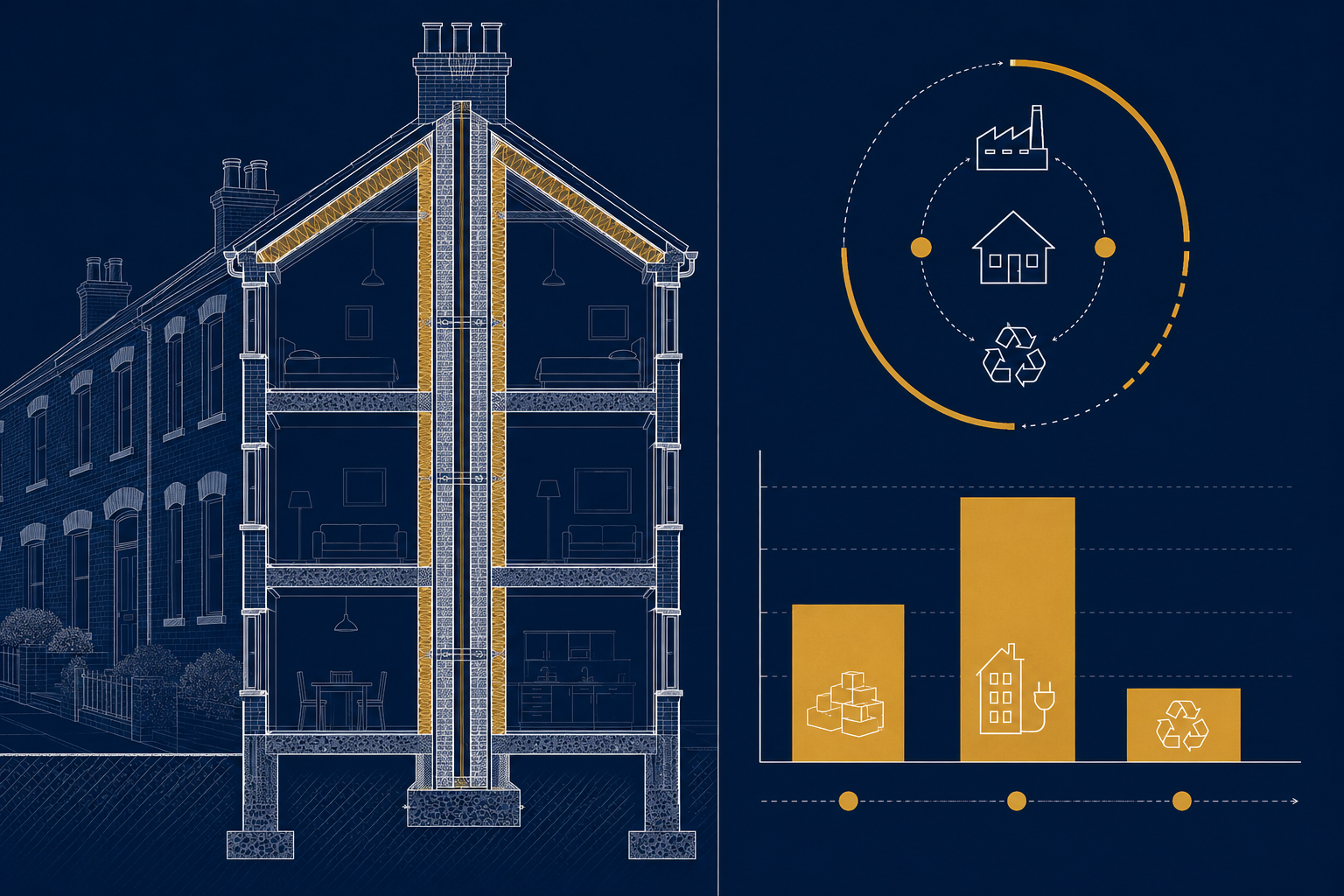
Applying Chartered Surveyor Protocols for PAS 2080:2023 in Whole Life Carbon Party Wall Awards Across Common Project Types
Different notifiable works carry different carbon profiles. The following sections address the most common scenarios surveyors encounter in 2026.
Rear Extensions and Side Returns
Single-storey and two-storey rear extensions are the most frequent trigger for party wall notices. Carbon considerations centre on:
- Foundation specification: Strip foundations in concrete carry significant embodied carbon. Alternatives such as screw piles or recycled aggregate concrete should be noted in the carbon schedule if proposed.
- New party wall leaf: Whether the extension creates a new section of party wall affects the material carbon calculation.
- Roof construction: Flat roofs with insulated build-ups have different carbon profiles from pitched alternatives.
For loft conversions, which often involve cutting into or building upon the party wall, the party wall agreement requirements for lofts page explains the notice obligations that then trigger the carbon protocol described here.
Basement Excavations
Basement works represent the highest embodied carbon category in residential party wall practice. Reinforced concrete retaining walls, waterproofing membranes, and underpinning all generate substantial carbon at the A1-A5 stages. PAS 2080:2023 requires leadership at all levels to drive carbon reduction decisions [6], and in basement projects this means the party wall surveyor should actively prompt the building owner's team to justify material choices against lower-carbon alternatives before the award is issued.
The party wall schedule of condition process, which documents the pre-works condition of the adjoining owner's property, should be updated to note any carbon-relevant baseline data — for example, the condition of existing insulation that may be disturbed.
Commercial and Mixed-Use Developments
For commercial properties, the carbon obligations are more formal. RICS members conducting commercial property valuations are required from 2026 to reflect ESG-related carbon risks as quantifiable value factors, mandating the inclusion of whole life carbon assessments in survey and valuation reports [2]. Where party wall works form part of a larger commercial development, the party wall award's carbon annex should cross-reference the project's main PAS 2080:2023 compliance documentation.
Organisations such as Jacobs have achieved PAS 2080:2023 verification, demonstrating that third-party verification of carbon management processes is becoming an industry benchmark [5]. Surveyors working on commercial party wall matters should be aware that their clients may be subject to such verification requirements, and the award documentation should be compatible with that process.
The updated PAS 2080:2023 may also be used in BREEAM Infrastructure assessments, replacing the previous version [7], which means commercial projects with BREEAM ratings will have additional carbon documentation requirements that the party wall award must not contradict.
Collaboration, Governance, and Professional Responsibilities Under PAS 2080:2023
PAS 2080:2023 places explicit emphasis on collaboration across the value chain [1]. For party wall surveyors, this translates into a set of practical governance obligations that go beyond the traditional bilateral relationship between building owner and adjoining owner.
Key collaboration requirements include:
- Engaging with the building owner's architect or structural engineer to obtain carbon data before the award is drafted
- Communicating carbon schedule requirements to the adjoining owner's surveyor (where an agreed or two-surveyor procedure applies)
- Confirming that the building owner's contractor is aware of any carbon-related conditions in the award
- Retaining carbon documentation as part of the award file for the duration of the works and any post-completion monitoring period
PAS 2080:2023 also highlights the need for leadership at all levels to drive a carbon management process that leads to actual carbon reduction [6]. In the party wall context, the surveyor is not merely a passive recorder of carbon data — the protocols require the surveyor to flag where proposed material choices are inconsistent with the carbon reduction commitments stated in the building owner's planning application or pre-application sustainability statement.
For surveyors operating across multiple London boroughs and the South East, where the volume of notifiable works is highest, the party wall drawings service provides the technical drawing support that underpins accurate carbon schedule preparation.
The party wall agreement cost guide is also relevant here: the additional work involved in preparing a carbon annex to the award represents a legitimate and billable professional service, and surveyors should communicate this clearly to clients at the outset.

Common Errors and How to Avoid Them
Even experienced party wall surveyors can make avoidable mistakes when first implementing PAS 2080:2023 protocols. The most common errors are:
-
Treating the carbon annex as optional. From 2026, for any project where the building owner's team has produced carbon data as part of planning or BREEAM compliance, the party wall award should reference and incorporate that data. Omitting it creates a gap in the project's carbon governance record.
-
Reproducing the full whole life carbon assessment within the award. This creates duplication and potential inconsistency if the assessment is subsequently updated. The award should reference the assessment by document title, version, and date rather than reproducing its contents.
-
Failing to assign carbon monitoring responsibilities. The award should name the party responsible for reporting any significant deviations from the specified carbon schedule during the construction phase.
-
Ignoring end-of-life carbon. Temporary works — hoarding, propping, scaffolding — generate carbon at the C1-C4 stages when removed and disposed of. These are often overlooked in party wall carbon schedules.
-
Not updating the schedule of condition to reflect carbon-relevant baseline data. If existing insulation, party wall fabric, or structural elements are to be disturbed, their pre-works condition and specification should be recorded to enable accurate carbon accounting.
Conclusion
The integration of PAS 2080:2023 into party wall practice is not a bureaucratic addition — it is a structural shift in what it means to act as a competent chartered surveyor in 2026. Chartered Surveyor Protocols for PAS 2080:2023 in Whole Life Carbon Party Wall Awards require a disciplined, collaborative approach that treats the party wall award as a carbon governance document as well as a legal one.
Actionable next steps for surveyors:
- Review the ICE guidance document for PAS 2080:2023 and identify which elements are directly applicable to party wall scenarios [3]
- Develop a standard carbon annex template for party wall awards, covering the five key elements in the carbon schedule table above
- Establish a pre-award carbon data request protocol to send to building owners' design teams at the notice stage
- Communicate the additional professional service scope — and associated fees — to clients before accepting instructions
- Build relationships with architects, structural engineers, and sustainability consultants who can supply verified carbon data for the award file
- Stay current with RICS guidance updates as the 2026 mandatory carbon assessment requirements bed in across the profession [2]
The surveyors who establish robust protocols now will be best placed to serve clients efficiently, avoid professional liability, and contribute meaningfully to the UK's net-zero trajectory.
References
[1] Pas2080 2023 – netzerocompare.com
[2] Whole Life Carbon Assessments In Building Surveys Rics Pas 20802023 Compliance For 2026 Property Valuations – canterburysurveyors.com
[3] Guidance Document Pas2080 – ice.org.uk
[4] Pas 2080 – bsigroup.com
[5] Jacobs Recognized Commitment Carbon Management – jacobs.com
[6] Specification For Managing Building And Infrastructure Whole Of Life Carbon Pas 2080 – groundlevelalliance.org
[7] Pas 2080 2023 Breeam Infrastructure – kb.breeam.com