

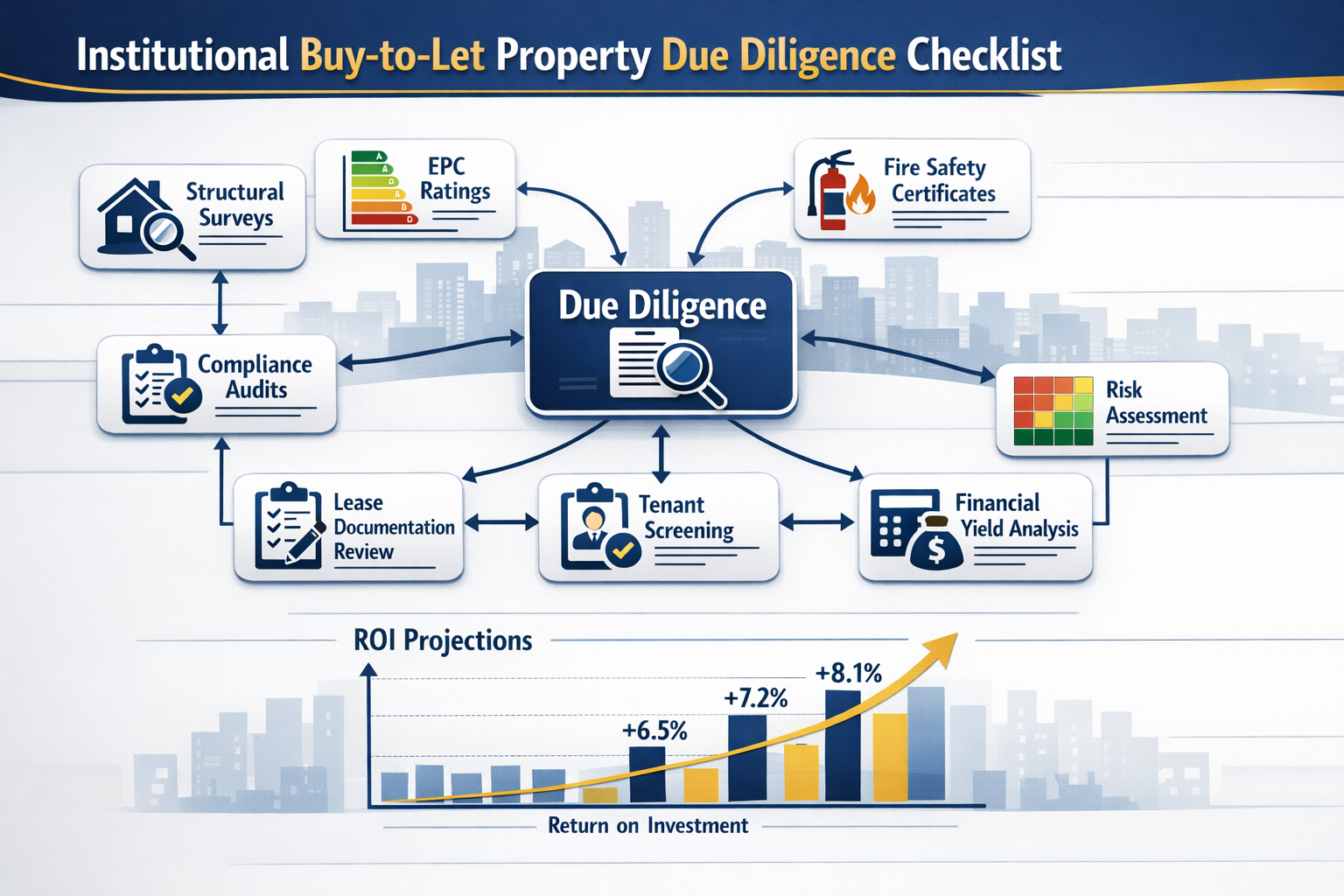
{"cover":"Professional landscape format (1536x1024) editorial hero image featuring bold text overlay 'Chartered Surveyor Opportunities in Institutional Buy-to-Let Surge 2026' in extra large 72pt white sans-serif font with dark gradient shadow, positioned in upper third. Background shows modern glass office building with institutional investors reviewing architectural blueprints and property portfolios, RICS chartered surveyors conducting property inspections with tablets and laser measuring tools, residential apartment blocks in background, professional business setting. Color scheme: deep navy blue, white, gold accents representing premium property sector. High contrast, magazine cover quality, financial editorial style with subtle overlay of property valuation charts and rental yield graphs.","content":["Detailed landscape format (1536x1024) image showing professional chartered surveyor in business attire conducting detailed property inspection of modern buy-to-let apartment building, holding digital tablet displaying valuation software and property assessment checklist, measuring tools and laser distance meter visible, architectural blueprints spread on table, institutional investor representatives observing in background, bright natural lighting through large windows, professional photography style with text overlay 'Valuation Excellence in BTL Sector', clean corporate aesthetic with blue and white color scheme","Professional landscape format (1536x1024) infographic-style image displaying comprehensive due diligence checklist for institutional buy-to-let properties, featuring visual flowchart with connected nodes showing structural surveys, compliance audits, EPC ratings, fire safety certificates, lease documentation review, tenant screening processes, financial yield calculations, risk assessment matrices, professional business graphics with icons representing each due diligence component, clean modern design with navy blue, white and gold accents, data visualization elements showing ROI projections","Detailed landscape format (1536x1024) image showing modern co-working style meeting room with chartered surveyors presenting market opportunity analysis to institutional investment team, large wall-mounted screen displaying UK property market heat map with regional rental yield data, Manchester and Liverpool highlighted as growth markets, professional presentation setup with laptops, property portfolio documents, RICS certification visible on wall, contemporary office interior with glass walls, professional photography with warm lighting, text overlay 'Regional BTL Growth Opportunities 2026'"]}

The UK property market is witnessing a fundamental shift in 2026. While traditional buy-to-let landlords retreat under regulatory pressure, institutional investors are stepping forward with unprecedented confidence. This transformation creates exceptional opportunities for chartered surveyors who understand the unique demands of professional landlords. The Chartered Surveyor Opportunities in Institutional Buy-to-Let Surge 2026: Valuation and Due Diligence Essentials landscape represents a pivotal moment where expertise in yield assessment, defect identification, and compliance verification becomes the cornerstone of successful institutional property investment.
Professional landlords—those working systematically with property professionals rather than operating as accidental investors—recognize the critical value of comprehensive surveys.[1] They understand that proper due diligence protects capital, ensures regulatory compliance, and maximizes long-term returns. As big development firms move aggressively into the rental sector with purpose-built rental properties featuring high-quality services and professional management structures, the demand for specialized surveying expertise continues to accelerate.[3]
Key Takeaways
✅ Institutional investors are dominating the buy-to-let market in 2026, with professional landlords capturing significant market share while smaller landlords exit due to regulatory pressures and tax burdens.
✅ Chartered surveyors face unprecedented demand for specialized services including yield assessments, compliance audits, defect surveys, and portfolio valuations as institutional capital flows into the rental sector.
✅ Government reforms may fundamentally transform surveying workflows, with proposed changes making property condition assessments a standard upfront requirement in transactions.[1]
✅ Regional opportunities extend beyond London, with Manchester leading growth and Liverpool offering strong value propositions, requiring surveyors to develop geographic expertise across multiple markets.[3]
✅ Professional development and digital capabilities are essential for surveyors to capitalize on institutional buy-to-let opportunities, with RICS actively building capacity through enhanced qualification pathways and digital tools.[1]
Understanding the Institutional Buy-to-Let Surge in 2026

The Shift from Accidental to Professional Landlords
The UK rental market has undergone a dramatic restructuring. Rental supply is contracting rapidly as stricter regulations and increased tax burdens force smaller, accidental landlords to exit the market.[3] This exodus creates a vacuum that institutional investors—with superior financial capacity and professional management infrastructure—are eagerly filling.
Institutional and professional landlords remain bullish about buy-to-let investments despite broader market caution.[1] These sophisticated investors approach property acquisition with a fundamentally different mindset than their predecessors. They:
- Work systematically with property professionals at every stage of acquisition
- Understand the value of comprehensive surveys and due diligence
- Focus on long-term portfolio performance rather than short-term capital gains
- Prioritize regulatory compliance and professional management standards
In certain markets, approximately 77% of properties sold to investors or corporate structures (including LLCs) demonstrate institutional capital's dominant role.[4] This concentration of professional investment creates consistent, predictable demand for high-quality surveying services.
Build-to-Rent: The New Institutional Model
Big development firms are fundamentally changing the rental landscape by building properties specifically designated for rental with integrated high-quality services and professional management structures.[3] This build-to-rent (BTR) model shifts rental culture toward institutional setups featuring:
- Long-term lease models providing stability for both tenants and investors
- Professional on-site management teams
- Enhanced amenities and community facilities
- Standardized quality across portfolio properties
For chartered surveyors, BTR developments present unique opportunities. These projects require specialized commercial valuations that account for operational income streams, management costs, and long-term value retention strategies that differ significantly from traditional residential assessments.
Market Dynamics Driving Institutional Investment
Several converging factors make 2026 an exceptional year for institutional buy-to-let activity:
Supply Constraints: Tenant demand is rising while landlord supply remains constrained, creating pressure on rental prices to remain firm in the near term.[2] This dynamic particularly appeals to institutional investors evaluating buy-to-let opportunities, as tight supply supports sustainable rental yields.
Rental Yields Remain Strong: Despite market challenges, rental yields continue supporting institutional investment in build-to-rent and buy-to-let sectors as an attractive alternative to transactional sales markets.[3]
Refinancing Opportunities: As mortgage rates dip, refinancing opportunities emerge, creating potential need for updated valuations and due diligence work as institutional investors restructure financing on existing portfolios.[3]
| Market Factor | Impact on Institutional BTL | Surveyor Opportunity |
|---|---|---|
| Supply Contraction | Reduced competition, higher yields | Portfolio acquisition surveys |
| Rising Tenant Demand | Sustained rental income | Tenant-readiness assessments |
| Regulatory Pressure | Professional advantage | Compliance audits |
| Refinancing Window | Portfolio restructuring | Updated valuations |
| Regional Growth | Geographic diversification | Multi-location expertise |
Chartered Surveyor Opportunities in Institutional Buy-to-Let Surge 2026: Core Service Demands
Yield Assessment and Investment Valuation
Accurate yield assessment forms the foundation of institutional buy-to-let investment decisions. Unlike traditional homebuyers focused primarily on property condition, institutional investors require comprehensive financial analysis that integrates:
Rental Income Projections
Chartered surveyors must evaluate realistic rental income based on:
- Comparable rental evidence from similar properties in the locality
- Market positioning relative to competing rental properties
- Tenant demographic analysis and demand patterns
- Seasonal variations and occupancy rates
- Potential for rental growth over the investment horizon
Professional valuation services must account for the institutional investor's need for conservative, defensible rental projections that withstand scrutiny from lenders and stakeholders.
Operating Cost Analysis
Institutional investors require detailed understanding of:
- Management fees and professional service costs
- Maintenance reserves and lifecycle replacement schedules
- Compliance costs including safety certificates, inspections, and licensing
- Void periods and tenant turnover expenses
- Insurance premiums for professional landlord coverage
Net Yield Calculations
The surveyor's role extends beyond gross yield to provide comprehensive net yield analysis that accounts for all operating expenses, capital expenditure requirements, and potential value enhancement opportunities.
"Professional landlords understand that proper surveys protect their capital and ensure regulatory compliance. They're not looking for the cheapest option—they want comprehensive expertise that identifies risks and opportunities." – Industry Expert
Defect Identification and Risk Assessment
Institutional investors cannot afford unexpected capital expenditure that erodes investment returns. Chartered surveyors provide critical value through comprehensive defect identification that goes beyond standard homebuyer surveys.
Structural and Building Pathology Expertise
Professional landlords require surveyors with deep building pathology expertise who can:
- Identify latent defects that may not be immediately apparent
- Assess structural integrity and long-term stability
- Evaluate building systems (mechanical, electrical, plumbing)
- Predict lifecycle replacement requirements
- Quantify remediation costs with accuracy
For portfolio acquisitions, surveyors must develop standardized assessment frameworks that enable consistent evaluation across multiple properties while identifying property-specific risks.
Compliance and Regulatory Audits
The regulatory landscape for rental properties has become increasingly complex. Chartered surveyors must verify:
✅ Energy Performance Certificate (EPC) ratings and improvement pathways
✅ Fire safety compliance including alarm systems, escape routes, and compartmentation
✅ Electrical safety certificates and periodic inspection requirements
✅ Gas safety records and annual inspection compliance
✅ Legionella risk assessments for water systems
✅ Asbestos surveys for older properties
✅ Licensing requirements for Houses in Multiple Occupation (HMOs)
Non-compliance represents significant financial and reputational risk for institutional investors. Surveyors who provide comprehensive compliance audits deliver exceptional value.
Budgeting for Repairs and Restoration
Institutional investors require detailed budgeting for repairs and restoration that enables accurate financial modeling. Surveyors must provide:
- Itemized cost estimates for identified defects
- Prioritization frameworks distinguishing urgent, medium-term, and long-term requirements
- Lifecycle cost projections for major building components
- Value enhancement opportunities through strategic improvements
- Contractor recommendations and procurement guidance
Portfolio Due Diligence Services
When institutional investors acquire property portfolios, chartered surveyors face unique challenges requiring specialized approaches.
Standardized Assessment Protocols
Portfolio acquisitions demand consistent evaluation methodologies that enable:
- Comparative analysis across properties
- Risk stratification identifying highest-priority concerns
- Portfolio-level cost projections for capital expenditure planning
- Performance benchmarking against industry standards
Surveyors must develop proprietary assessment frameworks that deliver consistency while accommodating property-specific variations.
Desktop and Physical Inspection Balance
Large portfolio acquisitions may require tiered inspection approaches:
- Desktop reviews of existing documentation, certificates, and historical records
- Sample physical inspections of representative properties
- Detailed inspections of high-value or high-risk properties
- Specialist investigations for identified concerns (structural, environmental, etc.)
This balanced approach manages cost and timeline while maintaining due diligence rigor.
Technology-Enhanced Surveys
Institutional clients increasingly expect digital survey deliverables including:
- Interactive digital reports with hyperlinked navigation
- Photographic evidence with annotations and commentary
- 3D property models from premium drone surveys
- Thermal imaging for insulation and moisture analysis
- Database integration enabling portfolio management systems
Chartered surveyors who invest in digital capabilities position themselves advantageously for institutional work.
Essential Skills and Capabilities for Chartered Surveyors in 2026
Technical Expertise and Specialization
The Chartered Surveyor Opportunities in Institutional Buy-to-Let Surge 2026: Valuation and Due Diligence Essentials landscape demands specialized technical capabilities beyond general practice competence.
Multi-Tenure Valuation Skills
Institutional buy-to-let properties often involve complex tenure arrangements requiring expertise in:
- Leasehold valuations and lease extension implications
- Freehold investment analysis
- Mixed-use properties combining residential and commercial elements
- Ground rent investments and their impact on capital values
Extended lease terms are becoming increasingly important for institutional landlords seeking to protect property value and ensure operational stability over long-term investment horizons.[3] Surveyors must understand how lease length affects both current valuation and future marketability.
Regional Market Intelligence
Regional growth opportunities exist outside London and the South East, with Manchester leading and Liverpool offering strong property values.[3] Successful surveyors develop:
- Geographic expertise across multiple growth markets
- Local rental market knowledge including tenant demographics and demand drivers
- Regional regulatory variations in licensing and compliance requirements
- Development pipeline awareness affecting future supply and competition
Whether practicing as chartered surveyors in Guildford, West London, or expanding to emerging markets, geographic diversification enhances institutional appeal.
Financial Modeling Proficiency
Institutional investors expect surveyors to contribute to sophisticated financial analysis including:
- Discounted cash flow (DCF) modeling for long-term investment evaluation
- Sensitivity analysis showing impact of variable assumptions
- Scenario planning for different market conditions
- Exit strategy valuations under various holding periods
These capabilities position surveyors as strategic advisors rather than transactional service providers.
Professional Development and Continuous Learning
RICS is actively building surveyor capacity through clearer qualification pathways for graduates, enhanced CPD (Continuing Professional Development) platforms, improved digital tools, and a new RICS member app to meet anticipated increased activity demands.[1]
Embracing Regulatory Changes
Proposed government reforms to the homebuying process under consultation would make property condition assessments a standard upfront requirement, potentially increasing survey demand earlier in the transaction process.[1] These reforms could "fundamentally change how and when we operate."
Surveyors must:
- Monitor regulatory consultations and proposed changes
- Adapt service offerings to align with new requirements
- Develop upfront assessment protocols that meet regulatory standards
- Educate clients about changing processes and timelines
Technology Adoption and Digital Transformation
Institutional clients expect digital-first service delivery. Essential technology capabilities include:
📱 Mobile survey applications enabling real-time data capture
📊 Cloud-based reporting platforms for instant client access
🤖 AI-assisted defect identification improving accuracy and consistency
📈 Data analytics tools for portfolio performance tracking
🔐 Secure document management protecting sensitive client information
Surveyors who resist digital transformation risk obsolescence in the institutional market.
Specialized Training Programs
Meeting institutional demands requires targeted professional development in:
- Investment valuation methodologies and financial analysis
- Building pathology and advanced defect diagnosis
- Regulatory compliance frameworks across multiple jurisdictions
- Portfolio management and strategic advisory skills
- Client relationship management for institutional accounts
Building Institutional Client Relationships
Securing and retaining institutional buy-to-let clients requires different relationship approaches than traditional residential work.
Understanding Institutional Decision-Making
Institutional investors operate with:
- Committee-based approval processes requiring comprehensive documentation
- Multiple stakeholder groups (investment managers, asset managers, lenders)
- Standardized procurement requirements and preferred supplier frameworks
- Performance metrics and service level agreements
Surveyors must adapt communication styles and deliverables to institutional expectations.
Demonstrating Consistent Quality
Institutional clients prioritize reliability and consistency over lowest cost. Building reputation requires:
- Standardized quality assurance processes
- Peer review protocols for complex assignments
- Professional indemnity insurance at appropriate levels
- Track record documentation demonstrating expertise
- Client testimonials and case studies
Following the Prince Chartered Surveyors way of delivering consistent excellence builds institutional confidence.
Value-Added Advisory Services
Differentiation comes through strategic advisory capabilities beyond basic surveying:
- Market intelligence briefings on rental trends and opportunities
- Portfolio optimization recommendations identifying underperforming assets
- Risk management frameworks for property portfolios
- Sustainability strategies improving EPC ratings and environmental performance
- Tenant experience enhancements supporting retention and rental growth
Regional Opportunities and Market-Specific Considerations
Manchester: Leading Regional Growth
Manchester has emerged as the leading regional market for institutional buy-to-let investment in 2026.[3] The city offers:
Strong Fundamentals:
- Robust employment growth in technology and professional services
- Major infrastructure investment including transport improvements
- Thriving student population supporting rental demand
- Regeneration projects creating new residential supply
Surveyor Considerations:
- Understanding micro-market variations across Greater Manchester districts
- Expertise in new-build apartment assessments common in city center developments
- Knowledge of local planning policies affecting future development
- Awareness of flood risk in certain areas requiring specialist assessment
Liverpool: Value Proposition for Institutional Investors
Liverpool offers strong property values relative to rental yields, attracting institutional capital seeking higher returns.[3]
Investment Drivers:
- Lower acquisition costs compared to Manchester and Birmingham
- Significant regeneration activity in waterfront and city center areas
- Growing professional services sector
- Cultural attractions supporting population growth
Surveyor Expertise Required:
- Assessment of period property conversions common in Liverpool
- Understanding conservation area restrictions affecting alterations
- Evaluation of regeneration area risks and opportunities
- Knowledge of local authority licensing requirements for HMOs
London and South East: Established Institutional Markets
Despite regional growth, London and the South East remain significant institutional buy-to-let markets with distinct characteristics.
Areas like Barnes, Chelsea, Fulham, and Battersea attract institutional investment in:
- Prime residential rental targeting high-income professionals
- Build-to-rent developments with premium amenities
- Corporate let properties serving relocating executives
- Student accommodation near major universities
Surveyors in these markets require expertise in:
- High-value property assessment with appropriate professional indemnity coverage
- Leasehold complexities common in London apartments
- Listed building considerations affecting alterations and maintenance
- Premium finish quality standards expected by institutional clients
Emerging Markets and Diversification Strategies
Forward-thinking surveyors are developing expertise in emerging institutional markets including:
Midlands Cities: Birmingham, Nottingham, and Leicester offering affordability and growth potential
Northern Powerhouse: Leeds, Sheffield, and Newcastle benefiting from infrastructure investment
Southern Growth Towns: Reading, Milton Keynes, and Cambridge with strong employment drivers
Coastal Regeneration: Brighton, Bournemouth, and Portsmouth attracting lifestyle-focused renters
Geographic diversification enables surveyors to serve institutional clients with national portfolio strategies while reducing dependence on single-market conditions.
Navigating Regulatory Complexity and Compliance Requirements
Current Regulatory Landscape for Buy-to-Let
The regulatory environment for rental properties has intensified significantly, creating both challenges and opportunities for chartered surveyors.
Energy Efficiency Standards
Minimum EPC ratings (currently E or above) are mandatory for rental properties, with potential future tightening to C or above. Surveyors must:
- Assess current EPC ratings and improvement pathways
- Estimate costs for achieving higher ratings
- Evaluate return on investment for energy efficiency improvements
- Understand exemption criteria and registration requirements
Safety Certification Requirements
Institutional landlords face rigorous safety obligations:
🔥 Fire Safety: Particularly critical for multi-occupancy buildings following regulatory reforms
⚡ Electrical Safety: Five-year inspection cycles with detailed certification
🔧 Gas Safety: Annual inspections by Gas Safe registered engineers
💧 Water Safety: Legionella risk assessments and control measures
🏗️ Structural Safety: Ongoing maintenance obligations and periodic assessments
Surveyors providing comprehensive safety audits deliver significant value by consolidating compliance verification.
Licensing and Registration
Many local authorities operate selective or additional licensing schemes for rental properties. Surveyors must understand:
- Geographic extent of licensing requirements
- Property types subject to licensing (HMOs, single lets, etc.)
- Physical standards required for license approval
- Application processes and timescales
Proposed Regulatory Reforms and Future Requirements
Government reform proposals could transform surveying demand through several mechanisms.[1]
Upfront Property Condition Assessments
Proposed reforms would make property condition assessments a standard upfront requirement in transactions, fundamentally changing how and when surveyors operate.[1]
Implications for Surveyors:
- Earlier engagement in transaction timelines
- Standardized assessment protocols across the industry
- Potential for seller-commissioned surveys becoming standard
- Integration with digital property information packs
Enhanced Consumer Protection
Reforms aim to improve transparency and reduce transaction failures through:
- Standardized information disclosure requirements
- Binding reservation agreements reducing fall-throughs
- Clearer timelines and process expectations
- Enhanced redress mechanisms for poor service
Surveyors must adapt to higher accountability standards and more formalized reporting requirements.
Compliance as Competitive Advantage
Institutional investors view regulatory compliance as non-negotiable. Surveyors who position themselves as compliance specialists gain competitive advantage through:
Compliance Audit Services
Comprehensive audits covering:
- All statutory certification requirements
- Local authority licensing compliance
- Planning and building regulation adherence
- Lease covenant compliance
- Management company obligations
Compliance Monitoring Programs
Ongoing services for portfolio clients including:
- Certification renewal tracking and scheduling
- Regulatory change monitoring and impact assessment
- Periodic re-inspection programs
- Compliance dashboard reporting for institutional oversight
Remediation Project Management
When compliance issues are identified, surveyors can provide:
- Remediation specification and contractor procurement
- Project management ensuring quality and timely completion
- Re-certification coordination following remediation
- Cost control and budget management
Technology and Innovation in Institutional Buy-to-Let Surveying
Digital Survey Methodologies
Technology is transforming how chartered surveyors deliver services to institutional clients.
Building Information Modeling (BIM)
BIM integration enables surveyors to create comprehensive digital property records including:
- Accurate spatial measurements and floor plans
- Building component specifications and conditions
- Maintenance history and lifecycle data
- Integration with facilities management systems
For institutional portfolios, BIM creates valuable digital assets supporting long-term property management.
Drone and Aerial Survey Technology
Premium drone surveys provide advantages for institutional buy-to-let assessments:
- Roof condition assessment without access equipment costs
- Façade inspection of tall buildings
- Site context documentation for planning and development
- Marketing imagery for rental promotion
Drone technology improves safety, efficiency, and thoroughness while reducing costs.
Thermal Imaging and Environmental Sensors
Advanced diagnostic tools enhance defect identification:
- Thermal imaging cameras detecting insulation defects, moisture ingress, and heating system issues
- Moisture meters quantifying dampness levels
- Air quality sensors identifying ventilation problems
- Acoustic testing for sound insulation verification
These technologies provide objective, quantifiable data supporting investment decisions.
Data Analytics and Portfolio Intelligence
Institutional clients increasingly expect data-driven insights beyond individual property assessments.
Portfolio Performance Benchmarking
Surveyors can provide value through:
- Comparative analysis of properties across portfolios
- Performance metrics tracking maintenance costs, defect rates, and capital expenditure
- Predictive modeling forecasting future requirements
- Best practice identification from high-performing assets
Market Intelligence Integration
Combining survey data with market intelligence creates strategic advisory capabilities:
- Rental yield comparisons against market benchmarks
- Capital value trends and appreciation forecasts
- Supply pipeline analysis affecting future competition
- Demographic shifts influencing tenant demand
Automated Reporting and Dashboards
Institutional clients benefit from real-time access to portfolio information through:
- Cloud-based dashboards showing key performance indicators
- Automated alerting for certification renewals and compliance deadlines
- Mobile access enabling remote portfolio monitoring
- API integration with client property management systems
Artificial Intelligence and Machine Learning Applications
Emerging AI technologies offer potential to enhance surveying services:
Defect Recognition Systems
AI-powered image analysis can:
- Identify common defects from photographs
- Flag potential issues requiring specialist investigation
- Provide consistency across large portfolios
- Reduce inspection time while maintaining quality
Predictive Maintenance Algorithms
Machine learning models analyzing historical data can:
- Forecast component failure probabilities
- Optimize maintenance scheduling
- Reduce emergency repair costs
- Extend asset lifecycles through proactive intervention
Natural Language Processing for Report Generation
NLP technologies can assist with:
- Standardized report section generation
- Consistency in terminology and descriptions
- Multi-language report production for international clients
- Automated executive summary creation
While technology enhances capabilities, professional judgment and expertise remain irreplaceable in complex institutional assignments.
Building a Successful Practice in Institutional Buy-to-Let Surveying

Service Differentiation Strategies
Succeeding in the institutional market requires clear differentiation from general practice competitors.
Specialization Focus
Rather than attempting to serve all markets, successful practices develop recognized expertise in:
- Specific property types (apartments, HMOs, student accommodation, etc.)
- Geographic markets with deep local knowledge
- Service specializations (compliance, portfolio due diligence, etc.)
- Client segments (pension funds, REITs, private equity, etc.)
Quality Assurance Systems
Institutional clients expect consistent, reliable quality supported by:
- ISO certification or equivalent quality management systems
- Peer review processes for complex assignments
- Standardized templates and checklists ensuring comprehensive coverage
- Client feedback mechanisms driving continuous improvement
Professional Indemnity and Risk Management
Adequate professional indemnity insurance is essential, with coverage levels appropriate to:
- Property values being assessed
- Portfolio sizes and aggregate exposures
- Service types and associated risks
- Client contractual requirements
Robust risk management protocols protect both clients and practices.
Marketing and Business Development
Attracting institutional clients requires professional marketing approaches distinct from residential consumer marketing.
Thought Leadership and Content Marketing
Establishing expertise through:
- Market insight publications analyzing rental trends and opportunities
- Technical guidance on regulatory changes and compliance requirements
- Case studies demonstrating successful institutional assignments
- Conference presentations and industry event participation
Relationship Development
Institutional business is built on long-term relationships requiring:
- Consistent communication with key decision-makers
- Proactive market updates demonstrating ongoing value
- Networking within institutional investor communities
- Referral partnerships with complementary professionals (lawyers, accountants, etc.)
Digital Presence and Credentials
Professional online presence including:
- Website showcasing institutional expertise and case studies
- LinkedIn profiles demonstrating professional credentials
- RICS directory optimization for searchability
- Client testimonials and success stories
Pricing Strategies for Institutional Work
Institutional assignments require value-based pricing rather than commodity hourly rates.
Fixed-Fee Proposals
Institutional clients prefer predictable costs through:
- Comprehensive scope definition
- Fixed fees for defined deliverables
- Clear exclusions and assumptions
- Transparent fee structures for additional services
Portfolio Pricing Models
For multi-property assignments, consider:
- Volume discounts reflecting efficiency gains
- Tiered pricing based on property values or complexity
- Retainer arrangements for ongoing services
- Framework agreements establishing rates for future work
Value Demonstration
Justify premium pricing through:
- Risk mitigation quantifying potential cost avoidance
- Time savings from efficient processes
- Quality advantages reducing transaction failures
- Strategic insights supporting better investment decisions
Future Outlook: Chartered Surveyor Opportunities Beyond 2026
Sustained Institutional Investment Trends
The institutional buy-to-let surge shows strong momentum continuing beyond 2026 driven by:
Demographic Factors:
- Aging population requiring retirement housing
- Changing household formation patterns
- Migration to growth regions
- Student population growth
Economic Drivers:
- Persistent housing affordability challenges
- Build-to-rent sector maturation
- Pension fund allocation to real assets
- International capital seeking UK exposure
Regulatory Evolution:
- Continued pressure on small landlords
- Professionalization of rental sector
- Enhanced tenant protections
- Sustainability requirements
These trends create sustained demand for specialized surveying expertise.
Emerging Service Opportunities
Forward-thinking surveyors are developing capabilities in emerging service areas:
ESG and Sustainability Advisory
Environmental, Social, and Governance (ESG) considerations are increasingly important for institutional investors. Surveyors can provide:
- Carbon footprint assessments and reduction strategies
- Sustainability certification support (BREEAM, etc.)
- Social value measurement and community impact
- Governance framework development for responsible property management
Retrofit and Decarbonization Planning
Achieving net-zero targets requires comprehensive retrofit strategies:
- Whole-building energy modeling
- Technology evaluation (heat pumps, solar, insulation, etc.)
- Cost-benefit analysis of improvement options
- Phased implementation planning
- Grant funding and incentive optimization
PropTech Integration Consulting
Institutional landlords are investing in property technology solutions. Surveyors can advise on:
- Smart building systems and IoT sensors
- Tenant experience platforms
- Predictive maintenance technologies
- Energy management systems
- Digital twin creation and utilization
Professional Development Pathways
RICS and other professional bodies are enhancing qualification pathways and CPD to meet evolving demands.[1]
Specialist Accreditations
Pursuing additional credentials in:
- Registered Valuer status for formal valuations
- Building Conservation for heritage properties
- Environmental Assessment methodologies
- Expert Witness qualifications for dispute resolution
Cross-Disciplinary Expertise
Developing knowledge in complementary areas:
- Property management operations and best practices
- Construction project management for remediation works
- Financial analysis and investment appraisal
- Legal frameworks governing landlord-tenant relationships
International Perspectives
For surveyors serving international institutional investors, understanding:
- Comparative regulatory environments
- International valuation standards
- Cross-border investment structures
- Cultural differences in property expectations
Conclusion: Capitalizing on Chartered Surveyor Opportunities in Institutional Buy-to-Let Surge 2026
The Chartered Surveyor Opportunities in Institutional Buy-to-Let Surge 2026: Valuation and Due Diligence Essentials represent a transformative moment for the profession. As institutional investors dominate the buy-to-let market with professional approaches and long-term perspectives, demand for specialized surveying expertise has never been stronger.
Success requires chartered surveyors to evolve beyond traditional residential practice, developing sophisticated capabilities in:
✅ Investment-focused valuations that integrate rental yield analysis, operating cost assessment, and financial modeling
✅ Comprehensive due diligence covering defect identification, compliance verification, and risk quantification
✅ Portfolio-scale services with standardized methodologies and digital delivery platforms
✅ Regional market expertise spanning growth markets beyond traditional London focus
✅ Technology adoption leveraging drones, thermal imaging, BIM, and data analytics
✅ Regulatory mastery navigating complex compliance requirements and anticipating future reforms
✅ Strategic advisory positioning surveyors as valued partners rather than transactional service providers
The institutional buy-to-let surge is not a temporary phenomenon but a fundamental market restructuring favoring professional landlords with capital, expertise, and long-term commitment. Surveyors who recognize this shift and adapt their capabilities accordingly will find exceptional opportunities for practice growth and professional development.
Actionable Next Steps
For chartered surveyors seeking to capitalize on institutional buy-to-let opportunities:
-
Assess current capabilities against institutional client requirements, identifying skill gaps and development priorities
-
Invest in technology including digital reporting platforms, diagnostic equipment, and data management systems
-
Develop specialized expertise in high-demand areas such as compliance auditing, portfolio due diligence, or regional markets
-
Build institutional relationships through targeted marketing, thought leadership, and professional networking
-
Enhance professional credentials through RICS CPD, specialist accreditations, and cross-disciplinary learning
-
Monitor regulatory developments to anticipate changing requirements and adapt service offerings proactively
-
Consider strategic partnerships with complementary professionals serving institutional investors
-
Document and showcase expertise through case studies, client testimonials, and market insights
The institutional buy-to-let surge of 2026 creates a rising tide that can lift all boats—but only for those who position themselves strategically to serve this demanding, sophisticated client segment. Professional landlords understand the value of proper surveys and work systematically with property professionals.[1] Chartered surveyors who deliver excellence in valuation and due diligence essentials will find themselves indispensable partners in the continued growth of institutional buy-to-let investment.
Market confidence is edging higher in early 2026,[2] and institutional investors remain bullish despite broader economic uncertainties.[1] For chartered surveyors prepared to meet the challenge, the opportunities are exceptional and enduring.
References
[1] Surveying In 2026 Reform Recovery And Renewed Demand – https://www.lrg.co.uk/news-and-insights/surveying-in-2026-reform-recovery-and-renewed-demand/
[2] Market Confidence Edges Higher In Early 2026 – https://www.winkworth.co.uk/articles/market-confidence-edges-higher-in-early-2026
[3] The 2026 Property Reset Market Forecasts Budget Impacts Investor Focus – https://surveyingcorp.com/2025/12/the-2026-property-reset-market-forecasts-budget-impacts-investor-focus/
[4] 10 Things To Know About The Property Market January 2026 – https://www.cotality.com/uk/press-releases/10-things-to-know-about-the-property-market-january-2026