

Last updated: July 24, 2026
Quick Answer: Combining a Level 3 building survey with party wall procedures means commissioning a full structural inspection of the affected property before any party wall notice is served. This creates a documented baseline of existing defects, protects both the building owner and the adjoining owner from disputed liability, and gives surveyors the evidence they need to produce an accurate Schedule of Condition and Party Wall Award.
Key Takeaways
- A Level 3 (Full Building Survey) is the most thorough inspection available under the RICS framework and covers structural defects, damp, roofing, and hidden building pathology.
- The Party Wall etc. Act 1996 requires notice to be served before certain types of work, but it does not legally require a Level 3 survey first, however, commissioning one is strongly advisable.
- Pre-notification Level 3 inspections create an objective defect record that prevents neighbours from later attributing pre-existing damage to your building work.
- Common defects identified at this stage include subsidence cracking, damp penetration, deteriorating mortar, and structural movement in shared walls.
- A Level 3 survey typically costs between £600 and £2,000 depending on property size and complexity; party wall surveyor fees are separate.
- The RICS professional standard for party wall legislation (7th edition) emphasises understanding the adjoining property's condition before making an Award.
- Integrating both processes reduces the risk of formal disputes, delays, and costly legal proceedings.
- A chartered surveyor experienced in both disciplines can coordinate the Level 3 inspection and the party wall procedure as a single, streamlined service.
What Is a Level 3 Building Survey and How Does It Differ from Level 1 and 2?
A Level 3 building survey, also called a Full Building Survey, is the most detailed property inspection available under the RICS Home Survey Standard. It covers every accessible element of a building's structure, fabric, and condition, and it includes advice on defects, repair options, and maintenance priorities.
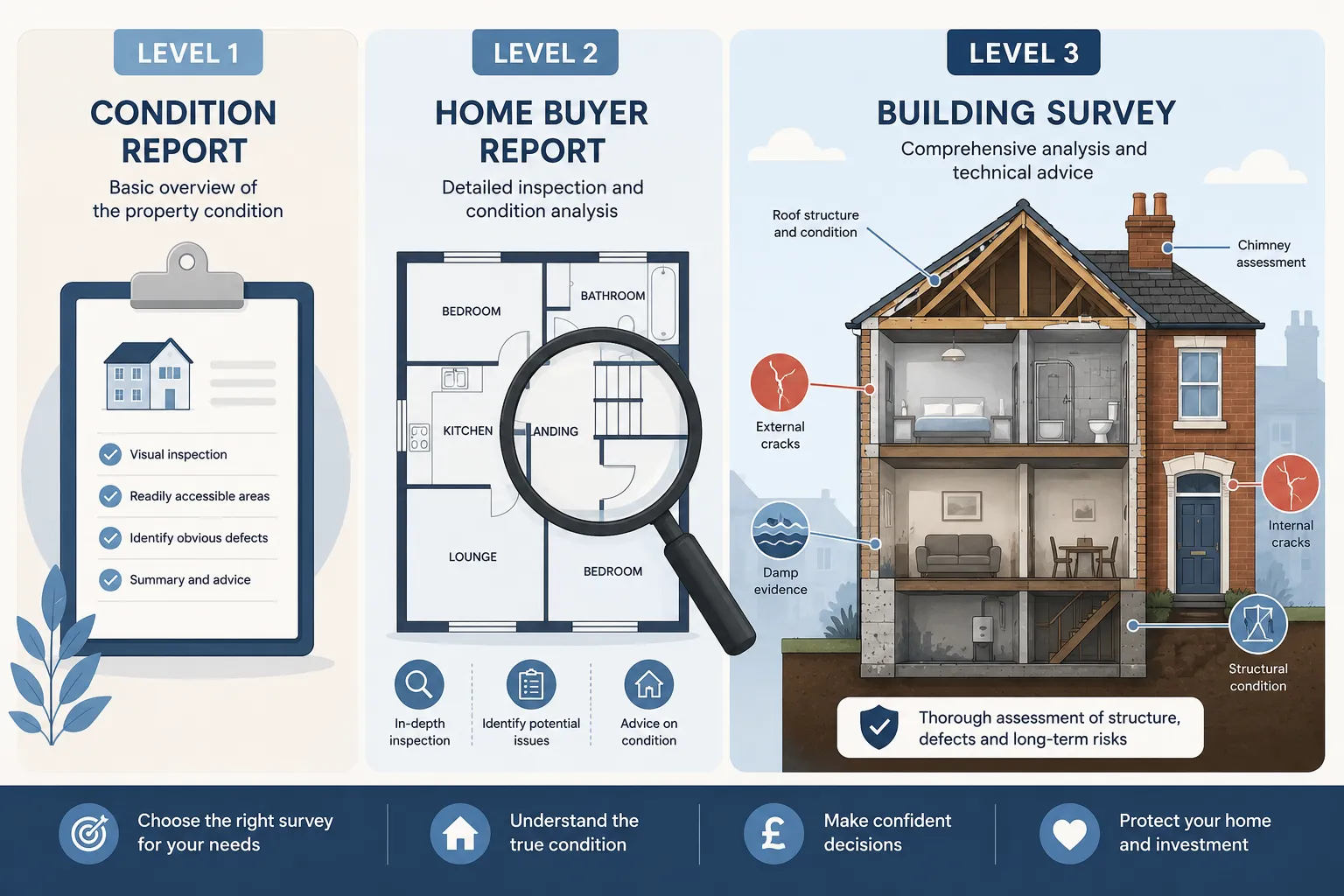
The three RICS survey levels differ significantly in scope:
| Survey Level | Also Known As | Scope | Best For |
|---|---|---|---|
| Level 1 | Condition Report | Visual only, traffic-light ratings | New builds, modern properties in good condition |
| Level 2 | HomeBuyer Report | Visual plus basic advice | Conventional properties in reasonable condition |
| Level 3 | Full Building Survey | In-depth structural and fabric inspection | Older, altered, or complex properties |
A Level 3 inspection goes beyond what a Level 2 report covers. The surveyor examines roof spaces, subfloor voids where accessible, wall construction, drainage, and any signs of structural movement or historic repair. For properties involved in party wall works, this depth is precisely what's needed.
For a detailed breakdown of what the inspection covers, see this guide to what's in a Level 3 building survey.
Choose a Level 3 if: the property is pre-1920, has been extended or altered, sits in a terrace or semi-detached row, or is about to be subject to notifiable party wall works.
What Are Party Wall Regulations and When Do They Apply?
The Party Wall etc. Act 1996 is the primary legislation governing work on or near shared walls, boundary structures, and excavations close to neighbouring properties in England and Wales. It applies whenever a building owner proposes specific types of construction work.
The Act applies in three main scenarios:
- Party structure notices, work directly on a shared wall, floor, or ceiling (for example, inserting a beam, cutting in a damp-proof course, or demolishing and rebuilding a party wall).
- Line of junction notices, building a new wall at or astride the boundary between two properties.
- Three-metre and six-metre notices, excavations within three or six metres of a neighbouring structure, depending on the depth of the proposed foundations.
Once a notice is served, the adjoining owner has 14 days to consent or dissent. If they dissent, or fail to respond, a dispute is deemed to have arisen and one or more party wall surveyors must be appointed to produce a Party Wall Award.
For a practical overview of the process, the top questions about party wall surveys covers the most common points of confusion.
How Do Level 3 Inspections Help Identify Defects Before Party Wall Notification?
When building surveys meet party walls through integrated Level 3 inspections for pre-notification defect identification, the primary benefit is establishing an objective, timestamped record of a property's condition before any construction activity begins. This record is the foundation of a defensible Schedule of Condition.
Without a pre-notification inspection, any crack or damp patch that appears after work starts becomes a potential dispute. The adjoining owner may claim the damage was caused by the building works; the building owner may insist it was pre-existing. Without documentary evidence, both parties are arguing from memory.
A Level 3 survey conducted before notice is served:
- Photographs and describes every visible defect in the adjoining property (with consent)
- Records crack widths, damp readings, and structural movement indicators
- Provides a baseline against which post-works conditions can be compared
- Supports the party wall surveyor in drafting an accurate, evidence-based Award
The RICS professional standard for party wall legislation (7th edition) specifically prioritises understanding the adjoining property's condition before making an Award. A Level 3 inspection is the most thorough way to satisfy that requirement.
What Defects Can Be Found During a Pre-Notification Level 3 Survey?
A pre-notification Level 3 survey can identify a wide range of defects that would otherwise go undocumented. For properties in terraced or semi-detached rows, the most common context for party wall work, the following are frequently found:
- Structural cracking in party walls, gable walls, and chimney stacks, including diagonal cracks indicating differential settlement
- Damp penetration through shared walls, particularly in older solid-brick construction
- Deteriorating mortar joints (spalling or eroded pointing) that could be worsened by vibration from adjacent works
- Roof structure defects such as sagging rafters, spread at eaves, or damaged wall plates near the party wall line
- Subfloor issues including timber decay, inadequate ventilation, or evidence of ground movement
- Previous repairs that may have masked underlying problems, patched render, repointed sections, or replaced brickwork
For a comprehensive look at how defects are categorised and reported, see the building defects survey service.
A surveyor experienced in building pathology will also identify the likely cause of each defect, which matters enormously when attributing liability later.
Do I Need a Level 3 Survey Before Serving Party Wall Notices?
A Level 3 survey is not a legal requirement before serving party wall notices under the 1996 Act. However, commissioning one is strongly advisable in most cases involving older or complex properties.
The legal minimum is to serve the correct notice and, if a dispute arises, appoint a surveyor to produce an Award. But the Award is only as good as the evidence underpinning it. A party wall surveyor who has access to a thorough Level 3 inspection report can produce a more accurate Schedule of Condition and a more defensible Award.
When a pre-notification Level 3 survey is especially important:
- The adjoining property shows visible signs of existing defects
- The proposed works involve deep excavation, underpinning, or demolition
- The adjoining owner is likely to be uncooperative or dispute-prone
- The property is listed, in a conservation area, or of unusual construction
When it may be less critical:
- The proposed works are minor (for example, a small loft conversion with no structural changes to the party wall)
- Both properties are modern, recently built, and in demonstrably good condition
For guidance on whether your specific works require a party wall agreement, the party wall agreement essentials guide is a useful starting point.
What's the Difference Between a Party Wall Survey and a Building Survey?
These are two distinct services that serve different purposes, though they can and should work together.
| Feature | Level 3 Building Survey | Party Wall Survey |
|---|---|---|
| Purpose | Assess overall condition of a property | Manage the legal process for notifiable works |
| Who commissions it | Buyer, owner, or building owner pre-works | Building owner (or adjoining owner if dissenting) |
| Output | Detailed condition report with repair advice | Party Wall Award and Schedule of Condition |
| Legal basis | RICS professional standards | Party Wall etc. Act 1996 |
| Timing | Before purchase or before works begin | After notice is served and dispute arises |
A party wall surveyor's Schedule of Condition is typically a narrower document than a Level 3 report. It records the condition of the adjoining property at a specific point in time, but it does not usually include the diagnostic depth, causes of defects, repair specifications, cost estimates, that a Level 3 survey provides.
The two services complement each other: the Level 3 report feeds into and strengthens the Schedule of Condition, giving the party wall surveyor richer evidence to work with.
Can a Level 3 Inspection Prevent Party Wall Disputes?
In many cases, yes. When building surveys meet party walls through integrated Level 3 inspections for pre-notification defect identification, the result is a shared, objective record that removes the most common source of neighbour disputes: disagreement about what damage existed before the works began.
A well-documented pre-works inspection:
- Removes ambiguity about pre-existing defects
- Gives both parties confidence in the baseline condition record
- Reduces the likelihood of an adjoining owner claiming compensation for damage that predates the works
- Supports faster resolution if a dispute does arise, because the evidence is already documented
That said, a Level 3 inspection cannot prevent all disputes. If an adjoining owner is determined to dissent, they are entitled to do so under the Act regardless of the survey evidence. What the inspection does is make the subsequent process faster, cheaper, and more likely to reach a fair outcome.
For context on what happens when neighbours refuse to engage, the article on what to do if a neighbour refuses party wall works covers the key steps.
What Happens If Defects Are Found During a Pre-Notification Inspection?
Finding defects before works begin is the intended outcome of a pre-notification Level 3 survey, it is not a problem, it is protection. The surveyor documents each defect, records its severity, and photographs it in context.
The findings then inform three things:
- The Party Wall Award, the party wall surveyor can include specific conditions in the Award to protect defect-prone areas, require particular working methods, or specify monitoring during construction.
- The Schedule of Condition, the pre-existing defects are formally recorded so they cannot later be attributed to the building works.
- The building owner's approach, if significant structural issues are found in the adjoining property, the building owner may need to adjust their design, seek specialist advice, or take additional precautions before proceeding.
In some cases, defects found during a pre-notification inspection may be serious enough to require urgent attention before any party wall works proceed. For guidance on how to handle urgent structural findings, see urgent or dangerous building issues.
How Long Does a Level 3 Survey Take Before Party Wall Work Starts?
A Level 3 building survey inspection typically takes between two and eight hours on site, depending on the size and complexity of the property. The written report is usually delivered within five to ten working days of the inspection.
For party wall purposes, the overall timeline looks like this:
- Level 3 survey commissioned and completed: Allow two to three weeks from instruction to report delivery.
- Party wall notice served: Can be served once the survey is complete. The adjoining owner then has 14 days to respond.
- Dispute period and Award: If a dispute is deemed to have arisen, the Award process typically takes four to eight weeks.
- Minimum notice period before works begin: One month for party structure notices; two months for line of junction and excavation notices.
Total lead time from commissioning the Level 3 survey to being legally able to start works is typically ten to fourteen weeks in a straightforward case. Planning for this timeline at the outset avoids costly delays later.
For more detail on inspection timescales, see building survey timeframes.
How Much Does a Level 3 Building Survey Cost?
A Level 3 building survey in the UK typically costs between £600 and £2,000 for a standard residential property, with fees varying based on property size, location, age, and complexity. London and the South East generally attract higher fees than other regions.
Party wall surveyor fees are charged separately and typically range from £700 to £1,500 per surveyor per Award, though complex cases involving multiple adjoining owners or disputed matters can cost significantly more.
For a detailed breakdown of party wall costs, the cost of a party wall agreement article provides current guidance.
Key cost factors for a Level 3 survey:
- Property size (floor area and number of storeys)
- Age and construction type (Victorian terraces cost more to survey than modern semis)
- Accessibility of roof spaces, subfloors, and outbuildings
- Whether specialist reports (asbestos, drainage, structural engineering) are needed
Viewing the Level 3 survey cost as part of the overall party wall process budget, rather than an optional extra, is the most practical framing. The cost of a disputed party wall case, including legal fees and remediation works, can easily exceed £10,000.
Who Needs to Be Present During a Level 3 Building Survey?
The property owner or their authorised representative should be available at the start of the inspection to provide access. They do not need to accompany the surveyor throughout.
For a pre-notification party wall inspection of an adjoining property, the adjoining owner's consent and cooperation are required. The surveyor cannot enter a neighbouring property without permission. In practice:
- The building owner's surveyor should write to the adjoining owner to explain the purpose of the inspection and request access.
- The adjoining owner may wish to be present or have their own surveyor present.
- If the adjoining owner refuses access, the party wall surveyor can still produce a Schedule of Condition from the exterior and from any accessible common areas, but the record will be less comprehensive.
Gaining early cooperation from neighbours, before notices are served and before any adversarial dynamic develops, is one of the strongest arguments for commissioning the Level 3 inspection at the earliest opportunity.
What Are Common Mistakes When Integrating Surveys with Party Wall Procedures?
The most common mistake is treating the Level 3 building survey and the party wall process as entirely separate exercises, commissioned at different times by different professionals with no coordination between them.
Other frequent errors include:
- Commissioning the survey too late, after the party wall notice has already been served and a dispute has arisen, leaving no time to establish a pre-works baseline.
- Using a Level 2 report instead of a Level 3, a HomeBuyer Report lacks the structural depth needed to support a robust Schedule of Condition.
- Failing to inspect the adjoining property, surveying only the building owner's property misses the point; it is the adjoining property's condition that needs to be documented.
- Not retaining photographic evidence, a written description of a crack is far weaker than a dated, geotagged photograph with a scale reference.
- Ignoring the consequences of inaction, failing to document pre-existing defects can result in the building owner being held liable for damage they did not cause. For a clear account of what can go wrong, see consequences of failing to act.
How Do Surveyors Document Defects Found in Level 3 Inspections for Party Wall Cases?
Surveyors use a combination of written descriptions, photographic records, and measurement data to document defects in a format that is useful for both the Level 3 report and the party wall Schedule of Condition.
Standard documentation methods include:
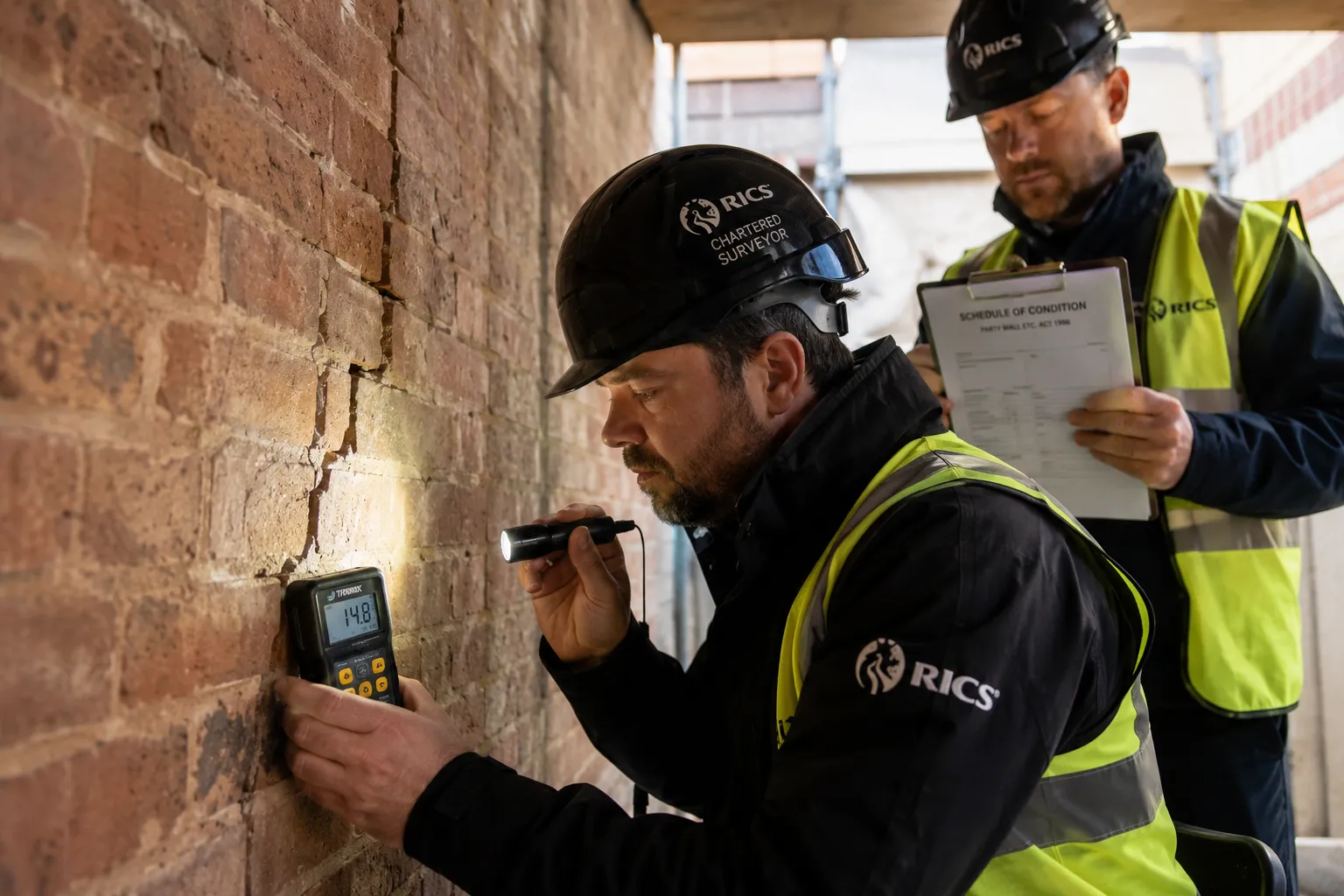
- Crack monitoring, recording crack width, length, orientation, and location using a crack gauge and scale card, with dated photographs
- Damp readings, using a calibrated moisture meter to record readings at specific points, referenced to a floor plan
- Structural movement indicators, noting tell-tale signs of movement such as diagonal cracking, out-of-plumb walls, or distorted door and window openings
- Photographic schedules, a systematic set of photographs covering every elevation, every room, and every defect, with metadata confirming date and time
- Floor plans and sketches, annotated drawings showing the location of defects in relation to the proposed works
When the Level 3 report and the party wall Schedule of Condition are produced by the same surveyor, or by surveyors working closely together, the documentation is consistent, cross-referenced, and far more useful as evidence than two separate reports produced in isolation.
Conclusion: Making the Case for Integrated Pre-Notification Surveys
When building surveys meet party walls through integrated Level 3 inspections for pre-notification defect identification, the result is a stronger, fairer, and more efficient process for everyone involved. The building owner gets protection against spurious claims. The adjoining owner gets an objective record of their property's condition. The party wall surveyors get the evidence they need to produce a defensible Award. And both parties reduce the risk of a costly, time-consuming dispute.
Actionable next steps:
- If you are planning works that may trigger the Party Wall etc. Act 1996, commission a Level 3 building survey of the adjoining property before serving any notice.
- Engage a chartered surveyor who has experience in both building surveys and party wall procedures, ideally one who can coordinate both services.
- Allow ten to fourteen weeks from commissioning the survey to the earliest legal start date for works.
- Retain all survey documentation, photographs, and correspondence as part of your project record.
- If the Level 3 inspection reveals significant defects in the adjoining property, take specialist advice before proceeding.
Frequently Asked Questions
Is a Level 3 building survey a legal requirement before serving a party wall notice?
No. The Party Wall etc. Act 1996 does not require a Level 3 survey before serving notice. However, commissioning one is strongly advisable for older or complex properties, as it creates the defect baseline that protects both parties throughout the works.
Can the same surveyor carry out the Level 3 inspection and act as party wall surveyor?
Yes, in principle, but there are circumstances where impartiality requirements under the Act may make this inadvisable. A surveyor acting as the agreed surveyor for both parties can use the Level 3 findings directly. Where separate surveyors are appointed, the Level 3 report should be shared with the party wall surveyor.
What if the adjoining owner refuses to allow access for a pre-notification inspection?
The surveyor can document the exterior condition and any accessible common areas. If access is refused entirely, this is recorded and the Schedule of Condition will note the limitation. The building owner's liability for damage to areas that could not be inspected is not automatically reduced, which is why early, cooperative engagement with neighbours is important.
How is a Level 3 building survey different from a Schedule of Condition?
A Level 3 building survey is a comprehensive assessment of a property's overall condition, including causes of defects, repair advice, and maintenance priorities. A Schedule of Condition is a narrower document that records the state of a property at a specific point in time, primarily for legal or contractual purposes. The Level 3 report provides the depth of evidence that makes a Schedule of Condition more accurate and defensible.
Does a pre-notification Level 3 survey cover environmental issues like asbestos?
A standard Level 3 survey will note materials that may contain asbestos and recommend specialist testing, but it does not include a full asbestos survey. For properties built before 2000, a separate asbestos building survey may be advisable, particularly if the works involve disturbance of existing fabric.
Who pays for the Level 3 survey in a party wall context?
The building owner, the person proposing the works, typically commissions and pays for the pre-notification Level 3 survey. Party wall surveyor fees are also generally borne by the building owner under the Act, unless the adjoining owner's actions have unreasonably increased costs.
.pw-tool{font-family:Arial,sans-serif;max-width:560px;margin:2em auto;background:#f7f9fc;border:1px solid #d0d8e4;border-radius:8px;padding:20px}
.pw-tool h3{margin:0 0 4px;font-size:1.1em;color:#1a2e4a}
.pw-tool p.pw-sub{margin:0 0 16px;font-size:.85em;color:#555}
.pw-item{display:flex;align-items:flex-start;margin-bottom:10px;background:#fff;border:1px solid #e0e6ef;border-radius:6px;padding:10px 12px;cursor:pointer;transition:border-color .2s}
.pw-item.done{border-color:#2e7d52;background:#edf7f2}
.pw-item input[type=checkbox]{margin:2px 10px 0 0;accent-color:#2e7d52;width:16px;height:16px;flex-shrink:0}
.pw-item label{font-size:.9em;color:#222;cursor:pointer;line-height:1.4}
.pw-item.done label{color:#2e7d52}
.pw-progress{margin-top:14px;background:#e0e6ef;border-radius:4px;height:10px;overflow:hidden}
.pw-bar{height:10px;background:#2e7d52;border-radius:4px;transition:width .3s}
.pw-count{font-size:.82em;color:#555;margin-top:6px;text-align:right}
Pre-Notification Survey Checklist
Track your key steps before serving party wall notices.
function upd(){var t=6,d=0,ids=[“c1″,”c2″,”c3″,”c4″,”c5″,”c6”];ids.forEach(function(id,i){var cb=document.getElementById(id),item=document.getElementById(“i”+(i+1));if(cb.checked){d++;item.classList.add(“done”)}else{item.classList.remove(“done”)}});document.getElementById(“bar”).style.width=Math.round(d/t*100)+”%”;document.getElementById(“cnt”).textContent=d+” of “+t+” complete”}
Tags: level 3 building survey, party wall act, party wall survey, pre-notification defect identification, building defects, Schedule of Condition, party wall notice, chartered surveyor, RICS survey, building pathology, party wall disputes, full building survey