

Over four million social housing properties in England are now subject to tightened inspection regimes following the phased rollout of Awaab's Law — a landmark piece of legislation that has fundamentally changed how landlords must respond to hazardous conditions. For housing associations and local councils, building surveys for social housing compliance: Awaab's Law and stock condition assessments in 2026 are no longer a box-ticking exercise. They are a legal obligation with hard deadlines, financial penalties, and reputational consequences attached.
Key Takeaways
- Awaab's Law introduces strict response timelines for hazards including damp, mould, and structural defects — non-compliance carries serious legal risk.
- Stock condition assessments must now align with Awaab's Law reporting requirements, not just the Decent Homes Standard.
- Pathology surveys that identify root causes — not just surface symptoms — are essential for defensible compliance records.
- Retrofit and decarbonisation programmes must be integrated with compliance surveying to avoid duplication of cost and effort.
- Chartered surveyors with social housing experience are in high demand; early commissioning is critical in 2026.
What Awaab's Law Means for Social Housing Landlords in 2026
Awaab's Law is named after Awaab Ishak, a two-year-old boy who died in 2020 from a respiratory condition caused by prolonged mould exposure in a Rochdale social housing flat. His case triggered a national reckoning with housing standards, culminating in provisions under the Social Housing (Regulation) Act 2023 that are now being enforced with real teeth.
The legislation requires registered providers of social housing — including local authorities and housing associations — to investigate and fix reported hazards within defined timeframes. The Regulator of Social Housing has been given expanded powers to inspect, issue improvement plans, and impose unlimited fines.
The Core Compliance Timelines
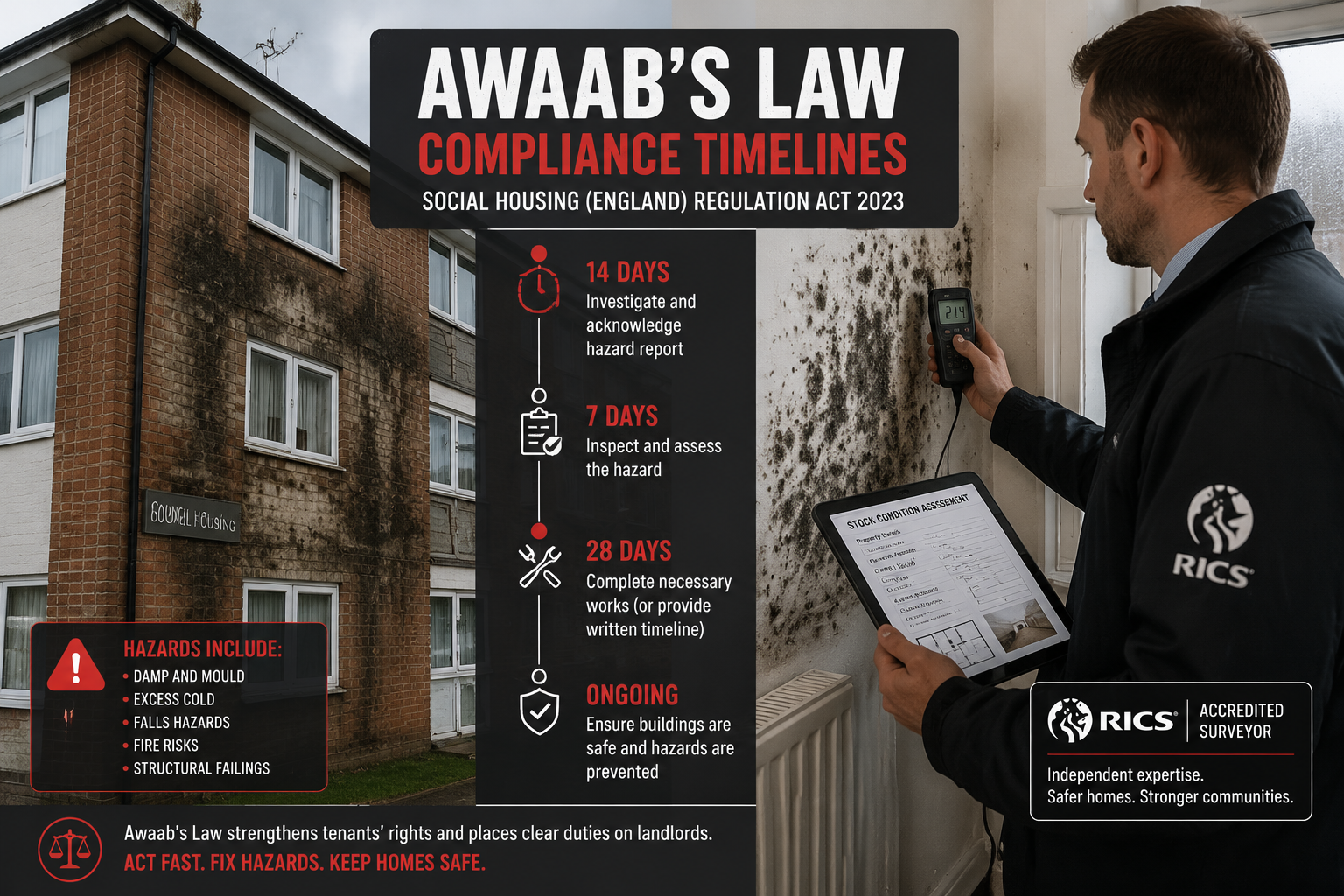
The timelines introduced under Awaab's Law are precise and non-negotiable:
| Hazard Type | Investigation Deadline | Repair Deadline |
|---|---|---|
| Emergency hazards (risk to life) | 24 hours | 24 hours |
| Damp and mould (serious) | 14 days | 7 weeks |
| Other hazards (non-emergency) | To be confirmed by secondary legislation | Expected 2026 rollout |
"The 14-day investigation window is not a target — it is a legal ceiling. Landlords who cannot demonstrate a documented survey response within that window face enforcement action."
For housing providers managing thousands of units, this demands a systematic surveying infrastructure, not ad hoc responses. A reactive approach is no longer viable.
Who Is Covered
Awaab's Law applies to all registered providers of social housing in England. This includes:
- Local authority housing departments
- Housing associations (registered providers)
- Arms-length management organisations (ALMOs)
- Tenant management organisations (TMOs) where they hold management responsibilities
Private landlords are currently outside the scope of Awaab's Law, though parallel reforms under the Renters' Rights Act 2024 are tightening standards across the private rented sector.
Stock Condition Assessments: The Foundation of Compliance
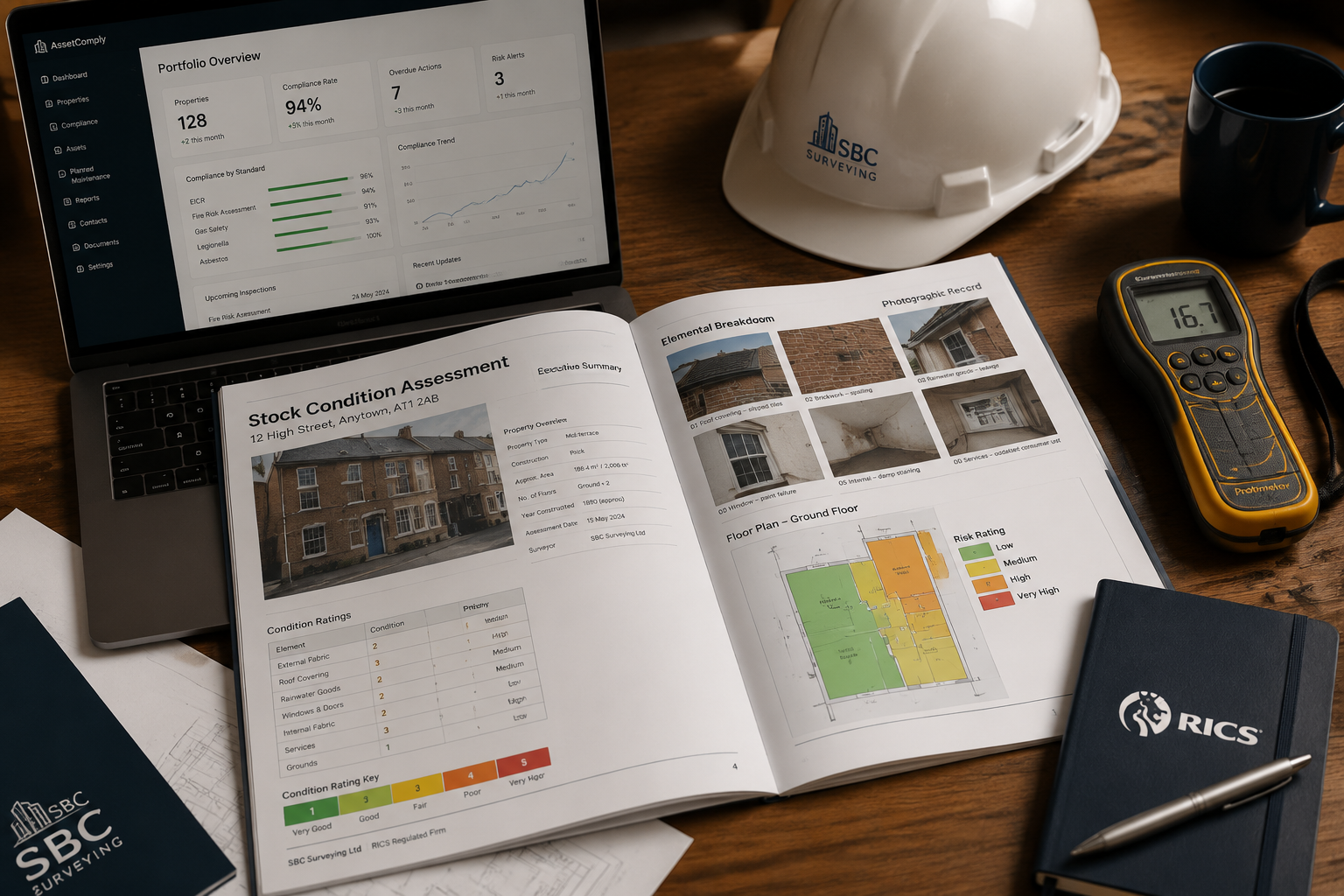
A stock condition assessment (SCA) is a systematic survey of a housing provider's entire property portfolio. It records the physical condition of each asset, identifies defects, estimates remaining component lifespans, and informs investment planning. In the context of building surveys for social housing compliance: Awaab's Law and stock condition assessments in 2026, the SCA has become the cornerstone document upon which legal defensibility rests.
What a Modern SCA Must Include
A compliant SCA in 2026 goes well beyond a visual inspection checklist. It must capture:
- Component condition ratings using a standardised scale (typically 1–5 or A–D)
- Hazard identification aligned with the Housing Health and Safety Rating System (HHSRS)
- Damp and mould pathology — not just presence, but root cause (rising damp, penetrating damp, interstitial condensation)
- Structural integrity indicators including roof condition, wall ties, foundations, and drainage
- Energy performance data to support EPC compliance and retrofit planning
- Photographic evidence with geo-tagged timestamps for audit trails
- Predicted component replacement timelines for 5, 10, and 30-year investment modelling
For a deeper understanding of what a thorough property inspection involves, the comprehensive condition survey reports guide provides useful context on survey methodology and reporting standards.
Pathology Surveys: Going Beyond the Surface
One of the most significant shifts in 2026 compliance practice is the emphasis on pathology surveying — identifying the underlying cause of a defect rather than simply recording its presence. This matters enormously for Awaab's Law compliance because:
- A landlord who treats mould with biocide wash without addressing the root cause (e.g., cold bridging or inadequate ventilation) will face repeat complaints and potential enforcement action.
- Regulatory inspections now scrutinise whether the investigation identified causation, not just symptoms.
- Repair records that cannot demonstrate root-cause analysis are unlikely to satisfy the Regulator of Social Housing's evidence requirements.
Pathology surveys for damp typically involve moisture meter readings at multiple heights, thermal imaging to detect cold bridges, assessment of ventilation provision, and review of construction type. For properties with persistent issues, a specialist damp survey provides the diagnostic depth that a standard visual inspection cannot.
Survey Frequency and Prioritisation
Most housing providers are now operating on a rolling five-year SCA cycle, with interim surveys triggered by tenant reports, post-works inspections, and annual void checks. The Regulator of Social Housing expects providers to demonstrate:
- A current, data-rich stock condition database updated at least every five years
- A risk-based prioritisation model that escalates high-hazard properties
- Evidence that survey findings feed directly into planned maintenance programmes
Properties built before 1980, those with non-traditional construction types (e.g., prefabricated concrete, timber-framed), and those with known damp histories should be prioritised for early inspection cycles.
Integrating Retrofit Programmes with Compliance Surveying
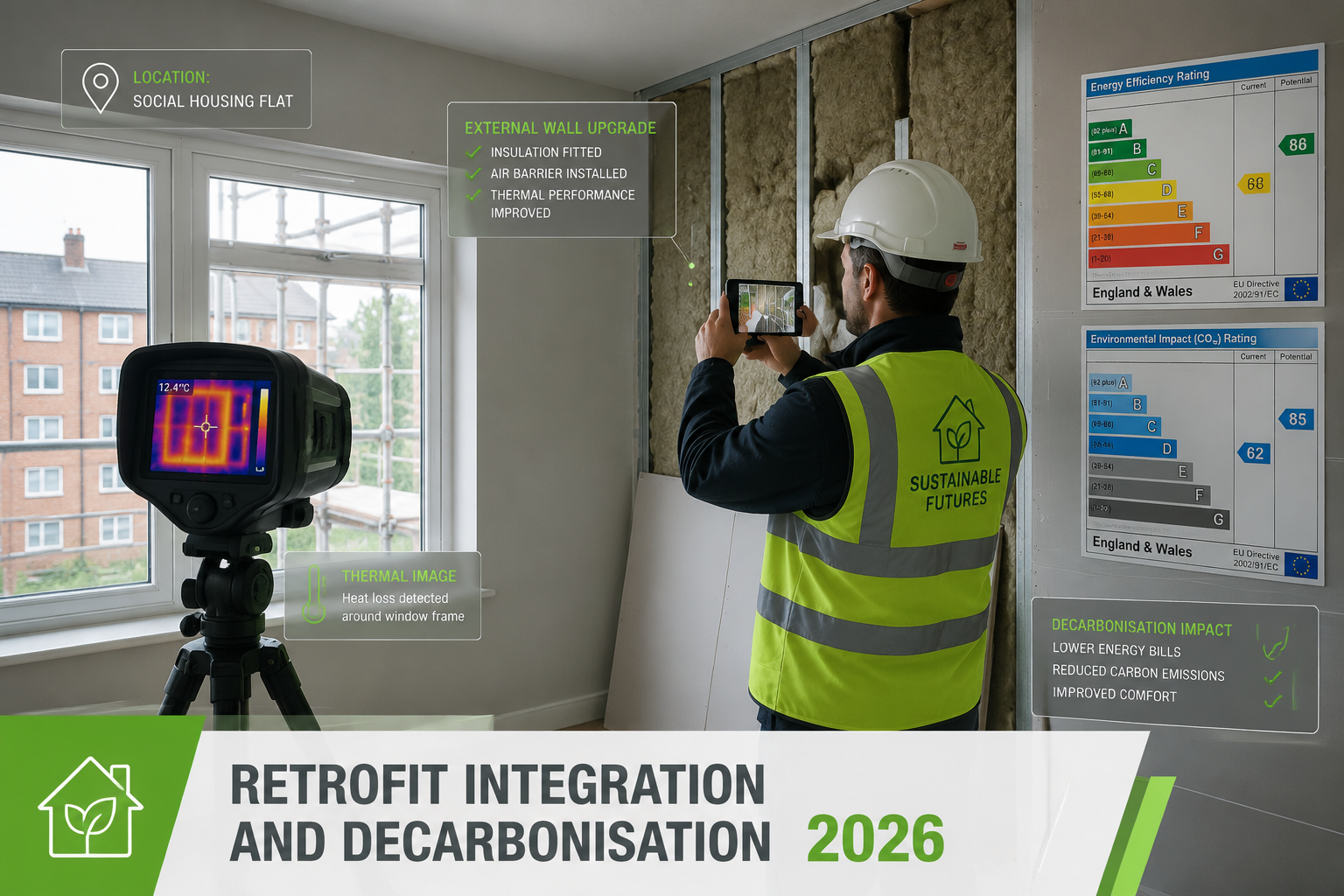
One of the practical challenges facing housing providers in 2026 is the overlap between compliance surveying and decarbonisation retrofit programmes. The government's target of bringing all social housing to EPC Band C by 2030 means that providers are simultaneously managing:
- Awaab's Law compliance inspections
- HHSRS hazard remediation
- Energy efficiency upgrades (insulation, heat pumps, glazing)
- Structural surveys for retrofit feasibility
Running these as separate workstreams is expensive and inefficient. The most forward-thinking providers are commissioning integrated surveys that capture compliance, structural, and energy data in a single site visit.
Why Integration Matters
Consider a pre-1970s solid-wall terrace block. A compliance survey might identify damp penetration through the external wall. A retrofit survey might recommend external wall insulation (EWI) as the energy upgrade. If these are conducted separately, the landlord risks:
- Installing EWI over an unresolved damp source, trapping moisture and worsening conditions
- Paying for two site visits, two reports, and two sets of contractor mobilisation costs
- Creating conflicting recommendations that confuse the maintenance programme
An integrated approach — using a Level 3 building survey methodology adapted for social housing stock — captures all relevant data in one visit, producing a single report that informs both compliance and retrofit decision-making.
Drone and Thermal Imaging Technology
Technology is accelerating the efficiency of stock condition assessments. Drone surveys are now widely used for roof inspections, tall building facades, and large estate overviews, reducing the need for scaffolding and significantly cutting inspection costs. Thermal imaging cameras — either drone-mounted or handheld — identify heat loss, cold bridges, and moisture ingress that are invisible to the naked eye.
These technologies are particularly valuable for:
- High-rise blocks where access is costly
- Large estates requiring rapid triage to identify highest-risk properties
- Post-retrofit verification to confirm insulation continuity
Structural Surveys in the Compliance Context
For properties with more serious defects — subsidence, structural cracking, failing lintels, or deteriorating rooflines — a standalone structural survey may be required alongside the SCA. Structural issues can create HHSRS Category 1 hazards (the most serious classification), which trigger the shortest Awaab's Law response windows.
Providers should ensure that their surveying contracts include clear escalation protocols: if a stock condition assessor identifies a potential structural hazard, there must be a defined pathway to commission a structural engineer's report within the compliance timeline.
Reporting, Record-Keeping, and Regulatory Scrutiny
The Regulator of Social Housing's consumer standards, which came into full effect in April 2024, require registered providers to maintain accurate, accessible data about their stock. In 2026, this means:
- Digital asset management systems that link survey data to individual property records
- Audit trails showing when surveys were conducted, by whom, and what actions were taken
- Tenant communication records demonstrating that residents were informed of findings and timescales
- Completion evidence for all remediation works, including post-works inspection sign-off
Providers that cannot produce this documentation during a regulatory inspection face improvement notices and, in serious cases, special measures. The Regulator has already used its enhanced powers to intervene in several large housing associations since 2024.
Specific Defect Reports and Legal Defensibility
Where a tenant raises a formal complaint about a hazard, a specific defect report from a chartered surveyor provides an independent, professionally prepared assessment that can withstand legal scrutiny. This is particularly important where:
- A tenant has instructed their own surveyor and the findings differ from the landlord's assessment
- The case is being considered by the Housing Ombudsman
- Litigation is a possibility
A specific defect report documents the nature of the defect, its probable cause, the recommended remediation, and the urgency of action. It carries professional indemnity insurance backing and RICS regulatory oversight — both of which matter in a legal or regulatory context.
Practical Steps for Housing Providers in 2026
Building surveys for social housing compliance: Awaab's Law and stock condition assessments in 2026 demand a structured, proactive approach. The following framework reflects current best practice:
Step 1: Audit Your Current Data
Before commissioning new surveys, assess the quality and currency of existing stock condition data. Identify:
- Properties where the last SCA is more than five years old
- Properties with open damp or mould complaints
- Non-traditional construction types with known vulnerabilities
- Properties flagged in the last regulatory inspection
Step 2: Commission a Risk-Stratified Survey Programme
Use existing data to stratify your stock by risk. High-risk properties (older stock, complaint history, non-traditional construction) should be surveyed first. Commission surveys that capture HHSRS, damp pathology, structural condition, and EPC data simultaneously.
For commercial or mixed-use social housing assets, a commercial building survey may be more appropriate than a residential-format SCA.
Step 3: Establish Repair Escalation Protocols
Define clear internal workflows that translate survey findings into repair instructions within Awaab's Law timelines. Every HHSRS Category 1 hazard identified in a survey must trigger an immediate response chain.
Step 4: Integrate with Retrofit Planning
Share survey data with your energy and sustainability team. Identify properties where compliance remediation and retrofit works can be combined to reduce cost and disruption.
Step 5: Maintain and Update Records Continuously
Survey data degrades. A property surveyed in 2022 may have deteriorated significantly by 2026. Implement a rolling programme of interim inspections, void checks, and post-works sign-offs to keep your asset database current.
Conclusion
The legislative landscape for social housing in England has shifted decisively. Awaab's Law has transformed building surveys from periodic asset management tools into live compliance instruments with legal deadlines attached. Housing providers that treat stock condition assessments as a bureaucratic requirement rather than a genuine risk management discipline will find themselves exposed — to regulatory enforcement, Housing Ombudsman determinations, and the reputational damage of tenant harm.
The practical path forward is clear: commission thorough, pathology-led surveys that identify root causes rather than surface symptoms; integrate compliance and retrofit data collection to reduce cost; invest in digital record-keeping that can withstand regulatory scrutiny; and engage qualified chartered surveyors who understand both the technical requirements of social housing stock and the legal framework within which providers must now operate.
For housing providers seeking to build a defensible, proactive compliance programme, the starting point is a rigorous, up-to-date stock condition assessment — conducted by professionals who understand what is at stake.
References
- Ministry of Housing, Communities and Local Government. (2023). Social Housing (Regulation) Act 2023. London: HMSO.
- Regulator of Social Housing. (2024). Consumer Standards: Guidance for Registered Providers. London: RSH.
- Housing Ombudsman Service. (2021). Spotlight on: Damp and Mould — It's Not Lifestyle. London: Housing Ombudsman.
- Royal Institution of Chartered Surveyors. (2021). RICS Home Survey Standard. London: RICS.
- Department for Levelling Up, Housing and Communities. (2023). Awaab's Law: Consultation on Timescales for Hazard Remediation in Social Housing. London: DLUHC.
- Shelter. (2022). A Lethal Lottery: The State of Social Housing in England. London: Shelter.
How Prince Surveyors can help: explore our Level 3 building surveys or learn about our Level 2 vs Level 3 guide.