


Last updated: July 24, 2026
Quick Answer: Radon gas poses a measurable health and financial risk in UK granite regions, particularly Cornwall, Devon, parts of Wales, Derbyshire, and the Scottish Highlands. Building surveys for radon gas risks in UK granite regions require dedicated testing protocols beyond a standard visual inspection, and mitigation costs typically range from £500 to £2,500 depending on construction type and radon levels. Buyers, sellers, and landlords in affected areas should commission radon testing as part of any Level 3 building survey.
Key Takeaways
- Radon is a naturally occurring radioactive gas that seeps from granite and uranium-rich soils; the UK Health Security Agency (UKHSA) sets the action level at 200 Becquerels per cubic metre (Bq/m3) for homes.
- The highest-risk UK regions include Cornwall, Devon, Northamptonshire, Derbyshire, parts of Wales, and the Scottish Highlands.
- Standard building surveys do not automatically include radon testing; it must be specifically requested or recommended by the surveyor.
- Two main testing methods exist: short-term electret ion chamber tests (days to weeks) and long-term alpha-track detectors (three months minimum, preferred for accuracy).
- Radon mitigation typically costs £500 to £2,500 for a standard residential property; complex cases can exceed this.
- High radon levels do not prevent a property sale, but they must be disclosed and can affect valuation and mortgage conditions.
- Mitigation measures, when properly installed and certified, can actually protect or recover property value.
- Landlords have legal obligations to assess radon risk in properties within Radon Affected Areas.
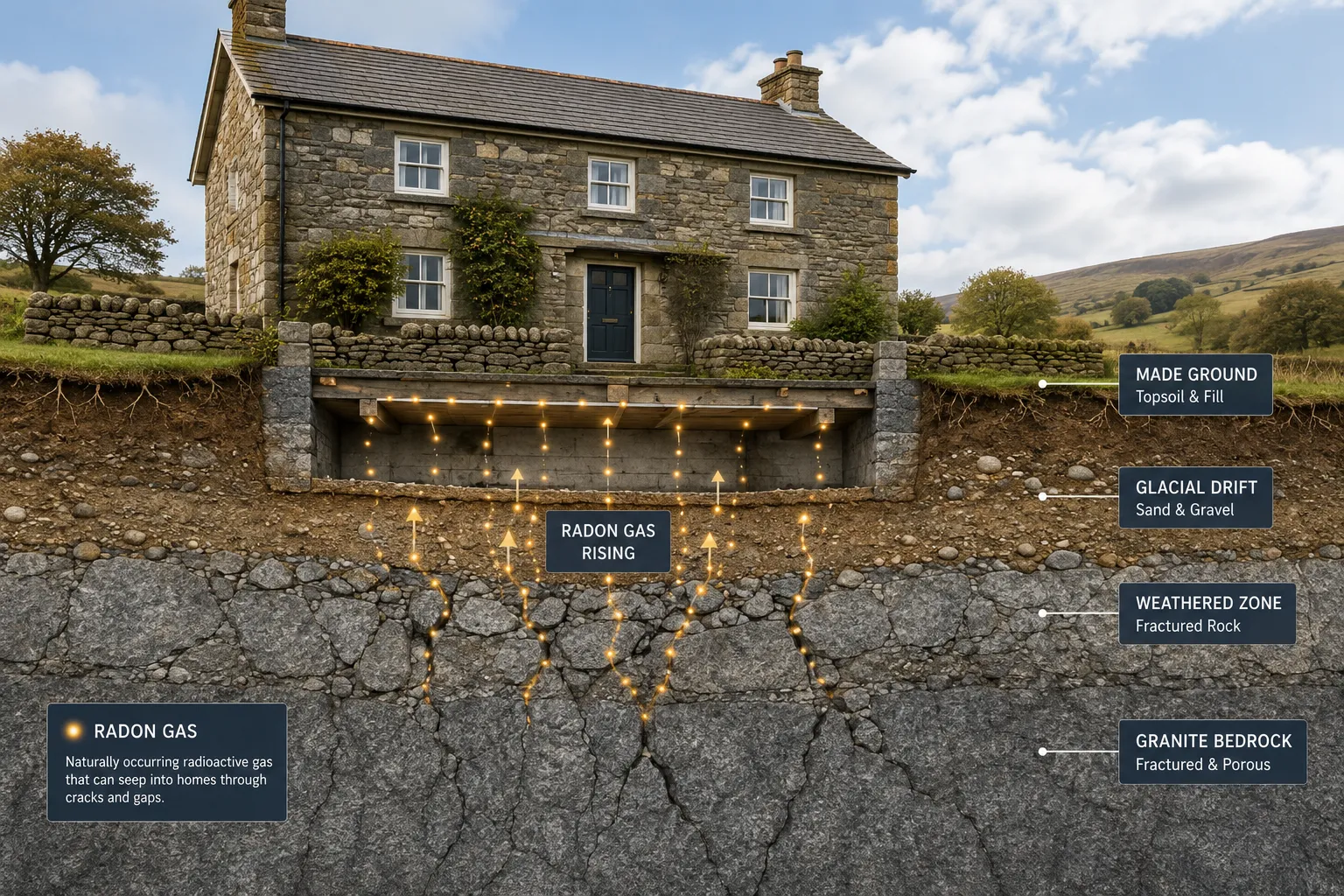
What Is Radon Gas and Why Is It a Problem in Granite Areas of the UK
Radon is a colourless, odourless radioactive gas produced by the natural decay of uranium and radium found in rocks and soil. In granite-rich geology, uranium concentrations are significantly higher than average, making radon accumulation in buildings a genuine public health concern.
When radon seeps into enclosed spaces, particularly ground floors, basements, and poorly ventilated areas, it can reach concentrations that increase the long-term risk of lung cancer. The UKHSA estimates that radon is the second leading cause of lung cancer in the UK after smoking, responsible for around 1,100 deaths per year nationally.
Why granite matters: Granite contains elevated levels of uranium compared with sedimentary rocks such as limestone or chalk. As uranium decays, it produces radium, which in turn produces radon gas. That gas migrates upward through fractures in rock and soil, entering buildings through foundations, floor joints, and service entry points.
Properties built directly on granite bedrock, or on soils derived from granite, face the highest exposure risk. This is why building surveys for radon gas risks in UK granite regions require a different level of scrutiny than surveys in low-risk geological areas.
Which UK Regions Have the Highest Radon Risk
The highest-risk areas in the UK are those underlain by granite or uranium-rich geology. According to UKHSA radon mapping data, the following regions carry the greatest concentration of properties above the action level:
- Cornwall and the Isles of Scilly, the highest-risk county in England, with large portions of the county classified as Radon Affected Areas
- Devon, particularly Dartmoor and surrounding granite uplands
- Northamptonshire, ironstone and granite-derived soils elevate risk
- Derbyshire, Peak District limestone and gritstone areas
- Somerset, Mendip Hills
- Parts of Wales, especially Gwynedd and Powys
- Scottish Highlands and Grampian, significant granite intrusions across Aberdeenshire and Inverness-shire
The UKHSA publishes a free postcode-level radon risk checker, which gives a percentage probability that a property exceeds the action level. Any result above 1% is considered a Radon Affected Area and warrants further testing.
"A property in central Cornwall may have a 10-30% probability of exceeding the action level, a risk no buyer or landlord should ignore without testing."
How Do Surveyors Measure Radon Risk in Building Surveys
In the context of building surveys for radon gas risks in UK granite regions, surveyors assess radon risk through a combination of desk-based research and physical testing. A chartered surveyor undertaking a Level 3 full building survey should, at minimum, check the UKHSA radon risk map for the property's postcode and flag any elevated probability in the survey report.
What a surveyor does:
- Checks the UKHSA radon affected area classification for the postcode.
- Inspects the construction type, suspended timber floors, solid concrete slabs, and cellars each carry different radon entry risks.
- Identifies existing ventilation, sub-floor voids, and any visible radon sumps or membranes.
- Recommends specialist radon testing if the postcode risk is above 1%, or if construction features suggest elevated risk.
- Advises on mitigation options and estimated costs within the survey report.
A surveyor cannot measure radon gas directly during a single-day inspection. Radon levels fluctuate with weather, season, and ventilation patterns. This is why dedicated testing devices are deployed over a set period. For more on what a building survey covers, see our guide to areas of further investigation in a Level 3 survey.
What Is the Difference Between Radon Testing Methods
Two primary methods are used for radon testing in UK residential properties. Choosing the right one depends on the purpose of the test and the time available.
| Method | Duration | Accuracy | Best Used For |
|---|---|---|---|
| Alpha-track detector | 3-12 months | High | Pre-purchase, landlord compliance |
| Electret ion chamber | 2-7 days | Moderate | Initial screening, quick sale timelines |
| Continuous electronic monitor | Real-time | Variable | Post-mitigation verification |
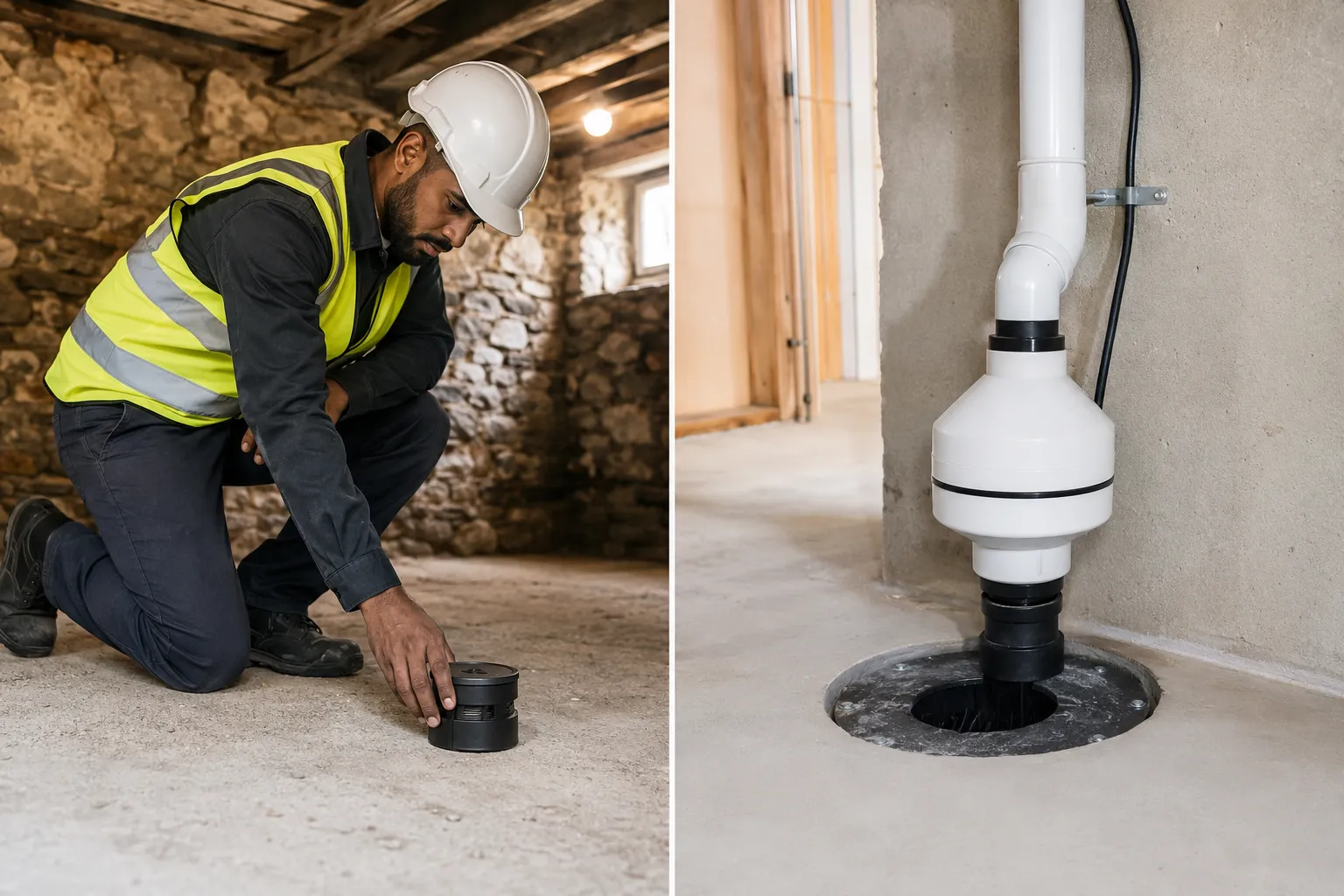
Alpha-track detectors are small passive devices placed in living areas and bedrooms. They record cumulative radon exposure over months, giving a seasonal average that reflects true long-term conditions. UKHSA recommends these for definitive measurement.
Short-term electret tests use an electrically charged disc that loses charge in proportion to radon exposure. Results are available within days, making them useful when a property transaction is time-sensitive. However, short-term results carry greater uncertainty and should be treated as indicative rather than conclusive.
Common mistake: Buyers sometimes request a short-term test during summer months, when radon levels are naturally lower due to ventilation and soil conditions. A summer short-term test can significantly underestimate annual average exposure. If time allows, always opt for the long-term alpha-track method.
How Long Does Radon Testing Take During a Building Survey
A radon test itself takes between three months and twelve months for a reliable long-term result, or two to seven days for a short-term screening test. The building survey inspection visit typically takes one day, but radon testing runs concurrently and separately.
For property transactions, this creates a practical challenge. If a buyer commissions a Level 3 building survey and the surveyor flags radon risk, the buyer has two options:
- Proceed with a short-term test (results in days) and factor uncertainty into negotiations.
- Request a long-term test (3+ months) and negotiate a conditional contract or price reduction pending results.
For landlords and existing homeowners, there is no time pressure, and the long-term test is always the better choice. See our overview of building survey timeframes for context on how specialist investigations fit into the overall survey process.
What Is the Cost of Radon Testing and Mitigation in the UK
Radon testing costs are relatively modest; mitigation costs vary based on construction type and severity of the problem.
Testing costs (2026 estimates):
- Long-term alpha-track detector kit: £30,£80 (including laboratory analysis)
- Professional radon survey with specialist contractor: £150,£400
- Short-term electret test: £100,£250
Mitigation costs:
- Basic positive pressure ventilation unit (PIV): £300,£600 installed
- Radon sump system (most common and effective): £800,£1,500 for a standard installation
- Complex cases (multiple entry points, suspended floors, cellar): £1,500,£2,500+
- Radon-resistant membrane installation (new build or major renovation): £500,£1,200
These figures are estimates based on industry benchmarks and contractor pricing common in 2026. Actual costs depend on property size, construction, and regional contractor rates. For broader context on budgeting for survey-identified works, the budgeting repairs and restoration guide provides a useful framework.
Can You Sell a House with High Radon Levels
Yes, a property with elevated radon levels can be sold. There is no legal prohibition on selling a property that exceeds the UKHSA action level. However, sellers have a legal obligation to disclose known material facts, and high radon readings are considered a material fact under UK property law.
Practical implications for sellers:
- Disclose test results to buyers and their solicitors.
- Consider commissioning mitigation works before marketing to protect the asking price.
- Alternatively, reflect the cost of mitigation in the asking price or accept a negotiated reduction.
- Ensure any existing mitigation system is serviced and certified.
For buyers: If a survey or seller disclosure reveals high radon levels, use the mitigation cost estimate as a negotiating tool. A properly installed sump system costing £1,000,£1,500 is a reasonable basis for a price reduction request. For guidance on how survey findings affect valuation, see our article on what to do if your home valuation is less than an offer.
What Happens If Radon Levels Are Found to Be High
If testing confirms radon levels above 200 Bq/m3 (the UKHSA action level), the property owner should commission mitigation works. Levels between 100 and 200 Bq/m3 fall within the "target level" range where action is strongly recommended, particularly for vulnerable occupants.
Step-by-step response to a high radon result:
- Obtain a second long-term test to confirm the reading if the initial test was short-term.
- Consult a UKHSA-registered radon remediation contractor.
- Select the appropriate mitigation method (sump, ventilation, membrane).
- Install and verify with a post-mitigation test (typically 3 months after installation).
- Document all works and retain certificates for future sale or tenancy purposes.
Landlords in Radon Affected Areas should be aware that the Health and Safety at Work Act 1974 and the Management of Health and Safety at Work Regulations 1999 place a duty of care on employers and, by extension, landlords of workplaces. Residential landlord obligations are evolving, and UKHSA guidance increasingly expects landlords to assess and address radon risk in their properties. For related statutory considerations, see our overview of statutory considerations in building surveys.
How Does Radon Mitigation Affect Property Value
Properly installed and certified radon mitigation systems generally protect, and in some cases recover, property value. An unmitigated high-radon property in a known risk area will face price reductions, buyer hesitation, and potential mortgage complications. A mitigated property, by contrast, demonstrates responsible ownership and removes a key buyer objection.
Valuation considerations:
- An unmitigated property with confirmed levels above 200 Bq/m3 may see a negotiated reduction of £1,000,£5,000 or more, depending on the market and severity.
- A property with a certified, functioning sump system and post-mitigation test confirming levels below 100 Bq/m3 should not suffer a material valuation discount.
- Some mortgage lenders and insurers will flag high radon results and may require mitigation before completing a loan offer.
The key principle: mitigation cost is finite and predictable. Leaving the issue unresolved creates open-ended uncertainty that buyers and lenders price in at a premium above the actual cost of the fix.
Do I Need Radon Testing If I Am Not in a Granite Area
Radon testing is most critical in granite and uranium-rich geological areas, but it is not exclusively a granite problem. Limestone, certain sandstones, and shales can also produce elevated radon in localised areas. The UKHSA radon map covers all geology, not just granite.
Choose radon testing if:
- The UKHSA postcode checker shows a risk above 1%.
- The property has a basement, cellar, or solid concrete ground floor with limited ventilation.
- The property is in a known Radon Affected Area, regardless of the specific rock type.
- The property has been extended or had groundworks that may have disturbed existing radon protection.
Testing may not be necessary if:
- The UKHSA map shows a risk below 1% and the property is a modern, well-ventilated upper-floor flat.
- The property has no ground-floor contact and sits above a ventilated void.
Even outside granite regions, a thorough building regulation compliance check as part of a full survey will flag whether radon-resistant construction was required and implemented under the Building Regulations applicable at the time of construction.
Is Radon Testing Mandatory for UK Property Surveys
Radon testing is not legally mandatory for standard residential property surveys in the UK. However, the RICS (Royal Institution of Chartered Surveyors) guidance and best practice standards expect chartered surveyors to identify and flag radon risk where the property is in a known affected area.
For landlords, the situation is more nuanced. While there is no single piece of legislation that mandates residential radon testing across the board, the Homes (Fitness for Human Habitation) Act 2018 requires landlords to ensure properties are free from hazards that affect health, and radon above the action level qualifies as such a hazard.
Bottom line: Testing is not legally compelled for buyers, but it is strongly advised by UKHSA, RICS, and public health bodies for any property in a Radon Affected Area. Failing to test and act on known risks carries both health and legal consequences. For a broader view of how surveys identify risks, see our guide to urgent or dangerous building issues.
Common Mistakes People Make with Radon Testing
Avoiding these errors will save time, money, and potential health risk:
- Testing only in summer: Radon levels are typically lower in warmer months. A summer-only short-term test can underestimate annual average exposure by a significant margin.
- Placing detectors incorrectly: Detectors should be in frequently occupied rooms at breathing height (0.5-1.5m from the floor), not in cupboards, lofts, or kitchens.
- Assuming a new build is safe: Properties built before 2000 may lack radon-resistant membranes even in high-risk areas. Even post-2000 builds should be checked if membranes were not specified.
- Not retesting after mitigation: A post-mitigation test three months after installation is essential to confirm the system is working.
- Ignoring the issue during conveyancing: Buyers who skip radon checks in granite areas and later discover high levels have limited legal recourse if the risk was publicly available on the UKHSA map.
Frequently Asked Questions
What is the UK action level for radon in homes?
The UKHSA action level is 200 Becquerels per cubic metre (Bq/m3) averaged over a year. Properties above this level should take remediation action. The target level, where action is recommended, is 100 Bq/m3.
How do I find out if my property is in a radon affected area?
Use the free UKHSA radon postcode checker at ukhsa.gov.uk. It provides a percentage probability that your property exceeds the action level based on geological mapping data.
Does a standard homebuyer survey include radon testing?
No. A Level 2 homebuyer survey or Level 3 building survey will flag radon risk based on the postcode, but the surveyor will not deploy testing equipment. Dedicated radon testing requires separate specialist detectors left in place for weeks or months.
Can radon mitigation be DIY?
Basic ventilation improvements can be self-managed, but radon sump installation should be carried out by a UKHSA-registered contractor to ensure effectiveness and to obtain the certification needed for future property transactions.
How quickly does a radon sump system work?
A radon sump system typically reduces radon levels by 50-99% within days of installation. However, a three-month post-mitigation test is required to confirm the annual average has fallen below the action level.
Does radon affect buildings insurance or mortgage offers?
High radon levels can influence mortgage lender decisions, particularly for buy-to-let properties. Some lenders require confirmation of mitigation before releasing funds. Buildings insurance is not typically affected by radon, but landlord liability policies may be relevant if tenants are exposed to levels above the action level without remediation.
What is the difference between a radon sump and a positive pressure ventilation system?
A radon sump draws gas from beneath the floor slab and vents it outside using a fan, directly targeting the source. A positive pressure ventilation (PIV) unit pressurises the living space to reduce radon ingress. Sumps are generally more effective for properties with high radon concentrations; PIV units are better suited to moderate-risk properties or as a supplementary measure.
Conclusion
Building surveys for radon gas risks in UK granite regions are not optional extras for cautious buyers, they are a sound, evidence-based step for anyone purchasing, renting, or managing property in Cornwall, Devon, Derbyshire, parts of Wales, and the Scottish Highlands. The cost of testing is low, the cost of mitigation is predictable, and the cost of inaction, in health terms and in future sale complications, is far higher.
Actionable next steps:
- Check your property's postcode on the UKHSA radon risk map before commissioning any survey.
- If the risk is above 1%, instruct a chartered surveyor to include radon risk assessment within a full Level 3 building survey.
- Commission a long-term alpha-track test (three months minimum) for the most accurate result.
- If levels exceed 200 Bq/m3, engage a UKHSA-registered contractor for sump installation.
- Retest three months after mitigation and retain all certificates for your property file.
- Disclose known radon history and mitigation works to future buyers or tenants.
Radon is a manageable risk. The key is knowing whether it applies to your property and acting on that knowledge with the right professional support.
Radon Risk and Mitigation Cost Estimator
.rre-wrap{font-family:Arial,sans-serif;max-width:520px;margin:24px auto;background:#f4f6f8;border-radius:8px;padding:20px;border:1px solid #d0d7de}
.rre-wrap h3{margin:0 0 14px;font-size:1.05rem;color:#1a2e44}
.rre-row{margin-bottom:12px}
.rre-row label{display:block;font-size:0.88rem;color:#333;margin-bottom:4px;font-weight:600}
.rre-row select,.rre-row input{width:100%;padding:7px 10px;border:1px solid #b0b8c1;border-radius:5px;font-size:0.9rem;box-sizing:border-box}
.rre-btn{background:#1a2e44;color:#fff;border:none;padding:10px 22px;border-radius:5px;cursor:pointer;font-size:0.92rem;width:100%;margin-top:6px}
.rre-btn:hover{background:#2c4a6e}
.rre-result{margin-top:14px;padding:12px;border-radius:6px;font-size:0.9rem;display:none}
.rre-low{background:#e6f4ea;border:1px solid #a8d5b5;color:#1e5631}
.rre-med{background:#fff8e1;border:1px solid #f5c842;color:#7a5200}
.rre-high{background:#fdecea;border:1px solid #f5a5a0;color:#7a1a1a}
Radon Risk & Mitigation Cost Estimator
function rreCalc(){
var region=document.getElementById(‘rre-region’).value;
var floor=document.getElementById(‘rre-floor’).value;
var lvl=parseInt(document.getElementById(‘rre-level’).value)||0;
var risk=’low’,msg=”,cls=’rre-low’;
if(lvl>=200||(region===’high’&&floor===’solid’)||(region===’high’&&lvl>=100)){risk=’high’;}
else if(lvl>=100||(region===’high’)||(region===’med’&&floor===’solid’)){risk=’med’;}
if(floor===’upper’&&lvl<100){risk='low';}
if(risk==='high'){
cls='rre-high';
msg='High Risk. Radon testing strongly advised. Estimated mitigation cost: £800,£2,500 (sump system). Commission a long-term alpha-track test immediately and engage a UKHSA-registered contractor.’;
} else if(risk===’med’){
cls=’rre-med’;
msg=’Moderate Risk. Testing recommended. Estimated mitigation cost if needed: £500,£1,200 (ventilation or sump). Request radon assessment as part of your Level 3 building survey.’;
} else {
cls=’rre-low’;
msg=’Lower Risk. Standard building survey likely sufficient. If untested, consider a basic alpha-track detector kit (£30,£80) for peace of mind. Recheck if you add a basement or do groundworks.’;
}
var el=document.getElementById(‘rre-result’);
el.className=’rre-result ‘+cls;
el.innerHTML=msg;
el.style.display=’block’;
}
Tags: radon gas, building surveys, UK granite regions, radon testing, radon mitigation, chartered surveyor, Level 3 building survey, radon affected areas, property valuation, radon sump, UKHSA radon, Cornwall radon risk