

Approximately 19 million homes in England and Wales currently sit below an EPC rating of C — and under the government's tightening energy efficiency framework, that figure represents an enormous compliance liability for landlords, sellers, and buyers alike. The pressure to retrofit is no longer theoretical. With minimum EPC standards reshaping transaction decisions in 2026, building surveys for EPC retrofit mandates: Level 3 protocols ahead of 2026 minimum standards have become one of the most strategically important tools in the property professional's toolkit.
A Level 3 building survey is no longer simply about identifying damp or cracked lintels. It now sits at the intersection of structural assessment, energy performance analysis, and retrofit feasibility — a convergence that demands both updated technical competence and a thorough understanding of evolving regulation.
Key Takeaways
- EPC C minimum standards are driving demand for comprehensive Level 3 building surveys that assess retrofit feasibility alongside structural condition.
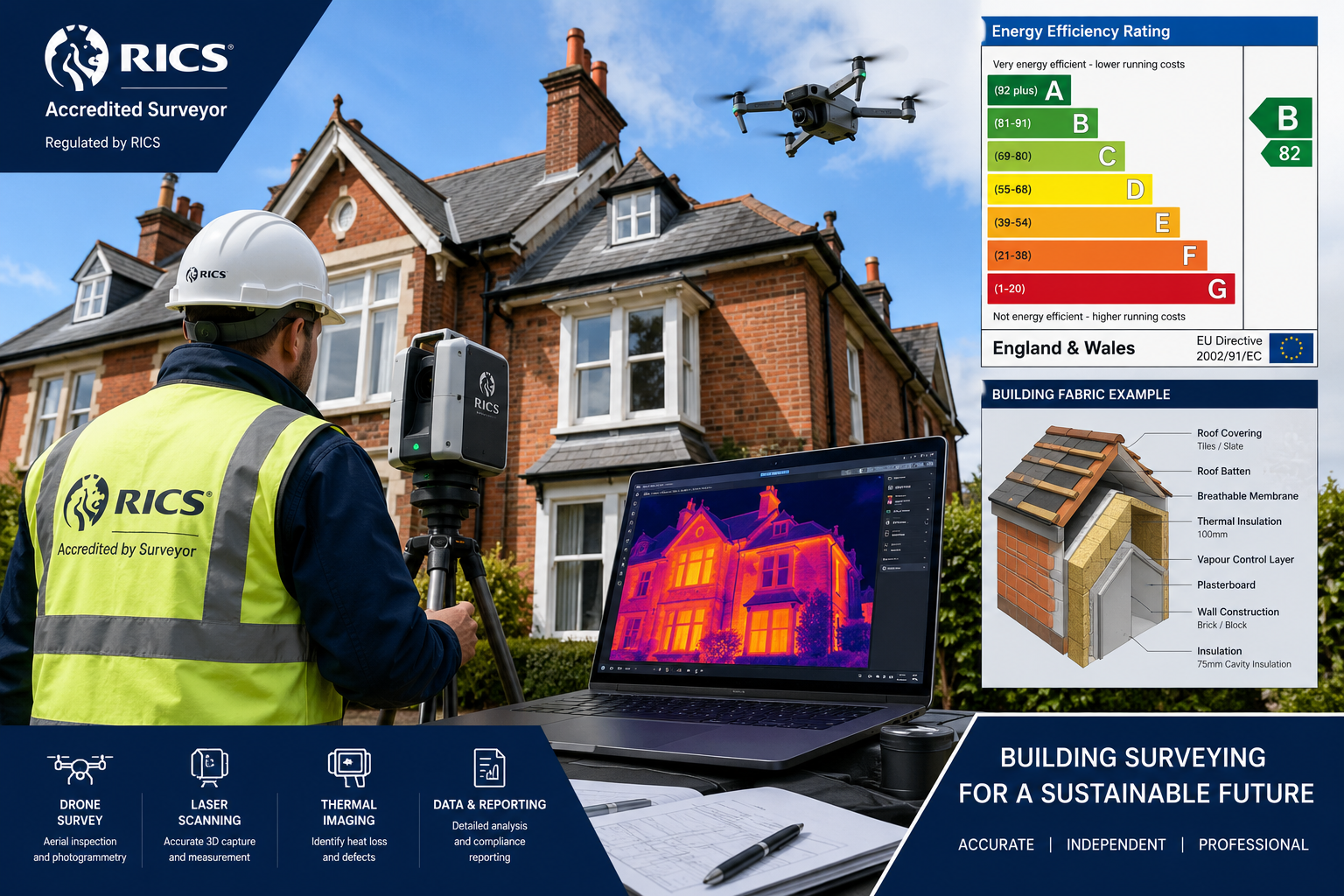
- RICS updated its Home Survey Standard in February 2026 to incorporate drones, laser scanning, thermal imaging, and blower door testing into Level 3 protocols.
- The Home Energy Model (HEM), due in October 2026, will replace SAP calculations and requires surveyors to develop new assessment competencies.
- Whole Life Carbon assessments and fire safety evaluations are now embedded within Level 3 survey obligations under updated RICS guidance.
- Standardised reporting templates and mandatory CPD in retrofit competence are reshaping professional practice across the sector.
Why EPC Retrofit Mandates Are Reshaping Survey Demand in 2026
The UK government's trajectory toward mandatory EPC C ratings for rental properties and the broader push for net-zero-ready housing stock has created a structural shift in what buyers, lenders, and landlords need from a survey. Properties that fail to meet minimum energy efficiency thresholds now carry tangible financial risk: reduced mortgage options, diminished resale value, and potential legal exposure for landlords.
This has made the pre-purchase building survey a critical decision-support tool. Buyers commissioning a Level 3 building survey are now asking surveyors not only "what is wrong with this building?" but also "what will it cost to bring this building up to EPC C, and are there hidden defects that would make retrofit impractical or prohibitively expensive?"
The Retrofit Feasibility Dimension
Retrofit feasibility is a concept that has moved from specialist consultancy into mainstream survey practice. A Level 3 survey conducted in 2026 should now address:
- Current EPC rating and projected post-retrofit rating based on visible fabric condition
- Barriers to insulation installation such as solid walls, narrow cavities, or moisture ingress
- Roof condition as it relates to the viability of loft insulation or solar PV installation
- Heating system age and compatibility with heat pump or hybrid systems
- Structural elements that could complicate or increase the cost of retrofit works
For buyers considering older or non-standard properties, this integrated approach can be the difference between a sound investment and an expensive liability. The comprehensive guide to Level 3 building surveys explains how these surveys differ from lower-level assessments and why they are particularly suited to properties with complex energy profiles.
Updated Level 3 Protocols: What Has Changed in 2026
RICS updated its Home Survey Standard in February 2026, and the changes are substantive. The updated protocols for building surveys for EPC retrofit mandates: Level 3 protocols ahead of 2026 minimum standards reflect both technological advancement and a broadened regulatory landscape. [2]
Advanced Technology Integration
Drones and laser scanning have been formally incorporated into Level 3 survey methodology. These tools allow surveyors to inspect rooftops, upper facades, and other inaccessible areas with a precision that visual inspection from ground level cannot match. [1] This is particularly relevant for retrofit assessments, where roof condition directly affects the viability of insulation upgrades and solar installations.
Thermal imaging cameras and blower door testing have also become standard diagnostic tools within Level 3 protocols. Thermal imaging identifies heat loss pathways, cold bridges, and moisture ingress that would be invisible to the naked eye. Blower door tests measure airtightness — a critical metric for properties being assessed for fabric-first retrofit approaches. [7]
"A Level 3 survey conducted without thermal imaging in 2026 is, in practical terms, an incomplete assessment of a property's retrofit readiness."
Whole Life Carbon Assessments
Under updated RICS guidance aligned with PAS 2080, surveyors are now expected to integrate Whole Life Carbon (WLC) assessments into their evaluations. This means analysing the carbon impact of proposed building materials and construction methods — not just the operational energy savings from retrofit. [5]
For clients weighing retrofit options, this matters. A wall insulation solution that performs well on energy savings but carries a high embodied carbon cost may not align with a buyer's sustainability goals or future regulatory requirements. WLC analysis gives clients a more complete picture of the long-term implications of their retrofit choices.
Fire Safety and Steel-Framed Buildings
RICS has expanded Level 3 survey obligations to include thorough assessments of post-2000 steel-framed properties. Surveyors must now inspect for corrosion risks and fire safety deficiencies, including the adequacy of firestopping measures. [4] This reflects the post-Grenfell regulatory environment and the extension of building safety obligations across a wider range of property types.
For properties undergoing retrofit, fire safety is particularly relevant. Adding insulation to walls, ceilings, or service voids without proper firestopping can create or exacerbate fire spread risks. A Level 3 survey that identifies these issues before works begin can prevent costly remediation after the fact.
Awaab's Law Extensions
The 2026 extensions of Awaab's Law have added further obligations to high-risk property assessments. Surveyors are now required to include detailed evaluations of structural collapse risks, damp penetration pathways, and fall hazards within Level 3 reports for applicable properties. [8] For properties with significant damp issues — which are also often the properties most in need of retrofit — this creates an important overlap between legal compliance and energy upgrade planning.
Damp surveys are a natural complement to Level 3 assessments in this context. Identifying the source and extent of moisture ingress is essential before any insulation or airtightness measures are installed, as trapping moisture within the building fabric can cause serious long-term damage.
The Home Energy Model and What It Means for Surveyors
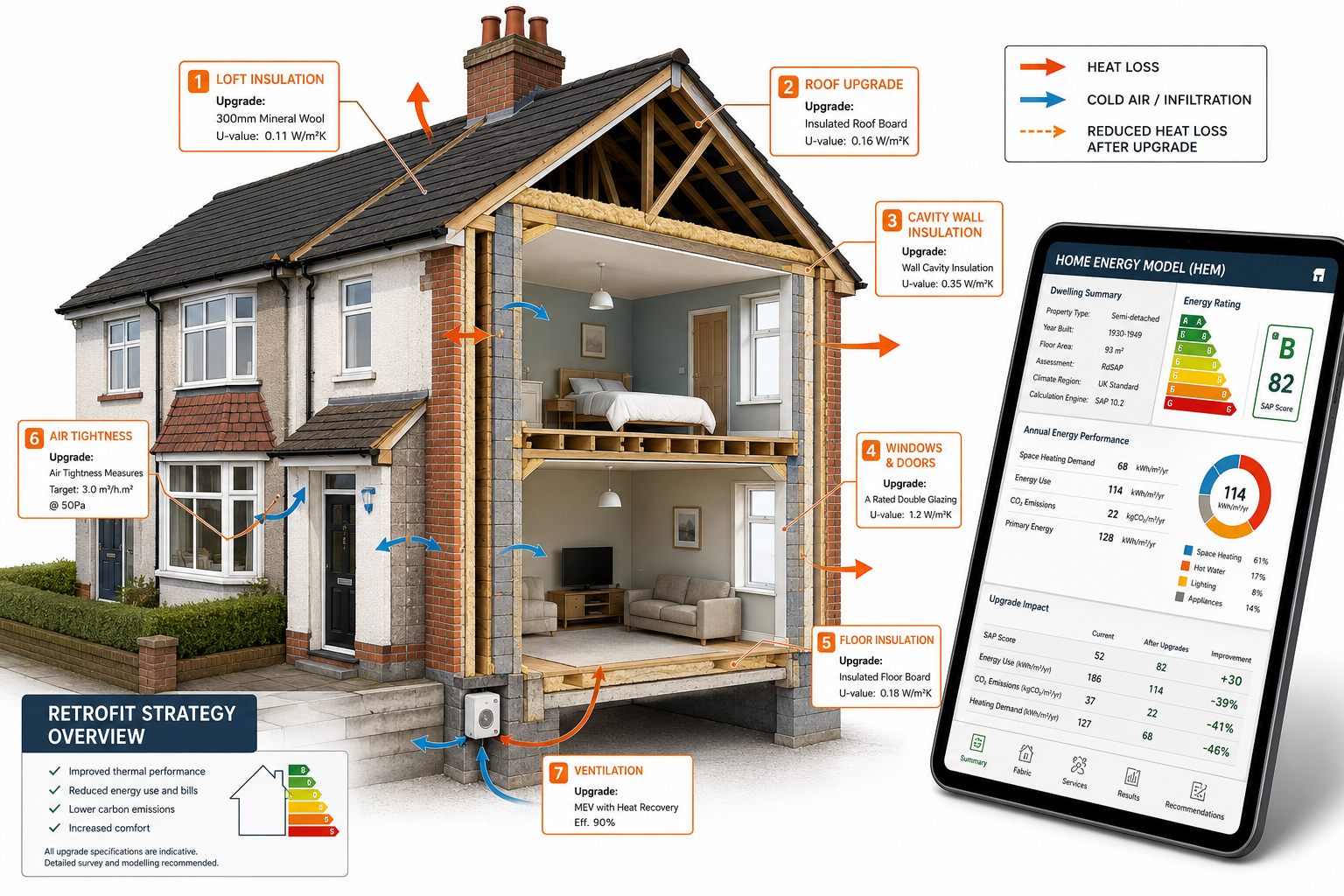
The Home Energy Model (HEM) is scheduled for introduction in October 2026, replacing the Standard Assessment Procedure (SAP) as the primary methodology for calculating energy performance in new and existing homes. [3] This is a significant shift for surveyors involved in EPC-related assessments.
Key Differences Between SAP and HEM
| Feature | SAP | HEM |
|---|---|---|
| Calculation basis | Simplified monthly energy balance | Hourly dynamic simulation |
| Fabric assessment | Basic U-value inputs | Detailed thermal bridging and airtightness |
| Heating systems | Standard efficiency ratings | Modelled system performance |
| Occupancy assumptions | Fixed standard occupancy | Flexible, adjustable profiles |
| Retrofit modelling | Limited scenario analysis | Comprehensive upgrade pathway modelling |
The shift to HEM means that surveyors advising clients on retrofit compliance will need to understand a more complex and data-intensive methodology. Properties that currently meet EPC C under SAP may not do so under HEM — and vice versa. This uncertainty makes pre-purchase Level 3 surveys even more valuable as a risk management tool.
Surveyor Competency Requirements
Surveyors must familiarise themselves with HEM to provide accurate evaluations and assist clients in achieving compliance. [3] This has direct implications for CPD planning. The RICS Residential Retrofit Standard, which emphasises a systems-based approach to retrofit assessments, provides a framework for this competency development. [6]
Engagement with programmes such as the Retrofit Academy and alignment with PAS 2035 — the publicly available specification for domestic retrofit — are increasingly expected of surveyors operating in this space. Those who invest in this knowledge now will be better positioned to serve clients navigating the post-HEM compliance landscape.
Practical Guidance: Commissioning and Conducting Level 3 Surveys for EPC Compliance
Building surveys for EPC retrofit mandates: Level 3 protocols ahead of 2026 minimum standards require careful preparation from both the commissioning client and the surveyor. The following guidance applies to buyers, landlords, and property professionals.
For Property Buyers
Buyers purchasing properties with a current EPC rating of D or below should treat a Level 3 survey as essential rather than optional. The survey should explicitly address:
- Retrofit upgrade pathways and estimated costs
- Structural barriers to common retrofit measures
- Existing defects that must be remediated before retrofit works
- Current and projected EPC ratings under both SAP and HEM
Understanding whether a Level 3 survey is worth the investment is straightforward when the alternative is purchasing a property with hidden retrofit barriers that could cost tens of thousands of pounds to resolve.
For Landlords
Landlords with properties currently rated E, F, or G face the most immediate compliance pressure. A Level 3 survey provides the detailed defect and condition data needed to plan retrofit works in the correct sequence — addressing structural and moisture issues before installing insulation or airtightness measures.
The essential guide to Level 3 building surveys for property buyers outlines what to expect from the inspection process and how to use the resulting report effectively.
For Commercial Properties
Commercial property owners face their own EPC compliance trajectory. A commercial building survey conducted at Level 3 standard provides the fabric condition data needed to model energy upgrade options and assess the financial viability of compliance pathways.
Standardised Reporting
One of the practical improvements introduced post-RICS Quality Summit is the standardisation of reporting templates for Level 2 and Level 3 surveys. [6] Standardised reports improve clarity for clients, reduce ambiguity in condition ratings, and make it easier to compare findings across multiple properties. For clients evaluating a portfolio of properties for retrofit compliance, consistent reporting format is a significant practical benefit.
Professional Indemnity Insurance
Surveyors integrating AI tools, drones, and advanced diagnostics into their practice must ensure their professional indemnity insurance is updated to cover these technologies. [2] This is not merely a procedural formality — the use of novel tools in surveys creates new liability questions that standard PII policies may not automatically address.
Choosing the Right Survey Level for EPC Retrofit Decisions
Not every property requires a Level 3 survey, but the threshold for recommending one has effectively lowered in 2026. The following table provides a practical guide:
| Property Type | Recommended Survey Level | Reason |
|---|---|---|
| Post-2000 standard construction, good condition | Level 2 | Lower risk, standard construction |
| Pre-1980 construction, any condition | Level 3 | Age increases retrofit complexity |
| Non-standard construction (timber frame, steel frame) | Level 3 | Specific defect risks require detailed assessment |
| EPC rating D or below | Level 3 | Retrofit feasibility assessment essential |
| Listed or conservation area properties | Level 3 | Retrofit constraints require specialist evaluation |
| Any property with visible damp, cracks, or structural concerns | Level 3 | Defect complexity warrants full assessment |
For properties that fall into the Level 2 category, a Level 2 home survey still provides valuable condition information, though it will not deliver the retrofit feasibility depth of a Level 3 report.
The Role of Specific Defect Reports and Damp Surveys
In some cases, a targeted assessment may complement rather than replace a full Level 3 survey. Where a specific concern — such as suspected cavity wall insulation failure or rising damp — has been identified, a specific defect report or dedicated damp survey can provide focused diagnostic information.
These targeted reports are particularly useful when a Level 3 survey has already been completed and a specific issue requires deeper investigation before retrofit works proceed. They should not, however, substitute for a full Level 3 assessment where the property's overall condition and retrofit readiness are unknown.
Conclusion
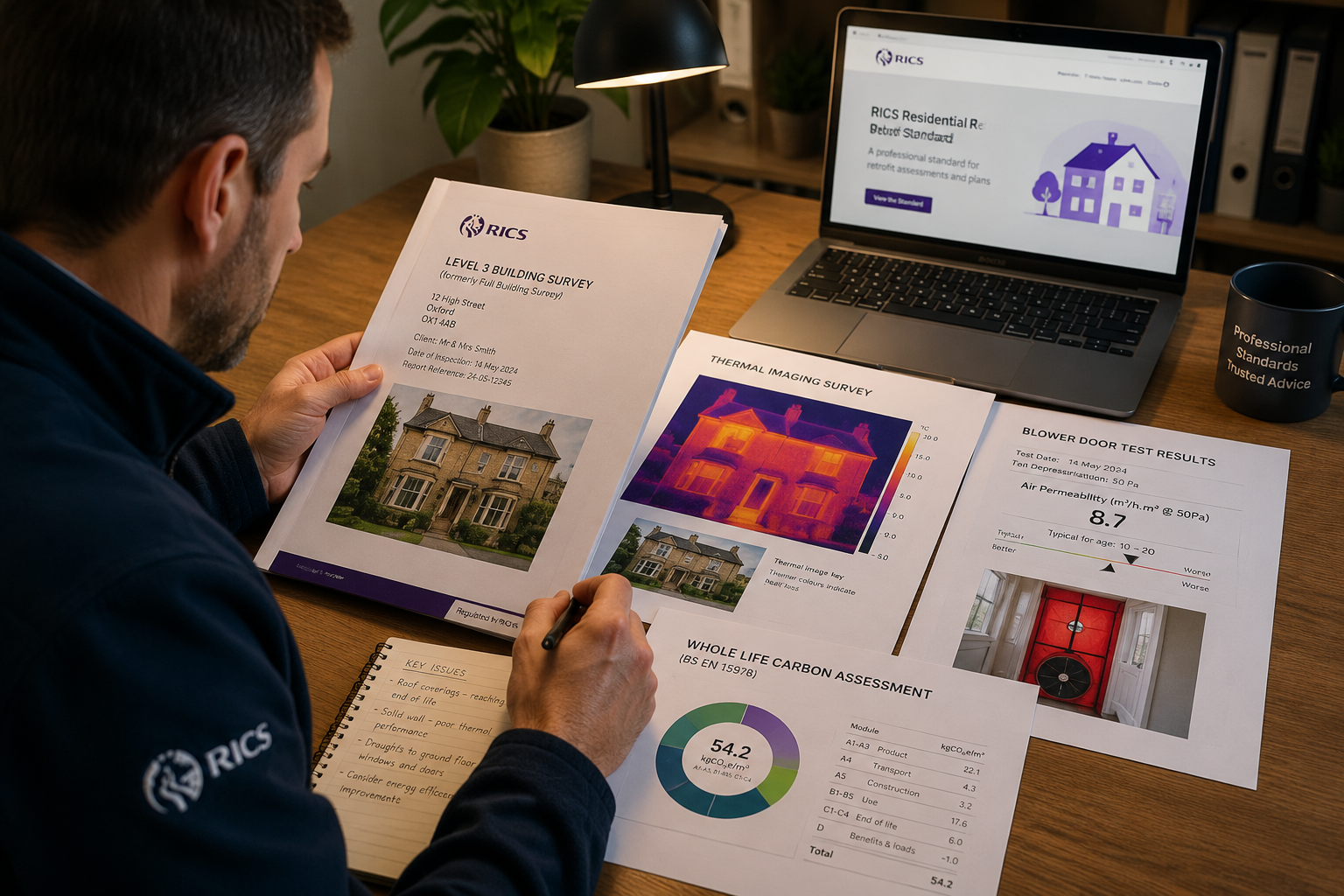
The convergence of EPC retrofit mandates, updated RICS protocols, and the forthcoming Home Energy Model has fundamentally changed what a Level 3 building survey must deliver in 2026. Buyers, landlords, and property professionals who approach these surveys with the old mindset — treating them purely as structural defect reports — will miss critical information that has direct financial and legal consequences.
Actionable next steps for property stakeholders in 2026:
- Commission a Level 3 building survey for any property rated EPC D or below, or built before 1980, before exchanging contracts.
- Ensure the appointed surveyor is competent in retrofit assessment, familiar with PAS 2035, and equipped with thermal imaging and airtightness testing capability.
- Request that the survey report explicitly addresses retrofit upgrade pathways, estimated costs, and structural barriers to common energy efficiency measures.
- Factor HEM methodology changes into compliance planning, particularly for properties currently borderline at EPC C under SAP.
- For landlords managing portfolios, prioritise Level 3 surveys for properties most at risk of falling below minimum standards under updated calculation methods.
- Verify that your surveyor's professional indemnity insurance covers the advanced diagnostic tools being used in the assessment.
The building survey has evolved from a risk mitigation tool into a strategic planning instrument. Those who use it effectively in 2026 will be better equipped to navigate the retrofit challenge — and to make property decisions that stand up to the regulatory and financial scrutiny ahead.
References
[1] Drones And Laser Scanning In Level 3 Building Surveys 2026 Rics Protocols For Precision Defect Detection – manchestersurveyors.com
[2] Building Surveys For 2026 Epc Retrofit Mandates Surveyor Strategies Post Rics Quality Summit – Building surveys for 2026 epc retrofit mandates surveyor strategies post rics quality summit
[3] Building Surveys For Epc Retrofits In 2026 Achieving Compliance And Unlocking Buyer Incentives In Recovering Markets 5 – canterburysurveyors.com
[4] Level 3 Building Surveys For Post 2000 Steel Frame Defects 2026 Rics Protocols For Corrosion And Fire Risks – kingstonsurveyors.com
[5] Whole Life Carbon Assessments In Building Surveys Rics Pas 2080 Updates For 2026 Retrofit Valuations – kingstonsurveyors.com
[6] Building Survey Protocols Post Rics Quality In Retrofit Summit 2026 Updates For Enhanced Home Standards – canterburysurveyors.com
[7] Level 3 Building Surveys For Passivhaus And Fabric First Retrofits Detecting Defects In 2026 Energy Efficiency Upgrades – wimbledonsurveyors.com
[8] Building Survey Protocols For Structural Collapse Risks Awaabs Law 2026 Extensions And High Risk Property Assessments – nottinghillsurveyors.com
How Prince Surveyors can help: explore our independent damp surveys or learn about our Level 3 building survey.