

Last updated: July 24, 2026
Quick Answer: Bungalows are among the most undersupplied property types in the UK, and demand has accelerated sharply through 2026. A Level 3 building survey gives buyers, investors, and landlords a precise picture of a bungalow's structural condition, retrofit potential, and realistic post-improvement value, making it the single most important pre-purchase tool in this competitive, undersupplied market.
Key Takeaways
- Bungalow stock is critically short across much of England, with demand from downsizers and accessibility-focused buyers outpacing supply in most regions.
- Building surveys for bungalow demand surge conditions must go beyond basic condition checks to assess retrofit feasibility and valuation uplift potential.
- A Level 3 (Full Building Survey) is the appropriate survey type for most bungalows, especially those built before 1980.
- Retrofit improvements, particularly insulation, heat pumps, and glazing, can add meaningful value and improve EPC ratings, directly affecting mortgage eligibility and resale price.
- Survey costs for bungalows typically range from £500 to £900 depending on size, age, and location, but can save thousands in post-purchase surprises.
- A building survey is not the same as a valuation; each serves a distinct purpose and both may be needed.
- Common surveyor findings in older bungalows include flat roof deterioration, asbestos-containing materials, inadequate insulation, and subfloor damp.
- Undersupplied markets amplify the importance of pre-purchase due diligence because competition reduces the time available to negotiate on defects.
What Is a Building Survey and Why Do Bungalows Need One
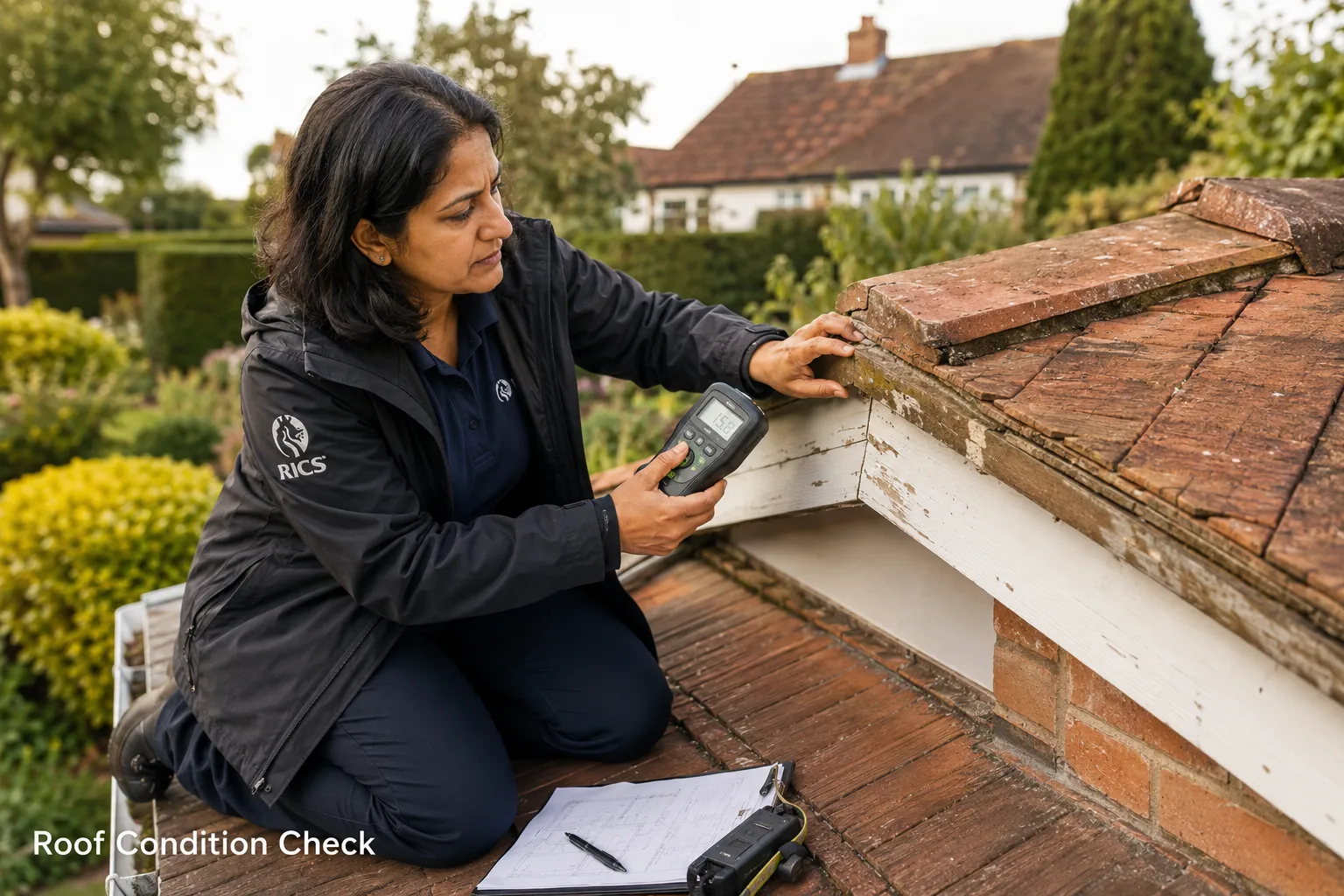
A building survey is a detailed, professional inspection of a property's structure, fabric, and condition carried out by a chartered surveyor. For bungalows specifically, the survey type matters: most pre-1980 bungalows warrant a Level 3 Full Building Survey, which is the most thorough option available under the RICS framework.
Bungalows present a distinctive risk profile that makes a full survey especially valuable:
- Single-storey construction means the roof structure bears a different load pattern than two-storey homes, and defects in flat or low-pitched roofs are common.
- Age of stock: A significant proportion of UK bungalows were built between the 1930s and 1970s, making asbestos, outdated wiring, and inadequate insulation recurring findings.
- Accessibility demand: Buyers seeking step-free living often have less flexibility to walk away, which increases the cost of discovering problems after purchase.
- Extension history: Many bungalows have been extended informally over decades, sometimes without building regulations approval.
For a broader overview of which survey level suits different property types, the RICS building survey guide for home buyers sets out the key distinctions clearly.
Common mistake: Buyers in fast-moving bungalow markets sometimes opt for a cheaper Level 2 HomeBuyer Report to save time. For any bungalow over 30 years old or with visible alterations, this is a false economy. See the Level 2 vs Level 3 survey comparison for a direct breakdown.
What's the Difference Between a Survey and a Valuation for Bungalows
A building survey assesses physical condition; a valuation assesses market worth. They are separate products, serve different purposes, and are often confused, especially by first-time buyers.
| Feature | Building Survey | Valuation |
|---|---|---|
| Purpose | Condition and defect assessment | Market value opinion |
| Commissioned by | Buyer or owner | Lender or buyer |
| Output | Detailed condition report | Single figure or range |
| Retrofit guidance | Yes (in Level 3) | No |
| Affects purchase price? | Indirectly (via negotiation) | Directly (mortgage approval) |
In undersupplied bungalow markets, buyers sometimes assume a high valuation means the property is structurally sound. It does not. A bungalow can achieve a strong market price while concealing costly defects. Commissioning both a survey and an independent valuation gives the fullest picture before exchange.
For investment decisions, understanding the top factors considered during a property valuation helps buyers understand how retrofit improvements feed into revised valuations.
How Do Building Surveys Identify Retrofit Potential in Older Bungalows
A Level 3 building survey identifies retrofit potential by assessing the existing fabric of the building against current energy efficiency standards and flagging where upgrades are both feasible and cost-effective.
Key areas a surveyor will examine for retrofit feasibility:
- Roof void and insulation depth: Most pre-1980 bungalows have inadequate loft insulation. Surveyors measure existing depth and assess whether the void is accessible for top-up insulation.
- Wall construction: Cavity walls built after approximately 1935 may be suitable for cavity wall insulation; solid walls require external or internal insulation, which is more disruptive and expensive.
- Heating system: Age and type of boiler, pipework condition, and space available for a heat pump installation are all noted.
- Glazing: Single-glazed or early double-glazed units are flagged, along with frame condition and replacement feasibility.
- Subfloor construction: Suspended timber floors are common in older bungalows and can be insulated from below if access exists.
The EPC and MEES building survey guidance explains how survey findings translate into EPC rating improvements, a critical factor for landlords facing Minimum Energy Efficiency Standards obligations.
Edge case: Some bungalows in conservation areas or with non-standard construction (e.g., Airey, Cornish Unit, or Reema types) face planning restrictions on external changes. A surveyor experienced in building pathology will flag these constraints explicitly.
How Much Does a Building Survey Cost for a Bungalow
Building survey costs for bungalows in the UK typically fall between £500 and £900 in 2026, though larger or more complex properties can exceed this. The fee depends on floor area, age, construction type, and geographic location.
Factors that increase survey cost:
- Non-standard construction (e.g., prefabricated or system-built bungalows)
- Presence of outbuildings, garages, or annexes
- Suspected asbestos requiring specialist asbestos building survey assessment
- Remote or rural locations with additional travel time
- Drone inspection of inaccessible roof areas (see premium drone survey services)
Decision rule: If the survey fee represents less than 0.5% of the purchase price, which it almost always does, the cost-benefit case for commissioning it is straightforward. The average price reduction after a survey in the UK is typically several times the survey fee, particularly for older properties.
Can a Building Survey Increase Property Value Estimates
A building survey does not directly set a value, but its findings can support a higher or more defensible valuation when used strategically. When sellers commission a pre-sale survey and address identified defects, the resulting clean bill of structural health removes buyer uncertainty, and uncertainty suppresses offers.
For buyers intending to retrofit and resell, the survey provides the evidence base for projecting post-improvement value:
- The survey identifies current deficiencies (e.g., EPC band E, no cavity wall insulation).
- The buyer models the cost of improvements using the surveyor's repair budget estimates.
- A revised valuation is obtained based on the improved specification.
- The gap between current price and projected post-retrofit value defines the investment case.
This approach is particularly powerful in undersupplied bungalow markets where comparable sales data is thin and valuers rely heavily on condition-adjusted estimates.
What Retrofit Improvements Add the Most Value to Bungalows
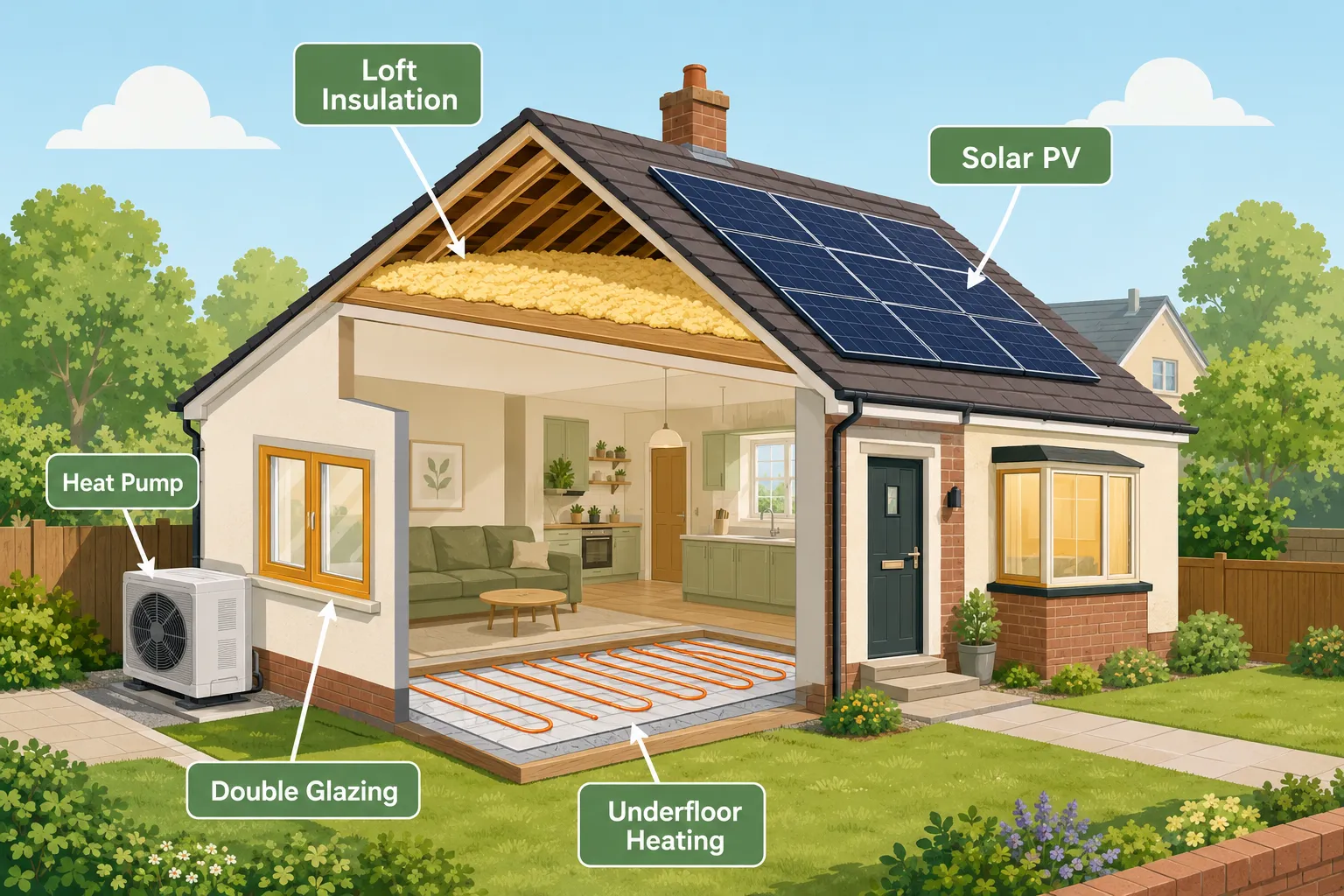
The retrofit improvements that add the most value to bungalows are those that improve EPC rating, reduce running costs, and appeal to the widest buyer pool. Based on chartered surveyor assessments and current market evidence, the highest-impact upgrades are:
High impact, lower cost:
- Loft insulation top-up (from under-100mm to 270mm+): low disruption, significant EPC gain
- Cavity wall insulation: cost-effective where walls are suitable
- Draught-proofing and upgraded controls: low cost, immediate comfort improvement
High impact, higher cost:
- Air source heat pump installation: major EPC uplift, increasingly expected by buyers
- Double or triple glazing replacement: visible, marketable improvement
- Solar PV panels: particularly effective on south-facing bungalow roofs with unobstructed pitch
Structural improvements that protect value:
- Flat roof replacement or overlay: prevents ongoing water ingress and insurance complications
- Subfloor ventilation and damp-proofing: addresses one of the most common bungalow defects
The surveyor's budgeting for repairs and restoration section of a Level 3 report will typically include cost ranges for each of these, giving buyers a ready-made investment model.
How Do I Know If My Bungalow Is in an Undersupplied Market
An undersupplied bungalow market is one where active buyer demand for bungalows exceeds available stock, resulting in faster sales, fewer days on market, and prices holding firm even when wider market conditions soften.
Signs of an undersupplied bungalow market in a specific area:
- Bungalows sell within days of listing, often with multiple offers
- Asking prices are routinely achieved or exceeded
- The ratio of bungalows to total housing stock is below the national average (estimated at roughly 8-9% of all UK dwellings)
- Local estate agents report waiting lists of registered buyers for bungalows
- New bungalow construction is negligible in the area (planning data confirms this in most UK localities)
Spring 2026 data from UK property portals shows bungalow listings consistently attracting higher click-through rates and faster sales progression than equivalent-sized semi-detached houses in the same postcodes, particularly across coastal, commuter-belt, and retirement-destination markets in the South East, East Anglia, and the South West.
Practical check: Search your target postcode on Rightmove or Zoopla, filter by bungalow type, and compare average days-to-sale against the wider market. A gap of more than two weeks indicates meaningful supply pressure.
What Should a Building Survey Report Include for Resale Purposes
For buyers intending to resell or let, a building survey report should include more than a standard condition assessment. A well-structured Level 3 report for investment purposes covers:
- Condition ratings for all main elements (structure, roof, walls, floors, services)
- Defect descriptions with photographs and location references
- Repair cost estimates or ranges for all identified works
- Retrofit feasibility notes covering insulation, heating, and glazing
- Statutory and regulatory flags including any suspected building regulations non-compliance for extensions
- Environmental considerations such as flood risk, ground stability, and contamination
- Maintenance schedule for ongoing upkeep costs
The consequences of failing to act on survey findings page outlines what happens when buyers proceed without addressing red-flag items, a particularly relevant risk in competitive markets where buyers feel pressure to waive conditions.
Common Mistakes When Surveying Bungalows for Investment
The most common mistakes when commissioning or interpreting building surveys on bungalows for investment are underestimating the scope of hidden defects and choosing the wrong survey level.
Mistake 1: Using a Level 2 survey on a pre-1970 bungalow. Level 2 surveys are designed for conventionally constructed properties in reasonable condition. Most older bungalows do not meet this threshold.
Mistake 2: Ignoring flat roof condition. Many bungalows have flat or low-pitched roof sections over extensions or garages. These have a finite lifespan and replacement costs are significant. Always ask the surveyor to inspect and report specifically on flat roof coverings.
Mistake 3: Overlooking asbestos risk. Bungalows built or extended between 1950 and 1999 may contain asbestos in textured coatings, floor tiles, soffit boards, or roof sheets. This affects renovation costs and legal obligations.
Mistake 4: Assuming planning permission exists for extensions. Many bungalow extensions were built under permitted development rules that have since changed, or without any formal consent. A surveyor can flag anomalies, but a separate planning search confirms legal status.
Mistake 5: Not budgeting for subfloor issues. Suspended timber ground floors in older bungalows are prone to inadequate ventilation, rot, and damp. These are frequently underestimated in renovation budgets.
Are Building Surveys Worth It Before Buying a Bungalow to Flip
Yes, a building survey is essential before buying a bungalow to flip. The entire profitability of a flip depends on accurately forecasting the gap between purchase price plus renovation costs and achievable resale value. A survey is the primary tool for establishing the renovation cost side of that equation.
Without a survey, investors routinely encounter:
- Unexpected structural repairs that eliminate projected margins
- Asbestos removal costs not factored into the budget
- Flat roof replacements discovered after exchange
- Services (electrics, plumbing) requiring full replacement rather than cosmetic update
Choose a Level 3 survey if: the bungalow is pre-1980, has been extended, shows any signs of damp or cracking, or is being purchased below market value (which often signals known issues).
For investors new to bungalow acquisitions, the construction and condition survey service provides the granular material and construction analysis that flip calculations require.
How Long Does a Bungalow Building Survey Take
A bungalow building survey typically takes two to four hours on site, with the written report delivered within five to ten working days. Smaller bungalows (under 80 sq m) are generally at the lower end; larger or more complex properties take longer.
Factors that extend the on-site inspection time:
- Large gardens with outbuildings or annexes
- Suspected asbestos requiring careful documentation
- Access difficulties (locked loft hatches, overgrown areas, no ladder access to roof)
- Complex drainage or services arrangements
The building survey timeframes page provides a more detailed breakdown of what affects turnaround. In competitive markets, buyers should confirm report delivery timescales with their surveyor before instructing, to ensure findings are available before exchange deadlines.
What Structural Issues Do Surveyors Look For in Older Bungalows
Surveyors inspecting older bungalows focus on a predictable set of structural vulnerabilities that are more prevalent in single-storey construction than in multi-storey homes.
Primary structural concerns:
- Roof spread: In older cut-rafter roofs without adequate ceiling ties, outward thrust can push walls apart over time. Visible signs include bowing walls or cracked render at eaves level.
- Foundation movement: Shallow foundations common in pre-war bungalows are susceptible to subsidence, particularly on clay soils during dry summers.
- Lintel failure: Original steel lintels over door and window openings can corrode, causing cracking in the brickwork above.
- Wall tie corrosion: In cavity wall bungalows from the 1930s to 1980s, original iron or steel wall ties may have corroded, causing horizontal cracking in mortar courses.
- Subfloor deterioration: Suspended timber floors with inadequate ventilation develop rot in joists and boards, sometimes extensively.
For urgent or dangerous findings, the urgent building issues service outlines how to respond when a survey uncovers immediate safety risks.
Can You Get a Survey Without Planning Permission for Bungalow Extensions
Yes, a building survey can be commissioned regardless of whether planning permission exists for any part of the property. The survey assesses physical condition and flags potential compliance issues, but it does not require planning consent to proceed.
However, the surveyor will note any extensions or alterations that appear to have been carried out without formal consent, and will recommend further investigation. This is important because:
- Unpermitted extensions can complicate mortgage applications and resale
- Some lenders require indemnity insurance before proceeding on properties with unresolved planning status
- Building regulations compliance is separate from planning permission, a structure can have one without the other
For guidance on planning-related survey considerations, the planning advice within building surveys page explains how surveyors document and advise on statutory compliance issues.
FAQ
Q: Do I need a building survey if I'm buying a bungalow with a mortgage?
A: Yes. Your mortgage lender's valuation only confirms the property is suitable security for the loan, it does not assess structural condition. A separate building survey protects your interests as a buyer.
Q: What is the best survey type for a 1960s bungalow?
A: A Level 3 Full Building Survey is the appropriate choice. Properties of this age commonly have asbestos, inadequate insulation, aging flat roofs, and non-standard construction details that require detailed inspection.
Q: Can a building survey help me negotiate the purchase price down?
A: Yes. Survey findings that identify defects, particularly costly ones like roof replacement or structural movement, provide documented grounds for price renegotiation. Many buyers recover the survey fee many times over through price reductions.
Q: How does a building survey support a retrofit investment strategy?
A: The survey identifies the current condition of all building fabric, flags energy efficiency shortfalls, and provides cost estimates for remedial works. This gives investors the data needed to model retrofit costs against projected post-improvement value.
Q: Will a surveyor flag asbestos in a bungalow?
A: A surveyor will note materials that are suspected to contain asbestos and recommend specialist testing. They do not test or remove asbestos themselves, but their report will identify high-risk locations and recommend further investigation before any renovation work begins.
Q: How do I find a qualified surveyor for a bungalow in an undersupplied market?
A: Look for RICS-accredited chartered surveyors with specific experience in residential building surveys. Confirm they carry professional indemnity insurance and ask whether they have experience with the construction type and age of the property you are buying.
Conclusion
The bungalow market in 2026 is defined by a structural imbalance: strong and growing demand from downsizers, accessibility-focused buyers, and investors, set against a stock of older properties that has barely grown in decades. That combination creates real opportunity, but only for buyers who understand what they are acquiring.
Building surveys for bungalow demand surge conditions are not a formality. They are the analytical foundation for every sound decision in this market: negotiating a fair price, projecting retrofit costs accurately, identifying valuation uplift potential, and avoiding the expensive surprises that older single-storey properties routinely conceal.
Actionable next steps:
- Confirm you need a Level 3 Full Building Survey, not a Level 2, for any bungalow built before 1980 or with visible alterations.
- Instruct a RICS-chartered surveyor before exchange, not after.
- Ask your surveyor to include retrofit feasibility notes and cost estimates for energy efficiency improvements in their report.
- Use survey findings as the basis for price negotiation or post-purchase improvement planning.
- If the property has extensions of uncertain consent, commission a planning search alongside the survey.
In undersupplied markets, speed matters, but not more than accuracy. A thorough building survey is the tool that lets buyers move with confidence rather than hope.
Tags: building survey, bungalow survey, retrofit potential, valuation uplift, Level 3 building survey, undersupplied property market, bungalow demand, RICS chartered surveyor, EPC improvements, property investment, bungalow retrofit, building defects