

Warranty claim volumes for new-build properties surged by 34% in Q1 2026 compared to the same period the previous year — a sharp reminder that a freshly painted front door does not equal a defect-free home [1]. With UK house price growth forecast at a modest 2-5% for 2026, buyers can no longer rely on rapid equity gains to absorb the cost of hidden construction faults. Getting the survey right before completion is no longer optional; it is the single most effective risk management tool available to a new-build buyer.
This article examines Building Survey Protocols for New Build Buyers in 2026: Snagging Defects and Warranty Compliance in Modest Growth Markets in detail — covering what surveyors inspect, how warranty frameworks operate, and what buyers must do to protect their investment in a market where every pound of equity counts.
Key Takeaways
- Warranty claim volumes rose 34% in Q1 2026, making independent snagging surveys more critical than ever [1].
- The RICS Home Survey Standard 2nd Edition (February 2026) introduced enhanced Level 3 protocols specifically for new-build warranty claims [1].
- The Building Safety Act 2022 extends retrospective developer liability for structural defects, strengthening buyers' legal positions [1].
- Room-by-room snagging checklists, thermal imaging, and AI-assisted drone inspections now form the backbone of modern new-build survey protocols [2].
- In a 2-5% price growth market, unresolved snags directly erode resale value and mortgage security — independent surveys pay for themselves.
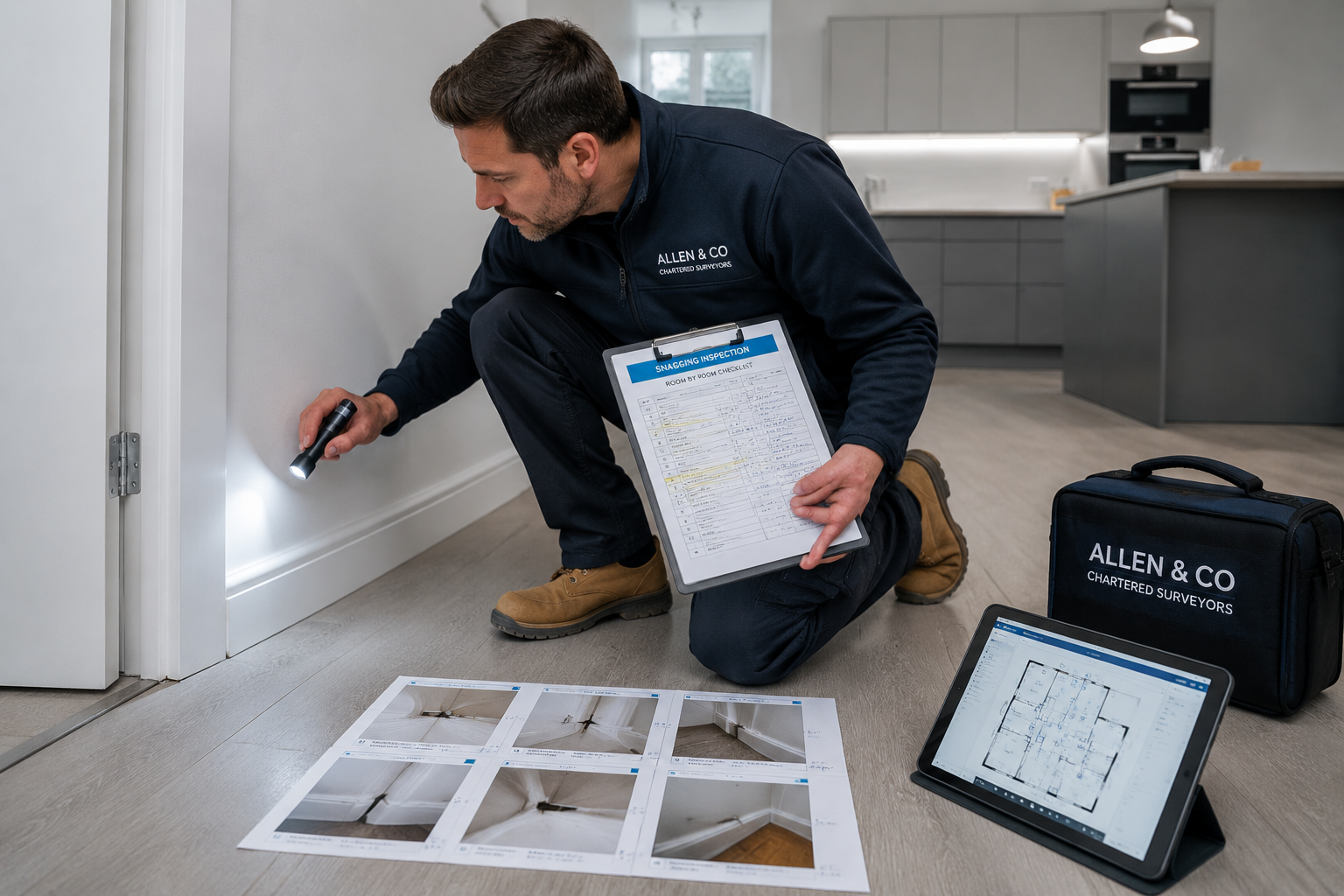
Why New-Build Surveys Matter More Than Ever in 2026
A common misconception persists among first-time buyers: that a brand-new property is, by definition, a safe property. The data tells a different story. Developers operating under tight margins and ambitious completion targets routinely hand over properties with dozens of defects ranging from cosmetic issues to structural concerns [2].
In a market growing at only 2-5% annually, the financial stakes of unresolved snags are disproportionately high. A buyer who pays a premium for a new-build and then faces a disputed warranty claim for a leaking roof or failed insulation may find that remediation costs consume the entirety of their first year's equity growth.
Building Survey Protocols for New Build Buyers in 2026: Snagging Defects and Warranty Compliance in Modest Growth Markets have evolved to address this reality. The RICS Home Survey Standard 2nd Edition, published in February 2026, introduced dedicated guidance for new-build snagging inspections, with enhanced Level 3 protocols designed specifically to support warranty claims through thorough documentation and evidence preservation [1].
For buyers unsure which survey level is appropriate, understanding the difference between a Level 2 and Level 3 survey is an essential first step. New builds, despite their apparent simplicity, frequently warrant a full Level 3 assessment given the complexity of modern construction systems.
The Legislative Backdrop: Building Safety Act 2022
The Building Safety Act 2022 changed the liability landscape for developers in a fundamental way. It imposes retrospective liability on developers for structural defects, extending their responsibility well beyond the traditional defects liability period [1]. This means that buyers who commission thorough surveys and document defects carefully are in a significantly stronger legal position when pursuing remediation.
Understanding construction law advice in the context of new-build purchases is now a practical necessity, not a luxury. Surveyors operating under the updated RICS standard are trained to flag issues that may trigger statutory obligations under the Act.
What a Modern New-Build Snagging Survey Covers
A professional snagging inspection in 2026 is far more comprehensive than the cursory walkthroughs that developers sometimes offer as a substitute. The following table outlines the core inspection categories and the types of defects typically identified in each area.
| Inspection Category | Common Defects Found |
|---|---|
| Structural integrity | Foundation settlement, wall cracking, roof truss misalignment |
| External envelope | Render cracking, poorly sealed windows, defective guttering |
| Roofing | Misaligned tiles, inadequate flashings, poor ventilation |
| Internal finishes | Skirting gaps, uneven plastering, door/window misalignment |
| Mechanical and electrical | Faulty sockets, inadequate ventilation, boiler commissioning gaps |
| Drainage and plumbing | Slow drainage, leaking joints, inadequate fall on waste pipes |
| Insulation and EPC compliance | Thermal bridging, insulation gaps, underperforming EPC rating |
| External spaces | Uneven paving, inadequate drainage gradients, boundary disputes |
Room-by-Room Snagging Checklists
Experienced surveyors use structured, room-by-room checklists to ensure no area is overlooked [2]. Each room is assessed against the developer's specification, building regulations, and relevant British Standards. Key items include:
- Kitchen: Cabinet alignment, worktop joints, appliance commissioning, extraction ducting
- Bathrooms: Silicone seal quality, tile grout consistency, shower tray falls, ventilation
- Bedrooms: Window operation, wall finish quality, electrical socket positioning
- Living areas: Floor level consistency, skirting board gaps, heating performance
- External: Drainage gradients away from the building, boundary fencing, driveway levels
Thermal Imaging and EPC Compliance
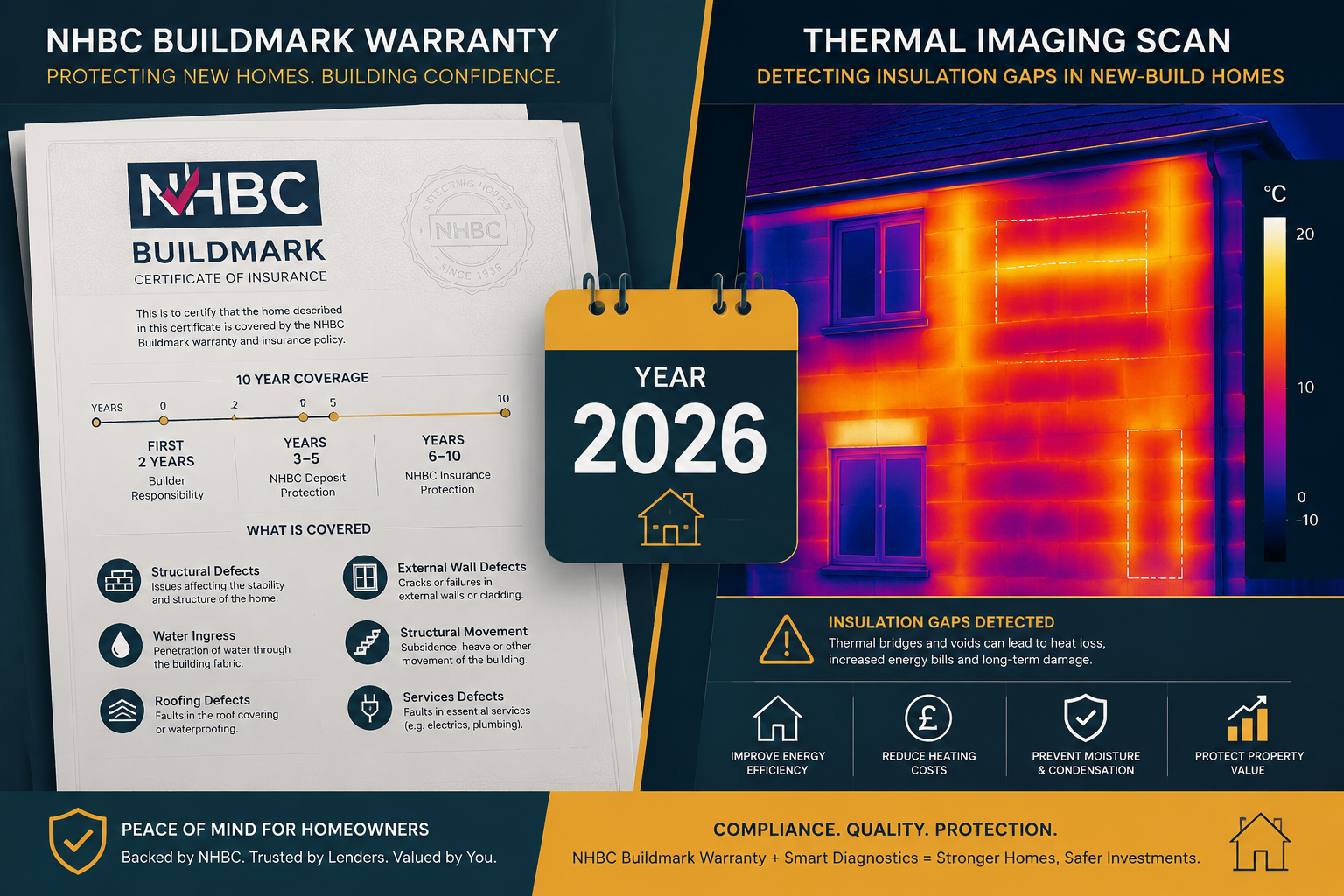
In 2026, new builds must achieve minimum Energy Performance Certificate ratings, and differences between C-rated and A-rated properties carry meaningful implications for running costs and future resale value [2]. Surveyors now routinely deploy thermal imaging cameras to identify insulation deficiencies, thermal bridging at junctions, and air leakage paths that would not be visible to the naked eye.
A property that fails to perform to its stated EPC rating is not merely an environmental concern — it represents a potential warranty claim and, in some cases, a misrepresentation by the developer.
For a detailed understanding of how building materials assessments inform snagging reports, buyers should engage a surveyor with specific experience in modern construction methods and materials.
Warranty Frameworks and Compliance in 2026
How New-Build Warranties Work
The majority of new-build properties in the UK are sold with a 10-year structural warranty, most commonly provided by NHBC (Buildmark), Premier Guarantee, or LABC Warranty. These warranties are structured in two distinct phases:
- Years 1-2 (Builder's Warranty Period): The developer is responsible for remedying all defects reported by the buyer. This is the most important window for snagging activity.
- Years 3-10 (Insurance Period): The warranty provider covers structural defects only. Cosmetic and minor defects are no longer covered.
"The first two years after completion represent the buyer's most powerful period for enforcing quality standards. Every defect documented during this window is a legitimate warranty claim."
This two-phase structure makes the timing of a professional snagging survey critical. Buyers who commission an independent survey before legal completion — or within the first few weeks of moving in — are best positioned to capture the full scope of defects while the developer remains fully liable.
Documenting Defects for Warranty Claims
The surge in warranty claims in 2026 has placed significant pressure on warranty providers and developers alike [1]. Successful claims depend on clear, professional documentation. A well-prepared snagging report should include:
- Photographic evidence with timestamps and location references
- Reference to the specific building regulation, British Standard, or developer specification breached
- A condition rating for each defect (cosmetic, minor, significant, urgent)
- Recommended remediation method and estimated cost where applicable
Condition surveys guided by the ASTM E2018-24 standard provide an objective framework for documenting visible defects and estimating the remaining service life of major building systems [4]. While this standard has its roots in commercial property assessment, its methodological rigour is increasingly applied to residential new-build inspections.
For buyers dealing with urgent or dangerous building issues identified during a snagging inspection, immediate written notification to the developer and warranty provider is essential to preserve legal rights.
The Role of RICS Regulation in Protecting Buyers
With 46% member support, RICS is actively considering a regulatory scheme that would introduce mandatory audit requirements and enhanced consumer protection for home survey services [1]. This proposed framework would require surveyors to demonstrate competency in new-build inspection methodologies and maintain audit trails for warranty-related reports.
For buyers, this means that choosing a RICS-regulated surveyor is not simply a quality assurance measure — it may soon be a prerequisite for warranty claims to be taken seriously by developers and their legal teams.
Technology-Driven Survey Protocols: AI and Drone Inspections
How Technology Is Changing New-Build Inspections
Modern building survey protocols now incorporate artificial intelligence and drone technology in ways that were largely experimental just two years ago [1]. In 2026, these tools are becoming standard practice for comprehensive new-build assessments.
Drone inspections allow surveyors to examine roofs, high-level facades, and external wall insulation systems without the need for access equipment. The resulting high-resolution imagery creates a permanent, timestamped evidence trail that is difficult for developers to dispute.
AI-assisted defect detection software analyses photographic and thermal imaging data to identify patterns of defects that might be missed in a manual review. These tools are particularly effective at identifying:
- Systematic insulation failures across multiple units in a development
- Recurring structural issues linked to a specific construction method
- Moisture ingress patterns that predict future water damage
The combination of drone imagery and AI analysis creates a significantly stronger evidence base for warranty claims — a development that has contributed to the 34% increase in successful claim volumes observed in Q1 2026 [1].
Survey Timeframes and Planning
Understanding building survey timeframes is important for buyers coordinating inspections around developer completion schedules. A thorough new-build snagging survey typically requires between three and six hours on site, depending on the size and complexity of the property. Buyers should build this into their completion timeline rather than treating it as an afterthought.
For buyers in specific locations, accessing local expertise matters. Chartered surveyors operating in West London and across South East London are familiar with the specific construction methods and developer practices common to their regions, which adds material value to the snagging process.

Practical Steps for New-Build Buyers in 2026
The following framework gives buyers a clear action plan for navigating Building Survey Protocols for New Build Buyers in 2026: Snagging Defects and Warranty Compliance in Modest Growth Markets from exchange of contracts through to the end of the builder's warranty period.
Before Legal Completion
- Commission an independent RICS-regulated surveyor to conduct a pre-completion snagging inspection
- Request access to the property at least 48 hours before the completion date
- Review the developer's specification document and use it as a benchmark for the survey
- Confirm the warranty provider and obtain a copy of the warranty documentation
At Completion
- Do not sign the developer's completion certificate until the snagging report has been reviewed
- Submit the snagging list to the developer in writing, with photographic evidence attached
- Set a clear deadline for remediation — typically 28 days for non-urgent defects
- Retain copies of all correspondence
During the First Two Years
- Commission a follow-up inspection at the 11-month mark (before the builder's warranty period expires)
- Document any new defects that emerge as the property settles
- Escalate unresolved issues to the warranty provider if the developer fails to act
- Keep a maintenance log to demonstrate that the buyer has not caused or exacerbated defects
Key Warning Signs That Require Immediate Action
- Cracking in walls or ceilings that appears within the first six months
- Condensation or moisture on internal wall surfaces
- Doors or windows that no longer operate correctly after the first winter
- Drainage problems that worsen with rainfall
- Heating system that fails to achieve design temperatures
For buyers who want to understand the broader scope of what a Level 3 full building survey covers, including its application to new-build properties, consulting with a chartered surveyor before committing to a purchase is strongly recommended.
Conclusion
The combination of rising warranty claim volumes, enhanced RICS survey standards, and the extended developer liability introduced by the Building Safety Act 2022 has fundamentally raised the bar for new-build buyer protection in 2026 [1]. In a market where price growth is measured in single digits, the cost of unresolved construction defects is not an abstract risk — it is a direct threat to financial returns.
Actionable next steps for buyers:
- Engage a RICS-regulated surveyor with specific new-build experience before legal completion.
- Use the two-year builder's warranty period aggressively — commission a formal inspection at the 11-month mark.
- Insist on written documentation of all defects and developer responses.
- Leverage thermal imaging and drone survey options where the property size or complexity justifies the investment.
- Understand the statutory protections available under the Building Safety Act 2022 and do not hesitate to escalate unresolved claims.
A professional snagging survey is not an additional cost — in a modest growth market, it is the most reliable way to protect the value of what is, for most buyers, the largest financial commitment of their lives.
References
[1] Building Survey Protocols For New Build Warranty Claims In 2026 Market Recovery Rics Tools For Snagging And Defects – wimbledonsurveyors.com
[2] Building Surveys For New Build Snags In 2026 Checklists For 2 5 Price Growth Buyer Protections – Building surveys for new build snags in 2026 checklists for 2 5 price growth buyer protections
[3] Whats New In The 2026 Alta Nsps Standards – altalandsurvey.com
[4] Condition Survey Scope Standards And The Report Process – legalclarity.org
[5] Mapconnected 2026 Warranty Study Dealer Insights – motor.com