

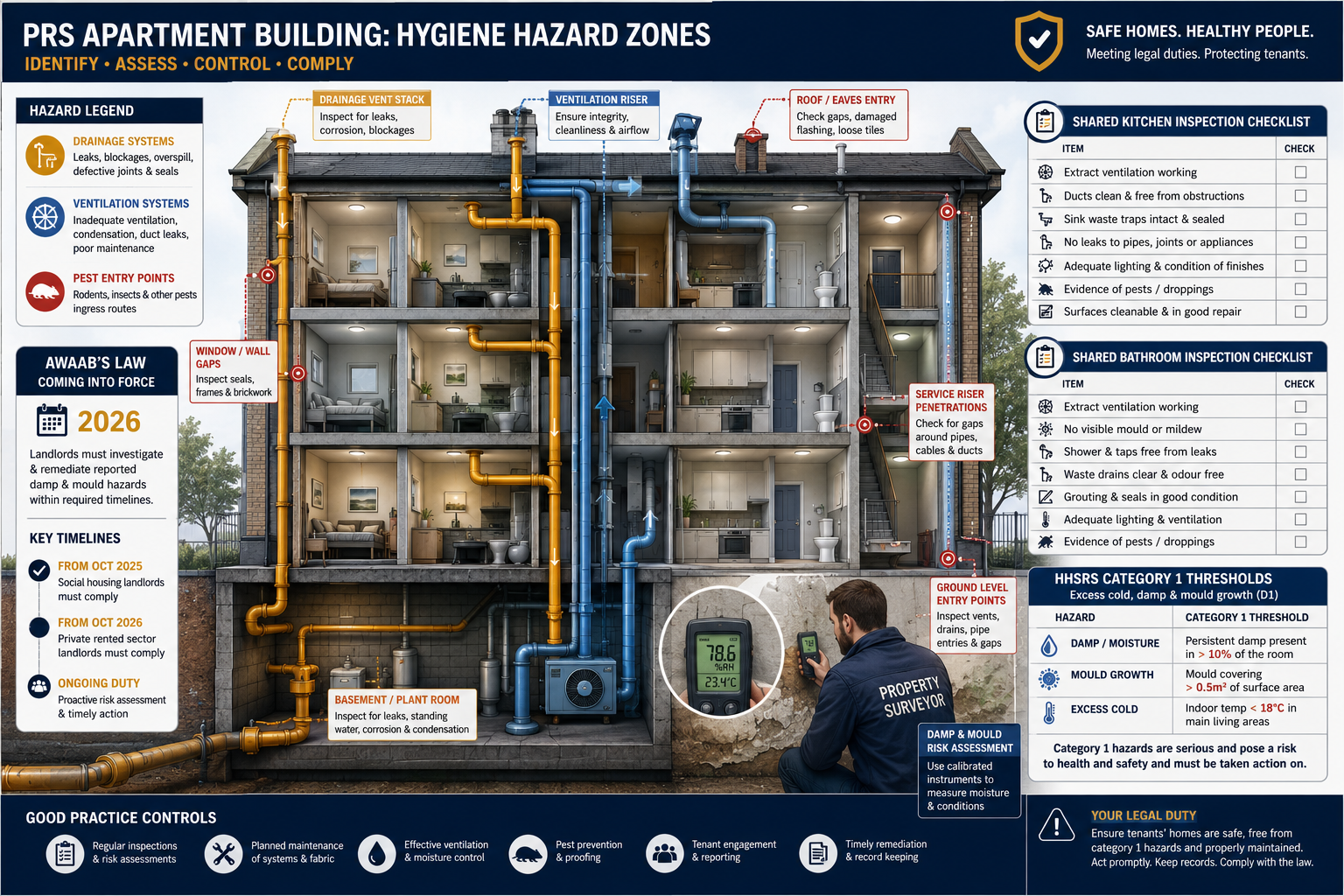
Enforcement notices issued under Awaab's Law have already reshaped how social landlords handle damp and mould — and as of May 2026, the same legal pressure now falls squarely on private rented sector (PRS) landlords managing multi-occupancy buildings. Building Survey Protocols for Domestic Hygiene Hazards: Awaab's Law 2026 in Multi-Occupancy PRS Properties represent one of the most significant shifts in residential surveying practice in a generation, demanding structured, evidence-based assessments of pest control risks, drainage failures, and inadequate ventilation in shared spaces before enforcement action arrives at the door.
Key Takeaways
- Awaab's Law expanded in May 2026 to cover domestic hygiene hazards in PRS properties, including drainage failures, poor sanitation, and inadequate ventilation.
- Landlords must investigate identified hazards within 10 working days, provide written summaries within 3 working days of completing the investigation, and finish remediation works within 5 working days.
- Level 3 building surveys must now go beyond standard HHSRS Category 1 thresholds and include person-centred vulnerability assessments for tenants.
- Complete assessment and remediation records must be retained for a minimum of 6 years.
- Non-compliance carries serious financial and legal consequences, including enforcement action and potential loss of rental income.
What Awaab's Law 2026 Means for Domestic Hygiene Hazards in PRS Buildings
Awaab's Law takes its name from Awaab Ishak, a two-year-old child who died in 2020 as a direct result of prolonged exposure to mould in a social housing flat in Rochdale. The original legislation, introduced through the Social Housing (Regulation) Act 2023, focused on damp and mould in the social rented sector. The May 2026 expansion is a turning point: it extends mandatory response timelines to domestic hygiene hazards and brings PRS properties firmly within scope [1].
Domestic hygiene hazards under the expanded framework include:
- Poor sanitation facilities (broken toilets, inadequate washing facilities)
- Drainage failures and sewage overflow risks
- Pest infestations (rodents, cockroaches, bed bugs)
- Inadequate food preparation hygiene conditions
- Ventilation failures in shared kitchens, bathrooms, and communal corridors
For multi-occupancy PRS properties — houses in multiple occupation (HMOs), purpose-built blocks of flats, and converted properties with shared facilities — these hazards are structurally amplified. A single blocked drain or a failed extractor fan in a shared bathroom affects every tenant on the floor, not just one household.
The Strict Compliance Timelines Landlords Must Now Meet
The legal timelines introduced under Awaab's Law 2026 are non-negotiable and tightly sequenced [1][3]:
| Obligation | Deadline |
|---|---|
| Investigate identified hazard | Within 10 working days |
| Provide written investigation summary to tenant | Within 3 working days of completing investigation |
| Complete necessary safety works | Within 5 working days of investigation |
| Retain all assessment and remediation records | Minimum 6 years |
These timelines apply from the point a hazard is identified or reported, not from when a landlord chooses to acknowledge it. In multi-occupancy settings, this distinction matters enormously — a tenant complaint logged in a block management system can trigger the clock immediately.
Failure to comply exposes landlords to enforcement actions, legal costs, and the potential loss of rental income if properties are deemed uninhabitable [1]. For landlords managing multiple units across a single building, the cumulative financial exposure from a single poorly documented survey can be severe.
Core Building Survey Protocols for Domestic Hygiene Hazards: Awaab's Law 2026 in Multi-Occupancy PRS Properties
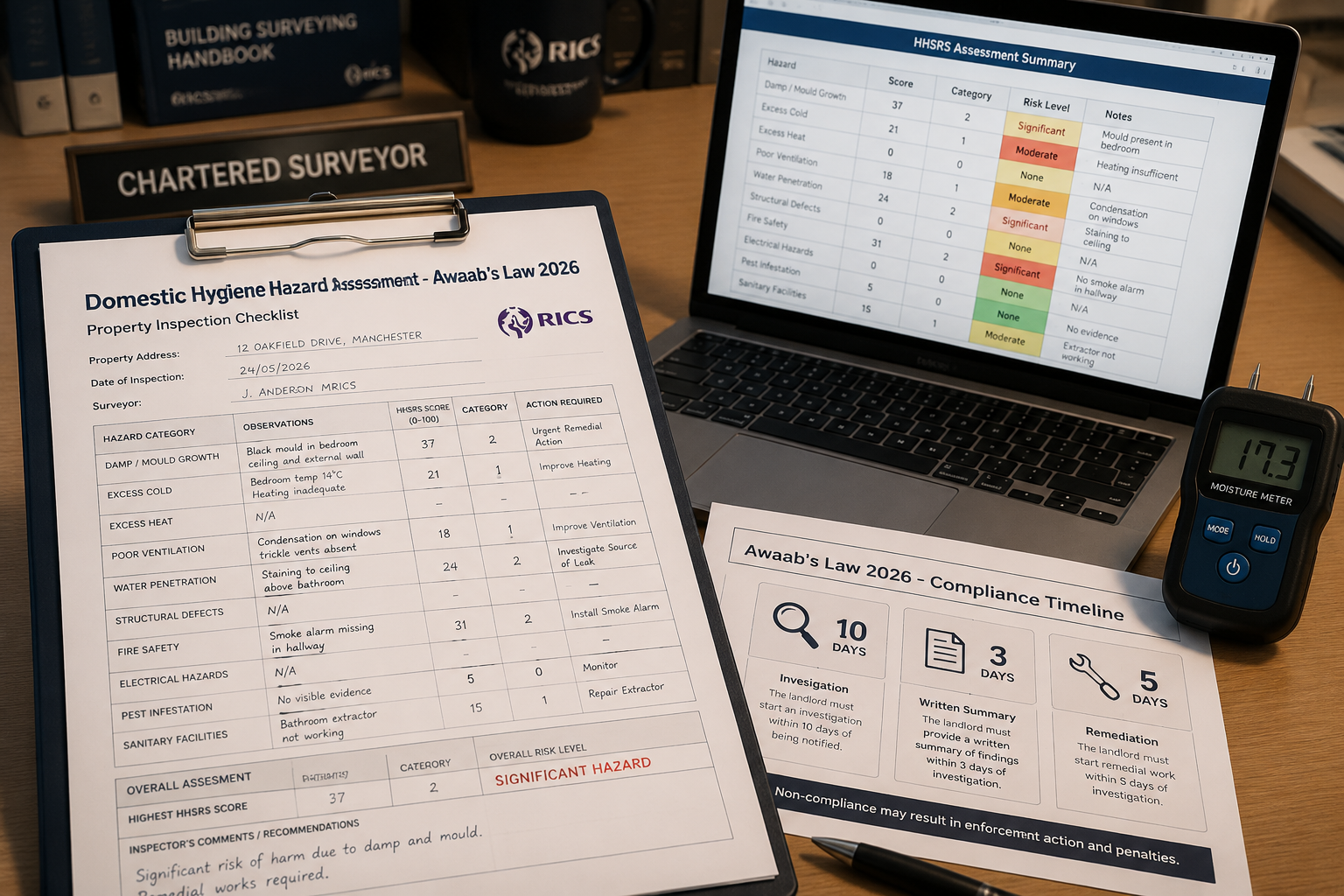
Effective compliance begins with a structured, repeatable survey methodology. The Housing Health and Safety Rating System (HHSRS) remains the statutory framework for hazard scoring, but Awaab's Law 2026 requires surveyors to go further than standard Category 1 thresholds. Level 3 building surveys must now incorporate person-centred assessments that account for tenant vulnerabilities — including age, disability, and pre-existing health conditions — when evaluating the severity of a hygiene hazard [1].
A Level 3 full building survey is the appropriate tool for this level of assessment. It provides the depth of investigation needed to identify latent defects in drainage, ventilation, and structural fabric that a standard homebuyer report would miss entirely.
Drainage and Sanitation Inspection Protocols
Drainage failures in multi-occupancy buildings are among the highest-risk hygiene hazards because they can affect multiple units simultaneously and escalate rapidly. Survey protocols should include:
- Visual inspection of all accessible drainage runs, inspection chambers, and soil stacks
- Identification of shared drainage infrastructure and responsibility boundaries
- Assessment of wastewater backflow risks in ground-floor and basement units
- Inspection of sanitary ware in shared bathrooms for cracking, seal failures, and inadequate fixing
- Review of grease trap and waste disposal arrangements in shared kitchens
Where drainage defects are suspected but not visible, surveyors should recommend CCTV drainage surveys as a follow-up. Documenting this recommendation in the survey report is essential for demonstrating due diligence under the new compliance framework.
Ventilation and Air Quality Assessment
Poor ventilation is a primary driver of mould growth, condensation, and airborne pathogen risk — all of which fall within the expanded domestic hygiene hazard category. In multi-occupancy PRS properties, shared corridors, stairwells, and communal bathrooms frequently lack adequate mechanical or passive ventilation.
Survey protocols must assess:
- Presence and condition of mechanical extract ventilation (MEV) in bathrooms, kitchens, and utility areas
- Trickle ventilator condition in windows across all units
- Positive input ventilation (PIV) systems where installed
- Airflow rates against Building Regulations Part F standards
- Evidence of condensation damage as a proxy indicator of chronic ventilation failure
The relationship between ventilation and hygiene hazards is well-established. A detailed article on mechanical ventilation in buildings illustrates how ventilation failures cascade into wider health and structural problems — a dynamic that applies equally to residential multi-occupancy settings.
Pest Control and Structural Vulnerability Assessment
Pest infestations in PRS properties are classified as domestic hygiene hazards under the HHSRS, and the 2026 expansion makes them subject to the same mandatory response timelines as damp and mould. Surveyors must now assess structural vulnerabilities that enable pest entry, not simply record evidence of infestation.
Key inspection points include:
- Gaps around service penetrations (pipes, cables, conduits) through external walls and floor plates
- Condition of air bricks and ventilation grilles — common rodent entry points
- Integrity of external masonry at ground floor level
- Condition of bin stores and waste management areas in communal spaces
- Evidence of rodent runs, droppings, or gnaw marks in roof voids, under floors, and in service ducts
"Surveyors must treat pest vulnerability as a structural defect category, not simply an environmental health matter. Identifying the entry point is as important as recording the infestation itself."
For older properties, understanding the construction type is critical. A building problems and solutions assessment can help identify where structural fabric creates systemic pest vulnerability across multiple units.
Electrical and Fire Safety Considerations
While electrical hazards and fire risks have their own assessment streams, they intersect with domestic hygiene hazards in multi-occupancy buildings. Surveyors must conduct visual inspections of consumer units, wiring, sockets, and earthing and bonding arrangements, identifying immediate red flags such as exposed live conductors and the absence of residual current device (RCD) protection [4].
Fire detection and warning systems, structural fire containment between units, and escape route integrity must also be assessed and reported with reference to HHSRS categories and recommended remedial actions [4]. In multi-occupancy PRS properties, fire risk assessment is a parallel but complementary obligation — landlords should ensure fire risk assessments are current and integrated with the building survey findings.
Documentation, Reporting Standards, and Surveyor Obligations

The documentation requirements under Awaab's Law 2026 are as demanding as the inspection protocols themselves. Surveyors and landlords share responsibility for creating and maintaining records that would withstand regulatory scrutiny.
What the Survey Report Must Include
A compliant building survey report for domestic hygiene hazards should contain [1][2]:
- Precise hazard descriptions with photographic evidence
- HHSRS hazard category and likelihood/harm scores
- Tenant vulnerability factors considered in the assessment
- Recommended remedial actions with priority classifications
- Compliance timeline references aligned to the 10/3/5 working day framework
- Surveyor's professional opinion on whether the hazard meets the threshold for immediate action
Reports must be written in plain English accessible to tenants, not just property professionals. This aligns with the person-centred approach mandated by the expanded legislation [1].
Record Retention and Audit Trail
All assessment and remediation records must be retained for a minimum of 6 years [1]. For multi-occupancy PRS properties, this means maintaining unit-level records alongside building-wide records, creating a clear audit trail that demonstrates:
- Date hazard was identified or reported
- Date investigation commenced and concluded
- Written summary provided to tenant
- Remediation works completed and signed off
- Post-remediation inspection confirming resolution
Block management structures can support this requirement. Understanding what block management involves helps landlords establish the administrative frameworks needed to meet these obligations consistently across large portfolios.
Surveyor Preparation and CPD Requirements
Surveyors operating in the PRS market in 2026 need to ensure their practice is aligned with the expanded legal framework. A preparation checklist for surveyors includes [2]:
- Review updated HHSRS guidance incorporating domestic hygiene hazards
- Update inspection templates to capture all required data points
- Calibrate HHSRS scoring methodologies against the new hazard categories
- Brief landlord clients on the expanded scope and their obligations
- Establish compliant reporting protocols with clear timelines
- Engage in continuing professional development (CPD) on Awaab's Law
- Review professional indemnity insurance to reflect expanded liability exposure
Surveyors should also be aware of the statutory considerations that apply to PRS properties, including licensing requirements for HMOs and the interaction between Awaab's Law and the Decent Homes Standard.
Understanding building survey timeframes is equally important — surveyors must be able to deliver compliant reports within windows that allow landlords to meet their legal response deadlines.
Looking Ahead: The 2027 Extension and What It Means Now
The 2026 expansion of Awaab's Law is not the final stage. In 2027, the legislation is set to extend further to cover all remaining HHSRS hazards — excluding overcrowding — that present a significant risk of harm [3]. This means hazards including structural collapse risk, excess heat, noise, and collision risks will all fall within mandatory response timelines.
Level 3 building surveys must already incorporate advanced structural defect detection aligned with RICS standards to meet current compliance requirements [5]. Surveyors who build comprehensive, HHSRS-aligned inspection protocols now will be better positioned when the 2027 extension arrives.
For landlords managing multi-occupancy PRS properties, the practical message is clear: investing in thorough, well-documented building surveys in 2026 is not just a compliance exercise — it is a risk management strategy that reduces exposure to enforcement action, legal costs, and reputational damage as the regulatory environment continues to tighten.
Landlords who want to understand how inspection frequency interacts with compliance obligations should review guidance on how often rental units should be inspected, which provides a practical framework for integrating survey cycles into property management routines.
Conclusion
Building Survey Protocols for Domestic Hygiene Hazards: Awaab's Law 2026 in Multi-Occupancy PRS Properties demand a step change in how surveyors and landlords approach inspection, documentation, and remediation. The 10/3/5 working day compliance framework is strict, the record-keeping obligations are long-term, and the consequences of non-compliance are financially and legally serious.
Actionable next steps for landlords and surveyors in 2026:
- Commission a Level 3 building survey for every multi-occupancy PRS property, specifically scoped to include domestic hygiene hazard assessment under the updated HHSRS framework.
- Establish a documented hazard reporting and response system that captures the date of identification, investigation, written summary, and remediation completion for every unit.
- Update tenancy management processes to ensure hazard reports trigger the compliance clock immediately upon receipt.
- Brief managing agents and block management teams on their obligations under the expanded legislation.
- Review professional indemnity insurance and surveyor contracts to confirm they reflect the expanded liability landscape.
- Plan for the 2027 extension by ensuring current survey protocols can accommodate the full range of HHSRS hazards.
The properties that face enforcement action in 2026 and beyond will not be those where hazards were found — they will be those where hazards were found and the response was slow, undocumented, or absent. Structured building survey protocols are the most effective defence available.
References
[1] Building Survey Checklists For Domestic Hygiene Hazards Under Awaabs Law 2026 Level 3 Protocols For Rentals – wimbledonsurveyors.com
[2] Domestic And Personal Hygiene Hazards In Building Surveys Awaabs Law 2026 Expansion And Surveyor Standards – manchestersurveyors.com
[3] Awaabs Law Guidance For Social Landlords Timeframes For Repairs In The Social Rented Sector – gov.uk
[4] Awaabs Law 2026 Extensions Building Surveyors Guide To Assessing Excess Cold Fire And Electrical Hazards In Prs Properties – canterburysurveyors.com
[5] Building Survey Protocols For Structural Collapse Risks Awaabs Law 2026 Extensions And High Risk Property Assessments – nottinghillsurveyors.com