

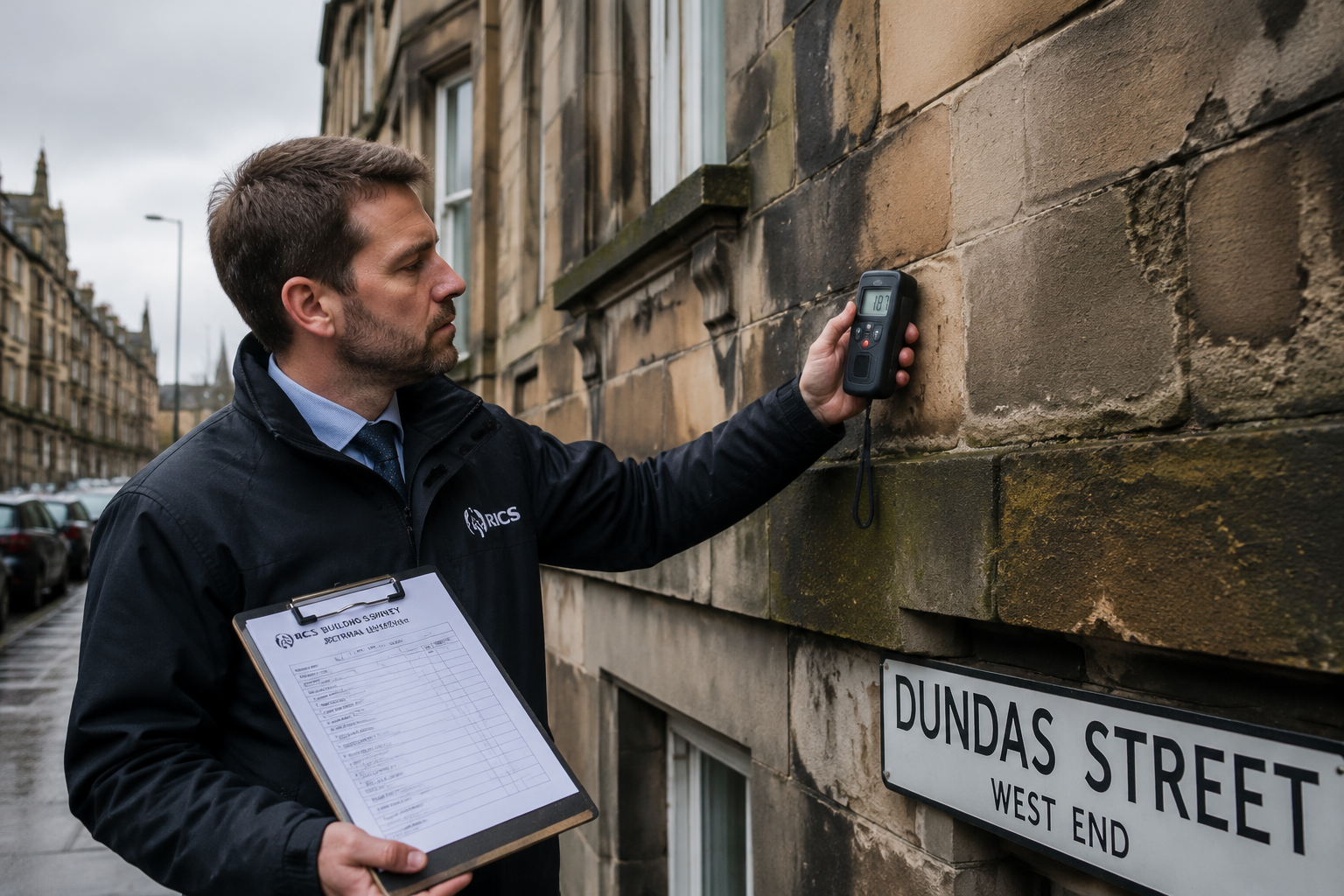
Scottish house prices rose faster than any other UK nation in the first quarter of 2026, with average values in cities like Edinburgh and Glasgow climbing more than 8% year-on-year according to the latest UK House Price Index data. For first-time buyers entering this market, the pressure to move quickly is intense — and that urgency is precisely when survey shortcuts become costly mistakes. Understanding the building survey essentials for first-time buyers in Scotland's 2026 price surge is not optional; it is the single most effective way to protect a purchase that may represent the largest financial commitment of a lifetime.
Key Takeaways
- Scotland's 2026 property price surge means buyers face compressed timescales, making a thorough building survey more critical than ever.
- Traditional Scottish construction — stone tenements, granite cottages, and Victorian villas — carries specific defect risks that standard mortgage valuations will not identify.
- RICS Level 2 and Level 3 surveys serve different purposes; choosing the wrong one can leave serious structural issues undiscovered.
- Damp, failing roof coverings, and defective pointing are the three most common costly defects found in Scottish residential stock.
- A survey report gives buyers documented leverage to renegotiate price or request remedial works before completion.
Why Scotland's 2026 Market Makes Surveys Non-Negotiable
The competitive conditions defining Scotland's 2026 property market have created a dangerous dynamic for first-time buyers. Closing dates — the Scottish equivalent of sealed bid deadlines — are being set within days of a property hitting the market. Buyers routinely offer above the Home Report valuation simply to secure a property.
This environment tempts buyers to skip or delay commissioning an independent survey. The logic is understandable: why spend money on a survey for a property that might be lost to a higher bidder? The answer is straightforward. A Home Report, which is legally required in Scotland before a property is marketed, contains a Single Survey conducted by a RICS surveyor. However, that survey is commissioned by the seller, not the buyer. Its purpose is to facilitate the transaction, not to protect the purchaser's interests.
The Home Report Single Survey is not a substitute for an independent building survey.
It uses a basic three-point condition rating system and does not investigate concealed defects, structural movement, or the full extent of damp penetration. In a rising market where buyers are paying premium prices, the gap between what a Home Report reveals and what an independent survey uncovers can represent tens of thousands of pounds in remedial costs.
"In a seller's market, buyers feel they cannot afford a survey. In reality, they cannot afford to skip one."
Understanding Scottish Property Construction and Its Unique Risks
Scotland's housing stock is architecturally distinct from much of England and Wales. The majority of pre-1919 properties — which make up a significant proportion of urban housing in Edinburgh, Glasgow, Aberdeen, and Dundee — are built from solid stone masonry. This construction type behaves very differently from cavity brick construction and requires specialist knowledge to assess correctly.
Solid Stone Walls and Damp Penetration
Solid stone walls rely on their mass and the quality of their mortar pointing to resist driving rain. Scotland's Atlantic climate delivers significant rainfall, and when pointing deteriorates — as it does in most properties over 50 years old — water penetration follows. This is not cosmetic damp. Water ingress through failed pointing can saturate internal plaster, cause timber rot in embedded floor joists, and create conditions for dry rot fungal growth.
A specialist damp survey goes beyond the surface readings taken in a standard Home Report. It traces moisture pathways through the building fabric and identifies the source, whether that is rising damp, penetrating damp, or condensation — each requiring a different remedial approach.
Roof Coverings and Chimney Stacks
Traditional Scottish properties commonly feature natural slate roofs, lead flashings, and multiple chimney stacks. Slate is a durable material, but it has a finite lifespan, and individual slates become porous or delaminate with age. A professional roof survey will assess the condition of the sarking boards beneath the slates, the integrity of lead valleys and flashings, and whether the chimney stacks show signs of movement or spalling brickwork.
In the 2026 market, where buyers are offering over the asking price, discovering that a roof requires full replacement — a cost that can exceed £15,000 on a larger property — after exchange of contracts is a serious financial shock.
Tenement Properties and Shared Structures
Tenement flats present an additional layer of complexity. In a tenement block, the roof, external walls, and common stair are typically shared among all proprietors. Liability for repairs is governed by the title deeds and, where these are silent, by the Tenements (Scotland) Act 2004. A building survey on a tenement flat must consider not only the individual flat but the condition of the shared fabric and whether a maintenance fund exists.
Choosing the Right Survey: Level 2 vs Level 3
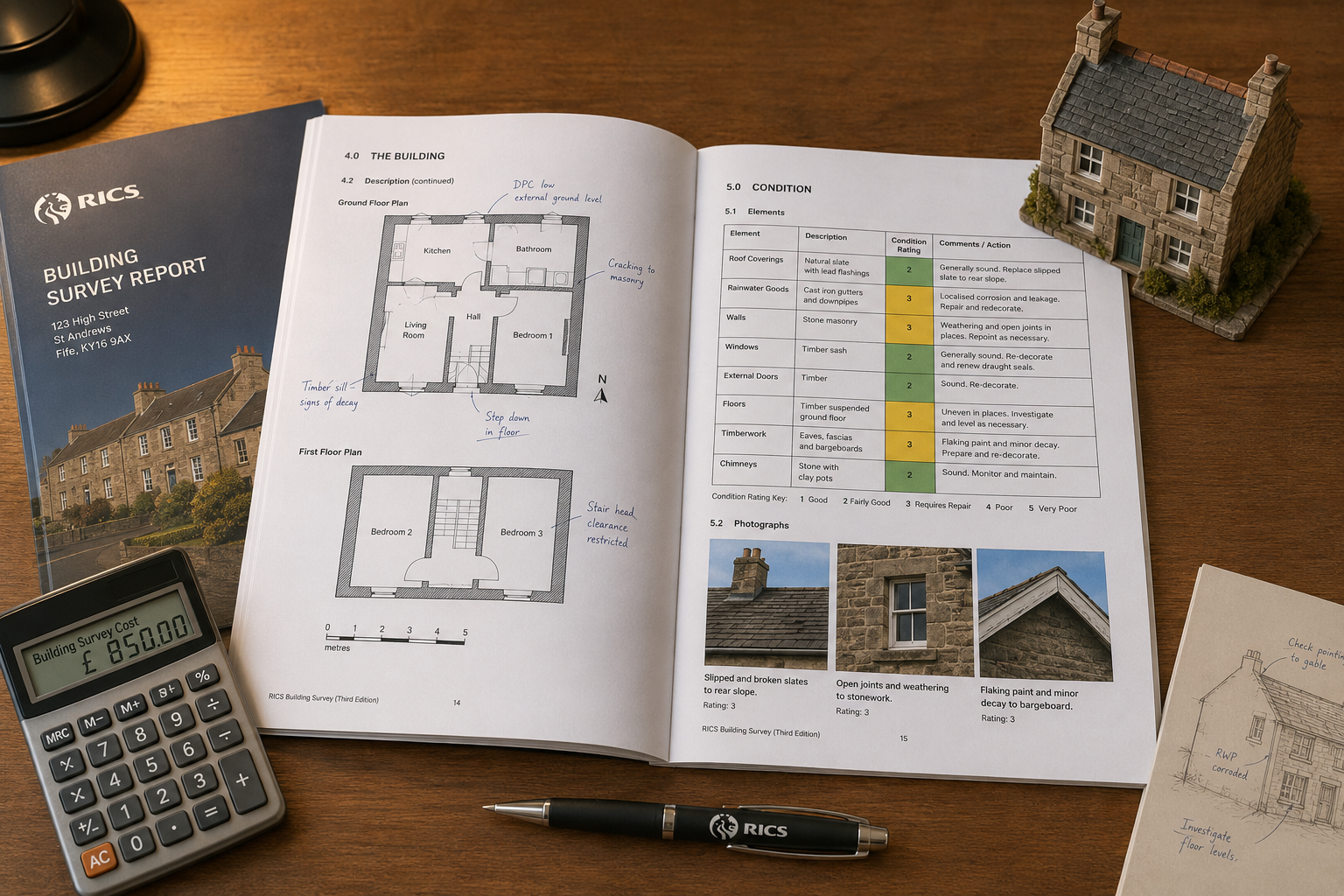
The building survey essentials for first-time buyers in Scotland's 2026 price surge include understanding which survey level matches the property being purchased. RICS currently offers a structured suite of residential surveys, and selecting the appropriate level is one of the most consequential decisions a buyer will make.
RICS Level 2: Home Survey
The RICS Home Survey (Level 2) is a visual inspection of accessible areas of the property. It uses the same three-point condition rating system as the Home Report Single Survey but provides more detail and, crucially, is commissioned by and reported to the buyer. It is suitable for:
- Conventional properties in reasonable condition
- Properties built after approximately 1930
- Standard construction types (brick, block, or timber frame)
- Properties that have not been significantly altered
For most modern Scottish new-builds or post-war semi-detached houses, a Level 2 survey provides adequate coverage. However, it is not appropriate for the majority of traditional stone-built Scottish properties.
RICS Level 3: Building Survey
The RICS Building Survey (Level 3) is the most comprehensive residential survey available. It involves a thorough inspection of all accessible parts of the property, including roof spaces, subfloor voids, and outbuildings. The report describes the construction in detail, identifies defects, assesses their severity, and provides advice on remedial options.
A Level 3 survey is strongly recommended for:
- Pre-1919 stone-built properties
- Tenement flats, particularly those in older blocks
- Properties that have been extended or significantly altered
- Any property showing visible signs of movement, damp, or deterioration
- Properties purchased at a significant premium above the Home Report valuation
The difference between a Level 2 and Level 3 survey is not simply one of cost. It is a difference in scope, depth, and the degree of protection afforded to the buyer.
| Feature | Level 2 Home Survey | Level 3 Building Survey |
|---|---|---|
| Inspection depth | Visual, accessible areas | Thorough, including roof space and subfloor |
| Construction description | Limited | Detailed |
| Defect analysis | Condition ratings | Full description and remedial advice |
| Suitable for older stone properties | No | Yes |
| Cost range (approx.) | £400 – £700 | £700 – £1,500+ |
| Damp investigation | Basic | Detailed |
Costs are approximate and vary by property size, location, and surveyor.
The RICS Checklist: What a Building Survey Should Cover in Scotland
Understanding what a quality survey report should address helps buyers evaluate the document they receive and ask informed follow-up questions. The building survey essentials for first-time buyers in Scotland's 2026 price surge include knowing what to look for in the report itself.
A comprehensive Level 3 building survey for a Scottish property should address all of the following:
Structural elements
- Foundations and any evidence of subsidence or heave
- External walls: condition of stonework, pointing, and render
- Roof structure: rafters, sarking, and purlins where accessible
- Internal floors: timber joist condition, evidence of rot or beetle infestation
Weatherproofing
- Roof coverings: slate, tile, or flat roof condition
- Chimney stacks: pointing, flaunching, and pot condition
- Rainwater goods: gutters, downpipes, and hoppers
- Window and door frames: condition of seals and sills
Services (visual inspection only)
- Electrical installation: age, visible condition, presence of RCD protection
- Plumbing and heating: boiler age, visible pipework condition
- Drainage: evidence of blockages or leaks
Specific Scottish risks
- Damp penetration through solid walls
- Dry rot or wet rot in embedded timbers
- Asbestos-containing materials in properties built before 2000
- Non-standard construction elements
For properties showing signs of structural movement, a residential structural engineering assessment may be recommended as a follow-up to the building survey.
Using the Survey Report to Protect Value in a Rising Market
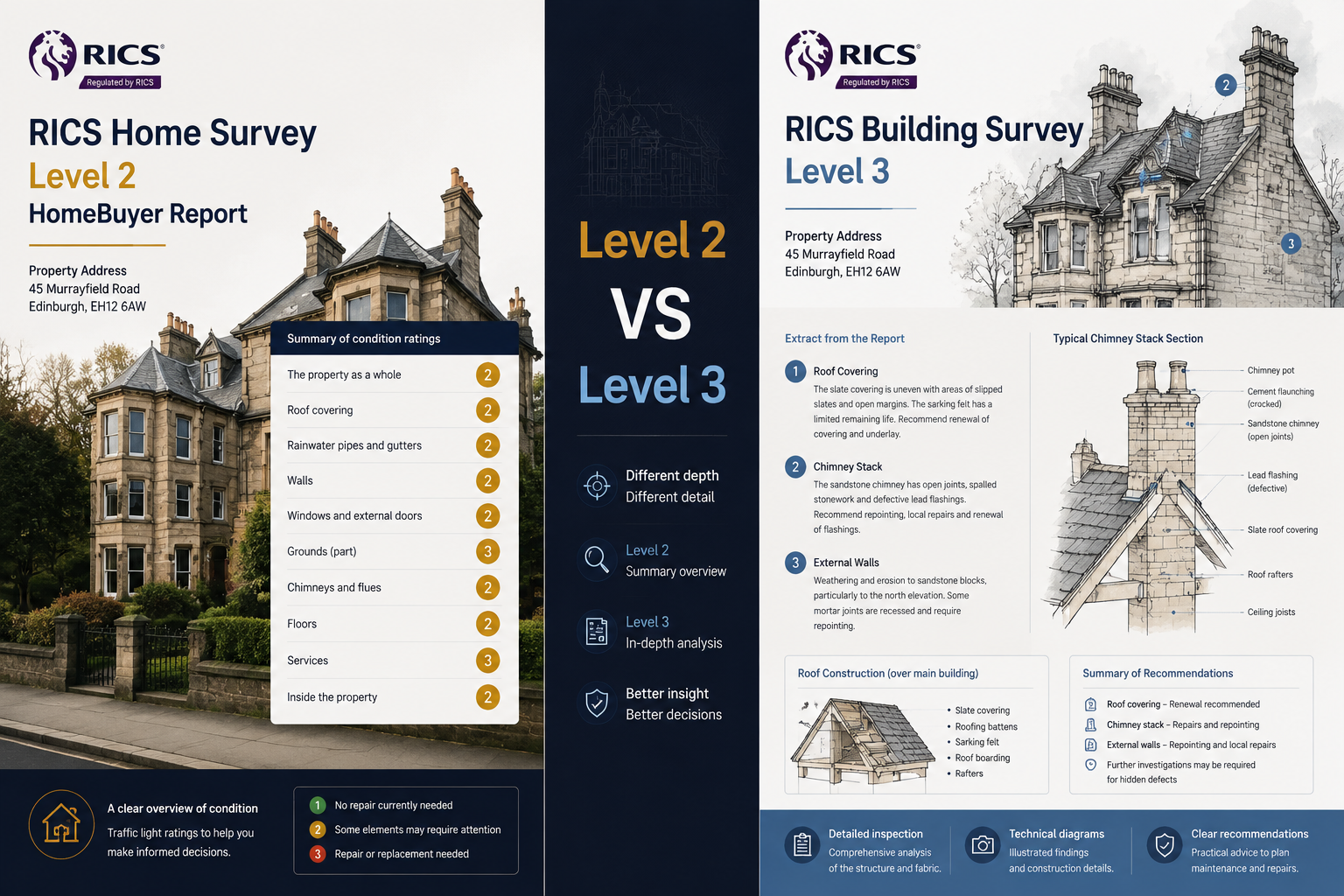
Receiving a survey report that identifies defects does not automatically mean walking away from the purchase. In Scotland's 2026 market, where supply remains constrained, many buyers will proceed with properties that have known issues. The survey report becomes a negotiating instrument.
Renegotiating the Purchase Price
If a Level 3 survey identifies significant remedial works — a failing roof, extensive repointing, or damp treatment — the buyer has documented evidence to support a price reduction request. The seller may decline, particularly in a competitive market, but the attempt is always worthwhile. Even a modest reduction of £5,000 on a £250,000 property represents a meaningful offset against repair costs.
The key is to obtain contractor quotes for the identified works before approaching the seller. A survey report that states "the roof covering requires attention" is less persuasive than one accompanied by a roofer's estimate of £12,000 for full replacement.
Requesting Remedial Works Before Completion
In some cases, particularly where defects pose an immediate risk to habitability or safety, buyers can request that the seller undertakes remedial works as a condition of the sale proceeding. This is more common in transactions where the buyer has significant leverage, but it is a legitimate option.
Informing Insurance and Reinstatement Valuation
A building survey also informs the buyer's insurance requirements. Properties with known structural issues or non-standard construction may require specialist insurance products. Additionally, the reinstatement cost assessment within the Home Report may not reflect the true cost of rebuilding a complex stone property. Buyers should consider whether an independent insurance reinstatement valuation is appropriate to ensure adequate buildings insurance cover.
Common Mistakes First-Time Buyers Make in Scotland's 2026 Market
Even buyers who commission surveys sometimes undermine their own protection through avoidable errors.
Relying solely on the Home Report
The Home Report Single Survey is a seller-commissioned document. It fulfils a legal marketing requirement. It is not designed to be the buyer's primary source of property condition information.
Choosing a Level 2 survey for an older stone property
A Level 2 survey on a Victorian tenement or Georgian townhouse will not investigate the roof space, will not probe for concealed damp, and will not assess the condition of embedded timbers. The cost saving over a Level 3 survey is false economy.
Not reading the report before exchange
Survey reports are detailed technical documents. Buyers should read them carefully, highlight any condition rating 3 items (requiring urgent attention), and contact the surveyor directly to discuss findings before proceeding.
Failing to commission specialist follow-up investigations
A building survey is a visual inspection. When a surveyor recommends further investigation — for example, a specialist damp and timber report or a structural engineer's assessment — that recommendation should be acted upon, not filed away.
Skipping the survey to speed up the transaction
In Scotland's 2026 market, closing dates create genuine time pressure. However, most surveyors can turn around a Level 3 report within five to seven working days of instruction. The timeline cost is minimal relative to the financial risk of proceeding without one.
How to Find a Qualified Surveyor for Scottish Properties
All building surveyors conducting RICS-standard surveys must be members of the Royal Institution of Chartered Surveyors. Buyers should verify RICS membership through the RICS Find a Surveyor tool before instructing anyone.
Beyond accreditation, buyers should look for surveyors with demonstrable experience of Scottish traditional construction. The specific skills required to assess a solid stone tenement are different from those needed for a modern brick-built semi-detached house. When requesting quotes, ask directly whether the surveyor has experience with the construction type of the property in question.
It is also worth noting that while many surveying firms operate primarily in England, the range of survey types available from established RICS practices covers the full spectrum of residential needs, and the principles of a Level 3 building survey apply consistently across the UK. Buyers relocating from England to Scotland, or purchasing investment property north of the border, can draw on the same RICS framework with which they may already be familiar.
Conclusion
Scotland's 2026 property price surge has compressed timescales, inflated offers, and increased the financial stakes for every first-time buyer entering the market. In this environment, the building survey essentials for first-time buyers in Scotland's 2026 price surge are not bureaucratic formalities — they are the foundation of an informed purchase decision.
The core actions are clear:
- Do not rely on the Home Report Single Survey as a substitute for an independent buyer's survey.
- Commission a Level 3 Building Survey for any pre-1919 stone-built property, tenement flat, or property showing visible signs of defects.
- Read the survey report thoroughly before proceeding and seek clarification from the surveyor on any condition rating 3 items.
- Obtain contractor quotes for identified defects and use them to support a price renegotiation if appropriate.
- Act on specialist follow-up recommendations, particularly for damp, structural movement, or asbestos.
- Verify RICS membership of any surveyor instructed and confirm their experience with Scottish traditional construction.
A building survey costing between £700 and £1,500 on a property purchased for £250,000 or more represents a fraction of a percent of the total investment. The information it provides can prevent buyers from inheriting repair bills that dwarf the survey fee many times over. In Scotland's fast-moving 2026 market, that protection is not a luxury — it is essential.
References
- UK House Price Index, HM Land Registry / Registers of Scotland (2024)
- Royal Institution of Chartered Surveyors. RICS Home Survey Standard (2019)
- Tenements (Scotland) Act 2004, Scottish Parliament
- Royal Institution of Chartered Surveyors. Guidance Note: Surveys of Residential Property (2022)
- Registers of Scotland. Property Market Report (2024)
How Prince Surveyors can help: explore our property valuations or learn about our which survey you need.