

Existing home sales rose 1.7% in February 2026 [2] — a modest but meaningful signal that buyer confidence is returning after years of suppressed demand. For RICS-registered surveyors and property professionals, this shift creates a specific operational challenge: how to structure building survey checklists that meet the needs of a new wave of first-time buyers entering a market that is stabilising, not surging. Building Survey Checklists for 2026 First-Time Buyer Enquiries: Capturing Stabilising Market Demand is not simply an administrative exercise. It is a strategic framework that determines whether survey firms capture this emerging demand or lose enquiries to competitors better prepared for it.
This article sets out a practical, protocol-driven approach to survey checklist design, buyer communication, and technology integration — tailored specifically for the conditions defining the 2026 property market.
Key Takeaways
- The 2026 housing market is stabilising, with modest inventory growth and improving buyer sentiment creating a renewed pipeline of first-time buyer enquiries.
- Building survey checklists must be adapted to reflect both the structural defect risks common in the current housing stock and the specific concerns of first-time buyers.
- RICS Level 2 and Level 3 survey protocols require clear differentiation in checklist design to serve different buyer profiles and property types.
- Technology integration — including AI-assisted reporting and digital inspection tools — is reshaping how surveyors capture, process, and communicate survey findings.
- Surveyors who invest in buyer-facing communication frameworks alongside technical checklists will convert more enquiries and build stronger referral pipelines.
Understanding the 2026 Market Context for First-Time Buyer Surveys
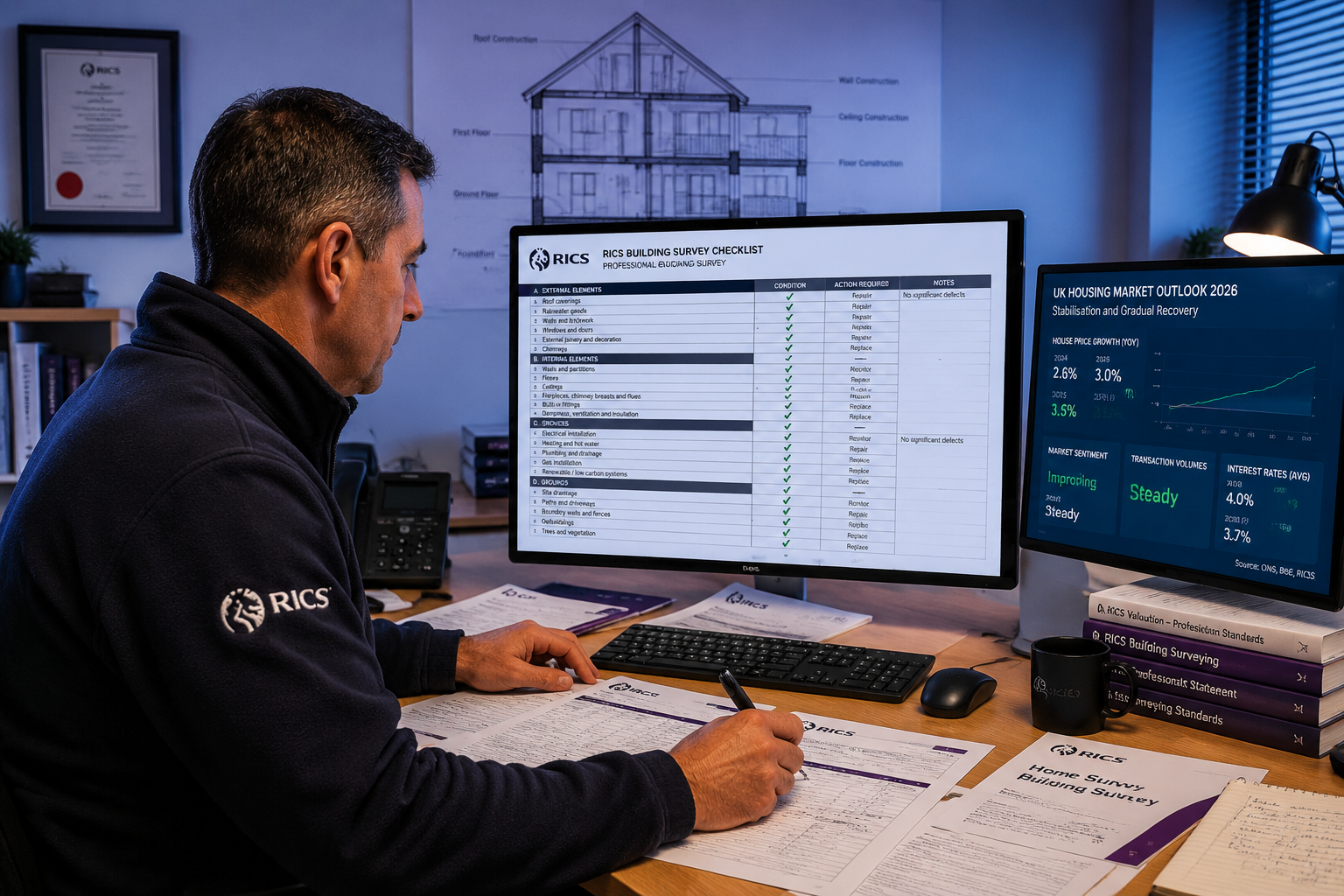
The conditions shaping Building Survey Checklists for 2026 First-Time Buyer Enquiries: Capturing Stabilising Market Demand are rooted in a specific set of market dynamics that differ meaningfully from the volatile years that preceded them.
Zillow forecasts a 1.2% increase in home values for 2026 [3], while mortgage rates are expected to average 6.3% — offering slight but tangible relief compared to recent peaks [4]. For-sale inventory is projected to grow by nearly 9% year-over-year [4], giving first-time buyers more options and, critically, more time to conduct proper due diligence before committing. This slower-paced environment is precisely where thorough building surveys become both more feasible and more valued.
Legislative momentum is also relevant. The bipartisan Road to Housing Act, passed in June 2026, includes nearly 50 measures designed to increase housing supply and affordability [1]. While it does not directly address mortgage rates, it signals a policy environment increasingly focused on enabling first-time buyers to enter the market. Surveyors who position their services clearly within this context — as essential tools for informed purchasing decisions — are better placed to capture the resulting enquiry volume.
What this means for checklist design:
- First-time buyers have more time to review survey findings, so reports must be thorough and clearly explained
- Older housing stock entering the market after years of reduced transaction volumes may present deferred maintenance issues
- Buyers are more cost-conscious, making pre-survey communication about scope and value critical
Regional disparities also matter. While some markets face acute shortages — Arizona, for example, has an immediate deficit of approximately 56,000 housing units [5] — UK regional markets show their own variations. Northern cities and outer London boroughs offer relative affordability, driving higher volumes of first-time buyer activity in areas such as Hackney, Southwark, and Newham. Survey checklists must be calibrated to the property typologies dominant in each area.
Core Components of an Effective Building Survey Checklist for First-Time Buyers
A well-constructed checklist for first-time buyer enquiries serves two simultaneous purposes: it guides the surveyor through a rigorous, defensible inspection process, and it produces output that a non-expert buyer can understand and act upon. These goals are not in tension — but they do require deliberate design.
Structural Integrity Assessment
The foundation of any building survey checklist is structural condition. For first-time buyers, who are unlikely to have experience interpreting structural findings, the checklist must prompt surveyors to document defects in plain language as well as technical terms.
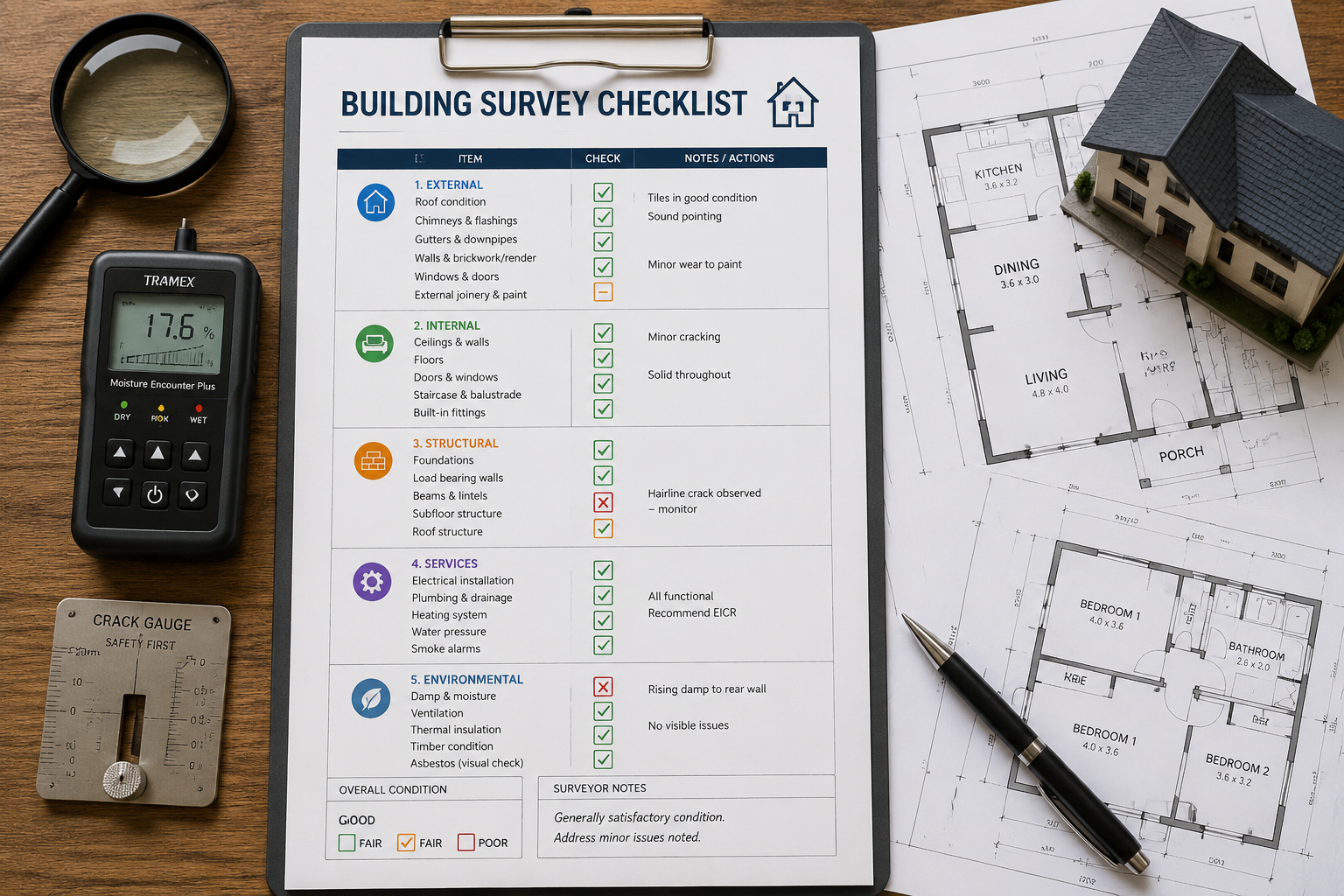
Key checklist items under structural integrity:
- Roof covering and structure: Condition of tiles, slates, flat roof membranes, ridge, hips, and verges; evidence of sagging or spread
- External walls: Crack mapping, pointing condition, cavity wall tie evidence, render adhesion
- Internal walls and ceilings: Crack patterns (distinguishing settlement from structural movement), plasterwork condition
- Floors: Deflection, bounce, evidence of subfloor dampness or timber decay
- Chimney stacks: Pointing, flashing, pot condition, internal flue integrity
Surveyors should review guidance on building inspection protocols to ensure checklist items align with current RICS standards and regional building typologies.
Damp and Timber Assessment
Damp remains one of the most frequently misunderstood findings in survey reports — and one of the most anxiety-inducing for first-time buyers. A robust checklist must distinguish between condensation, penetrating damp, and rising damp, and must flag any evidence requiring a specialist damp survey.
| Damp Type | Primary Indicators | Checklist Action |
|---|---|---|
| Condensation | Mould at cold bridges, window reveals | Note ventilation deficiencies |
| Penetrating damp | Localised staining linked to external defect | Identify source; recommend repair |
| Rising damp | Tide marks at low level, salt crystallisation | Recommend specialist investigation |
| Timber decay | Softness, discolouration, fruiting bodies | Flag for specialist report |
Services and Energy Performance
First-time buyers in 2026 are acutely aware of running costs. The checklist must address:
- Age and condition of boiler and heating system
- Electrical installation age and visible condition (consumer unit type, visible wiring)
- Evidence of recent upgrades or outstanding remediation
- EPC rating context and likely improvement measures
Legal and Tenure Considerations
For leasehold properties — common in London and many urban markets — the checklist must prompt review of lease length, service charge history, and ground rent terms. The guide to buying a leasehold property provides a useful reference framework for surveyors advising first-time buyers on these complexities.
Differentiating RICS Level 2 and Level 3 Checklists for First-Time Buyer Enquiries
One of the most consequential decisions a surveyor makes when handling a first-time buyer enquiry is recommending the appropriate survey level. Building Survey Checklists for 2026 First-Time Buyer Enquiries: Capturing Stabilising Market Demand requires a clear internal protocol for this triage process.
Understanding which home survey is right for a buyer is the starting point for checklist differentiation.
RICS Level 2 (HomeBuyer Report) Checklist Focus
The Level 2 survey is appropriate for conventional properties in reasonable condition, typically post-1930 construction with no significant alterations. The checklist for this level should emphasise:
- Condition ratings (1, 2, 3) applied consistently across all elements
- Clear identification of items requiring further investigation before exchange
- Concise market valuation commentary where instructed
- Buyer-facing summary of the most significant findings
Checklist efficiency tip: Pre-survey preparation significantly improves Level 2 report quality. Reviewing what to do before an RICS home survey helps surveyors set buyer expectations and gather relevant property history in advance.
RICS Level 3 (Building Survey) Checklist Focus
The Level 3 survey is appropriate for older properties, those with extensions or alterations, unusual construction, or where the buyer intends to carry out significant works. The checklist must be substantially more detailed:
- Exposed and hidden element assessment with clear limitations noted
- Detailed defect descriptions with probable cause and consequence
- Repair specification guidance (not just identification)
- Priority sequencing of recommended works
- Estimated cost ranges where instructed
A well-designed Level 3 checklist does not just record what a surveyor sees — it structures a narrative that helps a first-time buyer understand what they are committing to financially and practically.
For properties in areas with older Victorian and Edwardian stock — such as Camberwell or Chiswick — the Level 3 checklist should include specific prompts for:
- Original timber sash window condition
- Solid wall construction thermal performance
- Cellar and basement moisture ingress
- Historic chimney breast removal evidence
- Asbestos-containing materials in pre-2000 construction elements
Technology Integration in 2026 Survey Checklist Workflows
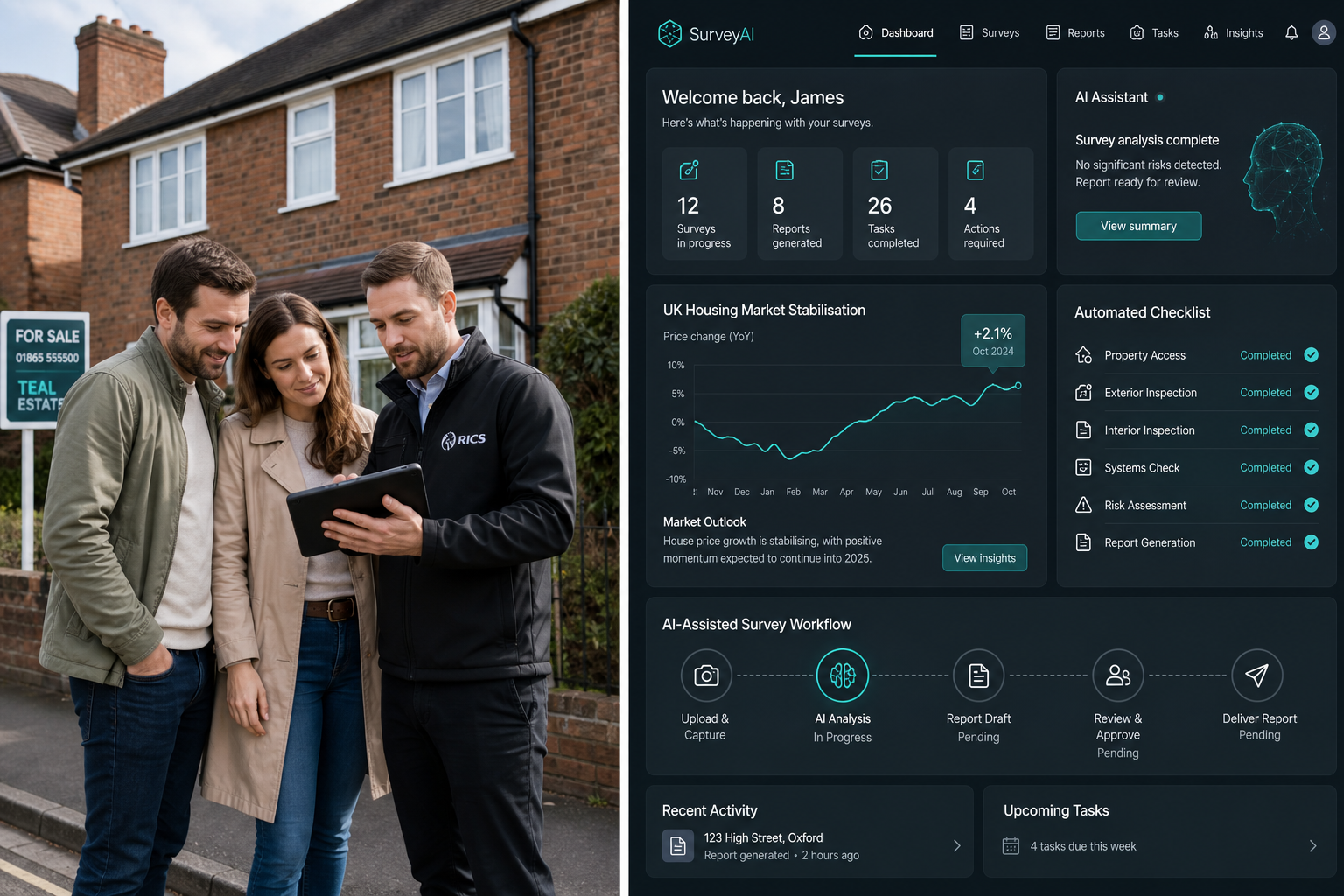
The post-Quality Summit landscape in 2026 has accelerated the adoption of digital tools in RICS survey practice. Zillow's research identifies AI as moving from advisory to coordinative roles in property transactions [3] — and this shift is visible in survey workflow technology as well.
Digital Inspection Platforms
Modern survey checklist software allows surveyors to:
- Complete structured checklists on tablet devices during inspection
- Attach geotagged photographs directly to checklist items
- Auto-generate condition rating summaries from field inputs
- Flag items for specialist follow-up with automated client notification
This reduces transcription time, improves report consistency, and creates an auditable inspection record — all of which are increasingly expected by clients and professional indemnity insurers alike.
AI-Assisted Report Drafting
Several platforms now offer AI-assisted drafting tools that convert structured checklist inputs into narrative report sections. For first-time buyer reports, this capability is particularly valuable in:
- Generating plain-English explanations of technical defects
- Producing consistent condition rating justifications
- Flagging checklist items that may require cross-referencing (e.g., a crack noted externally cross-referenced with internal wall findings)
Important caveat: AI drafting tools assist but do not replace professional judgment. Every AI-generated section must be reviewed and validated by the RICS-qualified surveyor of record. The checklist remains the authoritative source document.
Pre-Survey Digital Questionnaires
A growing best practice is deploying a short digital questionnaire to buyers before the survey appointment. This captures:
- Known issues or concerns the buyer has already identified
- Intended use and any planned alterations
- Specific areas of anxiety (e.g., roof age, damp history)
This input directly informs checklist prioritisation on the day of inspection and improves the relevance of the final report to the individual buyer's circumstances.
Capturing and Converting First-Time Buyer Enquiries in 2026
Technical checklist quality is necessary but not sufficient. Surveyors who convert the highest proportion of first-time buyer enquiries in 2026 combine rigorous inspection protocols with clear, buyer-centred communication.
Enquiry Response Framework
When a first-time buyer makes contact, the initial response should address three questions before any fee proposal is issued:
- What type of property is it? (Age, construction, tenure, location)
- What is the buyer's primary concern? (General condition, specific defect, pre-offer advice)
- What is the buyer's timeline? (Exchange deadline, mortgage valuation status)
This triage informs both the appropriate survey level and the fee structure. It also demonstrates professional competence at the first point of contact — a significant conversion factor for buyers who may be approaching multiple surveyors.
Fee Transparency and Value Communication
Affordability remains a genuine concern for first-time buyers in 2026 [7]. Survey fees must be presented in context:
- Compare the survey cost against the typical cost of undetected defects
- Reference specific defect types common in the area (e.g., Japanese knotweed risk, wall cracking patterns)
- Highlight the negotiation leverage a survey report provides
Surveyors operating in competitive markets can also reference resources like saving money with building surveys to frame the survey as a cost-saving tool rather than an additional expense.
Post-Survey Follow-Up Protocols
The survey report is not the end of the engagement. A structured post-survey follow-up checklist should include:
- A brief call or email to confirm the buyer has received and read the report
- Availability to answer questions (with a defined response window)
- Signposting to specialist contractors or further investigation services where recommended
- A referral request once the transaction has completed
This follow-up process is a direct driver of the referral business that sustains survey practices through market cycles.
Building a Repeatable Checklist System for Stabilising Market Conditions
The defining characteristic of a stabilising market is predictability. Unlike the frenzied conditions of 2021-2022 or the suppressed volumes of 2023-2024, the 2026 market offers surveyors the opportunity to build systematic, repeatable processes that scale with demand.
A repeatable checklist system should include:
- Master checklist templates differentiated by survey level, property age band, and construction type
- Location-specific addenda addressing regional defect risks (e.g., subsidence risk zones, flood plain proximity, specific local construction methods)
- Version control to ensure all surveyors in a practice are working from current, RICS-compliant templates
- Quality assurance review process for a sample of completed checklists each quarter
Firms operating across multiple London boroughs and outer areas — including locations such as Bromley, Woodford Green, and Harrow — benefit significantly from location-specific addenda that reflect the dominant property typologies and known defect risks in each area.
Working with RICS-qualified surveyors who understand both the technical and regulatory requirements of current survey practice is the foundation on which all checklist systems should be built.
Conclusion
The stabilisation of the 2026 housing market is not a temporary fluctuation — it represents a structural shift in the conditions under which first-time buyers are making purchasing decisions. Modest home value growth [3], improving inventory [4], and legislative support for affordability [1] are collectively creating a sustained pipeline of buyer enquiries that well-prepared survey practices are positioned to capture.
Building Survey Checklists for 2026 First-Time Buyer Enquiries: Capturing Stabilising Market Demand requires action on three fronts simultaneously: technical rigour in checklist design, clear differentiation between survey levels, and buyer-centred communication at every stage of the enquiry and inspection process.
Actionable next steps for survey professionals:
- Audit existing checklist templates against current RICS guidance and update for 2026 property market conditions
- Develop location-specific addenda for each primary operating area, reflecting local construction typologies and known defect risks
- Implement a pre-survey digital questionnaire to improve inspection focus and report relevance
- Establish a post-survey follow-up protocol to drive referrals and repeat business
- Review AI-assisted drafting tools available for RICS survey workflows and pilot with a defined cohort of Level 2 reports
- Ensure all client-facing materials communicate survey value in terms of financial protection and negotiation leverage — not just technical compliance
The first-time buyers entering the market in 2026 are better informed, more cautious, and more willing to invest in professional advice than their predecessors in the peak years. Survey practices that meet this sophistication with equally sophisticated systems will define the leading firms of the next market cycle.
References
[1] Housing Affordability Senate Trump – axios.com
[2] Watch – youtube.com
[3] 2026 Housing Predictions 35800 – zillow.com
[4] 2026 National Housing Forecast – realtor.com
[5] Arizona Housing Shortage Common Sense Institute Report – axios.com
[7] Chicago Housing Affordability Listings Down Home Prices Up Road To Housing Act – axios.com
How Prince Surveyors can help: explore our property valuations or learn about our which survey you need.