

Last updated: July 24, 2026
Quick Answer: Big data analytics in expert witness reports uses large-scale property datasets and statistical models to predict market values, supporting or challenging valuations in UK property tribunal proceedings. In 2026, RICS now requires expert witnesses to disclose any AI or data tools used in their reports, making transparency a legal obligation rather than a best practice. Predictive modelling can strengthen an expert's credibility when applied correctly, but it can also be challenged, and even overturned, if the methodology is not clearly explained and defensible.
Key Takeaways
- Predictive modelling in property valuation uses algorithms trained on transaction data, planning records, and economic indicators to estimate market value ranges.
- Since March 2026, RICS members must disclose AI and data analytics tools used in expert witness reports, including the tool name, version, provider, and known limitations.
- Tribunals weigh predictive models alongside comparable sales evidence; neither automatically overrides the other.
- A human valuer must apply independent professional judgment for an AI-assisted output to qualify as a written valuation under RICS Red Book standards.
- Common mistakes include using poorly sourced data, failing to explain model assumptions, and presenting probabilistic outputs as definitive figures.
- The cost of commissioning a data-analytics-supported expert witness report varies widely, but typically adds to the base cost of a standard valuation report.
- Predictive models can be challenged in tribunal on grounds of data quality, model selection, and the absence of human oversight.
- RICS is developing dedicated global guidance on AI in real estate valuation, with public consultation underway in 2026.
What Is Predictive Modelling in Property Valuation Expert Witness Reports
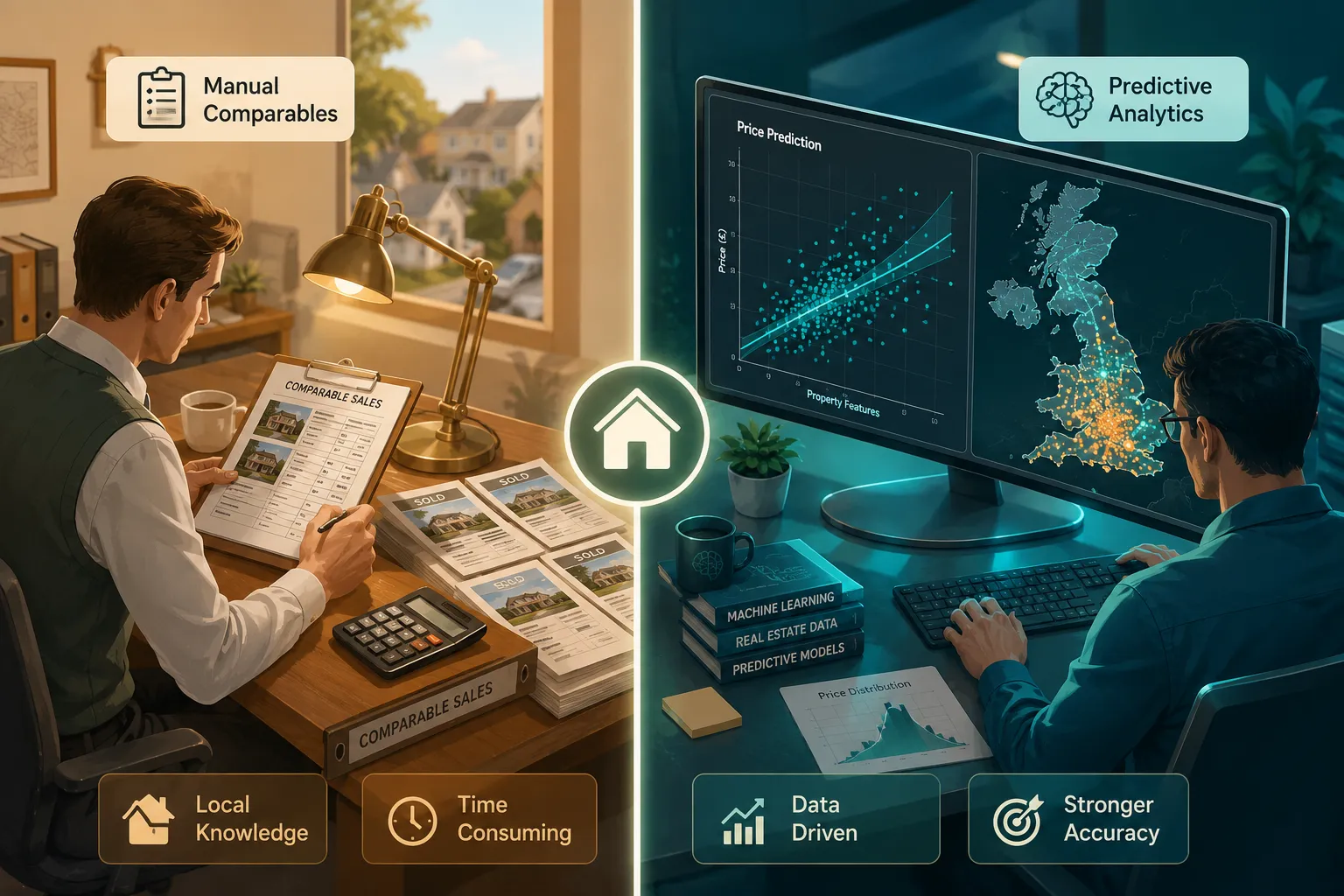
Predictive modelling in property valuation expert witness reports means using statistical or machine-learning techniques to estimate a property's market value based on patterns found in large datasets. Rather than relying solely on a handful of manually selected comparable sales, a predictive model can process thousands of transactions, planning approvals, lease terms, and macroeconomic variables to generate a value range with an associated confidence level.
In the context of big data analytics in expert witness reports and predictive modelling for valuation disputes in 2026 property tribunals, these models serve a specific legal purpose: they provide a quantitative, reproducible framework that an expert witness can present as part of their evidence. The model does not replace the expert's judgment, it informs it.
Key components of a predictive valuation model:
- Input data: Sold prices, rental yields, EPC ratings, flood risk scores, planning history, local infrastructure changes
- Model type: Hedonic regression, automated valuation models (AVMs), gradient boosting, or random forest algorithms
- Output: A predicted value or value range, with confidence intervals
- Human overlay: The chartered surveyor interprets the model output and applies local market knowledge
How Does Big Data Analytics Improve Expert Witness Credibility in Property Disputes
Big data analytics improves expert witness credibility by replacing subjective comparable selection with a transparent, auditable methodology. When an expert can demonstrate that their valuation is supported by a model trained on hundreds or thousands of data points, it becomes harder for the opposing party to dismiss the opinion as cherry-picked or anecdotal.
That said, credibility depends on how the analytics are presented, not just whether they were used. Tribunals respond well to experts who explain their methodology in plain terms, acknowledge the model's limitations, and show clearly where professional judgment was applied on top of the data output.
Credibility boosters for data-driven expert reports:
- Full disclosure of data sources and model parameters
- Sensitivity analysis showing how the value changes under different assumptions
- Cross-validation against traditional comparable evidence
- Clear separation between model output and expert opinion
- Compliance with RICS disclosure requirements effective from March 2026
For property owners or landlords involved in a dispute, commissioning a properly structured expert witness report from a chartered surveyor who understands both valuation standards and data methodology is the most direct way to ensure the evidence holds up.
What Is the Difference Between Traditional Appraisal and Data-Driven Valuation Methods
Traditional appraisal relies on a surveyor manually selecting three to six comparable sales, adjusting for differences in size, condition, and location, and arriving at a point estimate. Data-driven valuation uses automated or semi-automated models to analyse far larger datasets and produce a statistically derived value range.
Neither method is inherently superior. Traditional appraisals capture nuance, a surveyor who has physically inspected a property knows things no dataset can record. Data-driven models capture breadth, they can identify pricing trends across an entire postcode that a manual review might miss.
| Feature | Traditional Appraisal | Data-Driven Valuation |
|---|---|---|
| Data volume | 3-6 comparables | Hundreds to thousands of data points |
| Transparency | Relies on surveyor judgment | Auditable model parameters |
| Speed | Days to weeks | Hours (model run) + expert review |
| Local nuance | High | Moderate (depends on data granularity) |
| Tribunal acceptance | Well established | Growing, with disclosure requirements |
The 2026 standard: Under the updated RICS Red Book, AI-assisted models only count as written valuations when a human valuer has applied independent professional judgment. This means data-driven outputs must always be reviewed and signed off by a qualified expert, they cannot stand alone as evidence.
Who Needs Big Data Analytics for Property Valuation Disputes
Big data analytics in expert witness reports is most relevant to parties in high-value or complex valuation disputes where the margin of disagreement is large enough to justify the additional cost and analytical rigour.
Parties who typically benefit:
- Landlords and freeholders in lease extension or enfranchisement disputes, where small differences in valuation assumptions can mean tens of thousands of pounds. See our guide to leasehold extension and enfranchisement valuations.
- Commercial property owners facing rating appeals or compulsory purchase disputes, where comparable evidence is thin and market data is essential. Learn more about commercial valuations.
- Homeowners disputing a mortgage lender's down-valuation, particularly in volatile markets. Our article on what to do if your home valuation is less than an offer covers this scenario in detail.
- Developers in planning or viability disputes where land value is contested.
- Executors and beneficiaries disputing inheritance tax valuations with HMRC.
Who does not need it: For straightforward single-dwelling valuations with ample comparable evidence and no dispute, a standard RICS-compliant valuation report is sufficient and far more cost-effective.
What Predictive Modelling Tools Do Property Valuers Use in 2026
In 2026, UK property valuers draw on a mix of commercial platforms and bespoke analytical tools when preparing data-driven expert witness reports. The most widely used approaches include:
- Automated Valuation Models (AVMs): Platforms built on Land Registry transaction data, Rightmove/Zoopla listing histories, and EPC databases. These are used as a starting point, not a final answer.
- Hedonic regression models: Statistical models that price individual property attributes (bedrooms, floor area, proximity to transport) separately, then combine them. These are transparent and well understood by tribunals.
- Gradient boosting and random forest models: Machine learning approaches that can identify non-linear relationships in large datasets. More powerful but require careful explanation in tribunal settings.
- GIS-based spatial analysis: Maps value gradients across micro-markets, useful in disputes involving location-specific factors like flood risk or planned infrastructure.
The RICS guidance on AI in real estate valuation, currently in public consultation as of mid-2026, is expected to set minimum standards for which tools are considered appropriate for use in formal valuation contexts.
Are Predictive Valuation Models Admissible as Expert Evidence in UK Property Tribunals
Yes, predictive valuation models are admissible in UK property tribunals, but their weight depends entirely on how they are presented and whether the expert can defend the methodology under cross-examination. Admissibility is not the barrier, credibility is.
Since March 2026, RICS members are required to disclose any AI or data analytics tools used in preparing expert evidence. This includes the tool name, version, provider, the role it played (data analysis, comparables selection, or report drafting), and any known limitations. Failure to disclose is now a ground for legal challenge.
What tribunals look for:
- Is the model methodology explained clearly enough for a non-specialist to understand?
- Has the expert applied independent judgment, or simply reproduced model output?
- Are the data sources credible and current?
- Has the model been validated against actual market outcomes?
Can Predictive Models Be Challenged in Property Tribunal Hearings
Predictive models can and regularly are challenged in property tribunal hearings. The opposing party's expert or legal team can attack the model on several fronts.
Common grounds for challenge:
- Data quality: The training data included distressed sales, off-market transactions, or properties that are not genuinely comparable.
- Model selection: The chosen algorithm is not appropriate for the type of property or market being analysed.
- Overfitting: The model performs well on historical data but does not generalise to the subject property's specific circumstances.
- Lack of human oversight: The expert relied too heavily on the model output without applying independent professional judgment.
- Non-disclosure: The expert failed to identify the tools used, which since March 2026 is itself a procedural ground for challenge.
The best defence against challenge is a well-documented methodology section in the report that explains every step, every assumption, and every limitation.
What Data Sources Should Expert Witnesses Use for Property Valuation Predictions
Expert witnesses should use data sources that are verifiable, current, and appropriate to the property type and dispute context. The quality of the output depends entirely on the quality of the input.
Recommended primary sources:
- HM Land Registry price paid data (the most authoritative source of UK residential transaction prices)
- Valuation Office Agency (VOA) rating lists for commercial property
- RICS market surveys and residential market data
- Local authority planning portals for development context
- Energy Performance Certificate (EPC) register for physical property attributes
Secondary and supplementary sources:
- Rightmove and Zoopla listing data (useful for time-on-market and asking price trends, but not a substitute for transacted prices)
- ONS house price indices for macro-level trend context
- Environment Agency flood risk mapping
- Transport for London (TfL) or National Rail accessibility data where transport links affect value
Using listing prices rather than sold prices is one of the most common errors in data-driven valuation reports and is frequently exploited by opposing experts in tribunal.
How Accurate Do Predictive Models Need to Be for Property Valuation Disputes
There is no fixed accuracy threshold that predictive models must meet for property tribunal purposes. Instead, tribunals assess whether the model's output is a reasonable basis for the expert's opinion, given the available data and the nature of the dispute.
As a practical benchmark, well-constructed AVMs in the UK residential market typically achieve a median absolute percentage error of around 3-5% on standard properties in data-rich areas. In thin markets, rural properties, unusual building types, or niche commercial assets, errors can be significantly higher, and the model's limitations must be explicitly stated.
Decision rule: If the model's confidence interval spans a range wider than the disputed valuation gap, the model alone cannot resolve the dispute. In those cases, the expert's judgment and traditional comparable analysis must carry more of the evidential weight.
What Happens When Predictive Models Disagree with Comparable Sales Data
When a predictive model produces a value that conflicts with comparable sales evidence, the expert witness must explain the divergence rather than simply choosing one over the other. Tribunals expect experts to reconcile conflicting evidence, not ignore it.
Steps an expert should take:
- Identify why the divergence exists, is it a data quality issue, a model limitation, or a genuine market anomaly?
- Assess which evidence is more reliable in the specific context of the subject property.
- Apply a weighted reconciliation, clearly explaining the reasoning.
- Disclose the divergence in the report and address it proactively.
Hiding a conflict between model output and comparables is a serious error. Opposing experts will find it, and it undermines the entire report's credibility.
Common Mistakes Experts Make with Predictive Modelling in Valuation Reports
The most damaging mistakes in data-driven expert witness reports are methodological, not technical. They arise from over-reliance on outputs without sufficient human review.
Top mistakes to avoid:
- Treating model output as a valuation: A model produces an estimate; a valuer produces a valuation. The distinction matters legally.
- Using stale data: Property markets move quickly. Using transaction data more than 12 months old without adjustment weakens the analysis.
- Failing to disclose tools: Since March 2026, non-disclosure of AI tools is a procedural ground for challenge.
- Ignoring outliers: Removing outliers without explanation creates the appearance of data manipulation.
- Presenting confidence intervals as certainty: Probabilistic outputs must be communicated as ranges, not point estimates.
- No sensitivity testing: Failing to show how the value changes under different assumptions leaves the report exposed to straightforward cross-examination.
For a broader view of what a thorough property valuation should cover, see our overview of the top things examined during a property valuation.
How Do Tribunals View Machine Learning Predictions vs Traditional Appraisals
UK property tribunals in 2026 treat machine learning predictions and traditional appraisals as complementary rather than competing forms of evidence. Neither automatically outweighs the other. What matters is the quality of reasoning behind the expert's final opinion.
Tribunals are increasingly comfortable with data-driven evidence, particularly in leasehold, rating, and compulsory purchase cases where large transaction datasets exist. However, members sitting on the First-tier Tribunal (Property Chamber) and the Upper Tribunal (Lands Chamber) consistently emphasise that the expert must understand and be able to explain the model, not just produce its output.
The practical reality: An expert who presents a sophisticated machine learning model but cannot explain how it works under cross-examination is in a worse position than one who presents a simple, well-reasoned hedonic regression with clear methodology. Complexity without transparency is a liability, not an asset.

How Much Does It Cost to Hire a Big Data Analytics Expert for Property Tribunal Cases
The cost of commissioning a data-analytics-supported expert witness report in the UK depends on the complexity of the dispute, the property type, and the level of modelling required. There is no single market rate, and fees vary considerably between firms.
As a general guide:
- A standard RICS-compliant expert witness valuation report for a residential property dispute typically starts from a few thousand pounds.
- Adding a bespoke predictive modelling layer, including data sourcing, model construction, sensitivity analysis, and methodology documentation, can add substantially to that base cost.
- For complex commercial disputes or cases requiring bespoke machine learning models, total expert witness costs can reach five figures.
The cost should be weighed against the value at stake. In a leasehold enfranchisement case or a commercial rating appeal involving hundreds of thousands of pounds, investing in rigorous data analytics is often cost-justified. For a residential dispute over a relatively small valuation gap, a well-argued traditional comparable analysis may be sufficient.
For context on the range of professional valuation services available, see our chartered surveyor valuations overview.
Interactive Tool: Is a Predictive Modelling Report Right for Your Dispute?
.cg-tool{font-family:Arial,sans-serif;max-width:520px;margin:24px auto;background:#f7f9fc;border:1px solid #d0d8e4;border-radius:8px;padding:20px}
.cg-tool h3{margin:0 0 14px;font-size:1.05rem;color:#1a2e4a}
.cg-q{margin-bottom:12px}
.cg-q label{display:block;font-size:.9rem;color:#2c3e50;margin-bottom:4px;font-weight:600}
.cg-q select{width:100%;padding:7px 9px;border:1px solid #b0bec5;border-radius:5px;font-size:.88rem;background:#fff}
.cg-btn{background:#1a2e4a;color:#fff;border:none;padding:10px 22px;border-radius:5px;cursor:pointer;font-size:.9rem;margin-top:6px}
.cg-btn:hover{background:#2a4a7a}
.cg-result{margin-top:14px;padding:12px;border-radius:6px;font-size:.88rem;display:none}
.cg-yes{background:#e8f5e9;border:1px solid #81c784;color:#2e7d32}
.cg-maybe{background:#fff8e1;border:1px solid #ffd54f;color:#6d4c00}
.cg-no{background:#fce4ec;border:1px solid #ef9a9a;color:#b71c1c}
Should You Use Predictive Modelling in Your Dispute?
function cgAssess(){
var v=document.getElementById(‘cg-value’).value,
t=document.getElementById(‘cg-type’).value,
c=document.getElementById(‘cg-comps’).value,
r=document.getElementById(‘cg-result’);
if(!v||!t||!c){r.style.display=’block’;r.className=’cg-result cg-maybe’;r.textContent=’Please answer all three questions.’;return;}
var score=0;
if(v===’high’)score+=2;else if(v===’mid’)score+=1;
if(t===’complex’)score+=2;else if(t===’standard’)score+=1;
if(c===’few’)score+=2;else if(c===’some’)score+=1;
r.style.display=’block’;
if(score>=4){r.className=’cg-result cg-yes’;r.textContent=’Predictive modelling is likely to add significant value to your expert witness report. Consider commissioning a data-analytics-supported valuation.’;}
else if(score>=2){r.className=’cg-result cg-maybe’;r.textContent=’Predictive modelling may be useful alongside traditional comparable analysis. Discuss with your chartered surveyor.’;}
else{r.className=’cg-result cg-no’;r.textContent=’A standard RICS-compliant comparable analysis is likely sufficient for your dispute. Predictive modelling may not justify the additional cost.’;}
}
Frequently Asked Questions
What is the difference between an AVM and a predictive valuation model?
An Automated Valuation Model (AVM) is a specific type of predictive model designed to produce a point estimate or range for a property's value using historical transaction data. Predictive modelling is the broader category, which includes AVMs as well as more complex machine learning approaches such as gradient boosting or neural networks. In expert witness contexts, the methodology must be explained regardless of which type is used.
Do I need a chartered surveyor to use predictive modelling in a tribunal?
Yes. Under RICS Red Book standards, a predictive model output only qualifies as a written valuation when a qualified human valuer has applied independent professional judgment. An unreviewed model output is not admissible as a professional valuation opinion.
What happens if the opposing expert uses a different predictive model and gets a different answer?
This is common. Tribunals expect expert witnesses to explain their methodology, and when two models disagree, the tribunal will assess which methodology is better supported by the data and reasoning. This is why transparency and documentation are more important than the sophistication of the model itself.
Are there properties where predictive models are unreliable?
Yes. Predictive models perform poorly on properties with very few comparables, listed buildings, rural estates, highly bespoke commercial assets, or properties with unusual planning histories. In these cases, traditional appraisal methods supported by expert judgment carry more weight.
Is the RICS disclosure requirement for AI tools mandatory for all valuation reports or only expert witness reports?
The March 2026 RICS requirement applies specifically to members providing expert evidence in legal proceedings. However, the broader RICS Red Book update on AI-assisted valuations applies to all formal written valuations, including those used in mortgage lending, tax, and dispute contexts.
Can a landlord or homeowner commission their own predictive model analysis?
A party can commission their own analysis, but it will only carry evidential weight in a tribunal if it is prepared or reviewed by a qualified expert witness who takes responsibility for the methodology and conclusions. Self-commissioned model outputs without expert sign-off are unlikely to be given significant weight.
Conclusion
Big data analytics in expert witness reports and predictive modelling for valuation disputes in 2026 property tribunals represents a genuine shift in how property evidence is prepared and scrutinised. The tools are more accessible, the datasets are richer, and tribunals are more receptive than ever before. But the fundamentals have not changed: credible expert evidence requires transparent methodology, honest acknowledgment of limitations, and the application of genuine professional judgment.
The March 2026 RICS disclosure requirements have raised the bar for all expert witnesses using data tools. That is a positive development. It means that well-prepared, rigorously documented data-driven reports will stand out, while poorly constructed ones will be exposed quickly.
Actionable next steps for property owners, landlords, and professionals:
- If you are facing a valuation dispute, commission an independent property valuation early to understand your position before proceedings begin.
- Ask any expert witness you instruct whether they use data analytics tools and how they comply with the 2026 RICS disclosure requirements.
- For leasehold or commercial disputes, explore whether the value at stake justifies a data-analytics-supported report, use the tool above as a starting point.
- Review recent property management legislation changes that may affect the context of your dispute.
- Ensure your expert witness can explain their methodology in plain English, if they cannot, neither can the tribunal.
For specialist expert witness and valuation services that meet 2026 RICS standards, speak with a chartered surveyor who combines professional judgment with a clear understanding of modern data methods.