

Nearly one in five UK homebuyers who skip a professional survey later discover defects that cost more than £5,000 to repair, and a significant number face bills exceeding £20,000. Yet survey fees remain one of the most negotiated and misunderstood line items in the home-buying process. Understanding the best budget-friendly building survey options in the UK, from basic inspections to full Level 3 reports, can mean the difference between a sound investment and a costly surprise.
This guide cuts through the confusion around RICS survey levels, typical fee ranges in 2026, and the scenarios in which spending more upfront saves significantly more later.
Key Takeaways
- Three formal RICS survey levels exist in the UK: Level 1 (Condition Report), Level 2 (HomeBuyer/Home Survey), and Level 3 (Full Building Survey), each with a distinct scope and price band.
- Level 1 is the cheapest option but offers limited protection; Level 3 is the most comprehensive and is strongly recommended for older, larger, or structurally complex properties.
- Typical 2026 fees range from around £300 for a Level 1 report to £1,500 or more for a Level 3 survey on a large or high-value property.
- Regional pricing varies considerably, with London and the South East commanding premiums of 20-40% above the national average.
- Comparing quotes from multiple RICS-accredited surveyors and using online cost calculators are the most effective ways to control costs without sacrificing quality.
Understanding the Three RICS Survey Levels
The Royal Institution of Chartered Surveyors (RICS) governs professional home surveys in the UK through its Home Survey Standard, which was updated in its second edition in April 2026 [9]. This framework defines three levels of inspection, each calibrated to different property types, buyer risk profiles, and budgets.
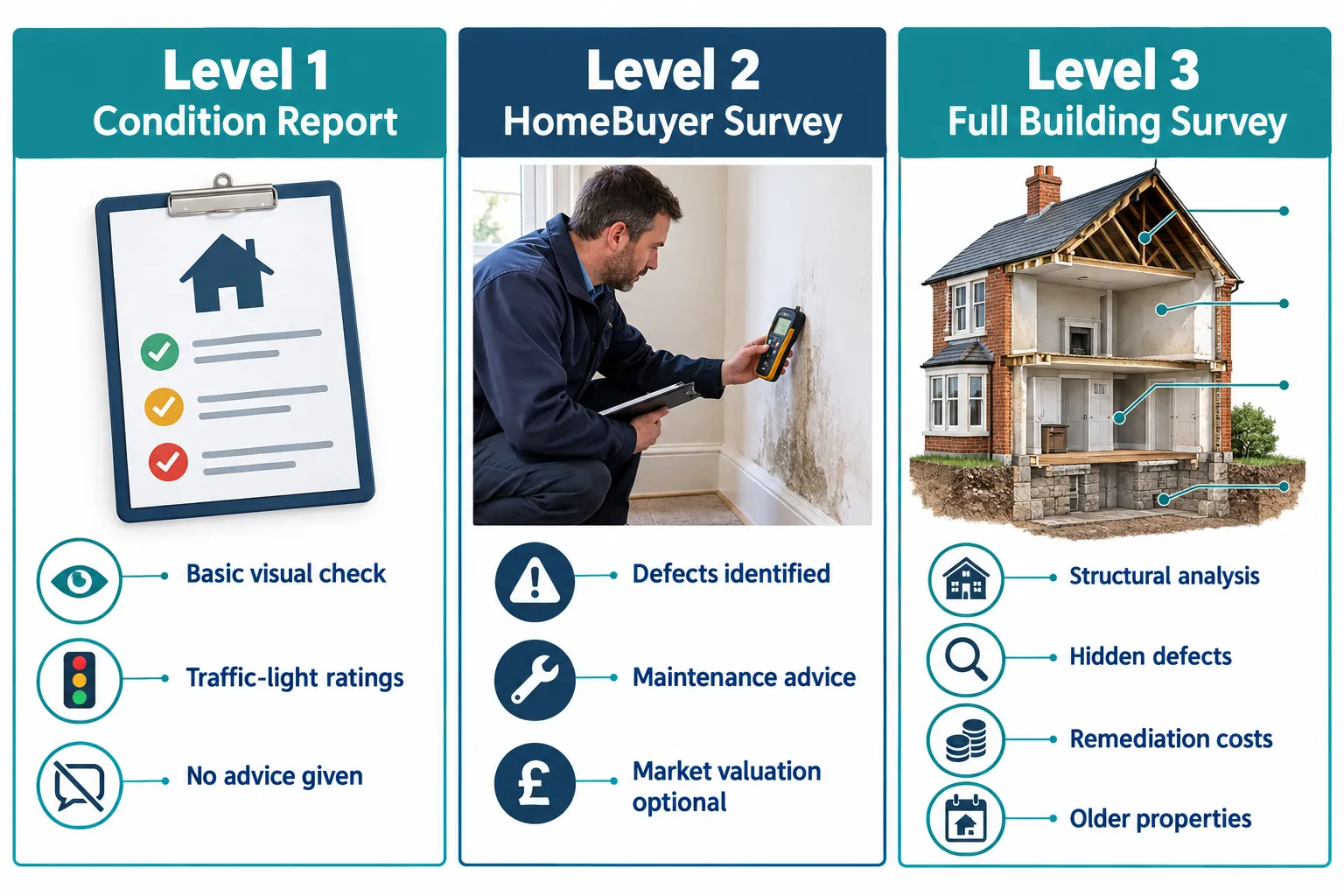
Level 1: Condition Report, The Entry-Level Option
The Level 1 Condition Report is the most basic and least expensive survey available. It uses a traffic-light rating system (Condition Ratings 1, 2, and 3) to flag visible defects but does not offer advice, valuations, or recommendations for remedial work [10].
Typical 2026 cost: £300,£500 [2]
Best suited for:
- Newly built or recently renovated properties
- Standard modern construction (post-1980s)
- Buyers purchasing with a mortgage lender who requires only a basic check
- First-time buyers on very tight budgets purchasing low-risk homes
Limitations: The Level 1 report is a visual-only inspection. It will not identify hidden damp, structural movement, or defects behind finishes. For most buyers, it provides minimal actionable information beyond what a careful walk-through might reveal.
Level 2: HomeBuyer / Home Survey, The Mid-Range Sweet Spot
The Level 2 survey, officially called the RICS Home Survey Level 2, is the most popular choice among UK homebuyers and represents the best balance of cost and coverage for standard residential properties [5].
Typical 2026 cost: £400,£900, depending on property size and location [2] [6]
What it covers:
- Visible defects in the structure, roof, walls, floors, and services
- Damp, timber issues, and insulation
- Condition ratings with explanatory comments
- An optional market valuation (usually an additional fee)
- Maintenance advice and suggested further specialist investigations
Best suited for:
- Conventional homes built after 1900 in reasonable condition
- Standard brick-built semi-detached and terraced properties
- First-time buyers purchasing a typical suburban home
- Buy-to-let investors assessing standard residential stock
"A Level 2 survey is often the most cost-effective choice for buyers of conventional post-war housing, it provides enough detail to negotiate on price or budget for repairs without the higher cost of a full structural report."
As building survey demand continues to accelerate through 2026, waiting times for Level 2 surveys have lengthened in some regions, making early booking advisable.
Level 3: Full Building Survey, The Comprehensive Option
The Level 3 Building Survey is the most thorough inspection available under the RICS framework. It involves a detailed examination of all accessible parts of the property, including the roof space, subfloor areas, and structural elements. The report includes advice on defects, their likely causes, and estimated repair costs [1] [3].
Typical 2026 cost: £630,£1,500+ [7] [8]
What it covers:
- Full structural assessment
- Identification of hidden and visible defects
- Advice on urgency and likely remediation costs
- Guidance on further specialist investigations (e.g., drainage, electrical)
- Detailed commentary on construction methods and materials
Best suited for:
- Properties built before 1919 (Victorian, Edwardian, Georgian)
- Large or unusual properties
- Properties with visible defects or suspected structural issues
- Buyers planning significant renovation or extension work
- High-value purchases where financial risk is elevated
Typical 2026 Fee Ranges and What Drives the Cost
Pricing for all three survey levels varies significantly across the UK. The table below summarises typical 2026 fee ranges by survey level and region [4] [7].
| Survey Level | National Average (2026) | London / South East | North of England / Wales |
|---|---|---|---|
| Level 1 Condition Report | £300,£500 | £400,£650 | £250,£400 |
| Level 2 HomeBuyer Survey | £400,£900 | £600,£1,100 | £350,£700 |
| Level 3 Building Survey | £630,£1,500+ | £900,£2,000+ | £500,£1,100 |
Sources: [2] [4] [6] [7]
Key Factors That Affect Survey Fees
Several variables influence the final quote beyond the survey level chosen:
- Property size: Larger floor areas take longer to inspect and report on.
- Property age and complexity: Pre-1919 construction, listed buildings, and non-standard materials (e.g., timber frame, concrete panel) increase inspection time.
- Location: London and the South East consistently attract the highest fees, often 20-40% above the national average [7].
- Surveyor firm size: Sole practitioners and regional firms often quote lower fees than national chains, though RICS accreditation ensures a consistent minimum standard.
- Add-ons: Optional market valuations, damp and timber reports, or drainage surveys carry additional charges.
Online cost calculators, such as those provided by specialist comparison platforms [6], allow buyers to generate indicative quotes based on postcode, property type, and survey level before contacting firms directly.
Choosing the Right Survey for Your Situation
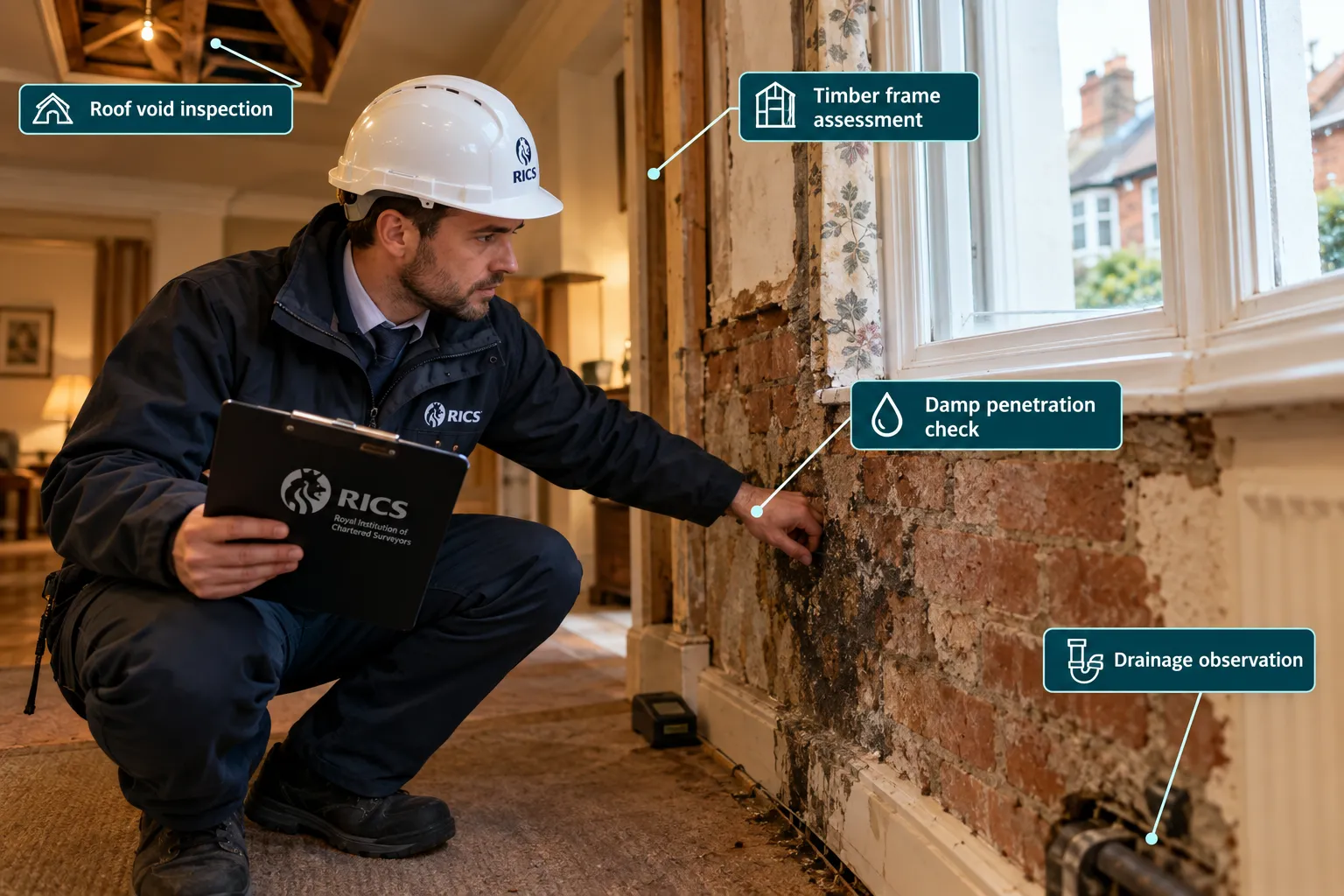
The best budget-friendly building survey options in the UK depend heavily on the buyer's specific circumstances. A one-size-fits-all approach rarely serves buyers well.
First-Time Buyers on a Tight Budget
For a first-time buyer purchasing a standard 1970s semi-detached in good visible condition, a Level 2 survey typically provides the best value. The cost is manageable, and the report delivers enough information to identify significant issues before exchange of contracts.
Skipping a survey entirely, or choosing only a Level 1 report, to save a few hundred pounds is a false economy. A single undiscovered defect, such as a failing roof covering or rising damp, can cost far more than the survey fee to rectify [1].
For guidance on what surveys are needed for newer properties, see this overview of whether you need a survey on a new build.
Buy-to-Let Investors
Investors purchasing residential stock for rental income need a clear picture of maintenance liability and compliance requirements. A Level 2 survey is usually appropriate for modern stock, but older properties in regeneration areas warrant a Level 3 [3]. EPC ratings and retrofit obligations are increasingly relevant to investment decisions, and surveyors are now expected to flag energy efficiency issues alongside structural ones [9].
For a deeper look at how surveys support investment decisions, see building surveys for buy-to-let investment decisions amid 2026 buyer migration to northern markets.
Buyers of Older or High-Risk Properties
Any property built before 1919 should be considered a candidate for a Level 3 Building Survey. Victorian and Edwardian homes frequently present issues including:
- Solid wall damp penetration
- Timber decay in roof structures and floors
- Settlement and subsidence
- Outdated electrical and plumbing systems
- Non-standard chimney and flue configurations
The cost of a Level 3 survey on a Victorian terraced house in the Midlands might be around £700,£900 [8]. If the report identifies £15,000 worth of essential repairs, that fee is returned many times over, either as a price reduction negotiated with the seller, or as advance knowledge that prevents a bad purchase.
Expert opinion consistently supports this view: a Level 3 survey is worth the additional cost whenever structural complexity, age, or visible defects create meaningful financial risk [1].
Properties with Fire Safety and Cladding Concerns
Buyers of flats or apartments in buildings over 11 metres in height should be aware that standard RICS surveys have specific limitations regarding cladding and fire safety assessments. Specialist EWS1 forms and fire risk assessments may be required in addition to a standard survey. For the latest protocols, see updated building survey protocols post-Grenfell for 2026 buyers.
How to Get the Best Value From a Building Survey
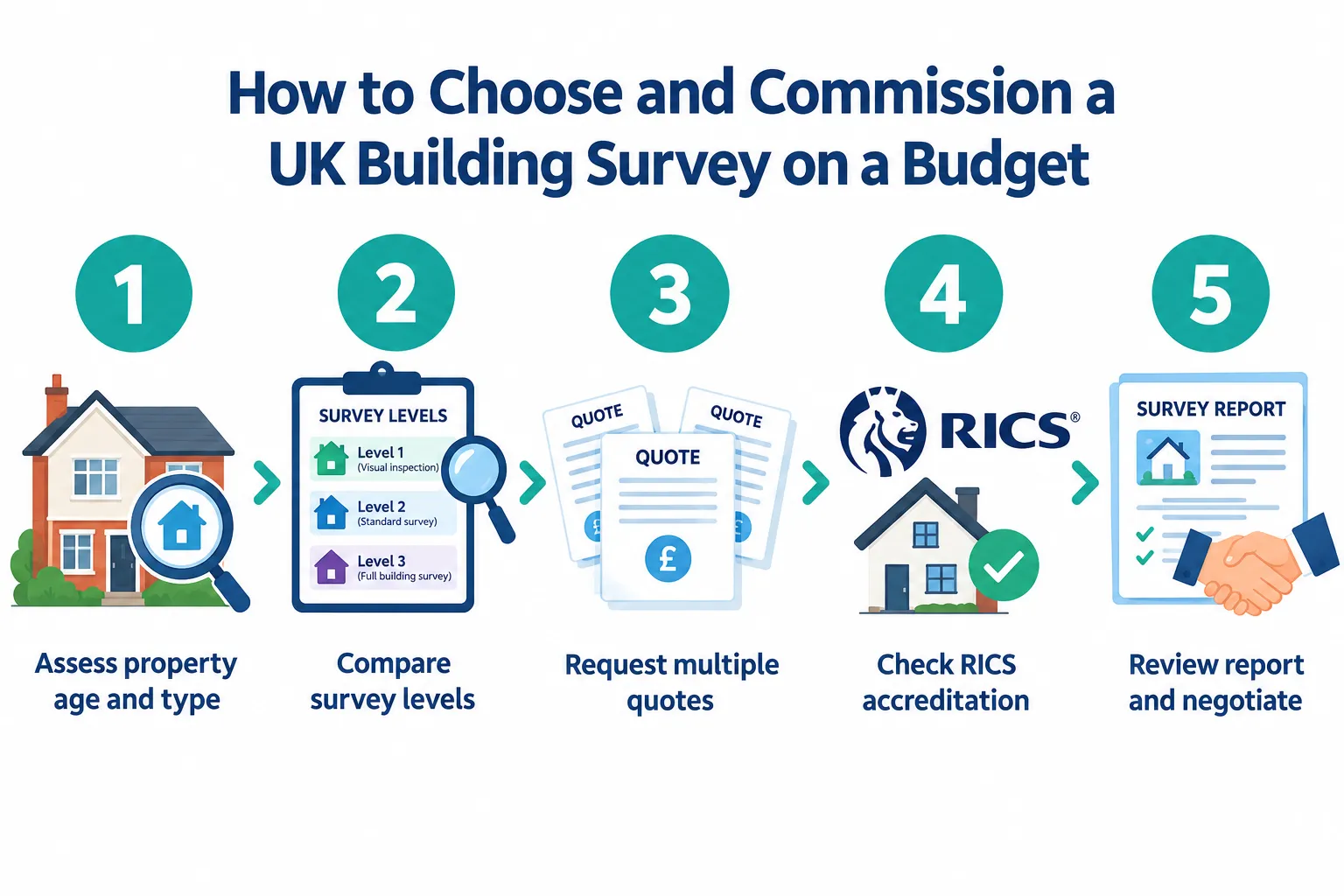
Securing the best budget-friendly building survey options in the UK is not simply about finding the lowest quote. It requires a structured approach to ensure the survey level matches the property risk and that the surveyor chosen is genuinely qualified.
Step 1: Match the Survey Level to the Property
Use the property's age, construction type, and visible condition as the primary guide. When in doubt, upgrade to the next level. The marginal cost difference between a Level 2 and a Level 3 survey is typically £200,£400 [4], a small premium against the potential cost of undetected defects.
Step 2: Obtain Multiple Quotes
RICS does not set fixed fees, so prices vary between firms. Obtaining at least three quotes from RICS-accredited surveyors in the local area is standard practice. Comparison platforms and online cost calculators [6] can streamline this process.
Step 3: Verify RICS Accreditation
Always confirm that the surveyor holds current RICS membership. The RICS Find a Surveyor tool allows buyers to verify credentials directly. The April 2026 update to the RICS Home Survey Standard introduced additional quality controls that all member firms must follow [9].
Step 4: Review the Report Thoroughly
A good survey report is only valuable if the buyer reads and acts on it. Level 3 reports in particular can run to 40-80 pages. Key sections to focus on include:
- Section E: Grounds and boundaries
- Section F: Roof
- Section G: External walls
- Section H: Internal walls, floors, and ceilings
- Section J: Services
The shift from static PDF reports to interactive digital formats is also changing how buyers engage with survey findings. For context on this evolution, see how cloud-based survey platforms are changing client expectations.
Step 5: Use the Report to Negotiate
A survey report is a negotiation tool. Significant defects identified in a Level 2 or Level 3 report can justify a price reduction, a request for the seller to carry out repairs before completion, or, in serious cases, withdrawal from the purchase. Buyers who treat the survey as a final check rather than a decision-making tool miss much of its value.
The Legal Status of Building Surveys in the UK
Building surveys are not legally required when purchasing a property in England, Wales, or Scotland. However, mortgage lenders require a valuation, which is not the same as a survey. A lender's valuation protects the lender, not the buyer. It does not assess the condition of the property in detail and provides no consumer protection if defects are later discovered.
The "optional but wise" framing used by RICS and consumer bodies reflects this reality: buyers are not compelled to commission a survey, but those who do not take on full financial risk for any defects that a survey would have identified.
For context on how mandatory upfront assessment proposals could change this landscape, see building survey scope expansion under mandatory upfront assessment proposals.
EPC Ratings and Their Growing Role in Survey Value
The April 2026 RICS Home Survey Standard update places greater emphasis on energy performance as part of the survey process [9]. With EPC retrofit mandates tightening, a survey that flags poor insulation, inefficient heating systems, or single glazing is increasingly valuable, particularly for buyers who may face mandatory upgrade costs before letting or selling the property in future.
For buyers and landlords navigating these requirements, understanding the intersection of EPC, MEES, and building surveys is essential to assessing the true cost of a purchase.
Conclusion
The best budget-friendly building survey options in the UK are not defined by the lowest upfront fee, they are defined by the best match between survey depth and property risk. For most buyers, the Level 2 HomeBuyer Survey delivers strong value on standard post-war housing. For older, larger, or structurally complex properties, the Level 3 Building Survey is the financially prudent choice, even when the headline cost appears high.
Actionable next steps for buyers in 2026:
- Identify the property's age and construction type before selecting a survey level.
- Use an online cost calculator to generate indicative quotes by postcode and property type [6].
- Request at least three quotes from RICS-accredited surveyors and compare scope, not just price.
- Verify RICS membership using the official Find a Surveyor tool before instructing.
- Read the full report upon receipt and raise any concerns with the surveyor directly before exchange.
- Use the report findings as a negotiation tool with the seller or as the basis for a revised offer.
Spending £600,£900 on a thorough survey before committing to a six-figure purchase is among the most cost-effective decisions a buyer can make in 2026's property market.
References
[1] Is A Level 3 Survey Worth It Heres When To Choose One – lmsurveyors.co.uk
[2] Rics Survey Cost – surveymatch.co.uk
[3] Level 3 Building Survey Cost Uk – homebuyercheck.co.uk
[4] Level 3 Survey Cost 2025 – surveymatch.co.uk
[5] How Much Does A House Survey Cost – cjbloor.co.uk
[6] Property Survey Cost Calculator Uk 2026 – ukcalculator.com
[7] How Much Does A Level 3 Building Survey Cost In 2026 – surveynorth.co.uk
[8] Level 3 Building Survey – housesurveycostcalculator.co.uk
[9] Home Survey Standard 2nd Edition April 2026 Update – rics.org
[10] Home Survey Standards – rics.org