

A market can grow and shrink at the same time. That is exactly what happened at UK property auctions in September, where auctioneers put more homes and commercial units under the hammer than a year earlier, yet fewer of them actually sold. The property auctions September 2026 EIG results, published by Essential Information Group and reported by The Intermediary on 15 October 2026, show lots offered climbing 5.7% year on year while the number of sales dropped 2.5%. For anyone weighing up an auction sale, a purchase, or a valuation, that gap between supply and demand is the story.
This widening gap matters because auction rooms are often seen as a barometer for the wider market. When sellers queue up but buyers hold back, pricing discipline becomes the difference between a lot that sells and one that gets withdrawn.
Key Takeaways
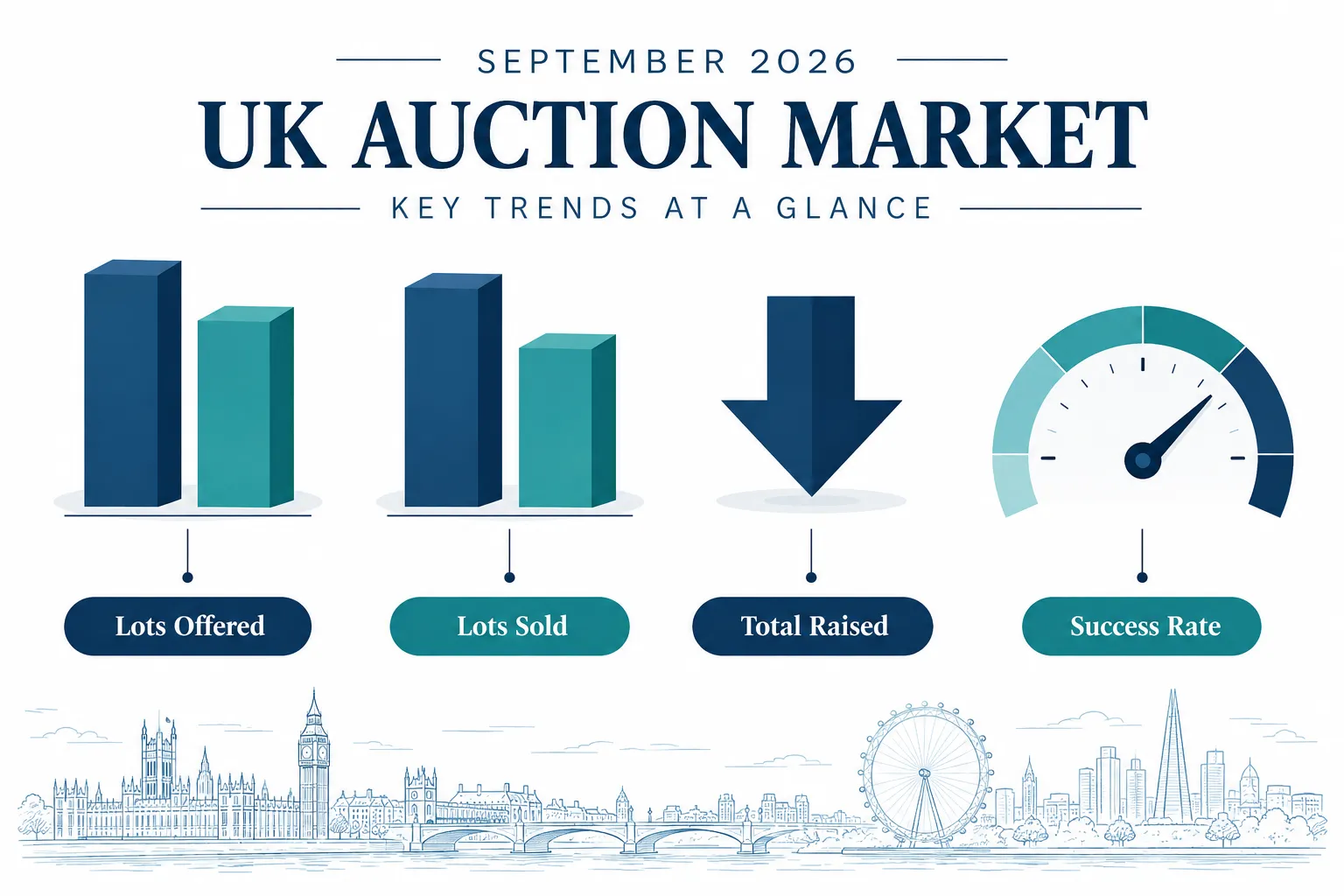
- Lots offered rose 5.7% year on year in September 2026, but sales fell 2.5% and total raised dropped 12.8% to £593.7 million.
- The national success rate held at 65.9%, even as competition for buyer attention increased.
- Residential entries grew 8.1%, outpacing residential sales, which slipped slightly below last year's level.
- Commercial auctions saw steeper falls in both sales and proceeds than residential.
- London bucked the slowdown: lots offered rose 10.6% and lots sold jumped 15.5% across July to September.
- Three regions, the North East, the North West Home Counties and the South East Home Counties, saw both sales volumes and total raised fall year on year.
What the Property Auctions September 2026 EIG Results Show
The headline numbers tell a clear story of rising supply meeting cautious demand. Essential Information Group recorded 4,903 lots offered in September, a 5.7% increase on the same month last year. But the number of lots actually sold fell 2.5%, and the total raised across all sales dropped by 12.8% to £593.7 million.
| Metric | September 2026 | Year-on-year change |
|---|---|---|
| Lots offered | 4,903 | +5.7% |
| Number of sales | Down | -2.5% |
| Total raised | £593.7 million | -12.8% |
| National success rate | 65.9% | Held broadly steady |
| Residential entries | Up | +8.1% |
Residential activity drove most of the extra supply, with entries up 8.1%. Residential sales, however, slipped slightly below last year's figure, a sign that even in the strongest sector, buyer appetite has not kept pace with seller interest. Commercial lots fared worse, with a steeper fall in both sales and proceeds than residential.
Matt Burrows, a member of NAVA Propertymark's advisory panel, summed up the pattern directly: "the latest monthly results show that growth in supply is not being matched by sales." He added that "professional judgement remains central to attracting buyer interest", a pointed reminder that how a lot is priced and presented now carries more weight than simply listing it.
Regional Picture and the 12-Month Trend Behind the EIG Results
Zoom out from the single month and a longer pattern becomes visible. Over the twelve months to September 2026, residential lots offered rose 11.3% and residential lots sold increased 9.1%, both signs of a steadily expanding auction market, even if sales growth now trails supply growth.
The regional breakdown for July to September 2026 shows this unevenly spread:
- London was the standout performer, with lots offered up 10.6% and lots sold up 15.5%, sales growing faster than supply, unlike the national picture.
- Scotland recorded rising sales across the quarter.
- The South West and Wales stayed ahead of last year's totals.
- Three regions lagged: the North East, the North West Home Counties, and the South East Home Counties all saw sales volumes and total raised fall year on year.
The North West Home Counties and South East Home Counties are EIG's terms for the commuter belt counties surrounding London, not shorthand for the wider North West or South East of England. Their underperformance suggests buyers in traditionally strong commuter markets are being more selective, possibly reflecting higher mortgage costs biting harder on higher-value stock.
Why Supply Is Outrunning Demand
The property auctions September 2026 EIG results do not exist in isolation. They echo trends already visible in the mainstream housing market. Zoopla's 1 October 2026 report found sales agreed down 9% year on year, and noted that one in four newly listed homes had been on the market before, six in ten of those relisted at a lower price after failing to sell first time round.

Rightmove's 21 September 2026 data adds further context: the number of homes for sale sits at a 12-year high for this time of year, and it now takes an average of 67 days to secure a buyer. Borrowing costs are a major factor. Mortgage rates have pushed above 5% for the first time in three years, and figures from PropertyWire via Tembo on 15 October put the average two-year fix at 5.97% and the five-year fix at 5.99%, against a Bank of England base rate of 3.75%. The next rate decision lands on 5 November, and the Autumn Budget on 28 October adds another layer of uncertainty that many buyers appear to be waiting to see play out.
Put simply, more sellers are testing the market than there are buyers willing to commit at current prices, and auction rooms are feeling that imbalance directly.
What the EIG Results Mean for Sellers Pricing a Lot
When supply outstrips demand, the lots that sell are usually the ones priced to reflect real market conditions, not last year's expectations. A guide price set too optimistically will simply sit unsold, or get withdrawn before the gavel falls.
Practical steps for sellers:
- Commission a RICS Red Book valuation before setting a reserve. An independent, evidence-based figure protects against both underselling and over-pricing.
- Understand the sale method. Unconditional auction sales typically require completion within 28 days and legally bind the buyer once the hammer falls. Conditional (modern method) sales give buyers more time but usually carry a non-refundable reservation fee.
- Review the legal pack early. Delays or missing information deter serious bidders before they even register.
- Price for the current climate, not last year's figures. With success rates holding at 65.9% nationally despite rising supply, well-priced lots are still finding buyers.
Executors handling probate sales and landlords exiting a portfolio face the same pressure: a realistic reserve, backed by a professional valuation, remains the most reliable route to a completed sale.
What the EIG Results Mean for Buyers at Auction
For buyers, a market with more lots and fewer competing bidders can mean better choice and slightly less pressure. But the fundamentals of safe auction buying have not changed.
- Get a pre-auction RICS survey. Auction properties are sold as seen, with no right to renegotiate after the hammer falls.
- Read the legal pack thoroughly, ideally with a solicitor, before bidding.
- Factor in finance costs. With two-year fixed mortgage rates near 5.97%, buyers using auction finance should confirm affordability well before the sale date.
- Set a hard ceiling based on independent valuation advice, not the published guide price alone, since guides can sit below the likely reserve.
Frequently Asked Questions
What were the main property auctions September 2026 EIG results?
Lots offered rose 5.7% year on year to 4,903, while sales fell 2.5% and total raised dropped 12.8% to £593.7 million. The national success rate held at 65.9%.
Why did sales fall even though more lots were offered?
Wider housing market conditions, mortgage rates above 5%, cautious buyer sentiment, and record stock levels reported by Rightmove, meant demand did not keep pace with the extra supply entering auction rooms.
Did every region perform the same way?
No. London saw sales grow faster than supply in the third quarter, while the North East, North West Home Counties and South East Home Counties all recorded falling sales and lower total proceeds.
How can sellers improve their chances of a sale?
A RICS Red Book valuation and a realistic reserve, combined with a clean, ready legal pack, give a lot the best chance of attracting serious bidders in a supply-heavy market.
Is now a good time to buy at auction?
Choice is wider than it has been in years, but buyers should still commission independent surveys and legal pack reviews, and budget for mortgage rates currently near 6% on fixed terms.
Conclusion
The property auctions September 2026 EIG results capture a market in transition: more sellers testing the auction route, but buyers growing more selective under the weight of higher borrowing costs and record housing stock. Success rates have held up, proving that well-prepared, realistically priced lots can still sell, but the margin for error has narrowed.
Sellers considering auction should start with an independent RICS valuation to set a defensible reserve, and buyers should never skip a pre-auction survey or legal pack review. Prince Surveyors provides RICS Red Book valuations and pre-auction surveys across London and the South East, helping clients price and bid with confidence as the market continues to rebalance ahead of the Autumn Budget and the Bank of England's next rate decision.
property auctions, EIG results, auction lots September 2026, UK property market, auction sales trends, RICS valuation, property investment, auction guide prices, residential auctions, commercial property auctions, mortgage rates 2026, probate property sales