

{"cover":"Professional landscape format (1536×1024) hero image with bold text overlay 'Building Survey Saves You More' (≤42 chars) in crisp white sans-serif on a deep navy semi-transparent overlay panel, centered with 8% safe margins from every edge. Background: bright editorial daylight photograph of a UK period terraced house exterior with a suited chartered surveyor holding a clipboard and inspection tools, examining brickwork closely, warm natural afternoon light, shallow depth of field on the surveyor, magazine cover aesthetic, professional teal-and-navy color palette, high contrast editorial quality.","content":["Three-panel annotated infographic diagram (1536×1024) illustrating the three RICS survey levels for UK homebuyers: Panel 1 labeled 'Level 1 Condition Report' showing a simple house icon with three short callout labels: 'Basic condition check', 'Traffic light ratings', 'New builds suitable'; Panel 2 labeled 'Level 2 HomeBuyer Survey' showing a mid-terrace house cross-section with callouts: 'Damp detection', 'Roof inspection', 'Structural overview'; Panel 3 labeled 'Level 3 Building Survey' showing a detailed Victorian house cutaway with callouts: 'Full structural analysis', 'Hidden defect mapping', 'Older properties', 'Remedial cost estimates'. Clean white background, teal-navy-amber palette, thin callout lines, editorial infographic polish, landscape format.","Split-screen editorial comparison image (1536×1024): left half shows a distressed UK homeowner in a modern kitchen surrounded by visible damp patches on walls, peeling plaster, and a contractor holding a repair quote clipboard, warm but tense indoor lighting, label overlay 'No Survey: Unexpected Repair Bills'; right half shows a confident mixed-ethnicity couple at a solicitor's desk reviewing a building survey report with a highlighted defect section and a reduced sale price agreement document visible, bright natural office light, label overlay 'With Survey: Negotiated Savings'. High-contrast split divider line, professional magazine composition, teal and amber accent palette.","Numbered step-by-step process flow diagram (1536×1024) showing the building survey cost-benefit decision journey for UK homebuyers: Step 1 labeled 'Commission Survey £400,£1,500' with a small surveyor icon; Step 2 labeled 'Defects Identified' with a magnifying glass over a crack icon; Step 3 labeled 'Renegotiate Purchase Price' with a downward arrow on a house price tag; Step 4 labeled 'Avoid Post-Purchase Repairs' with a crossed-out repair bill icon; Step 5 labeled 'Net Saving £2,600+ Average' with an upward savings graph. Clean white background, bold teal numbered circles, navy connecting arrows, amber accent highlights on savings step, editorial flat-vector illustration style, landscape format."]
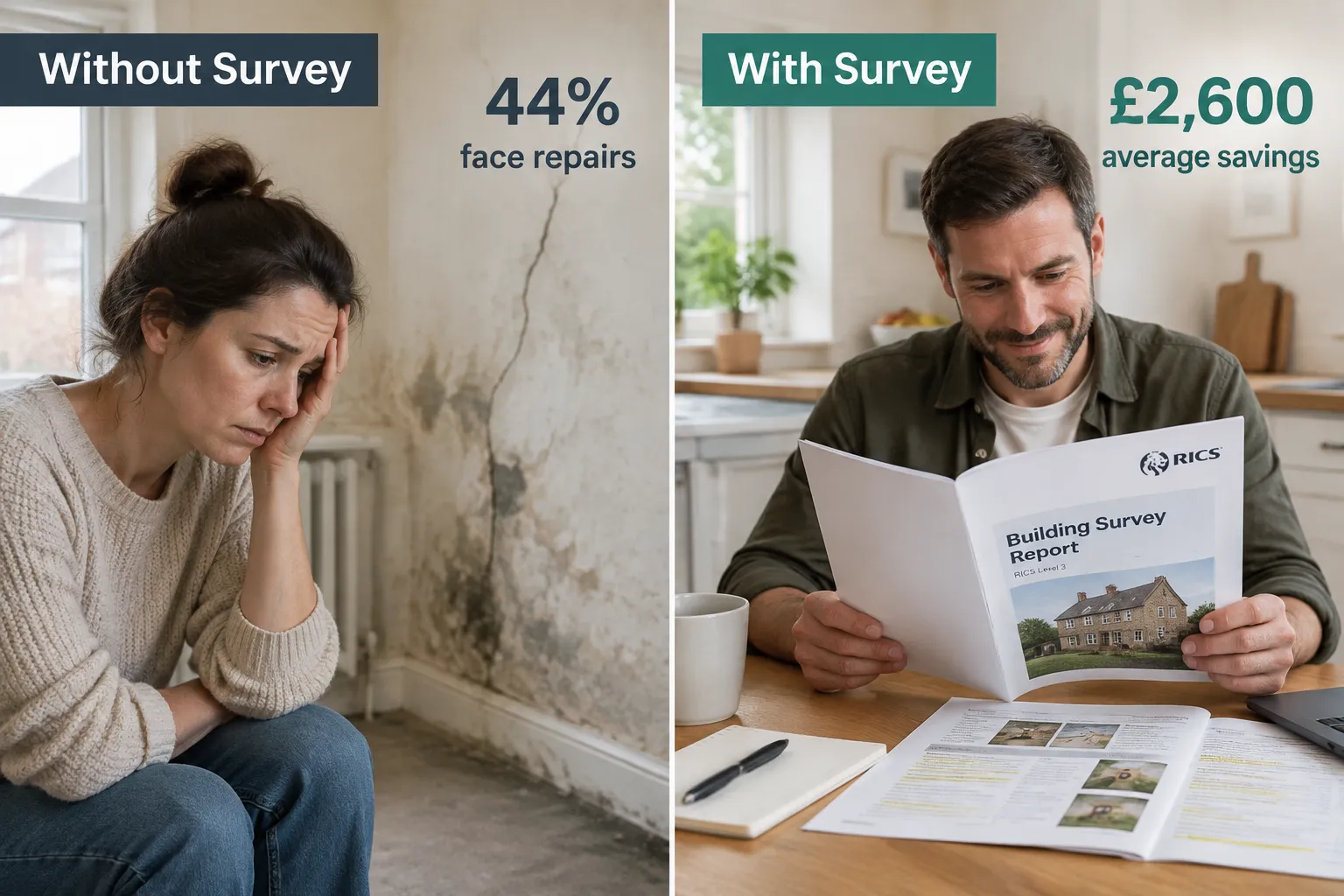
Forty-four percent of UK homeowners who skipped a professional building survey faced significant repair bills within their first year of ownership, and nearly half of those spent more than £3,000 putting things right [6]. That single statistic reframes the entire debate around survey costs. Understanding why "money" spent on a building survey saves you more later is not a matter of caution; it is a straightforward cost-benefit calculation that every UK homebuyer should run before exchanging contracts.
This article examines that calculation in detail: what surveys cost, what they uncover, how they strengthen negotiating positions, and why the upfront expenditure consistently delivers a measurable financial return.
Key Takeaways
- A building survey typically costs between £300 and £1,500, but buyers who commission one save an average of £2,600 through price renegotiation or avoided repairs.
- Buyers who skip surveys face a 44% chance of significant repair bills in year one, with 15% facing costs above £10,000.
- Damp, asbestos, and structural defects are among the most common hidden issues that only a professional survey reliably identifies.
- Survey findings give buyers documented leverage to renegotiate the purchase price or require sellers to remedy defects before completion.
- A Level 3 Building Survey is strongly recommended for older, larger, or non-standard properties where hidden defects are most likely.
Understanding the Three RICS Survey Levels and Their Costs
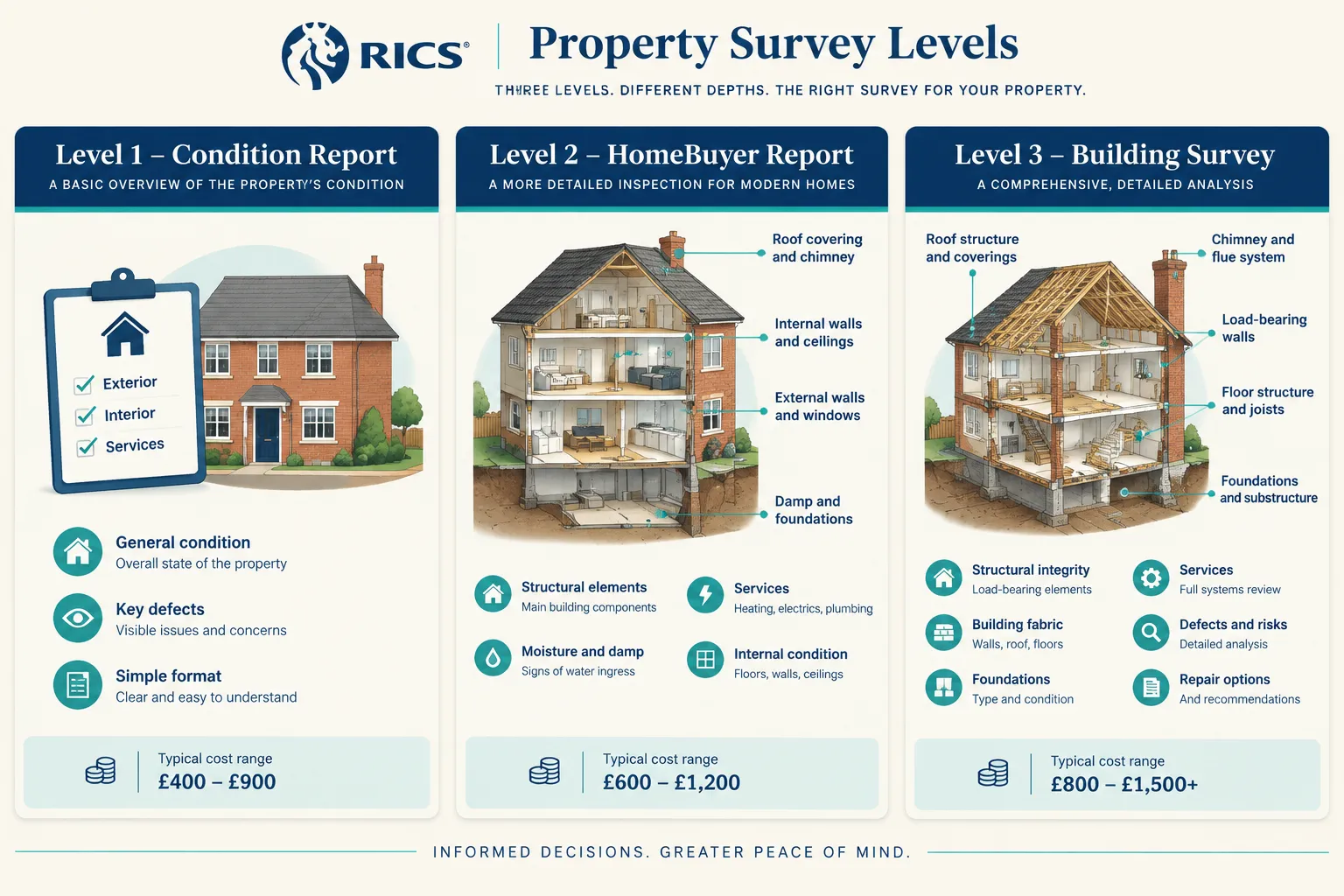
Before running any cost-benefit analysis, it helps to understand what the UK survey market actually offers. The Royal Institution of Chartered Surveyors (RICS) structures residential surveys into three levels, each designed for different property types and buyer needs [2][9].
Level 1, Condition Report: The most basic option, suited to new-build or conventionally constructed properties in good condition. Costs typically range from £300 to £450 [1][8]. It uses a traffic-light rating system to flag visible concerns but does not include a valuation or detailed advice.
Level 2, HomeBuyer Report: The most commonly commissioned survey in the UK. Costs range from approximately £400 to £950 depending on property size and value [1][4][8]. It covers visible defects, damp, drainage, and roof condition, and can include a market valuation. This level is appropriate for conventional properties in reasonable condition built after around 1900.
Level 3, Building Survey: The most comprehensive option, covering all accessible areas of the property and providing detailed analysis of structure, materials, and defects. Costs start at around £600 and can exceed £1,500 for large or complex properties [1][8][10]. This survey is strongly recommended for older homes, listed buildings, properties with extensions, or any building showing visible signs of distress.
| Survey Level | Typical Cost Range | Best Suited For |
|---|---|---|
| Level 1 Condition Report | £300, £450 | New builds, modern standard properties |
| Level 2 HomeBuyer Report | £400, £950 | Conventional properties post-1900 |
| Level 3 Building Survey | £600, £1,500+ | Older, larger, or non-standard properties |
These figures represent the upfront investment. The question is what that investment returns, and the data is compelling.
For first-time buyers navigating these choices, the building survey protocols for first-time buyers in 2026 leveraging affordability gains and negotiation power provides detailed guidance tailored to buyers entering the market for the first time.
The Real Cost of Skipping a Survey: What the Data Shows
The financial case for why "money" spent on a building survey saves you more later becomes clearest when examining what happens to buyers who choose not to commission one.
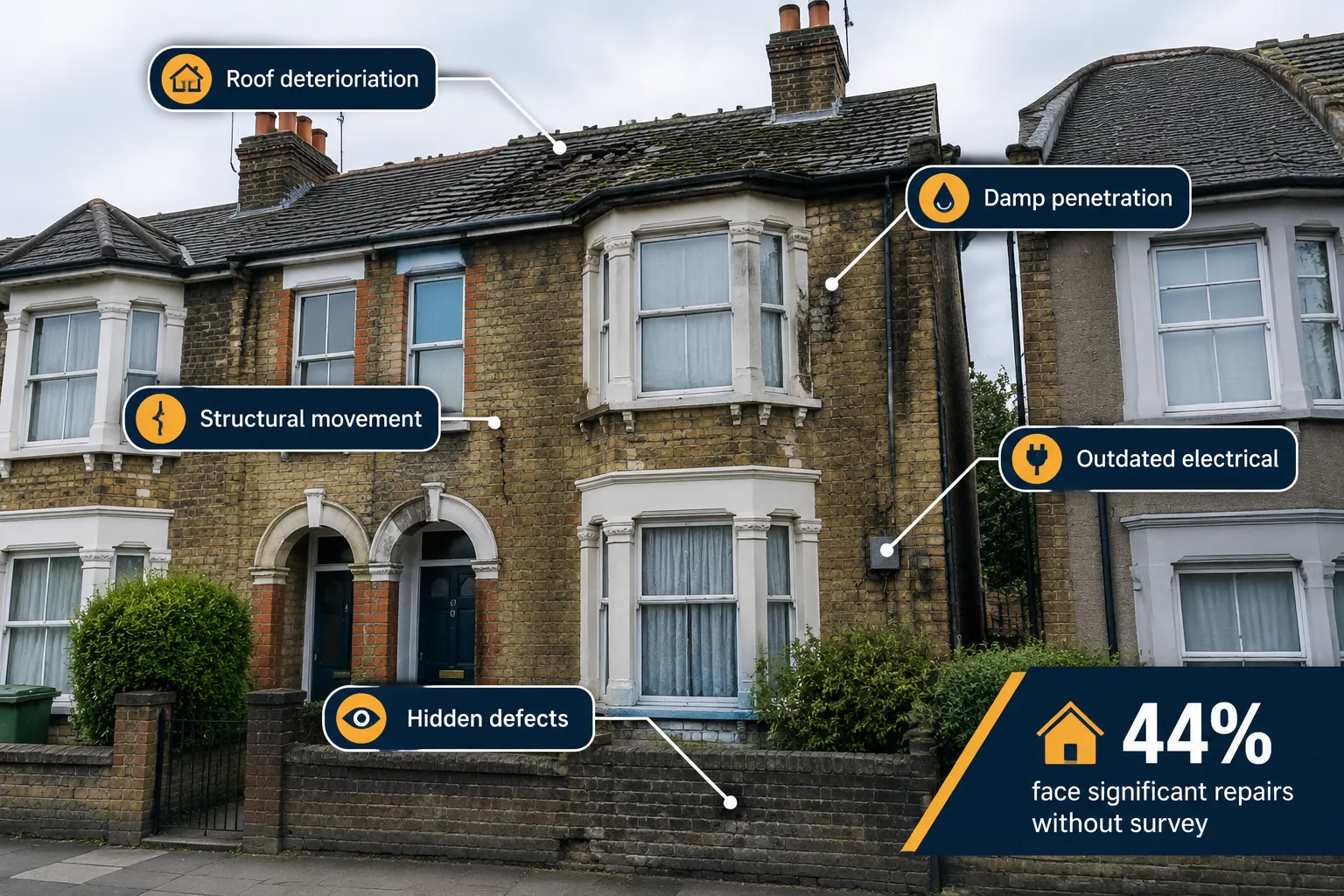
Research reported by Builder UK Magazine found that 44% of homeowners who did not get a professional survey faced significant repair needs in their first year [6]. Of those, 49% spent more than £3,000 on remedial work, and 15% faced bills exceeding £10,000 [6]. To put that in perspective: a buyer who saves £600 by skipping a Level 3 survey has a statistically meaningful chance of spending ten times that amount within twelve months.
Legal & General Surveying Services' 2026 research identifies the most common culprits: damp and asbestos are among the hidden problems most frequently missed by buyers who forgo a home survey [5]. A Level 2 survey costs around £400 on average, yet the cost of treating damp or managing asbestos-containing materials can run into thousands of pounds, particularly in older or poorly maintained properties [5].
"Saving a few hundred pounds on survey fees can lead to five-figure repair costs. That is not a risk calculation; it is a near-certainty for a significant minority of buyers."
Beyond the repair bills themselves, there are secondary costs that rarely appear in headline figures:
- Mortgage complications: Lenders may withdraw or reduce offers if structural problems emerge post-survey, creating costly delays or forcing buyers to renegotiate financing terms.
- Insurance implications: Some insurers will not cover pre-existing defects that a professional survey would reasonably have identified.
- Resale value impact: Unresolved structural or damp issues suppress future sale prices and complicate onward transactions.
- Stress and disruption: Living in a property undergoing emergency remedial work carries real personal and professional costs that no spreadsheet fully captures.
For buyers considering properties with specific modern risks, the article on cladding, RAAC, and hidden defects that a modern UK building survey must cover in 2026 outlines the expanded scope of issues that surveyors now assess.
How Survey Findings Translate Directly Into Financial Savings
The most direct financial benefit of commissioning a building survey is the negotiating power it creates. When a surveyor identifies defects, whether structural movement, roof deterioration, damp penetration, or outdated electrical systems, the buyer has documented, professional evidence to support a price reduction or a request for remedial works before completion.
Research cited by MovingCompared and Direct Line Home Insurance found that buyers who commissioned a survey saved an average of £2,600, primarily through renegotiating the purchase price or requiring sellers to address defects before exchange [3]. The HomeOwners Alliance reports that approximately 1 in 3 buyers who obtained a survey ended up saving money, either by paying less or by avoiding unforeseen post-purchase expenses [7][8].
This negotiation mechanism works in several ways:
- Price reduction: The buyer presents the survey report to the seller and requests a reduction equivalent to the estimated remediation cost. On a £350,000 property, a £5,000 reduction is modest for the seller but substantial for the buyer.
- Seller remediation: The seller agrees to fix identified issues before completion, at their own cost. This is common for straightforward defects such as roof tile replacement or minor damp treatment.
- Informed withdrawal: If the survey reveals problems too severe or too costly to justify the agreed price, the buyer can withdraw before exchange, avoiding a potentially catastrophic purchase altogether.
- Budget planning: Even where no renegotiation occurs, the survey gives buyers an accurate picture of near-term repair expenditure, allowing them to budget appropriately or secure additional financing.
It is worth noting that 21% of recent buyers skipped a survey entirely, effectively playing a guessing game with one of the largest financial commitments of their lives [3]. The average saving of £2,600 among those who did commission surveys represents a return of between 173% and 433% on the typical survey cost, depending on the level chosen.
Buyers purchasing properties with visible exterior concerns should also review building survey red flags in kerb appeal: 2026 protocols for roofs, paint, and driveways that affect valuations to understand how surface-level issues can signal deeper structural problems.
Choosing the Right Survey for Maximum Return on Investment
Not every property carries the same risk profile, and the cost-benefit calculation shifts depending on the building's age, construction type, and condition. Matching the survey level to the property is essential for maximising the return on survey expenditure.
When a Level 2 HomeBuyer Report is sufficient:
- Conventional brick-built properties constructed after approximately 1900
- Properties in visibly good condition with no obvious structural concerns
- Standard construction without significant extensions or alterations
- Buyers with some property knowledge who understand the report's limitations
When a Level 3 Building Survey is essential:
- Properties built before 1900, particularly Victorian and Edwardian terraces
- Any property showing visible signs of movement, damp, or neglect
- Non-standard construction: timber frame, thatched roofs, stone walls, prefabricated systems
- Properties with significant extensions, basement conversions, or loft conversions
- Listed buildings or properties in conservation areas
The cost difference between a Level 2 and Level 3 survey, often £200 to £600, is negligible compared with the potential cost of missing a serious structural defect. For older properties in particular, the Level 3 survey is not a premium option; it is the appropriate minimum standard.
Buyers considering properties that may have undergone office-to-residential conversion should also consult guidance on expert witness valuations for office-to-residential conversions and building survey integration in 2026, as these properties carry distinct structural and compliance risks.
Surveys and the Broader Homebuying Process in 2026
The role of building surveys in the UK homebuying process is evolving. Proposed RICS homebuying reforms under consideration in 2026 would make upfront condition assessments a standard part of property listings, shifting the survey from a buyer-commissioned afterthought to a front-loaded transaction tool [2][9]. This model, already established in Scotland, has been shown to reduce transaction fall-through rates and accelerate completions.
For buyers operating in the current market, understanding building surveys under RICS home buying reforms in 2026 is increasingly relevant as the regulatory landscape shifts.
The financial logic of why "money" spent on a building survey saves you more later is also reinforced by the current lending environment. Mortgage lenders conduct their own valuations, but these are designed to protect the lender, not the buyer. A lender's valuation will not identify damp behind a freshly painted wall, asbestos in artex ceilings, or movement in a chimney breast. Only an independent building survey commissioned by the buyer provides that level of protection.
For buyers seeking to understand how lender requirements interact with independent survey obligations, the mortgage lender survey requirements in 2026: what valuers need to know about changing lending standards offers a clear breakdown of where lender valuations end and buyer protection begins.
Key questions to ask a surveyor before commissioning:
- Is the surveyor RICS-accredited and experienced with properties of this age and type?
- What is included and excluded from the survey scope?
- Will the report include estimated remediation costs for identified defects?
- How long will the report take to produce, and in what format will it be delivered?
- Does the surveyor carry professional indemnity insurance?
The Cost-Benefit Summary: Numbers That Make the Case
The core argument for why "money" spent on a building survey saves you more later can be distilled into a straightforward financial comparison:
Cost-Benefit at a Glance
| Scenario | Typical Cost | Typical Outcome |
|---|---|---|
| Level 2 survey commissioned | £400, £950 | Average saving of £2,600 via renegotiation |
| Level 3 survey commissioned | £600, £1,500+ | Full structural picture; avoids post-purchase surprises |
| No survey commissioned | £0 upfront | 44% chance of significant repairs in year one; 15% face bills over £10,000 |
The expected value calculation is unambiguous. A buyer spending £800 on a Level 3 survey on a Victorian terraced house has a reasonable statistical expectation of either saving that amount through renegotiation or avoiding repair bills that could be ten to twenty times larger. The survey does not guarantee a saving in every case, some properties are genuinely defect-free, but the aggregate data consistently favours commissioning one.
Conclusion
The financial case for commissioning a building survey before purchasing a UK property is not a matter of opinion, it is supported by consistent, quantifiable evidence. Buyers who invest between £300 and £1,500 in a professional survey save an average of £2,600 through renegotiation, while those who skip the survey face a 44% probability of significant first-year repair costs, with 15% spending more than £10,000 [3][6]. Damp, asbestos, structural movement, and roofing failures do not announce themselves at viewings; they surface in survey reports, or in contractor invoices after completion [5].
Actionable next steps for UK homebuyers in 2026:
- Commission the right level of survey for the property. Use a Level 2 HomeBuyer Report for modern, standard properties and a Level 3 Building Survey for anything older than 1900, non-standard, or showing visible defects.
- Instruct an RICS-accredited surveyor with demonstrable experience in the property type and region. Ask for professional indemnity confirmation before instructing.
- Use the report as a negotiation tool. Do not treat survey findings as obstacles, treat them as leverage. Request a price reduction or seller remediation for every material defect identified.
- Budget for the findings. Even where renegotiation is not possible, use the survey to plan post-purchase expenditure accurately rather than discovering costs after moving in.
- Do not rely on the mortgage lender's valuation as a substitute for an independent survey. Lender valuations protect the lender, not the buyer.
The money spent on a building survey is not a cost, it is one of the highest-return investments available in the homebuying process.
References
[1] Survey Costs 2026 – housesurveys.co.uk
[2] House Surveys UK: The Costs, Types and Benefits of an RICS Home Survey – rics.org
[3] The £2,600 Guessing Game: 21% of Recent Buyers Skipped a Survey – modernlender.co.uk
[4] House Survey Costs 2026 – movingcompared.co.uk
[5] Damp and Asbestos Most Common Hidden Issues Missed by Buyers Skipping Home Surveys, Reveals Legal & General Surveying Services – group.legalandgeneral.com
[6] Half of Homebuyers Face £3k Repairs in First Year After Skipping Survey – builderukmag.co.uk
[7] Survey When Buying a House – barnesandbarnes.london
[8] How Much Does a House Survey Cost – hoa.org.uk
[9] Home Survey Standards – rics.org
[10] House Survey Cost – housecheckup.co.uk