

Only one in five UK homebuyers commissions a full building survey before exchanging contracts, yet the average cost of unexpected structural repairs discovered after purchase exceeds £5,500, according to consumer property research. That gap between the cost of a thorough survey and the cost of ignoring one is precisely why budgeting for a full building survey in the UK: using your "budget" wisely before you buy deserves far more attention than most buyers give it.
In 2026, with subdued buyer demand and higher mortgage rates creating a more cautious market [2][5][8], the financial case for rigorous pre-purchase due diligence is stronger than ever. This guide explains what a full building survey costs, how to allocate your overall purchase budget across surveys, specialist reports and repair contingencies, and how to decide which level of survey your target property genuinely needs.
Key Takeaways
- A RICS Home Survey Level 3 (full building survey) typically costs £630,£1,800 in 2026, depending on property size, age and location [4][7][9]
- The survey fee is only one part of your pre-purchase budget; specialist follow-up reports and a repair contingency fund are equally important to plan for
- Matching the survey level to the property's risk profile, not just its price, is the single most effective way to use your survey budget wisely
- In a subdued 2026 market, survey findings give buyers genuine negotiating power that can recover the survey fee many times over [2][5]
- RICS currently organises home surveys into three levels under the Home Survey Standard, with Level 3 being the most thorough option [1][6][10]
Understanding the Three RICS Survey Levels
Before allocating any budget, buyers need to understand what they are actually choosing between. RICS currently organises home surveys into three levels under the Home Survey Standard (1st edition, April 2024), which remains in force while a second edition is under review [1][6].
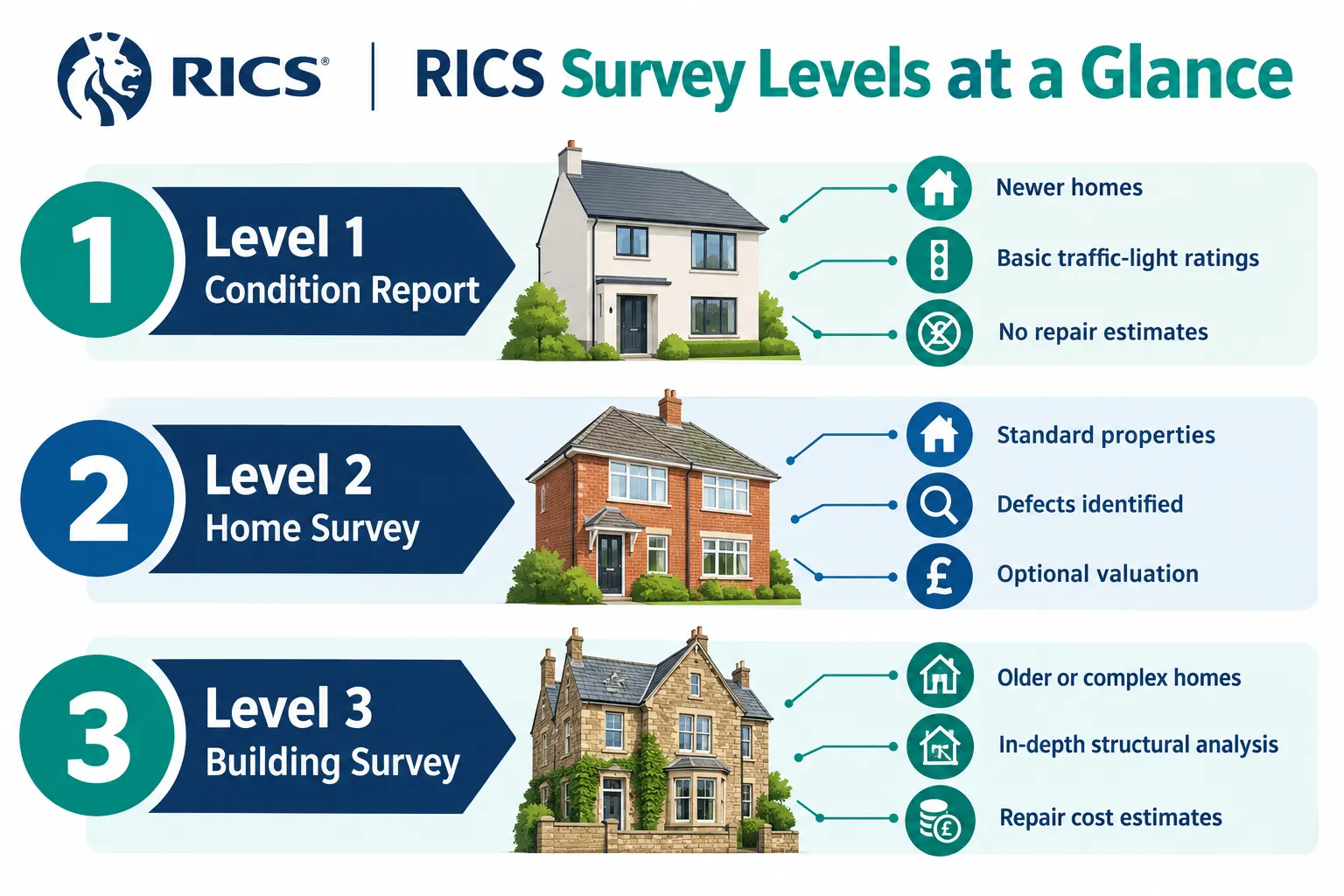
Level 1, Condition Report: The most basic option, using a traffic-light rating system to flag visible defects. It does not include advice on repairs or maintenance and suits only newer, conventionally built homes in apparently good condition. Typical cost: £300,£400 outside London [7].
Level 2, Home Survey (formerly Homebuyer Report): A more detailed inspection covering accessible parts of the property, with commentary on defects and, optionally, a market valuation. Suitable for standard properties built after roughly 1900 that show no obvious signs of major problems. Typical cost: £400,£1,000 [7][9].
Level 3, Building Survey (Full Structural Survey): The most comprehensive option, providing an in-depth view of the property's condition, commentary on construction methods, and, in many cases, estimates of repair costs for identified defects [9][10]. It is the appropriate choice for older, larger, listed, heavily altered or structurally complex properties. Typical cost: £600,£1,800 [7][9].
"The Level 3 building survey is designed to give you a thorough understanding of the property's construction and condition, but it is not a design or specification document. It identifies risks and may recommend further investigations." [9][10]
For a detailed explanation of what the Level 3 option covers, see What Is A Level 3 Building Survey.
What Does a Full Building Survey Actually Cost in 2026?
Realistic budgeting for a full building survey in the UK starts with understanding how fees are structured. Costs are not fixed, they scale primarily with property value, floor area, age and geographic location [4][9][13].
Typical Fee Ranges
| Property Value | Typical Level 3 Fee (Outside London) | Typical Level 3 Fee (London) |
|---|---|---|
| Up to £200,000 | £630,£900 | £800,£1,100 |
| £200,001,£400,000 | £800,£1,100 | £950,£1,350 |
| £400,001,£600,000 | £950,£1,300 | £1,100,£1,500 |
| £600,001,£1,000,000 | £1,100,£1,500 | £1,300,£1,800 |
Sources: [4][7][9]. Figures are indicative 2026 ranges; always obtain written quotes.
The average across all UK regions sits close to £1,000 for a Level 3 survey on a mid-range property [4][9]. A useful rule of thumb: budget approximately 0.1%,0.2% of the purchase price for the survey fee alone.
Why Fees Vary
Several factors push costs toward the upper end of the range:
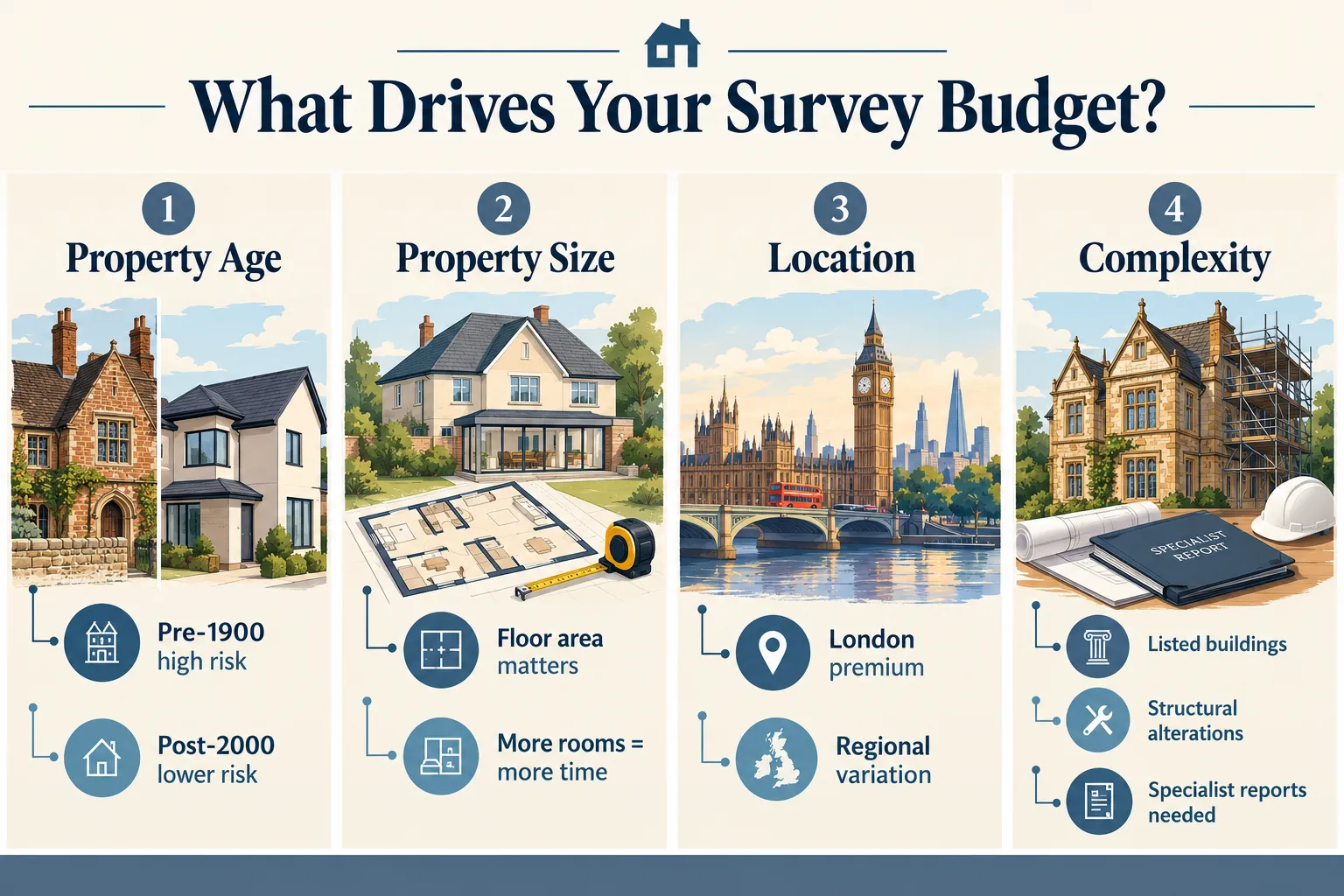
- Age and construction type: Pre-Victorian properties, timber-framed buildings and those with non-standard construction require more surveyor time and specialist knowledge
- Size: More rooms and outbuildings mean a longer inspection
- Condition: Visible defects prompt more detailed investigation
- Location: London and the South East consistently attract a premium [7]
- Listed status: Grade I and II listed buildings almost always command higher fees due to the complexity of assessing historic fabric
For buyers of high-value properties, the Chartered Surveyor Checklists For High Value Properties Under 2026 Budget Tax Thresholds Mitigating 2m Risks resource provides additional context on survey scope at the upper end of the market.
Building a Complete Pre-Purchase Survey Budget
The headline survey fee is only the starting point. Using your budget wisely before you buy means accounting for the full range of costs that a Level 3 survey may trigger.
Layer 1: The Core Survey Fee
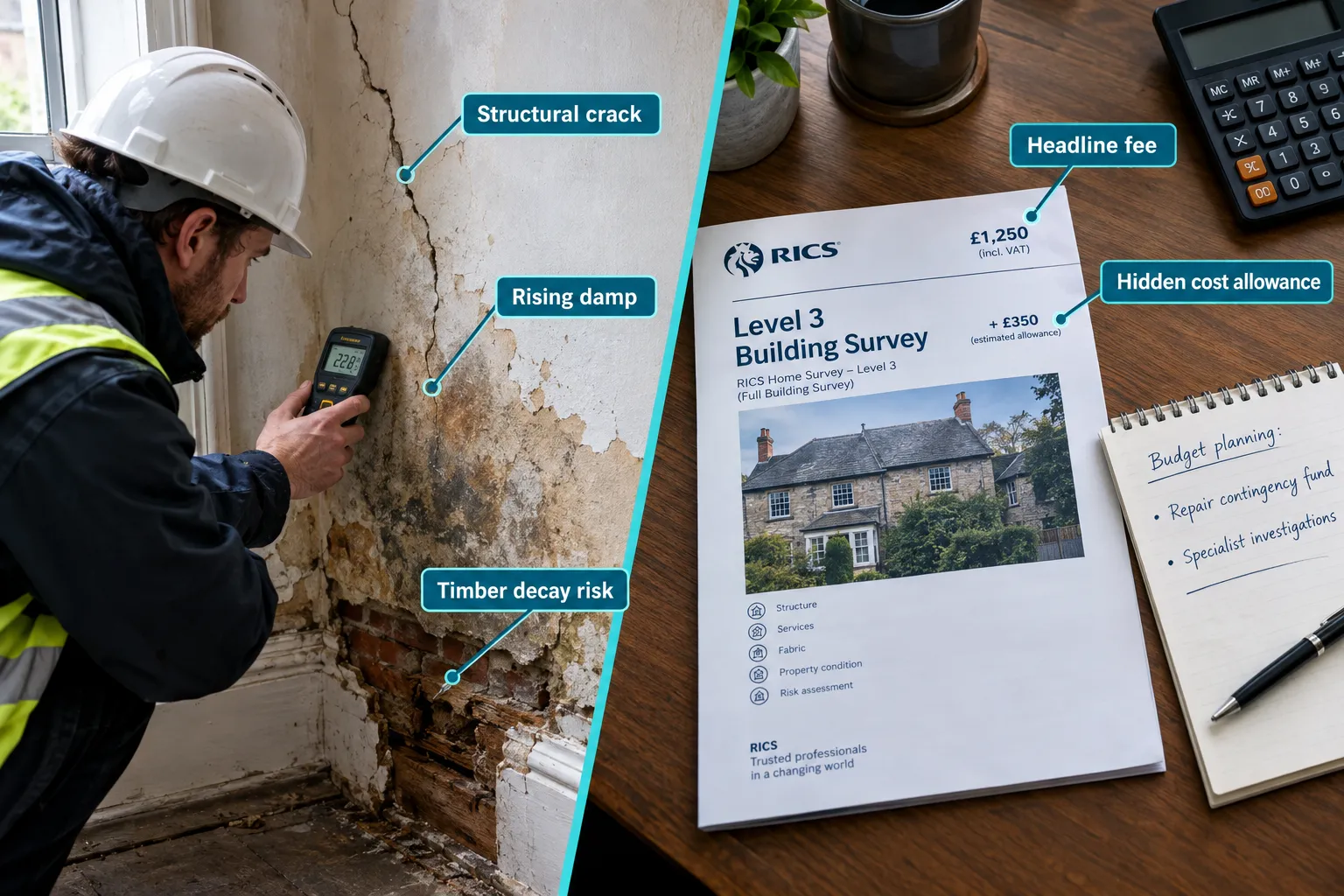
As outlined above, reserve £630,£1,800 for the Level 3 survey itself, calibrated to the property's value and complexity [4][7][9].
Layer 2: Specialist Follow-Up Reports
A Level 3 building survey identifies defects and risks; it does not always provide definitive diagnoses or repair specifications [9][10]. When a surveyor flags a concern, further investigation by a specialist is frequently recommended. Common follow-up costs to budget for include:
- Structural engineer's report: £300,£600 (for subsidence, cracking or foundation concerns)
- Damp and timber specialist report: £150,£300 (often provided free by remediation contractors, though independent reports are preferable)
- Drainage CCTV survey: £150,£300
- Electrical installation condition report (EICR): £150,£250
- Asbestos survey (pre-2000 properties): £200,£400
- Chimney or roof specialist inspection: £100,£250
Not every survey will trigger all of these. However, for an older or complex property, budgeting an additional £500,£1,500 for specialist reports is prudent financial planning.
Layer 3: Repair Contingency Fund
The most financially significant layer is the repair contingency. A Level 3 survey on an older property routinely identifies defects requiring remediation. Common findings include:
- Roof covering replacement: £3,000,£12,000+
- Repointing brickwork: £1,000,£5,000
- Rising damp treatment: £1,500,£4,000
- Rewiring: £3,000,£8,000
- Structural repairs: highly variable, from £1,000 to £50,000+
A sensible approach is to reserve 1%,3% of the purchase price as a repair contingency before exchange, adjusting this figure once the survey report is in hand. For a £300,000 property, that means holding £3,000,£9,000 in reserve.
The Full Budget Picture
- Level 3 Building Survey fee: £900,£1,100
- Specialist follow-up reports (estimated): £500,£900
- Repair contingency (1.5% of purchase price): £5,250
- Total pre-purchase survey budget: £6,650,£7,250
This total represents approximately 1.9%,2.1% of the purchase price, a modest allocation relative to the financial risk of buying blind.
Deciding Which Survey Level Your Property Needs
Budgeting for a full building survey in the UK: using your "budget" wisely before you buy is not simply about finding the cheapest option. It is about matching the survey level to the property's genuine risk profile.
The Decision Framework
Use the following criteria to guide the choice:
Choose Level 1 if:
- The property was built after 2000
- It is a standard flat or terraced house in apparent good condition
- A mortgage lender's valuation has already been completed with no concerns raised
Choose Level 2 if:
- The property was built between roughly 1930 and 2000
- It is of conventional construction with no obvious alterations
- There are no visible signs of significant defects
Choose Level 3 if any of the following apply:
- The property was built before 1930 (especially pre-1900)
- It is listed or in a conservation area
- There are visible signs of cracking, damp, subsidence or structural movement
- Significant extensions or alterations have been made
- It is a large, detached or unusual property
- The buyer plans extensive renovation
For first-time buyers navigating this decision, the resource on Building Survey Protocols For First Time Buyers In 2026 Leveraging Affordability Gains And Negotiation Power provides practical guidance tailored to buyers entering the market in the current climate.
The False Economy of Under-Surveying
Opting for a Level 1 or Level 2 survey on a property that genuinely warrants Level 3 is one of the most common and costly mistakes UK buyers make. The saving of £300,£500 on the survey fee is negligible compared to the potential cost of structural defects, damp, or fire safety issues that a more thorough inspection would have flagged.
In 2026, buyers of properties with cladding or fire safety concerns face additional complexity. The Fire Safety And Cladding Remediation Updated Building Survey Protocols Post Grenfell For 2026 Buyers article outlines the specific survey considerations for affected properties.
Using Survey Findings to Negotiate and Protect Your Investment
A well-budgeted survey does more than identify problems, it creates leverage. In the subdued 2026 market, characterised by weak momentum and cautious buyer demand driven by higher mortgage rates [2][5][8], sellers are more open to price renegotiation following survey findings than they have been in recent years.
Negotiation Strategies After a Level 3 Survey
Once the report is received, buyers have several options:
- Request a price reduction equivalent to the estimated repair costs identified in the survey
- Ask the seller to carry out specific repairs before exchange, with completion confirmed by a re-inspection
- Proceed at the agreed price but use the contingency fund to address defects post-completion
- Withdraw from the purchase if the defects are more extensive than the survey fee revealed
The key is to treat the survey report not as a reason to panic, but as a negotiating document. Surveyors who provide repair cost estimates within their Level 3 reports give buyers a quantified basis for renegotiation [9][10].
Energy Performance and Retrofit Costs
An increasingly important element of the post-survey budget in 2026 is energy efficiency. Properties with poor EPC ratings may require significant retrofit investment to meet evolving standards. Buyers should review the Energy Performance Certificates In 2026 Building Surveys Retrofit Recommendations For Rising Costs And Epc Band Upgrades guidance to understand how retrofit costs should factor into the overall purchase budget.
Landlord and Investment Buyers
For buyers purchasing as landlords or investors, the survey budget calculation includes an additional layer: regulatory compliance. The Stricter Rental Regulations 2026 Building Survey Checklists For Landlord Compliance And Risk Mitigation resource details the specific survey requirements that landlords must factor into their pre-purchase due diligence in 2026.
Practical Tips for Getting the Best Value From Your Survey Budget
Allocating funds effectively is only half the equation. The following practical steps help buyers extract maximum value from every pound spent on pre-purchase surveys.
Get at least three written quotes. Survey fees are not regulated at a fixed rate. Comparing quotes from RICS-registered surveyors in the local area often reveals meaningful differences, particularly for properties outside major cities [4][9].
Ask for a sample report. RICS standards encourage surveyors to provide sample reports so buyers can assess the quality and clarity of the output before commissioning [1][6]. A report that uses plain language and provides clear condition ratings is far more useful than one laden with caveats and technical jargon.
Commission the survey before exchange, not after. This sounds obvious, but some buyers delay the survey to save time. The survey must be completed before exchange of contracts to retain the option to renegotiate or withdraw.
Do not rely on the mortgage lender's valuation. A lender's valuation is conducted for the lender's benefit, not the buyer's. It is not a structural survey and will not identify most defects [9][10].
Factor in the surveyor's availability. In periods of high market activity, RICS-registered surveyors can have waiting lists of two to four weeks. Build this into the overall transaction timeline to avoid delays. For context on current surveyor workload pressures, see Chartered Surveyor Workload Management In 2026 Scaling Building Survey Operations As Market Demand Surges.
Ensure the surveyor is RICS-registered. Only RICS-regulated surveyors are bound by the Home Survey Standard and its consumer protection provisions [1][6][10]. Always verify registration via the RICS Find a Surveyor tool.
Conclusion
Budgeting for a full building survey in the UK: using your "budget" wisely before you buy is not a single line item, it is a layered financial strategy. The survey fee itself (£630,£1,800 for a Level 3 in 2026) is the foundation, but a complete pre-purchase budget must also account for specialist follow-up reports and a meaningful repair contingency fund [4][7][9].
The most important decision is matching the survey level to the property's genuine risk profile. For any property built before 1930, listed, structurally altered or showing visible signs of defects, a Level 3 building survey is not an optional extra, it is the minimum responsible standard of due diligence [1][6][9][10].
In a 2026 market defined by caution and subdued demand [2][5][8], survey findings carry real negotiating weight. Buyers who invest in thorough pre-purchase surveys are better positioned to renegotiate prices, avoid costly surprises and make informed decisions about whether to proceed at all.
Actionable next steps:
- Identify the property's age, construction type and visible condition to determine whether Level 2 or Level 3 is appropriate
- Obtain at least three written quotes from RICS-registered surveyors and request sample reports
- Build a complete pre-purchase budget covering the survey fee, specialist reports and a 1%,3% repair contingency
- Review the survey report as a negotiating document and act on its recommendations before exchange
- Factor in energy performance and retrofit costs as part of the total cost of ownership assessment
References
[1] Home Survey Standard – isurv.com
[2] UK Residential Survey April 2026 – rics.org
[4] How Much Is A Building Survey – westvilleassociates.com
[5] UK Residential Survey May 2026 – rics.org
[6] Home Survey Standards – rics.org
[7] Survey Cost Calculator – ukcalculator.com
[8] UK Residential Survey June 2026 – rics.org
[9] How Much Does A House Survey Cost – hoa.org.uk
[10] Building Surveying Standards – rics.org