

Last updated: July 24, 2026
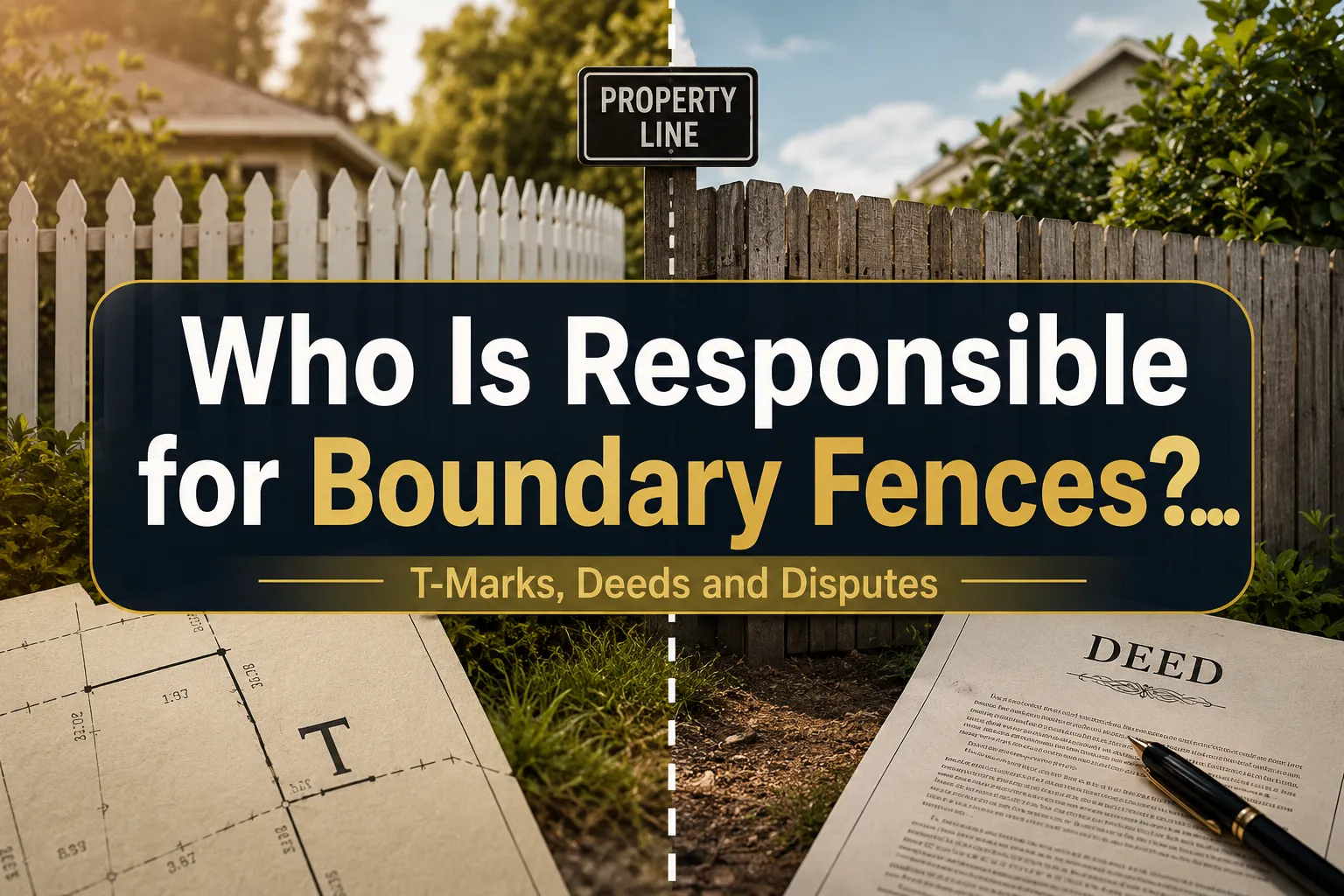
Quick Answer: In England and Wales, who is responsible for boundary fences is determined primarily by your title deeds or Land Registry documents, not by any universal left-hand or right-hand rule. T-marks on a deed plan indicate the owner of a boundary feature, but if deeds are silent, responsibility must be inferred from other evidence. There is no automatic legal obligation to fence your boundary unless your deeds say otherwise.
Key Takeaways
- Responsibility for a boundary fence is set by your title deeds, not by a general "left fence" or "right fence" rule.
- A T-mark on a deed plan points inward toward the property responsible for that boundary feature.
- An H-mark (two T-marks facing each other) suggests shared responsibility.
- If deeds are silent on fencing, neither neighbour is legally obliged to build or maintain a fence.
- There is no law in England and Wales that forces a homeowner to share fence costs with a neighbour.
- A party wall agreement does not cover boundary fences; these are separate legal matters.
- Boundary disputes can be resolved through mediation, a boundary determination survey, or, as a last resort, court proceedings.
- Checking the Land Registry title plan is the first practical step when ownership is unclear.
Who Is Legally Responsible for Maintaining a Boundary Fence Between Properties
Responsibility for a boundary fence falls on whichever party the title deeds assign it to. In England and Wales, there is no statute that automatically makes one neighbour responsible for a fence simply because of its position. The answer comes from the property's legal documents.
When deeds include a "fence covenant," the burdened owner must maintain that boundary feature. This obligation runs with the land, meaning it transfers to new owners on sale. If your deeds say "the owner shall at all times maintain the fence on the [north/south/east/west] boundary," that obligation is binding and enforceable.
Key point: Responsibility is a legal question, not a physical one. The fact that a fence leans toward your garden does not make it yours to repair.
What Does a T-Mark on a Property Deed Mean for Fence Responsibility
A T-mark is a short line drawn perpendicular to a boundary on a deed plan, with the stem of the "T" pointing into the property that owns and is responsible for that boundary feature. It is the most common way conveyancers indicate fence ownership in England and Wales.
- Single T-mark: The property whose land the stem points into is responsible for that fence, wall, or hedge.
- H-mark (double T): Both properties share responsibility for the boundary feature.
- No mark: The deeds are silent, and responsibility is unclear without further investigation.
T-marks are a convention, not a statutory requirement. Their precise meaning should always be read alongside any written obligations in the deed. If the plan is unclear or the T-mark has been omitted, a boundary surveyor can examine the original conveyance documents and historical evidence to determine intent.
How Do I Know If I Have to Pay for the Fence or My Neighbour Does
Check your title deeds first. You can download your official title register and title plan from the Land Registry website for a small fee. Look for:
- A T-mark on the plan indicating which side owns the boundary.
- A written covenant in the register describing maintenance obligations.
- Any transfer deed or conveyance attached to the title that includes fencing clauses.
If the documents are unclear, a boundary determination survey from a chartered surveyor can provide a professional opinion based on the deeds, historical maps, and physical evidence. For a practical guide on building a stronger case before any dispute escalates, see how to win a boundary dispute.
Is the Left-Hand Fence Rule Real?
No. The "left-hand fence rule", the belief that you always own the fence on your left as you face your property from the street, is a myth. It has no basis in English or Welsh property law. The same applies to any equivalent right-hand rule.
This misconception is widespread, but acting on it without checking your deeds can lead to costly mistakes. The only reliable source of fence ownership information is the title documentation for your specific property.
Can My Neighbour Force Me to Split the Cost of a Fence
No, a neighbour cannot legally compel you to contribute to fence costs unless your deeds specifically create that obligation. England and Wales have no general "party fence" statute equivalent to the Party Wall etc. Act 1996 (which covers party walls, not boundary fences).
If your deeds are silent, any cost-sharing arrangement is voluntary. Neighbours may agree to split costs informally, but this should be recorded in writing to avoid future disputes. Never assume a verbal agreement will be enforceable.
"There is no automatic legal obligation in England and Wales to share the cost of a boundary fence with your neighbour."
What Happens If My Neighbour Won't Fix or Maintain the Shared Fence
If your neighbour's fence is falling into your garden or is in disrepair, your options depend on who the deeds say is responsible.
- If the deeds assign responsibility to your neighbour: Write a formal letter citing the specific covenant. If they still fail to act, you may have grounds for a civil claim for breach of covenant.
- If deeds are silent: You have limited legal recourse. You can erect your own fence inside your boundary line without their permission, but you cannot force them to repair theirs.
- If the fence poses a safety risk: Contact your local council; in some cases, they can intervene under nuisance or planning legislation.
For disputes that have already escalated, an expert witness report from a chartered surveyor can provide the independent evidence needed for mediation or court proceedings.
Do Both Neighbours Have to Agree to Build a New Boundary Fence
Not necessarily. If your deeds give you the right to erect a fence on your boundary, you can generally do so without your neighbour's consent, provided the fence sits within your own land and complies with permitted development rules (typically no higher than 2 metres for a rear boundary fence, or 1 metre fronting a highway).
However, if the proposed fence would sit on or very close to the legal boundary, it is sensible to notify your neighbour in writing beforehand. This avoids later disputes about encroachment. Note that boundary fences are not covered by the Party Wall etc. Act 1996, so no formal party wall notice is required for a fence alone.
What If the Fence Is on My Property Line but My Neighbour Built It
The position of a fence does not automatically determine ownership. If your neighbour built a fence that sits on or near your boundary, ownership depends on what the deeds say and whether any encroachment has occurred.
- If the fence encroaches onto your land, you can ask your neighbour to move it.
- If the fence has stood unchallenged for many years, adverse possession rules could complicate matters.
- Always get a measured boundary survey before taking action, as boundary positions on Land Registry plans are general indications only, accurate to approximately plus or minus one metre at the 1:1250 scale used for urban properties.
What If the Deeds Are Silent on Fence Responsibility
When deeds contain no T-marks and no written covenant, neither neighbour has a legal obligation to fence the boundary. In practice, this means:
- Neither party can be forced to build or maintain a fence.
- Either party may erect a fence within their own land at their own cost.
- Evidence from historical Ordnance Survey maps, old photographs, and neighbouring title deeds may help establish a pattern of responsibility, but this is persuasive rather than conclusive.
Resolving a silent-deeds situation often requires a professional boundary determination. A chartered surveyor will examine all available evidence and produce a report setting out the most defensible position.
What's the Cheapest Way to Resolve a Fence Dispute With a Neighbour
Direct negotiation is always the cheapest first step. A calm, written approach citing the relevant deed provisions often resolves disputes without professional involvement.
If that fails, the options in ascending cost order are:
- Mediation, A trained mediator facilitates a binding or non-binding agreement. Costs are typically shared and are far lower than litigation.
- Boundary determination survey, A chartered surveyor's report provides an authoritative opinion and often prompts settlement.
- Land Registry adjudication, For registered land, the Land Registry can determine boundary positions through a formal process.
- Court proceedings, The most expensive route and rarely proportionate for a fence dispute alone.
FAQ
Q: Does the Land Registry title plan show who owns a boundary fence?
A: The title plan shows the general extent of the property, but it does not definitively show fence ownership. You need to read the title register and any attached deeds for T-marks and written covenants.
Q: Can I remove a fence on my property line without my neighbour's permission?
A: Only if the deeds confirm the fence is yours to maintain. If your neighbour owns the fence according to the deeds, removing it without permission could expose you to a civil claim.
Q: Is a boundary fence the same as a party fence wall?
A: No. A party fence wall straddles the boundary and is jointly owned. A boundary fence typically sits on one side of the boundary and belongs to one owner. The legal rules differ significantly.
Q: My deeds show a T-mark on all four sides of my property. Does that mean I own all the fences?
A: Yes, in principle. T-marks on all four boundaries indicate you are responsible for all four boundary features. This is sometimes seen on plots carved from a larger estate.
Q: Does planning permission affect fence responsibility?
A: Planning permission relates to whether you can build a fence, not who is legally responsible for it. Responsibility is a conveyancing matter, not a planning one.
Q: What is the difference between a boundary fence and a partition fence?
A: In common usage they are often interchangeable. "Partition fence" is an older legal term used in some jurisdictions (including some US states) to describe a fence on a shared boundary. In England and Wales, "boundary fence" is the standard term, and the rules described above apply.
Conclusion
Knowing who is responsible for boundary fences comes down to one thing: reading the legal documents for your property. Check your title register and deed plan for T-marks and written covenants before assuming any rule applies. The left-hand fence myth, neighbourhood convention, and the position of an existing fence are all unreliable guides. If deeds are silent, get professional advice before spending money or making accusations. Mediation and a boundary determination survey resolve the vast majority of disputes without court involvement, saving both time and cost.
Get a boundary determination, call Prince Surveyors on 0204 579 8270.
References
- HM Land Registry, Practice Guide 40: Land Registry Plans (2019), gov.uk
- Party Wall etc. Act 1996, legislation.gov.uk
- HM Land Registry, How to Search for Title Information (2021), gov.uk
.cg-fence-tool{font-family:Arial,sans-serif;max-width:520px;margin:2em auto;background:#f7f9fc;border:1px solid #d0d8e4;border-radius:8px;padding:20px}
.cg-fence-tool h3{margin:0 0 12px;font-size:1.1em;color:#1a2e4a}
.cg-fence-tool label{display:block;font-size:.9em;color:#333;margin-bottom:4px}
.cg-fence-tool select{width:100%;padding:8px;border:1px solid #b0bcc8;border-radius:5px;font-size:.95em;margin-bottom:14px;background:#fff}
.cg-fence-btn{background:#1a2e4a;color:#fff;border:none;padding:10px 22px;border-radius:5px;cursor:pointer;font-size:.95em;width:100%}
.cg-fence-btn:hover{background:#2a4a70}
.cg-fence-result{margin-top:14px;padding:12px;border-radius:6px;font-size:.9em;line-height:1.5;display:none}
.cg-result-yes{background:#e6f4ea;border-left:4px solid #2e7d32;color:#1b5e20}
.cg-result-no{background:#fff3e0;border-left:4px solid #e65100;color:#bf360c}
.cg-result-unclear{background:#e8eaf6;border-left:4px solid #3949ab;color:#1a237e}
Boundary Fence Responsibility Checker
function cgCheckFence(){
var tm=document.getElementById(‘cg-tmark’).value;
var cv=document.getElementById(‘cg-covenant’).value;
var el=document.getElementById(‘cg-fence-result’);
var msg=”,cls=”;
if(cv===’yes-you’){msg=’Your deeds include a written covenant naming you as responsible. You are legally obliged to maintain this boundary fence.’;cls=’cg-result-yes’;}
else if(cv===’yes-them’){msg=’Your deeds name your neighbour as responsible. They are legally obliged to maintain the fence. Cite the covenant in any written request.’;cls=’cg-result-no’;}
else if(tm===’tmark-you’){msg=’The T-mark points into your property. This indicates you own and are responsible for this boundary feature.’;cls=’cg-result-yes’;}
else if(tm===’tmark-them’){msg=’The T-mark points into your neighbour’s property. Responsibility lies with them, not you.’;cls=’cg-result-no’;}
else if(tm===’hmark’){msg=’An H-mark indicates shared responsibility. Both parties should contribute to maintenance and repair costs.’;cls=’cg-result-unclear’;}
else if(tm===’silent’||cv===’no’){msg=’Your deeds are silent. Neither party has a legal obligation to fence this boundary. Consider a boundary determination survey for clarity.’;cls=’cg-result-unclear’;}
else{msg=’Please select both options above to get a result.’;cls=’cg-result-unclear’;}
el.className=’cg-fence-result ‘+cls;
el.style.display=’block’;
el.textContent=msg;
}
Tags: boundary fences, who owns boundary fence, T-marks property deeds, fence responsibility UK, boundary disputes, Land Registry, party fence wall, fence ownership, neighbour fence disputes, boundary determination, fence maintenance obligations, property deeds