

Last updated: July 24, 2026
Quick Answer: RICS valuation red flags are specific warning signs in a chartered surveyor's property assessment that suggest a figure may be inflated beyond what the market can genuinely support. In cautious 2026 markets, where buyer demand is uneven and mortgage lending remains tight, spotting these red flags early can protect buyers, landlords, and lenders from overpaying or over-lending. The most reliable approach is to cross-check comparable evidence, scrutinise the surveyor's methodology, and commission an independent valuation if anything looks inconsistent.
Key Takeaways
- A RICS valuation that relies on too few comparables, or comparables from a different market period, is one of the most common overvaluation signals in 2026.
- Professional scepticism is a formal requirement under the RICS Red Book 2025 global standard, meaning surveyors must actively question data reliability rather than accept it at face value.
- Overvaluation differs from normal market variance: a gap of more than 10-15% between a valuation and recent local sale prices warrants investigation, not just acceptance.
- Cautious market conditions, including higher mortgage rates and subdued transaction volumes, create conditions where stale or selective comparable evidence is more likely to inflate figures.
- First-time buyers are statistically more exposed to overvaluation risk because they lack the transaction history to benchmark figures independently.
- Anyone who suspects a RICS valuation is too high has the right to request the comparable evidence used and, if necessary, formally dispute the figure through the RICS complaints process.
- Lenders' mortgage valuations are not the same as a full RICS survey, and a high mortgage valuation does not confirm a property is worth that price to a buyer.
- Getting an independent property valuation from a separate RICS-registered firm is the single most effective way to verify a suspicious figure.
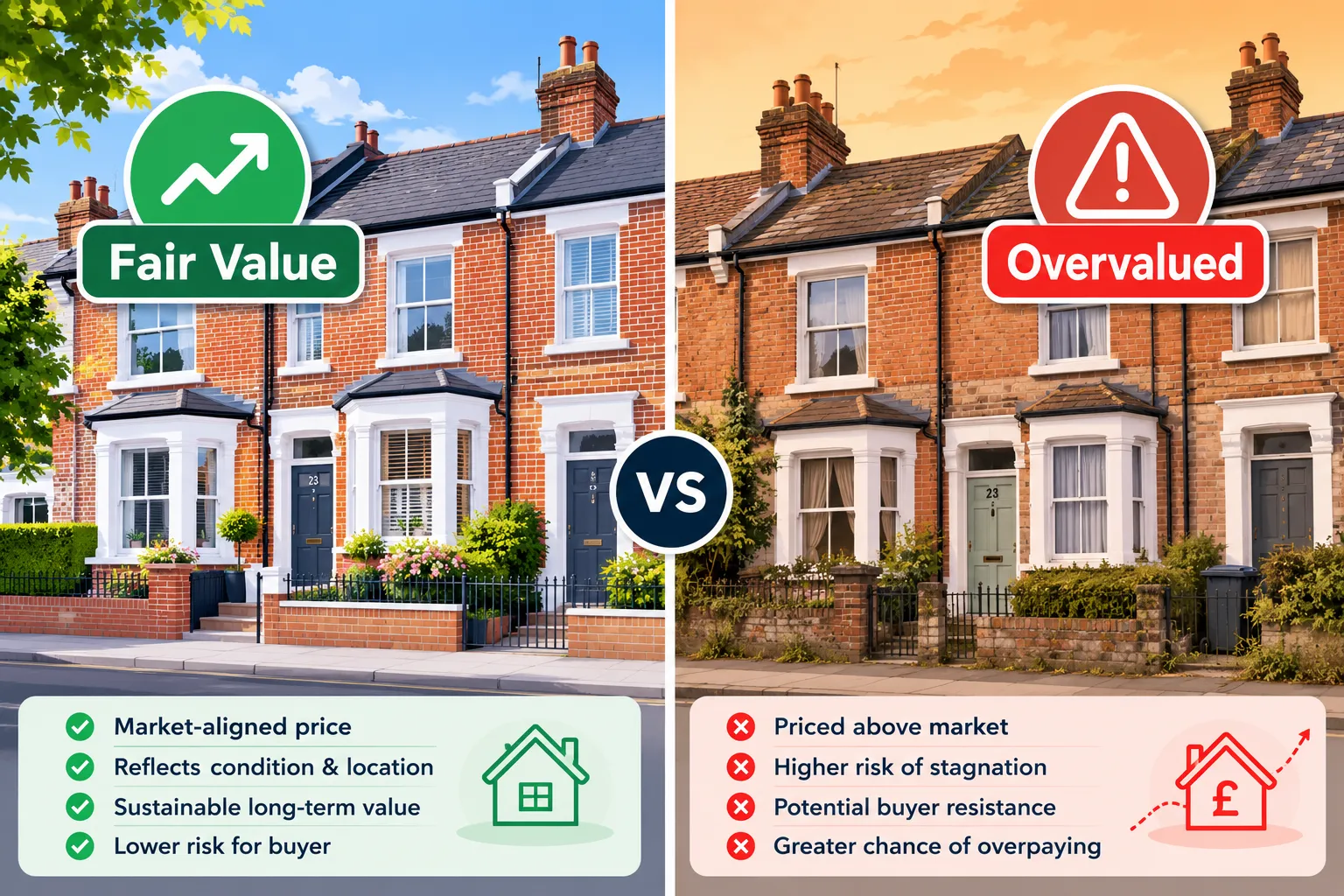
What Are the Most Common RICS Valuation Red Flags in 2026
The most common RICS valuation red flags in 2026 centre on weak comparable evidence, conflicts of interest, and methodology that does not reflect current market sentiment. When any of these appear in a valuation report, the figure deserves closer scrutiny before a transaction proceeds.
Specific red flags to watch for include:
- Thin comparable evidence: The report cites fewer than three recent sales, or comparables are drawn from sales completed more than six months ago in a shifting market.
- Geographic stretch: Comparables are pulled from neighbouring postcodes or streets with meaningfully different demand profiles, rather than the immediate locality.
- Condition assumptions: The valuation assumes a condition standard that the property does not currently meet, inflating the figure on the basis of works not yet carried out.
- Unexplained adjustments: Positive adjustments are applied to the subject property without a clear, documented rationale.
- Conflict of interest: The valuer has a relationship with the seller, estate agent, or developer that is not disclosed in the report.
- Ignoring negative factors: Issues such as short lease terms, flood risk, or structural defects are noted but not adequately reflected in the final figure.
Under the RICS Red Book 2025 global standard, valuers are required to exercise professional scepticism and document the reliability of the data they use. A report that lacks this transparency is itself a red flag.
For a broader understanding of what surveyors examine during an assessment, the top 3 things looked at during a property valuation provides useful context.
How to Spot Overvaluation in Real Estate Property Assessments
Overvaluation in a property assessment is detectable when the stated figure diverges significantly from verifiable market evidence without a credible explanation. Buyers and investors can identify this by running their own comparable checks before accepting any valuation.
Practical steps to spot overvaluation:
- Search Land Registry sold prices for the same street and property type within the last three to six months.
- Compare the per-square-foot price implied by the valuation against recent local sales data.
- Check whether the estate agent's asking price history shows multiple reductions, which can indicate the market has already rejected a higher figure.
- Review the valuation report's comparable section and note whether the cited sales are genuinely similar in size, condition, and location.
- Ask the valuer directly which comparable sales were used and why others were excluded.
A gap of more than 10-15% between the valuation and independently verifiable comparable sales, without a documented explanation, is a reasonable threshold for concern. This is not a fixed RICS benchmark but a practical working rule used by experienced property professionals.
What Makes a RICS Valuation Unreliable or Suspicious
A RICS valuation becomes unreliable when the underlying data is weak, the methodology is poorly documented, or the valuer's independence is compromised. Reliability is not just about the final number; it is about whether the process that produced that number can withstand scrutiny.
Key reliability concerns include:
- Overreliance on asking prices rather than completed transaction data.
- Desktop-only assessments where the valuer has not physically inspected the property.
- Pressure from instructing parties: In some cases, lenders, developers, or sellers may exert informal pressure on valuers to reach a particular figure. This is a serious professional conduct issue under RICS rules.
- Outdated market assumptions: Using yield rates or price growth assumptions from 2023 or 2024 in a 2026 market that has corrected is a methodological error.
- Insufficient local knowledge: A valuer unfamiliar with hyper-local demand factors, such as school catchment boundaries or planned infrastructure changes, may miss factors that materially affect value.
The RICS Red Book 2025 explicitly requires valuers to document data reliability and apply professional scepticism. A report that does not demonstrate this process is one where the conclusions should be treated with caution.
RICS Valuation Red Flags vs Standard Market Corrections
Overvaluation and a standard market correction are not the same thing, and conflating them leads to poor decisions. A market correction is a broad, systemic repricing of property values driven by macroeconomic forces. Overvaluation in a specific assessment is a property-level error in the valuation process itself.
| Factor | Overvaluation Red Flag | Standard Market Correction |
|---|---|---|
| Cause | Weak data, methodology error, or bias | Macroeconomic shift (rates, demand) |
| Scope | Single property or small set | Broad market or region |
| Detectability | Comparable evidence check | Index data and transaction volumes |
| Remedy | Challenge the valuation | Adjust offer price to market |
| Timeframe | Immediate issue | Gradual repricing over months |
The distinction matters because challenging a specific overvalued assessment is a legitimate and often successful process, whereas trying to argue against a genuine market correction is unlikely to change the outcome.
How Do Cautious Market Conditions Affect Property Valuations
In cautious market conditions, such as those seen across much of the UK in 2026, lower transaction volumes mean there are fewer recent comparable sales available. This creates a genuine technical challenge for valuers and increases the risk that stale or unrepresentative data inflates a figure.
Specific effects of cautious markets on valuation accuracy:
- Fewer transactions mean each comparable carries more weight, so a single atypical sale can skew a result.
- Longer time on market for listed properties means asking prices diverge further from achievable sale prices.
- Lender caution means mortgage valuations may be more conservative than independent market valuations, creating a gap that can confuse buyers.
- Sentiment lag: Valuers trained in a rising market may unconsciously apply optimistic assumptions that no longer reflect current buyer behaviour.
Understanding how property market legislation changes and economic shifts interact with valuation methodology is important context for anyone commissioning a report in 2026. The property market legislation changes page covers relevant regulatory developments.
Are RICS Valuations Accurate in Uncertain Economic Times
RICS valuations can remain accurate in uncertain economic times, but only when the valuer applies rigorous methodology and explicitly accounts for market uncertainty in their report. The Red Book 2025 standard includes provisions for valuers to flag material uncertainty where market conditions make precise valuation genuinely difficult.
When a valuation report includes a "material valuation uncertainty" clause, this is not a red flag in itself; it is a sign of professional honesty. The red flag is when a report states a precise figure with high confidence in conditions where that confidence is not warranted.
Buyers should look for:
- Explicit acknowledgement of market uncertainty in the report narrative.
- A stated range or sensitivity analysis where appropriate.
- Clear documentation of the assumptions underpinning the figure.
A valuation that reads as if it were produced in a stable 2021 market, with no acknowledgement of 2026 conditions, should prompt questions.

Red Flags in Comparable Property Analysis for Valuations
Comparable analysis is the foundation of almost every residential RICS valuation, and it is also where the most common errors occur. The quality of the comparables used is often more important than the final figure itself.
Warning signs in comparable analysis:
- Comparables selected from a period of peak market activity that no longer reflects current conditions.
- Properties used as comparables that differ significantly in size (more than 15-20% floor area variance) without adjustment.
- New-build properties used as comparables for second-hand stock, or vice versa, without a clear rationale.
- Comparables that include developer incentives (such as cashback or stamp duty contributions) in the headline price, which inflates the true market figure.
- Failure to use the most recent available Land Registry data.
For buyers considering a RICS HomeBuyer Report, it is worth understanding that the valuation section within that report uses the same comparable methodology and is subject to the same potential weaknesses.
How Do Interest Rates and Market Sentiment Affect RICS Valuation Accuracy
Interest rates affect RICS valuation accuracy by changing the pool of active buyers and therefore the price level at which transactions actually complete. When rates rise, affordability falls, transaction volumes drop, and the comparable evidence base shrinks, all of which increase valuation uncertainty.
In 2026, with mortgage rates remaining above the historic lows of 2020-2021, valuers face a market where:
- Buyers are more price-sensitive and more likely to negotiate below asking price.
- The spread between asking prices and achieved prices is wider than in a buoyant market.
- Sentiment-driven price growth from the pandemic era is no longer a valid assumption.
Market sentiment also affects valuation through the "marriage value" concept in certain property types, particularly leasehold properties where the perceived desirability of an area can shift quickly. For those involved in leasehold extension and enfranchisement valuations, this sensitivity to market sentiment is especially relevant.
Who Needs to Watch Out for Overvaluation Risks Most
First-time buyers, landlords purchasing at auction, and anyone buying in a new-build or off-plan context face the highest overvaluation risk. These groups share a common vulnerability: limited access to independent comparable data at the point of purchase.
By buyer type:
- First-time buyers: No prior transaction experience to benchmark figures. Often relying solely on the lender's mortgage valuation, which is a limited document produced for the lender's benefit, not the buyer's.
- Buy-to-let investors: May focus on yield calculations and overlook capital value risk, particularly in markets where rental demand is softening.
- New-build purchasers: Developer-set prices are not always supported by independent comparable evidence, and new-build premiums can erode quickly in a secondary market.
- Probate and estate buyers: Properties sold through estates may be priced on an outdated or sentimental basis rather than current market evidence.
For landlords assessing investment properties, understanding property valuation services in detail before committing is a straightforward risk-reduction step.
What Should I Do If I Suspect a RICS Valuation Is Too High
If a RICS valuation appears too high, the first step is to request the full comparable evidence from the valuer and check it against publicly available Land Registry data. This is a legitimate request that any RICS-registered valuer should fulfil.
Step-by-step approach:
- Request the comparables: Ask the valuer in writing to provide the full list of comparable transactions used, including addresses, sale dates, and prices.
- Run an independent check: Search Land Registry sold prices and property portals for the same area and property type.
- Commission an independent valuation: A second opinion from a separate RICS-registered firm is the most reliable way to test the figure. See how to get an independent property valuation for guidance on this process.
- Raise a formal complaint: If the valuer is RICS-registered, complaints can be submitted through the RICS Dispute Resolution Service.
- Negotiate on the basis of evidence: If the independent valuation supports a lower figure, use it as the basis for renegotiating the purchase price.
For situations where a valuation comes in lower than an offer already made, the process is different but equally important. The guide on what to do if your home valuation is less than an offer covers that scenario in detail.
How to Challenge or Dispute a RICS Valuation
Challenging a RICS valuation is a formal process with specific steps, and it is more likely to succeed when supported by documented comparable evidence rather than a general sense that the figure is wrong. Emotional objections carry no weight; factual counter-evidence does.
The dispute process in brief:
- Write to the valuer's firm with specific evidence of comparable sales that contradict the stated figure.
- If the firm does not respond satisfactorily, escalate to the RICS Dispute Resolution Service.
- For mortgage valuations, the lender's internal complaints process is the first port of call, followed by the Financial Ombudsman Service if unresolved.
- In high-value commercial or development contexts, a formal RICS arbitration or independent expert determination may be appropriate. Commercial valuation services can provide expert support in these cases.
A challenge is most likely to succeed within 28 days of the original valuation, while the market evidence is still directly comparable.
Common Mistakes in RICS Property Valuations and How to Avoid Them
The most common mistakes in RICS property valuations are avoidable with better data discipline and clearer methodology. Both valuers and their clients can take steps to reduce these errors.
For valuers:
- Failing to physically inspect the property before issuing a figure.
- Applying blanket percentage adjustments without property-specific justification.
- Not updating comparable evidence when a report is reissued after a delay.
For clients commissioning valuations:
- Providing incomplete or misleading information about the property's condition or tenure.
- Selecting a valuer based on price rather than local expertise.
- Accepting a valuation report without reading the assumptions and limitations section.
For buyers reviewing a valuation:
- Treating a lender's mortgage valuation as equivalent to a full independent assessment.
- Not checking whether the valuer has recent experience in the specific local market.
A RICS building survey commissioned alongside a valuation provides a fuller picture of condition factors that can materially affect value.
Interactive RICS Valuation Red Flag Checker
.rfc-wrap{font-family:Arial,sans-serif;max-width:560px;margin:0 auto;background:#f7f9fc;border:1px solid #dce3ed;border-radius:8px;padding:20px}
.rfc-wrap h3{margin:0 0 4px;font-size:1.05rem;color:#1a2e4a}
.rfc-wrap p.rfc-sub{margin:0 0 14px;font-size:.85rem;color:#555}
.rfc-item{display:flex;align-items:flex-start;gap:10px;margin-bottom:10px}
.rfc-item label{font-size:.88rem;color:#2c3e50;cursor:pointer;line-height:1.4}
.rfc-item input[type=checkbox]{margin-top:2px;accent-color:#c0392b;width:16px;height:16px;flex-shrink:0}
.rfc-btn{background:#1a2e4a;color:#fff;border:none;padding:9px 20px;border-radius:5px;cursor:pointer;font-size:.9rem;margin-top:6px}
.rfc-btn:hover{background:#c0392b}
.rfc-result{margin-top:14px;padding:12px;border-radius:6px;font-size:.88rem;line-height:1.5;display:none}
.rfc-low{background:#e8f5e9;border-left:4px solid #27ae60;color:#1b5e20}
.rfc-med{background:#fff8e1;border-left:4px solid #f39c12;color:#7d4e00}
.rfc-high{background:#fdecea;border-left:4px solid #c0392b;color:#7b1a1a}
RICS Valuation Red Flag Checker
Tick any red flags present in your valuation report, then check your risk level.
function rfcCheck(){
var ids=[“f1″,”f2″,”f3″,”f4″,”f5″,”f6″,”f7”],count=0;
ids.forEach(function(id){if(document.getElementById(id).checked)count++;});
document.getElementById(“rfcLow”).style.display=”none”;
document.getElementById(“rfcMed”).style.display=”none”;
document.getElementById(“rfcHigh”).style.display=”none”;
if(count===0)document.getElementById(“rfcLow”).style.display=”block”;
else if(count<=2)document.getElementById("rfcMed").style.display="block";
else document.getElementById("rfcHigh").style.display="block";
}
FAQ: Evergreen RICS Valuation Red Flags and Overvaluation Risks
Q: What is the difference between overvaluation and normal market variance?
Overvaluation is a specific error in the valuation process, caused by weak data or poor methodology. Normal market variance is the natural spread of prices around a true market value, typically within 5% either way. A gap of more than 10-15% without documented justification points to overvaluation rather than variance.
Q: Can a RICS-registered surveyor still produce an overvalued report?
Yes. RICS registration sets a professional standard but does not eliminate human error or the influence of instructing party pressure. The Red Book 2025 requires professional scepticism, but enforcement depends on the individual valuer's rigour and the quality of available data.
Q: Is a lender's mortgage valuation the same as an independent RICS valuation?
No. A mortgage valuation is a limited document produced for the lender's risk assessment purposes. It is not a comprehensive property survey and does not represent a full independent opinion of market value for the buyer's benefit.
Q: How long does it take to dispute a RICS valuation?
An informal challenge, supported by comparable evidence, can sometimes be resolved within two to four weeks. A formal RICS Dispute Resolution Service process typically takes longer, often two to four months depending on complexity.
Q: Are new-build properties more prone to RICS overvaluation?
New-build properties carry a higher overvaluation risk because developer pricing is not always supported by independent comparable evidence, and new-build premiums can erode quickly in the secondary market. Independent valuations are especially advisable for off-plan purchases.
Q: What does a "material valuation uncertainty" clause mean in a RICS report?
It means the valuer has identified that current market conditions make a precise valuation genuinely difficult, and the stated figure carries a wider margin of uncertainty than normal. This is a sign of professional honesty, not incompetence, and should prompt buyers to factor that uncertainty into their offer and financing decisions.
Conclusion
Spotting evergreen RICS valuation red flags and overvaluation risks in cautious 2026 markets requires a combination of methodological awareness and practical due diligence. The warning signs are consistent across market cycles: thin comparable evidence, unexplained adjustments, condition assumptions that flatter the property, and a report narrative that ignores the realities of current market sentiment.
Actionable next steps:
- Before accepting any valuation, run an independent comparable check using Land Registry sold prices for the same street and property type within the last three to six months.
- If a report cites fewer than three recent, locally relevant comparables, request the full evidence pack from the valuer in writing.
- Commission a second, independent RICS valuation if three or more red flags are present in the original report.
- For complex transactions, including leasehold, commercial, or development properties, instruct a valuer with demonstrable recent experience in that specific asset class and location.
- Use the formal RICS Dispute Resolution Service if an informal challenge does not produce a satisfactory response.
The cautious conditions of 2026 make rigorous valuation scrutiny more important, not less. Buyers and investors who treat a valuation as a starting point for their own due diligence, rather than a definitive answer, are consistently better protected.