

Last updated: July 24, 2026
Quick Answer: Expert witness preparation for geopolitical risk valuation disputes requires a RICS-qualified surveyor to produce an independent, court-compliant report that quantifies how geopolitical events have affected a property's market value. Following RICS updates in early 2026, expert witnesses must now meet stricter accreditation standards, explicitly disclose conflicts of interest, and demonstrate active CPD. The overriding duty is to the tribunal, not the instructing client.
Key Takeaways
- Geopolitical risk valuation disputes arise when global instability events, sanctions, trade disruptions, conflict spillover, are claimed to have materially affected UK property values.
- RICS updated its expert witness standards in early 2026, raising accreditation thresholds and reinforcing that the expert's primary duty is to the court, not the client.
- Conditional or success-based fee arrangements are banned for expert witnesses under current RICS and court rules.
- Admissible evidence must be objective, reproducible, and grounded in recognised valuation methodology such as comparable analysis or discounted cash flow.
- Courts evaluate geopolitical risk factors by testing whether the claimed impact is measurable, proximate, and supported by market evidence at the relevant valuation date.
- Preparation typically takes four to twelve weeks depending on case complexity and the volume of transactional data available.
- Expert witnesses need RICS membership, relevant specialism, demonstrable CPD, and ideally formal accreditation under the updated 2026 criteria.
- Disputes can sometimes be resolved without expert testimony through mediation or agreed joint expert instruction, but complex geopolitical risk cases rarely settle without at least one independent report.

What Is Geopolitical Risk Valuation in Real Estate Disputes?
Geopolitical risk valuation in real estate disputes refers to the process of quantifying how political instability, international sanctions, armed conflict, trade restrictions, or related macro-level events have affected the market value of a specific property or portfolio at a defined date. In litigation or arbitration, one or both parties claim that these external forces caused a measurable departure from what the property would otherwise have been worth.
In practice, this arises in several scenarios:
- A commercial landlord argues that sanctions imposed on a tenant's home country caused a lease to collapse and the property's investment value to fall.
- A developer claims that sudden trade tariffs raised construction costs and reduced the gross development value of a scheme.
- A homeowner disputes a lender's down-valuation, arguing that the surveyor failed to account for a geopolitically driven market correction.
The key legal question is always: can the claimed value change be attributed to the geopolitical event with sufficient precision to support a damages award or a revised figure? That is the task of the expert witness.
For a broader understanding of how professional valuations are structured in the UK, see Prince Chartered Surveyors' valuation services.
How Do RICS Guidelines Handle Geopolitical Risk in Property Valuations?
RICS guidelines do not create a separate methodology for geopolitical risk. Instead, they require valuers to identify and reflect all material factors affecting value at the valuation date, and geopolitical conditions qualify as material when they demonstrably influence buyer and seller behaviour in the relevant market.
The RICS Red Book (Valuation, Global Standards) requires valuers to:
- State all assumptions and special assumptions clearly.
- Identify market conditions at the valuation date, including any extraordinary external factors.
- Apply a recognised basis of value, most commonly Market Value, and explain departures from normal market conditions.
When geopolitical risk is a live issue, valuers are expected to reference transaction evidence, market commentary from recognised sources (such as RICS market surveys), and, where appropriate, risk-adjusted discount rates in income-based approaches. The valuer must not simply assert that geopolitical risk had an impact; the impact must be evidenced and quantified.
What Changed in RICS Standards After the February 2026 Survey?
The February 2026 RICS survey marked a significant shift in how expert witness competence and conduct are governed. Several changes came into effect or were formalised in the months that followed.
Key post-February 2026 developments:
- Fifth edition of the RICS expert witness standard is in active development, with explicit global scope to address cross-border and geopolitically complex disputes. This signals that RICS recognises these cases as a distinct and growing category.
- New accreditation criteria (March 2026) raised the bar for expert witnesses. Surveyors wishing to act as experts must now demonstrate a higher threshold of relevant experience, pass updated competency assessments, and commit to structured ongoing CPD.
- April 2026 compliance guidance restated legal and regulatory risks for expert witnesses and clarified that failure to comply with court procedural rules (such as CPR Part 35 in England and Wales) constitutes a professional conduct matter, not merely a procedural one.
- Conflicts of interest and fee arrangements must now be explicitly addressed in the expert's declaration. Success-based or conditional fees remain prohibited.
- Practice alert on report preparation (originally issued in a housing disrepair context) established general principles that RICS now applies across dispute types, including valuation: reports must be structured, referenced, and written for the tribunal, not the instructing solicitor.
"The expert's overriding duty is to the tribunal. That duty overrides any obligation to the person from whom the expert has received instructions or by whom the expert is paid."
, RICS Expert Witness Standard (restated in April 2026 guidance)
How to Prepare Expert Witness Testimony for Valuation Disputes
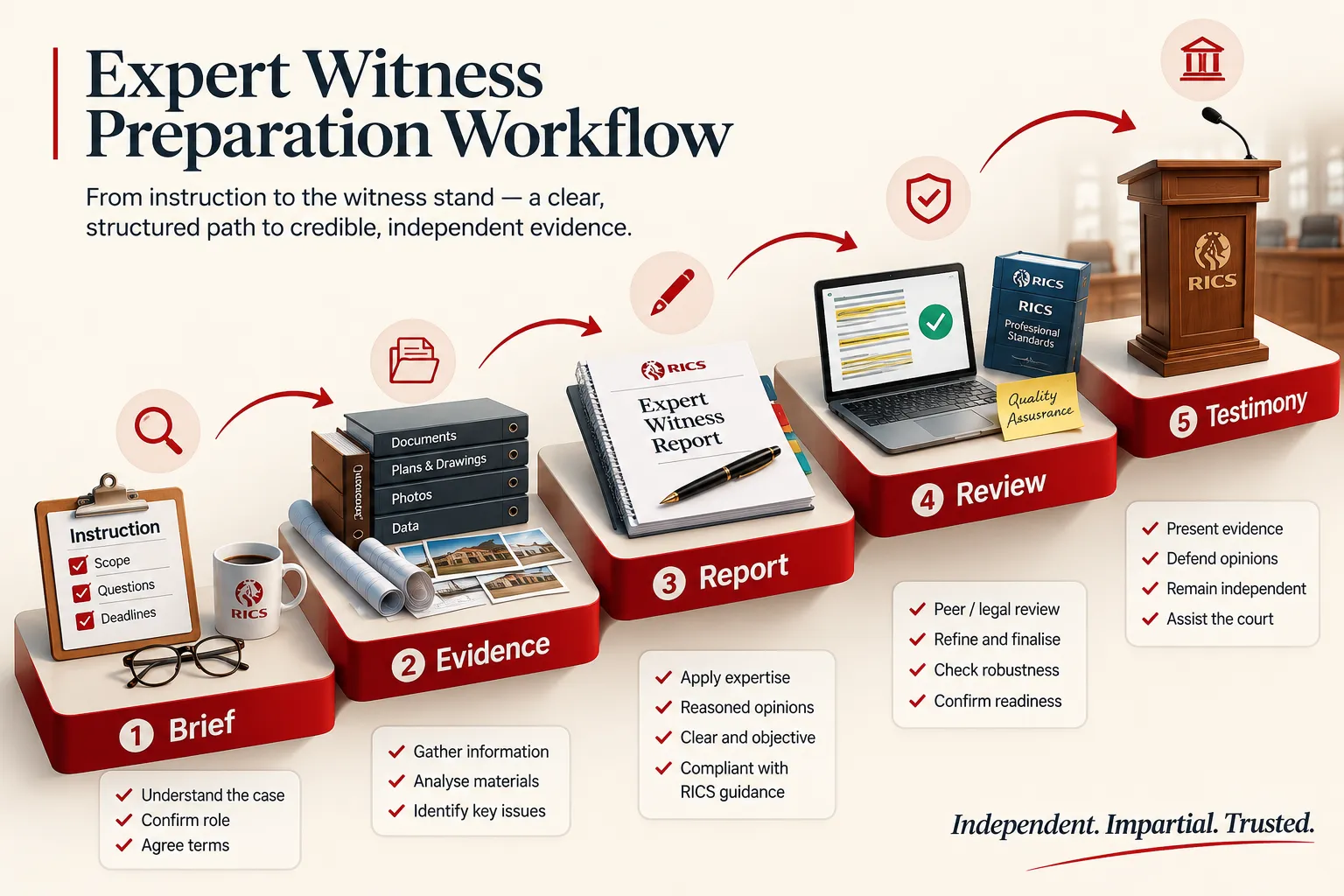
Effective expert witness preparation for geopolitical risk valuation disputes follows a structured process. Cutting corners at any stage creates vulnerabilities that opposing counsel will exploit during cross-examination.
Step-by-step preparation process:
- Accept the instruction carefully. Confirm there is no conflict of interest. Review the fee arrangement and ensure it is fixed or time-based, never conditional on outcome.
- Define the valuation question precisely. What property, what basis of value, what date, and what is the specific geopolitical event in question?
- Gather primary evidence. Collect comparable transactions, rental evidence, yield data, and market reports from around the relevant valuation date.
- Assess geopolitical impact on market conditions. Use contemporaneous market commentary, published indices, and transaction data to establish whether the event caused a measurable shift in values in the relevant sub-market.
- Apply recognised methodology. Whether comparable analysis, income capitalisation, or residual valuation, the method must be appropriate to the asset type and defensible under cross-examination.
- Draft the report for the tribunal. The report must comply with CPR Part 35 (or the relevant procedural rules), include a statement of truth, and set out the expert's reasoning transparently.
- Prepare for cross-examination. Review the opposing expert's report, identify points of agreement and disagreement, and be ready to explain methodology in plain language.
For cases involving commercial property valuations, the complexity of income-based approaches and lease structures adds additional layers to this preparation process.
What Evidence Is Admissible in Geopolitical Risk Valuation Cases?
Admissible evidence in these cases must be objective, verifiable, and directly relevant to the valuation question. Courts and tribunals in England and Wales apply the Civil Evidence Act 1995 and CPR rules; arbitrations follow the agreed procedural rules, which typically mirror these standards.
Types of evidence that are generally admissible:
- Comparable transaction data (land registry records, CoStar, EGi, or equivalent)
- Published market surveys and indices (RICS, IPF, ONS house price data)
- Contemporaneous valuations or appraisals from the relevant date
- Expert reports from qualified RICS members
- Economic and geopolitical analysis from recognised institutions (central banks, international organisations), used to contextualise market conditions
Evidence that is typically challenged or excluded:
- Retrospective commentary that was not available at the valuation date (hindsight evidence)
- Unverified or anecdotal market opinion
- Reports from experts who cannot demonstrate relevant specialism
- Any analysis that relies on assumptions not disclosed in the report
The expert witness must be clear about what is fact, what is assumption, and what is opinion. Conflating these categories is one of the most common reasons expert evidence is given reduced weight by tribunals.
How Do Courts Evaluate Geopolitical Risk Factors in Property Disputes?
Courts evaluate geopolitical risk factors by applying a three-part test: Was the risk real and identifiable at the valuation date? Did it materially affect the relevant market? And is the claimed quantum of impact supported by evidence rather than assertion?
Judges and arbitrators are not valuation experts. They rely on the expert witnesses to translate market dynamics into a clear, evidence-based narrative. The expert who explains their reasoning most clearly, and who can withstand cross-examination without retreating from their methodology, typically carries the greater weight.
Factors courts look at closely:
- Whether the geopolitical event was publicly known and priced into the market at the valuation date
- Whether comparable transactions from the same period reflect the claimed impact
- Whether the expert applied a consistent methodology to all scenarios considered
- Whether the expert acknowledged contrary evidence and explained why it was given less weight
A common judicial criticism is that experts act as advocates rather than independent analysts. Post-2026 RICS guidance addresses this directly by requiring experts to acknowledge the limits of their opinion and to identify the range of values that could reasonably be supported by the evidence.
Common Mistakes Expert Witnesses Make in Valuation Testimony
The most damaging mistakes in expert witness testimony are not technical errors, they are failures of process and independence. Courts notice when an expert's report reads like a submission written for the client rather than an analysis written for the tribunal.
Mistakes to avoid:
- Advocacy creep: Framing findings to favour the instructing party rather than presenting a balanced analysis.
- Undisclosed assumptions: Failing to state the assumptions underpinning a valuation clearly, leaving the report open to attack.
- Hindsight bias: Using information that was not available at the valuation date to justify a figure.
- Inadequate comparable analysis: Relying on too few comparables, or comparables that are not genuinely comparable in location, condition, or timing.
- Overstating certainty: Presenting a single point value as definitive when the evidence supports a range.
- Ignoring the opposing expert's report: Failing to engage with the other side's methodology in a joint statement or supplemental report.
- Fee arrangement errors: Accepting any arrangement that could be construed as conditional on the outcome, even informally.
For cases involving leasehold extension or enfranchisement valuations, these errors are particularly costly because the methodology is already complex and contested.
What Qualifications Do You Need to Testify as a Valuation Expert Witness?
To act as an expert witness in a UK property valuation dispute, a surveyor must hold RICS membership (typically MRICS or FRICS), have demonstrable specialism in the relevant property type, and meet the updated 2026 accreditation criteria where these apply.
Core qualification requirements:
- Full RICS membership (MRICS or FRICS)
- Specialism in the relevant asset class (residential, commercial, industrial, or mixed-use)
- Compliance with RICS CPD requirements, including post-2026 expert witness CPD modules
- No undisclosed conflict of interest with any party
- Familiarity with CPR Part 35 and the RICS expert witness practice statement
Additional factors that strengthen credibility:
- Formal accreditation under the RICS Expert Witness Accreditation Scheme (updated March 2026)
- Prior experience of giving evidence in court, tribunal, or arbitration
- Published work or recognised expertise in geopolitical risk and property markets
It is worth noting that technical valuation skill alone is not sufficient. The ability to communicate complex methodology clearly to a non-specialist tribunal is equally important and is now explicitly tested in the updated accreditation process.
For context on how chartered surveyors approach expert witness reports, the scope of the instruction and the required level of specialism are defined at the outset.
How Much Does Expert Witness Preparation Cost for Valuation Cases?
Expert witness fees for geopolitical risk valuation disputes vary significantly depending on the complexity of the case, the seniority of the expert, and the volume of evidence to be reviewed. There is no fixed tariff, but the following ranges reflect typical UK market rates in 2026.
| Case Type | Estimated Fee Range | Typical Timeline |
|---|---|---|
| Straightforward residential dispute | GBP 3,000 to GBP 8,000 | 4 to 6 weeks |
| Complex commercial or mixed-use case | GBP 10,000 to GBP 40,000+ | 8 to 16 weeks |
| Multi-property or portfolio dispute | GBP 25,000 to GBP 100,000+ | 12 to 24 weeks |
| Joint expert instruction (shared cost) | GBP 5,000 to GBP 20,000 | 6 to 12 weeks |
These figures cover report preparation, attendance at joint expert meetings, and court or tribunal attendance. Travel, disbursements, and time spent reviewing opposing expert reports are typically charged additionally.
Cost-reduction options:
- Joint expert instruction (both parties share one expert) is appropriate where the dispute is not highly adversarial.
- Early mediation can avoid the need for a full expert report in some cases.
- Narrowing the issues in dispute before instruction reduces the scope of the expert's work.
How Do You Quantify Geopolitical Risk Impact on Property Values?
Quantifying geopolitical risk impact on property values requires isolating the effect of the specific event from other market movements occurring at the same time. This is methodologically demanding and is one of the areas where expert witnesses are most frequently challenged.
Recognised approaches:
- Paired sales analysis: Compare transactions in affected and unaffected markets over the same period to isolate the geopolitical effect.
- Before-and-after analysis: Establish a baseline value immediately before the event and compare with post-event transaction evidence, controlling for other variables.
- Risk-adjusted discount rates: In income-based valuations, increase the yield or discount rate to reflect elevated risk, supported by market evidence of yield movement.
- Scenario modelling: Present a range of values under different assumptions about the severity and duration of the geopolitical disruption.
The expert must be transparent about the limitations of each approach. No method perfectly isolates a single cause in a complex market, and the tribunal will expect the expert to acknowledge this rather than present false precision.
For capital gains tax valuations and inheritance tax valuations, similar methodological rigour applies when geopolitical events affect the value at a specific date.
What Documents Should You Prepare for Expert Witness Deposition or Hearing?
A well-prepared expert witness arrives at a hearing with a complete, organised document set. Missing or disorganised documents undermine credibility even before cross-examination begins.
Core documents to prepare:
- The signed expert witness report (CPR Part 35 compliant, with statement of truth)
- All comparables and market data relied upon, clearly referenced in the report
- The expert's CV and accreditation certificates
- Correspondence with the instructing solicitor (to demonstrate independence was maintained)
- The joint statement of experts (if one has been produced)
- Any supplemental or updated reports
- The opposing expert's report, annotated with responses
Documents to have available but not necessarily bring to the stand:
- Raw data files and workings underlying any calculations
- Contemporaneous market reports and publications
- Notes from property inspections
The expert should be able to explain every number in their report from memory, supported by the documents. Referring excessively to notes during cross-examination signals insufficient preparation.
Can Geopolitical Risk Valuation Disputes Be Settled Without Expert Testimony?
Yes, many geopolitical risk valuation disputes settle before expert testimony is ever given in open court. However, the existence of a credible expert report almost always drives settlement, because it defines the realistic range of outcomes for both parties.
Settlement pathways that avoid full expert testimony:
- Early neutral evaluation: A neutral expert reviews the evidence and gives a non-binding opinion, prompting settlement discussions.
- Mediation: A mediator facilitates negotiation; expert reports are often exchanged beforehand to inform the process.
- Joint expert instruction: Both parties agree to appoint one expert whose report is binding or strongly persuasive.
- Without-prejudice negotiation: Parties exchange valuation positions informally before committing to formal proceedings.
When settlement without expert testimony is unlikely:
- Where the quantum in dispute is large and both parties have strong positions
- Where the geopolitical event is novel and there is no established market consensus on its impact
- Where one party's position depends on a methodology the other side fundamentally rejects
How Long Does It Take to Prepare Expert Witness Testimony for These Cases?
Preparation time for expert witness testimony in geopolitical risk valuation disputes typically ranges from four to twelve weeks for a standard case, and up to six months for complex multi-property or cross-border matters.
Factors that extend the timeline:
- Limited comparable transaction data (common in niche commercial markets or during market disruption)
- Need to commission additional market research or specialist geopolitical analysis
- Multiple properties or valuation dates
- Requirement to respond to a detailed opposing expert report
- Court-imposed timetables that require sequential rather than parallel workstreams
Factors that shorten the timeline:
- Well-organised instruction with all relevant documents provided upfront
- A clearly defined valuation question with agreed assumptions
- Availability of strong comparable evidence
- Joint expert instruction (reduces the need for adversarial back-and-forth)
Instructing a surveyor early, ideally before proceedings are issued, gives the best chance of meeting court timetables without compromising the quality of the report.
Conclusion
Expert witness preparation for geopolitical risk valuation disputes is a specialist discipline that demands technical valuation skill, procedural knowledge, and strict professional independence. The RICS standards updated following the February 2026 survey have raised the bar significantly: higher accreditation thresholds, mandatory CPD, explicit conflict-of-interest declarations, and a reinforced duty to the tribunal rather than the client.
Actionable next steps for anyone involved in a geopolitical risk valuation dispute:
- Instruct a RICS-qualified surveyor with demonstrable specialism in the relevant asset class and familiarity with the post-2026 expert witness standards.
- Define the valuation question precisely before instruction begins, ambiguity at this stage multiplies cost and time.
- Gather and preserve all contemporaneous market evidence from around the relevant valuation date; retrospective evidence carries far less weight.
- Consider whether joint expert instruction or early neutral evaluation could resolve the dispute more efficiently than adversarial expert reports.
- Ensure the instructing solicitor and the expert have a clear written agreement on fees, scope, and the independence requirements under RICS and CPR rules.
For professional expert witness report services or an independent property valuation to support a dispute, working with a chartered surveyor who understands both the technical and procedural requirements of 2026 RICS standards is essential.
Frequently Asked Questions
What is the overriding duty of an expert witness in a UK property valuation dispute?
The expert's overriding duty is to the tribunal, whether a court, arbitration panel, or tribunal, not to the party who instructed or is paying them. This duty is explicitly stated in RICS standards and CPR Part 35 and takes precedence over any obligation to the client.
Can a RICS surveyor act as an expert witness if they previously valued the property?
Generally, no. A prior valuation of the same property creates a conflict of interest that must be disclosed and is likely to disqualify the surveyor from acting as an independent expert. The post-2026 RICS guidance requires explicit conflict-of-interest checks before accepting any expert witness instruction.
What is the difference between a party-appointed expert and a single joint expert?
A party-appointed expert is instructed by one side and produces a report in that party's interest (while maintaining independence to the tribunal). A single joint expert is appointed by both parties and produces one report that both sides rely on. Joint experts are more cost-effective but less appropriate where the dispute is highly adversarial.
Are geopolitical risk factors always reflected in comparable transaction data?
Not always. In illiquid markets or during periods of rapid change, transaction data may lag behind market sentiment. In these cases, expert witnesses may supplement comparables with yield movement data, published market surveys, and expert commentary, but must be transparent about the limitations of this approach.
What happens if two expert witnesses reach different valuations?
The court or tribunal will consider both reports, examine the methodology and evidence behind each, and hear cross-examination. Experts are usually required to produce a joint statement identifying agreed points and the reasons for disagreement. The tribunal then decides which approach is more persuasive.
Can an expert witness be penalised for an incorrect valuation?
An expert witness is not liable for an incorrect opinion, provided the opinion was genuinely held, properly reasoned, and within the range of reasonable professional judgment. However, an expert who misleads the tribunal, fails to disclose conflicts of interest, or produces a report that does not comply with CPR Part 35 faces professional conduct sanctions from RICS and potential costs orders from the court.
How does geopolitical risk valuation differ from standard market valuation?
Standard market valuation assumes normal market conditions. Geopolitical risk valuation requires the expert to identify and quantify the specific departure from normal conditions caused by an identifiable external event, which demands additional evidence, clearer assumptions, and more explicit methodology.
.ew-tool{font-family:Arial,sans-serif;max-width:520px;margin:2em auto;background:#f8f9fc;border:1px solid #d0d7e3;border-radius:8px;padding:20px}
.ew-tool h3{margin:0 0 14px;font-size:1.05rem;color:#1a2a4a}
.ew-tool label{display:block;font-size:.88rem;color:#333;margin-bottom:4px}
.ew-tool select,.ew-tool input[type=checkbox]{margin-bottom:12px;font-size:.88rem}
.ew-tool select{width:100%;padding:7px;border:1px solid #b0bcd0;border-radius:5px;background:#fff}
.ew-row{display:flex;align-items:center;gap:8px;margin-bottom:10px}
.ew-row input{width:16px;height:16px}
.ew-row label{margin:0;font-size:.87rem}
.ew-btn{background:#1a2a4a;color:#fff;border:none;padding:9px 22px;border-radius:5px;cursor:pointer;font-size:.9rem;margin-top:4px}
.ew-btn:hover{background:#2c4a7a}
.ew-result{margin-top:14px;background:#fff;border:1px solid #c8d4e8;border-radius:6px;padding:14px;display:none}
.ew-result .ew-weeks{font-size:1.4rem;font-weight:700;color:#1a2a4a}
.ew-result p{font-size:.86rem;color:#444;margin:6px 0 0}
Expert Witness Preparation Timeline Estimator
function ewCalc(){
var base=[4,8,12][document.getElementById(‘ew-case’).value-1];
var add=0;
if(document.getElementById(‘ew-limited’).checked)add+=3;
if(document.getElementById(‘ew-opposing’).checked)add+=2;
if(document.getElementById(‘ew-joint’).checked)add-=2;
var lo=Math.max(2,base+add-1),hi=base+add+3;
document.getElementById(‘ew-weeks’).textContent=lo+’, ‘+hi+’ weeks’;
var notes=[‘Instruct early to meet court timetables.’,’Gather all comparables before instruction begins.’,’Allow extra time for joint statement preparation.’];
document.getElementById(‘ew-note’).textContent=notes[document.getElementById(‘ew-case’).value-1];
document.getElementById(‘ew-result’).style.display=’block’;
}