

Last updated: July 24, 2026
Quick Answer: The RICS Sustainability Report 2025 directly shapes how chartered surveyors must approach expert witness valuations involving carbon emissions and EPC ratings. When these sustainability factors are disputed in tribunal, expert witnesses must align their methodology with RICS guidance on Whole Life Carbon Assessment and current EPC market impact data. Failing to do so exposes reports to successful cross-examination and tribunal rejection.
Key Takeaways
- The RICS 2025 Sustainability Report found that approximately 46% of construction professionals do not measure embodied carbon, revealing a major evidence gap in many tribunal disputes.
- RICS updated its Expert Witness Professional Statement in late 2025, reinforcing that the expert's primary duty is to the tribunal, not the instructing client.
- EPC ratings now carry measurable financial weight in UK property valuations, and tribunals expect expert witnesses to quantify that impact with market evidence.
- Carbon offsetting and actual sustainability improvements are treated differently in valuations; conflating the two is a common and costly expert witness error.
- Expert witnesses who cannot demonstrate familiarity with the RICS Whole Life Carbon Assessment standard face credibility challenges under cross-examination.
- A 26% decline in buyer inquiries for green buildings recorded in early 2026 has increased contested valuations, putting sustainability expertise at the centre of more disputes.
- Joint expert statements and expert conferencing are now strongly encouraged by RICS to narrow issues before tribunal hearings.
- AI-generated evidence and digital data must be handled carefully under the updated RICS expert witness standard.
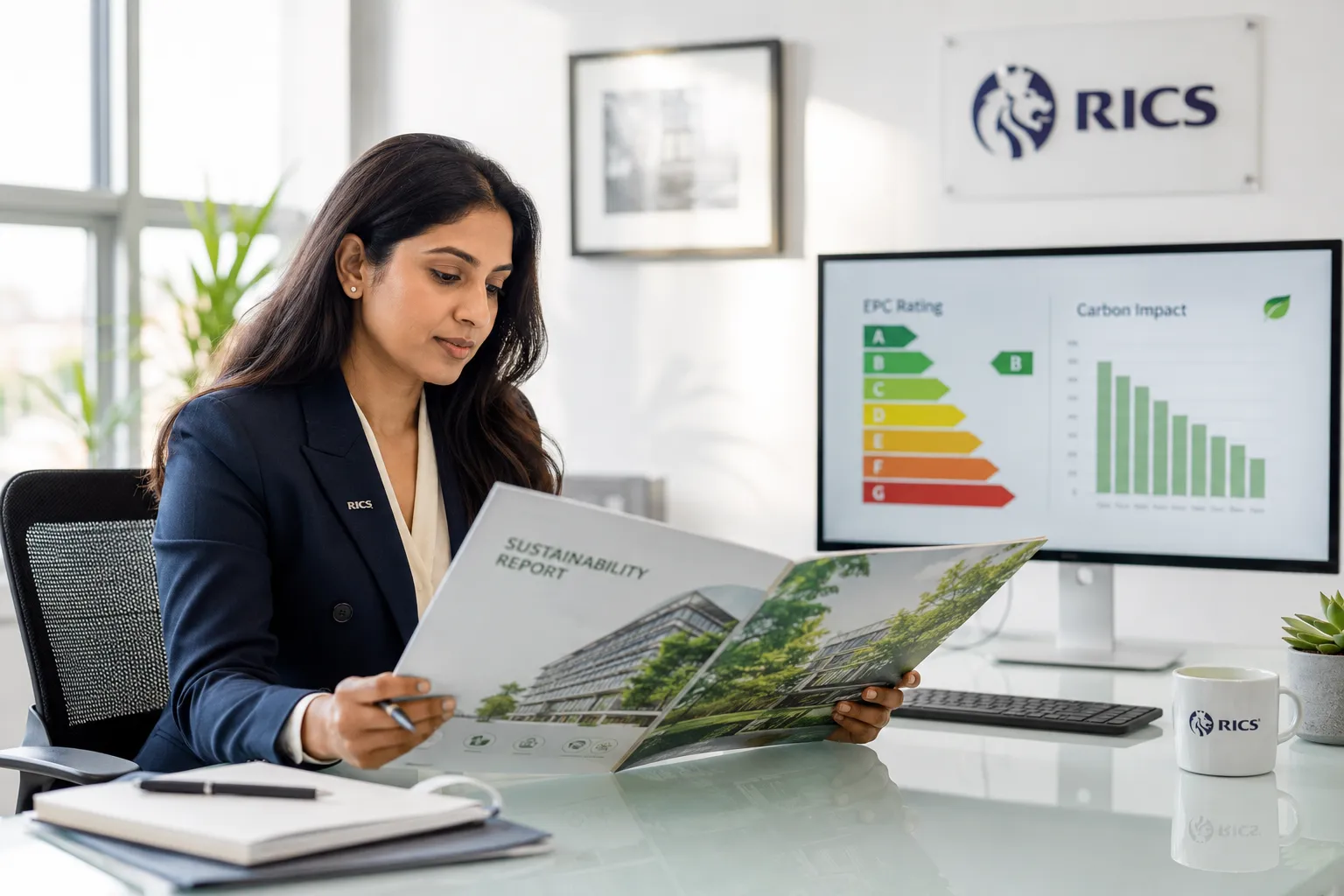
What Is the RICS Sustainability Report 2025 and How Does It Apply to Expert Witness Valuations
The RICS Sustainability Report 2025 is a sector-wide assessment published by the Royal Institution of Chartered Surveyors that benchmarks how the built environment profession is measuring, reporting, and responding to environmental factors including embodied carbon, operational carbon, and energy performance. For expert witnesses, it is not background reading, it is a live reference document that tribunals and opposing counsel will cite.
The report's most striking finding is that roughly 46% of construction professionals do not measure embodied carbon at all, and only around 16% allow carbon data to influence their material choices. This matters in tribunal because it establishes the current industry baseline. An expert witness who claims a property's carbon performance is standard practice must now account for the fact that most of the industry is not yet measuring it consistently.
How it applies in practice:
- It sets the evidential standard for what a reasonably competent surveyor should know about carbon and energy performance.
- It supports or undermines claims about market recognition of green features.
- It provides context for arguing whether a valuation discount or premium for sustainability factors is justified.
- It informs the Whole Life Carbon Assessment (WLCA) methodology that RICS has been actively promoting for comprehensive lifecycle carbon evaluation.
Expert witnesses instructed on sustainability disputes should treat the 2025 report as a primary reference alongside RICS Red Book Global Standards and the updated Expert Witness Professional Statement.
How Has RICS Updated Its Guidance on Environmental Valuations in 2025
RICS made two significant moves in 2025 that directly affect how expert witnesses handle sustainability claims. First, it launched a global public consultation in October 2025 to update its Expert Witness Professional Statement to a 5th edition, addressing emerging risks including conditional fees, AI-generated evidence, and the boundaries of expertise. Second, it made measurable progress in embedding the Whole Life Carbon Assessment standard across valuation practice.
The updated standard reinforces a principle that some practitioners underestimate: the expert witness's duty runs to the tribunal, not the client. This is not new, but the 2025 revision makes it explicit in the context of sustainability evidence, where client pressure to present favourable carbon or EPC narratives can compromise independence.
Key changes relevant to sustainability valuations:
- Provisions for handling AI and digital evidence in reports, including energy modelling outputs and automated EPC assessments.
- Clearer guidance on staying within one's area of expertise, a surveyor without specific carbon assessment training should not present embodied carbon calculations as expert opinion.
- Stronger emphasis on transparent methodology, particularly when valuing green features where market data is still developing.
For landlords and property professionals involved in disputes, understanding these updates helps in assessing whether an opposing expert's report meets current RICS standards. For a broader view of how RICS standards affect property assessments, the RICS building survey guide for home buyers provides useful context.
What Is an EPC Rating and Why Does It Matter for Expert Witness Testimony
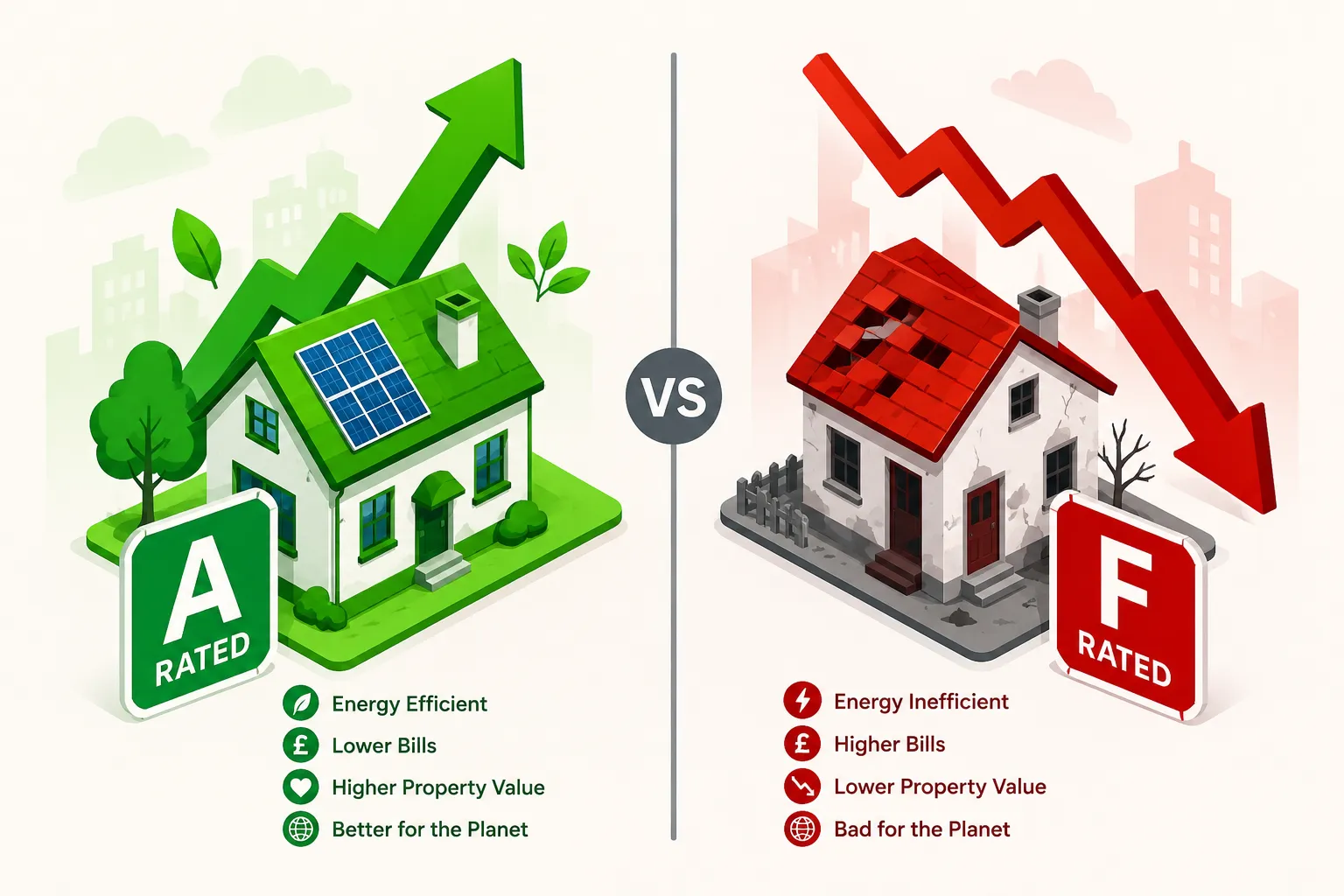
An Energy Performance Certificate (EPC) rates a property's energy efficiency on a scale from A (most efficient) to G (least efficient). It is a legal requirement for most residential and commercial property transactions and lettings in England and Wales. In expert witness testimony, EPC ratings matter because they carry a quantifiable financial impact that tribunals expect to see evidenced.
For expert witnesses, EPC ratings are not simply a compliance checkbox. They represent a data point that affects:
- Rental yield, properties rated F or G cannot legally be let under current Minimum Energy Efficiency Standards (MEES), directly affecting income valuation.
- Sale price, market evidence increasingly shows buyers applying discounts for lower-rated properties, though the size of that discount varies by location and property type.
- Mortgage availability, some lenders apply stricter criteria to lower-rated properties, affecting comparable transaction analysis.
Common mistake: Expert witnesses sometimes cite an EPC rating without contextualising it within local market evidence. A tribunal will not accept a blanket percentage discount; it requires comparable sales data showing how buyers in that specific market have responded to similar EPC ratings.
When instructed on a valuation dispute, an independent property valuation that accounts for EPC impact should reference actual transaction data, not theoretical energy cost savings alone.
How Do Carbon Claims Affect Property Valuations in Tribunal Disputes
Carbon claims in tribunal disputes typically arise in one of three contexts: dilapidations cases where a landlord or tenant disputes the cost of energy improvements; contested sale valuations where a buyer argues a property was overvalued due to poor carbon performance; and planning or development disputes where embodied carbon commitments affect a scheme's viability.
In each context, the expert witness must translate carbon data into financial terms the tribunal can apply. A carbon claim that remains abstract, "this building has high embodied carbon", carries no weight without a methodology showing how that translates to value.
What tribunals require from carbon evidence:
- A clear methodology, ideally aligned with the RICS Whole Life Carbon Assessment standard.
- Market evidence showing buyer or tenant behaviour in response to carbon performance.
- A distinction between operational carbon (energy use during occupation) and embodied carbon (carbon locked into materials and construction).
- Acknowledgement of uncertainty where market data is limited, rather than false precision.
The 2025 RICS report noted that 18% of professionals would like to measure embodied carbon if a standardised approach were available. Expert witnesses should acknowledge this gap honestly rather than presenting embodied carbon figures as settled science when the methodology is still maturing.
For disputes involving dilapidations, the dilapidations services overview provides context on how energy improvement costs are typically assessed.
How Do You Defend Carbon and EPC Claims in Tribunal Disputes as an Expert Witness
Defending carbon and EPC claims in tribunal requires a structured report, transparent methodology, and preparation for predictable cross-examination challenges. The RICS Sustainability Report 2025 in Expert Witness Valuations framework gives practitioners a defensible evidential foundation when applied correctly.
Step-by-step approach for defending sustainability claims:
- Establish the factual baseline. Confirm the current EPC rating, its date, and whether it reflects the property's actual condition or a modelled assessment.
- Identify the applicable RICS standard. Reference the Whole Life Carbon Assessment standard or Red Book guidance as appropriate to the dispute type.
- Quantify the financial impact. Use comparable transaction analysis to show how the market has priced similar EPC ratings or carbon profiles in the same area.
- Distinguish between offsetting and improvement. Carbon offsetting does not improve a building's operational or embodied carbon profile; it compensates for it externally. Tribunals treat these differently.
- Address uncertainty honestly. Where market data is thin, state the range of outcomes and the assumptions behind your central estimate.
- Prepare for cross-examination on methodology. Opposing counsel will probe the basis for any sustainability discount or premium. A well-documented methodology withstands this; a generalised assertion does not.
Expert witnesses should also consider requesting expert conferencing before the hearing. RICS actively encourages this approach to narrow disputed issues and produce a joint statement, which reduces tribunal time and demonstrates professional cooperation.
For professionals seeking to understand the full scope of expert witness services, the expert witness reports service page outlines what a properly structured report should contain.
What Evidence Do You Need to Support Carbon Impact Claims in Tribunal
The evidence required to support carbon impact claims in tribunal must be specific, verifiable, and methodologically transparent. General assertions about the importance of sustainability will not satisfy a tribunal; what is needed is a chain of evidence linking the property's carbon profile to a quantified effect on value.
Essential evidence types:
| Evidence Type | Purpose | Source |
|---|---|---|
| EPC certificate and lodgement history | Establishes current and historic energy rating | EPC Register |
| Comparable sales data | Shows market pricing response to EPC ratings | Land Registry / agent data |
| MEES compliance status | Confirms lettability for investment properties | Government regulations |
| Energy cost projections | Quantifies running cost differential | CIBSE / SAP calculations |
| Whole Life Carbon Assessment | Embodies carbon across lifecycle | RICS WLCA standard |
| Expert conferencing joint statement | Narrows agreed and disputed facts | Tribunal directions |
Edge case to note: Where a property has a low EPC rating but sits in a conservation area or is listed, the cost of improvement may be disproportionate or restricted. In these cases, the valuation impact of the EPC rating must be assessed differently, and the expert should acknowledge the constraint explicitly rather than applying a standard discount.
What Are Common Mistakes Expert Witnesses Make When Valuing Sustainability Factors
The most common mistakes in sustainability valuations arise from overconfidence in immature data, failure to distinguish between different types of carbon claims, and underestimating the scrutiny that sustainability evidence receives in tribunal.
The most damaging errors:
- Conflating EPC rating with actual energy performance. An EPC is a modelled assessment, not a measured one. Actual energy bills may tell a different story, and tribunals have rejected valuations that ignored this distinction.
- Applying national average discounts without local evidence. A 5% discount for an F-rated property may be defensible in one market and completely unsupported in another.
- Treating carbon offsetting as equivalent to physical improvement. A landlord who has purchased carbon offsets has not improved the building's EPC rating or reduced its operational carbon. These are separate matters in a valuation context.
- Exceeding the boundaries of expertise. A general practice surveyor presenting detailed embodied carbon calculations without specialist training is vulnerable to a successful challenge under the updated RICS expert witness standard.
- Failing to update evidence to the valuation date. Green building market conditions shifted significantly in early 2026, with a recorded 26% decline in buyer inquiries for green properties. An expert using pre-2025 market data in a 2026 dispute will face questions about relevance.
Understanding what drives property value more broadly can help frame sustainability factors correctly. The top three factors in a property valuation article provides a useful baseline perspective.
How Do Tribunals View Conflicting Expert Opinions on Sustainability Valuations
Tribunals approach conflicting sustainability expert opinions by examining the methodology, the evidence base, and whether each expert has stayed within their area of competence. Where two experts reach different conclusions, the tribunal will generally prefer the opinion that is better evidenced, more transparent in its assumptions, and more consistent with recognised RICS standards.
What tribunals look for when opinions conflict:
- Which expert has applied a recognised methodology (such as the RICS WLCA standard) versus a bespoke or unexplained approach.
- Whether each expert has acknowledged the limitations of available data.
- Whether the experts have engaged in the joint statement process to identify areas of agreement.
- Whether either expert has strayed outside their stated expertise.
A well-prepared expert who acknowledges uncertainty and presents a range of outcomes is often more credible than one who presents a precise figure without adequate support. Tribunals are experienced at identifying false precision in sustainability evidence.
What Is the Difference Between Carbon Offsetting and Actual Sustainability Improvements in Valuations
Carbon offsetting and physical sustainability improvements are treated as fundamentally different in property valuations, and conflating them is one of the most frequently exploited weaknesses in expert witness reports.
Carbon offsetting involves purchasing credits that compensate for a building's carbon emissions by funding reductions elsewhere, reforestation, renewable energy projects, and similar schemes. It does not change the building's EPC rating, reduce its energy bills, or improve its MEES compliance status.
Actual sustainability improvements, such as insulation upgrades, heat pump installation, or solar PV, change the physical performance of the building, improve its EPC rating, and directly affect its value, lettability, and running costs.
In a tribunal dispute, a landlord who argues that carbon offsetting justifies a higher valuation will face a straightforward challenge: the offsetting has no effect on the metrics that buyers and tenants actually use to assess the property. Expert witnesses should be prepared to explain this distinction clearly and to challenge opposing reports that conflate the two.
Who Needs to Understand RICS Sustainability Valuations for Expert Witness Work
The RICS Sustainability Report 2025 in Expert Witness Valuations framework is relevant to a broader group than just the surveyors writing the reports.
Who this affects:
- Chartered surveyors acting as expert witnesses in property disputes involving energy performance, dilapidations, or development viability.
- Landlords facing tribunal challenges over MEES compliance or energy improvement costs.
- Property investors and developers whose valuations are contested on sustainability grounds.
- Solicitors and barristers instructing expert witnesses in property tribunal cases.
- Homebuyers and sellers involved in contested valuations where EPC ratings or green features are disputed.
- Commercial property occupiers in lease disputes where energy performance obligations are in contention.
For landlords and developers working on sustainability-focused projects, the community housing projects and sustainability services page provides relevant context on how sustainability is integrated into property development from the outset.
How Do You Calculate the Financial Impact of Poor EPC Ratings on Property Value
Calculating the financial impact of a poor EPC rating requires a combination of comparable transaction analysis, energy cost modelling, and assessment of regulatory risk. There is no single universally accepted formula, which is why expert witnesses must show their working clearly.
A practical approach:
- Identify comparable sales of similar properties with different EPC ratings in the same area and time period.
- Isolate the EPC variable by controlling for size, condition, location, and tenure.
- Quantify the energy cost differential using SAP or CIBSE calculations to show the annual running cost difference between the subject property's rating and the market norm.
- Assess regulatory risk, for a let property, an F or G rating creates a legal barrier to letting under MEES, which a buyer will price in as a cost of compliance.
- Apply a transparent adjustment based on the above evidence, stated as a range where data is limited.
For residential properties, research has shown that EPC rating differences can produce measurable price differentials, though the size varies significantly by region and property type. Expert witnesses should use local data rather than national averages wherever possible.
Understanding how valuations are conducted in different contexts, including for capital gains purposes or inheritance tax valuations, can inform how sustainability adjustments are framed within a broader valuation methodology.
Where to Find the RICS Sustainability Report 2025 and Related Guidance
The full RICS Sustainability Report 2025 is available directly from the RICS website (rics.org) in the reports and publications section. The updated Expert Witness Professional Statement consultation documents were published via the RICS consultations portal in October 2025, and the finalised 5th edition standard is expected to be published through the standard RICS professional standards channels.
Key documents for expert witnesses handling sustainability disputes:
- RICS Sustainability Report 2025 (rics.org publications)
- RICS Whole Life Carbon Assessment for the Built Environment standard
- RICS Red Book Global Standards (current edition)
- RICS Professional Statement: Surveyors Acting as Expert Witnesses (5th edition, in consultation as of late 2025)
- MEES Regulations and associated government guidance (DLUHC)
- EPC Register (epcregister.com) for lodged certificates and historic data
Interactive EPC Impact Estimator
.cg-epc-wrap{font-family:Arial,sans-serif;max-width:480px;margin:0 auto;background:#f8f9fa;border:1px solid #dee2e6;border-radius:8px;padding:20px;box-sizing:border-box}
.cg-epc-wrap h3{margin:0 0 14px;font-size:1rem;color:#1a2e44;border-bottom:2px solid #1a7a4a;padding-bottom:8px}
.cg-epc-row{display:flex;align-items:center;justify-content:space-between;margin-bottom:12px;flex-wrap:wrap;gap:6px}
.cg-epc-wrap label{font-size:.85rem;color:#333;font-weight:600;min-width:140px}
.cg-epc-wrap input,.cg-epc-wrap select{padding:6px 8px;border:1px solid #ccc;border-radius:4px;font-size:.85rem;width:160px;box-sizing:border-box}
.cg-epc-btn{width:100%;padding:10px;background:#1a7a4a;color:#fff;border:none;border-radius:5px;font-size:.9rem;font-weight:700;cursor:pointer;margin-top:6px}
.cg-epc-btn:hover{background:#145e38}
.cg-epc-result{margin-top:14px;padding:12px;background:#fff;border-left:4px solid #1a7a4a;border-radius:4px;font-size:.85rem;color:#1a2e44;display:none}
.cg-epc-result strong{display:block;font-size:1rem;color:#1a7a4a;margin-bottom:4px}
.cg-epc-note{font-size:.75rem;color:#666;margin-top:10px;line-height:1.4}
EPC Valuation Impact Estimator
Estimates use indicative market adjustment ranges (1.5% per band) for illustrative purposes only. Expert witness valuations require local comparable evidence. Not financial advice.
function cg_calc(){
var v=parseFloat(document.getElementById(‘cg-val’).value);
var bands=[‘G’,’F’,’E’,’D’,’C’,’B’,’A’];
var c=document.getElementById(‘cg-cur’).value;
var t=document.getElementById(‘cg-tar’).value;
var r=document.getElementById(‘cg-res’);
if(!v||!c||!t){r.style.display=’block’;r.innerHTML=’Please fill all fields.‘;return;}
var ci=bands.indexOf(c),ti=bands.indexOf(t);
if(ti<=ci){r.style.display='block';r.innerHTML='Select a higher target rating than current.‘;return;}
var diff=ti-ci;
var low=(diff*1.0/100*v).toFixed(0);
var high=(diff*2.0/100*v).toFixed(0);
r.style.display=’block’;
r.innerHTML=’Estimated Value Uplift: £’+parseInt(low).toLocaleString()+’, £’+parseInt(high).toLocaleString()+’Improving from EPC ‘+c+’ to ‘+t+’ (‘+diff+’ band’+(diff>1?’s’:”)+’) may add approximately 1-2% per band to market value, subject to local evidence and property type.’;
}
Frequently Asked Questions
What is the RICS Sustainability Report 2025?
It is a report published by the Royal Institution of Chartered Surveyors benchmarking how the construction and property sector measures and responds to carbon emissions, energy performance, and green building demand. It is a key reference document for expert witnesses handling sustainability-related property disputes in 2026.
Does an expert witness have to follow RICS sustainability guidance?
Yes, if they are a RICS member. The updated Expert Witness Professional Statement requires RICS members to stay within their area of expertise and apply recognised methodologies. Departing from RICS guidance without explanation weakens the credibility of the report in tribunal.
Can a poor EPC rating reduce a property's value in a dispute?
Yes, but the reduction must be evidenced with comparable transaction data, not assumed. The financial impact varies by property type, location, and whether the rating creates a regulatory barrier such as a MEES compliance issue for a let property.
What is the difference between embodied carbon and operational carbon in a valuation?
Operational carbon refers to emissions from energy use during occupation (heating, lighting, and so on). Embodied carbon refers to emissions locked into the building's materials and construction process. Both can affect value, but they require different assessment methodologies and carry different weight in different dispute types.
How do tribunals handle conflicting expert opinions on EPC impact?
Tribunals assess the methodology, evidence base, and whether each expert stayed within their competence. The better-evidenced, more transparent opinion generally prevails. Joint expert statements, encouraged by RICS, help narrow the disputed issues before the hearing.
What happens if an expert witness uses carbon offsetting to justify a higher valuation?
This is a vulnerable position. Carbon offsetting does not improve a property's EPC rating, reduce energy bills, or change its MEES compliance status. Opposing counsel will likely challenge this directly, and a tribunal is unlikely to accept offsetting as a substitute for physical energy performance improvement in a valuation context.
Conclusion
The intersection of RICS Sustainability Report 2025 in Expert Witness Valuations: Defending Carbon and EPC Claims in Tribunal Disputes is no longer a niche concern. With a 26% decline in green building buyer inquiries recorded in early 2026, contested sustainability valuations are reaching tribunals with greater frequency, and the standard of evidence required is rising in step with RICS guidance updates.
Actionable next steps for property professionals and expert witnesses:
- Download and read the RICS Sustainability Report 2025 in full before accepting instructions on any sustainability-related valuation dispute.
- Confirm familiarity with the RICS Whole Life Carbon Assessment standard and the updated Expert Witness Professional Statement (5th edition consultation).
- Build valuation reports around local comparable transaction data, not national averages, when quantifying EPC impact.
- Clearly distinguish between carbon offsetting and physical sustainability improvements in every report.
- Request expert conferencing early in the dispute process to narrow issues and demonstrate professional cooperation to the tribunal.
- If sustainability expertise falls outside your core competence, instruct a specialist rather than risk a successful challenge under the updated RICS standard.
For property owners, landlords, and buyers facing valuation disputes with a sustainability dimension, instructing a chartered surveyor with specific experience in expert witness reports and sustainability valuation methodology is the most direct way to protect your position. Early, well-evidenced expert opinion is far more effective than attempting to rebuild a weak report under cross-examination.