

Last updated: July 24, 2026
Quick Answer: Expert witness services for landlord-tenant disputes provide independent, court-compliant professional opinions on property valuations, dilapidations schedules, and disrepair claims. In 2026, these services are most commonly provided by RICS-accredited chartered surveyors who produce CPR Part 35-compliant reports for use in litigation, arbitration, or settlement negotiations. The expert's duty is to the court, not to the instructing party.
Key Takeaways
- An expert witness in property disputes is a qualified professional whose primary duty is to the court, not the client who pays their fee.
- Dilapidations claims are capped by Section 18(1) of the Landlord and Tenant Act 1927, which limits a landlord's damages to the actual reduction in the value of their interest.
- CPR Part 35 governs how expert evidence must be prepared and presented in England and Wales; non-compliant reports can be rejected by the court.
- Expert witness fees for dilapidations and disrepair claims in 2026 typically range from approximately £1,500 to £10,000 or more, depending on property size and complexity.
- Photos alone are rarely sufficient for court proceedings; a formal expert report is required when quantum (the amount of money at stake) is disputed.
- The same expert cannot act for both landlord and tenant in the same dispute, though a single joint expert (SJE) can be appointed by agreement.
- Disagreeing expert witnesses may be directed by the court to meet and produce a joint statement identifying areas of agreement and disagreement.
- Finding a qualified expert requires checking RICS membership, relevant specialism, and prior experience giving evidence in similar disputes.
What Is an Expert Witness in Landlord-Tenant Disputes?
An expert witness in landlord-tenant disputes is a qualified professional, typically a chartered surveyor, appointed to give independent technical opinion to a court, tribunal, or arbitrator. Unlike a factual witness who describes what they saw, an expert witness interprets evidence and expresses professional judgments that a judge or arbitrator cannot be expected to form alone.
In the context of Expert Witness Services for Landlord-Tenant Disputes: Valuations, Dilapidations, and Disrepair Claims 2026, the expert's role covers three main areas:
- Valuations: Assessing the open market value of a property, or the diminution in value caused by disrepair, at a specific date.
- Dilapidations: Quantifying the cost of reinstatement works a tenant is obliged to carry out under their lease covenants, and applying the Section 18(1) cap where relevant.
- Disrepair claims: Evaluating whether a landlord has breached their repairing obligations and, if so, what loss the tenant has suffered.
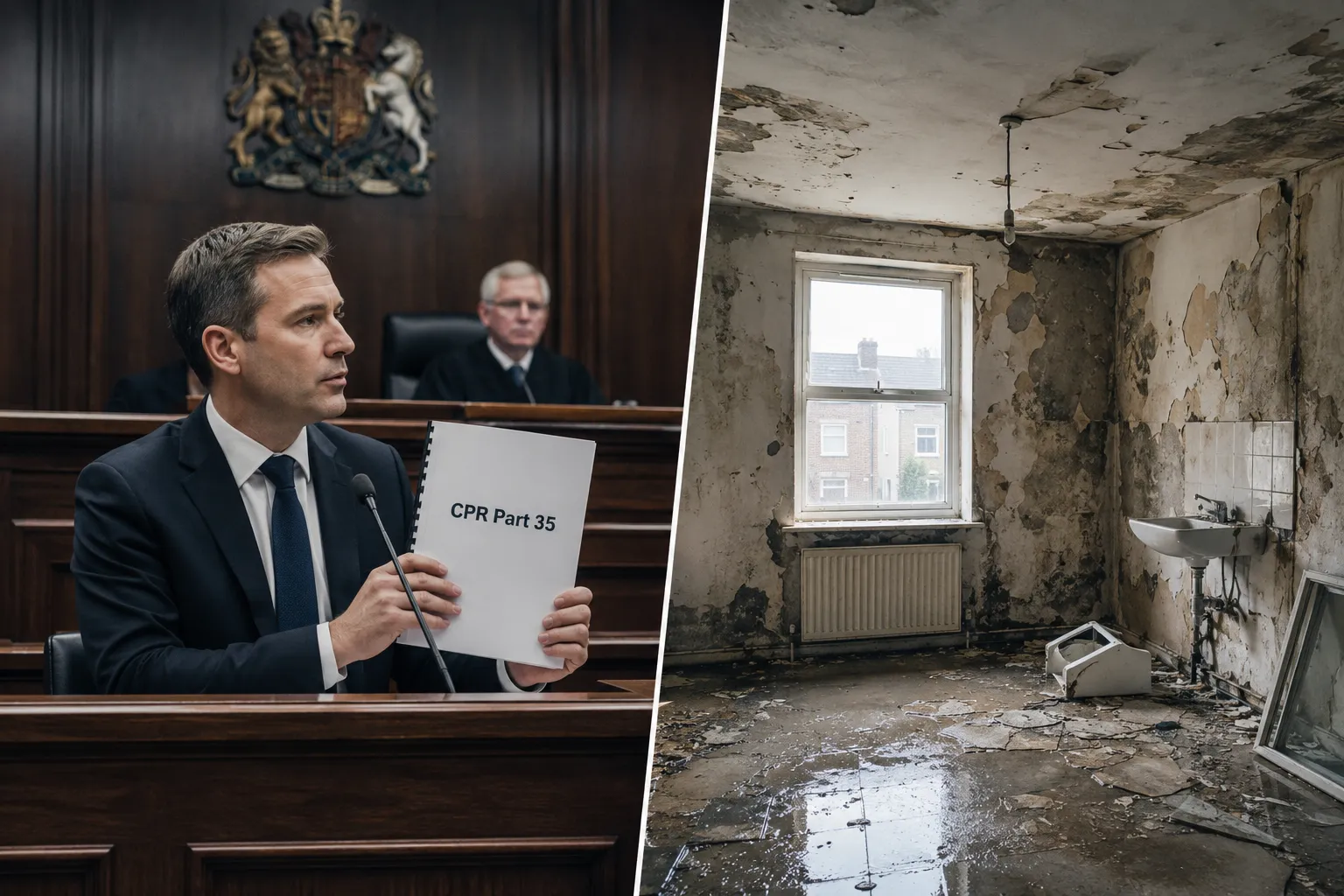
The expert's overriding duty under CPR Part 35 is to the court, not to the party who instructs them. This is not a formality; courts take it seriously, and an expert who appears to advocate for their client risks having their evidence disregarded.
What Is the Difference Between an Expert Witness and a Surveyor in Landlord Disputes?
Any chartered surveyor can inspect a property and produce a report, but only a surveyor instructed as an expert witness under CPR Part 35 can give opinion evidence in court proceedings. The distinction matters practically.
A standard surveyor's report prepared for a client is privileged and may be used for negotiation, but it cannot be put before a court as expert evidence without the surveyor signing a declaration of truth and confirming their duty to the court. Reports that lack this declaration, or that read as advocacy rather than independent opinion, are routinely challenged and sometimes excluded.
Choose a standard surveyor's report if: you need an internal assessment for negotiation purposes, you are at an early stage of a dispute, or the amount in dispute does not justify court proceedings.
Choose a formal expert witness report if: proceedings have been issued or are imminent, the other side has appointed their own expert, or a court or tribunal has given directions requiring expert evidence.
For dilapidations matters, see the dilapidations services overview for more on how schedule preparation differs from expert witness work.
What Qualifications Does an Expert Witness Need for Property Disputes?
There is no statutory licence to practise as a property expert witness in England and Wales, but courts expect a high standard of credentials and relevant experience. In practice, the accepted baseline is:
- RICS membership (MRICS or FRICS) with a specialism in building surveying, valuation, or both.
- Demonstrable experience in the specific type of dispute (commercial dilapidations, residential disrepair, rent review, etc.).
- Familiarity with CPR Part 35, the Practice Direction, and the RICS guidance on acting as an expert witness.
- Prior experience preparing expert reports and, ideally, giving oral evidence or attending joint expert meetings.
Some practitioners also hold the RICS Diploma in Arbitration or are accredited mediators, which broadens their dispute resolution capability. The key question when instructing an expert is not just whether they are qualified, but whether they have given evidence in disputes of similar type and value. An expert who has never attended a joint meeting or been cross-examined may struggle under pressure.
How Do Expert Witnesses Value Property Damage in Rental Disputes?
Expert witnesses use a combination of building cost analysis and market valuation to quantify property damage in rental disputes. The methodology depends on whether the claim is a dilapidations claim at lease end or an ongoing disrepair claim during the tenancy.
For dilapidations (end of lease):
- The expert prepares or reviews a schedule of dilapidations setting out each alleged breach of the tenant's repairing, decorating, and reinstatement covenants.
- A cost of works figure is calculated, typically using current BCIS (Building Cost Information Service) rates or competitive contractor quotes.
- A Section 18(1) diminution valuation is then carried out. This compares the value of the landlord's interest in the property as it stands (in disrepair) against its value if the tenant had complied with their covenants. The damages are capped at the lower of the two figures.
- If the landlord intends to redevelop or demolish the property, the Section 18(1) cap may reduce the claim to nil or near nil, because the disrepair causes no actual loss in value.
For disrepair claims (during tenancy):
- The expert assesses the nature and extent of the disrepair, the landlord's knowledge and response time, and the impact on the tenant's use and enjoyment.
- Damages may include a percentage reduction in rental value for the period of disrepair, plus any consequential losses (damaged belongings, health impacts, alternative accommodation costs).
You can read more about how dilapidation protocols work in practice in this dilapidation protocols explained guide.
How Much Do Expert Witness Services Cost for a Dilapidations Claim in 2026?
Expert witness fees for dilapidations and disrepair claims in 2026 vary significantly based on property type, the complexity of the dispute, and the stage at which the expert is instructed. The following are realistic estimates for England and Wales:
| Stage of Instruction | Typical Fee Range (2026) |
|---|---|
| Initial advice and report review | £500 – £1,500 |
| Full CPR Part 35 expert report (residential) | £1,500 – £3,500 |
| Full CPR Part 35 expert report (commercial) | £3,000 – £8,000+ |
| Joint expert meeting and statement | £750 – £2,500 |
| Attendance at trial or tribunal | £1,500 – £5,000 per day |
These figures are estimates based on current market rates and should be confirmed with the expert at the outset. Fees are typically charged at an hourly rate (commonly £150 to £400 per hour for RICS-accredited surveyors in London and the South East) or as a fixed fee for defined deliverables.
Common mistake: Instructing an expert on an hourly rate without agreeing a cost cap or budget estimate. Costs can escalate quickly if the other side's expert is combative or if the court directs multiple rounds of correspondence.
For context on how chartered surveyor valuations are priced more broadly, fee structures follow similar principles across dispute and non-dispute work.
Can the Same Expert Witness Act for Both Landlord and Tenant?
No. A single expert cannot act as an advocate for both parties simultaneously. However, courts in England and Wales do sometimes direct the appointment of a Single Joint Expert (SJE), who is instructed by both parties jointly and whose report is provided to both sides.
An SJE is most common in lower-value disputes where the cost of two separate experts would be disproportionate. Both parties contribute to the SJE's instructions, and both receive the report. The SJE still owes their duty to the court, not to either party.
Key distinction:
- Party-appointed expert: Each side appoints their own expert. Both experts produce separate reports, attend a joint meeting, and may give oral evidence.
- Single Joint Expert: One expert appointed by both parties. Cheaper, but neither side has the same degree of control over the instructions or the outcome.
If the dispute is high value or the parties have fundamentally different factual accounts of the property's condition, a party-appointed expert is usually preferable.
What Happens When Expert Witnesses Disagree on Property Valuation?
When expert witnesses disagree, the court does not simply pick the higher or lower figure. The judge evaluates the methodology, reasoning, and credibility of each expert's opinion and may accept one view in full, prefer parts of each, or reach an independent conclusion based on the evidence as a whole.
Before the matter reaches a judge, CPR Part 35 requires that expert witnesses in the same discipline meet without lawyers present, discuss their respective reports, and produce a joint statement. This statement must clearly identify:
- Points on which the experts agree.
- Points on which they disagree and the reasons for that disagreement.
In practice, joint meetings resolve a significant proportion of disputed items. Experts who have prepared thorough, well-reasoned reports tend to reach agreement on the majority of issues, leaving only genuinely contested points for the court.
Edge case: If an expert changes their opinion significantly after the joint meeting, they must notify the instructing party and the court promptly. Courts look unfavourably on experts who appear to capitulate under pressure rather than on the basis of new information or argument.
When Do You Actually Need an Expert Witness vs Just Photos of Damage?
Photographs are evidence of condition, not evidence of value or liability. They are useful but rarely sufficient on their own once a dispute reaches formal proceedings.
Photos alone may be sufficient if:
- The dispute is over a small deposit deduction in the First-tier Tribunal (Property Chamber).
- The damage is self-evident and both parties agree on the cost of repair.
- You are at the pre-action negotiation stage.
You need a formal expert witness report if:
- Proceedings have been issued in the County Court or High Court.
- The other side has appointed their own expert.
- The quantum of the dilapidations or disrepair claim is disputed.
- Section 18(1) diminution valuation is required.
- The landlord's repairing obligations under the Landlord and Tenant Act 1985 are in dispute.
For residential tenancy deposit disputes, the First-tier Tribunal (Property Chamber) has relatively informal procedures, and a detailed schedule of condition supported by photographs may carry significant weight. For commercial lease dilapidations running into tens or hundreds of thousands of pounds, a CPR Part 35-compliant expert report is non-negotiable.

How Long Does an Expert Witness Report Take for a Disrepair Claim?
A CPR Part 35-compliant expert report for a disrepair or dilapidations claim typically takes between three and eight weeks from instruction to delivery, depending on the complexity of the property and the volume of documentation to review.
The process generally follows these steps:
- Instruction and conflict check (1-3 days): The expert confirms they have no conflict of interest and agrees the scope of instruction.
- Document review (3-7 days): Reviewing the lease, schedule of condition, correspondence, prior surveys, and any existing schedules of dilapidations.
- Site inspection (1-2 days including travel): Physical inspection of the property, photographic record, and measurements.
- Report drafting and peer review (1-3 weeks): Drafting the report, applying the relevant legal tests, and having the report reviewed internally before issue.
- Issue and declaration (1-2 days): Signing the CPR Part 35 declaration and issuing the report to the instructing solicitor.
Urgent instructions are possible but typically attract a premium fee. For large commercial properties with extensive dilapidations, the process can take longer, particularly where access needs to be coordinated with an occupying tenant.
What Should Be Included in an Expert Witness Report for Disrepair?
A CPR Part 35-compliant expert witness report for a disrepair or dilapidations claim must contain specific elements. Courts have struck out reports that omit required declarations or that fail to distinguish between fact and opinion.
Required elements under CPR Part 35:
- Details of the expert's qualifications and relevant experience.
- A statement of the substance of all instructions (written and oral) on which the report is based.
- A statement that the expert understands their duty to the court and has complied with it.
- A declaration that the report is true to the best of the expert's knowledge and belief.
- A statement of the range of opinion on the matters addressed, where opinion is not unanimous.
- A summary of the conclusions reached.
- A statement that the expert is aware of the requirements of CPR Part 35 and the Practice Direction.
Substantive content for disrepair or dilapidations:
- Description of the property and the relevant lease terms.
- Schedule of alleged breaches, with each item assessed for liability and quantum.
- Section 18(1) diminution valuation (for terminal dilapidations claims).
- Photographs, plans, and supporting documentation as appendices.
- Commentary on the opposing party's schedule or report, if one has been served.
For an overview of the expert witness report services available from chartered surveyors, the scope of instruction can be tailored to the specific stage and nature of the dispute.
How to Find a Qualified Expert Witness for Rental Property Disputes
Finding the right expert requires more than a Google search. The following steps help identify a genuinely qualified and experienced professional.
- Check RICS membership: Verify the surveyor holds MRICS or FRICS status at rics.org. Membership is searchable by name and location.
- Confirm the relevant specialism: A building surveyor is appropriate for disrepair and dilapidations; a valuer (RICS Registered Valuer) is needed for diminution valuations. Some experts hold dual qualifications.
- Ask for a CV and list of prior instructions: A credible expert witness will have a track record of preparing CPR Part 35 reports and attending joint meetings or hearings.
- Check for conflicts of interest: The expert must not have acted for the other party or have a financial interest in the outcome.
- Agree the scope and fee in writing: Confirm what the report will cover, the expected timeline, and the fee structure before issuing formal instructions.
- Consider geographic coverage: An expert familiar with local property values and market conditions will produce more credible valuations than one unfamiliar with the area.
For landlords and tenants with properties in London and the South East, Prince Chartered Surveyors' expert witness services cover the full range of residential and commercial dispute types.
Common Mistakes Landlords Make with Expert Witness Evidence
Instructing an expert too late. Courts set tight timetables for expert evidence. Instructing an expert after directions have been given, or close to a hearing date, limits the expert's ability to produce a thorough report and may result in the evidence being excluded.
Using a partisan report as expert evidence. A schedule of dilapidations prepared by the landlord's own surveyor as part of the claim is not the same as an independent expert report. Courts distinguish between the two, and attempting to pass one off as the other undermines credibility.
Failing to serve a quantified demand. Before commencing proceedings for terminal dilapidations, landlords should serve a quantified demand in accordance with the Pre-Action Protocol for Claims for Damages in Relation to the Physical State of Commercial Property at Termination of a Tenancy (the Dilapidations Protocol). Failure to follow the Protocol can result in cost penalties.
Ignoring the Section 18(1) cap. Landlords sometimes pursue large reinstatement cost claims without commissioning a diminution valuation. If the property was always going to be redeveloped, the Section 18(1) cap may reduce the recoverable damages to a fraction of the reinstatement cost. Understanding this early avoids wasted costs.
For more on whether dilapidations can also create tax planning opportunities, see is dilapidations an opportunity for tax relief?
FAQ: Expert Witness Services for Landlord-Tenant Disputes
What is CPR Part 35 and why does it matter for property disputes?
CPR Part 35 is the Civil Procedure Rule governing expert evidence in England and Wales. It sets out the duties of expert witnesses, the form expert reports must take, and the rules for joint expert meetings. Any expert report that does not comply with CPR Part 35 risks being excluded from court proceedings.
Can a tenant appoint their own expert witness for a disrepair claim?
Yes. A tenant has the same right as a landlord to instruct an independent expert witness to assess the condition of the property, quantify their losses, and produce a CPR Part 35-compliant report. In disrepair claims, the tenant's expert will typically assess the nature and duration of the disrepair and the impact on the tenant's use and enjoyment of the property.
What is a Section 18(1) valuation and when is it needed?
A Section 18(1) valuation is required in terminal dilapidations claims (claims at the end of a lease). Section 18(1) of the Landlord and Tenant Act 1927 caps the landlord's damages at the diminution in the value of their reversionary interest caused by the disrepair. If the landlord intends to redevelop or the disrepair has not reduced the market value of the property, the recoverable damages may be significantly lower than the cost of reinstatement works.
How is an expert witness different from an arbitrator or mediator?
An expert witness gives opinion evidence to a court or tribunal; they do not decide the dispute. An arbitrator is a private decision-maker appointed by the parties whose award is binding. A mediator facilitates negotiation but has no power to impose a decision. In some lease renewal and rent review disputes, a surveyor may be appointed as an independent expert to determine a question (such as open market rent), which is a different role from giving evidence as an expert witness in litigation.
Do expert witnesses attend court in person?
Not always. In many cases, the joint expert meeting and joint statement resolve the disputed issues, and the expert's written report is accepted without oral evidence. Where oral evidence is required, the expert attends the hearing, confirms their report, and may be cross-examined by the opposing party's legal representative.
What is a schedule of condition and how does it relate to dilapidations?
A schedule of condition is a record of the property's state at the start of a lease, usually prepared by a surveyor with photographs. It limits the tenant's repairing obligations to ensuring the property is returned in no worse condition than recorded at the outset. Without a schedule of condition, tenants may face dilapidations claims for pre-existing defects. For more detail, see the party wall schedule of condition service, which follows similar principles.
Conclusion
Expert witness services for landlord-tenant disputes sit at the intersection of property expertise and legal process. Getting the right expert, at the right stage, with a properly scoped instruction is the single most important factor in achieving a credible outcome, whether in court or in settlement.
Actionable next steps for landlords and tenants in 2026:
- Identify the type of dispute early. Dilapidations, disrepair, rent review, and valuation disputes each require different expertise. Clarify the nature of the claim before instructing anyone.
- Check the Pre-Action Protocol. For commercial dilapidations, follow the Dilapidations Protocol before issuing proceedings. Failure to do so attracts cost sanctions.
- Instruct a RICS-accredited expert promptly. Do not wait until proceedings are issued. Early expert advice can shape the claim strategy and identify weaknesses before they become costly.
- Commission a Section 18(1) valuation. If you are a landlord pursuing terminal dilapidations, understand the cap on your recoverable damages before committing to litigation.
- Use the joint meeting process constructively. Expert meetings resolve most disputed items. Prepare your expert thoroughly and approach the process as an opportunity to narrow the issues, not entrench positions.
For professional expert witness services covering dilapidations, disrepair, and property valuations across London and the South East, Prince Chartered Surveyors provides RICS-accredited expertise with a track record in both residential and commercial dispute resolution.
.cg-checker { font-family: Arial, sans-serif; max-width: 560px; margin: 24px auto; border: 1px solid #d0d7de; border-radius: 8px; padding: 20px; background: #f8fafc; }
.cg-checker h3 { margin: 0 0 14px; font-size: 1.05rem; color: #1a2e44; }
.cg-question { margin-bottom: 12px; }
.cg-question label { display: block; font-size: 0.9rem; color: #334155; margin-bottom: 6px; font-weight: 600; }
.cg-question select { width: 100%; padding: 7px 10px; border: 1px solid #b0bec5; border-radius: 5px; font-size: 0.88rem; background: #fff; }
.cg-btn { display: block; width: 100%; padding: 10px; background: #1a2e44; color: #fff; border: none; border-radius: 5px; font-size: 0.95rem; cursor: pointer; margin-top: 14px; }
.cg-btn:hover { background: #243d5a; }
.cg-result { margin-top: 14px; padding: 12px; border-radius: 6px; font-size: 0.88rem; display: none; }
.cg-result.show { display: block; }
.cg-result.info { background: #e8f4fd; border-left: 4px solid #1a73e8; color: #1a2e44; }
.cg-result.warn { background: #fff8e1; border-left: 4px solid #f9a825; color: #4a3800; }
.cg-result strong { display: block; margin-bottom: 4px; font-size: 0.92rem; }
Dilapidations Claim: Do You Need an Expert Witness?
function cgCheck() {
var pt = document.getElementById(‘cg-proptype’).value;
var ls = document.getElementById(‘cg-leasestage’).value;
var val = document.getElementById(‘cg-value’).value;
var proc = document.getElementById(‘cg-proceedings’).value;
var r = document.getElementById(‘cg-result’);
if (!pt || !ls || !val || !proc) { r.className = ‘cg-result warn show’; r.innerHTML = ‘Please answer all questions.‘; return; }
var msg = ”, cls = ‘info’;
if (proc === ‘yes’ || val === ‘high’ || (pt === ‘commercial’ && ls === ‘ended’)) {
msg = ‘Formal Expert Witness Report RecommendedA CPR Part 35-compliant expert report is strongly advisable. For commercial terminal dilapidations, a Section 18(1) diminution valuation is also likely required. Instruct a RICS-accredited chartered surveyor promptly.’;
} else if (val === ‘mid’) {
msg = ‘Expert Report Likely NeededAt this claim value, a formal expert report will strengthen your position significantly, especially if the other side appoints their own expert. Consider instructing early to shape the negotiation.’;
cls = ‘info’;
} else {
msg = ‘Surveyor Report May SufficeFor lower-value disputes still in negotiation, a standard surveyor’s report or schedule of condition may be adequate. If the dispute escalates to proceedings, upgrade to a CPR Part 35 expert report.’;
cls = ‘warn’;
}
r.className = ‘cg-result ‘ + cls + ‘ show’;
r.innerHTML = msg;
}
Tags: expert witness services, landlord-tenant disputes, dilapidations claims, disrepair claims, property valuation, CPR Part 35, Section 18(1) valuation, chartered surveyor, RICS expert witness, diminution valuation, schedule of dilapidations, property disputes 2026