

Last updated: July 24, 2026
Quick Answer: From 6 April 2026, the regulatory framework for Personal Emergency Evacuation Plans (PEEPs) in medium-rise residential blocks (11 to 18 metres) is fully in force, making specialist building surveys a legal and commercial necessity. Chartered surveyors must now assess whether a block meets PEEPs obligations as part of any comprehensive inspection, and non-compliance carries direct consequences for property valuations, mortgage lending, and leaseholder liability.
Key Takeaways
- PEEPs compliance became mandatory for medium-rise residential blocks (11-18 m) from 6 April 2026 under the Building Safety Act framework.
- A PEEPs compliance survey is a specialist inspection assessing evacuation provisions for residents who cannot self-evacuate, distinct from a standard EPC or fire risk assessment.
- Non-compliance can trigger valuation discounts, mortgage retention, and enforcement action by the Building Safety Regulator.
- Only qualified professionals, typically chartered building surveyors or fire safety engineers, should conduct PEEPs compliance surveys.
- Survey costs for medium-rise blocks vary based on block size and complexity, but typically range from £1,500 to £4,500 as a professional estimate.
- Freeholders and responsible persons bear primary legal responsibility for PEEPs compliance costs, though service charge implications for leaseholders are common.
- High-rise blocks (over 18 m) have operated under stricter Building Safety Act provisions since 2023; medium-rise rules now mirror and extend that framework.
- Failing a PEEPs survey does not mean a block is unsellable, but remediation must be documented and costed before a valuation can be finalised.
What Is PEEPs Compliance for Residential Buildings?
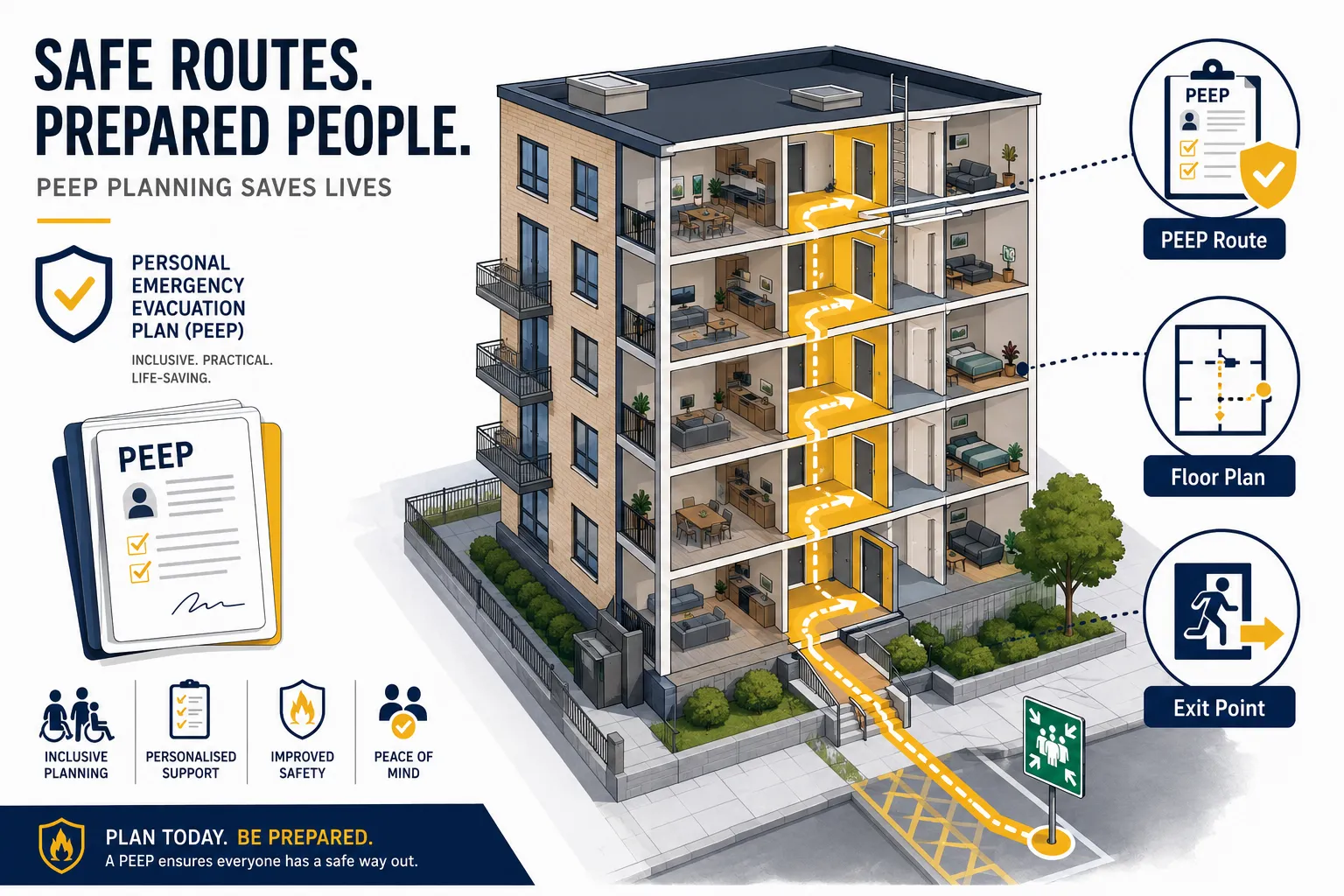
PEEPs compliance means a building has documented, workable evacuation plans for every resident who cannot self-evacuate in an emergency, such as those with mobility impairments, sensory disabilities, or cognitive conditions. For residential blocks, this goes beyond a generic fire risk assessment: it requires individual plans tied to specific people, specific flats, and specific building features.
The term PEEP stands for Personal Emergency Evacuation Plan. Under the Building Safety Act 2022 and its secondary legislation, the responsible person for a residential building must identify residents who need assistance, assess the building's physical capacity to support their evacuation, and produce written plans that are reviewed regularly.
Key elements of a PEEPs framework include:
- Resident vulnerability assessments (conducted at or near the time of occupation)
- Physical building assessments covering stairwells, refuges, evacuation lifts, and signage
- Documented individual plans for each at-risk resident
- Staff or warden training records where applicable
- Review and update protocols (typically annual or following any material building change)
PEEPs compliance is not the same as having a fire risk assessment. A fire risk assessment covers general building hazards; a PEEPs framework is specifically about individual people and their ability to exit safely.
When Does PEEPs Compliance Become Mandatory for Medium-Rise Blocks?
The April 2026 changes made PEEPs requirements fully enforceable for medium-rise residential blocks. The 6 April 2026 date marks the point at which the regulatory framework for blocks between 11 and 18 metres became fully operational, with no further transitional grace periods.
Before April 2026, medium-rise blocks occupied an ambiguous middle ground: high-rise buildings (over 18 m or over seven storeys) had been subject to the Building Safety Act's principal accountable person regime since 2023, but medium-rise obligations were phased in. From April 2026, that phasing ended.
What changed on 6 April 2026:
- Responsible persons for 11-18 m blocks must now have a completed PEEPs framework in place, not merely in progress.
- Building Safety Regulator inspections can now include medium-rise blocks without prior notice.
- Mortgage lenders and valuers are expected to treat absent or inadequate PEEPs documentation as a material defect.
- Leaseholders seeking to sell or remortgage flats in non-compliant blocks may face delays or down-valuations.
What Is the Difference Between Medium-Rise and High-Rise for PEEPs Rules?
Medium-rise blocks (11-18 m) and high-rise blocks (over 18 m) are both subject to PEEPs obligations from 2026, but the regulatory intensity differs. High-rise blocks face the full Building Safety Act principal accountable person regime, mandatory registration with the Building Safety Regulator, and more prescriptive inspection cycles. Medium-rise blocks have a slightly lighter-touch regime but are no longer exempt from enforcement.
| Feature | Medium-Rise (11-18 m) | High-Rise (over 18 m) |
|---|---|---|
| PEEPs mandatory from | 6 April 2026 | 2023 (phased) |
| BSR registration required | No (as of 2026) | Yes |
| Evacuation strategy | Simultaneous evacuation | Stay put or simultaneous |
| Inspection frequency | Risk-based | Mandatory cycle |
| Valuation impact of non-compliance | Significant | Severe |
The simultaneous evacuation strategy is the default for medium-rise blocks, meaning all residents are expected to leave at once in an emergency. This makes PEEPs particularly critical: if some residents cannot self-evacuate, the building must have physical and procedural provisions to support them during a full building evacuation.
How Do Building Surveys for PEEPs Compliance Work?
Building surveys for PEEPs compliance in medium-rise residential blocks combine physical inspection of the building fabric with a review of management documentation and resident data. A chartered surveyor or fire safety engineer visits the block, assesses evacuation routes, refuge areas, signage, and communication systems, then cross-references findings against the responsible person's existing PEEPs documentation.
A typical PEEPs compliance survey follows these stages:
- Pre-survey document review – The surveyor requests existing fire risk assessments, building plans, any previous PEEPs documentation, and the current resident register.
- Physical inspection – All common areas, stairwells, corridors, refuge points, evacuation lifts (if present), and fire doors are inspected. The surveyor checks whether physical features actually support the evacuation plans on paper.
- Gap analysis – The surveyor identifies where the building's physical condition or the documentation falls short of the April 2026 requirements.
- Resident vulnerability mapping – In collaboration with the block manager, the surveyor confirms whether all at-risk residents have individual PEEPs in place.
- Report and recommendations – A written report sets out compliance status, deficiencies, and a prioritised remediation schedule.
For buyers or lenders commissioning a survey, the Level 3 full building survey is the most appropriate starting point, as it covers structural condition, statutory compliance, and material defects in a single instruction.
Can I Do a PEEPs Survey Myself, or Do I Need a Professional?
Self-assessment is not sufficient for PEEPs compliance in medium-rise residential blocks. The Building Safety Act framework requires that assessments are carried out by a competent person, and in practice, the Building Safety Regulator and mortgage lenders expect a qualified professional to sign off on compliance.
A responsible person (typically the freeholder or their managing agent) can coordinate the process, gather resident information, and maintain records. But the physical building survey element must be conducted by someone with demonstrable competence in fire safety and building assessment, such as a chartered building surveyor or a fire safety engineer with relevant accreditation.
Attempting a self-certified PEEPs survey exposes the responsible person to enforcement risk and can invalidate insurance cover. It also creates significant liability if an incident occurs and the documentation is later found to be inadequate. For building regulation compliance testing, professional sign-off is not optional.
What Is the Difference Between PEEPs and EPC Surveys?
A PEEPs survey and an EPC (Energy Performance Certificate) survey are entirely different in scope, purpose, and legal basis. An EPC measures a building's energy efficiency and is required for sales and lettings. A PEEPs compliance survey assesses whether a building can safely evacuate all residents, including those with disabilities or mobility limitations.
The two are sometimes confused because both are triggered by property transactions and both affect valuations. But they assess completely different things:
- EPC surveys focus on insulation, heating systems, windows, and energy use. They are conducted by accredited domestic energy assessors.
- PEEPs surveys focus on fire safety, evacuation routes, physical accessibility, and individual resident plans. They are conducted by chartered surveyors or fire safety professionals.
For a detailed look at how EPC requirements interact with building surveys, see this guide on EPC, MEES, and building surveys.
A building can have an excellent EPC rating and still fail a PEEPs compliance assessment, and vice versa.
How Much Does a PEEPs Compliance Survey Cost?
For a medium-rise residential block, a PEEPs compliance survey typically costs between £1,500 and £4,500, based on professional estimates for blocks of 20 to 60 units. Larger blocks, those with complex layouts, or buildings with significant existing deficiencies will sit at the higher end or above this range.
Factors that affect survey cost:
- Number of storeys and total floor area
- Number of residential units
- Complexity of evacuation routes and refuge arrangements
- Quality and completeness of existing documentation
- Whether remediation advice is included in the scope
- Travel and access requirements
These figures are estimates based on typical market rates for chartered surveyor services in 2026 and should be confirmed with a qualified firm before instruction. For context on what building surveys generally cost, the measured building survey cost guide provides useful benchmarks for comparable professional inspections.
How Does PEEPs Compliance Affect Property Valuation?
Non-compliance with PEEPs requirements is now treated as a material defect by RICS-registered valuers, meaning it directly reduces a property's assessed market value. Post-April 2026, valuers are expected to flag absent or inadequate PEEPs documentation in valuation reports, and lenders may apply retentions or decline to lend until compliance is evidenced.
The valuation impact follows a clear logic: a flat in a non-compliant block carries legal and financial risk for the buyer. The responsible person faces potential enforcement action, and the leaseholder may be required to contribute to remediation costs through the service charge.
Typical valuation consequences of non-compliance:
- Mortgage retention (lender withholds a portion of the loan until compliance is demonstrated)
- Down-valuation (the surveyor reduces the assessed value to reflect remediation costs)
- Unmortgageable status in severe cases, particularly where physical defects are identified
- Delayed exchange and completion while documentation is obtained
Conversely, a block with a current, well-documented PEEPs framework can support a clean valuation and may command a modest premium over comparable non-compliant stock. For context on how valuations respond to building defects, see this guide on what to do if your home valuation is less than an offer.
What Happens If My Building Fails a PEEPs Compliance Survey?
Failing a PEEPs compliance survey does not mean the building is condemned or immediately uninhabitable, but it does trigger a mandatory remediation process. The responsible person receives a written report identifying specific deficiencies and is expected to produce a remediation plan with a realistic timeline.
Consequences of a failed survey can include:
- Formal notice from the Building Safety Regulator requiring remediation within a specified period
- Restrictions on new lettings until compliance is achieved
- Lender retentions or refusal to lend on flats in the block
- Potential civil liability if a resident is harmed due to an inadequate evacuation plan
- Reputational and service charge implications for block management
The consequences of failing to act on building compliance issues are well-documented: delays in remediation consistently increase both the cost and the legal exposure for responsible persons.
A failed survey is best treated as a prioritised action list rather than a crisis. Most medium-rise blocks can achieve compliance through a combination of physical upgrades (improved signage, refuge points, fire door maintenance) and documentation improvements, without major structural works.
Which Buildings Are Exempt from PEEPs Compliance Requirements?
Not all residential buildings fall within the medium-rise PEEPs regime. The April 2026 framework applies specifically to residential blocks with a floor height of 11 to 18 metres that use a simultaneous evacuation strategy. Several building types fall outside this scope.
Buildings generally exempt or outside the medium-rise PEEPs regime:
- Residential buildings under 11 metres (though general fire safety duties still apply)
- Single-occupancy dwellings and houses (PEEPs are an individual responsibility, not a building management obligation)
- Purpose-built student accommodation and care homes (subject to separate regulatory regimes)
- Buildings already registered under the high-rise regime (over 18 m), which operate under the more stringent BSA principal accountable person framework
- Non-residential commercial buildings
Edge case to note: A mixed-use building with residential flats above commercial premises is assessed on the residential element. If the residential floors bring the building to 11 metres or above, the PEEPs regime applies to the residential portion regardless of the commercial use below.
Do Leaseholders or Freeholders Pay for PEEPs Compliance Surveys?
The primary legal and financial responsibility for PEEPs compliance sits with the responsible person, which is typically the freeholder or their appointed managing agent. The cost of commissioning a PEEPs compliance survey is a building management cost, not a leaseholder's direct obligation.
However, in practice, the cost is often recovered through the service charge, which means leaseholders do contribute indirectly. The Building Safety Act contains provisions limiting the extent to which certain remediation costs can be passed to leaseholders, particularly where defects relate to original construction or developer failures. PEEPs compliance costs for documentation and management processes are generally recoverable through service charges; costs for physical remediation of structural defects may be subject to the Act's leaseholder protections.
Leaseholders who are concerned about how compliance costs are being allocated should review their lease and, if necessary, seek advice on service charge management. Block managers overseeing compliance programmes will also find the fire risk assessment services relevant to coordinating the broader safety framework alongside PEEPs obligations.
How Long Does a PEEPs Compliance Survey Take?
For a typical medium-rise block of 20 to 40 units, the physical inspection element of a PEEPs compliance survey takes between half a day and a full day on site. The full process, including document review, gap analysis, and written report, typically takes one to three weeks from instruction to delivery.
Factors that extend the timeline:
- Incomplete or absent existing documentation (the surveyor must work from scratch)
- Access difficulties (residents not available, locked areas)
- Large or complex blocks with multiple stairwells or wings
- Requirement for specialist sub-reports (structural, fire engineering)
For buyers or lenders working to a transaction deadline, it is worth instructing a PEEPs compliance survey at the same time as the main building survey rather than sequentially. For more on survey timelines, see how long a building survey takes.
Common Mistakes When Preparing for PEEPs Surveys
The most common mistake is treating PEEPs compliance as a paperwork exercise rather than a physical building assessment. Many responsible persons produce resident questionnaires and draft individual plans but fail to verify that the building's physical features actually support those plans.
Other frequent errors include:
- Outdated resident registers – PEEPs documentation must reflect current occupants. High turnover blocks often have plans for residents who have moved out.
- Assuming a fire risk assessment covers PEEPs – These are separate obligations. A fire risk assessment does not substitute for individual PEEPs.
- Ignoring temporary residents – Short-term lets and Airbnb-style occupancies create gaps in resident vulnerability data.
- Failing to review after building works – Any material change to the building (new fire doors, altered corridors, lift upgrades) requires a PEEPs review.
- Commissioning the wrong surveyor – A general residential surveyor without fire safety competence is not appropriate for a PEEPs compliance survey. Ensure the appointed professional has relevant experience.

.cg-peeps-wrap { font-family: Arial, sans-serif; max-width: 560px; margin: 24px auto; background: #f8f9fb; border: 1px solid #dde2ea; border-radius: 8px; padding: 24px; box-sizing: border-box; }
.cg-peeps-wrap h3 { margin: 0 0 6px; font-size: 1.1rem; color: #1a2a4a; }
.cg-peeps-wrap p.cg-sub { margin: 0 0 18px; font-size: 0.88rem; color: #555; }
.cg-q { margin-bottom: 14px; }
.cg-q label { display: block; font-size: 0.9rem; font-weight: 600; color: #1a2a4a; margin-bottom: 5px; }
.cg-q select { width: 100%; padding: 7px 10px; border: 1px solid #c5cdd8; border-radius: 5px; font-size: 0.9rem; background: #fff; }
.cg-btn { background: #1a2a4a; color: #fff; border: none; padding: 10px 22px; border-radius: 5px; font-size: 0.95rem; cursor: pointer; width: 100%; margin-top: 4px; }
.cg-btn:hover { background: #2c4270; }
.cg-result { margin-top: 16px; padding: 14px; border-radius: 6px; font-size: 0.9rem; display: none; }
.cg-result.cg-yes { background: #e8f5e9; border-left: 4px solid #2e7d32; color: #1b5e20; }
.cg-result.cg-no { background: #fff8e1; border-left: 4px solid #f9a825; color: #5d4037; }
.cg-result strong { display: block; margin-bottom: 4px; font-size: 0.95rem; }
Does Your Block Need a PEEPs Compliance Survey?
Answer three quick questions to check if the April 2026 rules apply to your building.
function cgCheck() {
var h = document.getElementById(‘cg-height’).value;
var r = document.getElementById(‘cg-res’).value;
var e = document.getElementById(‘cg-evac’).value;
var el = document.getElementById(‘cg-result’);
if (!h || !r || !e) { el.style.display=’block’; el.className=’cg-result cg-no’; el.innerHTML=’Please answer all three questions.‘; return; }
var needed = (h === ‘mid’ && r === ‘yes’ && e === ‘yes’);
var high = (h === ‘high’ && r === ‘yes’);
if (needed) {
el.className=’cg-result cg-yes’; el.innerHTML=’PEEPs compliance survey required.Your block falls within the April 2026 medium-rise framework. A chartered surveyor should be instructed promptly.’;
} else if (high) {
el.className=’cg-result cg-yes’; el.innerHTML=’High-rise regime applies.Your block is subject to the full Building Safety Act principal accountable person requirements. PEEPs obligations have applied since 2023.’;
} else {
el.className=’cg-result cg-no’; el.innerHTML=’Medium-rise PEEPs rules likely do not apply.Based on your answers, the April 2026 framework may not apply. General fire safety duties still apply to all residential buildings.’;
}
el.style.display=’block’;
}
Frequently Asked Questions
What height defines a medium-rise block for PEEPs purposes?
A medium-rise residential block is defined as a building with a floor height between 11 and 18 metres. This is measured from ground level to the finished floor of the highest residential storey, not to the roof. Buildings in this range became subject to full PEEPs compliance obligations from 6 April 2026.
Is a PEEPs compliance survey the same as a fire risk assessment?
No. A fire risk assessment covers general fire hazards within a building and is a separate legal requirement. A PEEPs compliance survey specifically assesses whether the building can support the safe evacuation of residents who cannot self-evacuate, and whether individual written plans are in place for those residents. Both are required; one does not replace the other.
Can a block fail PEEPs compliance due to documentation issues alone?
Yes. Even if the physical building is well-maintained, absent or out-of-date PEEPs documentation constitutes non-compliance. Valuers and lenders treat missing documentation as a material defect in the same way they would treat a physical building defect.
How often must a PEEPs compliance survey be repeated?
There is no fixed statutory cycle for medium-rise blocks equivalent to the high-rise regime, but best practice and regulatory guidance indicate that PEEPs documentation should be reviewed at least annually and following any material change to the building or its occupants. A full professional survey should be repeated whenever significant building works are carried out.
Who is the responsible person for PEEPs compliance in a leasehold block?
The responsible person is typically the freeholder or, where a right-to-manage company or resident management company holds the building management function, that entity. The managing agent acts on behalf of the responsible person but does not assume legal responsibility unless the management agreement specifically transfers it.
Will a PEEPs compliance survey affect my ability to sell my flat?
Not directly, but non-compliance at the building level will affect your buyer's ability to obtain a mortgage and may result in a down-valuation. Sellers in non-compliant blocks should request evidence of compliance from their freeholder or managing agent before listing, to avoid transaction delays.
Conclusion
The April 2026 regulatory changes have made building surveys for PEEPs compliance in medium-rise residential blocks a non-negotiable element of responsible property ownership, management, and transaction due diligence. Whether you are a freeholder, leaseholder, buyer, or lender, the absence of a current PEEPs compliance framework now carries direct financial and legal consequences.
Actionable next steps:
- Identify your building's height and evacuation strategy to confirm whether the April 2026 medium-rise framework applies.
- Request existing PEEPs documentation from your freeholder or managing agent before any transaction proceeds.
- Instruct a chartered surveyor with fire safety competence to carry out a PEEPs compliance survey if documentation is absent, out of date, or incomplete.
- Commission a full building survey alongside the PEEPs assessment for any purchase or remortgage of a flat in a medium-rise block, to capture all material defects in a single report.
- Budget for remediation if the survey identifies physical or documentation deficiencies, and ensure costs are correctly allocated between the responsible person and service charge accounts.
For professional guidance on building surveys and compliance assessments for medium-rise residential blocks, speak to a chartered building surveyor with experience in post-2026 fire safety obligations.
Tags: PEEPs compliance, building surveys, medium-rise residential blocks, fire safety, Building Safety Act, property valuation, chartered surveyors, evacuation plans, leaseholder obligations, block management, building regulation compliance, personal emergency evacuation plans