


Last updated: July 24, 2026
Quick Answer: Dilapidations as expert witness service for residential leases covers the formal process by which a chartered surveyor provides independent, court-compliant evidence on property condition and repair obligations at the end of a lease. In 2026, valuation evidence standards have been updated to reflect the Renters' Rights Act 2026 and tightened Civil Procedure Rules (CPR) Part 35 compliance. Landlords, tenants, and their legal teams need expert witness reports that meet these standards to succeed in disputes.
Key Takeaways
- Dilapidations are breaches of a tenant's repair and reinstatement obligations under a residential lease, and they can result in significant financial claims at lease end.
- Expert witnesses in dilapidations cases must be RICS-qualified chartered surveyors who comply with CPR Part 35 and owe their primary duty to the court, not to the instructing party.
- Section 18(1) of the Landlord and Tenant Act 1927 caps recoverable damages at the diminution in the property's market value, making a robust valuation methodology essential.
- The Renters' Rights Act 2026 (effective 1 May 2026) has introduced new energy efficiency and property condition standards that directly affect repair obligations and valuations.
- Expert witnesses must clearly distinguish between fair wear and tear (not recoverable) and actionable disrepair (recoverable).
- A dilapidations expert witness assessment typically takes four to eight weeks from instruction to final report.
- Fees for a residential dilapidations expert witness report generally range from approximately £1,500 to £5,000 depending on property size and dispute complexity.
- Tenants can challenge an expert witness valuation by appointing their own RICS-qualified expert and requesting a joint statement of agreed and disputed issues.
- Courts are scrutinising expert evidence more closely in 2026, and poorly prepared reports are being rejected or given little weight.
What Are Dilapidations in a Residential Lease?
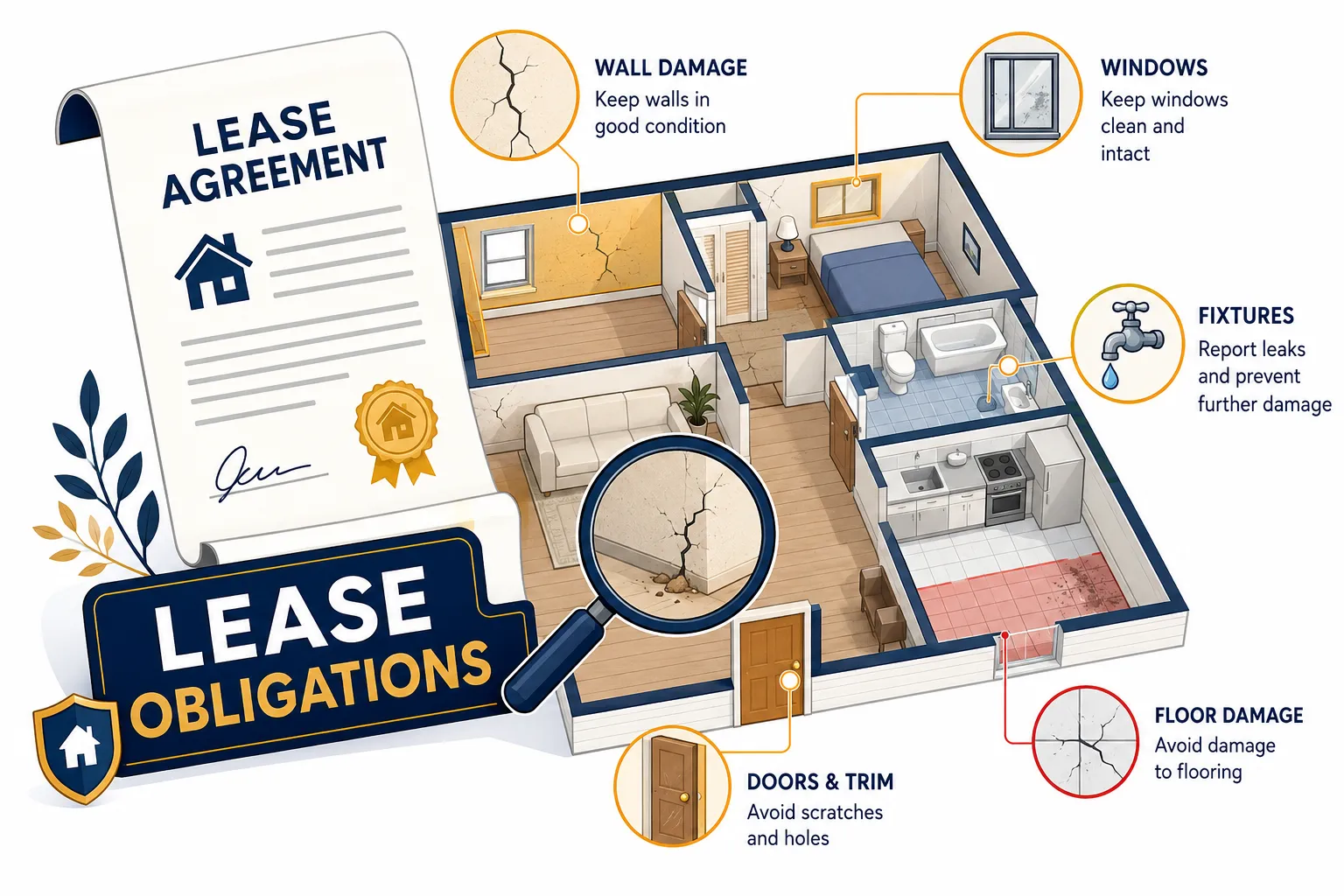
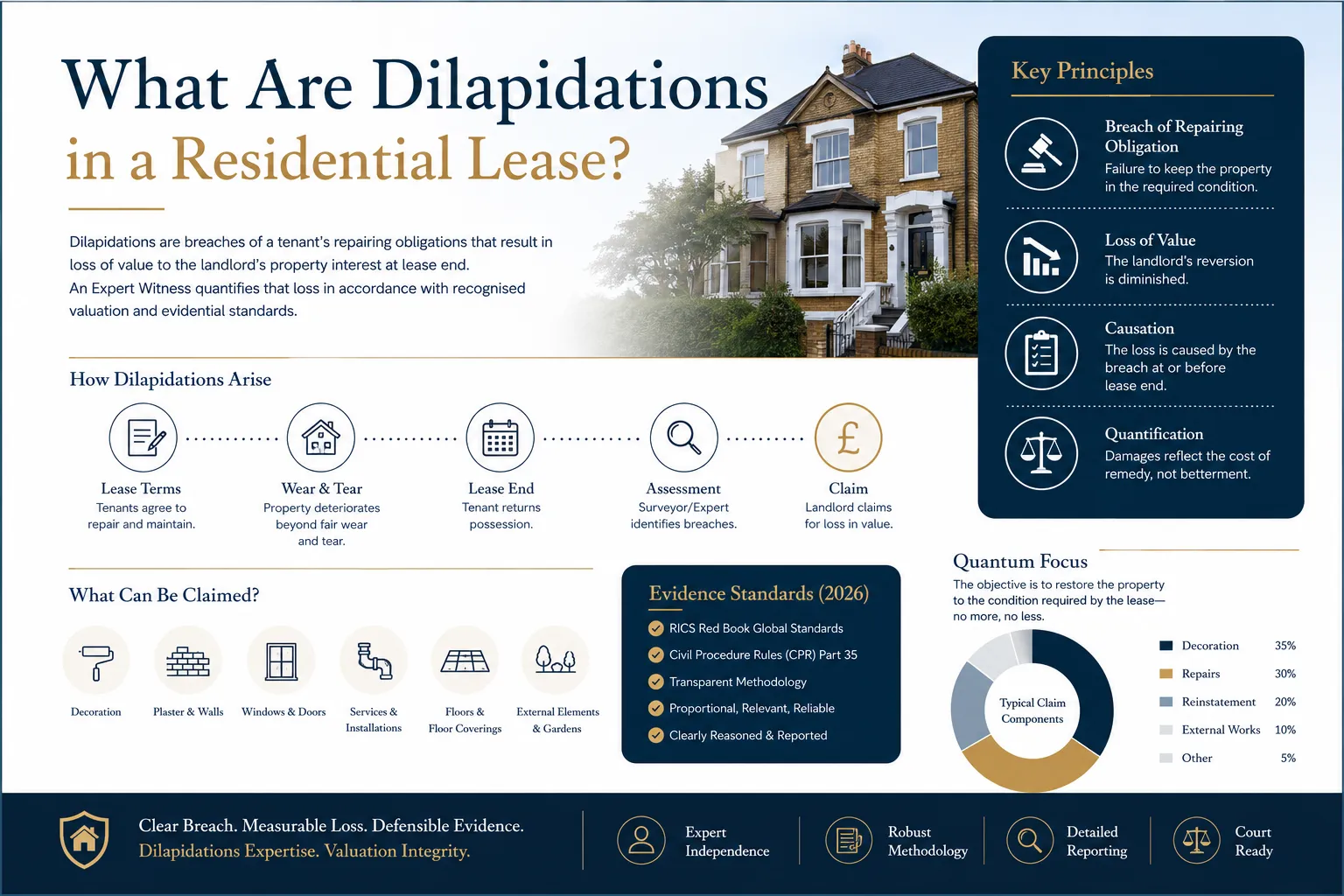
Dilapidations are a tenant's unfulfilled obligations to repair, redecorate, or reinstate a property at the end of a lease. When a residential lease contains repairing covenants, the tenant is legally required to return the property in a condition that meets those obligations. Failure to do so gives the landlord the right to claim damages.
Common dilapidations in residential leases include:
- Structural repairs not carried out during the tenancy (for example, failed roof sections or cracked external walls)
- Decorative redecoration where the lease requires periodic repainting
- Reinstatement of alterations made without consent
- Mechanical and electrical defects, such as broken heating systems or faulty wiring left unrepaired
- Garden and external areas left in poor condition contrary to lease terms
The scope of any claim depends entirely on the specific repairing covenants in the lease. A dilapidations survey assesses each alleged breach against those covenants, not against a general standard of condition.
Common mistake: Landlords sometimes claim for improvements or upgrades rather than genuine reinstatement to the condition required by the lease. Courts and expert witnesses will reject these elements.
How Do Expert Witnesses Value Property Damage in Lease Disputes?
Expert witnesses use a structured methodology to value dilapidations claims, and the most important legal constraint is Section 18(1) of the Landlord and Tenant Act 1927. This section caps the landlord's recoverable damages at whichever is the lower of: the cost of the repair works, or the diminution in the property's market value caused by the disrepair.
The standard valuation approach for a Section 18(1) assessment involves three steps:
- Compliant condition valuation, the open market value of the property if all lease obligations had been met
- Actual condition valuation, the open market value in its current state of disrepair
- Diminution calculation, the difference between steps 1 and 2, which sets the ceiling on recoverable damages
If the cost of repairs is lower than the diminution figure, the repair cost is the measure of damages. If the property would be redeveloped or substantially altered regardless of the disrepair, the diminution may be nil, which means the landlord recovers nothing even if real damage exists.
Expert witnesses providing property valuations for dilapidations disputes must use comparable market evidence, document their methodology clearly, and be prepared to defend their figures under cross-examination.
What Changed in Dilapidations Valuation Standards for 2026
The most significant development affecting dilapidations as expert witness service for residential leases in 2026 is the Renters' Rights Act 2026, which came into force on 1 May 2026. Expert witnesses must now factor in these regulatory changes when assessing repair obligations and valuations.
Key changes for 2026 include:
- New minimum energy efficiency standards, properties must meet updated EPC requirements, and pre-existing deficiencies that breach these standards can affect both the scope of the dilapidations claim and the diminution valuation
- Mandatory property condition requirements, the Act introduces baseline habitability standards, which means some items previously treated as tenant obligations may now be classified as landlord responsibilities
- Safety feature requirements, updated standards for smoke alarms, carbon monoxide detectors, and electrical safety affect what constitutes actionable disrepair
- Tighter CPR Part 35 compliance, courts are applying stricter scrutiny to expert reports, requiring clearer statements of methodology, sources of comparable evidence, and the expert's reasoning
Expert witnesses who do not update their methodology to reflect the 2026 regulatory landscape risk having their reports challenged or disregarded. For context on how valuation standards apply across different property types, see the guidance on commercial valuations and how comparable evidence is assembled.
What Counts as Normal Wear and Tear vs Dilapidations?
Fair wear and tear is not recoverable as a dilapidation. The distinction between acceptable deterioration and actionable disrepair is one of the most contested issues in residential lease disputes, and it is a core part of any expert witness assessment.
Fair wear and tear refers to the gradual, reasonable deterioration of a property through ordinary use over time. It is not a breach of a repairing covenant. Factors that expert witnesses consider when making this distinction include:
- Age of the property and its fixtures, older fittings are expected to show more wear
- Length of the tenancy, a 10-year tenancy will produce more legitimate wear than a 2-year one
- Intensity of use, a property occupied by a large family will show more wear than one occupied by a single person
- Maintenance history, whether the tenant carried out reasonable ongoing maintenance
Actionable disrepair, by contrast, is damage or deterioration beyond what ordinary use would cause. Examples include:
- Holes in walls or doors caused by impact
- Staining from neglect rather than normal use
- Broken fixtures that were not reported or repaired
- Unauthorised alterations left unreinstated
A well-prepared expert witness report will address each item in the schedule of dilapidations and state clearly whether it falls within fair wear and tear or constitutes a genuine breach. Courts will not accept a blanket claim without this analysis.
Dilapidations Expert Witness vs Surveyor: What Is the Difference?
A dilapidations surveyor and a dilapidations expert witness are not the same role, though both are typically RICS-qualified chartered surveyors. The key difference is the purpose and legal standing of their work.
| Role | Purpose | Duty | Report Used In |
|---|---|---|---|
| Dilapidations surveyor | Assess condition, prepare schedule | Client | Negotiation, pre-litigation |
| Expert witness | Provide independent court evidence | The court | Litigation, tribunal |
A dilapidations surveyor acts as the client's advocate, preparing a schedule of dilapidations or a counter-schedule on the tenant's behalf. An expert witness, by contrast, owes their primary duty to the court under CPR Part 35. Their opinion must be independent and objective, even if it does not fully support the instructing party's position.
Choosing the wrong type of professional at the wrong stage is a common and costly mistake. If a dispute proceeds to court or tribunal, the expert witness role requires a formal declaration of independence and compliance with court procedural rules. See the full range of expert witness report services to understand how this works in practice.
What Evidence Do I Need for a Dilapidations Claim?
Strong dilapidations claims and defences are built on documentary evidence gathered throughout the tenancy, not just at the end. Expert witnesses are increasingly emphatic about this in 2026, as courts are placing greater weight on contemporaneous records.
Essential evidence for a dilapidations claim includes:
- The lease document, including all repairing covenants, schedules of condition, and any licence for alterations
- Schedule of condition at lease start, photographs and written records showing the property's state when the tenancy began
- Inspection records, any periodic inspection reports carried out during the tenancy
- Correspondence, emails or letters about repair requests, complaints, or alleged breaches
- Contractor quotes and invoices, to support the cost of remedial works
- Market comparables, to support the Section 18(1) diminution valuation
For landlords managing multiple residential properties, property inspection services provide a structured way to maintain contemporaneous condition records that will be directly useful in any future dilapidations dispute.
Edge case: If no schedule of condition was attached to the lease at the start, the expert witness must work from the lease terms alone, which often benefits the tenant. Courts will not assume the property was in perfect condition at the start of the tenancy.
Dilapidations Expert Witness Requirements and Qualifications
An expert witness in a dilapidations dispute must meet specific professional and procedural requirements. Courts will not accept evidence from an unqualified individual, and a report that does not comply with CPR Part 35 will be inadmissible or given no weight.
Required qualifications and standards include:
- RICS membership, the expert should be a chartered surveyor (MRICS or FRICS) with demonstrable experience in dilapidations and property valuation
- CPR Part 35 compliance, the report must include a statement that the expert understands their duty to the court and has complied with it
- Independence, the expert must not have a financial or personal interest in the outcome of the dispute
- Relevant expertise, the expert's experience must cover both building pathology and valuation, as dilapidations cases require both disciplines
The RICS publishes guidance on the preparation of expert witness reports, and courts expect compliance with that guidance as a baseline standard. An expert who cannot demonstrate familiarity with current RICS standards will face challenges to their credibility.
How Do Courts Use Expert Witness Reports in Dilapidations Cases?
Courts treat expert witness reports as independent evidence to assist the judge, not as advocacy for one party. In 2026, judicial scrutiny of dilapidations expert evidence has increased, and judges are more willing to reject or discount reports that do not meet procedural and substantive standards.
The key elements courts examine in a dilapidations expert witness report:
- The expert's duty statement, confirming independence and CPR Part 35 compliance
- Scope of liability, which items in the schedule are genuine breaches of the lease
- Standard of repair, what the lease actually required, not what would be ideal
- Supersession, whether the landlord's own intended works would have made the repairs unnecessary
- Section 18(1) valuation, whether the diminution cap applies and how it was calculated
- Realistic repair costs, based on contractor evidence, not theoretical figures
Where both parties instruct expert witnesses, the court will typically order a joint meeting of experts. The resulting joint statement identifies agreed facts and narrows the issues in dispute, which significantly reduces hearing time and costs.
How Much Does a Dilapidations Expert Witness Cost?
The cost of a dilapidations expert witness for a residential lease dispute varies depending on the size and complexity of the property, the volume of items in dispute, and the stage of proceedings. As a general guide for 2026:
- Initial assessment and report: approximately £1,500 to £3,500 for a standard residential property
- Complex or high-value disputes: £3,500 to £5,000 or more, particularly where a full Section 18(1) valuation is required
- Joint expert meetings and supplementary reports: additional fees, typically £500 to £1,500 per stage
- Court attendance: charged at a daily or half-day rate, usually £1,000 to £2,500 per day
These are indicative estimates. Actual fees depend on the individual expert's rate, the property's location, and the scope of instruction. For context on how professional valuation fees are structured more broadly, see the guidance on independent property valuations.
Decision rule: If the total value of the dilapidations claim is below approximately £5,000, the cost of a full expert witness report may approach or exceed the potential recovery. In those cases, a standard dilapidations survey and negotiated settlement is often more proportionate.
Can I Use an Expert Witness for Dilapidations in Small Claims Court?
Small claims court (the Small Claims Track in the County Court) handles disputes up to £10,000. Expert witness evidence is permitted in small claims proceedings, but the court has discretion to limit or exclude it if it considers the cost disproportionate to the amount in dispute.
Practically speaking:
- For claims under £5,000, a judge may prefer a single joint expert appointed by both parties rather than separate expert witnesses
- The court can restrict the fees recoverable for expert evidence, which affects how much of the expert's cost can be claimed back even if you win
- A well-prepared schedule of dilapidations with photographic evidence and contractor quotes will often carry significant weight even without a formal expert witness report
For disputes on the fast track or multi-track (claims above £10,000 or complex cases), a full CPR Part 35-compliant expert witness report is standard and expected.
How Long Does a Dilapidations Expert Assessment Take?
A dilapidations expert witness assessment for a residential lease dispute typically takes four to eight weeks from initial instruction to delivery of a final report. The timeline depends on access to the property, the volume of documentation to review, and whether a Section 18(1) valuation is required.
A typical timeline:
- Week 1-2, instruction received, lease and documentation reviewed, site inspection arranged
- Week 2-3, site inspection carried out, photographic and written condition record produced
- Week 3-5, analysis of each dilapidations item against lease obligations, wear and tear assessment, valuation evidence gathered
- Week 5-8, draft report prepared, reviewed, and finalised; CPR Part 35 declaration included
If the matter proceeds to a joint expert meeting, additional time of two to four weeks should be allowed. Court attendance, if required, is scheduled around the court's timetable and can add several months to the overall process.
Can Tenants Dispute a Dilapidations Expert Witness Valuation?
Yes, tenants have a clear right to challenge a dilapidations expert witness valuation, and doing so is often worthwhile where the landlord's claim is inflated or methodologically flawed. The most effective approach is to appoint a separate RICS-qualified expert to prepare a counter-report.
Steps a tenant can take to dispute a valuation:
- Appoint an independent RICS surveyor to review the landlord's schedule and expert report
- Identify procedural defects, does the report comply with CPR Part 35? Has the expert declared independence?
- Challenge the wear and tear analysis, are items wrongly classified as dilapidations rather than fair wear and tear?
- Contest the Section 18(1) valuation, is the diminution figure supported by genuine comparable evidence?
- Raise supersession arguments, if the landlord intended to redevelop or substantially alter the property, the diminution may be nil
- Request a joint expert meeting, this process often results in significant reductions to the claimed amount
Tenants who engage early and with qualified professional support consistently achieve better outcomes than those who respond without specialist advice. The legal works and dispute services available through specialist chartered surveyors can assist tenants in building a structured response.
Common Mistakes Landlords Make With Dilapidations Claims
Landlords who pursue dilapidations claims without proper professional guidance frequently undermine their own position. The following mistakes are among the most common seen in 2026 disputes.
- Failing to attach a schedule of condition at the start of the tenancy, without this, the baseline condition is disputed and often assumed to be poor
- Claiming for improvements rather than reinstatement, courts will not award damages for betterment
- Ignoring the Section 18(1) cap, claiming the full cost of repairs without commissioning a diminution valuation often results in a significantly lower award
- Using a partisan surveyor rather than a genuine expert witness, courts identify advocacy disguised as expert evidence and discount it heavily
- Delaying instruction, leaving expert assessment until the eve of proceedings limits the expert's ability to gather contemporaneous evidence
- Failing to serve a formal schedule of dilapidations, procedural failures can affect the court's view of the claim's credibility
For landlords managing residential blocks or multiple units, maintaining proper service charge accounting and inspection records throughout the tenancy significantly reduces the risk of these errors.
When Should I Hire a Dilapidations Expert Witness?
The right time to instruct a dilapidations expert witness depends on the stage and value of the dispute. Not every dilapidations matter requires expert witness involvement, but waiting too long is a common and costly error.
Hire a dilapidations expert witness if:
- The claim or counter-claim exceeds £10,000
- The dispute involves a Section 18(1) diminution valuation
- Proceedings have been issued or are imminent
- The lease contains complex or unusual repairing covenants
- The landlord's intended use of the property after the lease end is relevant to supersession arguments
- The matter involves the Renters' Rights Act 2026 compliance questions
A standard dilapidations surveyor (not expert witness) may be sufficient if:
- The dispute is at the negotiation stage
- The claim value is below £5,000
- Both parties are willing to use a single joint expert
Early instruction allows the expert to review the property while evidence is still available, gather contemporaneous condition records, and advise on the realistic range of outcomes before significant legal costs are incurred.
.dil-wrap{font-family:Arial,sans-serif;max-width:520px;margin:2em auto;background:#f4f7fb;border:1px solid #c8d6e8;border-radius:8px;padding:24px 28px}
.dil-wrap h3{margin:0 0 4px;color:#1a3a5c;font-size:1.1em}
.dil-wrap p{margin:0 0 16px;font-size:.85em;color:#555}
.dil-row{margin-bottom:14px}
.dil-row label{display:block;font-size:.88em;font-weight:bold;color:#1a3a5c;margin-bottom:4px}
.dil-row input{width:100%;box-sizing:border-box;padding:8px 10px;border:1px solid #b0bec5;border-radius:5px;font-size:.95em}
.dil-btn{background:#1a3a5c;color:#fff;border:none;padding:10px 22px;border-radius:5px;font-size:.95em;cursor:pointer;width:100%}
.dil-btn:hover{background:#24527a}
.dil-result{margin-top:16px;background:#fff;border:1px solid #c8d6e8;border-radius:6px;padding:14px 16px;display:none}
.dil-result strong{color:#1a3a5c}
.dil-note{font-size:.78em;color:#777;margin-top:8px}
Dilapidations Claim Estimator
Estimate your Section 18(1) diminution cap and expert witness cost range.
function dilCalc(){
var r=parseFloat(document.getElementById(‘dil-repair’).value)||0;
var c=parseFloat(document.getElementById(‘dil-compliant’).value)||0;
var a=parseFloat(document.getElementById(‘dil-actual’).value)||0;
var out=document.getElementById(‘dil-out’);
if(!r||!c||!a||a>c){out.style.display=’block’;out.innerHTML=’Please enter valid values (compliant value must exceed actual value).‘;return;}
var dim=c-a;
var cap=Math.min(r,dim);
var ewLow=cap<5000?1500:cap<15000?2000:3500;
var ewHigh=cap<5000?2500:cap<15000?3500:5000;
out.style.display='block';
out.innerHTML='Diminution (Section 18 cap): £’+dim.toLocaleString()+’
‘
+’Estimated recoverable damages: £’+cap.toLocaleString()+’
‘
+’Expert witness fee range: £’+ewLow.toLocaleString()+’, £’+ewHigh.toLocaleString()
+’
Indicative estimates only. Actual outcomes depend on lease terms, expert methodology, and court findings. Consult a chartered surveyor for a formal assessment.
‘;
}
FAQ: Dilapidations as Expert Witness Service for Residential Leases
What is the difference between a dilapidations claim and a deposit deduction?
A deposit deduction is a landlord's right under an assured shorthold tenancy to retain part of a deposit for damage or unpaid rent, governed by the tenancy deposit scheme rules. A dilapidations claim is a separate legal action for breach of repairing covenants in a lease, typically used for longer residential leases rather than standard ASTs. The two processes are distinct and governed by different rules.
Does Section 18(1) of the Landlord and Tenant Act 1927 apply to all residential leases?
Section 18(1) applies to leases of any premises, including residential ones. It caps the landlord's damages at the diminution in market value caused by the disrepair. However, its practical significance is greatest for longer leases where the repair cost might otherwise exceed the actual loss in value.
Can a landlord recover the full cost of repairs as dilapidations damages?
Not automatically. The Section 18(1) cap means the landlord can only recover the lower of the repair cost or the diminution in market value. If the property would be redeveloped regardless of the repairs, the diminution may be nil, meaning no damages are recoverable even if real disrepair exists.
What happens if the expert witnesses for each party disagree?
The court will order a joint meeting of experts to produce a joint statement identifying agreed and disputed points. The judge then decides the disputed issues based on the evidence and reasoning in each report, the joint statement, and any oral evidence given at the hearing.
Is a dilapidations expert witness report admissible in the First-tier Tribunal (Property Chamber)?
Yes. The First-tier Tribunal (Property Chamber) handles many residential lease disputes and accepts expert evidence. The same standards of independence and methodology apply, though the tribunal has its own procedural rules that differ slightly from the County Court.
How does the Renters' Rights Act 2026 affect existing dilapidations claims?
The Act affects claims where the lease expired on or after 1 May 2026. Expert witnesses must assess whether any alleged disrepair relates to standards that are now the landlord's statutory responsibility under the new Act, as those items cannot be claimed as tenant dilapidations.
Can both parties share a single expert witness to reduce costs?
Yes. A single joint expert (SJE) can be appointed by agreement or court order. The SJE owes their duty to both parties and the court. This approach reduces costs but means neither party has exclusive control over the expert's instructions or conclusions.
Conclusion
Dilapidations as expert witness service for residential leases has become a more technically demanding discipline in 2026. The combination of the Renters' Rights Act 2026, tighter judicial scrutiny of CPR Part 35 compliance, and the continued importance of Section 18(1) valuation methodology means that both landlords and tenants need properly qualified, genuinely independent expert witnesses to navigate disputes effectively.
Actionable next steps:
- Gather your evidence now, do not wait until proceedings are issued. Locate the lease, schedule of condition, inspection records, and any correspondence about repairs.
- Instruct a RICS-qualified chartered surveyor with demonstrable dilapidations and valuation experience as early as possible.
- Confirm CPR Part 35 compliance before relying on any expert report in court or tribunal proceedings.
- Commission a Section 18(1) diminution valuation if the claim value exceeds the likely cost of a professional assessment.
- Consider proportionality, for lower-value disputes, a negotiated settlement supported by a standard dilapidations survey is often faster and more cost-effective than full expert witness proceedings.
For professional, RICS-compliant dilapidations assessments and expert witness reports, consult a chartered surveyor with specific experience in residential lease disputes and 2026 valuation evidence standards.
Tags: dilapidations expert witness, residential lease dilapidations, Section 18 valuation, CPR Part 35 compliance, RICS chartered surveyor, Renters Rights Act 2026, lease end disputes, property dilapidations claim, fair wear and tear, dilapidations survey, expert witness report, landlord tenant dispute