


Last updated: July 24, 2026
Quick Answer: Retrofitting older buildings for 2026 regulations requires property owners in England to understand the Future Homes and Buildings Standards framework, which tightens energy performance requirements for existing stock. A specialist retrofit survey, carried out by a chartered surveyor, identifies compliance gaps and quantifies the cost of works. Buildings that fail to meet minimum EPC thresholds face measurable valuation discounts and potential mortgage restrictions, making early assessment essential for owners, buyers, and landlords alike.
Key Takeaways
- The 2026 regulatory framework, shaped by the Future Homes and Buildings Standards, raises the bar for energy performance in both residential and commercial properties.
- A retrofit survey is distinct from a standard building survey: it specifically assesses thermal performance, ventilation, insulation, and heating systems against current compliance thresholds.
- Properties with an EPC rating below E (and for landlords, below C under proposed MEES changes) face letting restrictions and reduced buyer demand.
- Valuation impacts are real: independent research and RICS guidance indicate non-compliant properties can attract discounts at sale, though the exact figure depends on property type, location, and works required.
- Listed buildings and certain conservation area properties carry exemptions, but owners must apply formally and cannot assume protection.
- Mortgage lenders are increasingly factoring EPC ratings into lending decisions, and some green mortgage products offer preferential rates for compliant properties.
- The cheapest retrofit route is almost always a sequenced approach: fabric first (insulation and draught-proofing), then heating, then renewables.
- Failing to act by the relevant compliance deadlines can trigger civil penalties for landlords and complicate sales for all owners.
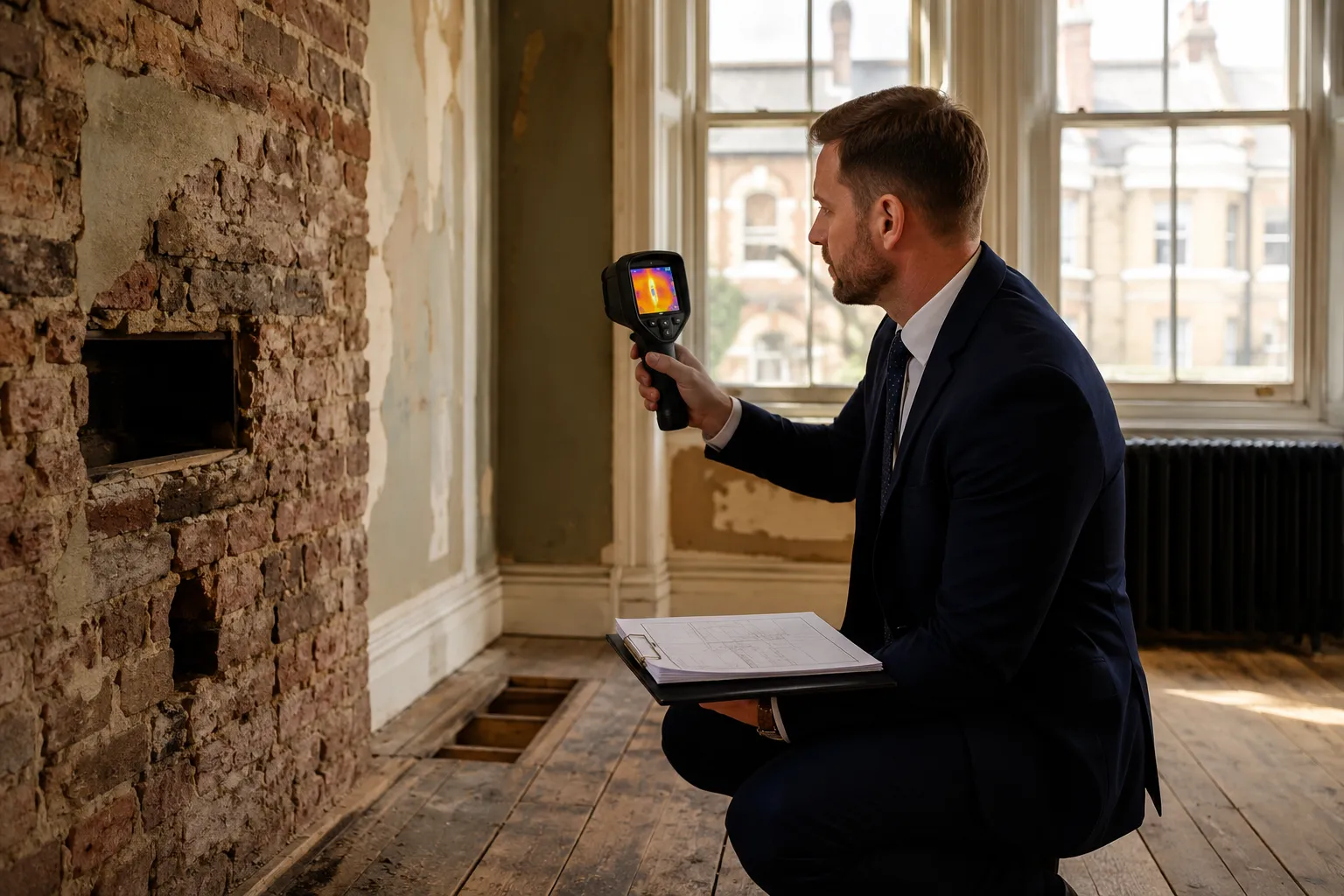
What Are the 2026 Building Regulations for Older Properties?
The 2026 regulatory landscape for existing buildings in England is anchored in the Future Homes and Buildings Standards (FHBS) and associated amendments to Part L of the Building Regulations. For older properties, the key obligations fall into two categories: triggered upgrades (works required when a property undergoes certain renovations) and minimum energy performance standards for the rental sector.
The core thresholds to know in 2026:
- Residential landlords in England are expected to meet a minimum EPC rating of C for new tenancies, with enforcement timelines that have been subject to government consultation. Owners should verify the current position with a qualified surveyor, as implementation dates have shifted.
- When undertaking notifiable works (extensions, re-roofing, window replacement, or heating system changes), the relevant parts of the building must be upgraded to meet current U-value and air-tightness standards.
- Part F (ventilation) requirements have tightened alongside Part L, meaning that insulation upgrades without corresponding ventilation improvements can create compliance failures and moisture risk.
What this means in practice: An older property that is sold, re-let, or substantially renovated will almost certainly trigger a compliance check. Owners who wait until a transaction is underway face compressed timelines and higher contractor costs.
For a detailed breakdown of how statutory considerations affect older buildings, see the statutory considerations guidance for building surveys.
How Do Building Surveys Work for Retrofit Compliance?
A retrofit compliance survey is a structured inspection that maps a property's existing fabric and services against current regulatory benchmarks. It goes well beyond a standard condition report.
A retrofit survey typically covers:
- Thermal envelope assessment: wall, roof, and floor U-values compared against Part L targets
- Heating system efficiency and compatibility with low-carbon alternatives (heat pumps, hybrid systems)
- Ventilation adequacy under Part F, including assessment of air permeability
- Window and door performance (glazing specification and frame condition)
- Identification of cold bridges, moisture risk, and areas where insulation cannot be added without specialist intervention
- Current EPC rating versus the target rating, with a gap analysis
The surveyor will produce a prioritised schedule of works, often with indicative costs, so owners can plan expenditure and approach contractors with a clear brief.
Common mistake: Many owners commission a standard Level 2 HomeBuyer Report and assume it covers retrofit compliance. It does not. A Level 3 full building survey is the appropriate starting point for older properties, and a dedicated retrofit or EPC assessment should be commissioned alongside it for compliance purposes.
For a fuller comparison of survey types, the guide on full building survey vs HomeBuyer survey explains which level of inspection suits different property ages and conditions.
What Does a Retrofit Survey Cost and How Long Does It Take?
Costs vary by property size, age, and the depth of assessment required. As a general guide for 2026:
| Property Type | Indicative Survey Cost | Typical Duration |
|---|---|---|
| 1-2 bed flat (pre-1980) | £400 – £700 | Half day |
| 3-4 bed Victorian/Edwardian house | £700 – £1,200 | Full day |
| Large detached or commercial | £1,200 – £2,500+ | 1-2 days |
These figures are estimates based on typical market rates and will vary by region and surveyor. London and the South East tend to sit at the higher end.
A combined Level 3 building survey with retrofit assessment offers better value than two separate commissions, and the resulting report gives both condition and compliance data in one document.
For more detail on survey timelines, see how long a building survey takes.
How Much Does Retrofitting an Older Building Reduce Its Value?
Non-compliant properties do attract valuation discounts, though the scale depends on the gap between current and required performance, local market conditions, and buyer awareness.
RICS guidance and market evidence consistently show that properties with EPC ratings of D or below sell at a discount compared to equivalent properties rated C or above. In some markets, the discount on a low-rated property can represent several percentage points of the asking price, and the effect is more pronounced in areas where buyer demand is strongest.
Valuation impacts work in both directions:
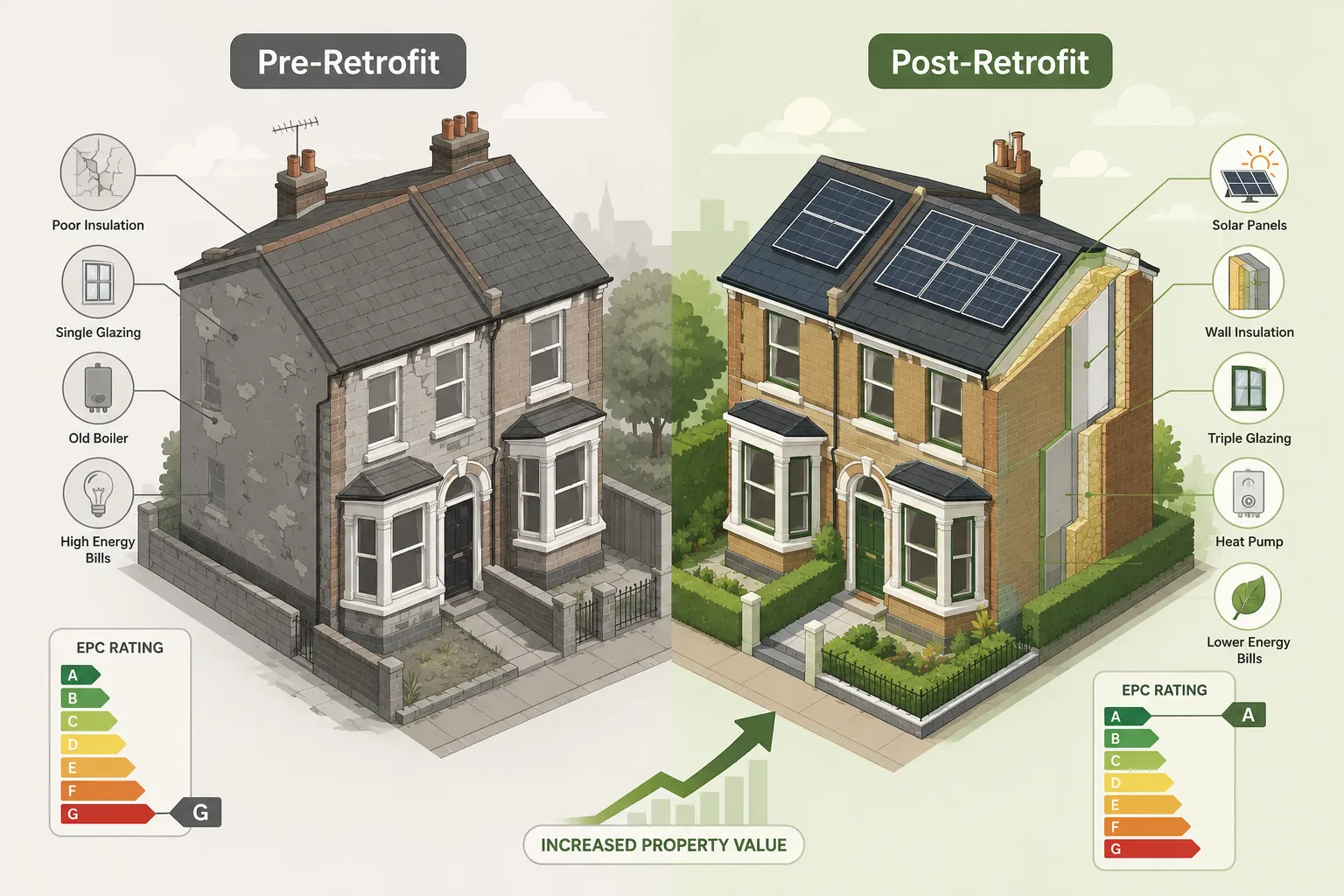
- A property that has been retrofitted to a high standard, with documented works and an updated EPC, can command a premium over comparable non-upgraded stock.
- A property with known compliance failures, particularly one where works are technically complex (solid wall construction, listed status), may require a price reduction to reflect the buyer's anticipated cost of works.
Chartered surveyors carrying out property valuations are now expected to explicitly consider energy performance as a valuation factor, not treat it as a footnote.
Can You Get a Mortgage on a Building That Needs 2026 Retrofits?
Most mainstream lenders will still offer mortgages on properties with low EPC ratings, but the landscape is shifting. Several lenders have introduced minimum EPC requirements for buy-to-let mortgages, and green mortgage products with preferential rates are now widely available for properties rated C or above.
Key lending considerations in 2026:
- Some buy-to-let lenders require a minimum EPC of E or D as a condition of lending. A few have moved to C for new applications.
- Residential mortgages are less restricted, but lenders may flag properties rated F or G and require a retrofit plan as a condition of offer.
- Green mortgages typically offer a rate reduction of 0.1% to 0.3% for properties meeting the C threshold, which is worth factoring into purchase calculations.
Edge case: A property that is exempt from minimum EPC requirements (listed building, certain conservation area properties) will generally be treated more favourably by lenders, provided the exemption is formally registered.
What Is the Difference Between a Standard Survey and a Retrofit Assessment?
A standard building survey (Level 2 or Level 3) focuses on the physical condition of a property: structural integrity, defects, damp, drainage, and maintenance needs. A retrofit assessment focuses on energy performance and regulatory compliance.
| Feature | Standard Building Survey | Retrofit Assessment |
|---|---|---|
| Structural condition | Yes | Partial |
| EPC compliance gap | No | Yes |
| U-value analysis | No | Yes |
| Ventilation adequacy | No | Yes |
| Schedule of works for regs | No | Yes |
| Defect identification | Yes | Limited |
The two are complementary, not interchangeable. For older properties, the most thorough approach is to commission both, or to find a chartered surveyor who can deliver a combined report covering building defects and retrofit compliance in a single inspection.
Which Older Buildings Are Exempt from 2026 Regulations?
Exemptions exist, but they are narrower than many owners assume. The main categories are:
- Listed buildings: Works that would unacceptably alter the character of a listed building are exempt from certain energy efficiency requirements. However, this does not mean listed buildings are entirely exempt: where works can be carried out without harm, they may still be required.
- Temporary buildings: Structures with a planned use of less than two years are generally outside scope.
- Small detached buildings: Buildings with a floor area under 50m² in some categories may qualify for reduced requirements.
- Registered exemptions (rental sector): Landlords who can demonstrate that works would cost more than the cost cap (currently £3,500 per property under MEES, subject to review) can register a cost exemption with the PRS Exemptions Register.
Critical point: Exemptions are not automatic. They must be formally registered or evidenced. A surveyor working on a listed or conservation area property should always advise on the correct exemption route. For more on listed buildings and conservation areas, see what are listed buildings and conservation areas.
How Do You Know If Your Building Fails a Retrofit Survey?
A building fails a retrofit survey when its current energy performance falls below the applicable regulatory threshold and the gap cannot be closed without works. The most common failure indicators are:
- EPC rating of D, E, F, or G where C is required
- U-values for walls, roofs, or floors that exceed current Part L limits
- Single glazing or poorly performing double glazing
- No loft insulation or inadequate cavity/solid wall insulation
- An oil boiler or electric storage heaters as the primary heating system
- Inadequate mechanical ventilation where air-tightness improvements have been made
The survey report will typically use a traffic-light or RAG (red/amber/green) system to indicate which elements fail, which are borderline, and which already comply. A clear building regulation compliance assessment will set out the specific works needed and their relative priority.
What Is the Cheapest Way to Retrofit an Older Building for New Regs?
The most cost-effective approach is fabric first: address the building envelope before investing in new heating systems or renewables. This sequencing matters because a leaky, poorly insulated building will underperform any heating system installed within it.
A cost-effective retrofit sequence:
- Draught-proofing (doors, windows, letterboxes, floorboards) – low cost, immediate impact
- Loft insulation to current depth (270mm mineral wool) – typically £300-£600, often grant-funded
- Cavity wall insulation where applicable – typically £500-£1,500
- Hot water cylinder and pipe insulation
- Upgrade to a high-efficiency condensing boiler or heat pump (if fabric is already good)
- Secondary or triple glazing where budget allows
- Solar PV or other renewables as a final layer
Grant funding in 2026: The Great British Insulation Scheme and ECO4 continue to offer funding for lower-income households and certain property types. Eligibility criteria change regularly, so owners should check current availability with an energy assessor.
Solid wall properties (common in pre-1920 stock) present the greatest challenge and cost. External wall insulation (EWI) or internal wall insulation (IWI) can cost £8,000-£20,000 or more for a typical terrace, and planning permission may be required in conservation areas.
Do Commercial and Residential Retrofits Have Different Survey Requirements?
Yes. Commercial and residential properties operate under different regulatory frameworks, and the survey protocols reflect this.
Residential properties are assessed primarily against the EPC framework, Part L (conservation of fuel and power), and the Minimum Energy Efficiency Standards (MEES) for the private rented sector.
Commercial properties are subject to Display Energy Certificates (DECs) for public buildings, Energy Performance Certificates at sale or let, and the Streamlined Energy and Carbon Reporting (SECR) framework for larger organisations. The MEES regulations also apply to commercial lettings, requiring a minimum EPC of E (with proposals to raise this).
A commercial retrofit survey will additionally consider:
- HVAC system efficiency and compliance
- Lighting controls and LED specification
- Building Management System (BMS) capability
- Metering and sub-metering for carbon reporting
For commercial building owners, the mechanical ventilation requirements in particular have become a significant compliance area alongside thermal performance.
What Happens If You Don't Retrofit by 2026?
For landlords, the consequences of non-compliance with MEES are financial and operational. Local authorities can issue compliance notices and civil penalties of up to £30,000 per property for breaches of the minimum EPC standard in the private rented sector.
For sellers, non-compliance does not prevent a sale but does affect price and buyer pool. A property with a known compliance deficit will attract fewer mortgage-eligible buyers and may sit on the market longer.
For all owners, the longer-term risk is value erosion. As buyer and lender awareness of energy performance increases, non-compliant properties are likely to see growing discounts relative to compliant stock. Acting early, before a transaction forces the issue, gives owners more control over the works and the cost.
How Does Retrofitting Affect Insurance and Property Taxes?
Insurance reinstatement costs are affected by retrofit works, particularly where external wall insulation or new cladding systems are added. Owners should notify their insurer of any significant works and commission an updated insurance reinstatement cost valuation after completion to ensure the sum insured remains accurate.
On the tax side, the position in 2026 is:
- VAT on energy-saving materials installed in residential properties is charged at 0% (reduced from 5% following the 2022 change, maintained in 2026), making insulation, heat pumps, and solar panels significantly cheaper to install.
- Capital allowances for commercial property owners can apply to qualifying energy-efficient plant and machinery.
- Council tax and business rates are not directly affected by EPC rating, but a significant change in property condition following retrofit may trigger a revaluation in some circumstances.
Can You Sell an Older Building Without Doing Retrofits First?
Yes, in most cases. There is no legal requirement to complete retrofit works before selling a residential property. However, sellers must provide a valid EPC at the point of marketing, and the rating will be visible to all potential buyers.
Practical implications for sellers:
- A low EPC rating will be factored into buyer offers, often as a direct deduction for estimated works.
- Some buyers, particularly those using mortgage finance, may be restricted by lender EPC requirements.
- Sellers who complete targeted works before marketing can often recover more than the cost of works in the achieved sale price, particularly in competitive markets.
A pre-sale survey that identifies the most cost-effective improvements, and quantifies the likely valuation uplift, is a worthwhile investment for owners of older stock. See the guide on preparing your property for market for practical advice on this approach.
What Common Mistakes Do People Make When Surveying for Retrofits?
Several recurring errors cause owners and buyers to underestimate retrofit complexity or overestimate compliance.
The most common mistakes:
- Relying on an outdated EPC. EPCs are valid for ten years, but a certificate issued before significant works (or before the regulatory goalposts moved) may not reflect current compliance status.
- Assuming a Level 2 survey covers compliance. It does not. A HomeBuyer Report will flag obvious defects but will not assess U-values, ventilation adequacy, or EPC gap.
- Ignoring ventilation when adding insulation. Sealing a building without improving ventilation creates condensation, mould, and potential Part F failures. This is one of the most expensive mistakes to correct after the fact.
- Treating listed building status as a blanket exemption. Listed buildings still need to meet energy standards where technically feasible. Owners who assume full exemption without taking advice risk non-compliance.
- Not sequencing works correctly. Installing a heat pump in a poorly insulated building, or adding solar PV before addressing the fabric, wastes money and may not achieve the required EPC uplift.
- Failing to document works. Retrofit works that are not accompanied by updated EPCs, building control sign-off, and contractor warranties will not be recognised by lenders or future buyers.
Retrofit Compliance Cost Estimator
.cg-retro{font-family:Arial,sans-serif;max-width:520px;margin:24px auto;background:#f8f9fa;border:1px solid #dde2e8;border-radius:8px;padding:20px 24px;color:#222}
.cg-retro h3{margin:0 0 14px;font-size:1.1rem;color:#1a3a5c}
.cg-retro label{display:block;font-size:.85rem;font-weight:600;margin:10px 0 3px}
.cg-retro select,.cg-retro input{width:100%;padding:7px 9px;border:1px solid #bcc5cf;border-radius:5px;font-size:.9rem;box-sizing:border-box}
.cg-retro button{margin-top:14px;width:100%;background:#1a3a5c;color:#fff;border:none;padding:10px;border-radius:5px;font-size:.95rem;cursor:pointer}
.cg-retro button:hover{background:#2a5080}
.cg-result{margin-top:14px;background:#fff;border:1px solid #c8d4df;border-radius:6px;padding:12px 14px;display:none}
.cg-result p{margin:4px 0;font-size:.88rem}
.cg-result strong{color:#1a3a5c}
.cg-note{font-size:.75rem;color:#666;margin-top:10px}
Retrofit Cost Estimator (2026)
Estimated Works Range:
Likely EPC Uplift:
Priority Action:
Estimates only. Obtain a professional survey for accurate costings.
function cgCalc(){
var pt=document.getElementById(‘cg-ptype’).value;
var ep=document.getElementById(‘cg-epc’).value;
var wl=document.getElementById(‘cg-wall’).value;
var base={flat:[3000,7000],terrace:[5000,14000],semi:[6000,16000],detached:[8000,22000]};
var r=base[pt];
var lo=r[0],hi=r[1];
if(wl===’solid’){lo=Math.round(lo*2.2);hi=Math.round(hi*2.5);}
if(ep===’F’){lo=Math.round(lo*1.2);hi=Math.round(hi*1.3);}
if(ep===’G’){lo=Math.round(lo*1.5);hi=Math.round(hi*1.6);}
var uplift=ep===’G’?’Up to 3 bands’:ep===’F’?’2-3 bands’:ep===’E’?’1-2 bands’:’1 band’;
var action=wl===’solid’?’External or internal wall insulation (fabric first)’:’Cavity wall insulation + loft insulation’;
document.getElementById(‘cg-range’).textContent=’£’+lo.toLocaleString()+’, £’+hi.toLocaleString();
document.getElementById(‘cg-uplift’).textContent=uplift;
document.getElementById(‘cg-action’).textContent=action;
document.getElementById(‘cg-result’).style.display=’block’;
}
Frequently Asked Questions
What is the minimum EPC rating required for rental properties in 2026?
The government's proposed minimum for new tenancies in the private rented sector is EPC C, though implementation timelines have been subject to revision. Landlords should confirm the current enforcement date with a qualified surveyor or energy assessor and not rely on older guidance.
Does a retrofit survey replace an EPC?
No. A retrofit survey is a detailed inspection that informs a schedule of works. An EPC is a separate, accredited assessment that produces the official energy rating. Both are needed: the survey tells you what works to do; the EPC confirms the rating before and after.
Are pre-1919 solid wall properties harder to retrofit?
Yes. Solid wall construction cannot be cavity-filled, so insulation must be applied externally or internally. Both options are more expensive and disruptive than cavity fill, and external insulation may require planning permission in conservation areas or for listed buildings.
Will retrofitting always increase my property's value?
Not automatically. The valuation uplift depends on the local market, the quality of works, and whether the improvement is documented with an updated EPC and building control sign-off. Poorly executed works, or works without evidence, may not be recognised by valuers or lenders.
How do I find a surveyor qualified to carry out a retrofit assessment?
Look for a chartered surveyor (MRICS or FRICS) with experience in older residential stock, combined with an accredited energy assessor or retrofit coordinator (PAS 2035 qualified). Some firms offer combined services; others will refer to a specialist energy assessor for the EPC component.
What is PAS 2035 and why does it matter?
PAS 2035 is the British Standard for retrofitting domestic buildings. It sets out the process that must be followed for funded retrofit projects, including the roles of retrofit assessor, coordinator, and designer. For privately funded works, PAS 2035 compliance is not always mandatory, but following its principles reduces the risk of poorly sequenced or damaging interventions.
Can I claim VAT relief on retrofit works?
Yes. Since April 2022, the installation of qualifying energy-saving materials in residential properties has been zero-rated for VAT. This applies to insulation, heat pumps, solar panels, and several other measures, making a significant difference to overall project cost.
What happens if a retrofit survey reveals asbestos?
Asbestos is common in properties built before 2000, particularly in insulation boards, floor tiles, and roof materials. If a survey identifies potential asbestos-containing materials, a specialist asbestos building survey should be commissioned before any retrofit works begin. Disturbing asbestos without proper management is a criminal offence.
Conclusion
Retrofitting older buildings for 2026 regs is no longer a future consideration: it is an active compliance and valuation issue for owners, landlords, and buyers across England. The gap between a property's current energy performance and the standards now expected by regulators, lenders, and buyers has a direct and measurable effect on market value, lettability, and mortgage eligibility.
Actionable next steps:
- Commission a current EPC if the existing certificate is more than three years old or predates significant works.
- Instruct a Level 3 full building survey for any pre-1980 property you are buying, selling, or letting, and ask explicitly whether the surveyor can include a retrofit compliance assessment.
- Use the fabric-first principle to sequence works: insulation and draught-proofing before heating upgrades, heating before renewables.
- Check current grant eligibility under ECO4 and the Great British Insulation Scheme before instructing contractors.
- Ensure all completed works are signed off by building control and reflected in an updated EPC before marketing or re-letting.
- For listed buildings or conservation area properties, take specific advice on exemptions before assuming any protection from compliance requirements.
The cost of acting early is almost always lower than the cost of a distressed retrofit during a transaction or under regulatory pressure. A qualified chartered surveyor is the right starting point for any property owner navigating this landscape in 2026.
Tags: retrofitting older buildings, 2026 building regulations, retrofit survey, EPC compliance, building survey protocols, valuation impacts, MEES regulations, energy performance certificate, Future Homes Standard, listed building exemptions, chartered surveyor, property retrofit costs