

Last updated: July 24, 2026
Quick Answer: Selecting the right RICS firm for expert witness services in 2026 litigation means verifying full RICS membership, confirming the surveyor holds specific experience in court proceedings, and matching their specialism (valuation, party wall, or building survey) to your dispute type. The wrong choice can undermine your case before a single word is spoken in court.
Key Takeaways
- RICS membership alone does not qualify a surveyor as an expert witness, court experience and CPD in expert witness practice are essential additional requirements.
- For property valuation disputes, party wall matters, and building survey litigation, each discipline requires a different RICS specialism; one firm does not automatically cover all three.
- Expert witness fees in 2026 typically range from around £150 to £400 per hour depending on specialism, seniority, and report complexity.
- Always verify a firm's RICS registration through the official RICS Find a Surveyor directory before instructing them.
- A surveyor's duty in court is to the tribunal, not to the client, understanding this distinction protects you from hiring someone who will simply advocate your position rather than provide impartial evidence.
- Common hiring mistakes include choosing on price alone, failing to check court experience, and instructing a generalist for a highly technical dispute.
- Red flags include reluctance to confirm RICS registration, lack of Professional Indemnity Insurance (PII) documentation, and no prior experience preparing CPR Part 35-compliant reports.
What Does a RICS-Qualified Expert Witness Do in Court
A RICS-qualified expert witness provides independent, impartial technical evidence to a court, tribunal, or arbitration panel on matters requiring specialist property knowledge. Their primary duty is to the court, not the instructing party, and this is a legal obligation under Civil Procedure Rules (CPR) Part 35 in England and Wales.
In practice, this means the surveyor:
- Prepares a written expert witness report that sets out their opinion, methodology, and reasoning in a structured, court-compliant format.
- May be required to attend hearings and give oral evidence under cross-examination.
- Can be asked to participate in "without prejudice" meetings with the opposing expert to narrow the issues in dispute (a joint statement is often required).
- Advises solicitors on the technical merits of a case before proceedings begin.
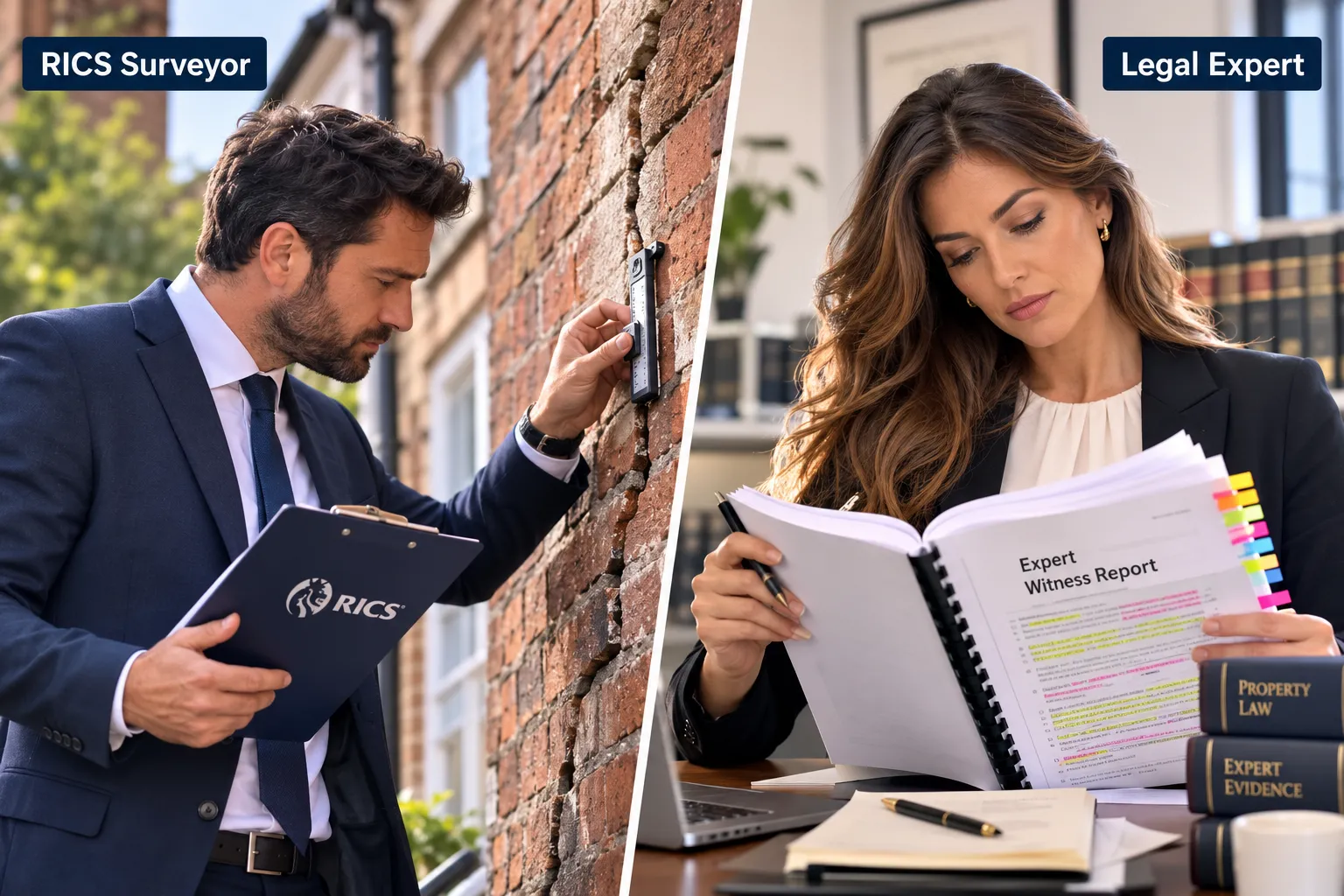
The scope of work differs by discipline. A valuation expert addresses market value, diminution, or rental disputes. A party wall expert examines whether works complied with the Party Wall etc. Act 1996 and whether damage resulted. A building survey expert assesses defects, causation, and remediation costs.
Decision rule: If your dispute involves a specific technical question (damp, subsidence, boundary, lease renewal rent), always instruct a surveyor whose day-to-day practice covers that exact area, not a generalist who has occasionally dealt with it.
How to Choose a RICS Firm for Property Valuation Disputes
For property valuation disputes, the right RICS firm is one whose surveyors hold RICS Registered Valuer status and have direct experience producing Red Book-compliant valuations in a litigation context. General RICS membership is not sufficient on its own.
Key selection criteria include:
- RICS Registered Valuer status, required for any formal valuation opinion used in legal proceedings.
- Relevant property type experience, residential, commercial, and mixed-use valuations each require different market knowledge.
- Track record in disputed valuations, ask specifically whether they have acted as a single joint expert (SJE) or as a party-appointed expert in previous cases.
- Familiarity with the relevant legal context, matrimonial, inheritance tax, capital gains, and compulsory purchase disputes each carry different legal frameworks.
For matrimonial or inheritance-related property disputes, firms offering matrimonial valuations or inheritance tax valuations with explicit litigation support are better positioned than those offering valuations for transactional purposes only.
Common mistake: Instructing a firm that produces valuations for mortgage purposes but has never prepared a report for court. The format, language, and disclosure obligations are entirely different.
Party Wall Surveyor Qualifications and RICS Accreditation
A party wall surveyor does not legally need to be RICS-accredited, the Party Wall etc. Act 1996 sets no formal qualification requirement. However, for litigation purposes, RICS membership significantly strengthens the credibility of any expert opinion given.
When a party wall dispute reaches court or the First-tier Tribunal, the surveyor's credentials will be scrutinised. A RICS-accredited party wall surveyor brings:
- Adherence to RICS professional standards and ethical obligations.
- Mandatory Professional Indemnity Insurance.
- Continuing Professional Development (CPD) requirements that keep their knowledge current.
- A clear complaints and disciplinary framework if conduct is questioned.
For complex party wall matters, basement excavations, structural alterations, or disputes involving significant alleged damage, the party wall schedule of condition prepared before works begin is often the single most important document in any subsequent litigation. A RICS firm will produce this to an evidential standard.
Further guidance on party wall rights and procedures is available in resources covering party wall agreements for renovations and party wall awards.
RICS Expert Witness Fees and Costs in 2026
RICS expert witness fees in 2026 are not fixed by any central body and vary considerably based on the surveyor's seniority, specialism, and the complexity of the matter. As a working estimate:
| Service | Indicative Fee Range |
|---|---|
| Initial case review / advice | £500, £1,500 |
| Written expert witness report | £1,500, £6,000+ |
| Attendance at hearing (per day) | £1,200, £3,500 |
| Joint statement preparation | £400, £1,200 |
| Hourly rate (general) | £150, £400/hr |
These are market estimates for 2026 based on typical RICS firm pricing structures. Actual fees will vary.
Costs are generally recoverable from the losing party in litigation, but this is not guaranteed. In small claims track cases, expert witness costs are rarely awarded. In fast track and multi-track cases, recovery is more likely but subject to the court's discretion.
Edge case: If the court appoints a single joint expert (SJE), costs are shared between the parties, which can reduce overall expenditure significantly. Ask your solicitor whether an SJE appointment is appropriate for your dispute.
The Difference Between RICS and Non-RICS Surveyors for Litigation
In litigation, the difference between a RICS and non-RICS surveyor is not merely professional, it is evidential. Courts and tribunals place greater weight on expert evidence from surveyors who are subject to a recognised professional framework.
A RICS-registered expert:
- Is bound by the RICS Rules of Conduct and can face disciplinary action for misleading a court.
- Must carry Professional Indemnity Insurance, protecting both the client and the integrity of the proceedings.
- Is required to comply with RICS guidance on conflicts of interest and impartiality.
A non-RICS surveyor may be technically competent, but opposing counsel will challenge their credibility more aggressively. Judges and arbitrators are familiar with RICS standards; they are not obliged to give the same weight to unaccredited opinions.
For building survey matters in litigation, a Level 3 full building survey produced by a RICS-accredited firm carries significantly more evidential weight than an informal inspection report.
What Makes a RICS Firm Credible in Court Cases
Credibility in court comes from four factors: qualifications, independence, methodology, and presentation. A RICS firm that scores well on all four will withstand cross-examination far better than one that scores well on only one or two.
Qualifications: RICS membership (MRICS or FRICS), relevant specialism, and specific training in expert witness practice (such as the RICS Expert Witness Certificate or equivalent CPD).
Independence: The firm should have no financial or personal interest in the outcome. Avoid instructing a firm that also acted as your transactional surveyor on the same property, this creates a conflict that will be exploited in court.
Methodology: The report must clearly explain how the expert reached their opinion, what data they relied on, and what assumptions they made. Vague or conclusory reports are easily dismantled.
Presentation: Clarity matters. A technically accurate report written in impenetrable jargon will confuse a judge and weaken your case. The best RICS expert witnesses write for a legally trained but non-technical audience.
How Long Does a RICS Building Survey Take for Legal Proceedings
A RICS building survey for legal proceedings typically takes longer than a standard pre-purchase survey because the scope, documentation, and reporting standards are more demanding. Allow for the following timeframes:
- Site inspection: One to two days for a standard residential property; longer for large or complex buildings.
- Report preparation: Two to four weeks from inspection to draft report in most cases.
- Review and finalisation: Additional one to two weeks if solicitors require amendments or clarifications.
- Total elapsed time: Four to eight weeks from instruction to a court-ready report is a reasonable expectation.
For matters with tight court deadlines, always confirm the firm's current availability and turnaround time before instructing. Some firms offer expedited services at a premium. More detail on building survey timeframes is available for reference.
For cases involving building defects or building pathology, additional specialist testing or investigation may extend these timelines further.
Common Mistakes When Hiring an Expert Witness Surveyor
The most damaging mistakes in RICS firm selection for expert witness services happen before the case even reaches court. Avoiding them is straightforward once you know what to look for.
Choosing on price alone. The cheapest expert witness is rarely the most effective. A poorly prepared report can be struck out by the court or, worse, used by the opposing party to undermine your entire case.
Failing to check court experience. Ask directly: "Have you prepared CPR Part 35-compliant reports before? Have you given oral evidence in court?" A surveyor who has never been cross-examined may perform poorly under pressure.
Instructing too late. Courts set tight timetables for expert evidence exchange. Instructing a firm with insufficient lead time often results in rushed reports, which show.
Not confirming independence. If the surveyor has any prior relationship with the opposing party, the property, or the transaction in dispute, disclose this immediately. Failure to do so can result in the expert being disqualified mid-proceedings.
Assuming all RICS surveyors are interchangeable. A valuation expert is not the right choice for a party wall dispute, and a building surveyor is not the right choice for a rent review arbitration. Match the specialism to the dispute.
RICS Firm Red Flags to Avoid for Expert Witness Work
Certain warning signs should cause any instructing party or solicitor to pause before proceeding with a particular RICS firm.
- Cannot confirm current RICS registration. Always verify via the RICS Find a Surveyor tool at rics.org. If a firm is reluctant to provide their registration details, walk away.
- No PII documentation available. Professional Indemnity Insurance is a RICS membership requirement. A firm that cannot produce evidence of current PII cover is either lapsed or non-compliant.
- Guarantees a particular outcome. A genuine expert witness cannot promise to win your case. Any surveyor who implies they can tailor their opinion to suit your position is breaching their duty to the court, and exposing you to serious procedural risk.
- No experience with CPR Part 35. The Civil Procedure Rules govern how expert evidence must be presented in English and Welsh courts. A surveyor unfamiliar with these rules will produce a non-compliant report.
- Conflicts of interest not disclosed. Ask whether the firm or any of its surveyors has acted for the opposing party, their solicitors, or any related entity in the past three years.
Can a RICS Surveyor Testify in Court Without Special Training
A RICS surveyor can technically be appointed as an expert witness without specific expert witness training, but doing so carries real risk. RICS membership establishes technical competence; it does not, by itself, prepare a surveyor for the procedural and ethical demands of court proceedings.
The RICS offers an Expert Witness Certificate programme specifically designed to address this gap. Surveyors who have completed this or equivalent training are better equipped to:
- Understand their overriding duty to the court under CPR Part 35.
- Prepare reports that meet the formal requirements for admissibility.
- Handle cross-examination without inadvertently undermining their own evidence.
Practical rule: When instructing a RICS firm for litigation, ask specifically whether the appointed surveyor has completed formal expert witness training and how recently they have given court evidence. This single question filters out a large proportion of unsuitable candidates.
How to Verify RICS Firm Credentials Before Hiring
Verifying a RICS firm's credentials before instruction takes less than 15 minutes and can prevent significant problems later.
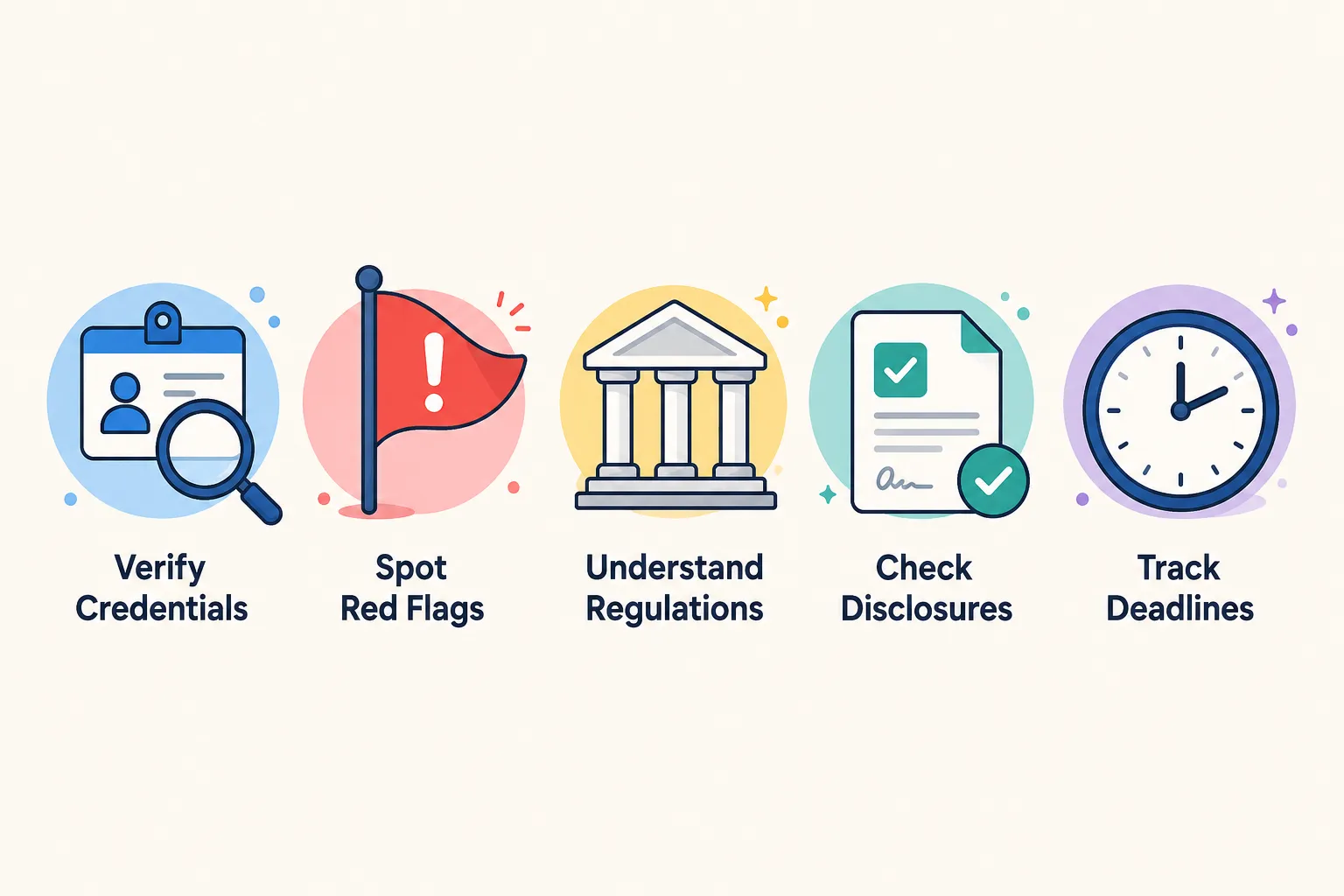
Step 1: Search the firm and the individual surveyor on the RICS Find a Surveyor directory at rics.org. Confirm their membership grade (AssocRICS, MRICS, or FRICS) and that their registration is current.
Step 2: For valuation disputes, confirm the individual holds RICS Registered Valuer status, this is a separate designation from general RICS membership.
Step 3: Request a copy of their current Professional Indemnity Insurance certificate. Check the level of cover is appropriate for the value of the dispute.
Step 4: Ask for two or three examples of previous expert witness reports (redacted if necessary) or references from solicitors who have instructed them previously.
Step 5: Confirm there are no outstanding RICS disciplinary findings against the firm or individual. RICS publishes regulatory decisions on its website.
For expert witness report services, a reputable RICS firm should be able to provide all of the above without hesitation.
What If My RICS Expert Witness Loses the Case
An expert witness losing a case is not the same as the expert performing poorly. Courts weigh all the evidence before them, and the outcome depends on far more than any single expert's report.
However, if the expert's report was demonstrably inadequate, factually wrong, procedurally non-compliant, or clearly biased, you may have grounds to:
- Complain to RICS. If the surveyor breached RICS Rules of Conduct or professional standards, a formal complaint can be lodged with RICS Regulation.
- Claim against their PII. If negligent advice caused you a quantifiable loss, a claim against the firm's Professional Indemnity Insurance may be available. Seek independent legal advice on this.
- Challenge costs. If the court finds that the expert's evidence was unreasonable or unhelpful, it may refuse to award the costs of that expert even if you win the case overall.
What you cannot do is instruct an expert witness on the basis that they will advocate your position. Their duty is to the court. If the evidence genuinely does not support your case, a competent expert will tell you that before proceedings begin, and that is exactly what you should want.
.cg-ew-wrap{font-family:Arial,sans-serif;max-width:560px;margin:2em auto;background:#f8f9fb;border:1px solid #d0d7e2;border-radius:8px;padding:20px}
.cg-ew-wrap h3{margin:0 0 12px;font-size:1.05rem;color:#1a2e4a}
.cg-ew-row{margin-bottom:12px}
.cg-ew-row label{display:block;font-size:.85rem;color:#444;margin-bottom:4px}
.cg-ew-row select{width:100%;padding:7px 9px;border:1px solid #bcc5d3;border-radius:5px;font-size:.9rem;background:#fff}
.cg-ew-btn{background:#1a2e4a;color:#fff;border:none;padding:9px 22px;border-radius:5px;cursor:pointer;font-size:.9rem;margin-top:4px}
.cg-ew-btn:hover{background:#2a4a72}
.cg-ew-result{margin-top:14px;padding:12px;background:#e8f0fb;border-left:4px solid #1a2e4a;border-radius:4px;font-size:.88rem;color:#1a2e4a;display:none}
Which RICS Expert Witness Specialism Do You Need?
function cgShowResult(){
var d=document.getElementById(‘cg-dispute’).value;
var c=document.getElementById(‘cg-court’).value;
var r=document.getElementById(‘cg-result’);
var msgs={
val:”Instruct a RICS Registered Valuer with Red Book experience and prior court/tribunal reporting. Confirm Registered Valuer status separately from general RICS membership.”,
pw:”Instruct a RICS-accredited party wall surveyor experienced in schedule of condition reports and the Party Wall etc. Act 1996. Check for CPR Part 35 report experience.”,
defect:”Instruct a RICS Building Surveyor (MRICS/FRICS) with Level 3 survey and building pathology experience. Confirm they can produce a CPR Part 35-compliant defects report.”,
rent:”Instruct a RICS Registered Valuer with commercial lease and rent review experience. Arbitration/PACT experience is a strong advantage.”,
boundary:”Instruct a RICS-accredited Land Surveyor or Geomatics professional. Confirm experience with Land Registry title plan disputes.”
};
if(!d||!c){r.style.display=’block’;r.textContent=’Please select both options above.’;return;}
var note=c===’civil’?’ Ensure full CPR Part 35 compliance.’:c===’tribunal’?’ Confirm experience with the relevant tribunal rules.’:’ A written opinion letter may suffice, confirm scope with your solicitor.’;
r.style.display=’block’;
r.textContent=(msgs[d]||’Consult a RICS firm to confirm the right specialism.’)+note;
}
FAQ: RICS Firm Selection for Expert Witness Services
Q: Does a RICS surveyor automatically qualify as an expert witness?
No. RICS membership establishes technical competence but does not automatically qualify someone as a court expert witness. The surveyor must also understand their duties under CPR Part 35, have experience preparing compliant reports, and ideally hold specific expert witness training.
Q: What is a single joint expert (SJE) and should I request one?
A single joint expert is appointed by both parties and instructed jointly, sharing the cost. Courts often encourage SJE appointments in lower-value disputes. Whether to request one depends on the complexity of the dispute and whether both parties trust the same firm, ask your solicitor.
Q: Can I use the same surveyor who did my pre-purchase survey as my expert witness?
Generally not advisable. A surveyor who previously acted for you in a transactional capacity may have a conflict of interest that opposing counsel will exploit. Instruct a separate firm with no prior involvement in the property.
Q: How do I know if a RICS firm has experience with party wall litigation specifically?
Ask directly for examples of party wall disputes they have supported through court or tribunal proceedings. Also ask whether they have prepared joint statements with opposing experts and whether they hold any specialist party wall training or membership of the Faculty of Party Wall Surveyors.
Q: Are RICS expert witness fees recoverable if I win my case?
In multi-track civil cases, reasonable expert witness costs are usually recoverable from the losing party, subject to the court's discretion. In small claims track cases, expert costs are rarely awarded. Always discuss cost recovery prospects with your solicitor before instructing.
Q: What is the difference between a party-appointed expert and a single joint expert?
A party-appointed expert is instructed by one side only and advocates that party's technical position (within the bounds of their duty to the court). A single joint expert is instructed by both parties and provides a neutral opinion. Courts increasingly prefer SJEs in lower-value or less complex disputes.
Conclusion
RICS firm selection for expert witness services in 2026 litigation is a decision that shapes the credibility of your entire case. The right firm brings verified RICS credentials, relevant specialism, genuine court experience, and a clear understanding that their duty runs to the tribunal, not to you as the instructing party.
Actionable next steps:
- Identify the precise type of dispute (valuation, party wall, building defects) and match the specialism accordingly.
- Verify RICS registration and, where relevant, Registered Valuer status via rics.org before any other step.
- Request PII documentation and ask directly about CPR Part 35 experience.
- Instruct early, rushed expert reports are weaker reports.
- Discuss cost recovery with your solicitor before committing to fees.
For building survey and party wall matters, a comprehensive building survey or party wall service from a RICS-accredited firm provides the evidential foundation that litigation demands. Where construction law advice or statutory considerations are relevant to your dispute, ensure the instructed firm can address these within the same report.
The cost of getting this decision right is modest compared to the cost of getting it wrong.
Tags: RICS expert witness, party wall surveyor, building survey litigation, property valuation dispute, RICS firm selection, expert witness fees 2026, CPR Part 35, party wall act, RICS registered valuer, building defects survey, expert witness report, property litigation UK