


Last updated: July 24, 2026
Quick Answer: Undertaking valuation surveys as an expert witness requires a building surveyor to hold RICS membership, complete specialist expert witness training, and follow strict legal protocols set out under the Civil Procedure Rules (CPR) and RICS professional standards. In 2026, surveyors must demonstrate both technical valuation competence and an overriding duty to the court, not to the instructing party. Failure to meet these standards can result in a report being rejected and professional disciplinary action.
Key Takeaways
- Expert witness building surveyors owe their primary duty to the court, not to the client who instructs them.
- RICS membership (MRICS or FRICS) is the baseline qualification; specialist expert witness training is an additional, strongly recommended step.
- The forthcoming 5th edition of the RICS guidance note "Surveyors Acting as Expert Witnesses" sets the current benchmark for conduct and report format.
- A February 2024 RICS Practice Alert reinforced mandatory conduct rules, including a strict prohibition on conditional fee arrangements for expert witnesses.
- Expert witness fees are not regulated by RICS, but day rates for experienced chartered surveyors typically range from £1,500 to £4,000 per day (market estimate, 2026).
- Building surveyors without RICS accreditation can technically provide expert evidence, but courts and solicitors strongly prefer RICS-qualified professionals.
- Common mistakes include failing to declare conflicts of interest, overstating certainty, and producing advocacy-style reports rather than objective analyses.
- Expert witness work differs fundamentally from standard building survey work in its legal obligations, report structure, and professional liability exposure.
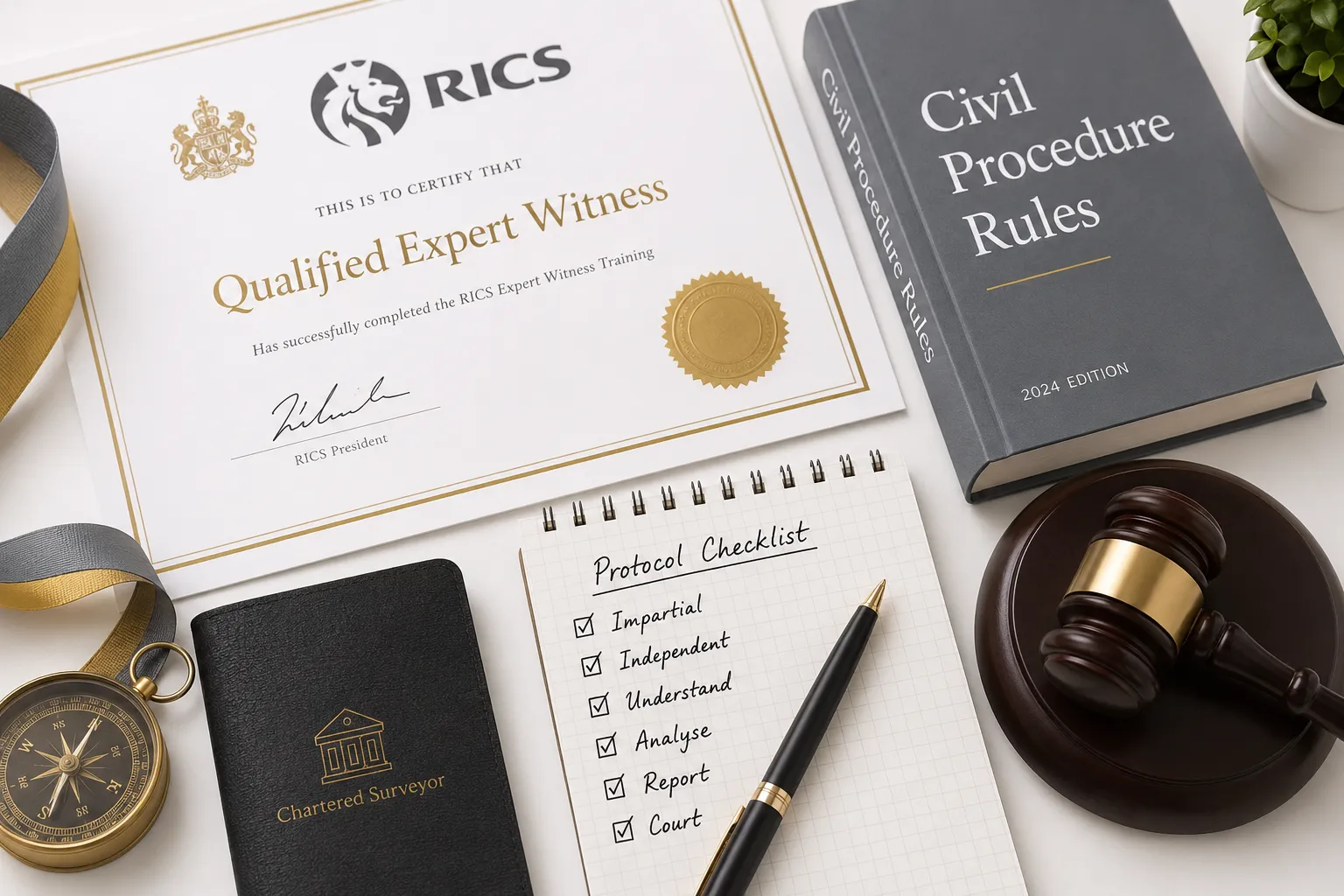
What Is a Valuation Survey Expert Witness and What Do They Do?
A valuation survey expert witness is a qualified building surveyor or valuer appointed by a court, tribunal, or disputing parties to provide independent, objective opinion evidence on property-related matters. Their role is to assist the court in understanding technical issues that fall outside the knowledge of a judge or arbitrator.
In practice, expert witnesses in this field are instructed in cases involving:
- Disputed property valuations in matrimonial proceedings
- Dilapidations claims between landlords and tenants
- Boundary disputes and rights of light
- Negligence claims against other surveyors
- Leasehold enfranchisement and lease extension disagreements
- Insurance reinstatement value disputes
The expert witness does not act as an advocate. Their written report and oral evidence must reflect a genuinely held professional opinion, supported by evidence, even if that opinion is unfavourable to the instructing party. This distinction is central to undertaking valuation surveys as an expert witness under RICS training and protocols for building surveyors in 2026.
For context on how standard building surveys differ from expert witness work, the Level 3 Full Building Survey service provides a useful baseline comparison.
Who Needs Expert Witness Valuation Surveys and When?
Expert witness valuation surveys are needed whenever a property dispute reaches formal legal proceedings or an alternative dispute resolution (ADR) process such as arbitration or mediation.
Common instructing parties include:
- Solicitors acting in property litigation
- Barristers preparing for tribunal hearings
- Parties in RICS-administered arbitration
- Courts dealing with probate or matrimonial asset division
- Local authorities in compulsory purchase cases
The trigger is usually when the parties cannot agree on a property's value, condition, or the cost of remedying defects. At that point, an independent expert opinion carries significant weight. For example, in a dilapidations dispute at lease end, an expert witness surveyor may be asked to assess whether the landlord's schedule of repairs is reasonable and what the true diminution in value is. You can read more about dilapidation protocols and how they interact with expert evidence.
What Qualifications Do You Need to Become an Expert Witness Building Surveyor?
The minimum qualification is RICS membership at MRICS or FRICS level, combined with demonstrable experience in the relevant area of valuation or building surveying.
There is no single mandatory licence to practise as an expert witness in England and Wales. However, courts and instructing solicitors expect:
- RICS membership (MRICS or FRICS) as proof of professional competence.
- Relevant experience in the specific type of dispute (e.g., residential valuation, commercial dilapidations, or construction defects).
- Completion of expert witness training, such as the RICS Expert Witness Certificate or equivalent CPD-accredited courses.
- Professional indemnity insurance that explicitly covers expert witness work, as standard surveying PI policies may exclude this activity.
- Familiarity with Part 35 of the Civil Procedure Rules, which governs expert evidence in civil proceedings in England and Wales.
Surveyors who also hold membership of the Expert Witness Institute (EWI) or the Academy of Experts strengthen their credibility in court. These bodies provide additional training, a code of conduct, and a searchable register that solicitors use when selecting experts.
RICS Expert Witness Protocols and Standards in 2026
In 2026, the governing document for undertaking valuation surveys as an expert witness under RICS training and protocols for building surveyors is the forthcoming 5th edition of the RICS guidance note "Surveyors Acting as Expert Witnesses," which updates earlier editions to reflect changes in case law, the CPR, and professional conduct expectations.
Key protocols that every expert witness surveyor must follow include:
Overriding duty to the court: The expert's duty is to the court, not to the client. This is a legal requirement under CPR Part 35, not just professional guidance.
Declaration of truth: Every expert report must contain a statement of truth and a declaration that the expert understands and has complied with their duty to the court.
No conditional fees: The February 2024 RICS Practice Alert explicitly confirmed that expert witnesses must not enter into conditional fee arrangements (success fees tied to the outcome). This prohibition protects the independence of the evidence.
Single Joint Expert (SJE) rules: Courts increasingly appoint a Single Joint Expert instructed by both parties. Surveyors must understand how to operate in this capacity without favouring either side.
Letter of instruction compliance: The expert must address only the questions put to them in the letter of instruction and must not stray into advocacy.
Meetings between experts: Where two opposing experts are appointed, they are often directed by the court to meet, produce a joint statement identifying areas of agreement and disagreement, and narrow the issues before trial.
For surveyors dealing with complex structural or environmental matters within expert witness instructions, understanding building pathology and areas requiring further investigation is directly relevant to producing credible reports.
How Long Does It Take to Get RICS Expert Witness Accreditation?
There is no single RICS "accreditation" for expert witnesses in the same way as, for example, an RICS Registered Valuer designation. The pathway is a combination of qualification, experience, and training rather than a single exam.
A realistic timeline looks like this:
| Stage | Typical Duration |
|---|---|
| Achieve MRICS status | 3-7 years post-degree |
| Build relevant dispute experience | 2-5 years |
| Complete RICS Expert Witness Certificate | 3-6 months (part-time) |
| First court appointment | Variable; often 1-3 years after training |
The RICS Expert Witness Certificate is a structured CPD programme delivered over several months. It covers report writing, cross-examination preparation, and the legal framework. Some surveyors fast-track this process if they already have significant tribunal experience, for example through leasehold extension and enfranchisement valuations or matrimonial valuations, where disputes are common.
How Much Does RICS Expert Witness Training Cost in 2026?
RICS expert witness training costs vary depending on the course provider and format. The figures below are market estimates for 2026 and should be verified directly with providers before committing.
- RICS Expert Witness Certificate: approximately £1,500 to £2,500 for the full programme.
- One-day CPD workshops on expert witness skills: approximately £300 to £600 per day.
- Expert Witness Institute membership and training: approximately £200 to £500 per year, plus course fees.
- Academy of Experts courses: approximately £500 to £1,200 depending on the module.
These costs are generally tax-deductible as a professional development expense for self-employed surveyors. Larger surveying practices sometimes fund training centrally as part of their professional development budget.
How Much Can You Charge as an Expert Witness Surveyor?
Expert witness fees are not regulated by RICS. Rates are set by the individual surveyor based on experience, specialism, and the complexity of the case.
As a market estimate for 2026:
- Junior MRICS expert witnesses: £800 to £1,500 per day.
- Experienced MRICS/FRICS experts: £1,500 to £3,000 per day.
- High-profile specialists (e.g., complex commercial valuations): £3,000 to £4,500 per day or more.
Surveyors typically charge separately for report preparation, site inspection, travel, expert meetings, and attendance at court or tribunal. It is standard practice to agree a fee estimate with the instructing solicitor at the outset. Courts can scrutinise and reduce expert witness fees if they are considered disproportionate to the value of the claim, so transparent fee schedules matter.

What Is the Difference Between a Building Surveyor and an Expert Witness Valuation?
A standard building survey assesses the physical condition of a property for a buyer or owner. An expert witness valuation is a formal legal document prepared for court or tribunal proceedings, carrying specific legal obligations that a standard survey does not.
Key differences at a glance:
- Purpose: A building survey informs a purchase decision. An expert witness report informs a court or tribunal.
- Duty: A building surveyor's duty is to their client. An expert witness's primary duty is to the court.
- Format: Expert witness reports must comply with CPR Part 35 requirements, including specific declarations not required in standard surveys.
- Liability: Expert witnesses have qualified immunity from civil liability for their court evidence, but can face disciplinary action for dishonest or misleading reports.
- Fees: Standard surveys are typically fixed-fee. Expert witness work is usually charged at an hourly or daily rate.
A surveyor asked to provide an expert witness report must switch from a client-service mindset to a court-service mindset. These are genuinely different professional roles, even when the underlying technical knowledge overlaps.
What Are the Legal Requirements for Expert Witnesses in UK Property Disputes?
In England and Wales, expert witnesses in civil property disputes are governed primarily by CPR Part 35 and the associated Practice Direction. These rules apply to all courts below the Supreme Court and to most tribunals.
Core legal requirements include:
- Written permission from the court is required before expert evidence can be adduced in most cases.
- The expert must be independent and must not be an employee of either party.
- The report must state the substance of all material instructions, whether written or oral, that led to the expert's opinion.
- The expert must inform the court if their opinion changes after the report is filed.
- Experts may be cross-examined on their report at trial.
In the First-tier Tribunal (Property Chamber), which handles leasehold disputes and some valuation matters, similar rules apply under the Tribunal Procedure Rules, though the process is often less formal than the High Court.
Surveyors handling statutory considerations or construction law advice will find that these legal frameworks intersect directly with expert witness obligations.
Can You Do Expert Witness Work Without RICS Accreditation?
Technically, yes. There is no statutory requirement in England and Wales for an expert witness to hold RICS membership. Courts can admit evidence from any person with relevant expertise.
However, in practice:
- Solicitors and barristers strongly prefer RICS-qualified experts because RICS membership signals regulated professional standards and PI insurance.
- Opposing counsel will challenge the credentials of an unqualified expert, potentially undermining the weight given to their evidence.
- RICS members are bound by the RICS Rules of Conduct, which provides a disciplinary backstop that courts find reassuring.
- Without RICS membership, a surveyor cannot use the MRICS or FRICS designation, which is often specified in letters of instruction.
The practical answer is: surveyors without RICS membership will find it very difficult to secure regular expert witness instructions in property disputes, particularly in higher-value cases.
Common Mistakes Building Surveyors Make as Expert Witnesses
Even experienced surveyors make errors when moving into expert witness work. The most consequential mistakes include:
1. Writing an advocacy report. The most common and serious error. If a report reads as though it is arguing a case for the instructing party rather than providing objective analysis, a judge will discount it and may make adverse costs orders.
2. Overstating certainty. Valuations involve judgment. Presenting a single figure without acknowledging the range of reasonable opinion invites cross-examination that can destroy credibility.
3. Failing to declare conflicts of interest. Any prior relationship with a party, property, or related matter must be disclosed. Failure to do so can result in the report being excluded and a referral to RICS for disciplinary action.
4. Exceeding the scope of instructions. Addressing issues not raised in the letter of instruction, or straying into legal conclusions, is a procedural error that weakens a report.
5. Inadequate site inspection. Expert opinions on physical condition or value must be grounded in a thorough inspection. Relying solely on desk-based research or photographs provided by a party is rarely sufficient.
6. Missing the joint statement deadline. Courts set strict timetables. Missing a deadline for the experts' joint statement can delay proceedings and attract judicial criticism.
What Happens If Your Expert Witness Report Gets Challenged in Court?
When an expert witness report is challenged, the expert will typically be cross-examined at trial or hearing. This is a normal part of the process and does not in itself mean the report has failed.
However, if the challenge reveals serious problems, the consequences can include:
- The report being given little or no weight by the judge, meaning the instructing party effectively has no expert evidence.
- An adverse costs order against the instructing party if the report was found to be partisan or unreliable.
- A referral to RICS if the report showed a breach of professional standards or the RICS Rules of Conduct.
- Reputational damage that reduces future instructions from solicitors and law firms.
In extreme cases, where an expert is found to have given deliberately false evidence, they can face contempt of court proceedings. This is rare but has occurred in high-profile property cases.
The best protection is rigorous preparation: thorough inspection, honest analysis, and a report that clearly distinguishes between facts, assumptions, and professional opinion.
Is Expert Witness Training Different from Regular Building Surveyor Training?
Yes, significantly. Standard building surveyor training focuses on technical competence: assessing construction, identifying defects, interpreting planning rules, and advising clients. Expert witness training adds a legal and procedural layer that is entirely separate from technical knowledge.
Expert witness training specifically covers:
- The legal framework (CPR Part 35, tribunal rules, arbitration procedures)
- Report structure and mandatory declarations
- How to handle cross-examination
- The ethics of independence and the prohibition on advocacy
- Joint expert meetings and producing agreed statements
- Fee arrangements and what is and is not permissible
A surveyor with 20 years of technical experience but no expert witness training will still make procedural errors in their first few instructions. The training is not optional for anyone who wants to build a credible practice in this area. Undertaking valuation surveys as an expert witness under RICS training and protocols for building surveyors in 2026 is a distinct professional discipline, not simply an extension of standard surveying work.
Frequently Asked Questions
What is the primary duty of an expert witness building surveyor?
The primary duty is to the court or tribunal, not to the party who instructs or pays them. This is a legal requirement under CPR Part 35 and is reinforced by RICS professional standards.
Do I need separate professional indemnity insurance for expert witness work?
Yes. Standard building surveying PI policies often exclude expert witness activities. Surveyors must check their policy wording and obtain specific cover for this work before accepting instructions.
Can a building surveyor act as both an advocate and an expert witness in the same case?
No. These roles are incompatible. An expert witness must be independent. Acting as an advocate or adviser to a party in the same case disqualifies a surveyor from providing expert evidence in that matter.
What is a Single Joint Expert (SJE) and when are they used?
An SJE is an expert appointed jointly by both parties and approved by the court, rather than each side having their own expert. Courts in lower-value cases often direct parties to use an SJE to reduce costs and avoid a "battle of experts."
How is an expert witness valuation different from a Red Book valuation?
A Red Book (RICS Valuation – Global Standards) valuation is produced for a client for a specific purpose such as secured lending or purchase. An expert witness valuation is produced for court proceedings and must comply with CPR Part 35. Both require RICS competence, but the legal obligations and report format differ substantially.
Can expert witness fees be recovered from the losing party in litigation?
In most civil proceedings, the losing party can be ordered to pay the winning party's costs, which can include reasonable expert witness fees. However, courts assess proportionality and may reduce fees they consider excessive. Keeping detailed time records and transparent fee schedules is essential.
Conclusion
Undertaking valuation surveys as an expert witness represents one of the most technically and legally demanding roles available to a building surveyor in 2026. The combination of RICS professional standards, Civil Procedure Rules obligations, and the personal credibility required to withstand cross-examination means that preparation and specialist training are not optional extras.
Actionable next steps for building surveyors considering this work:
- Confirm your RICS membership is current and that your PI insurance explicitly covers expert witness activities.
- Enrol in the RICS Expert Witness Certificate or an equivalent accredited programme before accepting your first instruction.
- Read CPR Part 35 and the associated Practice Direction in full, and review the RICS guidance note "Surveyors Acting as Expert Witnesses" (5th edition).
- Build experience in relevant dispute types, such as leasehold extension valuations or matrimonial valuations, before seeking court appointments.
- Consider joining the Expert Witness Institute or the Academy of Experts to access ongoing training and a professional network.
For property owners, landlords, or homebuyers involved in a dispute who need an independent expert opinion, working with a chartered surveyor who has specific expert witness training provides the strongest possible foundation for your case. You can explore expert witness report services and chartered surveyor valuations to understand what a qualified expert can provide.
.ew-wrap{font-family:Arial,sans-serif;max-width:560px;margin:24px auto;border:2px solid #003366;border-radius:8px;padding:20px;background:#f9fbff}
.ew-wrap h3{margin:0 0 12px;color:#003366;font-size:1.1rem}
.ew-item{display:flex;align-items:center;margin:8px 0;font-size:.93rem}
.ew-item input{margin-right:10px;accent-color:#003366;width:18px;height:18px}
.ew-bar-bg{background:#dde6f0;border-radius:6px;height:18px;margin:14px 0 6px;overflow:hidden}
.ew-bar{height:18px;background:#003366;border-radius:6px;transition:width .4s}
.ew-score{font-weight:bold;color:#003366;font-size:.95rem}
.ew-msg{margin-top:10px;padding:10px;border-radius:6px;font-size:.9rem}
.ew-low{background:#fff3cd;color:#7a5c00}
.ew-mid{background:#d1ecf1;color:#0c5460}
.ew-high{background:#d4edda;color:#155724}
Expert Witness Readiness Checker
Tick each criterion you currently meet. See your readiness score below.
function calc(){
var boxes=document.querySelectorAll(‘.ew-wrap input[type=checkbox]’);
var n=0;boxes.forEach(function(b){if(b.checked)n++;});
var pct=Math.round(n/6*100);
document.getElementById(‘ewBar’).style.width=pct+’%’;
document.getElementById(‘ewScore’).textContent=n+’ / 6 criteria met’;
var m=document.getElementById(‘ewMsg’);
if(n<=2){m.className='ew-msg ew-low';m.textContent='Further training and qualification steps are needed before taking expert witness instructions.';}
else if(n<=4){m.className='ew-msg ew-mid';m.textContent='Good progress. Address the remaining criteria before accepting court instructions.';}
else{m.className='ew-msg ew-high';m.textContent='Strong readiness. You meet the core criteria for expert witness valuation work.';}
}
Tags: expert witness surveyor, RICS expert witness training, valuation survey expert witness, building surveyor expert witness, CPR Part 35 property, RICS protocols 2026, property dispute valuation, expert witness report, chartered surveyor court evidence, leasehold valuation dispute, building survey expert, RICS accreditation
How Prince Surveyors can help: explore our expert witness surveyors or learn about our RICS valuations.