

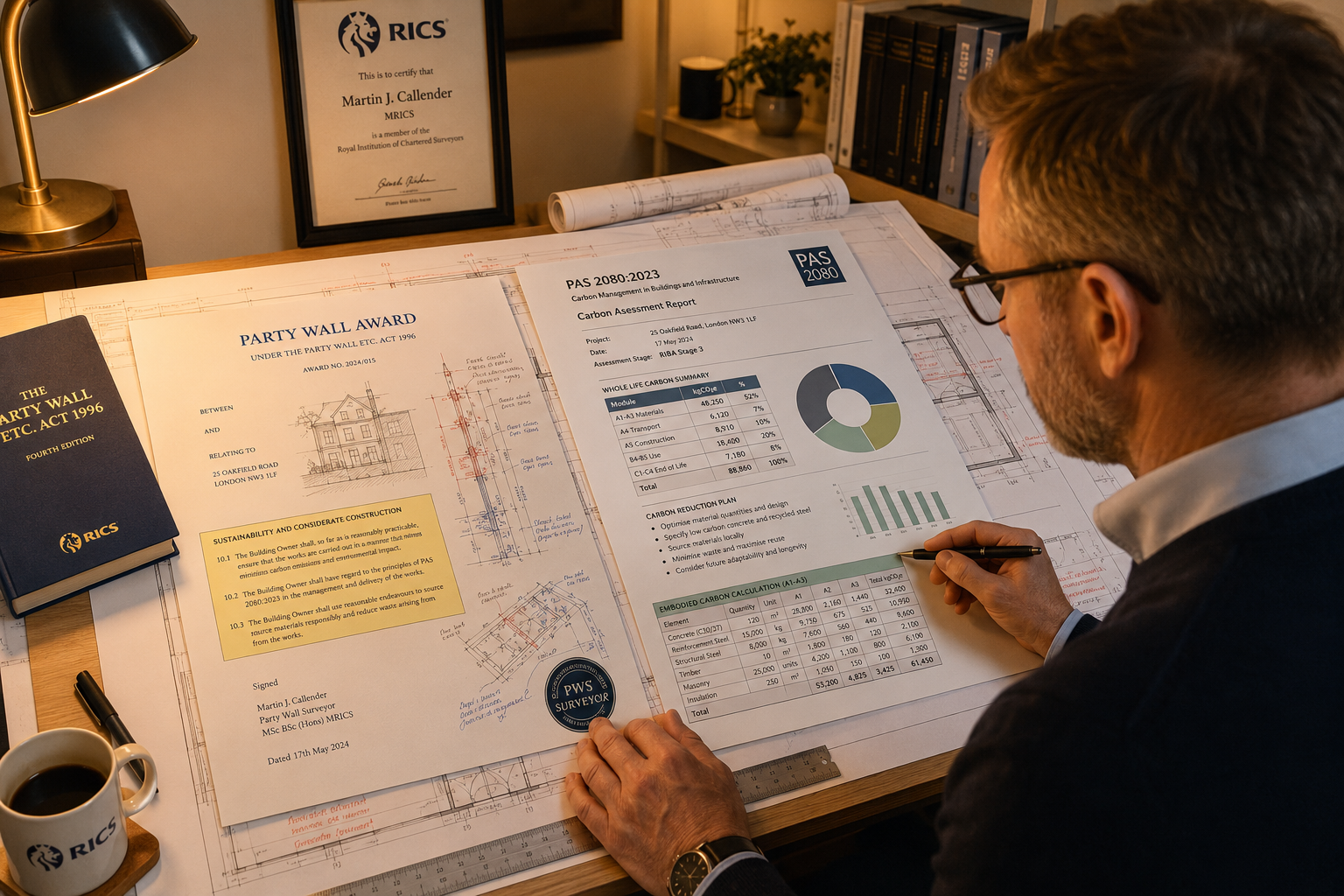
The UK built environment accounts for approximately 25% of the nation's total greenhouse gas emissions, yet the legal document governing millions of extension projects — the Party Wall Award — has historically said nothing about carbon at all. That gap is closing fast. In 2026, surveyors incorporating RICS second-edition standards into party wall processes are now actively advising on carbon impacts for eco-extensions, aligning legal compliance with client sustainability goals. The convergence of Whole Life Carbon in Party Wall Awards: Integrating PAS 2080 for Sustainable Extensions 2026 represents one of the most significant shifts in residential construction practice in a generation.
Key Takeaways
- PAS 2080:2023 and the RICS Whole Life Carbon Assessment (WLCA) Professional Statement now directly influence how Party Wall Awards are drafted for sustainable extensions.
- Whole life carbon (WLC) covers both embodied carbon (materials and construction) and operational carbon (energy use over time), and both must be considered in modern party wall practice.
- Sustainability clauses within Party Wall Awards can protect adjoining owners from thermal performance degradation caused by extension works.
- The UK Government's March 2026 Whole Life Carbon Management handbook provides best-practice guidance that surveyors can reference when drafting awards.
- Early-stage integration of WLC assessments delivers the greatest carbon savings and reduces the risk of costly redesigns later in the project.
What Is Whole Life Carbon and Why Does It Matter for Party Wall Awards
Whole life carbon (WLC) refers to all greenhouse gas emissions generated across a building's entire lifespan — from extracting raw materials and manufacturing components, through construction, operation, maintenance, and eventually demolition or reuse. Unlike a simple energy performance rating, WLC captures the full environmental cost of a project.
For residential extensions in England and Wales, the Party Wall Act 1996 creates a legal framework that governs works to shared walls, boundary walls, and excavations near neighbouring properties. The resulting legal document — the Party Wall Award — traditionally focused on structural protection, access rights, and damage schedules. It did not address carbon.
That position is changing. The RICS Whole Life Carbon Assessment Professional Statement, effective from September 2023, mandated a consistent methodology for assessing carbon impacts across a building's lifecycle [3]. Simultaneously, the British Standards Institution updated PAS 2080 in April 2023 to cover both buildings and infrastructure, making it the definitive UK standard for whole-life carbon management [1]. Together, these developments mean that surveyors drafting Party Wall Awards for eco-extensions now have both the tools and the professional obligation to consider sustainability.
Why does this matter for adjoining owners? An extension that removes or bridges existing insulation at the party wall junction can degrade the thermal performance of a neighbour's home, increasing their heating bills and carbon footprint. A well-drafted Party Wall Award with sustainability clauses can prevent this outcome before work begins.
Understanding PAS 2080: The Standard Behind Sustainable Extensions
PAS 2080 is the world's first published specification for managing whole-life carbon in buildings and infrastructure. Originally published in 2016 and significantly revised in April 2023, it provides a structured framework for identifying, assessing, and reducing carbon emissions across every stage of a project [1].
The Core Carbon Stages
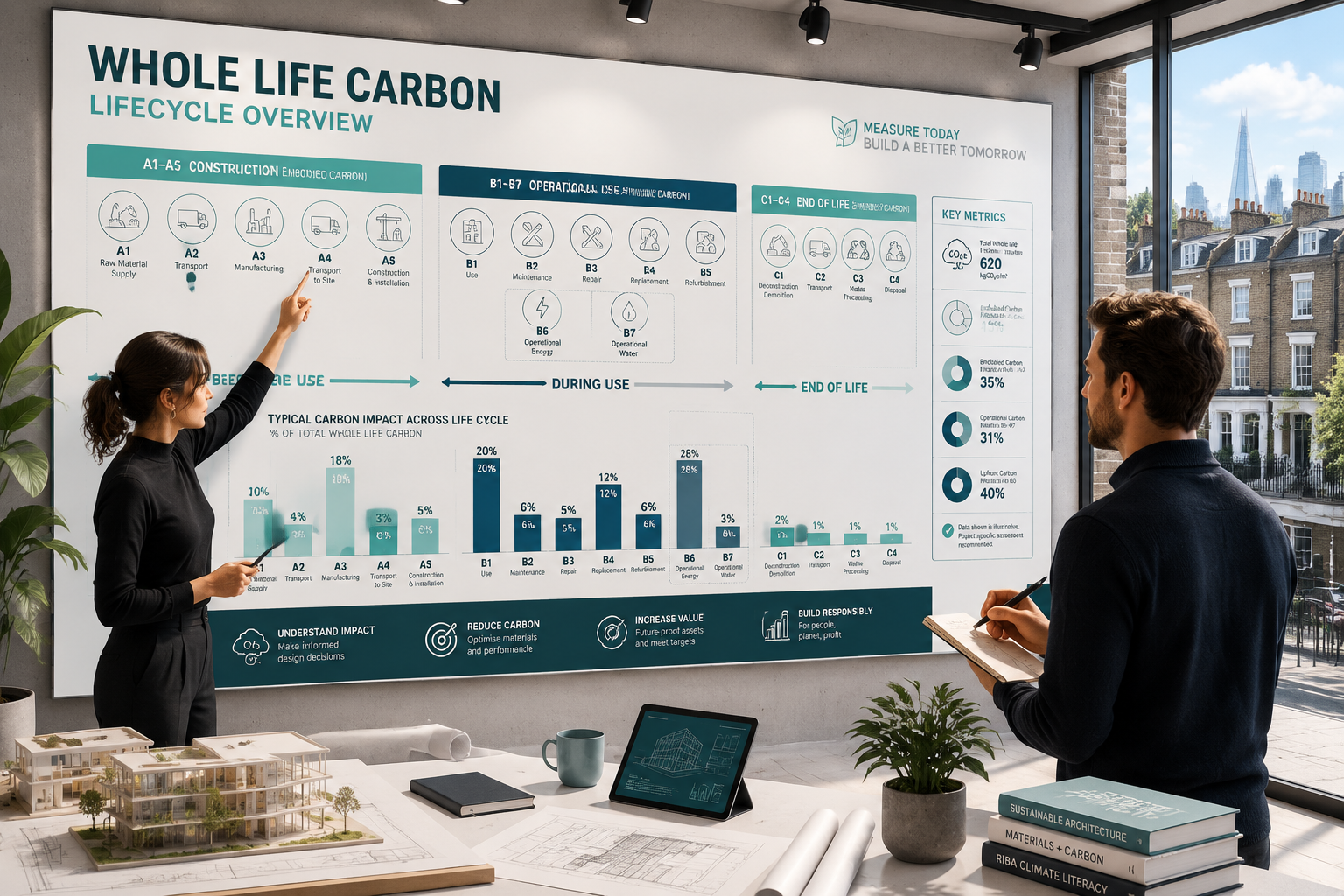
PAS 2080 organises carbon emissions into internationally recognised lifecycle stages, aligned with EN 15978 and the RICS WLCA methodology:
| Stage | Description | Relevance to Extensions |
|---|---|---|
| A1-A3 | Product manufacture (embodied carbon) | Choice of bricks, insulation, structural materials |
| A4-A5 | Construction and transport | Site waste, machinery fuel use, material delivery |
| B1-B7 | In-use operational carbon | Heating, cooling, lighting of the new space |
| B8 | Operational water use | Plumbing fixtures, water efficiency |
| C1-C4 | End-of-life demolition and disposal | Deconstruction, waste, landfill vs. recycling |
| D | Beyond boundary benefits | Reuse, energy export, carbon sequestration |
For a typical rear extension in London, embodied carbon in the construction phase (A1-A5) can represent 50-70% of the total WLC over a 60-year building lifespan. This is why PAS 2080 emphasises that the greatest opportunities for carbon reduction occur during the early stages of project development [8]. By the time a Party Wall Award is being finalised, key material choices are often already locked in — making early surveyor involvement critical.
What the 2023 Revision Added
The 2023 PAS 2080 update expanded its scope considerably [1]:
- Nature-based solutions were formally integrated, recognising green roofs, living walls, and planted boundaries as valid carbon reduction strategies [5].
- Collaboration across the value chain was elevated as a core principle, requiring designers, contractors, and clients to share carbon data openly [6].
- Alignment with ICMS 3rd Edition ensured that WLC assessments are consistent with global cost management standards [7].
- Infrastructure projects were brought within scope alongside buildings, reflecting the interconnected nature of the built environment.
The Institution of Civil Engineers (ICE) has published practical guidance on implementing PAS 2080, including case studies that demonstrate how WLC principles can be embedded into project documentation from the earliest design stages [5].
Integrating PAS 2080 for Sustainable Extensions: How Party Wall Awards Are Evolving
The practical integration of Whole Life Carbon in Party Wall Awards: Integrating PAS 2080 for Sustainable Extensions 2026 requires surveyors to move beyond their traditional structural and legal role. This section outlines how that integration works in practice.
Sustainability Clauses in Party Wall Awards
Recent industry guidance confirms that Party Wall Awards can and should include clauses addressing both embodied and operational carbon impacts [3]. These clauses serve several purposes:
- Protecting thermal continuity at the party wall junction, ensuring that insulation is not compromised during construction.
- Specifying low-carbon materials where the building owner has agreed to use them, creating a contractual record.
- Requiring a pre-construction carbon baseline so that any degradation to the adjoining owner's thermal performance can be measured and remedied.
- Mandating waste management protocols aligned with PAS 2080's A5 stage requirements.
"Sustainability clauses within Party Wall Awards represent a practical mechanism for translating high-level carbon policy into enforceable project-level obligations."
This is not merely aspirational. The RICS ESG standard, effective from April 30, 2026, requires commercial property valuations to consider sustainability factors [7]. While residential Party Wall Awards sit outside formal valuation, the same professional standards apply to the surveyors involved — creating a clear expectation that carbon considerations will be documented.
The Role of the Party Wall Surveyor in 2026
Surveyors are now expected to conduct whole-house assessments and quality assurance for retrofit projects, ensuring that Party Wall Awards reflect comprehensive WLC assessments [7]. This represents a meaningful expansion of the traditional role.
For building owners planning extensions, this means that choosing a qualified party wall surveyor with knowledge of PAS 2080 and RICS WLCA methodology is no longer optional — it is the standard of care that a competent professional is expected to meet.
For adjoining owners, it means that the Party Wall Award they receive should now include meaningful protections against carbon-related harm, not just structural damage. Understanding party wall rights in this context extends to the right to have thermal performance protected during neighbouring works.
Practical Steps for Surveyors Drafting Carbon-Aware Awards
The following process reflects current best practice for integrating PAS 2080 into party wall practice:
- Pre-notice stage: Advise the building owner to commission a WLC assessment alongside structural drawings. The UK Government's March 2026 Whole Life Carbon Management handbook provides a recognised framework for this assessment [2].
- Schedule of Condition: Extend the traditional schedule to include thermal imaging or U-value records at the party wall, creating a baseline for operational carbon performance.
- Award drafting: Include specific sustainability clauses covering material specifications, insulation continuity, waste management, and post-construction verification.
- Construction monitoring: Where agreed, include provisions for a surveyor to inspect insulation installation at the party wall junction — a step that checking engineers' involvement in party wall works makes considerably more effective.
- Post-completion: Document any deviations from the agreed carbon specification and record remedial actions taken.
When Neighbours Disagree on Sustainability Requirements
One of the more complex scenarios in 2026 party wall practice arises when a building owner wants to use low-carbon materials but the adjoining owner disputes the specification, or vice versa. The Party Wall Act provides a dispute resolution mechanism through the award process, and surveyors have discretion to include conditions they consider reasonable.
If a neighbour refuses to engage with the party wall process, the consequences can extend beyond structural risk to include unresolved carbon impacts on the shared boundary. Understanding what happens when a neighbour refuses party wall works is essential context for any building owner pursuing a sustainable extension.
Practical Guidance for Building Owners Planning Eco-Extensions in 2026
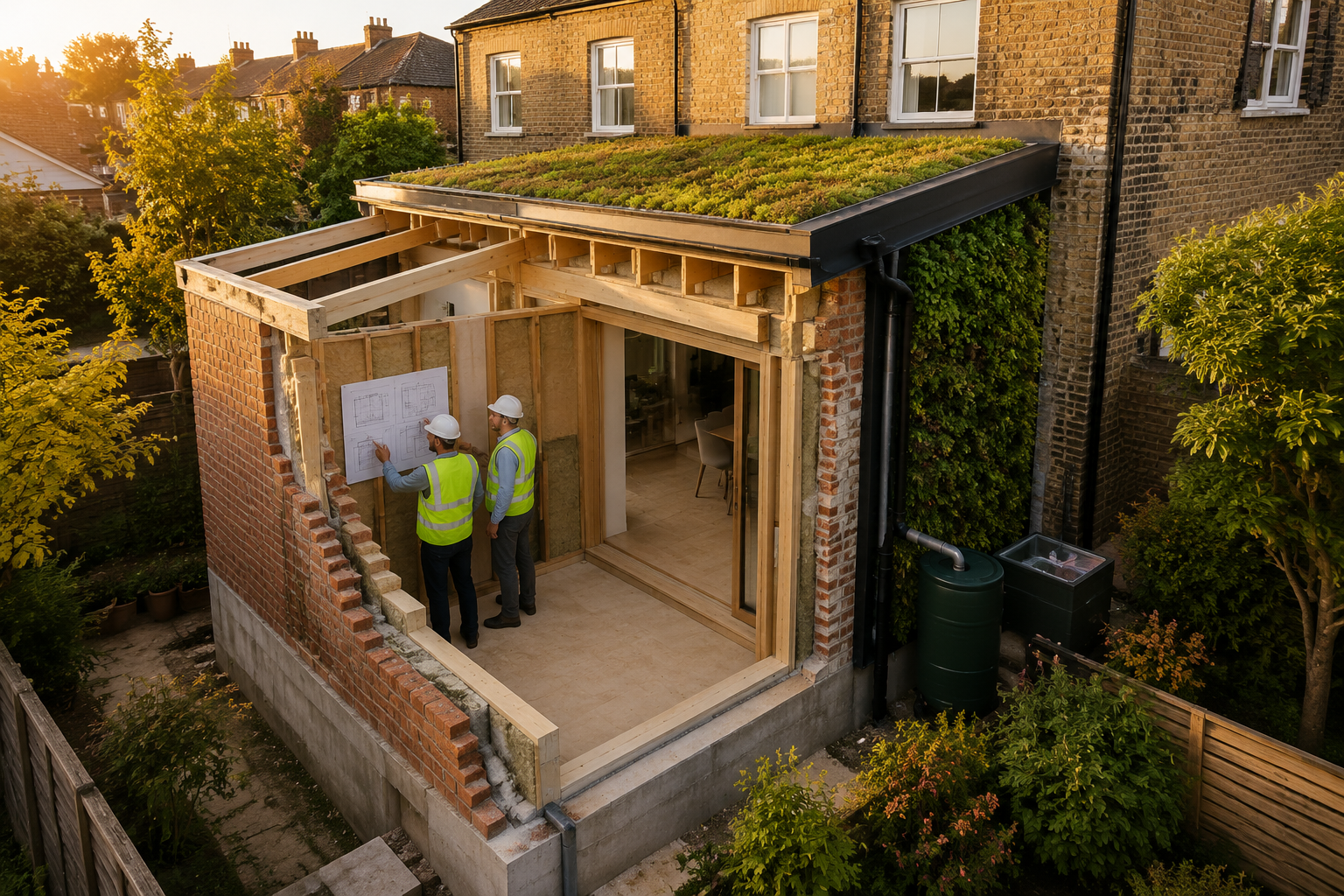
For homeowners planning extensions in 2026, the intersection of Whole Life Carbon in Party Wall Awards: Integrating PAS 2080 for Sustainable Extensions 2026 with day-to-day project management can feel overwhelming. The following practical guidance simplifies the key decisions.
Material Selection and Embodied Carbon
The single most impactful decision a building owner can make is material selection. The table below compares common extension materials by approximate embodied carbon:
| Material | Embodied Carbon (kgCO2e/m2) | Notes |
|---|---|---|
| Reclaimed brick | 15-30 | Lowest embodied carbon option |
| Timber frame (FSC certified) | 40-80 | Carbon sequestration offsets some emissions |
| Concrete block | 90-130 | Standard choice; significant carbon load |
| Structural insulated panels (SIPs) | 60-100 | High performance, moderate embodied carbon |
| Steel frame | 150-250 | High embodied carbon; consider recycled content |
These figures are indicative. A full PAS 2080-aligned WLC assessment will produce project-specific numbers. The key point is that material choices made before the Party Wall Award is issued have lasting consequences for the project's total carbon footprint.
Insulation at the Party Wall Junction
This is the point where party wall law and carbon performance intersect most directly. Poor insulation detailing at the party wall can create:
- Thermal bridging, which increases heat loss and operational carbon in both properties.
- Cold spots that lead to condensation and mould — a problem explored in detail when understanding what causes moisture in buildings.
- Reduced EPC ratings for the adjoining property, potentially affecting its market value and mortgage eligibility under Minimum Energy Efficiency Standards (MEES).
A Party Wall Award that includes specific insulation continuity requirements protects both parties from these outcomes.
The Cost Dimension
Some building owners worry that integrating PAS 2080 requirements into a Party Wall Award will increase costs. The evidence suggests the opposite. Early carbon assessment identifies over-specified or high-carbon elements that can be substituted for lower-cost, lower-carbon alternatives. The cost of a party wall surveyor is modest relative to the total project budget, and a surveyor with WLC expertise adds measurable value by reducing the risk of costly remediation later.
Companies such as Jacobs and GRS have achieved PAS 2080 certification, demonstrating that whole-life carbon management is commercially viable and increasingly expected by sophisticated clients [4]. The same expectation is filtering down to residential projects.
Industry Collaboration and the Value Chain
PAS 2080 places significant emphasis on collaboration across the entire project value chain [6]. For a residential extension, this means architects, structural engineers, contractors, and surveyors sharing carbon data and working toward a common target. The party wall drawings that accompany an award should reflect this collaborative approach, incorporating carbon specifications alongside structural details.
An agreed surveyor arrangement — where both the building owner and adjoining owner appoint a single neutral surveyor — can facilitate this collaboration more efficiently than a three-surveyor process. A complete guide to the agreed surveyor role explains how this arrangement works and when it is appropriate.
Conclusion
The integration of whole life carbon principles into Party Wall Awards is no longer a theoretical aspiration — it is an emerging professional standard with regulatory backing, industry precedent, and clear client demand. PAS 2080:2023, the RICS WLCA Professional Statement, and the UK Government's March 2026 Whole Life Carbon Management handbook collectively provide surveyors with a robust framework for embedding carbon considerations into the party wall process from the outset [1][2][3].
Actionable next steps for building owners and surveyors in 2026:
- Commission a PAS 2080-aligned WLC assessment before serving party wall notices, so that carbon data informs the award from the start.
- Instruct a party wall surveyor with demonstrable knowledge of RICS WLCA methodology and current sustainability standards.
- Ensure the Schedule of Condition includes thermal performance baseline data, not just structural records.
- Request that sustainability clauses covering insulation continuity, material specifications, and waste management are included in the award.
- Engage all project parties — architect, structural engineer, contractor — in a collaborative carbon reduction process aligned with PAS 2080's value chain principles.
The party wall process has always been about protecting neighbours from harm. In 2026, that protection extends to carbon harm — and the surveyors, building owners, and adjoining owners who understand this shift will be best placed to deliver extensions that are both legally compliant and genuinely sustainable.
References
[1] Bsi Launches An Update Of The Worlds First Specification For The Decarbonization Of Buildings And Infrastructure – bsigroup.com
[2] Whole Life Carbon Management – gov.uk
[3] Sustainability Clauses In Party Wall Awards 2026 Rics Guidance For Green Builds – partywallsurveyorlondon.uk
[4] Jacobs Recognized Commitment Carbon Management – jacobs.com
[5] Guidance Document Pas2080 – ice.org.uk
[6] Specification For Managing Building And Infrastructure Whole Of Life Carbon Pas 2080 – groundlevelalliance.org
[7] Whole Life Carbon Assessments In Building Surveys Rics Pas 2080 Updates For 2026 Retrofit Valuations – kingstonsurveyors.com
[8] Pas 2080 – mottmac.com