

Ninety-seven percent of organisations now conduct at least two compliance audits per year — and 74% of large enterprises run four or more [7]. That figure alone signals how dramatically the regulatory burden has shifted. For property owners, developers, and surveyors operating in coastal and disaster-prone regions, navigating stricter environmental regulations: how surveys ensure compliance in 2026 has become one of the most pressing operational challenges of the decade.
Climate change is accelerating coastal erosion, flooding, and subsidence events at a pace that regulators are scrambling to match. The result? A fragmented, fast-moving patchwork of local, national, and federal rules that demands real-time data, documented evidence, and professionally executed surveys at every stage of a project lifecycle.
Key Takeaways 📋
- Regulatory fragmentation is at an all-time high in 2026, with state-level EHS rules proliferating as federal standards shift [8].
- Professional building surveys are now a front-line compliance tool, not just a due-diligence formality.
- Asbestos, PFAS, and hazardous materials rules carry specific survey obligations with serious legal consequences for non-compliance.
- Technology — including LiDAR, drone surveys, and AI-driven reporting — is transforming how surveyors collect and present compliance data.
- Proactive surveying in coastal and disaster-prone areas can reduce liability, protect asset value, and support sustainability strategies.

The 2026 Regulatory Landscape: Why It's More Complex Than Ever
The environmental compliance environment in 2026 is not simply stricter — it is structurally more complex. Federal rollbacks in some areas have triggered a wave of state-level environmental, health, and safety (EHS) regulations, creating a compliance mosaic that varies dramatically by geography [8]. For surveyors and property professionals, this means that a single site may fall under multiple overlapping regulatory frameworks simultaneously.
BSI's analysis of the top environmental concerns for 2026 identifies three recurring pressure points: fragmented regulations, limited compliance resources, and the urgent need for proactive risk management [5]. These are not abstract concerns. They translate directly into practical challenges for anyone commissioning or conducting a building survey near a coastline, floodplain, or industrial brownfield.
Key Regulatory Developments Shaping 2026
| Regulation Area | Development | Compliance Implication |
|---|---|---|
| PFAS in Drinking Water | EPA proposed maintaining MCLs for PFOA/PFOS; compliance extensions to 2031 available [2] | Sites near water sources need contamination surveys |
| Coal Combustion Residuals | EPA extended compliance deadlines to support grid reliability [4] | Legacy industrial sites require updated condition assessments |
| Facility Response Plans | EPA proposed extending hazardous substance discharge planning deadline to June 2030 [6] | Coastal and riverside properties need documented response protocols |
| State EHS Rules | Federal rollbacks driving proliferation of state-level standards [8] | Location-specific survey requirements now essential |
💬 "Compliance functions are operating at their limits, with increasing regulatory complexity and resource constraints." — Regology, February 2026 [10]
A February 2026 survey by Regology confirmed that compliance teams across industries are stretched thin [10]. For the property and construction sector, this makes outsourcing compliance evidence-gathering to qualified surveyors not just convenient but strategically essential.
Understanding what types of building surveys are available is the first step toward matching the right survey to the right regulatory requirement.
How Surveys Serve as the Backbone of Environmental Compliance
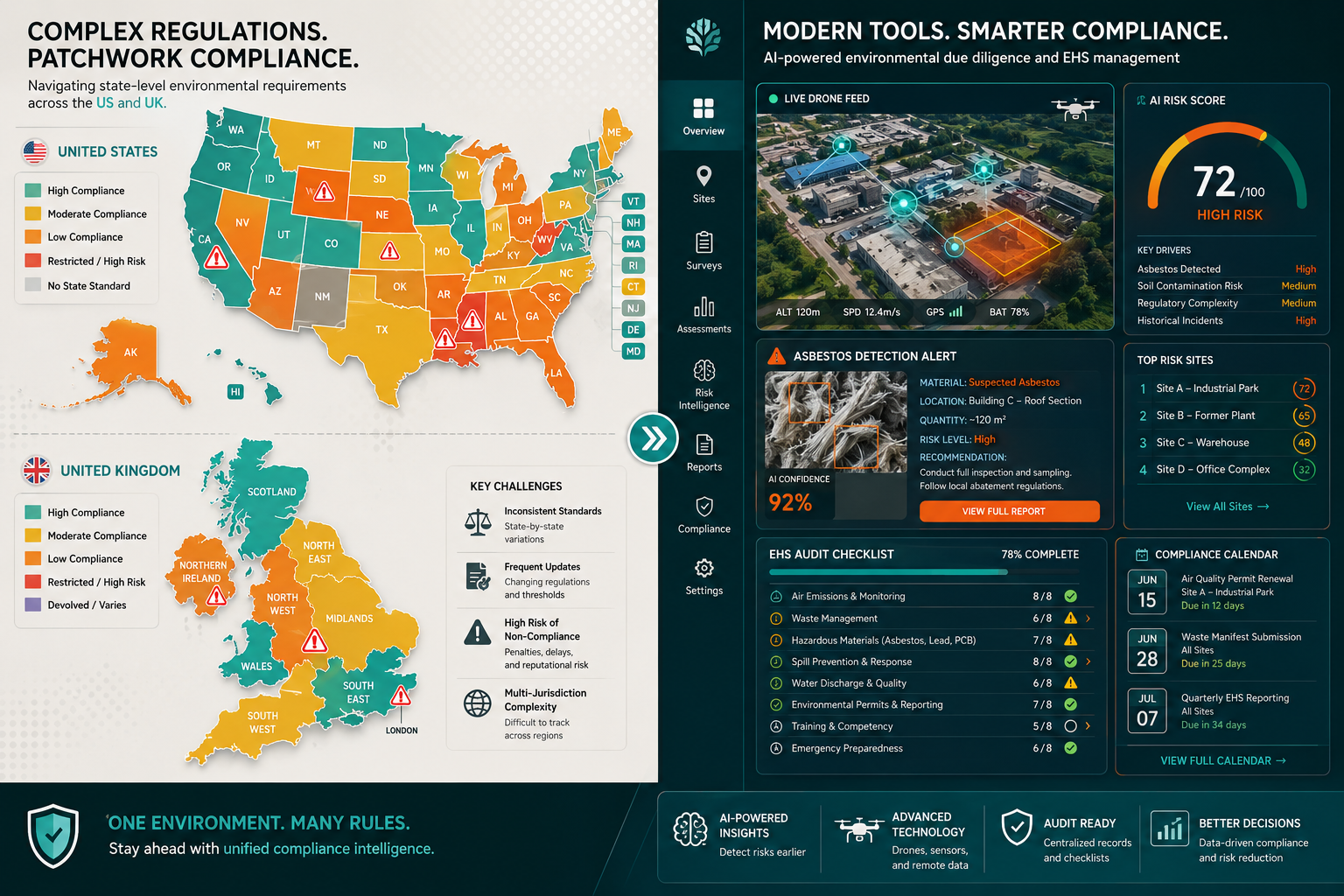
Navigating stricter environmental regulations: how surveys ensure compliance in 2026 is fundamentally about documentation, evidence, and professional accountability. Regulators and stakeholders now demand that EHS programmes be documented, auditable, and consistently executed [11]. A professional survey provides exactly that: a timestamped, expert-verified record of a property's condition, hazards, and risks.
🏗️ Asbestos Surveys: A Non-Negotiable Compliance Requirement
Asbestos remains one of the most tightly regulated hazardous materials in UK and international property law. Any building constructed before 2000 is potentially at risk. In 2026, enforcement activity around asbestos management has intensified, particularly in coastal areas where storm damage and flood events can disturb previously stable asbestos-containing materials (ACMs).
An asbestos building survey identifies the location, type, and condition of ACMs before any refurbishment, demolition, or emergency repair work begins. This is not optional — it is a legal duty under the Control of Asbestos Regulations 2012. Understanding what asbestos is and the dangers under UK regulations helps property owners grasp why this survey type is central to any compliance strategy.
Key asbestos survey triggers in 2026:
- Post-flood or post-storm structural damage assessments
- Pre-demolition or pre-refurbishment works
- Change of building use applications
- Insurance renewal for older commercial properties
🔍 Level 3 Full Building Surveys: The Gold Standard for Compliance Evidence
For properties in high-risk zones — coastal, flood-prone, or near industrial sites — a Level 3 Full Building Survey provides the most comprehensive condition assessment available. It goes beyond surface-level inspection to evaluate structural integrity, drainage, damp, and potential environmental hazards.
A Level 3 survey is particularly valuable because it:
- Documents building problems and potential solutions in detail
- Provides evidence for planning applications in sensitive environmental zones
- Supports insurance claims following climate-related damage events
- Identifies issues that could trigger regulatory enforcement action
For a deeper understanding of what this survey covers, the guide to what's in a Level 3 survey is an essential read for any property professional.
📐 Measured Surveys: Precision Data for Regulatory Reporting
In 2026, regulators increasingly require precise spatial data as part of environmental impact assessments and planning submissions. A measured building survey produces accurate floor plans, elevations, and sections using laser scanning and LiDAR technology — the same tools being deployed in real-time coastal monitoring programmes.
What are measured surveys? They are the foundation of any data-driven compliance reporting system. When a local authority or environmental agency requests evidence of a building's footprint, drainage layout, or proximity to a flood boundary, a measured survey delivers the precision required.
Technology, Real-Time Data, and the Future of Compliance Surveying

The intersection of climate risk and regulatory compliance has driven rapid technological adoption in the surveying profession. Navigating stricter environmental regulations: how surveys ensure compliance in 2026 increasingly depends on real-time data collection, AI-assisted analysis, and digital reporting platforms that can satisfy regulators at speed.
🛰️ Drone and LiDAR Technology in Coastal Surveys
Coastal and disaster-prone areas present unique access challenges. Eroded cliffs, unstable ground, and post-flood contamination zones make traditional manual inspection dangerous and impractical. Drone-mounted LiDAR scanners can now map entire coastal stretches in hours, producing millimetre-accurate 3D models that:
- Detect subsidence, erosion, and structural movement invisible to the naked eye
- Generate before-and-after comparisons following storm events
- Feed directly into regulatory compliance reports and planning submissions
- Create auditable digital records that satisfy EHS documentation requirements
The EiQ 2026 survey on responsible sourcing identified automation and AI as imperative shifts in compliance processes across industries [12]. The surveying sector is no exception. AI-powered anomaly detection in LiDAR data can flag potential asbestos disturbance, drainage failures, or structural compromise far faster than manual review.
📊 Sustainability Surveys and Decarbonisation Reporting
A May 2026 Morgan Stanley survey found that over 90% of corporate decision-makers are actively advancing sustainability strategies, with 47% acknowledging the need for improvement [3]. PwC's April 2026 report reinforced this, emphasising that decarbonisation is now a strategic business priority, not just a compliance checkbox [9].
For property portfolios, this translates into demand for surveys that assess:
- Energy Performance Certificate (EPC) compliance and upgrade pathways
- Carbon embodied in existing structures and retrofit potential
- Ventilation and air quality standards — particularly relevant given the growing body of regulation around indoor air quality in commercial buildings
- Flood resilience and climate adaptation measures
Proper mechanical ventilation in commercial buildings is increasingly a regulatory requirement, not just a best-practice recommendation. Surveys that assess ventilation systems provide evidence of compliance with both health regulations and sustainability commitments.
🗺️ Case Study Snapshot: Coastal Compliance in Practice
Scenario: A mixed-use development on the South Coast of England, built in the 1970s, required a full compliance audit following a severe storm event that caused partial flooding and structural movement.
Survey actions taken:
- ✅ Level 3 Full Building Survey to assess structural damage and identify hazardous materials disturbed by flooding
- ✅ Asbestos survey triggered by discovery of damaged ceiling tiles and pipe lagging
- ✅ Measured survey to document changes to the building footprint for insurance and planning purposes
- ✅ Drainage and environmental contamination assessment for PFAS and heavy metal presence in groundwater
Outcome: The survey package provided the local authority with the documented evidence required to approve emergency repair works, satisfied the insurer's loss assessment requirements, and identified £180,000 in remediation works that, if left unaddressed, would have constituted a regulatory breach.
This scenario reflects the real-world complexity that property professionals face when navigating stricter environmental regulations in 2026.
Building a Proactive Compliance Strategy with Surveys
Waiting for a regulatory inspection or an enforcement notice is no longer an acceptable risk management approach. The data is clear: organisations that treat compliance as a reactive function are falling behind [10]. A proactive survey-led compliance strategy offers several distinct advantages.
The Proactive Compliance Framework 🔄
Step 1 — Risk Mapping
Identify which properties in a portfolio sit within high-risk environmental zones: coastal erosion zones, flood plains, brownfield sites, or areas with known PFAS contamination. Use publicly available Environment Agency flood maps alongside professional survey data.
Step 2 — Baseline Survey
Commission a Level 3 or construction and condition survey to establish a documented baseline of the property's current condition. This creates the audit trail that regulators and insurers require.
Step 3 — Hazardous Materials Assessment
For any pre-2000 building, an asbestos survey is legally required before intrusive works. Extend this to include lead paint, Japanese knotweed, and ground contamination assessments where site history warrants it.
Step 4 — Measured Survey for Spatial Data
Produce accurate spatial records that can be submitted to planning authorities, environmental agencies, and insurers. Update these records following any significant weather event or structural change.
Step 5 — Regular Re-Survey Schedule
Given that 97% of organisations now conduct multiple compliance audits annually [7], property surveys should follow a similar cadence. High-risk coastal properties warrant annual or biennial re-surveys.
Step 6 — Digital Record Management
Store all survey reports, photographs, and remediation records in a secure, searchable digital system. Regulators increasingly expect instant access to compliance documentation.
⚠️ Common Compliance Failures Surveys Prevent
| Failure Type | Consequence | Survey Solution |
|---|---|---|
| Undisclosed asbestos in refurbishment | Criminal prosecution, project shutdown | Pre-works asbestos survey |
| Inaccurate flood risk disclosure | Insurance voidance, legal liability | Measured survey + flood risk assessment |
| Missing EPC compliance evidence | Planning refusal, fines | Energy performance survey |
| Undocumented structural movement | Insurance claim rejection | Level 3 building survey |
| PFAS contamination near water source | Regulatory enforcement, remediation costs | Environmental contamination survey |
Conclusion: Surveys as Strategic Compliance Assets in 2026
The regulatory environment of 2026 rewards preparation and punishes complacency. With state and national EHS rules proliferating [8], compliance deadlines shifting [4][6], and climate events accelerating damage to coastal and disaster-prone properties, professional surveys have evolved from a transactional service into a strategic compliance asset.
The organisations and property professionals who will navigate stricter environmental regulations most successfully are those who treat surveys not as a cost to minimise, but as evidence infrastructure — the documented, auditable foundation upon which every planning application, insurance claim, and regulatory submission rests.
✅ Actionable Next Steps
- Audit your current portfolio against the latest Environment Agency flood and erosion risk maps to identify high-priority properties.
- Commission a Level 3 Full Building Survey on any coastal, flood-prone, or pre-2000 property that lacks a recent condition assessment.
- Schedule an asbestos survey before any refurbishment, repair, or emergency works on older buildings.
- Invest in measured survey data to create accurate spatial records for regulatory submissions and insurance purposes.
- Establish a regular re-survey schedule aligned with your EHS audit calendar — at minimum annually for high-risk sites.
- Consult a chartered surveyor with environmental compliance experience to build a bespoke compliance strategy for your portfolio.
The cost of a professional survey is a fraction of the cost of a regulatory enforcement action, an insurance dispute, or a failed planning application. In 2026, that calculation has never been clearer.
References
[1] Patchwork Rules Put Manufacturers On Alert In 2026 – ohiomfg.com
[2] Proposed Pfoa And Pfos Compliance Extension Rule – epa.gov
[3] Morgan Stanley Sustainable Signals Corporates 2026 Announcement – morganstanley.com
[4] Epa Strengthens Grid Reliability Energy Security Extended Compliance Deadline Several – epa.gov
[5] Straight From The Source Top 5 Environmental Concerns To Watch In 2026 – bsigroup.com
[6] Rule Extension Proposal Clean Water Act Hazardous – epa.gov
[7] A Lign Releases 2026 Compliance Benchmark Report Unveils How Compliance Teams Can Navigate Evolving Governance Landscape 302671958 – prnewswire.com
[8] Ehs Compliance Trends 2026 – enhesa.com
[9] Decarbonization Strategic Plan – pwc.com
[10] The State Of Regulatory Compliance In 2026 What The Data Is Telling Us – regology.com