

Nearly one in three UK homeowners who built a garden room or home office in recent years did so without realising they may have been legally required to serve a Party Wall Notice first — a mistake that can trigger costly disputes, injunctions, and forced demolition orders. Party Wall Surveying for Garden Rooms, Outbuildings and Home Offices: When 2026 Homeowners Still Need to Serve Notice is not a niche concern for large extensions. It applies to compact timber studios, prefabricated garden offices, and modest outbuildings just as much as it does to full-scale house extensions — and the rules have not changed in 2026 [7].
The Party Wall etc. Act 1996 remains the governing legislation, and no substantive statutory amendments have been introduced for 2025–2026 [1][7]. That means the same notice requirements, the same timelines, and the same consequences for non-compliance apply today as they did when the Act came into force. What has changed is the sheer volume of garden structures being built — driven by sustained demand for home working space — and with it, the number of neighbour disputes landing on surveyors' desks.
This guide cuts through the confusion, explaining exactly when notice is required, which section applies, and what happens if homeowners skip the process.
Key Takeaways 📋
- The Party Wall etc. Act 1996 still applies in 2026 to garden rooms, outbuildings and home offices — not just traditional house extensions.
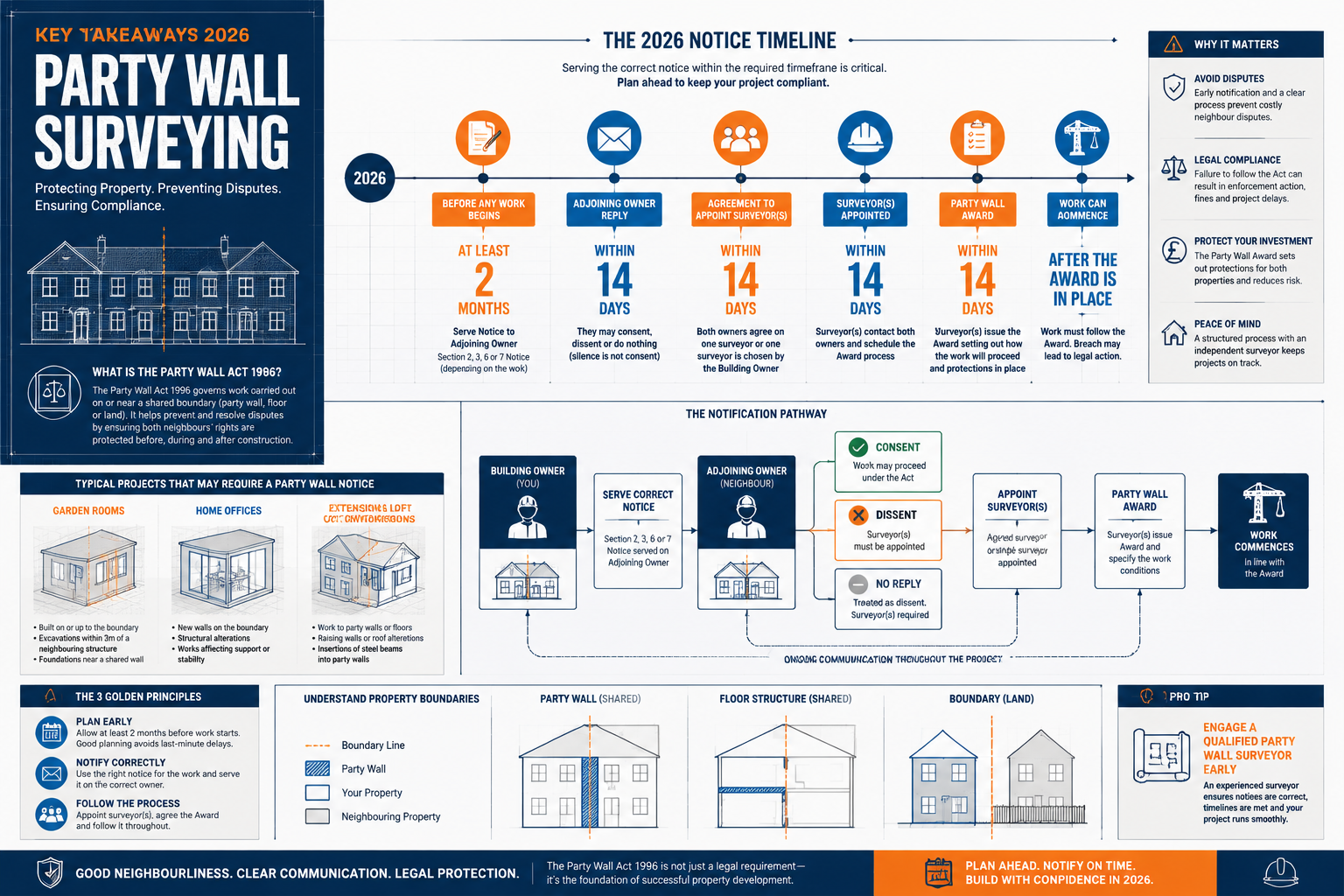
- Three notice types can be triggered: Section 1 (new wall at boundary), Section 3 (works to existing party wall/fence wall), and Section 6 (excavation within 3–6 m of a neighbour's structure).
- Notice periods are 1 month (Sections 1 & 6) and 2 months (Section 3) — neighbours have 14 days to respond before dissent is assumed.
- Notices must contain specific mandatory information; incomplete notices are invalid and restart the clock.
- Failing to serve notice does not stop the Act applying — it simply removes your legal protections and exposes you to injunctions and neighbour claims.
Why Garden Rooms and Home Offices Trigger Party Wall Duties in 2026
Many homeowners assume the Party Wall etc. Act 1996 only applies to semi-detached or terraced houses where walls are physically shared. That assumption is wrong — and expensive.
The Act covers any works that fall within its three operative sections, regardless of the building type being constructed. A freestanding garden studio positioned close to a boundary can trigger Section 6. A garden office whose external wall sits on the boundary line triggers Section 1. Raising or cutting into an existing shared garden wall to accommodate a new outbuilding triggers Section 3 [3][7].
💡 Pull Quote: "The label 'garden room' or 'home office' is irrelevant to the Act. What matters is the proximity to the boundary and the nature of the works." — Specialist party wall surveying practice guidance, 2026
The surge in garden building projects since 2020 has made this one of the most commonly misunderstood areas of property law. Homeowners invest £15,000–£50,000 in a premium garden office, only to discover — after the foundations are poured — that their neighbour has grounds to seek an injunction halting the works entirely. Understanding the Party Wall Act when buying or building is essential before any spade hits the ground.
The Three Sections That Catch Garden Building Projects
| Notice Type | Section | When It Applies to Garden Rooms/Outbuildings |
|---|---|---|
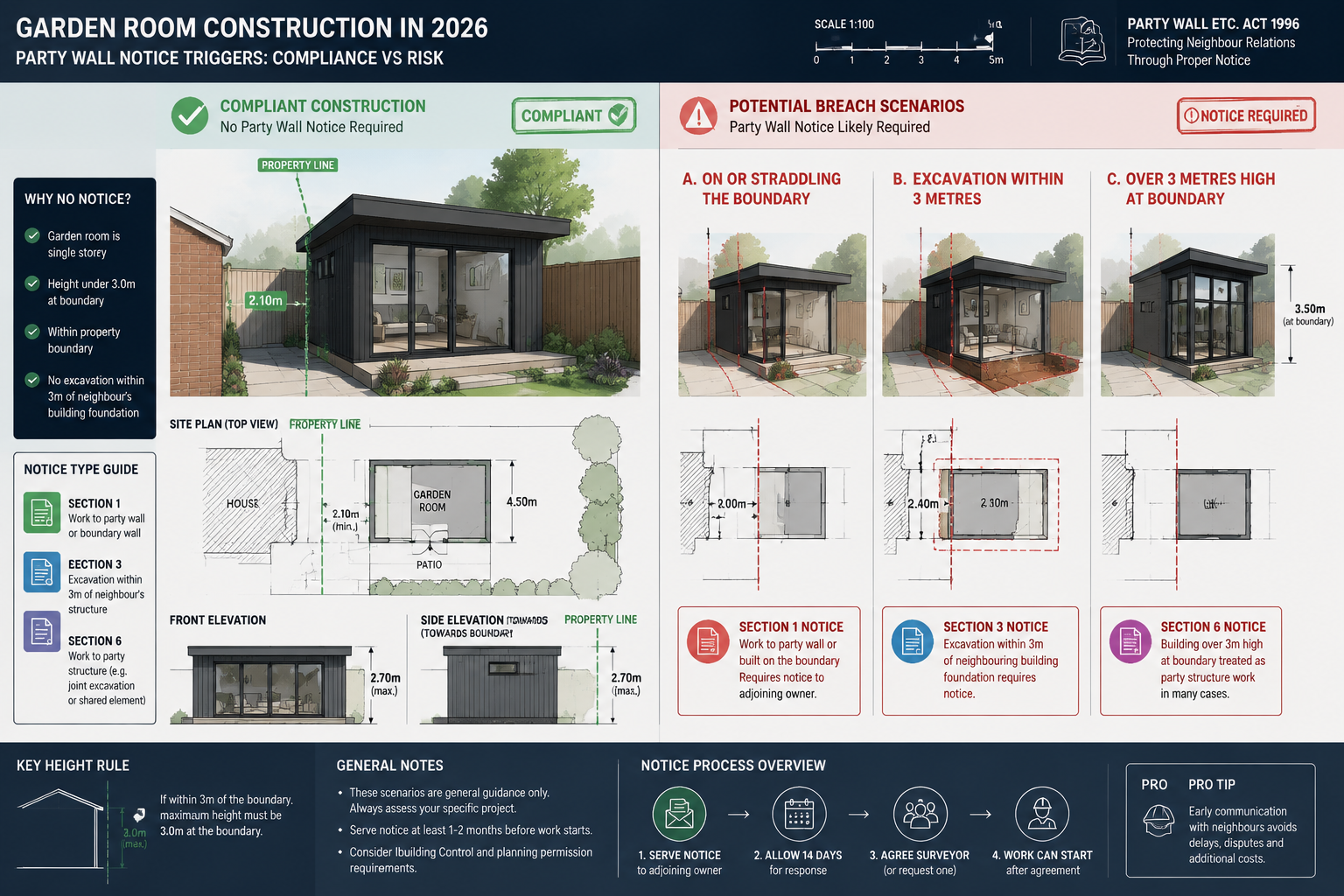
| Line of Junction Notice | Section 1 | External wall built at or astride the boundary line |
| Party Structure Notice | Section 3 | Works to an existing party wall or party fence wall (e.g., raising a shared garden wall) |
| Adjacent Excavation Notice | Section 6 | Foundations within 3 m (or 6 m if deeper) of a neighbour's structure |
All three can apply simultaneously on a single project. A garden office built against a shared garden wall, with deep foundations, close to the boundary, could trigger all three sections at once [3][5].
Understanding Which Notice Applies: Section 1, 3 or 6
Getting the right notice type right matters. Serving the wrong notice — or serving an incomplete one — does not protect the building owner. Here is how each section applies in the context of garden structures.
Section 1: New Wall on or Astride the Boundary
If the external wall of a proposed garden room, studio, or outbuilding will be built at the boundary line or astride it (i.e., straddling the legal boundary), a Section 1 Line of Junction Notice is mandatory [3][1].
This is more common than homeowners expect. Many garden room suppliers market "boundary-hugging" designs specifically to maximise garden space — but placing a wall on the boundary line immediately engages the Act. The notice must be served at least one month before works begin [7].
Section 3: Works to an Existing Party Wall or Party Fence Wall
If the project involves cutting into, raising, or otherwise altering a shared garden wall — for example, fixing a garden office roof to an existing party fence wall, or inserting beams into it — a Section 3 Party Structure Notice is required [5][7].
This section carries the longest notice period: two full months before works can begin. It is also the section most often overlooked when homeowners assume a garden wall is "just a garden wall." If the wall separates two properties and is used by both owners, it is likely a party fence wall under the Act.
Section 6: Adjacent Excavation Within 3 m (or 6 m)
This is the section that surprises the most homeowners. If the foundations of a new garden room or outbuilding are being dug within 3 metres of a neighbouring structure — and those foundations will be deeper than the neighbour's existing foundations — a Section 6 Adjacent Excavation Notice must be served [3][8].
The 6-metre rule applies where the proposed foundations are so deep that a line drawn at 45 degrees from the bottom of the neighbour's foundations would intersect with the new excavation. In practice, this means that even a garden office positioned several metres from the fence could trigger Section 6 if the ground conditions require deep foundations [3].
⚠️ Critical point: For Section 6 notices, drawings and sections showing the depth and location of proposed foundations are mandatory — not optional. Submitting a notice without these drawings renders it invalid [4].
Understanding the cost of a party wall agreement at the outset helps homeowners budget realistically before committing to a garden building project.
Party Wall Surveying for Garden Rooms, Outbuildings and Home Offices: Notice Requirements in Detail
What Must a Valid Notice Include?
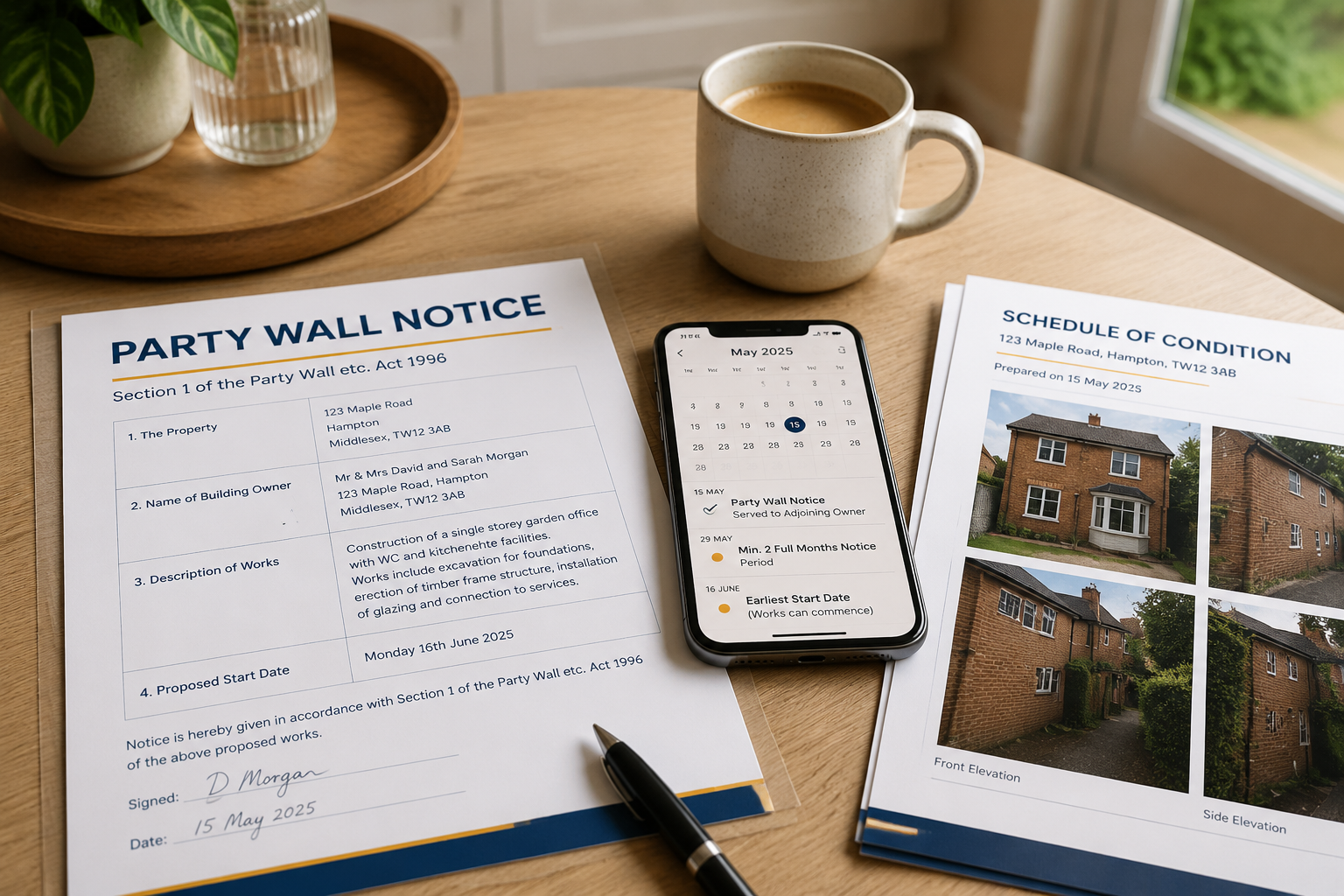
A common and costly mistake is serving a notice that is technically invalid because it omits mandatory information. Both the building owner and the adjoining owner need the notice to be legally sound — it protects both parties. Required content includes [1][3][4]:
- ✅ Full address of the property where works are being carried out
- ✅ Full legal names of the building owner (the person carrying out works) and the adjoining owner (the neighbour)
- ✅ A clear description of the proposed works — what is being built, where, and how
- ✅ The proposed start date for the works
- ✅ The date the notice is being served
- ✅ An explicit statement that the notice is served under the Party Wall etc. Act 1996
- ✅ For Section 6 notices: drawings and cross-sections showing foundation depth and location [4]
Vague descriptions such as "building a garden room" are insufficient. The notice should specify materials, dimensions, and the nature of any excavation or boundary works.
Notice Periods at a Glance ⏱️
| Section | Minimum Notice Period | Neighbour Response Window |
|---|---|---|
| Section 1 (new boundary wall) | 1 month | 14 days |
| Section 3 (party structure works) | 2 months | 14 days |
| Section 6 (adjacent excavation) | 1 month | 14 days |
If a neighbour does not respond within 14 days, dissent is automatically assumed — this triggers the surveyor appointment and award process, not a green light to proceed [7][2].
What Happens After the Notice Is Served?
The adjoining owner has three options:
- Consent in writing — works can proceed (though a Schedule of Condition is still strongly advisable)
- Dissent and agree to a single agreed surveyor — one surveyor acts for both parties
- Dissent and appoint their own surveyor — each party appoints a surveyor; the two surveyors produce a Party Wall Award
A Party Wall Schedule of Condition — a photographic and written record of the neighbouring property's condition before works begin — is a critical document that protects both the building owner and the neighbour if damage claims arise later.
For loft-style outbuildings or more complex structures, it is also worth reviewing whether party wall agreements apply to loft conversions to understand how the Act operates across different project types.
When Party Wall Surveying for Garden Rooms, Outbuildings and Home Offices Is NOT Required
Clarity on exemptions is just as important as understanding triggers. The Act does not apply in every garden building scenario [7][9]:
- 🟢 A garden room or shed positioned well away from the boundary with shallow, non-invasive foundations — no shared walls affected
- 🟢 Internal works only — no excavation, no boundary wall involvement
- 🟢 Works to a wall that is entirely within the building owner's property and does not form a party or boundary structure
- 🟢 Lightweight garden structures on surface-level bases (e.g., paving slabs) that do not involve excavation near neighbours' structures
However, "well away from the boundary" is not a casual eyeball estimate. A surveyor can confirm whether the 3-metre and 6-metre thresholds are engaged based on actual measurements and foundation depths. Many homeowners discover the threshold is breached only after work has started [8].
💡 Pull Quote: "The cost of a party wall surveyor at the outset is almost always less than the cost of resolving a dispute after works have begun without notice."
The cost of a party wall surveyor is a predictable, manageable expense when planned for in advance — unlike the legal costs of an injunction or forced remediation.
The Consequences of Skipping the Process
Failing to serve notice does not make the Act disappear. It simply removes the building owner's legal protections and creates significant risk [7][10]:
- Injunctions: Neighbours can apply to court to halt works immediately — even if the garden room is half-built
- Forced demolition: In serious cases, courts have ordered structures to be removed where works proceeded without notice and caused damage
- Damage claims: Without a Schedule of Condition, there is no baseline to dispute inflated damage claims from neighbours
- Mortgage and sale complications: Unpermitted works near boundaries can flag during conveyancing surveys and delay or derail property sales
The consequences of failing to act on legal obligations before building works begin extend well beyond the immediate project — they can affect a property's value and saleability for years.
Practical Steps for 2026 Homeowners Planning Garden Structures
Step-by-Step Checklist ✅
- Define the project scope — obtain plans showing exact boundary distances and proposed foundation depths
- Check the 3-metre and 6-metre thresholds — measure from the proposed foundations to the nearest neighbouring structure
- Identify whether any existing shared walls are affected — review the boundary treatment and any garden walls
- Engage a party wall surveyor early — ideally before planning permission is submitted, certainly before notice periods begin
- Serve the correct notice(s) — ensure all mandatory information is included and notices are served correctly (hand delivery, recorded post, or email if the neighbour has agreed to electronic service)
- Commission a Schedule of Condition — document the neighbour's property before works start
- Obtain the Party Wall Award if the neighbour dissents — do not start notifiable works until the Award is in place
The top five party wall agreement considerations for renovation projects provides additional context for homeowners managing more complex builds alongside garden structure projects.
How Long Does the Process Take?
Homeowners frequently underestimate the timeline. With a two-month notice period for Section 3 works, plus time to appoint surveyors and produce an Award if the neighbour dissents, the process can add three to four months to a project timeline if not planned for in advance [7][2]. Building this into the project programme from day one avoids costly delays.
For projects involving structural elements — such as a garden office with a mezzanine level or a substantial annexe — a building defects survey of the neighbouring property may also be advisable alongside the Schedule of Condition, to establish a comprehensive pre-works baseline.
Conclusion: Act Early, Avoid Disputes, Protect Your Investment
The demand for garden offices, studios and outbuildings shows no sign of slowing in 2026 — but neither does the Party Wall etc. Act 1996. Party Wall Surveying for Garden Rooms, Outbuildings and Home Offices: When 2026 Homeowners Still Need to Serve Notice is not a bureaucratic formality. It is a legal framework designed to protect both building owners and their neighbours, and it applies to far more garden building projects than most homeowners realise.
Actionable Next Steps
- Before any design is finalised: Ask an architect or party wall surveyor to assess boundary proximity and foundation depth requirements
- As soon as plans are drawn: Identify which sections of the Act apply and begin calculating notice periods
- Before serving notice: Ensure all mandatory information — including drawings for Section 6 — is complete and accurate
- Regardless of neighbour relations: Commission a Schedule of Condition to protect against future damage claims
- If in doubt: Consult a qualified party wall surveyor — the cost is modest compared to the risk of proceeding without notice
Early engagement with a specialist party wall surveyor is the single most effective step a homeowner can take to keep a garden building project on time, on budget, and dispute-free.
References
[1] How To Serve A Party Wall Notice – onlinearchitecturalservices.com
[2] Party Wall – antinoandassociates.com
[3] Garden Buildings And The Party Wall Act – bdcmagazine.com
[4] Serving Party Wall Notices Correctly – collier-stevens.co.uk
[5] Three Types Of Party Wall Notices – stokemont.com
[6] Party Wall Schedule Of Condition – onlinearchitecturalservices.com
[7] Party Wall Agreement – hoa.org.uk
[8] Party Wall Surveys And Neighbour Disputes During 2026s Construction Uptick RICS Compliance Framework – nottinghillsurveyors.com
[9] Do I Need Party Wall Notice For A Garden Wall – reddit.com
[10] Party Wall Agreements What You Need To Know – fmb.org.uk