

{"cover":"Professional landscape format (1536×1024) hero image with bold text overlay: 'Turning Survey Findings Into Negotiation Power: 2026 Housing Market' in extra large 72pt white bold sans-serif font with dark semi-transparent gradient overlay box, centered upper-third composition. Background shows a suited chartered surveyor holding a detailed building survey report and clipboard, standing in front of a classic British terraced property with a For Sale sign, dramatic overcast sky suggesting market uncertainty. Color palette: deep navy blue, crisp white, amber accent. Magazine cover aesthetic, editorial quality, high contrast, photorealistic.","content":["Landscape format (1536×1024) editorial illustration showing a split-screen composition: left side displays a downward-trending RICS housing market graph with red arrows and data points (-34% buyer enquiries, -34% house price indicator April 2026) on a dark navy background; right side shows a confident chartered surveyor at a desk presenting a structured risk report to an anxious couple, warm office lighting, survey documents spread across table. Bold caption overlay: 'Market Data as Negotiation Ammunition'. Professional infographic aesthetic, high detail.","Landscape format (1536×1024) close-up editorial image of a chartered surveyor's hands annotating a colour-coded building defect report with red, amber and green traffic-light risk ratings highlighted on printed pages, a magnifying glass resting on a structural crack photograph, drone survey imagery visible on a laptop screen in background, surveyor's RICS badge visible on lapel. Shallow depth of field, warm professional lighting, photorealistic detail. Overlay text: 'Defect Communication Frameworks That Protect Deals'.","Landscape format (1536×1024) wide-angle editorial scene of a property negotiation meeting around a modern conference table: solicitor, buyer, seller and chartered surveyor each holding survey documents, a large wall screen displaying a regional UK map with colour-coded price pressure zones (red in London/South East, green in Northern England/Scotland), sticky notes and repair cost estimates visible on table. Professional business environment, natural window light, photorealistic. Overlay text: 'Regional Risk Stratification & Deal-Saving Communication'."]

Buyer enquiries across the UK fell to a net balance of -34% in April 2026 — the weakest reading since August 2023 [2]. For chartered surveyors, that single statistic is not just a market headline. It is a communication challenge, a negotiation tool, and a professional responsibility, all at once. Understanding how chartered surveyors can communicate risk in a cautious 2026 housing market — turning technical findings into negotiation power — has never been more commercially urgent or professionally critical.
When markets soften, survey reports do not simply describe buildings. They shape decisions. They calm anxious buyers, inform cautious sellers, and give solicitors the evidence they need to renegotiate without collapsing a transaction. The surveyor who can translate damp readings, structural movement, and roof deterioration into clear, proportionate, actionable language holds significant power in a stalled market.
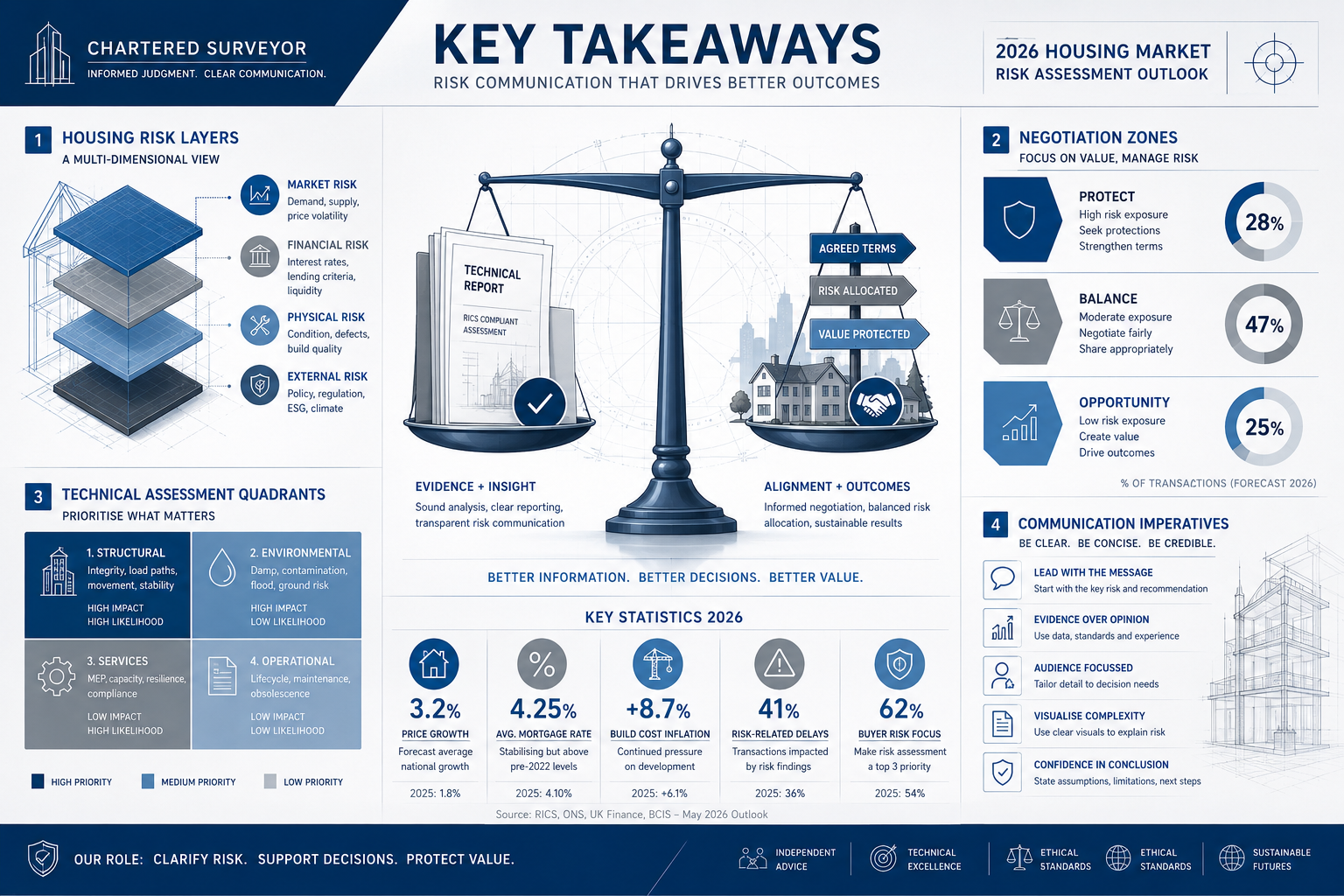
Key Takeaways 📋
- Market data is a communication tool: RICS April 2026 figures (buyer enquiries at -34%, house prices at -34%) give surveyors objective, external evidence to contextualise technical findings without appearing subjective.
- Risk must be tiered, not buried: Traffic-light frameworks and repair cost banding help clients prioritise defects and make informed decisions rather than panic or ignore findings.
- Regional context matters enormously: Northern England and Scotland are outperforming London and the South East — surveyors must tailor risk narratives to local market conditions.
- The goal is deal preservation, not deal destruction: Clear, proportionate communication turns survey findings into renegotiation leverage rather than transaction killers.
- Short-term pain vs. long-term outlook: Twelve-month price expectations sit at only -6% despite near-term weakness at -32% [2] — surveyors can use this divergence to manage client expectations constructively.
Why the 2026 Market Demands a New Communication Standard
The deteriorating trajectory from February through April 2026 tells a clear story. Buyer enquiries moved from -26% in February to -39% in March before recovering slightly to -34% in April [2]. Agreed sales remained persistently weak at -36% in April, barely changed from -35% the month before [2]. These are not temporary blips — they reflect structural pressures that every surveyor must understand and explain to clients.
"Affordability pressures are most acute in southern England and London." — Tarrant Parsons, RICS Head of Market Research [2]
Geopolitical factors are adding further complexity. The ongoing Middle East conflict has pushed oil and energy prices higher, feeding into mortgage rates and borrowing costs [2]. The Bank of England has signalled that further interest rate rises may be needed to tackle renewed inflation [2]. For a surveyor sitting across from an anxious first-time buyer, these are not abstract economic forces — they are the reason a valuation has come in lower than expected, and they need to be explained clearly.
The Surveyor's Dual Role: Technical Expert and Risk Translator
Chartered surveyors have always been technical experts. In 2026, they must also be risk translators. The gap between what a survey report says and what a client understands has real financial consequences. A client who misreads a Level 3 building survey may either panic unnecessarily and pull out of a viable purchase, or worse, dismiss serious findings and proceed into a costly mistake.
Understanding which building survey is appropriate for a given property is the first step. But the communication of findings once the survey is complete is where the real value is delivered — especially in a market as cautious as 2026's.
Practical Frameworks for Communicating Risk: How Chartered Surveyors Can Communicate Risk in a Cautious 2026 Housing Market

1. The Traffic-Light Defect System 🚦
One of the most effective tools available is a simple, visual traffic-light classification system for defects. Rather than burying findings in dense technical prose, surveyors can categorise every issue into one of three tiers:
| Colour | Risk Level | Typical Examples | Suggested Action |
|---|---|---|---|
| 🔴 Red | Urgent / High Risk | Structural movement, active roof leak, unsafe electrics | Renegotiate price or require remediation before exchange |
| 🟡 Amber | Monitor / Medium Risk | Minor damp, aging boiler, pointing deterioration | Factor into maintenance budget; consider price adjustment |
| 🟢 Green | Low Risk / Maintenance | Cosmetic decoration, minor garden drainage | No immediate action required |
This system works because it meets clients where they are. Most buyers and sellers are not construction professionals. They need to know: "Is this serious? Does it affect the price? What do I do next?"
2. Repair Cost Banding: Giving Numbers Meaning
Technical findings become negotiation tools the moment they are attached to realistic cost estimates. A surveyor who notes "significant deterioration to the flat roof covering" has described a defect. A surveyor who adds "remediation costs for this type of flat roof typically range from £4,000 to £9,000 depending on specification and access" has created negotiation leverage.
Repair cost banding does not require surveyors to act as quantity surveyors. Broad ranges, clearly caveated, give clients and their solicitors a starting point for price renegotiation that is grounded in professional evidence rather than guesswork.
For properties with more complex structural or environmental concerns, a building defects survey provides the depth of analysis needed to support robust cost estimates and negotiation positions.
3. Structuring the Report for Anxious Readers
The order of information in a survey report matters as much as the content. In a cautious market, clients are already anxious. A report that opens with a long list of defects before providing any context will trigger panic. Consider this structure instead:
- Executive Summary — Two paragraphs: what the property is, and the overall condition verdict.
- Market Context — A brief, factual note on current conditions (e.g., referencing RICS April 2026 data) to frame why certain findings carry particular weight right now.
- Priority Findings — Red-rated issues only, with cost banding and recommended next steps.
- Full Defect Schedule — Amber and green items, clearly separated.
- Negotiation Summary — A dedicated section stating which findings, in the surveyor's professional opinion, warrant price renegotiation and by what approximate range.
- Next Steps — Specific, actionable recommendations: specialist reports needed, tradespeople to consult, timelines.
This structure transforms a survey from a liability document into a decision-making tool. Solicitors, in particular, respond well to a dedicated negotiation summary — it gives them the professional backing they need to open price discussions without appearing speculative.
4. Using Market Data as Objective Risk Evidence
One of the most powerful shifts a surveyor can make in 2026 is to externalise risk. When a valuation comes in below the asking price, or when findings suggest a property is overpriced given its condition, clients often perceive this as the surveyor's subjective opinion. Market data changes that dynamic entirely.
Referencing the RICS April 2026 headline house price indicator of -34% [2] — or the dramatic drop in London's 12-month price expectations from +56% to +7% between February and March 2026 [1] — gives clients verifiable, third-party evidence that the surveyor's findings reflect real market conditions, not personal judgement.
💡 Pull Quote: "A surveyor who cites RICS data alongside a structural finding is not delivering bad news — they are delivering informed, evidence-based professional advice."
This approach is particularly valuable when communicating with sellers who are reluctant to accept that their property's value has softened. Geopolitical factors — oil prices, mortgage rate trajectories, Bank of England warnings — provide externalized, verifiable risk factors that remove the perception of bias from the surveyor's assessment [2].
Regional Risk Stratification: Tailoring the Message to the Market
How chartered surveyors can communicate risk in a cautious 2026 housing market also depends heavily on where the property is located. The April 2026 RICS survey identified a widening regional divide: Northern England, Scotland, and Northern Ireland continue to outperform the rest of the UK, with North West and Northern England posting marginally positive price readings [2].
By contrast, London, the South East, East Anglia, and the South West face stronger downward pressure, with affordability constraints most acute in these regions [2].

What This Means in Practice
For a chartered surveyor operating in North London or Central London, the communication of risk must account for a market where price expectations have deteriorated sharply. Findings that might be absorbed without renegotiation in a buoyant market now carry real weight. Clients in these areas need to understand that defect costs are not just repair bills — they represent additional exposure in a market already moving against them.
For surveyors working in Essex or Hertfordshire, the picture is more nuanced. These commuter belt markets sit between the pressured South East and the more resilient North, requiring careful calibration of risk language.
The Supply Side Argument for Sellers
New appraisals fell to -16% in April 2026, down from zero the previous month [2], while new instructions recorded only -3% [2]. This means the inventory pipeline is contracting. For sellers who are properly positioned — with a well-maintained property and a realistic asking price — the shrinking supply of quality stock is a genuine negotiating advantage.
Surveyors can communicate this to seller clients: "Your property's condition, relative to declining new supply, places you in a stronger position than the headline market data suggests — provided pricing reflects the findings in this report." This is honest, constructive, and commercially useful.
Turning Findings into Deal-Saving Conversations
The ultimate test of risk communication is whether it preserves the transaction while protecting the client. In a market where agreed sales sit at -36% [2], every deal that collapses represents a failure — not just commercially, but professionally. Surveyors who communicate findings in ways that kill viable transactions are not serving their clients well.
The Three-Conversation Framework
Effective post-survey communication often follows three distinct conversations:
Conversation 1: The Debrief Call 📞
Before the written report is delivered, a brief verbal summary call allows the surveyor to gauge the client's emotional response and frame the most significant findings. This prevents the client from reading a report cold and reacting disproportionately.
Conversation 2: The Prioritisation Meeting
A structured conversation — in person or by video — walking through the traffic-light schedule and identifying which red and amber items genuinely warrant renegotiation versus which are standard maintenance for a property of that age and type.
Conversation 3: The Negotiation Brief
A short, written document — separate from the full report — summarising the findings most relevant to price, with suggested renegotiation ranges. This is the document the solicitor takes into negotiations.
For older properties with complex defect profiles, understanding common defects in older homes helps surveyors contextualise findings for clients who may be alarmed by issues that are, in fact, typical for the property's age and construction type.
Managing the Sentiment Disconnect
One of the most nuanced communication challenges in 2026 is the gap between near-term and long-term sentiment. Near-term sales expectations (3 months) fell to -32% in April, yet twelve-month expectations softened only to -6% [2]. This divergence is a powerful tool for managing client anxiety.
Clients who are considering withdrawing from a purchase due to survey findings should understand that the current softness is widely expected to be temporary. A property with manageable defects, purchased at a renegotiated price that reflects those defects, may look very different in twelve months than it does today. Surveyors who can articulate this — without overstepping into financial advice — provide genuine added value.
Technology as a Communication Aid
Modern survey tools are expanding the surveyor's communication toolkit significantly. Premium drone surveys allow surveyors to capture roof and elevation defects with photographic clarity that no written description can match. When a client can see a cracked ridge tile or failing lead flashing in high-resolution imagery, the finding becomes undeniable — and the case for renegotiation becomes self-evident.
Thermal imaging, moisture mapping, and annotated photographic schedules all serve the same purpose: they make technical findings visible and understandable to non-technical clients, solicitors, and estate agents.
Conclusion: The Surveyor as Strategic Advisor in 2026
The cautious 2026 housing market has elevated the chartered surveyor's role from technical inspector to strategic advisor. With buyer enquiries at their weakest since August 2023 [2], house prices under accelerating downward pressure, and geopolitical forces reshaping borrowing costs, the ability to communicate risk clearly and constructively is a core professional competency — not an optional extra.
Actionable Next Steps for Surveyors 🎯
- Adopt a traffic-light defect classification system in every report — it reduces client anxiety and focuses attention on what matters.
- Include repair cost banding for all red and amber findings, clearly caveated, to support renegotiation conversations.
- Reference RICS market data in every report to externalise risk and demonstrate that findings reflect market conditions, not personal opinion.
- Tailor regional risk narratives — London and South East clients need different framing than those in Northern England or Scotland.
- Implement the three-conversation framework — debrief call, prioritisation meeting, negotiation brief — to guide clients through findings without panic.
- Use technology — drone imagery, thermal imaging, annotated photography — to make defects visible and undeniable.
- Highlight the short-term/long-term sentiment divergence to help clients distinguish between temporary market softness and structural risk.
For clients and surveyors alike, the goal in 2026 is the same: informed decisions, proportionate responses, and transactions that complete on fair terms. That outcome begins with a survey report that communicates risk not as a verdict, but as a roadmap.
To understand the Prince Chartered Surveyors approach to delivering professional, client-focused survey services across London and the South East, explore the full range of services and locations available.
References
[1] UK Residential Survey February 2026 – rics.org
[2] UK Residential Survey April 2026 – rics.org
[3] Latest RICS Survey Reveals Global Headwinds Are Weighing On Housing Market Confidence – buyassociationgroup.com
[4] Valuation Adjustments From February 2026 RICS Survey Countering Geopolitical Caution In Buyer Enquiries And Price Expectations – wimbledonsurveyors.com
[6] Chartered Surveyor Insights From RICS February 2026 Residential Survey Navigating 26 Buyer Enquiry Slump In Valuations – Chartered surveyor insights from rics february 2026 residential survey navigating 26 buyer enquiry slump in valuations
[8] Navigating Uncertainty In Spring 2026 Valuations How RICS Real Time Surveyor Data Outperforms Automated Valuation Models – nottinghillsurveyors.com
[9] Valuation Uncertainty In Spring 2026 How Building Surveyors Navigate Geopolitical Risks And Buyer Sentiment Volatility – kingstonsurveyors.com