

Over 700,000 leaseholders in England alone are estimated to be living in buildings with some form of unsafe cladding or fire safety defect — and in 2026, the regulatory framework governing how surveyors identify, document, and escalate these risks has never been more demanding. Fire Safety and Cladding Compliance in Building Surveys: 2026 Risk Assessment Protocols for High-Rise and Converted Properties is no longer a niche specialism reserved for post-disaster inquiries. It is now a front-line obligation for every chartered surveyor conducting a pre-purchase inspection, a condition assessment, or a full structural review.
This guide outlines the latest regulatory updates, structured surveyor checklists, and the critical decision points that determine when specialist input must be sought — ideally before contracts are exchanged.
Key Takeaways 📋
- Building envelope fire safety is now a mandatory compliance area, covering cladding, insulation, fire stops, windows, and balconies across all exterior-facing elements [1]
- Annual visual inspections and 3–5 year professional envelope assessments using thermal imaging are now baseline requirements for high-rise and converted properties [1]
- Post-renovation verification has been elevated to critical compliance status — any exterior works must be followed by documented fire-resistance checks [1]
- The Building Safety Regulator (BSR) continues to publish updated remediation guidance through its 2023–2026 strategic plan, with February 2026 technical notes setting new benchmarks [3][4]
- Surveyors must recommend specialist input pre-exchange when cladding, balcony materials, or conversion fire compartmentation cannot be verified through standard inspection alone
The Regulatory Landscape in 2026: What Has Changed
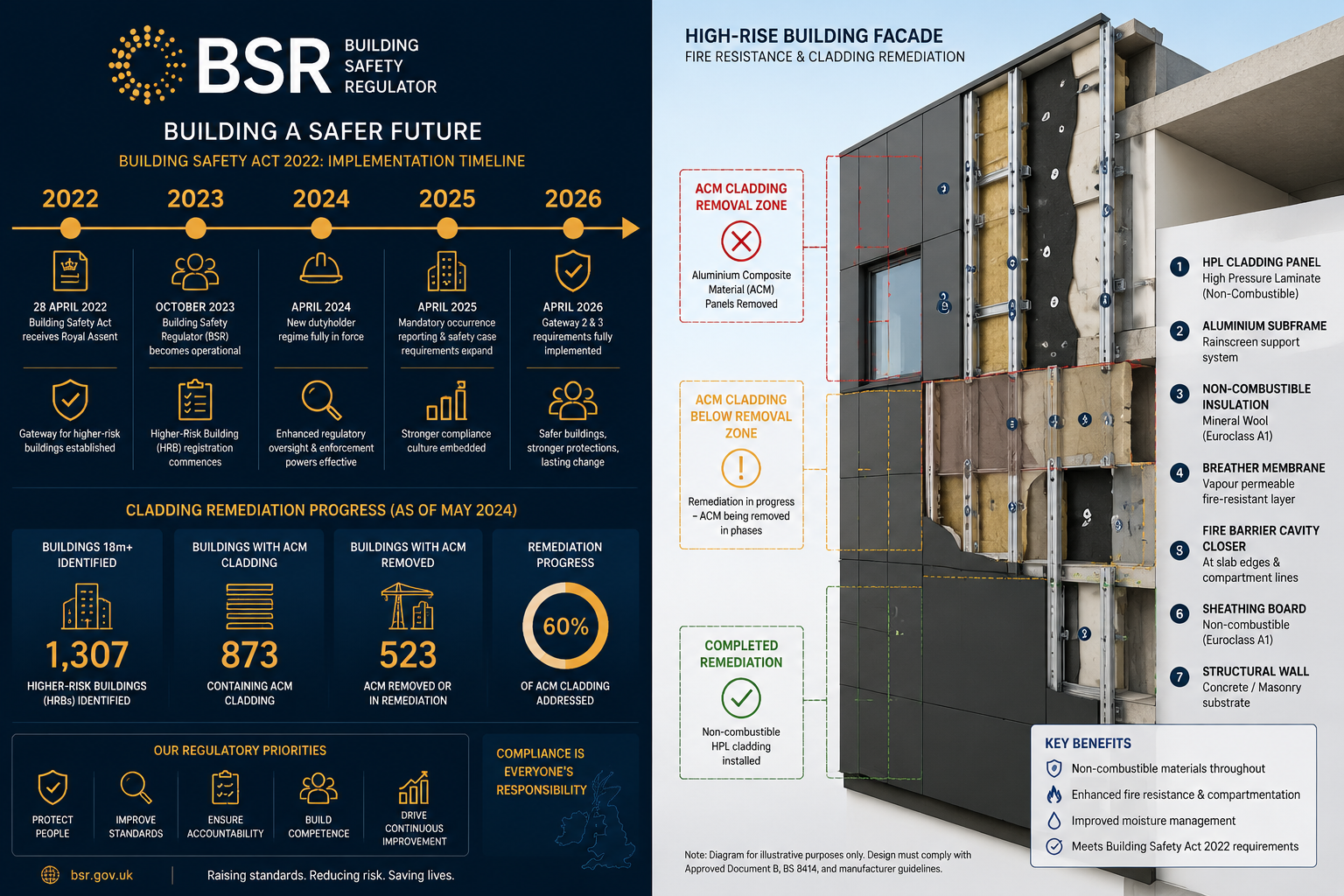
The Building Safety Act 2022 set the foundation. By 2026, its secondary legislation, combined with guidance from the Building Safety Regulator (BSR), has created a layered compliance environment that directly affects how building surveys are scoped and reported.
The Building Safety Regulator's 2023–2026 Strategic Plan
The BSR's strategic plan, running through 2026, established a clear framework for high-rise residential buildings (HRRBs) — defined as those 18 metres or more in height, or with seven or more storeys [3]. Under this framework:
- Principal Accountable Persons (PAPs) must maintain a Safety Case Report
- Building Assessment Certificates are required for all in-scope buildings
- Remediation timelines are actively monitored, with monthly technical data releases tracking progress [4]
The February 2026 technical note from the BSR confirmed that remediation data reporting has been refined, with updated definitions for "completed remediation" that now include verification of fire stops and cavity barriers — not just cladding panel replacement [4].
What the 2026 Envelope Compliance Shift Means for Surveyors
A significant regulatory shift in 2026 concerns building envelope fire safety as a holistic compliance category [1]. Previously, cladding was often assessed in isolation. Now, mandatory fire-resistance rating compliance extends across all exterior-facing elements:
| Envelope Component | Compliance Requirement |
|---|---|
| External wall cladding | Fire-resistance rating documentation |
| Insulation materials | Flame-spread classification records |
| Windows and doors | Fire-rated seals and frame integrity |
| Balconies and attachments | Non-combustible material verification |
| Roofing systems | Envelope continuity checks |
| Utility penetration points | Fire stop installation records |
| Cavity/draft stops | Systematic inspection and documentation |
💡 Pull Quote: "Building envelope fire safety must be integrated into overall life safety compliance programs — not treated as a separate concern." [1]
This integrated approach means a surveyor reviewing a converted Victorian terrace or a 1990s high-rise cannot simply note the presence of cladding. They must assess whether the entire envelope system maintains its fire-resistance integrity.
Fire Safety and Cladding Compliance in Building Surveys: 2026 Risk Assessment Protocols for High-Rise and Converted Properties — The Surveyor's Checklist
A structured checklist approach is now essential for any Level 3 full building survey involving high-rise or converted properties. The following framework reflects current 2026 protocols.
🏗️ Section A: External Wall and Cladding Assessment
Step 1 — Identify the cladding system type
Not all cladding is equal. Surveyors must distinguish between:
- ACM (Aluminium Composite Material) panels — particularly those with polyethylene cores, which remain the highest-risk category
- HPL (High-Pressure Laminate) panels — subject to ongoing remediation requirements
- Rendered external wall insulation systems (EWIS) — risk depends on insulation type
- Brick slip systems — generally lower risk but cavity integrity must be checked
- Timber cladding — requires specific fire-resistance documentation on converted properties
Step 2 — Request the EWS1 form or equivalent documentation
For buildings where external wall systems require assessment, the EWS1 (External Wall Survey) form remains a key document. In 2026, lenders continue to require this for mortgage purposes on affected buildings. Surveyors should flag its absence as a material risk in survey reports.
Step 3 — Inspect for visible envelope compromise
Annual visual inspections are now a baseline requirement [1]. During a survey, look for:
- ✅ Damaged or displaced cladding panels
- ✅ Gaps around window and door frames
- ✅ Signs of moisture ingress at envelope junctions
- ✅ Evidence of previous repairs or patch replacements
- ✅ Utility penetration points without visible fire-stopping
🔥 Section B: Fire Stops, Cavity Barriers, and Compartmentation
Fire stops and draft stops within wall cavities are explicitly identified as critical compliance components requiring systematic documentation [1]. For converted properties especially, this is a frequent failure point.
Key inspection actions:
- Review planning and building control records — confirm that any conversion works included cavity barrier installation
- Check for retrospective fire-stopping — particularly at floor-to-wall junctions in converted houses of multiple occupation (HMOs)
- Identify compartmentation breaks — look for service penetrations through fire-rated walls or floors without intumescent protection
- Request the Fire Risk Assessment (FRA) — mandatory for buildings with common areas; its findings directly inform the survey report
⚠️ Important: Where cavity barriers cannot be visually confirmed and records are absent, surveyors should recommend a specialist intrusive investigation before exchange of contracts. See guidance on urgent or dangerous building issues for escalation protocols.
🏠 Section C: Balconies and Attachments
Balconies on high-rise and converted properties present a specific and often underestimated fire risk. The Grenfell Tower Inquiry highlighted how attachments can accelerate external fire spread. In 2026, balcony compliance checks must include:
- Material classification — timber decking on balconies above 11 metres is a red flag requiring further assessment
- Structural attachment integrity — balconies fixed through the building envelope can compromise fire-resistance ratings
- Drainage and waterproofing — moisture damage at balcony junctions can degrade fire-resistant materials over time
- Glass balustrades — check for fire-rated specifications where required by building regulations
🔄 Section D: Post-Renovation Verification
Post-renovation verification has been elevated to critical compliance status in 2026 [1]. If a property has undergone any exterior works — window replacements, roof repairs, balcony additions, or cladding upgrades — surveyors must:
- Request completion certificates confirming building regulations compliance
- Verify fire stop continuity was maintained or reinstated after works
- Check that replacement materials carry equivalent or superior fire-resistance ratings to those removed
- Flag any unverified works as requiring specialist sign-off before exchange
This is particularly relevant for converted properties where permitted development rights may have been used, bypassing full building control oversight.
Fire Safety and Cladding Compliance in Building Surveys: 2026 Risk Assessment Protocols for High-Rise and Converted Properties — When to Recommend Specialist Input
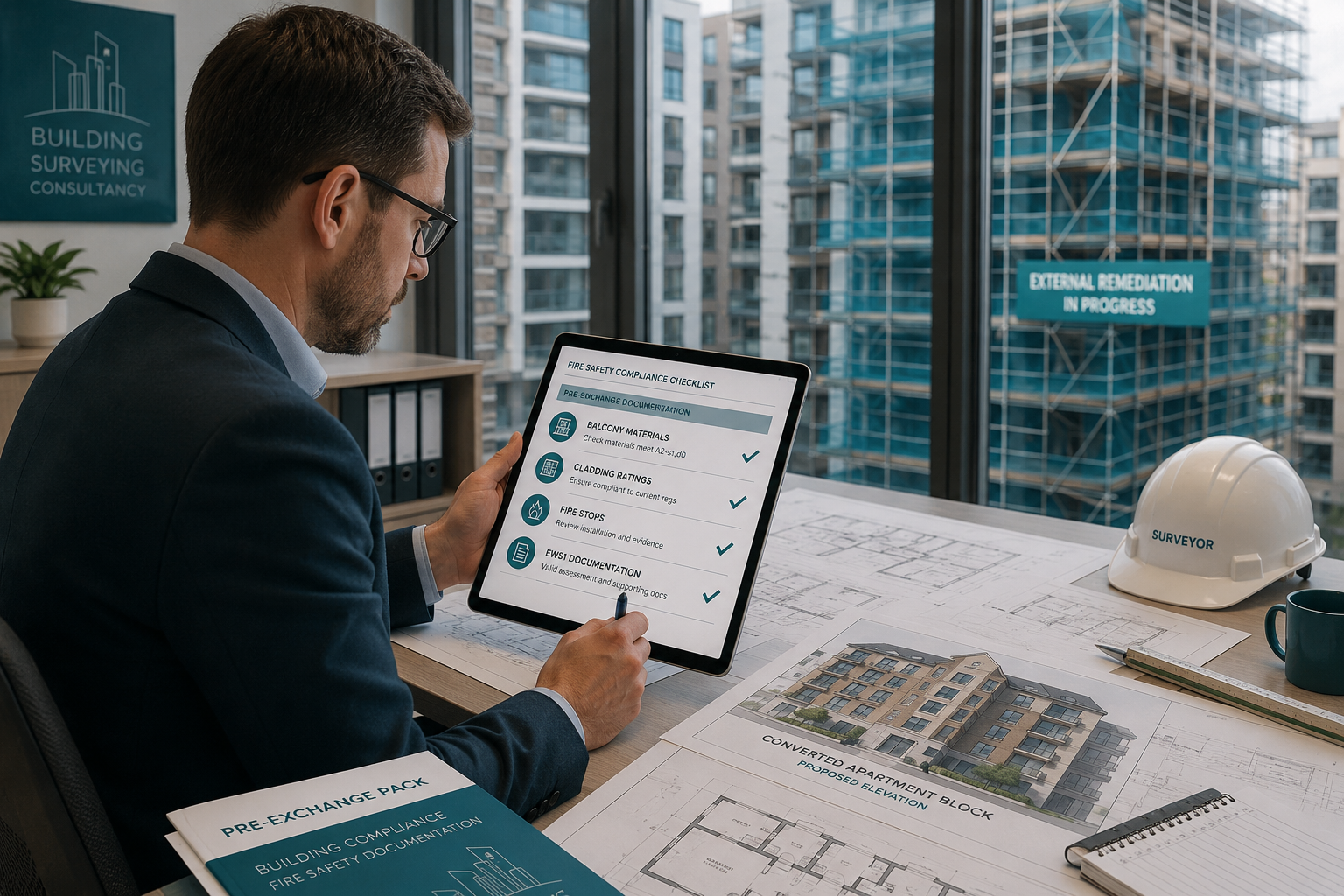
One of the most important judgements a surveyor makes is knowing when a standard inspection is insufficient. The 2026 protocols make this determination clearer — but it still requires professional expertise.
Thermal Imaging: Now a Standard Tool
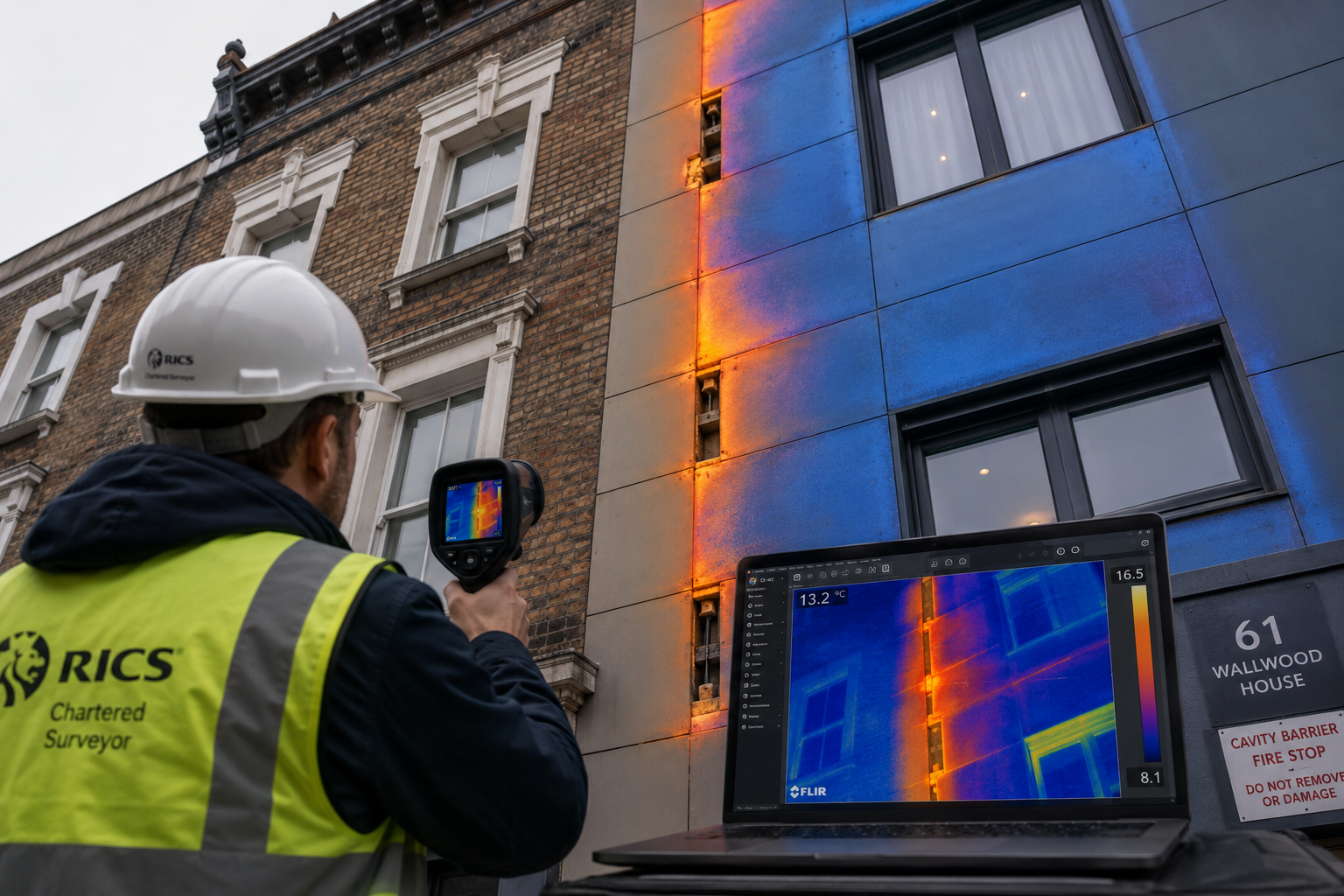
Professional envelope assessments must be conducted every 3–5 years using thermal imaging to identify hidden gaps and moisture intrusion that could compromise fire-resistance ratings [1]. For pre-purchase surveys, thermal imaging is increasingly recommended as a standard add-on for:
- Buildings over 11 metres in height
- Properties with external wall insulation systems
- Converted buildings where original cavity details are unknown
- Any building where the EWS1 assessment identifies Category B or C risks
A full building survey from a chartered surveyor can incorporate thermal imaging referrals or direct assessment, providing buyers with a much clearer picture of envelope integrity before committing to purchase.
The Pre-Exchange Decision Framework
The following scenarios should trigger a recommendation for specialist fire safety input before exchange of contracts:
| Scenario | Recommended Action |
|---|---|
| ACM or HPL cladding identified | Fire engineer assessment + EWS1 review |
| No EWS1 form available for qualifying building | Instruct specialist external wall assessment |
| Converted property with no compartmentation records | Intrusive investigation by fire safety specialist |
| Balconies with timber decking above 11m | Material assessment and BS 8579 review |
| Post-renovation works without completion certificate | Building control regularisation before exchange |
| Fire Risk Assessment over 2 years old or absent | Commission updated FRA |
| Thermal imaging reveals hidden moisture/gaps | Specialist envelope contractor investigation |
Digital Documentation: The 2026 Standard
Digital documentation systems are now recommended as standard practice for tracking building envelope maintenance and compliance [1]. For buyers, this means requesting:
- Digital maintenance logs from the building manager or freeholder
- Remediation programme schedules if the building is identified as requiring works
- BSR registration confirmation for buildings within scope of the Building Safety Act
The BSR's ongoing monthly data releases — including the February 2026 technical note — provide publicly accessible information on which buildings are progressing through remediation and at what stage [4]. Surveyors and buyers can cross-reference this data when assessing risk.
Converted Properties: Unique Compliance Challenges
Converted properties — particularly Victorian and Edwardian terraces converted into flats — present distinct challenges that differ from purpose-built high-rise blocks:
- Original construction predates fire compartmentation requirements
- Loft conversions may have introduced combustible materials into roof voids
- Shared service runs (electrical, gas, water) often penetrate fire-rated elements without proper stopping
- Mixed-use conversions (commercial ground floor, residential above) require specific fire separation standards
A condition survey report for a converted property should always include a dedicated section on fire compartmentation, even where cladding is not a primary concern. Equally, statutory considerations around building regulations compliance for conversion works must be reviewed as part of any comprehensive assessment.
For leaseholders in converted blocks, understanding block management obligations around major works — including fire safety remediation — is essential, particularly where Section 20 consultation is triggered by remediation costs.
Integrating Fire Safety Into the Broader Survey Report
Fire safety and cladding compliance cannot exist as a footnote in a building survey. The 2026 approach demands integration into the overall life safety compliance picture [1].
Reporting Best Practice for Surveyors
- Clearly categorise findings using a traffic light or numerical risk rating system
- Distinguish between observed defects and unverified risks — the latter require specialist referral, not assumption
- Reference relevant legislation — Building Safety Act 2022, Fire Safety Act 2021, Fire Safety (England) Regulations 2022
- Include remediation cost estimates where possible, or recommend an insurance reinstatement cost valuation to ensure adequate coverage
- State limitations clearly — a visual inspection cannot confirm cavity barrier presence; say so explicitly
Baseline Envelope Assessment: The Starting Point
Baseline envelope assessments are now a mandatory starting point for any building's fire safety compliance programme [1]. For surveyors, this translates into a non-negotiable scope item: every survey of a high-rise or converted property must include a documented assessment of the building envelope's fire-resistance status, even if that assessment concludes that specialist investigation is required.
This approach protects buyers, protects surveyors from professional liability, and — most importantly — protects the people who will live in these buildings.
Conclusion: Actionable Next Steps for Buyers, Owners, and Surveyors
Fire Safety and Cladding Compliance in Building Surveys: 2026 Risk Assessment Protocols for High-Rise and Converted Properties represents one of the most significant shifts in surveying practice of the past decade. The regulatory framework is clear, the tools are available, and the consequences of non-compliance — financial, legal, and human — are severe.
Here are the immediate actions to take:
- 🔍 Commission a Level 3 building survey for any high-rise or converted property purchase — a full building survey is the minimum standard for properties with potential cladding or fire safety concerns
- 📄 Request the EWS1 form, Fire Risk Assessment, and building safety case documentation before instructing solicitors to proceed
- 🌡️ Ask whether thermal imaging is included in your survey scope — if not, discuss whether it should be added given the property type
- ⚠️ Do not exchange contracts where cladding type, fire compartmentation, or balcony materials cannot be verified — instruct specialist assessment first
- 📊 Check the BSR's public remediation data for buildings within scope of the Building Safety Act to understand where your target property sits in the remediation pipeline
- 🏢 For converted properties, ensure the survey explicitly addresses compartmentation, service penetrations, and any post-conversion building works
- 📁 Request digital maintenance and compliance records from the freeholder or managing agent — their absence is itself a risk indicator
The 2026 protocols are not bureaucratic hurdles. They are the profession's best tool for ensuring that fire safety is assessed, documented, and acted upon — before it becomes a tragedy.
References
[1] Building Envelope Fire Safety The Overlooked Compliance Risk – confirmedlifesafety.com
[2] Building Safety Remediation Technical Note January 2026 – gov.uk
[3] Building Safety Regulator Strategic Plan 2023 To 2026 – gov.uk
[4] Building Safety Remediation Technical Note February 2026 – gov.uk
[5] Building Safety Technical Note May 2025 – assets.publishing.service.gov.uk
[6] Building Safety Recap February, 2026 – designingbuildings.co.uk
[7] Building Safety Technical Note October 2024 – assets.publishing.service.gov.uk