

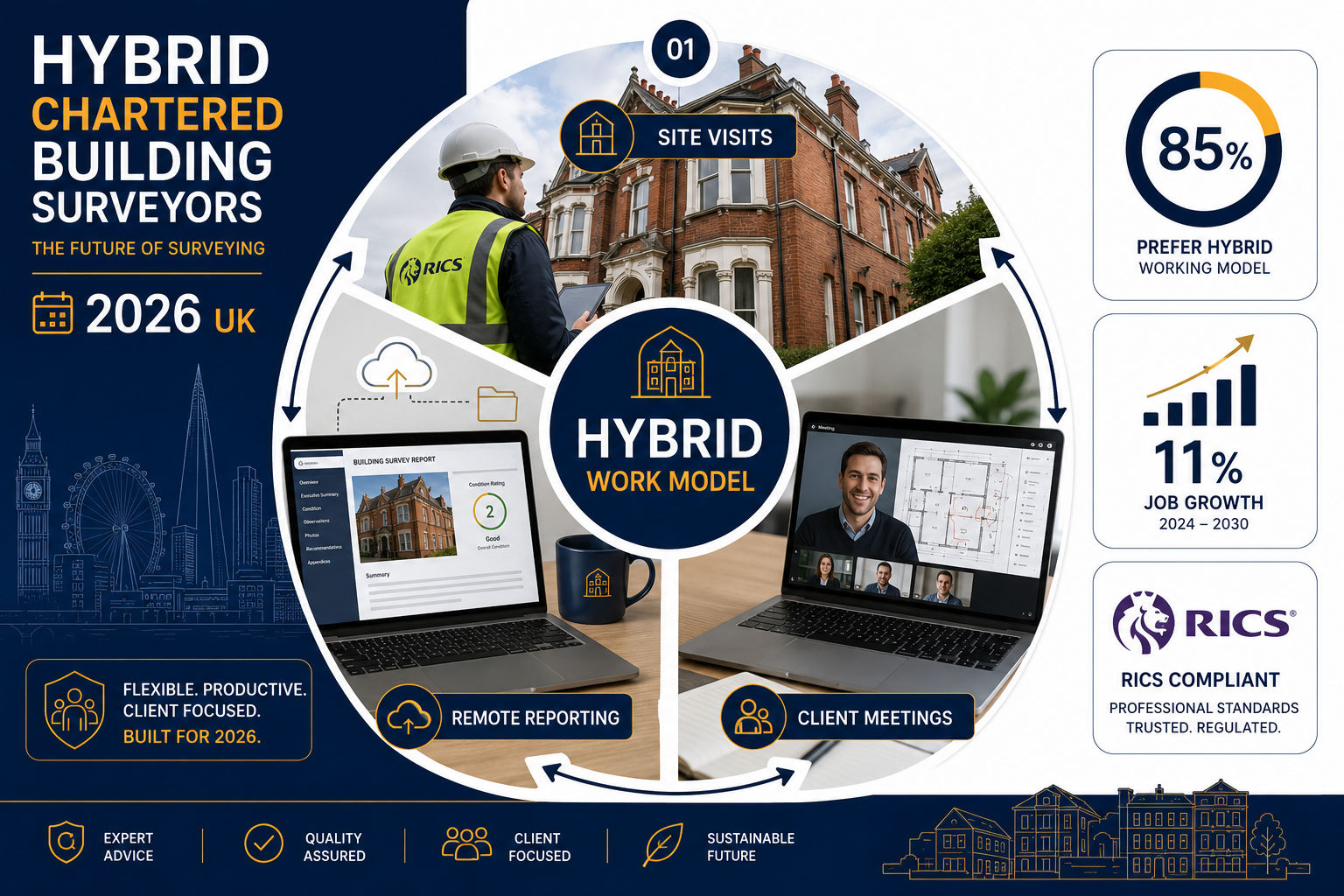
"85% of professionals who worked from home during the pandemic now favour continued hybrid arrangements" — and for chartered building surveyors, that preference is reshaping how the entire profession operates across the UK. [2]
The surveying profession has never been static. But the shift toward hybrid work models for chartered building surveyors — balancing site visits, remote reporting, and client meetings — represents one of the most significant structural changes the 2026 UK jobs market has seen in decades. With RICS forecasting an 11% rise in full-time permanent building surveyor positions between 2023 and 2027 [1], firms that master flexible working arrangements are positioning themselves to attract top talent, reduce overhead, and deliver sharper client outcomes.
This article unpacks how hybrid models are being structured, what tools and strategies make them work, and how surveyors can remain fully RICS-compliant while embracing the flexibility that defines the modern profession.
Key Takeaways 📌
- Hybrid work is now formal policy, not a perk — 63% of high-growth organisations already use flexible models [2]
- Productivity holds firm or improves under hybrid arrangements, with 71% of CIPD-surveyed companies reporting no negative impact [2]
- RICS compliance and hybrid working are compatible when firms invest in the right digital infrastructure and structured scheduling
- Digital tools — from drone surveys to cloud-based reporting — are the critical enablers of effective hybrid surveying
- Career development and CPD can be maintained remotely, with new hybrid HNC programmes launching in 2026 to fast-track construction careers [4]
Why Hybrid Work Models Are Now the Baseline for UK Surveyors
The days of treating hybrid working as an experiment are over. As of 2026, hybrid arrangements have moved from informal team-level agreements into formally codified organisational policy, often negotiated with worker representatives and embedded in employment contracts [3]. For chartered building surveyors, this formalisation matters enormously — it creates clear expectations, protects professional standards, and gives firms a competitive edge in a tightening talent market.
The Talent Competition Is Real
The UK building surveying sector is growing fast. RICS data points to an 11% increase in new full-time permanent roles over a four-year window [1], driven by rising demand for home improvement assessments, new-build inspections, and sustainability-focused property evaluations. Firms competing for qualified chartered surveyors cannot afford to ignore working preferences.
Eurofound's 2025 research on European hybrid work strategies — cited in recent office trends analysis — confirms that offering structured hybrid working has become a talent differentiation strategy, not merely a lifestyle benefit [3]. In practical terms, a surveying firm advertising two or three days of remote working will consistently outperform one demanding full-time office presence when recruiting experienced MRICS professionals.
The numbers are stark:
- 🏢 63% of high-growth organisations use flexible working models [2]
- 🏠 85% of home-working professionals want hybrid arrangements to continue [2]
- 📉 Organisations with no growth are far more likely to demand full-time office attendance [2]
"Flexible working is no longer a differentiator — it is the price of entry for attracting skilled surveyors in 2026."
Productivity: The Evidence Surveyors Need
Sceptics of hybrid working often cite productivity concerns. The data does not support that scepticism. A Chartered Institute of Personnel and Development (CIPD) survey found that 71% of companies reported increased home working either boosted productivity or made no measurable difference [2]. For building surveyors — whose output is largely report-driven, analytical, and document-heavy — remote working for non-site tasks is a natural fit.
The key insight: site visits require physical presence; everything else often does not. Report writing, client communication, compliance checking, research, and CPD can all be completed effectively from a home office or co-working space.
Structuring Hybrid Work Models for Chartered Building Surveyors: Boosting Flexibility and Productivity in 2026 UK Jobs Market
The most effective hybrid frameworks for surveyors are not simply "work from home when you want." They are deliberately structured schedules that align site-based activities with in-person days and concentrate remote work around reporting, analysis, and digital client engagement.
The Core Hybrid Framework: Three Activity Zones
| Activity Type | Best Location | Typical Days |
|---|---|---|
| Physical site inspections | On-site | Tuesdays & Thursdays |
| Report writing & analysis | Home/remote | Mondays & Fridays |
| Client meetings & team collaboration | Office or video call | Wednesdays |
| CPD, training & research | Home/remote | Flexible |
This structure — sometimes called the "Employer Active 5 Days" model in hybrid work literature — ensures that every working day has a clear purpose, whether the surveyor is on a roof in Bromley or writing up a Level 3 full building survey at their kitchen table [2].
For surveyors covering multiple regions, this framework is particularly powerful. A surveyor serving clients across West London and Essex can cluster site visits geographically by day, dramatically cutting travel time while keeping remote days productive.
Balancing Site Visits, Remote Reporting, and Client Meetings
The three pillars of a chartered building surveyor's working week each have distinct hybrid requirements:
1. 🏗️ Site Visits
Physical inspections cannot be delegated to a laptop. However, technology is compressing the time surveyors need on-site. Premium drone surveys now allow roof and elevation assessments to be completed in a fraction of the time previously required, with high-resolution imagery reviewed remotely. This means fewer return visits and more efficient use of on-site days.
2. 📄 Remote Reporting
Report writing is where hybrid models deliver the clearest productivity gains. Surveyors working from home report fewer interruptions, faster turnaround times, and higher-quality written outputs. Cloud-based platforms allow reports to be drafted, reviewed, and shared with clients without a single sheet of paper changing hands. Understanding how long a building survey takes helps firms set realistic remote reporting schedules and client expectations.
3. 💼 Client Meetings
Video conferencing has normalised remote client engagement. For initial consultations, progress updates, and report walkthroughs, video calls are now widely accepted. However, complex cases — particularly those involving building defects or urgent and dangerous building issues — may warrant in-person meetings to manage client anxiety and ensure clarity.
Maintaining RICS Compliance in a Hybrid Environment
RICS standards do not change based on where a surveyor writes their report. What changes is the discipline required to maintain those standards remotely. Key compliance considerations include:
- ✅ Secure document handling: All client data must be stored and transmitted in line with GDPR and RICS data security guidelines
- ✅ Audit trails: Cloud platforms must maintain version-controlled records of all survey documents
- ✅ Professional indemnity: Insurers must be informed of hybrid working arrangements; coverage terms may vary
- ✅ Supervision of junior staff: Remote supervision requires structured check-ins and clear sign-off protocols
- ✅ CPD requirements: RICS mandates ongoing professional development — hybrid models make this easier, not harder, through digital platforms
Digital Tools and Career Development: Enabling Hybrid Work Models for Chartered Building Surveyors in the 2026 UK Jobs Market
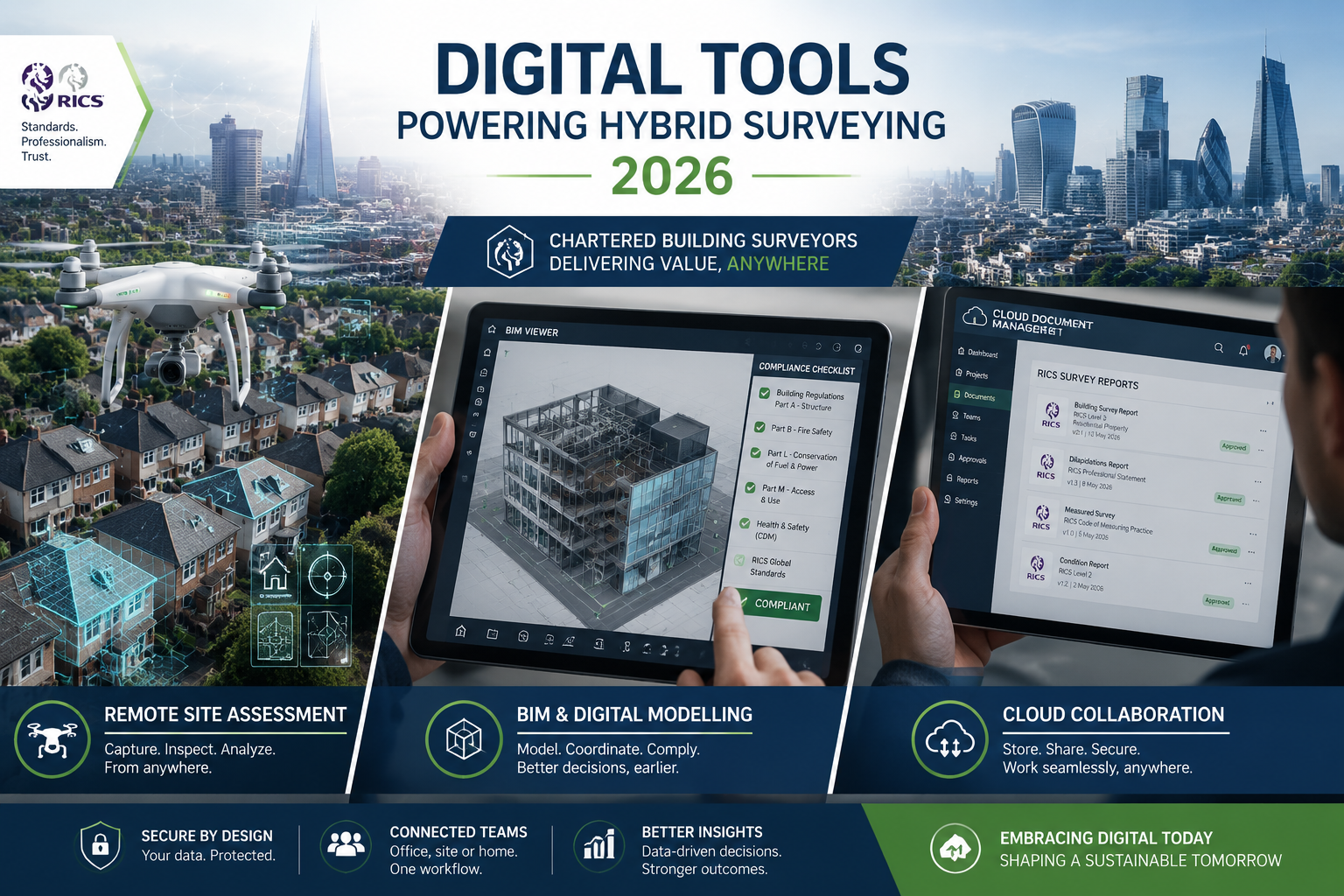
Hybrid work both requires and accelerates investment in digital infrastructure [3]. For surveying firms, this is not a cost — it is a competitive advantage that pays dividends in efficiency, talent retention, and client satisfaction.
The Technology Stack for Hybrid Surveyors
The most effective hybrid surveying operations in 2026 rely on a layered technology stack:
🛰️ Remote Assessment Tools
- Drone survey technology for roof and elevation inspections
- Thermal imaging cameras for moisture and insulation analysis
- 360° camera systems for remote property walkthroughs
☁️ Cloud-Based Platforms
- Practice management software (e.g., Rapport3, Deltek)
- Cloud storage with role-based access controls
- Digital signature platforms for client approvals
📱 Communication & Collaboration
- Video conferencing (Teams, Zoom) for client and team meetings
- Project management tools (Asana, Monday.com) for workload visibility
- Secure messaging platforms for sensitive client communications
📊 Reporting & Compliance
- RICS-compliant report templates accessible from any device
- Building information modelling (BIM) software for complex projects
- Building regulation compliance testing tools integrated into digital workflows
Cost Efficiency: A Strategic Benefit for Firms
Hybrid models deliver measurable cost savings. Organisations are actively committing to reduced physical office footprints as a direct result of hybrid adoption [3]. For a surveying firm with 20 professionals, moving from a full-time office to a hot-desking hybrid model can reduce property costs by 30–50% annually — funds that can be reinvested in technology, training, or competitive salaries.
Career Development and CPD in a Hybrid World
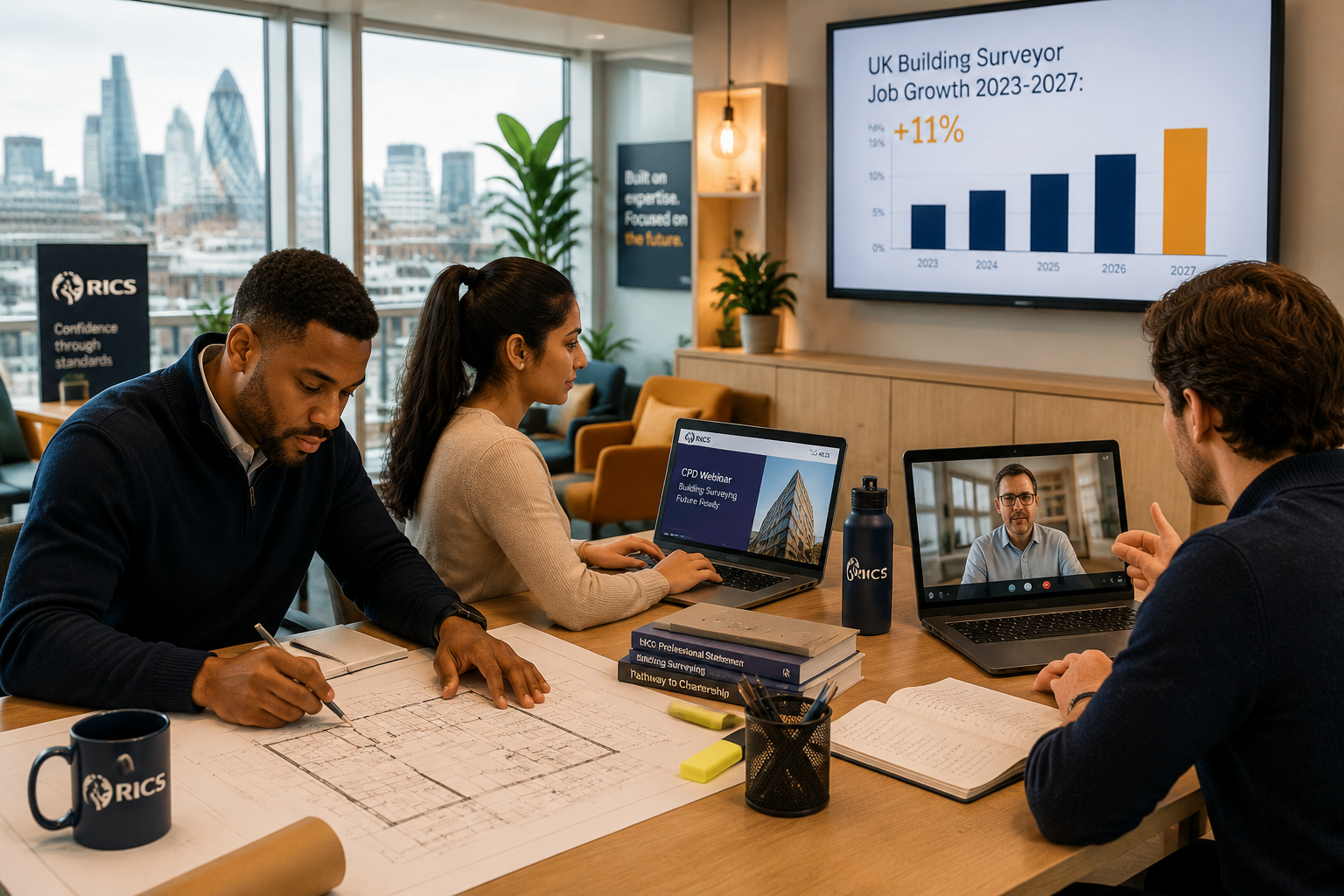
One of the most compelling arguments for hybrid working among younger surveyors is the access it provides to continuous professional development. Building surveyors can now attend RICS webinars, access industry lectures, and engage with professional networks via LinkedIn and specialist platforms — all from remote locations [1].
The education sector is responding in kind. In April 2026, DN Colleges Group launched innovative hybrid Higher National Certificate (HNC) programmes in construction, delivering full qualifications in a single academic year through one day per week of campus attendance combined with online delivery. These include HNC Quantity Surveying and HNC Building Services Engineering — designed specifically to allow students to remain employed while qualifying [4].
This blended approach mirrors the hybrid work model itself: face-to-face when it adds the most value, remote when it is equally effective [4]. For firms looking to develop junior surveyors without pulling them from billable work, these programmes represent a significant opportunity.
Firms exploring early careers programmes for trainee surveyors should consider how hybrid HNC routes can accelerate qualification timelines while maintaining productivity.
Sustainability and the Hybrid Surveyor
Building surveyors are increasingly central to the UK's sustainability agenda [1]. Hybrid working supports this role in two ways:
- Reduced commuting lowers the carbon footprint of surveying operations
- Focused remote time allows surveyors to conduct deeper sustainability analysis, research environmental issues in properties, and produce more thorough eco-assessment reports
As the UK government continues to tighten energy efficiency requirements for residential and commercial properties, chartered surveyors with strong sustainability expertise — and the time to develop it — will command premium rates.
Practical Implementation: Making Hybrid Work in Your Surveying Practice
Moving from theory to practice requires deliberate planning. The following steps give surveying firms and individual chartered surveyors a clear path to effective hybrid implementation.
Step-by-Step Hybrid Rollout for Surveying Firms
Step 1: Audit current workflows
Map every task against its optimal location. Identify which activities genuinely require physical presence and which can be completed remotely without quality loss.
Step 2: Invest in digital infrastructure
Before hybrid working begins, ensure all team members have access to secure, cloud-based systems. This is non-negotiable for RICS compliance and client data protection.
Step 3: Define clear hybrid policies
Document expectations around core hours, on-site days, response times, and supervision. Vague policies create conflict; clear policies create freedom.
Step 4: Train managers in remote leadership
The biggest failure point in hybrid models is management. Managers must learn to evaluate performance by output quality, not office visibility.
Step 5: Review and iterate
Schedule quarterly reviews of hybrid arrangements. Use data — turnaround times, client satisfaction scores, staff retention rates — to refine the model.
For Individual Surveyors: Maximising Hybrid Productivity
| Strategy | Why It Works |
|---|---|
| Cluster site visits geographically | Cuts travel time; maximises on-site efficiency |
| Use drone surveys where possible | Reduces return visits; speeds up reporting |
| Block remote days for deep work | Report writing requires focus; protect it |
| Maintain a professional home office | Signals professionalism on video calls |
| Engage in digital CPD consistently | RICS compliance + career advancement |
| Stay visible in professional networks | Hybrid can reduce visibility; counteract it |
Surveyors working across multiple regions — from Camden to Berkshire — will find that geographic clustering of site visits, combined with remote reporting days, dramatically improves both work-life balance and billable output.
Conclusion: The Hybrid Future Is Already Here
The evidence is unambiguous. Hybrid work models for chartered building surveyors are not a passing phase — they are the new professional standard in the 2026 UK jobs market. With an 11% rise in surveying roles forecast [1], productivity maintained or improved under flexible arrangements [2], and digital tools making remote surveying more capable than ever [3], the profession is well-positioned to thrive in a hybrid world.
The firms and individual surveyors who will lead this market are those who treat hybrid working as a strategic asset rather than a reluctant concession. That means investing in technology, formalising policies, developing remote leadership skills, and committing to continuous professional development — wherever it happens.
Actionable Next Steps ✅
- Audit your current workflow — identify which tasks are genuinely site-dependent
- Invest in drone and cloud technology to extend remote capability
- Document your hybrid policy with clear RICS-compliant protocols
- Explore hybrid HNC programmes for junior staff development [4]
- Cluster site visits geographically to reduce travel and maximise efficiency
- Review your digital CPD plan to ensure RICS requirements are met remotely
- Benchmark your hybrid model against high-growth organisations in the sector [2]
The 2026 UK jobs market rewards surveyors and firms that adapt. Hybrid working is not the challenge — it is the opportunity.
References
[1] Latest Trends In Uk Building Surveyor Jobs – surveymerchant.com
[2] Uk Hybrid Work Models Report – zoom.com
[3] Office Trends 2026 Hybrid Work Is No Longer A Trend It Is The Baseline – daysk.com
[4] New Hybrid Hncs Launch To Fast Track Regional Construction Careers – ucnl.ac.uk