

Loft conversions now account for nearly 40% of all permitted development applications in urban England — yet fewer than one in five homeowners correctly serve party wall notices before work begins. As construction activity surges in 2026 amid a cautious housing market, the collision between party wall obligations and right to light law has become one of the most contested areas in residential surveying. Understanding Party Wall Surveys for Right to Light Disputes in 2026 Loft Extensions: RICS Protocols Post-Planning Reforms is no longer optional for homeowners, developers, or the surveyors advising them.
Key Takeaways 📋
- RICS launched a consultation in April–May 2026 on the draft 8th edition of Party Wall Legislation and Procedure, introducing significant changes to notice protocols, fee practices, and Third Surveyor guidance.
- Right to light disputes are increasingly common in loft conversions — neighbours can seek compensation or demand design changes even after planning permission is granted.
- A party wall surveyor's appointment is statutory and personal, meaning it is independent of client instruction and cannot be overridden by the building owner.
- The Party Wall Award defines the scope, timing, and protective measures for construction work, and is the primary tool for resolving disputes before they reach court.
- RICS-compliant notice strategies and expert witness preparation are essential for surveyors navigating the post-reform landscape in 2026.
Why 2026 Is a Turning Point for Loft Extension Disputes
The UK's planning reform agenda has reshaped the residential development landscape. Permitted development rights have been extended, local authority processing times have tightened, and more homeowners than ever are choosing loft conversions as a cost-effective alternative to moving. This has created a surge in party wall notices — and a corresponding rise in disputes.
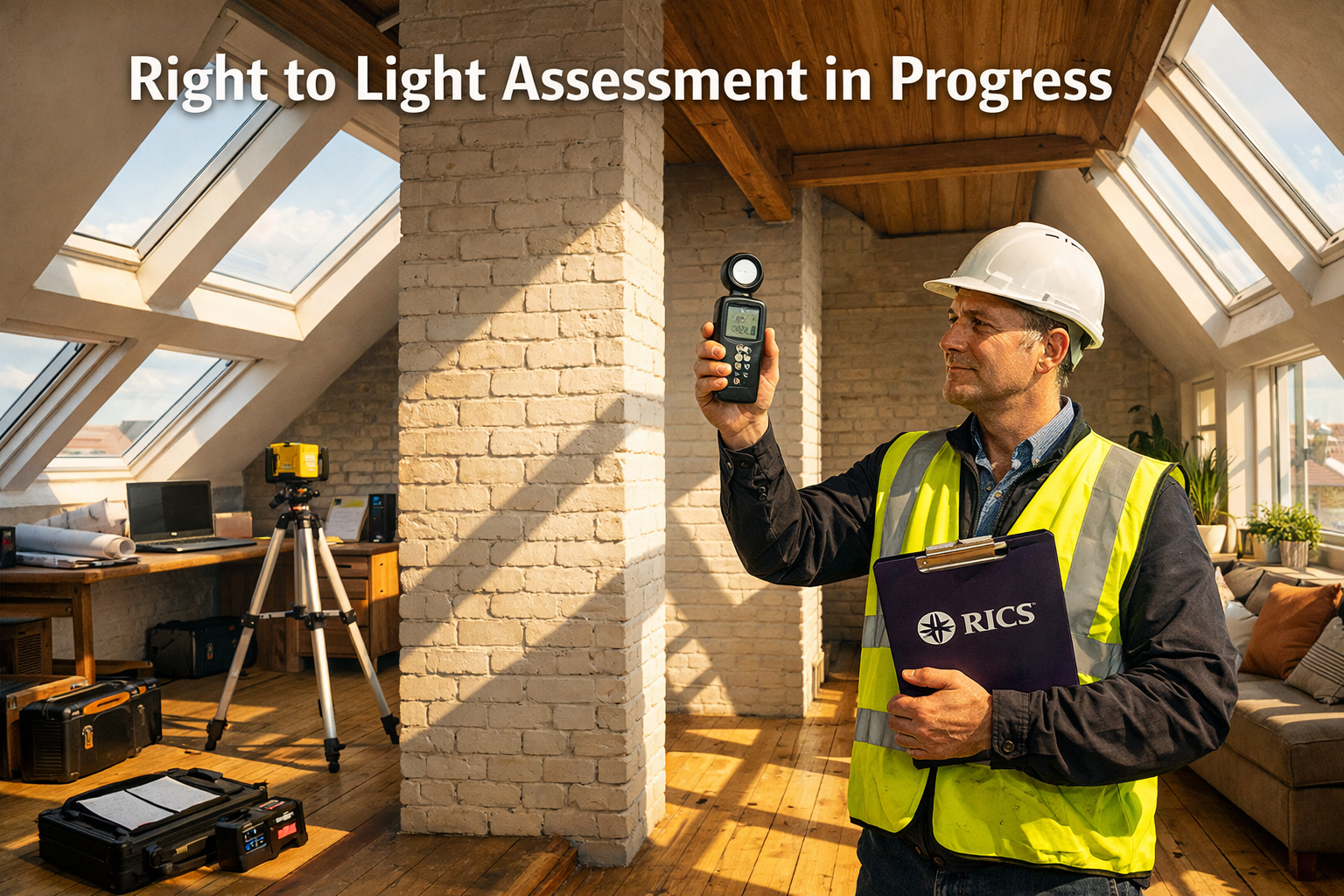
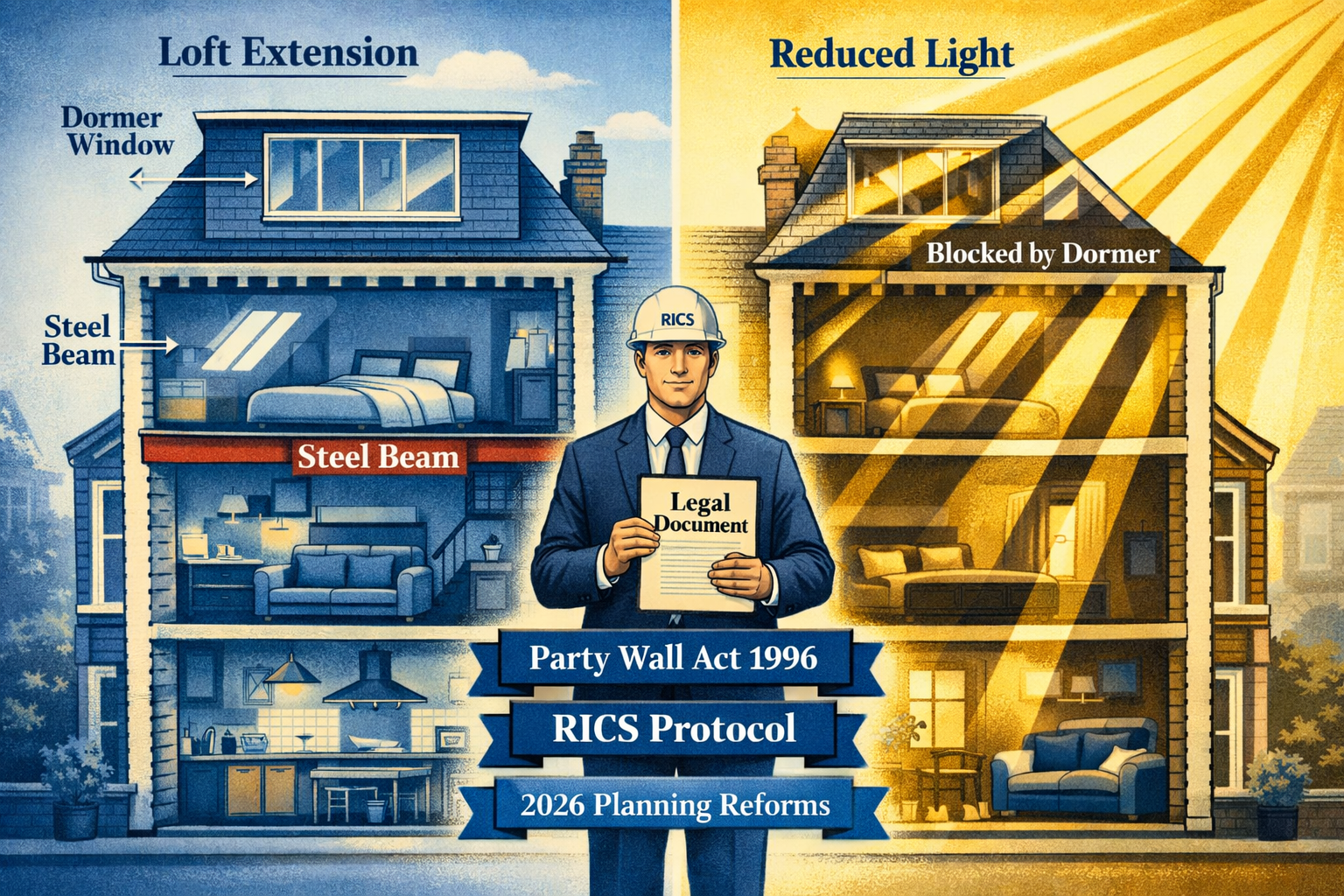
Right to light sits at the heart of many of these conflicts. Under established common law, a property owner acquires a right to light through 20 years of uninterrupted natural illumination through defined apertures (windows, skylights, rooflights). When a loft extension — particularly one with a large dormer — rises above the roofline of a neighbouring property, it can materially reduce the daylight entering adjacent rooms [4].
💡 Pull Quote: "Over half a room in residential properties should be lit by natural light to meet accepted standards. If a new development reduces light below this level, it constitutes an obstruction." — RICS Consumer Guide on Right to Light [4]
This standard, while seemingly simple, creates complex measurement challenges. Surveyors must assess:
- The 45-degree rule and the Waldram diagram methodology
- Whether the affected room is used for a purpose requiring adequate daylight
- The degree of interference relative to what the neighbour previously enjoyed
Neighbours retain the right to oppose developments at the planning stage and may seek compensation or demand modifications even after planning permission has been granted [4]. Courts can — in rare cases — order that developments be altered or even demolished to protect a neighbour's light [4]. This makes early, RICS-compliant surveying absolutely critical.
For a broader understanding of when professional surveying input becomes essential, see this guide on why property owners hire surveyors.
Understanding the RICS 8th Edition: What Has Changed Post-Planning Reforms
RICS launched its consultation on the draft 8th edition of Party Wall Legislation and Procedure in April 2026, running for approximately eight weeks and inviting feedback from surveyors, legal professionals, and dispute resolution practitioners across England and Wales [1].
The 8th edition replaces the 7th edition and represents the most significant update to RICS party wall practice guidance in over a decade [1]. Key changes include:
Enhanced Appendices and Updated Documentation
The revised draft includes:
- Revised letters of appointment and terms of engagement
- An updated draft Party Wall Award template
- Strengthened guidance on fee practices to address concerns about disproportionate charging
- Clearer rules on Third Surveyor use — including when referral is appropriate and how Third Surveyors should be selected [1]
Statutory Independence of the Surveyor
One of the most significant clarifications in the 8th edition concerns the nature of a party wall surveyor's appointment. The revised guidance emphasises that the appointment is personal and statutory — independent of client instruction [2]. This matters enormously in loft extension disputes where building owners may attempt to pressure their appointed surveyor into issuing awards that exceed proper jurisdiction or where no genuine dispute exists [2].
⚠️ Important: Awards have been successfully challenged in court where surveyors lacked proper jurisdiction. The 8th edition directly addresses this risk by tightening the conditions under which an award can be validly issued.
Notice Service and Public Engagement
The updated guidance also strengthens requirements around:
| Area | Previous Guidance | 8th Edition Update |
|---|---|---|
| Notice service methods | General guidance | Specific requirements for electronic and physical service |
| Public engagement | Limited detail | Enhanced transparency obligations |
| Regulatory conduct | Broad principles | Specific conduct standards for RICS members |
| Fee transparency | Advisory only | Strengthened requirements |
For those navigating the notice-serving process for the first time, this complete guide to party wall surveys answers the most common questions homeowners and developers face.
Party Wall Surveys for Right to Light Disputes in 2026 Loft Extensions: RICS Protocols Post-Planning Reforms — The Practical Framework
Applying Party Wall Surveys for Right to Light Disputes in 2026 Loft Extensions: RICS Protocols Post-Planning Reforms in practice requires surveyors to navigate two overlapping legal frameworks simultaneously: the Party Wall etc. Act 1996 and common law right to light principles. These are distinct but frequently intersecting.
Step 1: Identify Whether the Party Wall Act Is Engaged
Not every loft conversion triggers the Party Wall Act. The Act is engaged when work involves:
- Cutting into or building on a party wall (Section 2 works)
- Excavation near a neighbouring foundation (Section 6 works)
- Building a new wall at the boundary (Section 1 works)
Loft conversions involving steel beams — which are common in mansard and dormer extensions — almost always require party wall notice before construction begins if the beam bears on or cuts into a shared wall [3]. Failure to serve notice exposes the building owner to injunctions, damages, and enforcement action. For a detailed look at the consequences of non-compliance, see this article on the consequences of ignoring the Party Wall Act.
Step 2: Serve the Correct Notices
Under the Party Wall etc. Act 1996, the building owner must serve:
- Party Structure Notice (minimum 2 months before work begins) for Section 2 works
- Line of Junction Notice (minimum 1 month) for Section 1 works
- Notice of Adjacent Excavation (minimum 1 month) for Section 6 works
The 8th edition tightens the requirements for how these notices are served and what information they must contain. Errors in notice service remain one of the most common reasons awards are challenged.
Step 3: Appoint Surveyors and Agree or Dispute
If the neighbour consents in writing within 14 days, no award is needed. If they dissent or fail to respond, both parties must appoint surveyors. An agreed surveyor — appointed by both parties — can streamline the process significantly. Learn more about this option in this complete guide to agreed surveyor roles and appointment.
Step 4: Prepare the Party Wall Award
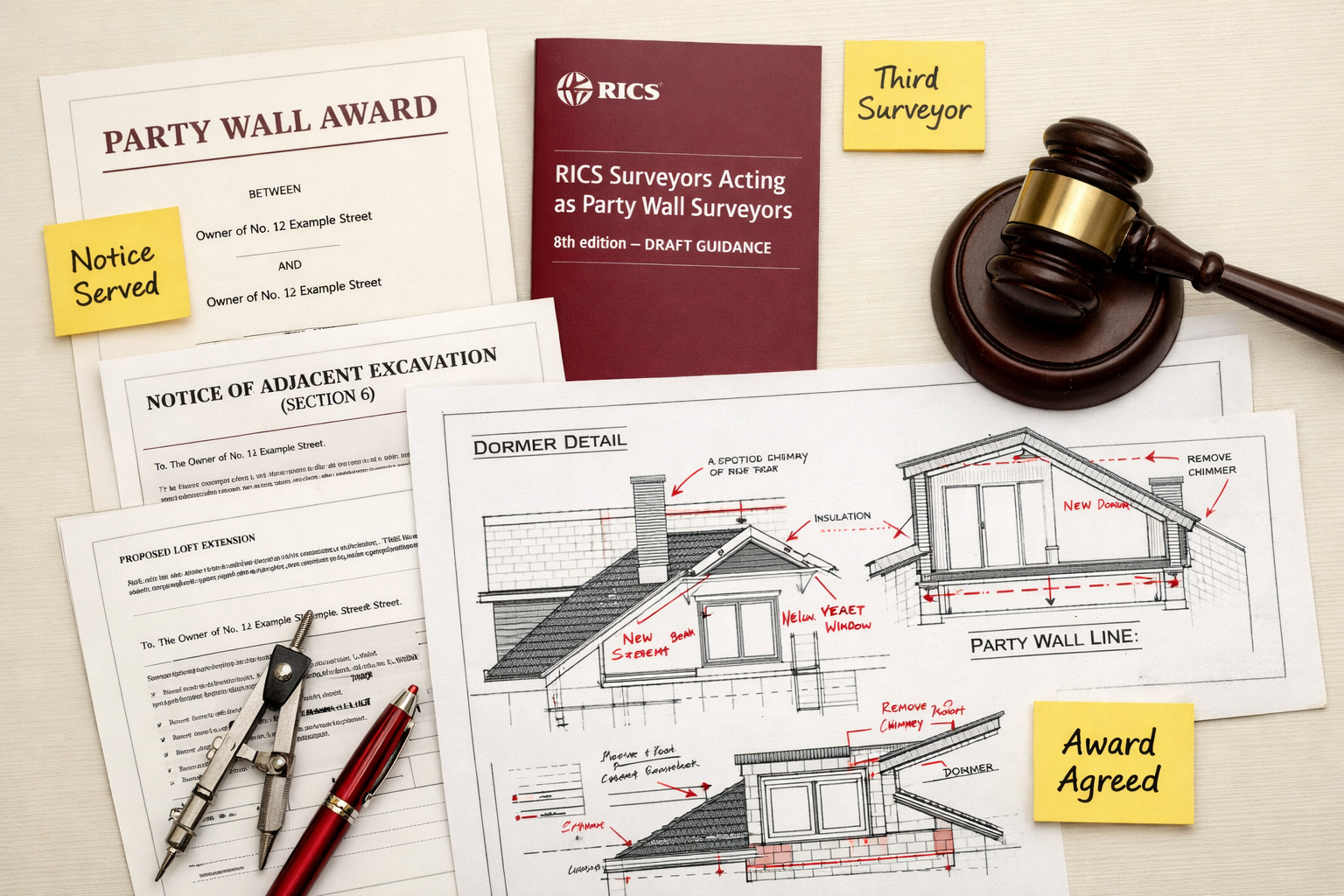
The Party Wall Award sets out [3]:
- ✅ The scope of building work permitted
- ✅ The timing and hours of construction
- ✅ Protection measures for the neighbouring property
- ✅ Procedures for resolving disputes that arise during construction
- ✅ Schedule of condition for the adjoining property before works begin
In right to light cases, the Award should also reference any agreed modifications to the design — such as reduced dormer height, repositioned rooflights, or light-well provisions — that protect the neighbour's daylight entitlement.
Step 5: Address Right to Light as a Parallel Process
Right to light is not covered by the Party Wall Act — it is a separate common law right. However, the two processes frequently run in parallel during loft extension projects. Surveyors acting under the Party Wall Act should:
- Flag potential right to light issues in their initial assessment
- Recommend specialist right to light consultants where significant interference is likely
- Document existing light conditions in the Schedule of Condition
- Advise clients that planning permission does not extinguish right to light claims [4]
RICS has published detailed professional standards on rights of light that all party wall surveyors should be familiar with [6].
Expert Witness Preparation and Dispute Resolution in 2026
When right to light disputes escalate — whether through injunction proceedings, damages claims, or planning objections — party wall surveyors may be called upon as expert witnesses. This requires a distinct skill set beyond standard surveying practice.
What Courts Expect from Expert Witnesses
Expert witnesses in right to light cases must:
- Provide independent, objective opinions based on evidence
- Apply recognised methodologies (Waldram diagrams, BRE daylight/sunlight assessments)
- Distinguish clearly between factual evidence and expert opinion
- Comply with Civil Procedure Rules Part 35 on expert evidence
The 8th edition's emphasis on surveyor independence directly supports this — a surveyor who has maintained proper statutory independence throughout the party wall process is better positioned to act credibly as an expert witness if a dispute escalates.
Mediation and Alternative Dispute Resolution
Courts increasingly expect parties to attempt mediation before litigation. In 2026, with the Civil Procedure Rules placing greater emphasis on proportionality, mediation of right to light disputes is often the most cost-effective route. Party wall surveyors with mediation training are increasingly valuable to clients navigating these conflicts.
💡 Pro Tip: Document everything from day one. A thorough Schedule of Condition, supported by photographs and — where appropriate — drone survey data, creates an indisputable baseline for any subsequent dispute.
The Role of the Third Surveyor
Where the two appointed surveyors cannot agree, either party may refer the matter to a Third Surveyor — pre-selected at the time of appointment. The 8th edition provides clearer guidance on when Third Surveyor referral is appropriate and how the Third Surveyor should conduct their assessment [1]. In right to light disputes, the Third Surveyor's determination on design modifications can be decisive.
Party Wall Surveys for Right to Light Disputes in 2026 Loft Extensions: RICS Protocols Post-Planning Reforms — Common Pitfalls to Avoid
Even experienced surveyors can fall into traps when handling loft extension disputes under the updated RICS framework. The most common errors include:
| Pitfall | Risk | How to Avoid |
|---|---|---|
| Serving notice too late | Injunction halting construction | Serve notice as soon as design is finalised |
| Conflating Party Wall Act with right to light | Inadequate advice to client | Treat as parallel but separate processes |
| Inadequate Schedule of Condition | Disputed liability for damage | Use photographs, video, and drone imagery |
| Accepting instructions that compromise independence | Award challenged in court | Follow 8th edition guidance on statutory independence |
| Ignoring Third Surveyor provisions | Procedural invalidity | Pre-select Third Surveyor at appointment stage |
| Failing to advise on planning permission limits | Client exposed to injunction | Explicitly advise that planning consent ≠ right to light waiver |
For those considering a loft conversion and unsure whether a party wall surveyor is needed, this resource on when you need a party wall surveyor provides clear guidance.
Practical Checklist for Surveyors and Homeowners in 2026 🏠
Whether acting as a building owner, adjoining owner, or appointed surveyor, the following checklist reflects best practice under the updated RICS framework:
For Building Owners:
- Commission a right to light assessment before finalising loft design
- Serve party wall notices at least 2 months before construction
- Appoint a RICS-qualified party wall surveyor
- Obtain a Schedule of Condition for all adjoining properties
- Do not assume planning permission resolves right to light obligations
For Adjoining Owners:
- Respond to party wall notices within 14 days
- Appoint your own surveyor if dissenting (costs met by building owner)
- Seek specialist right to light advice if dormer or mansard extension is proposed
- Consider mediation before pursuing injunction proceedings
For Surveyors:
- Review RICS 8th edition draft guidance and respond to consultation
- Maintain strict statutory independence throughout
- Pre-select Third Surveyor at appointment stage
- Document all light conditions thoroughly in Schedule of Condition
- Familiarise with Civil Procedure Rules Part 35 for potential expert witness roles
For projects involving complex structural elements or heritage considerations, a Level 3 Full Building Survey can identify statutory considerations that affect both party wall and right to light obligations before work begins.
Conclusion: Actionable Next Steps for 2026
The convergence of rising loft conversion activity, post-planning reform permitted development rights, and the RICS 8th edition consultation has created a pivotal moment for party wall surveying practice in 2026. Party Wall Surveys for Right to Light Disputes in 2026 Loft Extensions: RICS Protocols Post-Planning Reforms demand a more rigorous, independent, and holistic approach than ever before.
Here are the immediate actions to take:
-
Surveyors: Download the RICS draft 8th edition and submit consultation feedback before the deadline. Update appointment letters, award templates, and fee structures to align with the new guidance.
-
Homeowners planning loft conversions: Commission both a party wall assessment and a right to light report before finalising your design. Early identification of risks is dramatically cheaper than post-construction litigation.
-
Adjoining owners: Do not ignore party wall notices. Dissenting and appointing your own surveyor is the most effective way to protect your right to light and ensure construction does not damage your property.
-
All parties: Treat mediation as the first resort, not the last. The 2026 regulatory environment strongly favours proportionate dispute resolution over costly litigation.
The party wall framework exists to protect everyone involved in construction projects. Used correctly — and updated to reflect the realities of 2026's planning landscape — it remains one of the most effective dispute prevention tools available to the residential property sector.
References
[1] Rics Launches Consultation On Updated Party Wall Practice Guidance – rics.org
[2] Rics Launches Consultation On Party Wall Guidance – thenegotiator.co.uk
[3] Party Wall Surveyor Loft Conversion – biggerlivinglofts.com
[4] Right To Light – rics.org
[5] Party Wall Surveys And Neighbour Disputes During 2026s Construction Uptick Rics Compliance Framework – nottinghillsurveyors.com
[6] Rights Of Light – rics.org