

The abolition of Section 21 "no-fault" evictions on May 1, 2026, has fundamentally restructured how landlords approach major renovation projects in the private rented sector. With every possession now requiring documented grounds under Section 8 of the Housing Act 1988, landlords undertaking structural works that trigger party wall obligations face a complex intersection of compliance requirements. Understanding Private Rented Sector Database Registration: Party Wall Survey Implications for Section 8 Compliant Developments has become essential for property owners navigating the reformed regulatory landscape.
The introduction of the Private Rented Sector (PRS) Database from late 2026 adds another layer of complexity. This mandatory registration system requires property-level compliance documentation before landlords can legally market or let their properties. When major works requiring party wall surveys coincide with tenanted properties, landlords must now coordinate party wall procedures with new Section 8 Ground 6 requirements for vacant possession during demolition or major works.
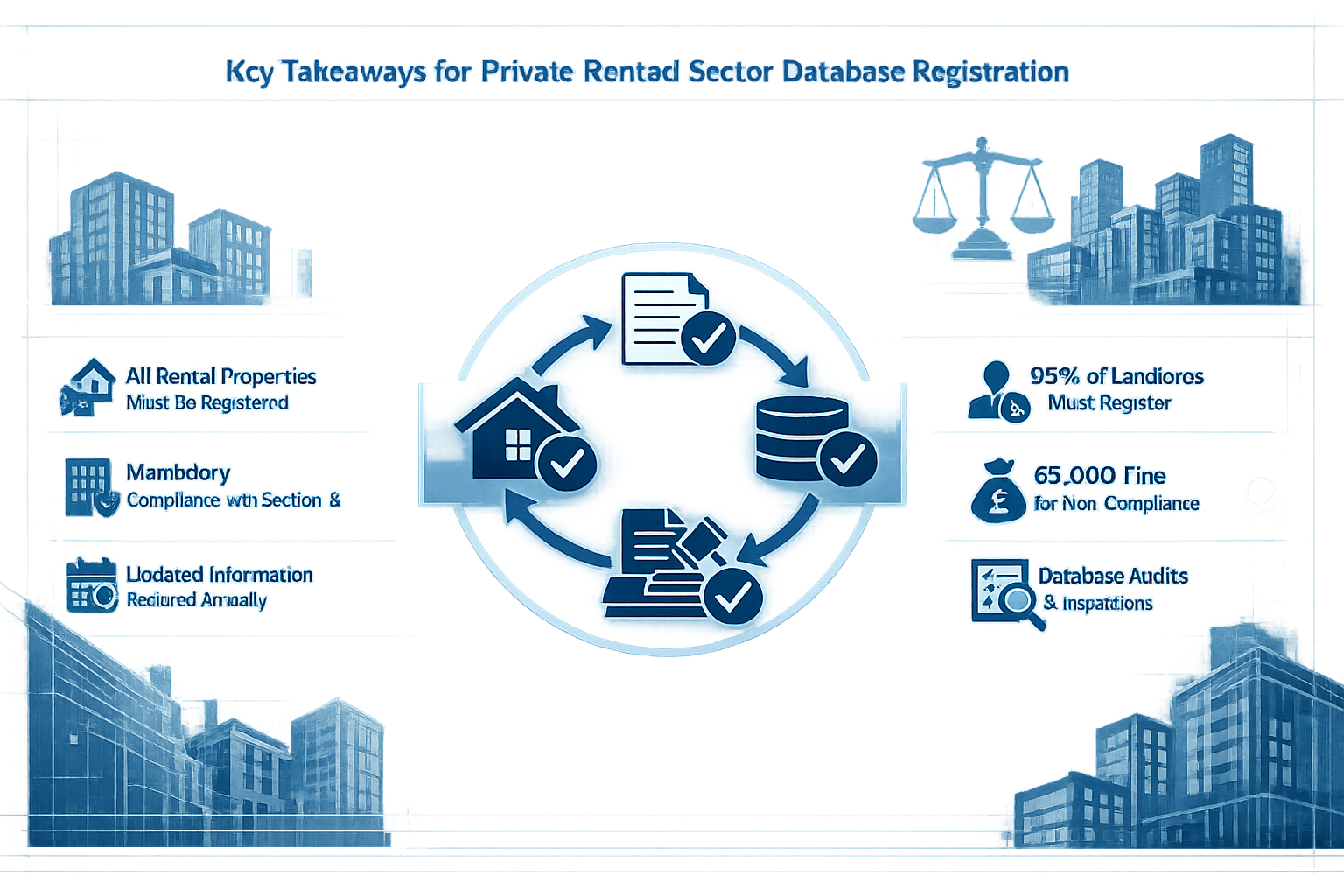
Key Takeaways
- Section 21 abolition from May 1, 2026 means all possession claims require Section 8 grounds, including new Ground 6 for major works requiring vacant possession
- PRS Database launches late 2026 with regional phased rollout requiring property-level registration with integrated compliance checks before letting
- Party wall surveys must now align with Section 8 documentation requirements when landlords initiate structural works on tenanted properties
- Annual registration fees and property-specific documentation create ongoing compliance obligations for landlords with multiple properties
- RICS guidance emphasizes surveyor independence in documenting party wall works that intersect with Renters' Rights Act requirements
Understanding the Private Rented Sector Database Registration Framework
What Is the PRS Database?
The Private Rented Sector Database represents the most significant administrative change to rental property regulation in decades. Unlike previous voluntary schemes, this system creates mandatory registration requirements for every rental property in England. The database will launch from late 2026 with a regional, phased approach rather than a single national implementation date.[2]
Each individual property requires separate registration—not a single landlord-level registration covering multiple holdings.[1] This property-specific approach means landlords with portfolios must compile and maintain compliance documentation independently for every unit they own.
Core Registration Requirements
The database collects comprehensive property information including:
- Full property address and unique identifiers
- Property type (house, flat, HMO designation)
- Number of bedrooms and occupancy indicators
- Number of households and residents
- Furnishing status and condition descriptors
- Current tenancy status and occupancy dates[2]
Integrated compliance checks form the database's most significant feature. Before registration can be completed, the system cross-references multiple regulatory requirements including:
✅ Gas safety certificates (annual)
✅ Electrical Installation Condition Reports (EICRs)
✅ Energy Performance Certificate (EPC) ratings
✅ HMO licensing status (where applicable)
✅ Selective licensing compliance
✅ Other local authority requirements[1]
This integration means landlords cannot simply register a property address—they must demonstrate active compliance across all regulatory domains before the database accepts their registration.
Phased Regional Rollout Timeline
The government has confirmed the database will "come online area by area" with no published sequence yet available.[2] This regional approach creates planning challenges for landlords with properties across multiple local authority areas, as compliance deadlines will vary geographically.
Initial access (late 2026 onwards) is restricted to:
- Landlords updating their property information
- Local councils supporting targeted compliance work
- Council enforcement teams responding to complaints[2]
Subsequent phases will enable public access and data sharing arrangements, potentially connecting with the new PRS Landlord Ombudsman scheme to reduce administrative duplication.[2]
Enforcement Powers and Penalties
Councils have received £18.2 million in enforcement funding, with new powers to:
- Enter letting agent offices without prior notice
- Seize documents and digital records
- Issue penalties up to £40,000 for serious breaches
- Prohibit non-compliant landlords from marketing properties[1]
The prohibition on marketing or letting unregistered properties creates immediate financial consequences for non-compliance. Landlords cannot legally advertise, show, or let any property not appearing on the database with current compliance status.
Party Wall Survey Requirements for Section 8 Compliant Developments

The Party Wall Act Framework
The Party Wall etc. Act 1996 governs construction work affecting shared walls, boundaries, and excavations near neighboring properties. When landlords undertake qualifying works—extensions, loft conversions, structural alterations, or excavations within three or six meters of adjacent structures—they must serve party wall notices on affected neighbors.
The Act requires landlords to:
- Serve written notice describing proposed works (typically 2 months for most works, 1 month for excavations)
- Obtain neighbor consent or proceed to party wall award
- Appoint party wall surveyors (agreed surveyor or one for each party)
- Complete schedule of condition surveys documenting pre-works property condition
- Produce party wall awards setting out work specifications and protections
For landlords with tenanted properties, this process now intersects with Section 8 possession requirements when works necessitate vacant possession.
Section 8 Ground 6: Major Works Requiring Vacant Possession
The reformed Section 8 grounds include Ground 6 as a mandatory ground where courts must grant possession if the landlord proves the property cannot reasonably be occupied during demolition or major works requiring vacant possession.[1]
This ground applies when:
- Structural works make continued occupation unsafe or impractical
- Extensive renovations require access to all areas of the property
- Building regulations mandate vacant possession during works
- Party wall works necessitate substantial disruption to tenant occupation
Ground 6 creates a direct link between party wall procedures and possession proceedings. When landlords initiate major works triggering party wall obligations, they must now document how these works meet Ground 6 criteria if they require tenants to vacate.
Coordinating Party Wall Notices with Section 8 Proceedings
Recent RICS guidance addresses the intersection between party wall surveys and Section 8 compliance, emphasizing surveyor independence and statutory duty.[3] When managing party wall works that require tenant possession, landlords must:
Document work necessity: Party wall awards should clearly specify why works require vacant possession, referencing structural necessity, safety requirements, or regulatory mandates. This documentation supports subsequent Section 8 Ground 6 possession claims.
Maintain timeline coordination: Party wall notice periods (typically 2 months) must align with Section 8 possession notice periods. Landlords should serve both notices concurrently where possible to avoid delays.
Preserve surveyor independence: Party wall surveyors must maintain professional independence when documenting works, even when those surveys support landlord possession claims. RICS consultation emphasizes this principle specifically for Renters' Rights Act compliance.[3]
Create comprehensive condition records: Schedule of condition surveys completed before works commence serve dual purposes—protecting against neighbor damage claims and documenting property condition for possession proceedings.
Party Wall Survey Documentation for PRS Database Registration
The PRS Database's integrated compliance checks create additional documentation requirements for properties undergoing party wall works. When landlords register properties where major works have occurred, they must demonstrate:
- Completed party wall awards showing proper notice procedures
- Building control approval for notifiable works
- Updated compliance certificates (gas, electrical) post-construction
- Revised EPC ratings reflecting improvements
- Tenant possession documentation if Ground 6 was invoked
Properties with ongoing party wall works may face registration complications if compliance documentation remains incomplete. Landlords should complete all party wall procedures and obtain final certificates before attempting database registration.
Private Rented Sector Database Registration: Party Wall Survey Implications for Section 8 Compliant Developments in Practice

Case Study: Loft Conversion in Tenanted Semi-Detached Property
Consider a landlord planning a loft conversion on a tenanted semi-detached rental property. This project illustrates the interconnected compliance requirements:
Party Wall Act obligations: The conversion requires structural alterations to the party wall, triggering notice requirements to the adjoining owner. The landlord must serve notice, appoint surveyors, and obtain a party wall award before commencing works.
Section 8 Ground 6 assessment: The conversion necessitates scaffolding, roof removal, and substantial internal disruption making continued occupation impractical. The landlord determines Ground 6 applies and must serve Section 8 notice alongside party wall notice.
PRS Database implications: Before re-letting after works completion, the landlord must update the database registration with:
- New bedroom count (loft conversion adds bedroom)
- Updated EPC reflecting insulation improvements
- New electrical certificate for additional circuits
- Completed party wall award documentation
- Building control completion certificate
Timeline coordination:
- Month 1: Serve party wall notice (2 months) and Section 8 notice concurrently
- Month 2: Appoint party wall surveyors, complete schedule of condition
- Month 3: Obtain possession, finalize party wall award, commence works
- Month 5: Complete construction, obtain building control sign-off
- Month 6: Update PRS Database registration, obtain new compliance certificates, re-market property
Common Pitfalls and How to Avoid Them
❌ Serving party wall notices without considering possession requirements
Many landlords initiate party wall procedures without assessing whether works require vacant possession under Ground 6. This creates timeline conflicts when possession becomes necessary mid-process.
✅ Solution: Assess Ground 6 applicability before serving party wall notices. If vacant possession is required, serve both notices simultaneously and coordinate surveyor appointments with possession timeline.
❌ Incomplete documentation for database registration
Landlords often complete party wall procedures but fail to collect all documentation required for PRS Database registration updates.
✅ Solution: Create a comprehensive documentation checklist including party wall awards, building control certificates, updated compliance certificates, and revised property descriptors before commencing works.
❌ Assuming regional database rollout timing
Without published rollout schedules, landlords risk planning works without knowing their area's registration deadline.
✅ Solution: Contact local authority housing departments for regional rollout information. Prepare registration documentation now to comply immediately when the database becomes available in your area.
❌ Overlooking surveyor independence requirements
Some landlords pressure party wall surveyors to produce awards supporting possession claims, compromising surveyor independence.
✅ Solution: Engage RICS-qualified surveyors who understand their statutory duties and maintain professional independence regardless of client preferences.[3]
Best Practices for Landlords
1. Conduct Pre-Works Compliance Audits
Before initiating any major works, audit current compliance status across all requirements:
- Gas safety certificate currency
- EICR validity (5-year maximum for rental properties)
- EPC rating and improvement recommendations
- HMO or selective licensing status
- Outstanding maintenance issues
This audit identifies compliance gaps that must be addressed before database registration updates.
2. Engage Qualified Party Wall Surveyors Early
Professional party wall surveyors provide crucial guidance on documentation requirements, timeline coordination, and compliance integration. Early engagement allows surveyors to:
- Assess whether proposed works trigger party wall obligations
- Advise on Ground 6 applicability for possession requirements
- Coordinate notice timing with possession proceedings
- Prepare comprehensive condition records supporting multiple compliance needs
3. Maintain Comprehensive Project Documentation
Create dedicated files for each property containing:
- Original party wall notices and neighbor responses
- Surveyor appointment letters and qualifications
- Complete party wall awards with specifications
- Schedule of condition photographs and reports
- Building control notifications and approvals
- Section 8 notices and possession order copies
- Post-works compliance certificates
- Database registration confirmation
This documentation serves multiple purposes—defending against neighbor claims, supporting possession proceedings, and enabling database registration updates.
4. Budget for Integrated Compliance Costs
The intersection of party wall requirements, Section 8 proceedings, and database registration creates cumulative costs:
| Cost Category | Typical Range | Notes |
|---|---|---|
| Party wall surveyor fees | £700-£2,000+ | Varies with work complexity |
| Schedule of condition survey | £300-£800 | Per neighboring property |
| Legal fees (Section 8) | £500-£1,500 | If possession is contested |
| Building control fees | £400-£1,200 | Depends on work scope |
| Updated compliance certificates | £200-£600 | Gas, electrical, EPC |
| Annual PRS Database fee | TBC | Government to confirm |
Total integrated compliance cost: £2,100-£6,100+ per project, excluding construction costs.
5. Understand Consequences of Non-Compliance
The reformed regulatory framework creates serious penalties for non-compliance:
- Unregistered properties: Cannot be legally marketed or let; councils can issue prohibition orders
- Party wall violations: Neighbors can seek injunctions halting works and damages for breaches
- Section 8 failures: Possession claims fail if Ground 6 requirements aren't properly documented
- Enforcement penalties: Up to £40,000 for serious breaches of rental regulations[1]
Understanding these consequences of failing to comply motivates proper planning and documentation.
Strategic Planning for Multi-Property Portfolios
Portfolio-Wide Compliance Assessment
Landlords with multiple properties face amplified complexity under the new framework. Each property requires individual registration, separate compliance documentation, and independent party wall procedures if works are undertaken.
Recommended approach:
Phase 1: Inventory and prioritization (Months 1-2)
- List all properties with addresses and current compliance status
- Identify properties requiring major works in next 12-24 months
- Assess which properties have shared party walls
- Prioritize properties in areas with early database rollout
Phase 2: Compliance gap remediation (Months 3-6)
- Obtain missing or expired compliance certificates
- Commission EPC assessments for properties below minimum standards
- Address outstanding maintenance issues
- Prepare documentation packages for each property
Phase 3: Works planning and coordination (Months 6-12)
- Schedule major works requiring party wall procedures
- Coordinate possession requirements with work timelines
- Engage surveyors for multiple properties simultaneously (potential fee discounts)
- Stagger projects to manage cash flow and contractor availability
Phase 4: Database registration (Ongoing from late 2026)
- Register properties as database becomes available in each area
- Update registrations immediately after completing major works
- Maintain annual registration renewals
- Monitor compliance status through council access portals
Leveraging Professional Project Management
For landlords with substantial portfolios, engaging professional project management services provides strategic advantages:
- Centralized compliance tracking across multiple properties
- Coordinated surveyor appointments reducing per-property costs
- Timeline optimization minimizing void periods during works
- Documentation management ensuring database registration readiness
- Regulatory monitoring tracking regional rollout schedules and requirement changes
Professional management becomes cost-effective when coordinating works across 5+ properties or managing complex multi-unit developments.
Future Regulatory Developments to Monitor
Expanded Database Functionality
Government statements indicate the PRS Database will evolve beyond initial registration requirements. Planned enhancements include:
Public access portals: Allowing prospective tenants to verify landlord registration and compliance status before viewing properties[2]
Data sharing integration: Connecting database records with the PRS Landlord Ombudsman scheme, reducing duplicate record-keeping[2]
Risk-based enforcement: Enabling councils to identify compliance patterns and target enforcement resources toward high-risk landlords[2]
Performance metrics: Publishing area-level statistics on compliance rates, enforcement actions, and property conditions
These enhancements will increase transparency and enforcement effectiveness, making proactive compliance increasingly important.
Evolving Party Wall Guidance
The RICS consultation launched April 8, 2026, specifically addresses surveyor independence and statutory duties for Renters' Rights Act compliance.[3] This consultation suggests professional guidance is still developing on how party wall procedures intersect with Section 8 requirements.
Landlords should monitor RICS guidance updates and consider how emerging best practices affect their documentation and procedural approaches.
Potential Ground 6 Refinements
As courts interpret the new Section 8 Ground 6 requirements, case law will establish precedents for what constitutes "major works requiring vacant possession." Early possession decisions will clarify:
- Threshold criteria for work severity requiring possession
- Documentation standards for proving vacant possession necessity
- Acceptable alternative arrangements (temporary accommodation, phased works)
- Compensation or assistance obligations for displaced tenants
Staying informed about Ground 6 case law helps landlords structure party wall projects to meet evolving judicial standards.
Conclusion
Private Rented Sector Database Registration: Party Wall Survey Implications for Section 8 Compliant Developments represents a fundamental shift in how landlords approach structural works on rental properties. The abolition of Section 21 notices, introduction of mandatory property-level registration, and integration of compliance checks create interconnected obligations that require careful coordination.
Successful navigation of this framework requires:
🔑 Early planning: Assess party wall requirements, Section 8 Ground 6 applicability, and database registration needs before initiating any major works
🔑 Professional engagement: Work with qualified party wall surveyors who understand Renters' Rights Act compliance requirements and maintain statutory independence
🔑 Comprehensive documentation: Maintain complete records supporting party wall procedures, possession proceedings, and database registration updates
🔑 Timeline coordination: Align party wall notice periods with Section 8 possession requirements and regional database rollout schedules
🔑 Proactive compliance: Address compliance gaps before works commence rather than attempting retrospective remediation
Actionable Next Steps
For landlords planning major works in 2026:
- Contact your local authority to determine expected PRS Database rollout timing in your area
- Audit current compliance status for all properties, identifying gaps requiring remediation
- Engage RICS-qualified party wall surveyors for preliminary consultations on proposed works
- Assess Section 8 Ground 6 applicability for projects requiring tenant possession
- Create property-specific documentation packages ready for database registration
- Budget for integrated compliance costs including party wall fees, legal costs, and certification updates
For landlords with existing tenancies:
- Review tenancy agreements to understand notice periods and possession procedures under reformed Section 8
- Communicate proactively with tenants about planned works and possession requirements
- Document work necessity thoroughly to support Ground 6 possession claims if challenged
- Maintain surveyor independence throughout party wall procedures
- Update database registrations immediately after completing works and obtaining certificates
The intersection of party wall requirements, Section 8 compliance, and database registration creates complexity, but also opportunity. Landlords who master these integrated requirements position themselves competitively in a more regulated rental sector, demonstrating professionalism and compliance that increasingly sophisticated tenants value.
By treating Private Rented Sector Database Registration: Party Wall Survey Implications for Section 8 Compliant Developments as interconnected elements of a comprehensive compliance strategy rather than isolated regulatory burdens, landlords can navigate the reformed framework efficiently while protecting their investments and maintaining positive tenant relationships.
References
[1] Private Rental Sector Changes 2026 – https://purseglove.co.uk/private-rental-sector-changes-2026/
[2] Late 2026 Prs Database Rollout Begins What We Know So Far What It Will Contain And Who Will Be Able To Access It – https://www.netrent.co.uk/2026/02/05/late-2026-prs-database-rollout-begins-what-we-know-so-far-what-it-will-contain-and-who-will-be-able-to-access-it/
[3] Party Wall Surveys For Renters Rights Act Compliance Managing Notices When Landlord Initiated Works Face New Section 8 Ground Requirements – https://nottinghillsurveyors.com/blog/party-wall-surveys-for-renters-rights-act-compliance-managing-notices-when-landlord-initiated-works-face-new-section-8-ground-requirements