

When two appointed party wall surveyors reach an impasse, the statutory mechanism shifts into high gear: Third Surveyor involvement becomes mandatory under the Party Wall etc. Act 1996. Recent data shows that approximately 8-12% of party wall disputes escalate to this level, adding £1,500 to £4,000 in additional costs and extending resolution timelines by 8-12 weeks. Understanding Third Surveyor Protocols in Party Wall Awards: Cost Management and Decision Timelines for 2026 Disputes is essential for property owners, developers, and construction professionals navigating boundary work in 2026.
This comprehensive guide provides step-by-step protocols for appointing independent third surveyors when agreed surveyors deadlock, complete with current fee structures, RICS best practices, and strategies for efficient dispute resolution.

Key Takeaways
- Mandatory Appointment: Third Surveyors are required only when the two originally appointed surveyors cannot agree on specific matters, with joint nomination ensuring complete impartiality[2]
- Cost Implications: Third Surveyor fees range from £1,500 to £4,000+ in 2026, coming on top of existing surveyor costs of £900 to £5,400, with liability determined by fault rather than automatic assignment[1][2]
- Binding Authority: The Third Surveyor's determination is final and binding on all parties, with appeals limited to a 14-day window through County Court proceedings[2]
- Timeline Impact: Third Surveyor involvement typically extends dispute resolution by 8-12 weeks, making early prevention strategies crucial for project schedules
- Fee Allocation: Costs are assigned to the party whose surveyor's position led to unnecessary disagreement, not automatically to the Building Owner[2]
Understanding Third Surveyor Protocols in Party Wall Awards: Cost Management and Decision Timelines for 2026 Disputes
The Legal Framework and Statutory Requirements
The Party Wall etc. Act 1996 establishes a clear hierarchy for dispute resolution in boundary construction matters. A Third Surveyor is not an optional consultation—they become mandatory when the two originally appointed surveyors cannot reach agreement on any matter within the Party Wall Award[2].
This statutory requirement serves as the final arbitration mechanism before court proceedings. The Third Surveyor process prevents project deadlock while protecting both Building Owner and Adjoining Owner rights through an impartial determination.
Key statutory provisions include:
- Section 10(1) mandates surveyor appointment for dispute resolution
- Section 10(8) requires Third Surveyor selection when appointed surveyors disagree
- Section 10(17) provides 14-day appeal rights to County Court
- Section 10(13) grants Third Surveyors authority to determine fee liability
The 2026 landscape sees increased Third Surveyor involvement due to more complex basement extensions, particularly in urban areas where basement construction projects require sophisticated party wall protocols.
When Third Surveyor Appointment Becomes Necessary
Third Surveyor involvement triggers under specific circumstances. The two appointed surveyors must demonstrate genuine disagreement on substantive matters—not merely delayed communication or scheduling conflicts.
Common trigger points include:
✅ Disagreement on Award Terms: Fundamental disputes about work scope, timing, or protective measures
✅ Condition Assessment Conflicts: Opposing views on pre-existing property condition documentation
✅ Cost Apportionment Disputes: Inability to agree on expense allocation between parties
✅ Access Requirements: Conflicting positions on necessary access provisions
✅ Compensation Claims: Disagreement on damage assessment or compensation amounts
Situations that do NOT require Third Surveyor:
❌ Administrative delays in scheduling inspections
❌ Minor wording disagreements in Award drafts
❌ Personality conflicts between surveyors
❌ One surveyor's temporary unavailability
Understanding the cost implications of party wall surveyor involvement helps property owners budget appropriately before disputes escalate to Third Surveyor level.
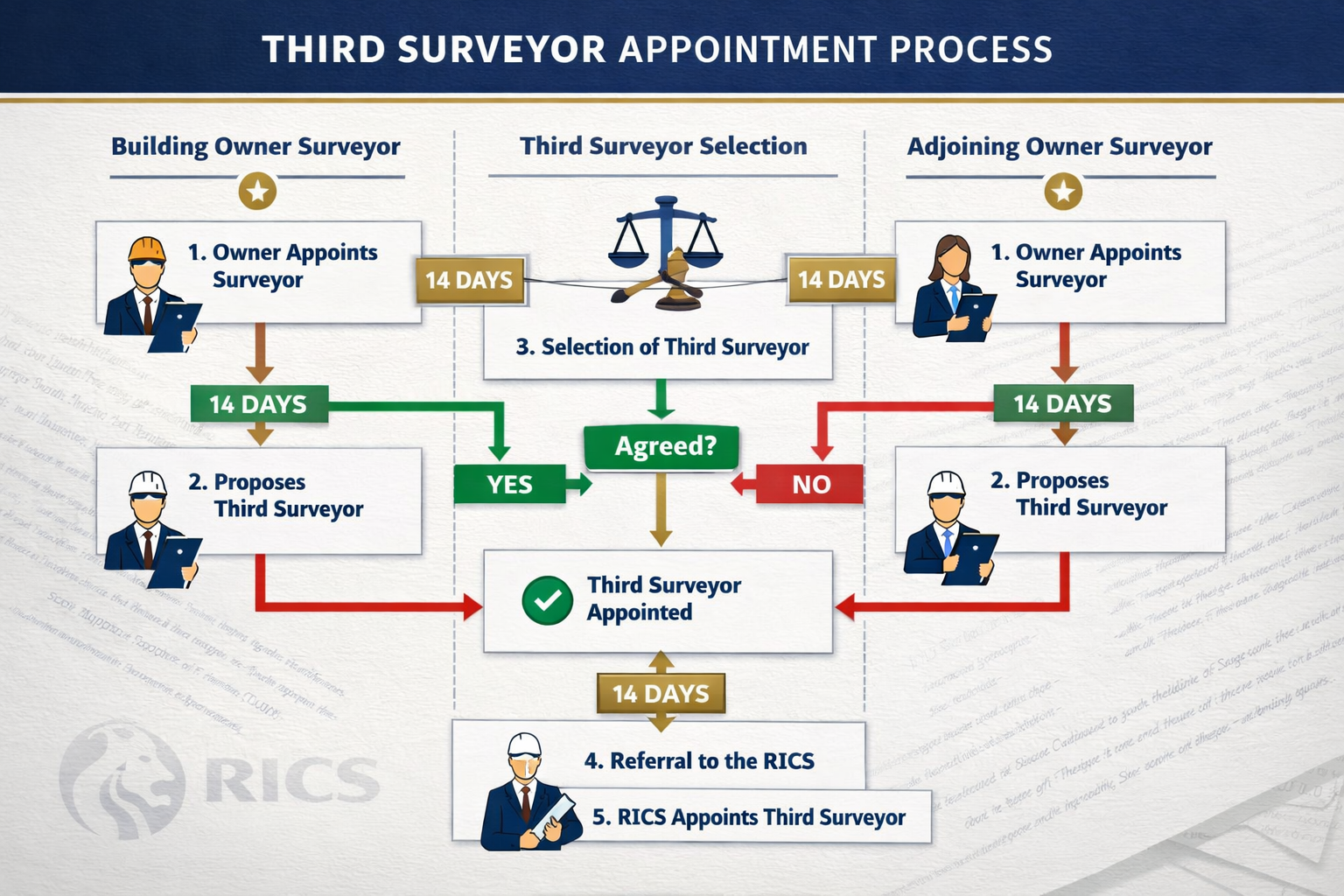
The Third Surveyor Appointment Process: Step-by-Step Protocols for 2026
Step 1: Formal Disagreement Declaration (Days 0-7)
When appointed surveyors reach impasse, either surveyor must formally declare the disagreement in writing. This declaration should specify:
- Precise point(s) of disagreement with reference to specific Award clauses
- Date disagreement became apparent to establish timeline
- Positions of both surveyors summarized objectively
- Attempts at resolution demonstrating good faith efforts
The disagreement notice starts the formal Third Surveyor appointment clock. Both surveyors have a statutory duty to proceed promptly—delays can result in fee liability adjustments.
Step 2: Joint Third Surveyor Selection (Days 7-21)
The two appointed surveyors—not the property owners—jointly nominate and appoint the Third Surveyor[2]. This ensures complete impartiality, as neither party controls the selection.
Selection criteria for 2026 best practice:
📋 RICS Accreditation: Current RICS membership with party wall specialization
📋 Independence: No prior relationship with either surveyor or property owner
📋 Experience Level: Minimum 10 years party wall experience; 15+ years preferred
📋 Local Knowledge: Familiarity with regional construction practices and property types
📋 Availability: Capacity to deliver determination within 6-8 weeks
📋 Fee Transparency: Clear fee structure provided upfront
If the two surveyors cannot agree on Third Surveyor selection within 10 days, either surveyor may apply to the appointing officer (typically the local authority) for selection under Section 10(8) of the Act.
Recommended Third Surveyor candidate sources:
- RICS Party Wall Specialist Register
- Faculty of Party Wall Surveyors member directory
- Pyramus & Thisbe Club professional listings
- Local authority appointing officer recommendations
Step 3: Terms of Appointment and Fee Agreement (Days 21-28)
Once selected, the Third Surveyor issues formal terms of appointment outlining:
Scope of Determination
- Specific questions submitted for ruling
- Matters outside determination scope
- Timeline for evidence submission
- Site inspection requirements
Fee Structure
- Hourly rates or fixed fee quotation
- Disbursement provisions (travel, reports, expert consultation)
- Payment terms and invoicing schedule
- Fee liability determination process
Procedural Rules
- Evidence submission deadlines
- Format requirements for submissions
- Communication protocols with appointed surveyors
- Confidentiality provisions
Both appointed surveyors must formally accept these terms before the Third Surveyor proceeds. This acceptance creates a binding contract for the determination process.
Step 4: Evidence Submission and Review (Weeks 4-6)
Each appointed surveyor submits comprehensive evidence supporting their position. The Third Surveyor reviews all materials, which typically include:
Documentary Evidence:
- Original party wall notices and responses
- Property condition schedules with photographs
- Technical reports (structural, drainage, subsidence)
- Correspondence between surveyors
- Relevant case law or precedent
Site Evidence:
- Current property condition documentation
- Access arrangements and constraints
- Neighboring property characteristics
- Construction methodology feasibility
The Third Surveyor may request additional information, commission independent technical reports, or conduct supplementary site inspections. These activities add to both timeline and costs but ensure thorough evaluation.
Step 5: Determination and Award Finalization (Weeks 7-10)
The Third Surveyor issues a written determination addressing each point of disagreement. This determination:
✔️ Is final and binding on all parties unless appealed within 14 days[2]
✔️ Becomes part of the Party Wall Award with same legal status
✔️ Determines fee liability based on which surveyor's position was reasonable[2]
✔️ Cannot be challenged except through formal County Court appeal
The determination must provide clear reasoning for each decision, referencing statutory provisions, case law, and technical evidence. Ambiguous determinations risk appeal and further delay.
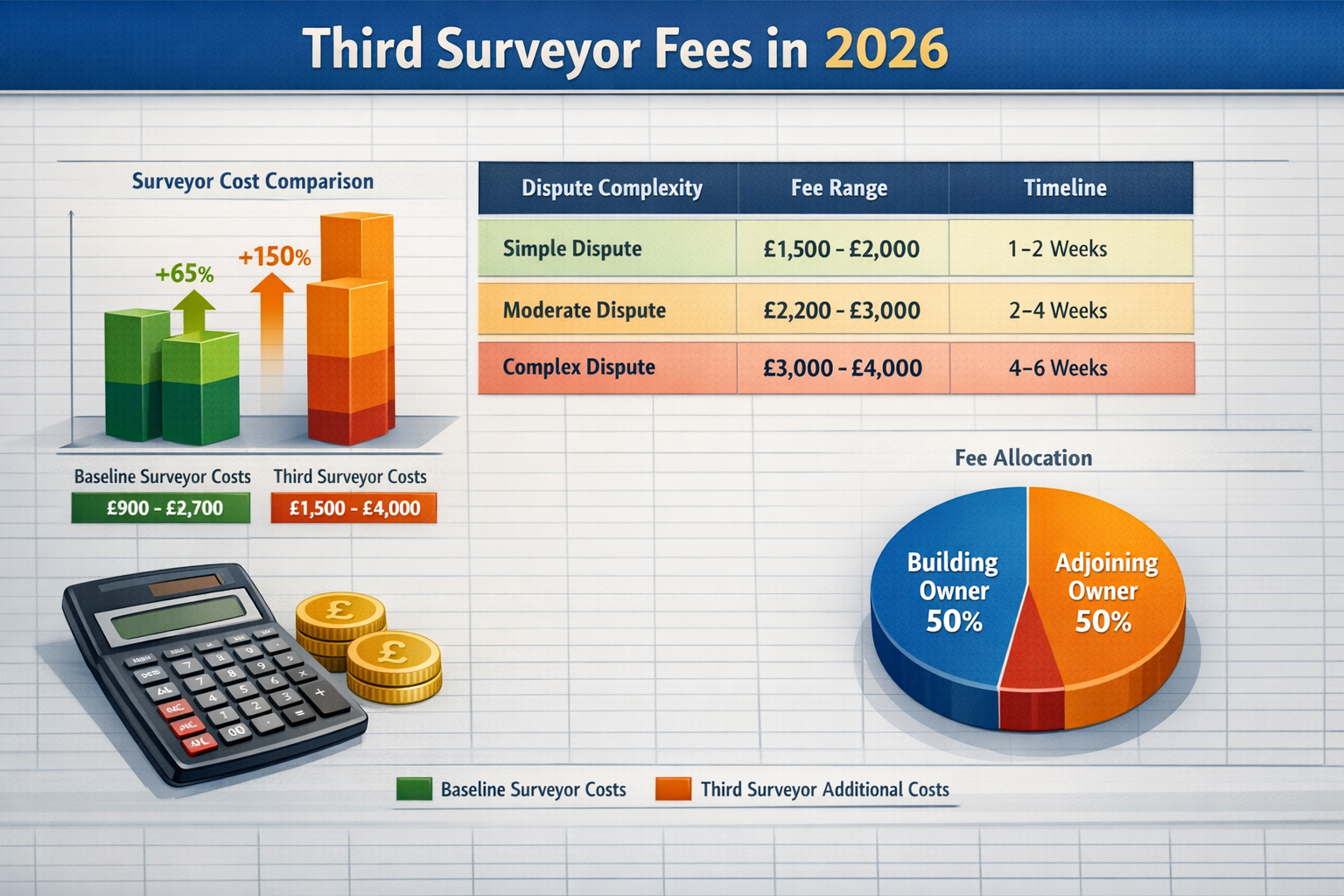
Cost Management in Third Surveyor Protocols: 2026 Fee Structures and Liability
Baseline Party Wall Surveyor Costs
Before examining Third Surveyor fees, understanding baseline costs provides context. Single party wall surveyor appointments in 2026 range from £900 to £2,700 depending on project complexity[1]. When both parties appoint separate surveyors, combined costs increase to £1,800 to £5,400[1].
Cost factors for standard appointments:
| Project Type | Complexity | Surveyor Fees (2026) |
|---|---|---|
| Single-story extension | Low | £900 – £1,200 |
| Two-story extension | Moderate | £1,200 – £1,800 |
| Loft conversion | Moderate | £1,000 – £1,500 |
| Basement excavation | High | £2,000 – £2,700 |
| Commercial development | Very High | £2,500 – £5,400+ |
These baseline costs represent the minimum expenditure before any Third Surveyor involvement.
Third Surveyor Fee Structures for 2026
Third Surveyor fees come in addition to existing surveyor costs, creating substantial financial impact[2]. Current market rates for 2026 show:
Hourly Rate Structure:
- Junior Third Surveyors: £150 – £200 per hour
- Mid-level Third Surveyors: £200 – £300 per hour
- Senior Third Surveyors: £300 – £450 per hour
Fixed Fee Arrangements:
- Simple single-issue determination: £1,500 – £2,500
- Moderate multi-issue determination: £2,500 – £4,000
- Complex technical determination: £4,000 – £7,000+
Additional Disbursements:
- Site inspection travel: £100 – £300
- Expert technical reports: £500 – £2,000
- Legal research and precedent review: £200 – £800
- Administrative costs: £150 – £400
Most Third Surveyors prefer fixed fee arrangements for straightforward matters, switching to hourly billing for complex disputes requiring extensive technical evaluation.
Fee Liability Determination: Who Pays?
Critical misconception: Building Owners do not automatically bear Third Surveyor costs. Fee liability is determined by the Third Surveyor based on which party's surveyor took an unreasonable position[2].
Fee allocation principles:
🔍 Reasonableness Test: Which surveyor's position aligns with statutory requirements and technical best practice?
🔍 Fault-Based Assignment: The party whose surveyor caused unnecessary disagreement typically bears costs[2]
🔍 Proportional Allocation: Fees may be split when both surveyors share responsibility
🔍 Instructing Party Liability: If an owner instructed their surveyor to take an untenable position, that owner bears costs
Example scenarios:
Scenario 1: Building Owner's surveyor proposes inadequate protective measures. Adjoining Owner's surveyor reasonably objects. Third Surveyor agrees with Adjoining Owner's surveyor. Result: Building Owner pays all Third Surveyor fees.
Scenario 2: Adjoining Owner's surveyor demands excessive and unreasonable protective works. Building Owner's surveyor objects. Third Surveyor finds demands unreasonable. Result: Adjoining Owner pays all Third Surveyor fees[2].
Scenario 3: Both surveyors misinterpret technical requirements. Third Surveyor clarifies correct approach. Result: Fees split 50/50 between parties.
This fault-based allocation creates strong incentive for both surveyors to maintain reasonable positions throughout the process.
Cost Management Strategies
For Building Owners:
💰 Early Technical Review: Commission independent structural assessment before serving notices
💰 Clear Scope Definition: Provide detailed work specifications to minimize interpretation disputes
💰 Experienced Surveyor Selection: Choose surveyors with proven negotiation track records
💰 Proactive Communication: Facilitate early surveyor meetings to identify potential conflicts
💰 Budget Contingency: Reserve 15-20% of surveyor budget for potential Third Surveyor costs
For Adjoining Owners:
💰 Reasonable Objection Standard: Focus on legitimate protection concerns, not project obstruction
💰 Evidence-Based Positions: Support objections with technical documentation
💰 Early Engagement: Respond promptly to notices and surveyor communications
💰 Independent Advice: Consult structural engineers before instructing surveyor on technical matters
Understanding building survey timeframes helps coordinate party wall processes with broader project schedules, minimizing delay costs.
Decision Timelines: Managing Third Surveyor Determination Schedules in 2026
Statutory vs. Practical Timelines
The Party Wall etc. Act 1996 provides limited specific timelines for Third Surveyor determinations. While the Act requires surveyors to act "with reasonable dispatch," it doesn't mandate determination deadlines.
Practical timeline expectations for 2026:
| Phase | Statutory Requirement | Practical Timeline |
|---|---|---|
| Disagreement declaration | "Forthwith" | 3-7 days |
| Third Surveyor selection | "Reasonable time" | 10-21 days |
| Terms acceptance | None specified | 5-10 days |
| Evidence submission | As directed by Third Surveyor | 14-21 days |
| Site inspection | As required | 7-14 days |
| Determination drafting | None specified | 14-28 days |
| Total Duration | No statutory limit | 8-12 weeks |
These timelines assume cooperative parties and straightforward technical issues. Complex disputes involving structural calculations, drainage assessments, or subsidence analysis can extend to 16-20 weeks.
Critical Timeline Milestones
Week 0-1: Disagreement Recognition
The appointed surveyors must promptly recognize when genuine disagreement exists. Delayed recognition extends overall timelines and increases holding costs for construction projects.
Best practice: Schedule formal surveyor conference calls at key Award drafting stages to identify potential disagreements early.
Week 1-3: Third Surveyor Appointment
Joint selection typically takes 10-14 days when surveyors maintain professional relationships and access the same candidate pools. Local authority appointing officer involvement adds 7-10 days.
Acceleration strategy: Maintain pre-approved Third Surveyor shortlists before disputes arise, with candidates already vetted for independence and availability.
Week 3-5: Evidence Compilation
Each surveyor gathers supporting documentation, photographs, technical reports, and legal precedents. Thorough evidence preparation strengthens positions and reduces determination time.
Efficiency tip: Maintain comprehensive project files throughout the party wall process, including dated correspondence, site visit notes, and technical calculations.
Week 5-7: Third Surveyor Review
The Third Surveyor analyzes submissions, conducts site inspections, and may commission additional technical reports. This phase shows highest timeline variability based on dispute complexity.
Week 7-10: Determination Drafting
The Third Surveyor prepares detailed written determination with reasoning, legal references, and fee allocation decision. Draft review and finalization typically requires 2-3 weeks.
Week 10+: Award Finalization
Once the determination is issued, the appointed surveyors incorporate it into the final Party Wall Award. The Award is then served on both parties, starting the 14-day appeal window[2].
Timeline Optimization Techniques
Parallel Processing
- Conduct site inspections during evidence submission period
- Commission technical reports before formal appointment
- Draft Award sections not subject to disagreement concurrently
Communication Protocols
- Establish dedicated communication channels between surveyors and Third Surveyor
- Set response time expectations (24-48 hours for routine matters)
- Use secure document sharing platforms for evidence submission
Scope Limitation
- Narrow disagreement to specific technical points
- Exclude peripheral issues from Third Surveyor determination
- Resolve non-contentious Award terms through standard surveyor agreement
Proactive Scheduling
- Book Third Surveyor site inspection dates during appointment phase
- Establish evidence submission deadlines in terms of appointment
- Set determination delivery date with penalty provisions for delay
Projects requiring expert witness reports benefit from early coordination with Third Surveyor timelines to avoid compounding delays.
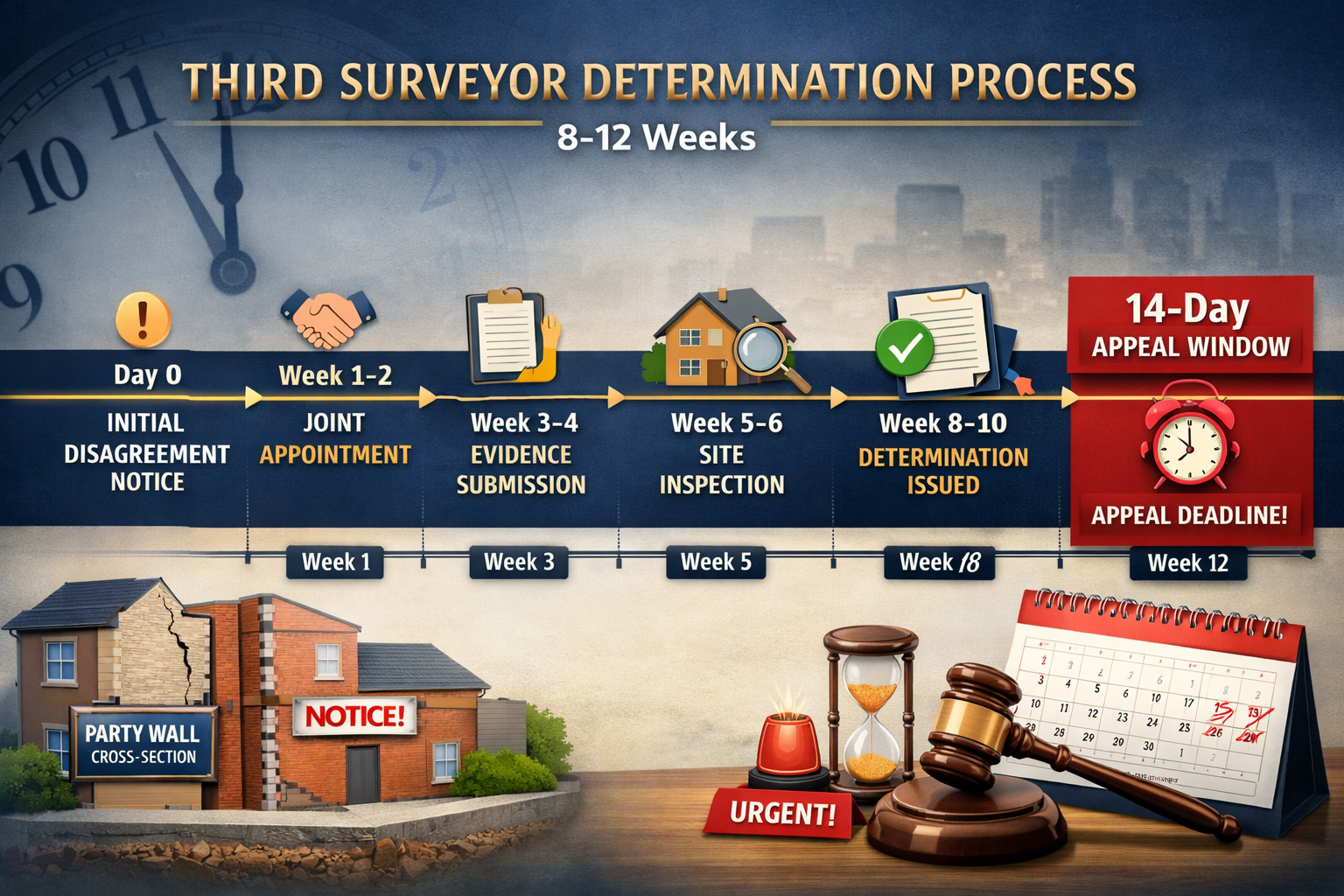
Appeal Rights and County Court Proceedings
The 14-Day Appeal Window
Once the Third Surveyor issues their determination, parties have exactly 14 days to lodge an appeal with the County Court under Section 10(17) of the Party Wall etc. Act 1996[2]. This deadline is strictly enforced—late appeals are rejected without consideration.
Appeal grounds (limited scope):
⚖️ Jurisdictional Error: Third Surveyor exceeded their authority or ruled on matters outside submission scope
⚖️ Procedural Irregularity: Determination process violated natural justice principles
⚖️ Legal Error: Misapplication of Party Wall Act provisions or relevant case law
⚖️ Perverse Decision: Determination so unreasonable no competent surveyor could reach same conclusion
Appeals cannot challenge the Third Surveyor's technical judgment on matters within their expertise. Courts defer to surveyor expertise on construction methodology, protective measures, and condition assessment.
Appeal Costs and Complexity
County Court appeals are "rare, highly technical, and often very expensive"[2], making them an uncommon dispute resolution path.
Typical appeal costs (2026):
- Legal representation: £5,000 – £15,000
- Court fees: £500 – £1,200
- Expert witness fees: £2,000 – £5,000
- Transcript and documentation: £800 – £2,000
- Total appeal costs: £8,300 – £23,200+
These costs come in addition to all surveyor fees and Third Surveyor costs already incurred. Unsuccessful appellants typically bear the other party's legal costs as well, potentially doubling financial exposure.
Appeal timeline:
- Initial application: 14 days from determination
- Court listing: 8-16 weeks
- Hearing preparation: 4-8 weeks
- Judgment delivery: 2-6 weeks post-hearing
- Total appeal duration: 4-8 months
This extended timeline creates substantial project delay, often making settlement more attractive than appeal pursuit.
Alternative Dispute Resolution
Given appeal complexity and cost, parties increasingly explore alternative resolution mechanisms:
Mediation
- Voluntary process facilitated by neutral mediator
- Cost: £1,500 – £4,000 for single-day session
- Success rate: 60-70% for party wall disputes
- Timeline: 4-6 weeks from initiation to resolution
Surveyor Conference
- Facilitated discussion between appointed surveyors and Third Surveyor
- Opportunity to clarify determination reasoning
- May identify implementation compromises
- Cost: Minimal (surveyor time only)
Negotiated Settlement
- Direct discussion between property owners
- Particularly effective when surveyor disagreement stems from owner instructions
- Can preserve neighbor relationships
- Requires both parties' willingness to compromise
RICS Best Practices for Efficient Third Surveyor Protocols in 2026
Professional Standards and Guidance
The Royal Institution of Chartered Surveyors (RICS) publishes comprehensive guidance for party wall surveyors, including Third Surveyor protocols. The 2024 RICS Party Wall Guidance Note (updated for 2026 practice) emphasizes:
Independence and Impartiality
- Third Surveyors must maintain complete independence from both appointed surveyors
- No prior professional relationship within previous 3 years
- No financial interest in dispute outcome
- Declaration of any potential conflicts before appointment
Procedural Fairness
- Equal opportunity for both surveyors to present evidence
- Transparent determination process with clear reasoning
- Written determination with statutory and technical references
- Reasonable timeline for evidence submission and review
Technical Competence
- Appropriate qualifications for dispute complexity
- Current knowledge of construction methodology and materials
- Understanding of relevant case law and statutory interpretation
- Access to specialist consultants when required
Cost Proportionality
- Fees proportionate to dispute complexity and value
- Clear fee agreements before proceeding
- Itemized billing for transparency
- Consideration of parties' financial circumstances in fee allocation
Efficiency Protocols for 2026 Practice
Pre-Appointment Screening
Before formal Third Surveyor appointment, the two appointed surveyors should:
✓ Verify candidate RICS membership and party wall accreditation
✓ Confirm availability to deliver determination within 8 weeks
✓ Review fee structure and obtain fixed-fee quotation where possible
✓ Check independence through conflict search
✓ Assess experience with similar dispute types
Streamlined Evidence Submission
Modern best practice emphasizes structured evidence packages:
- Executive summary (2 pages max) outlining position and key evidence
- Chronological narrative of dispute development
- Technical appendices with calculations, photographs, and reports
- Legal authorities cited with relevant passages highlighted
- Proposed resolution with specific Award wording
This structured approach reduces Third Surveyor review time and accelerates determinations.
Digital Collaboration Platforms
2026 practice increasingly uses secure digital platforms for:
- Evidence document sharing and version control
- Real-time communication between surveyors and Third Surveyor
- Site inspection photograph and video sharing
- Draft determination review and comment
- Digital signature for final Award execution
These platforms reduce administrative overhead and improve timeline management.
Early Neutral Evaluation
Some Third Surveyors offer preliminary non-binding evaluation after initial evidence review. This "early neutral evaluation" provides:
- Indication of likely determination outcome
- Identification of evidence gaps or weaknesses
- Settlement discussion framework
- Cost-benefit analysis of proceeding vs. negotiating
While adding 1-2 weeks to the process, early neutral evaluation achieves settlement in approximately 40% of cases, avoiding full determination costs.
Regional Variations and Local Practice
Party wall practice varies across UK regions, affecting Third Surveyor protocols:
London and Southeast
- Higher surveyor density creates competitive Third Surveyor market
- More complex projects (basements, commercial) require specialized expertise
- Fee levels 15-25% above national average
- Shorter appointment timelines due to surveyor familiarity
For projects in specific areas, consulting chartered surveyors in Richmond, Putney, or Surrey provides localized expertise.
Regional Centers (Birmingham, Manchester, Leeds)
- Smaller surveyor networks may require appointing officer involvement
- Fee levels closer to national average
- Longer appointment timelines (14-21 days typical)
- More collaborative surveyor culture reducing Third Surveyor frequency
Rural and Remote Areas
- Limited local Third Surveyor availability
- Travel costs add significantly to fees
- Remote determination via video inspection increasingly common
- Longer overall timelines due to logistics
Preventing Third Surveyor Escalation: Proactive Dispute Management
Early Warning Systems
The most effective cost management strategy is avoiding Third Surveyor involvement entirely. Proactive measures include:
Pre-Notice Technical Review
- Commission structural engineer assessment before serving party wall notices
- Identify potential Adjoining Owner concerns early
- Design protective measures exceeding minimum statutory requirements
- Prepare detailed construction methodology statements
Surveyor Selection Criteria
- Prioritize negotiation skills alongside technical competence
- Select surveyors with established professional relationships
- Avoid surveyors known for contentious approaches
- Consider agreed surveyor appointments where appropriate
Facilitated Early Meetings
- Arrange surveyor site visit within 7 days of appointment
- Property owner attendance to demonstrate cooperation
- Discussion of Adjoining Owner concerns before formal positions develop
- Agreement on inspection schedule and Award timeline
Transparent Communication
- Share construction plans, schedules, and contractor details
- Provide advance notice of potentially contentious work elements
- Invite Adjoining Owner questions and concerns
- Document all commitments and agreements
When Disagreement Emerges
If disagreement develops despite preventive measures:
Escalation Pause Protocol
- Request formal surveyor conference call before Third Surveyor appointment
- Identify specific technical or legal issue causing disagreement
- Obtain independent technical opinion on disputed point
- Explore Award wording compromises addressing both surveyors' concerns
- Consider time-limited trial protective measures with monitoring
Owner-Level Intervention
- Direct discussion between property owners can resolve surveyor impasses
- Particularly effective when disagreement stems from owner instructions
- Preserves neighbor relationships and reduces costs
- Requires both parties' willingness to override surveyor positions
Conditional Agreement
- Proceed with non-contentious Award terms
- Isolate disputed issue for Third Surveyor determination only
- Allows construction commencement on agreed works
- Reduces project delay and holding costs
These strategies reduce Third Surveyor involvement by approximately 30-40% in projects where disagreement initially appears inevitable.
Case Studies: Third Surveyor Determinations in 2026 Practice
Case Study 1: Basement Excavation Depth Dispute
Background: Building Owner proposed 3.5-meter basement excavation adjacent to Victorian terrace with shallow foundations.
Disagreement: Building Owner's surveyor approved underpinning to 1.5 meters below new basement level. Adjoining Owner's surveyor demanded 2.5-meter underpinning depth, adding £45,000 to project costs.
Third Surveyor Process:
- Appointed senior structural engineer with party wall accreditation
- Commissioned independent ground investigation report (£2,800)
- Conducted detailed foundation exposure inspection
- Reviewed comparable case precedents
Determination: Required 2.0-meter underpinning depth with enhanced monitoring protocol. Compromise solution reduced Adjoining Owner's surveyor demand while exceeding Building Owner's surveyor minimum.
Fee Allocation: Split 60/40 between Building Owner and Adjoining Owner. Third Surveyor found Building Owner's surveyor initially underestimated risk, but Adjoining Owner's surveyor demanded excessive depth without technical justification.
Total Third Surveyor Costs: £4,200 (including ground investigation)
Timeline: 11 weeks from disagreement to determination
Outcome: Both parties satisfied with balanced technical solution. Construction proceeded without further dispute.
Case Study 2: Construction Hours and Access Dispute
Background: Building Owner required Saturday working for loft conversion. Adjoining Owner objected due to young children.
Disagreement: Building Owner's surveyor argued Saturday working was reasonable and necessary. Adjoining Owner's surveyor demanded weekday-only restriction.
Third Surveyor Process:
- Appointed experienced party wall surveyor with mediation training
- Reviewed project program and critical path analysis
- Assessed noise impact and mitigation measures
- Considered comparable Award precedents
Determination: Permitted Saturday working 9:00 AM – 1:00 PM only, with 4-week advance notice and enhanced noise monitoring. Prohibited Sunday and bank holiday working.
Fee Allocation: 100% to Building Owner. Third Surveyor found total Saturday prohibition unreasonable given project constraints, but Building Owner's surveyor should have proposed compromise hours initially.
Total Third Surveyor Costs: £1,800
Timeline: 6 weeks from disagreement to determination
Outcome: Workable compromise allowing project completion within budget while respecting Adjoining Owner's reasonable concerns.
Case Study 3: Pre-Existing Damage Assessment
Background: Adjoining Owner claimed extensive pre-existing cracks were caused by Building Owner's foundation work completed 3 months prior.
Disagreement: Building Owner's surveyor argued cracks existed before work commenced. Adjoining Owner's surveyor claimed cracks developed during construction.
Third Surveyor Process:
- Appointed surveyor with building pathology specialization
- Reviewed pre-commencement condition schedules and photographs
- Conducted detailed crack pattern analysis and measurement
- Commissioned structural engineer's assessment of crack causation
Determination: Found 70% of cracks pre-existed construction, with 30% attributable to vibration from piling operations. Awarded proportional compensation of £4,200 (30% of Adjoining Owner's claimed £14,000 repair costs).
Fee Allocation: 100% to Adjoining Owner. Third Surveyor found Adjoining Owner's surveyor failed to properly review pre-commencement documentation before supporting excessive claim.
Total Third Surveyor Costs: £3,600 (including structural engineer's report at £1,200)
Timeline: 9 weeks from disagreement to determination
Outcome: Fair compensation based on objective technical analysis. Building Owner avoided excessive claim; Adjoining Owner received appropriate compensation for actual damage.
Conclusion: Mastering Third Surveyor Protocols for 2026 Disputes
Third Surveyor Protocols in Party Wall Awards: Cost Management and Decision Timelines for 2026 Disputes require sophisticated understanding of statutory requirements, cost structures, and timeline management. While Third Surveyor involvement adds £1,500 to £7,000+ in costs and 8-12 weeks to project schedules, the process provides essential dispute resolution preventing complete project deadlock.
Key success factors:
🎯 Prevention First: Invest in thorough pre-notice technical review and experienced surveyor selection to avoid disagreements
🎯 Early Recognition: Identify genuine disagreements promptly and initiate Third Surveyor appointment without delay
🎯 Strategic Selection: Choose Third Surveyors with appropriate technical expertise, proven efficiency, and transparent fee structures
🎯 Comprehensive Evidence: Prepare thorough, structured evidence submissions supporting technical positions
🎯 Timeline Management: Establish clear milestones and deadlines in Third Surveyor terms of appointment
🎯 Cost Awareness: Understand fault-based fee allocation creates incentives for reasonable positions
🎯 Appeal Realism: Recognize County Court appeals are expensive, lengthy, and rarely successful
Actionable Next Steps
For Building Owners Planning Construction:
- Commission pre-notice structural assessment identifying potential party wall concerns
- Budget 15-20% contingency above baseline surveyor costs for potential Third Surveyor involvement
- Select experienced surveyors with proven negotiation skills and collaborative approaches
- Maintain comprehensive project documentation supporting reasonable protective measure proposals
- Establish open communication with adjoining owners before formal notice service
For Adjoining Owners Receiving Notices:
- Respond within statutory deadlines to preserve rights and avoid deemed consent
- Appoint qualified surveyors with technical expertise matching project complexity
- Focus objections on legitimate protection concerns supported by technical evidence
- Avoid unreasonable positions that may result in Third Surveyor fee liability
- Consider agreed surveyor appointments for straightforward projects
For Appointed Surveyors:
- Schedule early joint site visits to identify potential disagreements before positions harden
- Maintain professional relationships with fellow surveyors enabling collaborative problem-solving
- Document disagreement attempts at resolution demonstrating good faith efforts
- Prepare comprehensive evidence packages when Third Surveyor involvement becomes necessary
- Advise clients realistically about Third Surveyor costs and fee allocation risks
Understanding the broader context of property surveying services helps integrate party wall protocols into comprehensive property development strategies.
The 2026 party wall landscape demands proactive dispute management, technical excellence, and cost-conscious decision-making. By mastering Third Surveyor protocols, property owners and construction professionals can navigate boundary disputes efficiently while protecting rights, managing costs, and maintaining project schedules.
For complex projects requiring specialist expertise, consulting chartered surveyors with local knowledge ensures compliance with regional best practices and efficient dispute resolution.
References
[1] Party Wall Surveyor Cost – hoa.org.uk
[2] Appointing The Third Surveyor When Disagreements Arise And Why This Costly Step Is Necessary – partywallslimited.com
[3] Party Wall Awards For Buy To Let Expansions In 2026 Protocols Amid Institutional Landlord Surge – nottinghillsurveyors.com
[4] Party Wall Surveys Under Renters Rights Act 2026 Protocols For Landlord Improvements Without Section 21 Evictions – nottinghillsurveyors.com