

The UK property market is experiencing a remarkable recovery in 2026, with homeowners rushing to renovate and extend their properties. This surge has created an unprecedented demand for party wall agreements, catching many property owners and professionals off guard. Understanding the Party Wall Act Updates for 2026 Market Recovery Renovations: RICS Templates for Volume Surge has become essential for anyone planning construction work that affects shared boundaries.

The Party Wall Act 1996 remains the governing legislation, but the practical application and volume of cases in 2026 has transformed how surveyors, property owners, and neighbours navigate these requirements. With renovation activity up significantly compared to previous years, the need for efficient processes and standardized templates has never been more critical. 🏗️
Key Takeaways
- The Party Wall Act 1996 framework remains unchanged, but 2026 has brought increased interpretation guidance and practical application methods to handle volume surges [1]
- RICS templates provide standardized documentation that speeds up the party wall process during high-demand renovation periods
- Common triggers include loft conversions, basement excavations, and foundation work – all seeing increased activity in the 2026 market recovery
- Early notification (at least two months before work) prevents costly delays and maintains good neighbour relations during the renovation boom
- Professional party wall surveyors ensure compliance and protect both property owners' interests amid the increased transaction volumes
Understanding the Party Wall Act Framework in 2026
The Party Wall Act 1996 continues to govern construction work affecting shared walls, boundaries, and excavations near neighbouring properties. While the legislation itself hasn't undergone formal amendments in 2026, the interpretation and practical application have evolved significantly to address the current market conditions [1].
What Qualifies as Party Wall Work?
Party wall procedures apply to three main categories of construction work:
1. Work Directly to a Party Wall (Section 2)
- Building a new wall on the boundary line
- Cutting into an existing party wall
- Raising the height of a party wall
- Demolishing and rebuilding a party wall
- Underpinning a party wall
2. Work to Party Structures (Section 2)
- Inserting a damp proof course
- Cutting away projecting foundations or walls
- Installing flashing or weathering
- Protecting walls with special coping or fillets
3. Excavation Near Neighbouring Buildings (Section 6)
- Digging within three meters of a neighbour's structure and going deeper than their foundations
- Digging within six meters and at a 45-degree angle intersecting their foundations [3]
The 2026 renovation surge has particularly increased Section 6 notifications, with basement conversions and extensions requiring careful excavation management near existing properties.
The Legal Framework Remains Robust
Despite no formal legislative changes, the Party Wall Act continues to provide a clear framework that protects both building owners and adjoining owners. The Act establishes procedures that must be followed, regardless of whether neighbours agree or disagree with proposed works [4].
Key legal principles include:
- Mandatory notification requirements – Building owners must serve proper notice
- Dispute resolution mechanisms – Surveyors appointed when agreement isn't reached
- Protection for adjoining owners – Rights to have conditions recorded and compensation for damage
- Enforcement provisions – Legal remedies available for non-compliance
For those wondering about the necessity of party wall surveyors, the 2026 market conditions have made professional guidance more valuable than ever.
Party Wall Act Updates for 2026 Market Recovery Renovations: Notice Requirements and Common Pitfalls
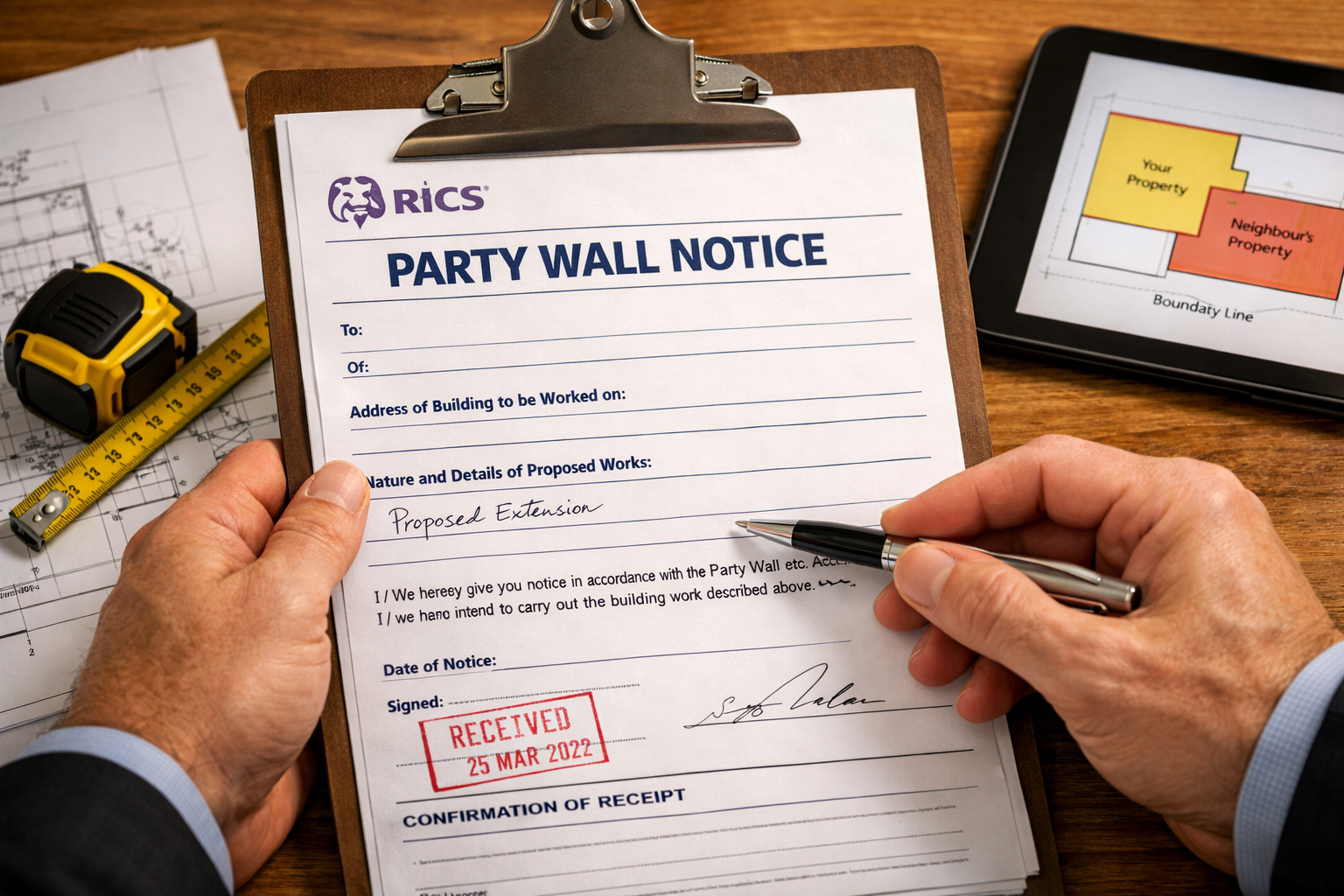
The renovation boom of 2026 has exposed numerous pitfalls in the party wall notification process. Property owners eager to start work quickly often make critical mistakes that lead to delays, disputes, and additional costs.
Proper Notice Timing and Content
The Party Wall Act specifies strict notice periods that cannot be shortened, even during busy market periods:
| Type of Work | Notice Period | Notice Type |
|---|---|---|
| Building on boundary line | 1 month | Line of Junction Notice |
| Work to existing party wall | 2 months | Party Structure Notice |
| Excavation near neighbour | 1 month | Adjacent Excavation Notice |
| Loft conversion affecting party wall | 2 months | Party Structure Notice |
Critical notice requirements include:
✅ Detailed description of proposed works – Vague descriptions lead to disputes
✅ Accurate plans and drawings – Show exact location and extent of work
✅ Proposed start date – Must allow for full notice period
✅ Building owner's details – Complete contact information
✅ Clear identification of affected structures – Specify which walls or boundaries
Common Notice Pitfalls in 2026
The volume surge has revealed recurring mistakes that delay projects:
1. Insufficient Notice Period ⚠️
Many property owners calculate notice periods incorrectly, counting from the wrong date or failing to account for weekends. The notice period begins when the adjoining owner receives the notice, not when it's sent.
2. Incomplete Work Descriptions
Generic statements like "loft conversion" aren't sufficient. Notices must specify whether work involves cutting into the party wall, inserting steel beams, or other specific interventions [5].
3. Failure to Identify All Affected Neighbours
Corner properties and semi-detached houses may require multiple notices. Missing even one affected neighbour can invalidate the entire process.
4. Starting Work Before Agreement or Award
The 2026 rush has tempted some owners to begin work prematurely. This constitutes trespass and can result in injunctions forcing work stoppage [4].
5. Inadequate Documentation
Notices must be in writing and served correctly. Verbal agreements or casual conversations don't satisfy legal requirements.
Understanding common misconceptions about party wall agreements helps avoid these pitfalls.
What Happens When Neighbours Refuse?
One of the most frequent concerns in 2026 involves neighbour objections. When an adjoining owner doesn't consent within 14 days, a "dispute" automatically arises under the Act – even if the neighbour simply doesn't respond [6].
The dispute resolution process:
- Surveyor Appointment – Each party appoints a surveyor, or both agree on a single "agreed surveyor"
- Site Inspection – Surveyors assess the property and proposed works
- Award Preparation – Surveyors prepare a Party Wall Award detailing conditions and protections
- Work Proceeds – Construction can begin once the Award is finalized
For detailed guidance on this scenario, see our article on what to do when neighbours refuse party wall works.
The role of an agreed surveyor has become particularly valuable in 2026, offering cost savings and efficiency during the high-volume period.
RICS Templates for Volume Surge: Streamlining the 2026 Process
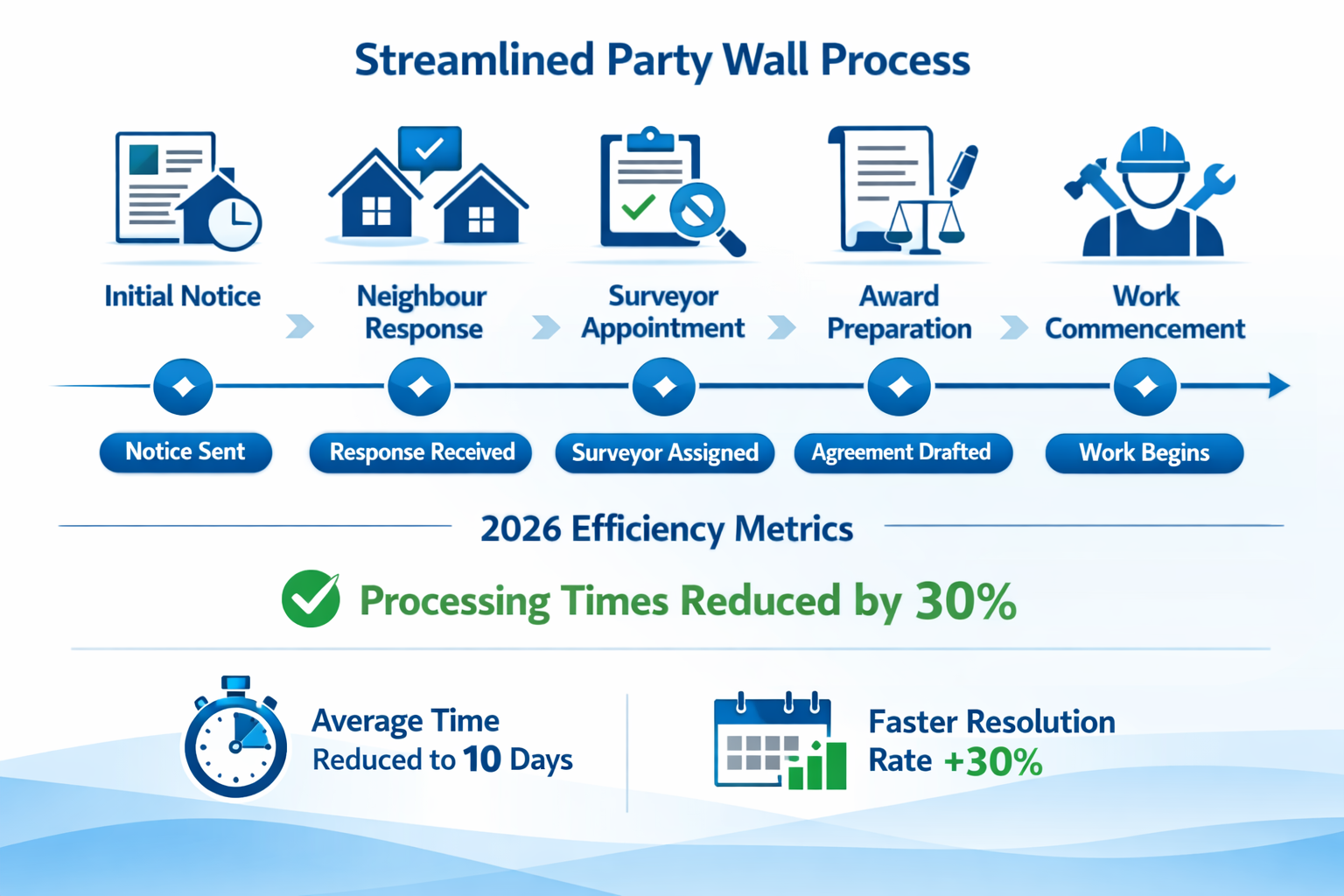
The Royal Institution of Chartered Surveyors (RICS) provides standardized templates that have become essential tools for managing the 2026 renovation surge. These templates ensure consistency, reduce errors, and speed up the party wall process when demand is at its peak.
Essential RICS Template Documents
Party Wall Notice Templates
RICS-approved notice templates ensure all legal requirements are met from the outset. These standardized forms include:
- Line of Junction Notice (Section 1)
- Party Structure Notice (Section 2)
- Adjacent Excavation Notice (Section 6)
- Acknowledgement of Notice forms
Each template includes mandatory fields that prevent common omissions and ensure proper service of notice.
Party Wall Award Templates
The Party Wall Award is the formal document that allows work to proceed. RICS templates provide comprehensive frameworks covering:
- Scope of works permitted – Detailed descriptions of authorized construction
- Timing and hours – Restrictions on when work can occur
- Access rights – Provisions for surveyor inspections
- Condition schedules – Pre-work documentation of existing conditions
- Dispute resolution procedures – Mechanisms for addressing issues during construction
Professional surveyors use these templates to prepare party wall awards efficiently while maintaining legal robustness.
Schedule of Condition Templates
Recording the pre-work condition of neighbouring properties protects all parties. RICS templates ensure comprehensive documentation including:
- Photographic records with date stamps
- Detailed descriptions of existing cracks, settlement, or defects
- Structural condition assessments
- Baseline measurements for monitoring
Benefits of Standardized Templates in High-Volume Periods
The 2026 market recovery has demonstrated clear advantages of using RICS templates:
⚡ Speed and Efficiency
Standardized formats allow surveyors to process multiple cases simultaneously without sacrificing quality. Pre-formatted sections reduce drafting time by up to 60%.
📋 Consistency and Quality
Templates ensure no critical elements are overlooked, even when surveyors handle increased caseloads. This consistency reduces disputes and appeals.
💰 Cost Control
Efficient processing translates to lower professional fees. Understanding the cost of party wall agreements helps property owners budget appropriately.
⚖️ Legal Compliance
RICS templates incorporate current legal requirements and best practices, reducing the risk of procedural errors that could invalidate agreements.
🤝 Professional Standards
Using recognized templates demonstrates professionalism and adherence to industry standards, building confidence among all parties.
Adapting Templates for Specific Projects
While templates provide excellent foundations, 2026's diverse renovation projects require customization:
Basement Excavations
Basement projects need enhanced provisions for:
- Underpinning procedures and sequencing
- Temporary support requirements
- Groundwater management
- Vibration monitoring protocols
Loft Conversions
Party wall considerations for loft work include:
- Steel beam insertions into party walls
- Party wall raising or modification
- Fire separation requirements
- Load distribution assessments
Extension Projects
Side and rear extensions require attention to:
- Foundation depth relative to neighbours
- Drainage and waterproofing near boundaries
- Scaffolding and access requirements
- Weatherproofing of exposed party walls
Digital Templates and Modern Workflows
The 2026 volume surge has accelerated adoption of digital party wall management systems. Modern surveyors increasingly use:
- Cloud-based template libraries – Instant access to current RICS templates
- Automated notice generation – Property details auto-populate standardized forms
- Digital signature platforms – Faster agreement execution
- Integrated scheduling tools – Coordinating multiple projects efficiently
- Mobile inspection apps – Real-time condition recording with photo integration
These technological advances complement RICS templates, enabling surveyors to handle the increased workload while maintaining professional standards.
Managing the 2026 Renovation Surge: Practical Strategies
The unprecedented volume of party wall cases in 2026 requires strategic approaches from all stakeholders – property owners, surveyors, and contractors.
For Property Owners Planning Renovations
Start Early ⏰
The most critical advice for 2026 renovations is to begin the party wall process as early as possible. With surveyors experiencing high demand, booking appointments and processing notices takes longer than in typical years.
Recommended timeline:
- 6 months before planned work – Initial surveyor consultation
- 4 months before – Finalize designs and serve notices
- 2-3 months before – Complete surveyor appointments and awards
- Work commencement – All agreements in place
Budget Appropriately
Party wall costs in 2026 vary based on project complexity and whether disputes arise. Typical expenses include:
- Building owner's surveyor fees: £700-£1,500 per case
- Adjoining owner's surveyor fees: £700-£1,500 (paid by building owner)
- Agreed surveyor fees: £1,000-£2,000 (shared or paid by building owner)
- Schedule of condition: £300-£600
For comprehensive cost breakdowns, review our guide on party wall agreement costs.
Maintain Good Neighbour Relations 🤝
Legal compliance doesn't replace good communication. Successful 2026 renovations involve:
- Informal discussions before serving formal notices
- Clear explanations of proposed work and timelines
- Addressing concerns proactively
- Minimizing disruption through considerate scheduling
Choose Experienced Professionals
The 2026 surge has unfortunately attracted some inexperienced practitioners. Verify that surveyors:
- Hold RICS membership or equivalent professional qualifications
- Have specific party wall expertise (not just general surveying)
- Carry appropriate professional indemnity insurance
- Provide clear fee structures and timelines
For Surveyors Managing Increased Caseloads
Implement Efficient Systems
High-volume periods demand streamlined workflows:
- Standardized client intake procedures
- Template libraries for common scenarios
- Automated notice tracking and deadline management
- Batch processing of similar cases
Prioritize Clear Communication
Managing expectations becomes critical when demand exceeds capacity:
- Transparent timelines from initial contact
- Regular status updates for ongoing cases
- Clear explanations of process stages
- Proactive notification of any delays
Leverage Technology
Digital tools enable surveyors to handle more cases without compromising quality:
- Virtual site inspections where appropriate
- Digital documentation and filing systems
- Electronic signature collection
- Automated report generation from templates
Maintain Professional Standards
Volume pressure shouldn't compromise quality. Essential practices include:
- Thorough site inspections for every case
- Comprehensive condition schedules
- Detailed, clear awards that prevent future disputes
- Proper documentation of all communications
For Contractors and Builders
Integrate Party Wall Requirements Early
Successful contractors in 2026 incorporate party wall considerations from project inception:
- Advise clients about party wall requirements during quotation stage
- Build party wall timelines into project schedules
- Coordinate with appointed surveyors
- Plan work sequences to comply with award conditions
Respect Award Conditions
Party Wall Awards specify permissible work methods and restrictions. Compliance includes:
- Adhering to specified working hours
- Providing access for surveyor inspections
- Following prescribed construction methods
- Documenting work progress as required
Manage Site Impacts
Minimizing disruption to neighbours reduces complaints and maintains project momentum:
- Effective dust and noise control
- Secure storage preventing encroachment
- Clear communication about upcoming noisy activities
- Prompt cleanup and site maintenance
For broader renovation planning, see our guide on property renovation order.
Key Considerations for Specific 2026 Renovation Types
Different renovation projects present unique party wall challenges in the 2026 market recovery.
Loft Conversions and Party Walls
Loft conversions remain among the most popular 2026 renovations, offering valuable additional space without extending the building footprint. Party wall implications include:
Structural Interventions
Most loft conversions require:
- Steel beams inserted into party walls for support
- Modifications to party wall height or structure
- New floor joists bearing on party walls
- Staircase installations affecting party structures
Each intervention requires proper notice and potentially surveyor involvement.
Fire Safety and Party Walls
Building regulations mandate fire separation between properties. Loft conversions must ensure:
- Adequate fire resistance in party walls (typically 60 minutes)
- Proper fire stopping around new penetrations
- Maintained fire barriers in roof spaces
Common Issues
The 2026 loft conversion boom has highlighted recurring problems:
- Inadequate notice descriptions omitting steel beam details
- Failure to address party wall raising requirements
- Incomplete fire separation causing building control issues
- Noise transmission concerns from new living spaces
Basement Excavations and Extensions
Basement projects present the most complex party wall scenarios, particularly prevalent in urban areas during the 2026 recovery.
Underpinning Requirements
Excavating below neighbouring foundations triggers Section 6 notices and typically requires:
- Detailed structural calculations and methodology
- Phased underpinning sequences
- Temporary support systems
- Continuous monitoring of adjacent properties
Our specialized guide on basements and party wall surveyors provides comprehensive coverage.
Risk Management
Basement excavations carry higher risks requiring:
- Comprehensive pre-work condition surveys
- Regular monitoring during construction
- Contingency plans for unexpected conditions
- Enhanced insurance coverage
Typical Timeline
Basement party wall processes in 2026 generally require:
- 3-4 months for surveyor appointments and award preparation
- 2-3 site inspections during construction
- Final inspection and sign-off post-completion
Rear and Side Extensions
Extensions remain popular 2026 renovations, often triggering party wall requirements.
Foundation Considerations
New extension foundations frequently:
- Exceed depth of neighbouring foundations
- Fall within the 3-meter or 6-meter zones requiring notice
- Require excavation methodology specifications
- Need temporary support provisions
Boundary Walls
Building on or near boundary lines involves:
- Line of Junction Notices for new boundary walls
- Agreements on wall ownership and maintenance
- Weatherproofing provisions for exposed party walls
- Access arrangements for future maintenance
Common Complications
The 2026 extension surge has revealed frequent issues:
- Disputes over boundary locations
- Drainage and soakaway placement near boundaries
- Scaffolding access across neighbouring properties
- Disagreements over finishes to exposed walls
Future-Proofing Your 2026 Renovation
Beyond immediate party wall compliance, successful 2026 renovations consider long-term implications.
Documentation and Record-Keeping
Comprehensive records protect property owners for years after work completion:
Essential Documents to Retain:
- All party wall notices served and received
- Consent letters or dispute notifications
- Party Wall Awards with all schedules and appendices
- Schedule of Condition reports with photographs
- Completion certificates and sign-offs
- Correspondence with surveyors and neighbours
These documents prove invaluable for:
- Future property sales (solicitors request party wall documentation)
- Insurance claims related to construction
- Resolving post-completion disputes
- Planning additional renovations
Digital Storage Best Practices
In 2026, maintaining both physical and digital copies ensures accessibility:
- Cloud storage with backup systems
- Organized folder structures by property and project
- Searchable PDF formats for key documents
- Shared access for property co-owners
Building Positive Neighbour Relationships
The party wall process, properly managed, can strengthen rather than strain neighbour relations:
Proactive Communication Strategies:
- Pre-notice informal discussions explaining plans
- Regular updates on project progress and timelines
- Advance warning of particularly disruptive activities
- Post-completion follow-up addressing any concerns
Addressing Issues Promptly
When problems arise during 2026 renovations:
- Acknowledge concerns immediately
- Involve surveyors to assess and resolve issues
- Document all communications and resolutions
- Implement corrective measures quickly
Long-Term Considerations
Today's building owner may be tomorrow's adjoining owner. Establishing precedents of:
- Respectful communication
- Proper procedure compliance
- Minimized disruption
- Fair resolution of issues
These precedents benefit everyone in the neighbourhood over time.
Staying Informed About Developments
While the Party Wall Act 1996 remains unchanged, practical applications continue evolving. Staying current involves:
Professional Resources:
- RICS guidance notes and practice statements
- Pyramus & Thisbe Club publications (party wall specialist group)
- Case law updates affecting interpretation
- Industry best practice developments
Market Awareness
Understanding 2026 market conditions helps planning:
- Surveyor availability and lead times
- Typical processing timelines in current market
- Cost trends for party wall services
- Common issues in similar projects
For comprehensive party wall information, explore our collection of party wall agreement resources.
Conclusion
The Party Wall Act Updates for 2026 Market Recovery Renovations: RICS Templates for Volume Surge reflects the critical intersection of established legislation and unprecedented renovation demand. While the Party Wall Act 1996 itself remains unchanged, the practical challenges of applying it during the 2026 market recovery require strategic approaches from all stakeholders.
Key takeaways for successful 2026 renovations:
✅ Start early – Begin the party wall process 4-6 months before planned work
✅ Use professional surveyors – RICS-qualified experts ensure compliance and protect interests
✅ Leverage standardized templates – RICS templates streamline processes during high-volume periods
✅ Maintain clear communication – Good neighbour relations complement legal compliance
✅ Document thoroughly – Comprehensive records protect long-term interests
✅ Budget appropriately – Factor party wall costs into overall renovation planning
✅ Respect the process – Shortcuts lead to delays, disputes, and additional expenses
The renovation surge of 2026 presents both opportunities and challenges. Property owners who understand party wall requirements, engage professionals early, and follow proper procedures position their projects for success. Those who attempt to bypass or rush the process risk costly delays, legal disputes, and damaged neighbour relationships.
Next Steps for Your 2026 Renovation
If you're planning renovation work in 2026:
- Assess party wall requirements – Determine whether your project triggers notice obligations
- Consult a qualified surveyor – Seek professional advice specific to your project
- Prepare comprehensive plans – Detailed designs enable accurate notices and awards
- Serve notices promptly – Allow full statutory periods plus buffer for surveyor appointments
- Budget for party wall costs – Include surveyor fees in your overall project budget
- Communicate with neighbours – Informal discussions before formal notices build goodwill
- Monitor compliance – Ensure contractors follow award conditions throughout construction
For expert guidance on your party wall requirements, professional surveyors provide invaluable support navigating the 2026 renovation landscape. The investment in proper party wall procedures protects your project, your property, and your neighbour relationships for years to come.
The Party Wall Act remains a robust framework that, when properly applied using modern tools like RICS templates and professional expertise, facilitates successful renovations even during periods of unprecedented demand. Understanding and respecting the process ensures your 2026 renovation contributes positively to the market recovery while protecting all parties' interests. 🏡
References
[1] Party Wall Agreements In Data Centre Developments 2026 Compliance Amid Ai Driven Uk Demand – https://nottinghillsurveyors.com/blog/party-wall-agreements-in-data-centre-developments-2026-compliance-amid-ai-driven-uk-demand
[2] Legal Developments In Construction Law March 2026 – https://www.mayerbrown.com/en/insights/publications/2026/03/legal-developments-in-construction-law-march-2026
[3] Party Wall Agreement – https://hoa.org.uk/advice/guides-for-homeowners/i-am-improving/party-wall-agreement/
[4] Party Wall Act Process From Start To Finish – https://charrettelaw.co.uk/party-wall-act-process-from-start-to-finish/
[5] What Is A Party Wall Agreement – https://muve.me.uk/conveyancing-advice/what-is-a-party-wall-agreement/
[6] How To Apply For A Party Wall Award 3 – https://www.uklegalguides.com/how-to-apply-for-a-party-wall-award-3/