

The surveying profession stands at a critical juncture in 2026. With regulatory reforms driving unprecedented demand for qualified professionals and an aging workforce creating succession gaps, firms face mounting pressure to secure and develop surveying talent. The Royal Institution of Chartered Surveyors (RICS) has responded with enhanced qualification pathways, expanded CPD platforms, and digital tools designed to streamline professional development. Understanding these Surveyor Talent Pipeline Strategies: RICS Graduate Pathways and CPD Upgrades for 2026 Demand Surge is essential for firms seeking to build resilient teams capable of meeting tomorrow's challenges.
Key Takeaways
- 📊 RICS now offers 22 sector pathways for MRICS qualification and 13 for AssocRICS, including a new data analytics pathway to address emerging market needs
- 🎓 Structured graduate schemes provide 2-3 year routes to qualification with integrated APC training, mentorship, and CPD support
- 💼 Government and private sector programmes offer guaranteed work placements starting September 2026, with notably high pass rates
- 🔧 Enhanced CPD platforms and digital member tools streamline continuing education and competency tracking for qualified professionals
- ✅ Strategic recruitment checklists and training frameworks help firms compete for talent amid sector-wide demand surge
Understanding the 2026 Surveying Talent Crisis
The surveying profession faces a perfect storm of demand drivers in 2026. Building safety reforms following the Grenfell Tower tragedy have created substantial compliance workloads. The government's ambitious housing targets require extensive land assessment and valuation services. Meanwhile, commercial property markets demand sophisticated advisory capabilities as hybrid working reshapes real estate strategies.
Demographic Challenges in the Surveying Workforce
The surveying sector's demographic profile reveals concerning trends:
- Average age of chartered surveyors exceeds 45 years, with significant retirement wave anticipated within the next decade
- Gender imbalance persists, with women representing less than 20% of RICS professionals in many surveying disciplines
- Regional talent shortages particularly affect areas outside major metropolitan centers
- Competition from adjacent professions draws potential candidates toward architecture, engineering, and property development roles
These factors combine to create recruitment challenges that require proactive talent pipeline development rather than reactive hiring strategies.
Market Demand Indicators
Several metrics demonstrate the scale of 2026's demand surge:
| Sector | Demand Increase | Primary Drivers |
|---|---|---|
| Building Surveying | 35-40% | Building safety compliance, retrofit assessments |
| Valuation | 25-30% | Housing transactions, commercial revaluations |
| Project Management | 30-35% | Infrastructure projects, development schemes |
| Quantity Surveying | 20-25% | Construction cost inflation, contract complexity |
Firms providing building survey services report extended lead times and capacity constraints, underscoring the urgency of talent acquisition.
Surveyor Talent Pipeline Strategies: Enhanced RICS Graduate Pathways for 2026
RICS has fundamentally restructured its qualification framework to create clearer, more accessible routes into the profession. These changes directly address historical barriers that deterred potential entrants and confused employers about candidate capabilities.
Expanded Sector Pathway Options
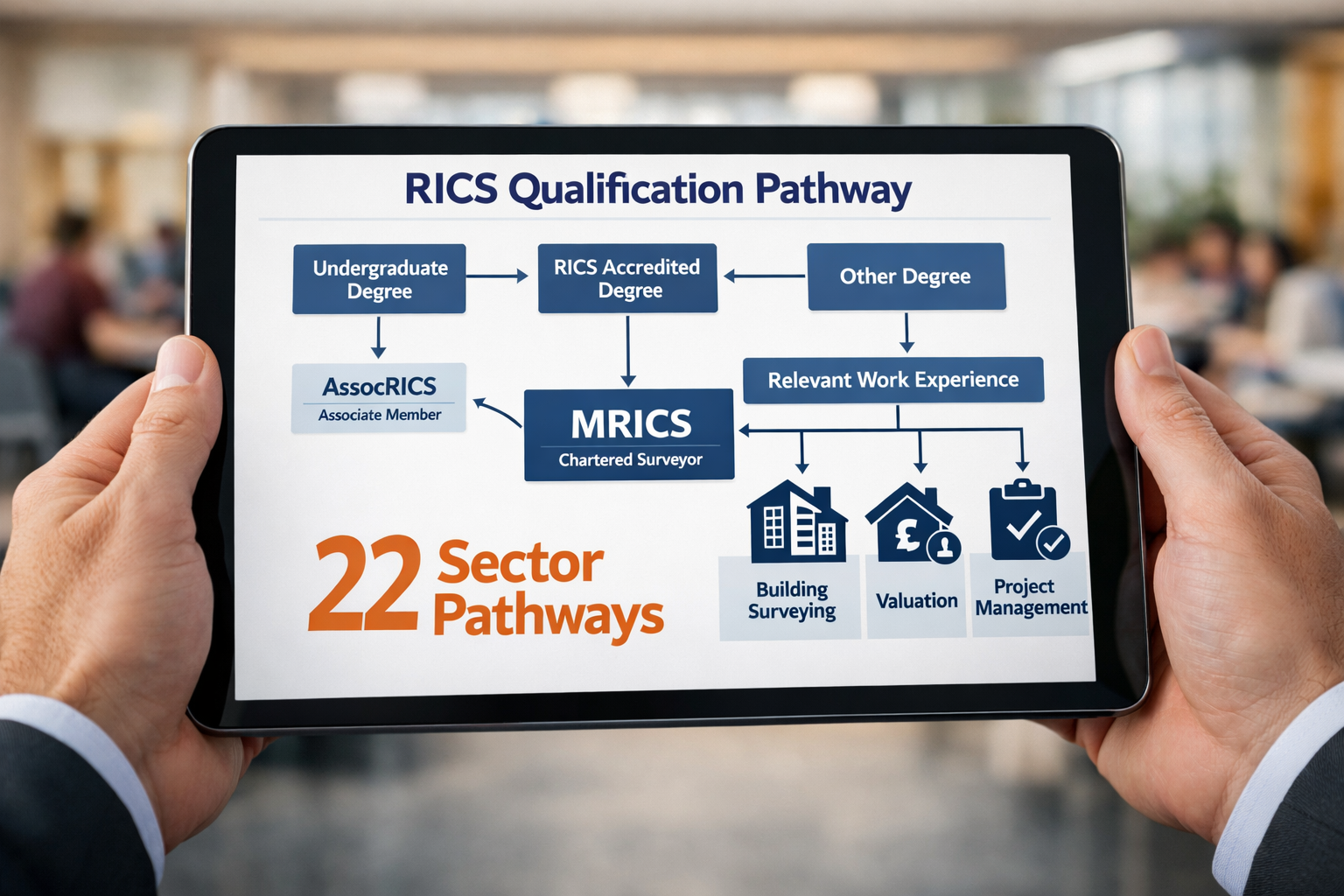
The institution now provides 22 distinct sector pathways for Chartered qualification (MRICS) and 13 pathways for Associate qualification (AssocRICS) [1]. This expansion allows candidates to specialize earlier in their careers while ensuring assessment criteria align precisely with sector-specific competencies.
Key pathways include:
- 🏗️ Building Surveying – focusing on building pathology, defect diagnosis, and construction technology
- 💰 Valuation – emphasizing market analysis, valuation methodology, and regulatory compliance
- 📐 Quantity Surveying & Construction – covering cost management, procurement, and contract administration
- 🏢 Commercial Property Practice – addressing agency, landlord & tenant, and investment advice
- 🌍 Project Management – encompassing programme delivery, risk management, and stakeholder coordination
Each pathway features tailored competency frameworks that reflect actual workplace requirements, making the qualification more relevant to employers and more achievable for candidates.
The New Data Analytics Pathway
Recognizing the profession's digital transformation, RICS is piloting a data analytics and intelligence pathway in 2026 [6]. This groundbreaking addition acknowledges that modern surveying increasingly relies on:
- PropTech platforms generating vast datasets requiring interpretation
- Building Information Modeling (BIM) creating digital twin environments
- Environmental performance metrics demanding sophisticated analysis
- Market intelligence tools enabling predictive modeling
The data analytics pathway prepares professionals to bridge traditional surveying expertise with computational capabilities, positioning them as strategic advisors rather than purely technical consultants.
Undergraduate to Professional Qualification Journey
The typical route from undergraduate study to full RICS qualification follows this structure:
Year 1-3/4: Complete RICS-accredited degree programme in surveying, real estate, or related discipline. Over 1,200 accredited courses are available globally [4], offering flexibility in specialization and study mode.
Year 4/5: Enter structured graduate training programme with employer providing:
- Supervised practical experience across multiple surveying disciplines
- Exposure to client interactions and project delivery
- Introduction to professional ethics and business development
Year 5-7: Complete Assessment of Professional Competence (APC), demonstrating competency across mandatory, core, and optional areas through:
- Structured training agreement with RICS-registered supervisor
- Documented evidence of experience (typically 24 months minimum)
- Critical analysis case study
- Final assessment interview with experienced assessors
This framework ensures graduates develop both technical proficiency and professional judgment before achieving chartered status.
Alternative Routes for Career Changers
RICS recognizes that valuable talent may come from non-surveying backgrounds. Postgraduate conversion pathways enable graduates from other disciplines to enter the profession through:
- RICS-accredited master's programmes (typically 12-24 months) covering surveying fundamentals and specialist knowledge
- Postgraduate diplomas offering focused technical education without full master's requirements
- Senior Professional Assessment (SPA) for experienced professionals demonstrating equivalent competency through alternative routes
These flexible pathways broaden the talent pool beyond traditional surveying undergraduates, bringing diverse perspectives and transferable skills into the profession.
Surveyor Talent Pipeline Strategies: Structured Graduate Schemes and Work Placements
Effective talent pipeline development requires coordinated employer investment in graduate development. Leading organizations have created comprehensive training programmes that combine workplace learning with formal qualification support.
Government Sector Graduate Opportunities
The Valuation Office Agency (VOA) exemplifies best-practice graduate recruitment for 2026. Their programme offers:
Graduate Scheme Features:
- Multiple hub locations across England and Wales providing geographic flexibility
- Requirements: RICS-accredited Real Estate or Valuation degree (2:2 minimum) or MSc in Real Estate by September 7, 2026
- Notably high RICS APC pass rates demonstrating quality of supervision and support [2]
- Structured rotation through different valuation specialisms
- Guaranteed progression pathway with competitive public sector benefits
MSc Chartered Surveyor Apprenticeship:
The VOA also offers an integrated 3-year apprenticeship programme combining:
- Employment as trainee surveyor with full salary and benefits
- Part-time MSc in Real Estate study through partner university
- Structured APC preparation leading to MRICS qualification
- No tuition fees for participants [2]
This model addresses a critical barrier for many potential entrants: the financial burden of postgraduate education while establishing professional experience.
Undergraduate Work Placements:
For students currently pursuing RICS-accredited degrees, the VOA provides 12-month placements starting September 2026 [2]. These placements offer:
- Early responsibility for individual caseloads under supervision
- Exposure to diverse property types and valuation methodologies
- Competitive placement salary
- Strong conversion rates to graduate scheme positions
Such structured placements create early talent identification opportunities for employers while giving students realistic career previews.
Commercial Sector Graduate Programmes
Private practice firms have developed equally sophisticated approaches. Typical 2-year commercial surveying graduate schemes feature [3]:
Rotation Structure:
- 6, 8, or 12-month rotations through different service lines (Landlord & Tenant, Valuations, Agency)
- Exposure to diverse client types and property sectors
- Progression from shadowing to independent project responsibility
- Multi-disciplinary team integration building collaborative capabilities
Professional Development Support:
- Formal APC training sessions covering competency requirements
- Dedicated RICS counsellors providing technical guidance
- Senior mentors offering career advice and networking opportunities
- Regular progress reviews with structured feedback
- CPD opportunities including external courses and conferences [3]
Business Skills Development:
- Client relationship management training
- Business development and pitching skills
- Financial acumen and commercial awareness
- Technology platform proficiency (PropTech, CRM systems, data analytics tools)
This holistic approach recognizes that technical competency alone is insufficient—modern surveyors require business acumen and interpersonal effectiveness.
Creating Effective In-House Training Programmes
Firms developing their own graduate schemes should consider these essential components:
✅ Structured Learning Plan:
- Clear competency framework aligned to RICS APC requirements
- Progressive responsibility with defined milestones
- Balanced exposure across technical, client, and business functions
- Documentation systems supporting APC evidence gathering
✅ Supervision and Mentorship:
- RICS-registered counsellors with appropriate sector experience
- Regular one-to-one supervision sessions (minimum monthly)
- Peer learning opportunities through graduate cohorts
- Senior leadership visibility and accessibility
✅ Assessment and Feedback:
- Quarterly competency reviews against APC criteria
- Mock final assessments preparing candidates for RICS interview
- Constructive feedback culture encouraging continuous improvement
- Recognition and celebration of achievement milestones
✅ Retention Strategies:
- Competitive compensation benchmarked against market rates
- Clear post-qualification career pathways
- Professional development budgets for CPD activities
- Work-life balance policies supporting wellbeing
Firms offering chartered surveying services across multiple locations benefit from geographic flexibility in graduate deployment, allowing exposure to diverse markets and property types.
Surveyor Talent Pipeline Strategies: CPD Upgrades and Continuing Professional Development
Qualification achievement represents the beginning rather than end of professional development. RICS has enhanced its CPD framework for 2026 to ensure qualified professionals maintain competency amid rapid sector evolution.
The Revised CPD Framework
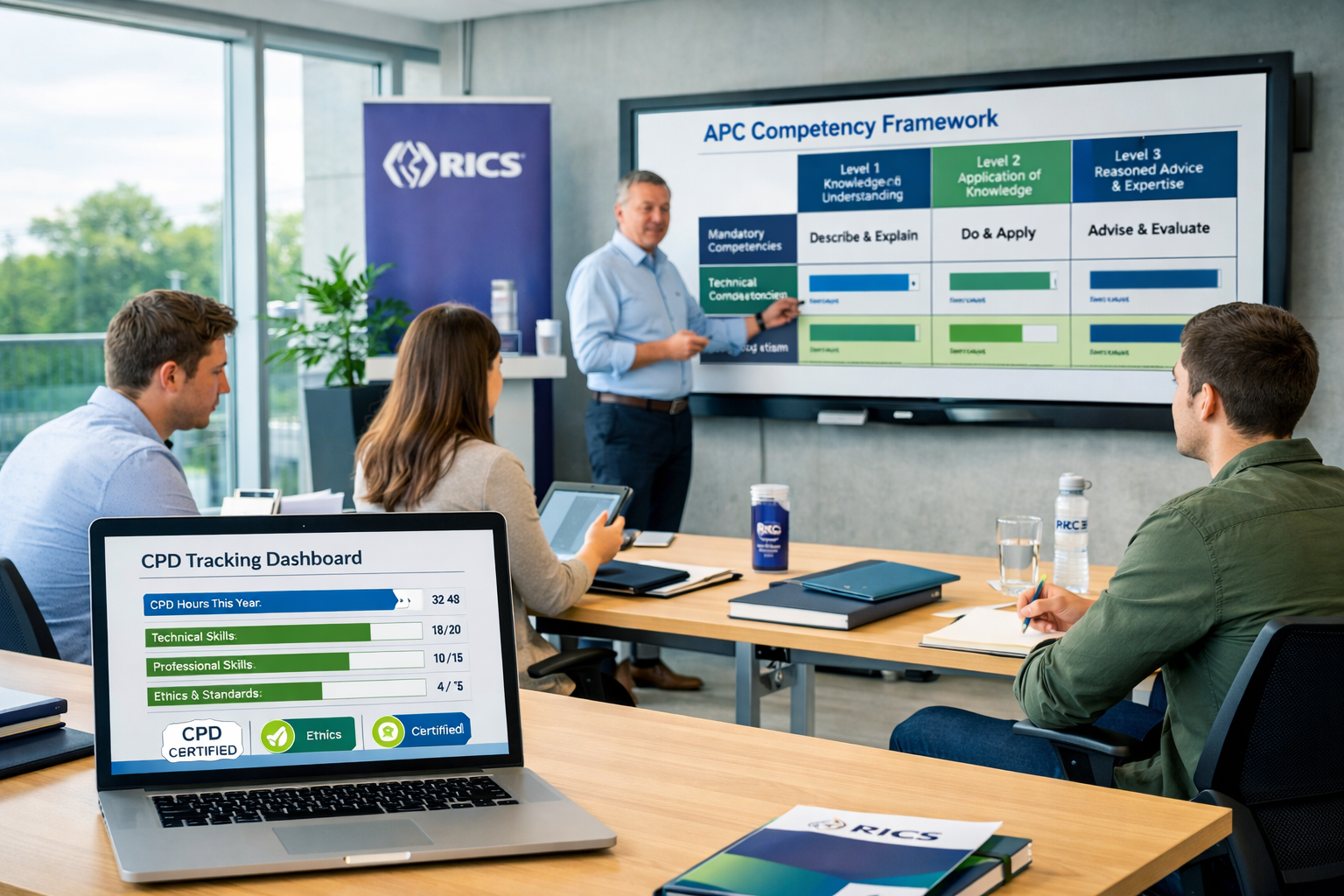
RICS requires all members to complete minimum 20 hours annual CPD, with at least 10 hours in formal learning activities. The 2026 framework emphasizes:
Outcomes-Focused Approach:
Rather than simply logging hours, professionals must demonstrate how CPD activities:
- Address identified competency gaps or development needs
- Enhance capability in current or anticipated future roles
- Contribute to professional judgment and ethical decision-making
- Support career progression objectives
Diverse Learning Formats:
Acceptable CPD activities include:
- 📚 Formal courses, conferences, and seminars
- 💻 Online learning modules and webinars
- 📖 Structured reading and research
- 🎓 Academic study and qualification programmes
- 👥 Mentoring others and peer learning groups
- ✍️ Writing articles and presenting at events
- 🔬 Research and development projects
This flexibility recognizes that professionals learn through varied mechanisms and should tailor development to their specific contexts.
Digital CPD Platforms and Tools
RICS has invested significantly in digital infrastructure supporting professional development:
Enhanced Member Portal:
The redesigned online platform provides:
- Personalized CPD tracking dashboards showing progress toward annual requirements
- Searchable database of accredited CPD providers and courses
- Competency self-assessment tools identifying development priorities
- Digital badges and certificates recognizing achievement
- Integration with professional profiles for client visibility
New RICS Member App:
A mobile application launched in 2026 enables:
- On-the-go CPD logging and evidence upload
- Push notifications about relevant learning opportunities
- Networking features connecting members with shared interests
- Quick access to technical standards and guidance
- Event registration and calendar integration
These tools reduce administrative friction while making professional development more visible and valued within firms.
Emerging CPD Focus Areas for 2026
The profession's evolving landscape demands CPD investment in specific domains:
🌱 Sustainability and Net Zero:
- Energy performance assessment and retrofit strategies
- Embodied carbon calculation and lifecycle analysis
- Green building certifications (BREEAM, LEED, WELL)
- Climate risk assessment for property portfolios
Understanding EPC ratings and MEES compliance has become essential for building surveyors advising on property transactions.
🔐 Building Safety and Compliance:
- Building Safety Act 2022 implications and responsibilities
- Fire risk assessment methodologies
- Structural integrity evaluation techniques
- Regulatory compliance frameworks
Professionals conducting comprehensive building surveys require current knowledge of safety regulations and inspection protocols.
💻 Digital Technology and PropTech:
- Building Information Modeling (BIM) and digital twins
- Drone surveying and photogrammetry
- Data analytics and predictive modeling
- Artificial intelligence applications in property assessment
Firms offering drone survey services exemplify technology adoption enhancing service delivery.
📊 Market Intelligence and Economics:
- Economic indicators and property market cycles
- Investment analysis and portfolio strategy
- Alternative asset classes and emerging sectors
- Global market trends and cross-border considerations
Employer-Supported CPD Strategies
Organizations maximizing return on CPD investment implement:
📅 Annual Development Planning:
- Individual development discussions linking business objectives to personal growth
- Team CPD plans addressing collective capability gaps
- Budget allocation proportionate to development priorities
- Calendar planning ensuring learning time is protected
🏢 In-House Learning Programmes:
- Lunch-and-learn sessions sharing project insights
- Technical workshops led by specialist team members
- Case study reviews analyzing challenging projects
- Cross-disciplinary knowledge exchange
🤝 External Partnership Development:
- Relationships with universities for guest lecturing and research collaboration
- Industry association engagement providing networking and learning
- Client-sponsored training on specific property types or sectors
- Technology vendor partnerships for platform training
📈 CPD Recognition and Incentives:
- Performance review integration valuing learning achievement
- Promotion criteria including CPD engagement and knowledge sharing
- Awards recognizing exceptional professional development
- Study leave policies supporting significant learning commitments
Firms providing specialist valuation services benefit from staff pursuing advanced CPD in valuation methodology and market analysis.
Practical Implementation: Recruitment and Training Checklists
Translating Surveyor Talent Pipeline Strategies: RICS Graduate Pathways and CPD Upgrades for 2026 Demand Surge into action requires systematic implementation. These checklists provide practical frameworks for firms.

Graduate Recruitment Checklist
🎯 Pre-Recruitment Planning:
- Define annual graduate intake numbers based on growth projections and succession planning
- Identify target universities with strong RICS-accredited programmes
- Establish relationships with university careers services and course directors
- Develop compelling employer brand highlighting development opportunities
- Create realistic job previews (videos, case studies, testimonials)
- Benchmark compensation packages against sector competitors
- Secure budget for recruitment activities and graduate programme costs
📢 Attraction and Selection:
- Attend university careers fairs and employer presentations
- Offer vacation placements and insight days for penultimate-year students
- Design assessment process evaluating technical aptitude, commercial awareness, and cultural fit
- Implement structured interviews with behavioral and technical components
- Provide timely feedback and positive candidate experience
- Make competitive offers with clear programme details
- Maintain engagement with accepted candidates until start date
🚀 Onboarding and Integration:
- Develop comprehensive induction programme covering firm culture, systems, and expectations
- Assign buddies from recent graduate cohorts for peer support
- Introduce to RICS counsellor and establish supervision framework
- Create personalized learning plans aligned to APC requirements
- Provide necessary equipment, software access, and workspace
- Schedule early client exposure and project involvement
- Establish regular check-in cadence with line manager and HR
Graduate Development Programme Checklist
📚 Structured Learning:
- Map graduate rotation schedule across different service lines or sectors
- Identify learning objectives for each rotation period
- Schedule formal APC training sessions covering mandatory and optional competencies
- Arrange technical workshops on core surveying skills
- Provide access to RICS online learning resources and CPD platforms
- Organize external course attendance for specialist topics
- Create resource library of technical guidance, case studies, and templates
👨🏫 Supervision and Mentorship:
- Confirm RICS counsellor registration and sector expertise
- Establish monthly supervision meetings with structured agenda
- Implement APC evidence gathering systems and templates
- Conduct quarterly competency reviews with documented feedback
- Facilitate senior mentor relationships for career guidance
- Create peer learning groups for knowledge sharing
- Provide mock final assessment practice with constructive critique
📊 Progress Monitoring:
- Track competency development against APC requirements
- Review quality and quantity of APC evidence documentation
- Monitor engagement with CPD activities and learning opportunities
- Assess integration into teams and client relationships
- Identify and address performance concerns early
- Celebrate achievement milestones and positive contributions
- Conduct exit interviews with departing graduates to inform programme improvement
🎓 APC Preparation and Support:
- Enroll candidates for APC when eligibility criteria met
- Review and provide feedback on critical analysis case study
- Arrange mock final assessment interviews with experienced assessors
- Provide study leave for final assessment preparation
- Offer pastoral support managing assessment stress
- Celebrate successful qualification achievement
- Plan post-qualification career development and specialization
Qualified Professional CPD Checklist
🎯 Individual Development Planning:
- Conduct annual development discussions identifying learning needs
- Create personal CPD plans with specific objectives and activities
- Allocate appropriate CPD budget and time allowance
- Identify opportunities for career progression and specialization
- Set goals for knowledge sharing and mentoring contributions
📅 Organizational CPD Infrastructure:
- Establish in-house learning programme schedule
- Curate list of preferred external CPD providers
- Implement CPD tracking system (RICS portal or internal platform)
- Create knowledge management system capturing project learnings
- Organize regular technical updates on regulatory and market changes
- Facilitate attendance at industry conferences and networking events
- Develop relationships with academic institutions for research collaboration
✅ Compliance and Quality Assurance:
- Monitor individual CPD completion rates
- Review CPD quality and relevance to business needs
- Conduct periodic audits of CPD documentation
- Address non-compliance issues promptly and supportively
- Recognize and reward exceptional CPD engagement
- Gather feedback on learning effectiveness
- Continuously improve CPD offerings based on member input
Talent Retention Checklist
💰 Compensation and Benefits:
- Benchmark salaries against market rates annually
- Implement transparent progression frameworks
- Offer performance-related bonuses and profit sharing
- Provide comprehensive benefits package (pension, healthcare, insurance)
- Consider flexible benefits allowing personalization
- Review and adjust compensation for newly qualified professionals
- Recognize and reward exceptional contributions
🌟 Career Development:
- Create clear career pathways with defined progression criteria
- Offer specialization opportunities in high-demand areas
- Support professional involvement (RICS committees, industry groups)
- Enable secondments to different offices or service lines
- Facilitate international experience where applicable
- Provide leadership development for emerging talent
- Offer partnership or equity participation pathways
⚖️ Work-Life Balance:
- Implement flexible working policies (remote work, flexible hours)
- Monitor workload distribution and address imbalances
- Encourage vacation utilization and genuine disconnection
- Provide wellbeing support (EAP, mental health resources)
- Create inclusive culture valuing diversity and different perspectives
- Recognize and address burnout risks proactively
- Celebrate team achievements and foster positive culture
Firms operating across multiple geographic locations can leverage regional diversity as a retention tool, offering relocation opportunities and exposure to varied property markets.
Strategic Considerations for Surveying Firms
Beyond operational checklists, firms must address strategic questions shaping long-term talent pipeline success.
Build vs. Buy Talent Decisions
Organizations face fundamental choices about talent acquisition:
Building Internal Talent:
- Advantages: Cultural alignment, loyalty, customized development, lower immediate cost
- Challenges: Time to competency, risk of early departure, supervision capacity requirements
- Best for: Firms with stable growth, strong mentoring culture, and long-term perspective
Buying External Talent:
- Advantages: Immediate capability, fresh perspectives, reduced training investment
- Challenges: Higher salary expectations, cultural integration risk, potential knowledge gaps in firm systems
- Best for: Firms with urgent capacity needs, specialized requirements, or rapid growth
Most successful firms pursue balanced portfolios combining graduate development with selective lateral hiring.
Specialization vs. Generalist Development
The 2026 market presents tension between:
Specialist Development:
- Deep expertise in high-demand niches (building safety, sustainability, data analytics)
- Premium fee potential and competitive differentiation
- Risk of narrow skill sets limiting flexibility
Generalist Development:
- Broad capability across multiple surveying disciplines
- Greater deployment flexibility and succession planning options
- Risk of insufficient depth in any single area
The expanded RICS pathway structure supports early specialization while maintaining foundational breadth, allowing firms to develop T-shaped professionals with deep expertise in one area and broad awareness across others.
Technology Investment and Digital Capability
Surveying's digital transformation requires parallel investment in technology platforms and human capability:
Essential Technology Domains:
- Building Information Modeling (BIM) and 3D visualization
- Drone surveying and photogrammetry equipment
- Data analytics platforms and business intelligence tools
- Customer relationship management (CRM) systems
- Mobile surveying applications and field data capture
Professionals conducting measured building surveys increasingly rely on laser scanning and digital modeling rather than traditional measurement techniques.
Capability Development Strategies:
- Recruit graduates with digital skills and technology aptitude
- Provide comprehensive training on adopted platforms
- Create specialist roles (BIM coordinator, data analyst) supporting wider team
- Partner with technology vendors for ongoing training and support
- Encourage experimentation and innovation with new tools
Firms that successfully integrate technology with traditional surveying expertise gain significant competitive advantages in efficiency, accuracy, and service innovation.
Diversity and Inclusion Initiatives
Addressing the profession's demographic challenges requires intentional diversity strategies:
Gender Diversity:
- Targeted outreach to female students and career changers
- Flexible working policies supporting work-life integration
- Visible female role models in leadership positions
- Inclusive culture challenging unconscious bias
Socioeconomic Diversity:
- Partnerships with widening participation universities
- Paid internships and work experience removing financial barriers
- Apprenticeship routes providing earn-while-learning pathways
- Transparent recruitment focusing on potential rather than polish
Geographic Diversity:
- Regional office presence attracting local talent
- Remote working enabling access to broader talent pools
- Relocation support for graduates willing to move
- Partnerships with regional universities and colleges
Diverse teams bring broader perspectives and enhanced problem-solving capabilities, improving service quality and innovation.
Measuring Talent Pipeline Success
Effective talent strategies require robust measurement frameworks tracking both leading and lagging indicators.
Key Performance Indicators
Recruitment Metrics:
- Applications per vacancy (measuring employer brand strength)
- Offer acceptance rate (measuring competitiveness)
- Time to fill positions (measuring recruitment efficiency)
- Cost per hire (measuring recruitment investment)
- New hire quality ratings (measuring selection effectiveness)
Development Metrics:
- APC first-time pass rate (measuring training quality)
- Time to qualification (measuring development efficiency)
- Competency progression rates (measuring learning effectiveness)
- CPD completion rates (measuring engagement)
- Internal promotion rates (measuring career development)
Retention Metrics:
- Overall turnover rate (measuring retention effectiveness)
- Regretted vs. non-regretted turnover (measuring talent loss quality)
- Tenure by cohort (measuring long-term retention)
- Exit interview themes (measuring departure drivers)
- Alumni engagement (measuring relationship maintenance)
Business Impact Metrics:
- Revenue per professional (measuring productivity)
- Client satisfaction scores (measuring service quality)
- Innovation indicators (measuring capability advancement)
- Succession planning coverage (measuring pipeline depth)
- Diversity metrics (measuring inclusion progress)
Benchmarking and Continuous Improvement
Firms should regularly benchmark against sector standards and competitors:
- Participate in industry salary surveys and talent studies
- Engage with RICS data on qualification trends and pass rates
- Network with peer firms sharing talent development insights
- Conduct employee engagement surveys measuring satisfaction
- Analyze talent data identifying trends and opportunities
This intelligence informs continuous improvement cycles refining recruitment, development, and retention strategies.
Conclusion
The Surveyor Talent Pipeline Strategies: RICS Graduate Pathways and CPD Upgrades for 2026 Demand Surge present both challenges and opportunities for surveying firms. The profession faces unprecedented demand driven by regulatory reform, demographic shifts, and market evolution. However, RICS has responded with enhanced qualification frameworks, expanded sector pathways, and improved digital infrastructure supporting professional development.
Successful firms will:
✅ Invest proactively in graduate recruitment rather than relying on reactive lateral hiring
✅ Implement structured development programmes with clear APC support and mentorship
✅ Leverage enhanced RICS pathways including emerging specialisms like data analytics
✅ Create compelling CPD cultures that value continuous learning and knowledge sharing
✅ Adopt systematic approaches using recruitment and training checklists
✅ Measure talent pipeline performance through robust KPIs and benchmarking
✅ Address diversity and inclusion to access broader talent pools
✅ Integrate technology with traditional surveying expertise
The firms that view talent development as strategic investment rather than operational cost will build resilient teams capable of delivering exceptional client service while navigating the profession's transformation. The 2026 demand surge creates urgency, but the enhanced RICS frameworks provide clear pathways for firms committed to developing the next generation of surveying professionals.
Actionable Next Steps
For Surveying Firms:
- Review current graduate intake numbers against projected demand and succession needs
- Audit existing training programmes against the checklists provided
- Establish relationships with universities offering RICS-accredited programmes
- Invest in RICS counsellor registration for senior staff
- Implement CPD tracking systems and development planning processes
- Benchmark compensation and benefits against sector standards
- Develop employer brand materials highlighting development opportunities
For Aspiring Surveyors:
- Research the 22 RICS sector pathways identifying best fit for interests and strengths
- Pursue RICS-accredited undergraduate or postgraduate programmes
- Seek vacation placements and work experience with reputable firms
- Engage with RICS student membership for networking and resources
- Develop digital skills alongside traditional surveying knowledge
- Consider apprenticeship routes offering earn-while-learning pathways
- Build awareness of current market issues through professional reading and events
For RICS Members:
- Complete annual CPD requirements using enhanced digital platforms
- Consider RICS counsellor registration to support graduate development
- Engage with emerging pathways (data analytics) to future-proof careers
- Participate in knowledge sharing through writing, presenting, and mentoring
- Stay current on regulatory changes affecting practice areas
- Leverage the new RICS member app for professional development tracking
- Contribute to the profession's evolution through committee involvement and advocacy
The surveying profession's future depends on collective commitment to talent development. By embracing enhanced RICS pathways, implementing systematic recruitment and training strategies, and fostering cultures of continuous learning, firms can build the talent pipelines essential for meeting 2026's demand surge and beyond.
Whether you're looking for expert building survey services, considering a career in surveying, or seeking to understand what different survey types offer, the enhanced talent pipeline strategies for 2026 ensure the profession remains equipped to deliver the expertise property markets demand.
References
[1] Sector Pathways – rics.org
[2] Valuation Office Agency Graduate Scheme – gov.uk
[3] 2026 Graduate Commercial Surveyor 189792 – targetjobs.co.uk
[4] How To Become A Surveyor – rics.org
[6] Rics Launches Expressions Of Interest For New Data Analytics Qualification Pathway – lexisnexis.co.uk