

{"cover":"Professional landscape format (1536×1024) hero image featuring bold text overlay 'Valuation Precision in East Anglia Lags: RICS Counter-Strategies for South East Recovery Disparities' in extra large 72pt white sans-serif font with dark shadow and semi-transparent navy overlay box, positioned in upper third. Background shows split-screen composition: left side displays East Anglia countryside with traditional brick homes and 'For Sale' signs, right side shows modern RICS chartered surveyor examining property documents with laptop displaying regional price decline graphs and heat maps of UK property markets. Color scheme: deep navy blue, burgundy red for declining trends, white text, professional editorial quality with subtle Union Jack accent colors, magazine cover aesthetic, high contrast, photorealistic style","content":["Landscape format (1536×1024) detailed infographic showing UK regional property price performance map with color-coded heat zones, East Anglia and South East regions highlighted in deep red indicating -26% and -24% net balance decline, contrasting with Scotland and North West in green showing positive growth, center features large downward trending arrow overlaid on East Anglia geography, side panels display bar charts comparing regional performance February 2026, RICS logo watermark, professional financial publication aesthetic with clean typography, data visualization style, muted color palette of burgundy, navy, sage green, cream background","Landscape format (1536×1024) professional scene showing RICS chartered surveyor conducting detailed property assessment inside period East Anglia home, surveyor holding tablet displaying comparable property data and valuation adjustment calculations, background shows exposed brick wall with moisture meter readings, clipboard with RICS valuation forms visible, foreground features open laptop screen showing spreadsheet with adjustment factors for affordability constraints and market conditions, natural lighting through Georgian windows, documentary photography style, realistic professional setting, tools of the trade prominently featured, warm interior tones with pops of RICS brand blue","Landscape format (1536×1024) strategic planning visualization showing recovery roadmap for South East property markets, central focus on large conference table with rolled architectural plans and property market reports spread out, hands pointing to specific strategies on documents, background features wall-mounted screens displaying positive trend projections and buyer sentiment recovery indicators, foreground shows tablet with RICS guidance documents and counter-strategy frameworks, professional office setting with London skyline visible through windows, collaborative business atmosphere, modern corporate aesthetic, balanced lighting, hope and recovery theme with upward arrows and green growth indicators"]"}

The UK property market in 2026 reveals a troubling geographic divide: while northern regions experience price growth, East Anglia and the South East are experiencing unprecedented downward pressure. For chartered surveyors working in these affordability-challenged areas, maintaining valuation precision has become increasingly complex. The question isn't whether prices are falling—the data confirms they are—but rather how professionals can defend their assessments and implement strategies that reflect true market value amid volatility. Understanding Valuation Precision in East Anglia Lags: RICS Counter-Strategies for South East Recovery Disparities has become essential for surveyors navigating these turbulent regional markets.
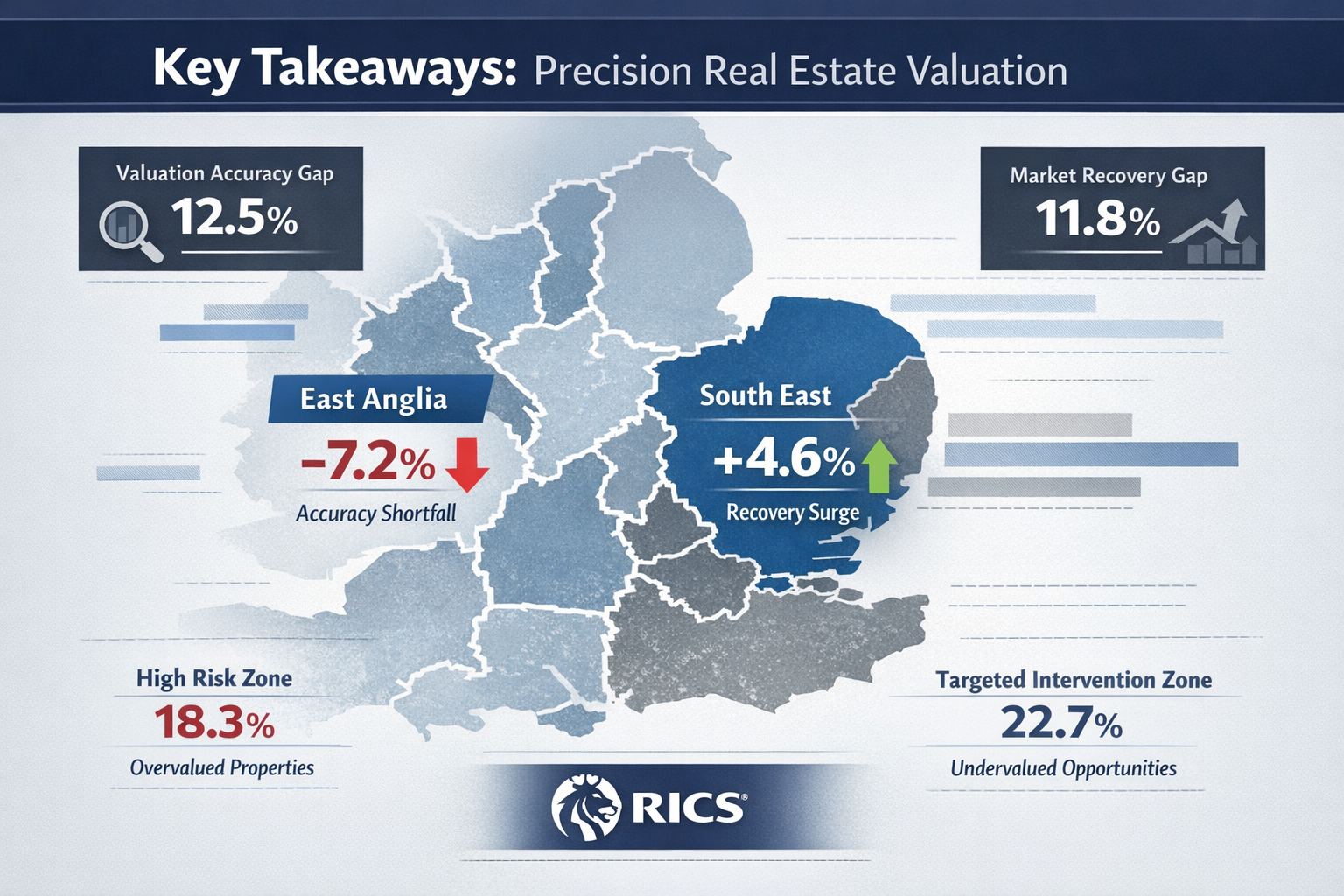
Key Takeaways
- East Anglia recorded a -26% net balance in price changes as of February 2026, with the South East at -24%, representing the most significant regional declines outside London's -40%[1]
- Affordability constraints remain the primary driver of southern market weakness, with high property-to-income ratios suppressing buyer demand across East Anglia and South East regions[2]
- RICS surveyors are implementing adjustment techniques including comparative market analysis refinements, affordability indexing, and stock-level pricing resets to stabilize valuations[3]
- Northern regions show contrasting strength, with Scotland, Northern Ireland, and North West England experiencing price gains, creating a stark north-south divide[1]
- Recovery mechanisms are emerging through realistic price adjustments and renewed buyer interest in previously overpriced stock, suggesting potential stabilization pathways[3]
Understanding the Regional Valuation Crisis: East Anglia and South East Data
The February 2026 RICS UK Residential Market Survey paints a stark picture of regional disparity. East Anglia's net balance of -26% means that significantly more surveyors reported falling prices than rising prices over the three-month period, placing the region among the worst-performing in the UK.[1] The South East follows closely with -24%, while London leads the decline at -40%.[1]
These figures represent more than statistical anomalies—they signal fundamental challenges in valuation precision that directly impact surveyors' professional practice. When market sentiment shifts this dramatically, traditional valuation methodologies require recalibration to maintain accuracy and professional credibility.
The Affordability Factor
The underlying cause of Valuation Precision in East Anglia Lags: RICS Counter-Strategies for South East Recovery Disparities centers on persistent affordability challenges. Despite price corrections, property values in these southern regions remain elevated relative to local income levels.[2] This creates a valuation paradox: comparable sales data may suggest certain price points, yet actual transaction volumes reveal buyer resistance at those levels.
For surveyors conducting commercial valuations or matrimonial valuations, this disconnect between historical comparables and current market reality presents significant professional challenges. The question becomes: which data points should carry greater weight when recent transactions are sparse and sentiment indicators point downward?
Buyer Sentiment Deterioration
February 2026 data reveals that buyer sentiment has deteriorated specifically in southern regions, with renewed concerns over interest rates and macroeconomic uncertainty weighing particularly heavily on demand.[4] This psychological component adds another layer of complexity to valuation work, as surveyors must account not only for tangible market metrics but also for the intangible impact of confidence erosion.
The contrast with northern regions is striking. Scotland, Northern Ireland, and the North West are reporting upward price trajectories, creating a geographic divide that challenges national valuation standards and requires region-specific adjustment approaches.[1]
RICS Counter-Strategies for Valuation Precision in East Anglia Lags
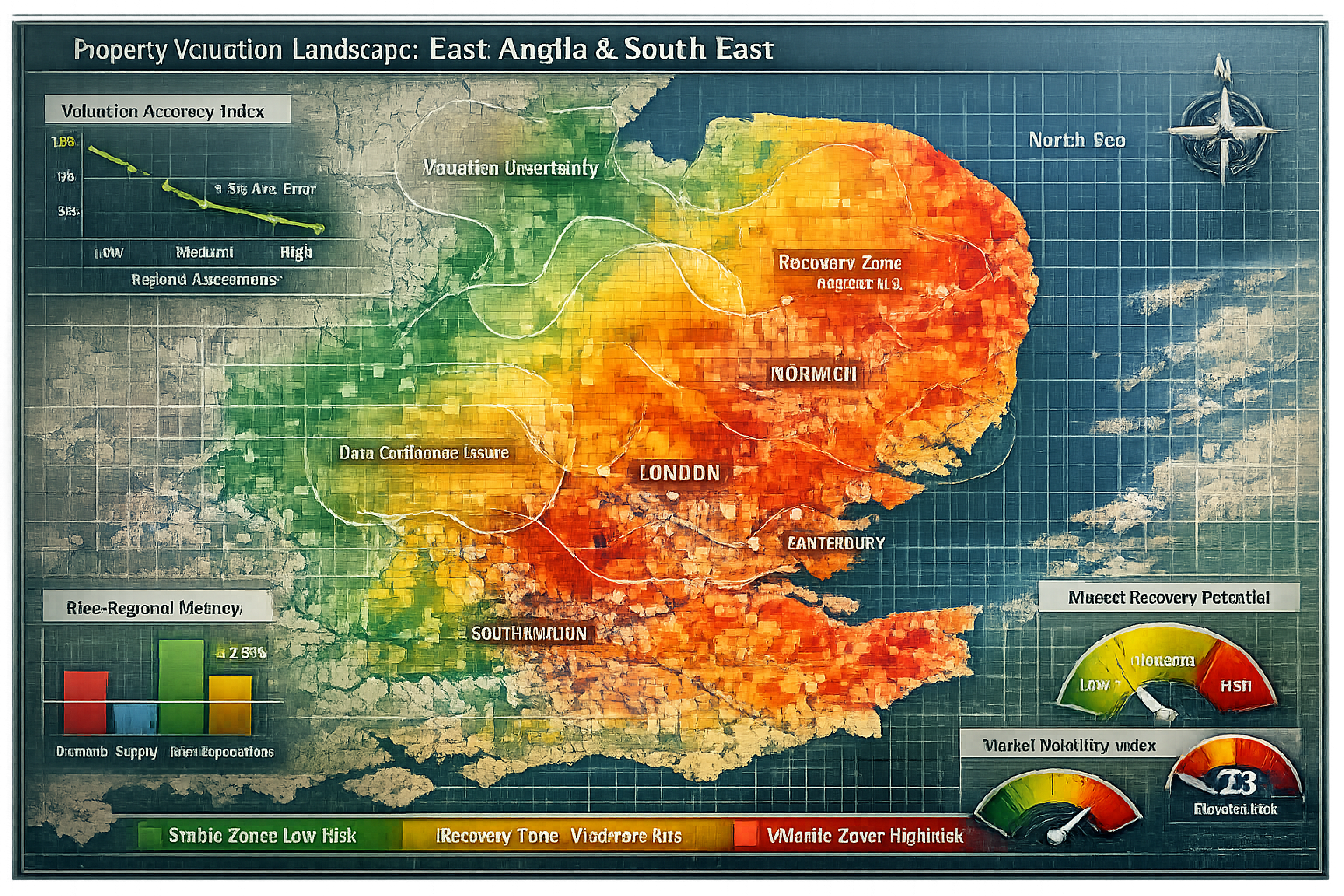
Recognizing the challenges facing surveyors in lagging regions, RICS has identified several counter-strategies that help maintain valuation precision while acknowledging market realities. These approaches balance professional standards with practical market conditions.
Comparative Market Analysis Refinement
Traditional comparable sales analysis relies on recent transactions within defined geographic and temporal parameters. However, in rapidly declining markets like East Anglia, this methodology requires refinement:
- Time-weighted adjustments: Apply greater weight to the most recent transactions, even if this means expanding geographic search parameters
- Sentiment-adjusted comparables: Factor in the direction and velocity of price changes when selecting and adjusting comparable properties
- Transaction volume analysis: Consider the significance of low transaction volumes as an indicator of price discovery challenges
When conducting insurance reinstatement cost valuations, surveyors must distinguish between replacement cost (which may remain stable) and market value (which is declining), ensuring clients understand these distinct valuation bases.
Affordability Indexing Methodology
A key innovation in addressing Valuation Precision in East Anglia Lags: RICS Counter-Strategies for South East Recovery Disparities involves incorporating affordability metrics directly into valuation adjustments:
| Adjustment Factor | Application | Impact on Valuation |
|---|---|---|
| Local income-to-price ratio | Compare subject property price to median local household income | Downward adjustment when ratio exceeds sustainable thresholds |
| Mortgage affordability stress testing | Calculate maximum sustainable mortgage at current rates | Caps realistic market value based on buyer capacity |
| Regional employment trends | Factor in local economic indicators | Adjusts demand assumptions in valuation models |
| Historical affordability benchmarks | Compare current ratios to long-term averages | Identifies extent of market overvaluation |
These quantitative approaches provide defensible justification for valuations that may fall below recent comparable sales, particularly important when surveyors face challenges from clients expecting higher figures based on outdated market perceptions.
Stock-Level Price Reset Recognition
Perhaps the most significant counter-strategy involves acknowledging and documenting the price reset process currently underway in southern markets. January 2026 RICS data noted that London surveyors observed "stock that remained unsold during last year's weaker market is now attracting renewed interest as asking prices adjust to more realistic levels."[3]
This observation provides a framework for East Anglia and South East surveyors:
✅ Document asking price reductions as evidence of market recalibration
✅ Track days-on-market trends to identify when price adjustments stimulate activity
✅ Monitor withdrawal and re-listing patterns as indicators of seller capitulation
✅ Record vendor motivation factors that may influence realistic pricing
For professionals conducting right to buy valuations, this reset recognition is particularly important, as statutory valuations must reflect genuine market conditions rather than aspirational pricing from a previous market cycle.
Enhanced Market Evidence Documentation
In volatile markets, the quality and depth of market evidence supporting valuations becomes paramount. RICS guidance emphasizes:
- Expanded commentary sections: Provide detailed narrative explaining market conditions and their impact on value conclusions
- Multiple valuation scenarios: Present range valuations reflecting uncertainty, particularly for matrimonial valuations where precision is legally significant
- Forward-looking indicators: Include data on new instructions, buyer registrations, and mortgage approvals as leading indicators
- Regional context: Explicitly compare local market performance to national trends, explaining divergence
This enhanced documentation approach protects surveyors professionally while providing clients with transparent understanding of valuation rationale. Those seeking comprehensive property assessments can benefit from understanding which building survey they need alongside valuation services.
Recovery Pathways: Implementing South East Counter-Strategies

While current data on Valuation Precision in East Anglia Lags: RICS Counter-Strategies for South East Recovery Disparities reveals significant challenges, recovery mechanisms are emerging that surveyors can leverage to stabilize valuations and support market normalization.
Realistic Pricing as Market Catalyst
The January 2026 observation that adjusted asking prices are "attracting renewed interest" provides a critical insight: price discovery through realistic adjustments can reignite market activity.[3] Surveyors play a pivotal role in this process by:
- Providing vendors with evidence-based pricing guidance that reflects current market capacity
- Quantifying the cost of overpricing through extended marketing periods and eventual price reductions
- Demonstrating how strategic pricing within buyer affordability parameters accelerates transactions
This approach requires professional courage—delivering valuations that may disappoint clients but ultimately serve their interests by facilitating actual sales rather than prolonged market exposure.
Segmented Market Analysis
Not all properties within East Anglia and the South East are experiencing uniform decline. Recovery strategies must recognize market segmentation:
Price Band Performance:
- Entry-level properties (below £300,000): Experiencing strongest relative demand due to first-time buyer activity and Help to Buy legacy
- Mid-market properties (£300,000-£600,000): Facing greatest pressure as affordability constraints peak
- Premium properties (above £600,000): More resilient due to cash buyer prevalence and international demand
Property Type Variations:
- Period properties requiring renovation: Attracting value-seeking buyers willing to invest in improvements
- New-build developments: Struggling with premium pricing in declining markets
- Rural properties: Maintaining relative strength due to lifestyle demand persistence
Understanding these segments allows surveyors to apply nuanced adjustment factors rather than blanket regional corrections, improving valuation precision. Those interested in property condition assessment can explore Level 2 vs Level 3 survey options to understand comprehensive evaluation approaches.
Cross-Regional Benchmarking
The performance disparity between southern and northern regions provides valuable calibration opportunities. By analyzing why Scotland, Northern Ireland, and the North West are experiencing price growth, surveyors can identify factors that might support East Anglia and South East recovery:
- Relative affordability thresholds: Northern regions remain within sustainable income-to-price ratios
- Economic diversification: Areas with varied employment bases show greater resilience
- Infrastructure investment: Regions benefiting from transport and development projects maintain demand
- Migration patterns: Understanding population movement helps predict demand shifts
This cross-regional analysis, detailed in resources like Northern England Valuation Surge 2026: RICS Insights, provides context for East Anglia and South East valuations while identifying potential recovery catalysts.[6]
Professional Development and Methodology Updates
Addressing Valuation Precision in East Anglia Lags: RICS Counter-Strategies for South East Recovery Disparities requires ongoing professional development in several areas:
📚 Advanced statistical techniques for volatile market analysis
📚 Economic indicator interpretation beyond traditional property metrics
📚 Client communication strategies for delivering challenging valuation conclusions
📚 Technology adoption including automated valuation model (AVM) integration with professional judgment
RICS continues to provide guidance through its market survey publications and professional development programs, ensuring surveyors have access to evolving best practices. Understanding the Prince Chartered Surveyors approach can provide insights into professional standards and methodologies.
Collaboration with Market Stakeholders
Recovery strategies extend beyond individual surveyors to encompass collaborative approaches with:
- Estate agents: Sharing market intelligence and coordinating realistic pricing strategies
- Mortgage lenders: Understanding lending criteria evolution and its impact on buyer capacity
- Local authorities: Engaging with planning and development initiatives that may influence future demand
- Professional networks: Participating in regional RICS forums to share experiences and standardize approaches
This collaborative framework helps ensure that counter-strategies are implemented consistently across the profession, supporting market stabilization through coordinated professional practice.
Long-Term Market Normalization Indicators
Surveyors should monitor specific indicators that signal potential recovery in East Anglia and South East markets:
✓ New buyer inquiry levels returning to historical averages
✓ Transaction volumes increasing quarter-over-quarter
✓ Days-on-market metrics declining toward normal ranges
✓ Price expectation surveys showing surveyor confidence improvement
✓ Mortgage approval rates rising in the region
February 2026 data shows these indicators remain negative, but early signs of stabilization may emerge as price adjustments work through the system.[4] Continuous monitoring allows surveyors to adjust methodologies as market conditions evolve, maintaining valuation precision throughout the recovery cycle.
For those considering property transactions in these challenging markets, understanding how to negotiate house prices down after survey findings provides valuable buyer-side perspectives that complement surveyor valuation work.
Conclusion
The challenges facing valuation precision in East Anglia and the South East represent more than temporary market fluctuations—they reflect fundamental affordability constraints that require sophisticated professional responses. With East Anglia recording a -26% net balance and the South East at -24% in February 2026, surveyors in these regions face unprecedented pressure to maintain accuracy while acknowledging market realities.[1]
The RICS counter-strategies outlined—comparative market analysis refinement, affordability indexing, stock-level price reset recognition, and enhanced documentation—provide practical frameworks for navigating these challenges. By implementing these approaches, surveyors can defend their valuations professionally while supporting the market normalization process through realistic pricing guidance.
Recovery pathways are emerging through strategic price adjustments, segmented market analysis, and cross-regional benchmarking. While current conditions remain difficult, the mechanisms for stabilization are being established through professional practice and collaborative stakeholder engagement.
Actionable Next Steps for Surveyors
- Review and update valuation methodologies to incorporate affordability metrics and sentiment-adjusted comparable analysis
- Enhance documentation practices to provide comprehensive market evidence supporting valuation conclusions
- Engage with RICS professional development resources focused on volatile market valuation techniques
- Establish collaborative relationships with local market stakeholders to share intelligence and coordinate strategies
- Monitor recovery indicators continuously, adjusting approaches as market conditions evolve
For property professionals seeking comprehensive surveying services that incorporate these advanced methodologies, exploring commercial valuations and other specialized assessment options provides access to RICS-compliant expertise navigating current market complexities.
The path forward requires professional courage, methodological rigor, and collaborative engagement. By implementing these counter-strategies, surveyors in East Anglia and the South East can maintain valuation precision while supporting market recovery—ultimately serving clients, the profession, and the broader property market through this challenging period.
References
[1] UK Residential Market Survey February 2026 – https://www.rics.org/content/dam/ricsglobal/documents/market-surveys/uk-residential-market-survey/UK-Residential-Market-Survey_February-2026.pdf
[2] UK Resi Survey Jan 2026 Report Shows Early Signs Market Recovery Despite Caution – https://www.rics.org/news-insights/uk-resi-survey-jan-2026-report-shows-early-signs-market-recovery-despite-caution
[3] UK Residential Market Survey January 2026 – https://www.rics.org/content/dam/ricsglobal/documents/market-surveys/uk-residential-market-survey/UK-Residential-Market-Survey_January-2026.pdf
[4] UK Residential Survey February 2026 – https://www.rics.org/news-insights/uk-residential-survey-february-2026
[6] Northern England Valuation Surge 2026 RICS Insights On Price Growth And Surveyor Adjustment Techniques – https://nottinghillsurveyors.com/blog/northern-england-valuation-surge-2026-rics-insights-on-price-growth-and-surveyor-adjustment-techniques