

Northern England is experiencing a remarkable property market resurgence in 2026. As development activity accelerates across cities like Manchester, Leeds, and Newcastle, party wall surveyors are facing unprecedented demand for their services. The combination of returning buyer confidence, increased construction projects, and complex shared boundary situations is creating a perfect storm for party wall matters. Understanding how to navigate Party Wall Surveys in Recovery Markets: Managing Notices and Disputes as Development Activity Accelerates in Northern England has never been more critical for property owners, developers, and construction professionals.
The Royal Institution of Chartered Surveyors (RICS) confirms that Northern regions are reporting upward price trajectories, signaling genuine recovery market conditions[5]. This momentum is translating directly into higher volumes of loft conversions, extensions, basement excavations, and commercial developments—all activities that trigger party wall obligations under the Party Wall etc. Act 1996.

Key Takeaways
- 🏗️ Northern England is leading the UK property market recovery with upward price trajectories and accelerating development activity, creating increased demand for party wall surveying services
- 📋 Proper notice service is essential to avoid disputes, with building owners required to serve notices 1-2 months before work begins depending on project type
- 💷 Party wall surveyor costs range from £900-£2,700 for standard projects in 2026, but can escalate significantly when disputes arise and multiple surveyors are appointed
- ⚖️ Dispute resolution becomes more complex in recovery markets as development pressure increases, making early professional guidance crucial
- 📈 AI-driven infrastructure growth and data centre developments are adding new dimensions to party wall matters across the region
Understanding Party Wall Obligations in Northern England's Recovery Market
The Party Wall etc. Act 1996 applies across England and Wales, providing a framework for preventing and resolving disputes between neighbours when building work affects shared walls, boundaries, or structures. In Northern England's current recovery phase, understanding these obligations is particularly important as development activity intensifies.
What Triggers Party Wall Requirements?
Several common construction activities require party wall notices:
- Building on or at the boundary line between properties
- Excavating within 3-6 meters of a neighbouring structure (depending on depth)
- Cutting into party walls for beam installations or structural alterations
- Removing chimney breasts that form part of a party wall
- Underpinning existing party walls or shared foundations
- Raising party walls or adding additional storeys
In recovery markets like those across Northern England, loft conversions and rear extensions are particularly popular, both of which frequently trigger party wall requirements. For comprehensive guidance on common scenarios, review these top questions about party wall surveys.
Regional Market Context for 2026
The Northern England property market is showing distinct recovery characteristics in 2026. RICS data indicates that regions including the North of England and North West are experiencing positive price momentum[5]. This recovery is driven by several factors:
- Improved affordability compared to Southern regions
- Infrastructure investment in major Northern cities
- Remote working flexibility enabling relocation from higher-cost areas
- Government regeneration initiatives supporting urban development
- Commercial expansion including AI-driven data centre developments[6]
This combination creates a high-volume environment for party wall matters, where surveyors must balance efficiency with thoroughness to serve clients effectively.
Party Wall Surveys in Recovery Markets: Notice Requirements and Timing Strategies
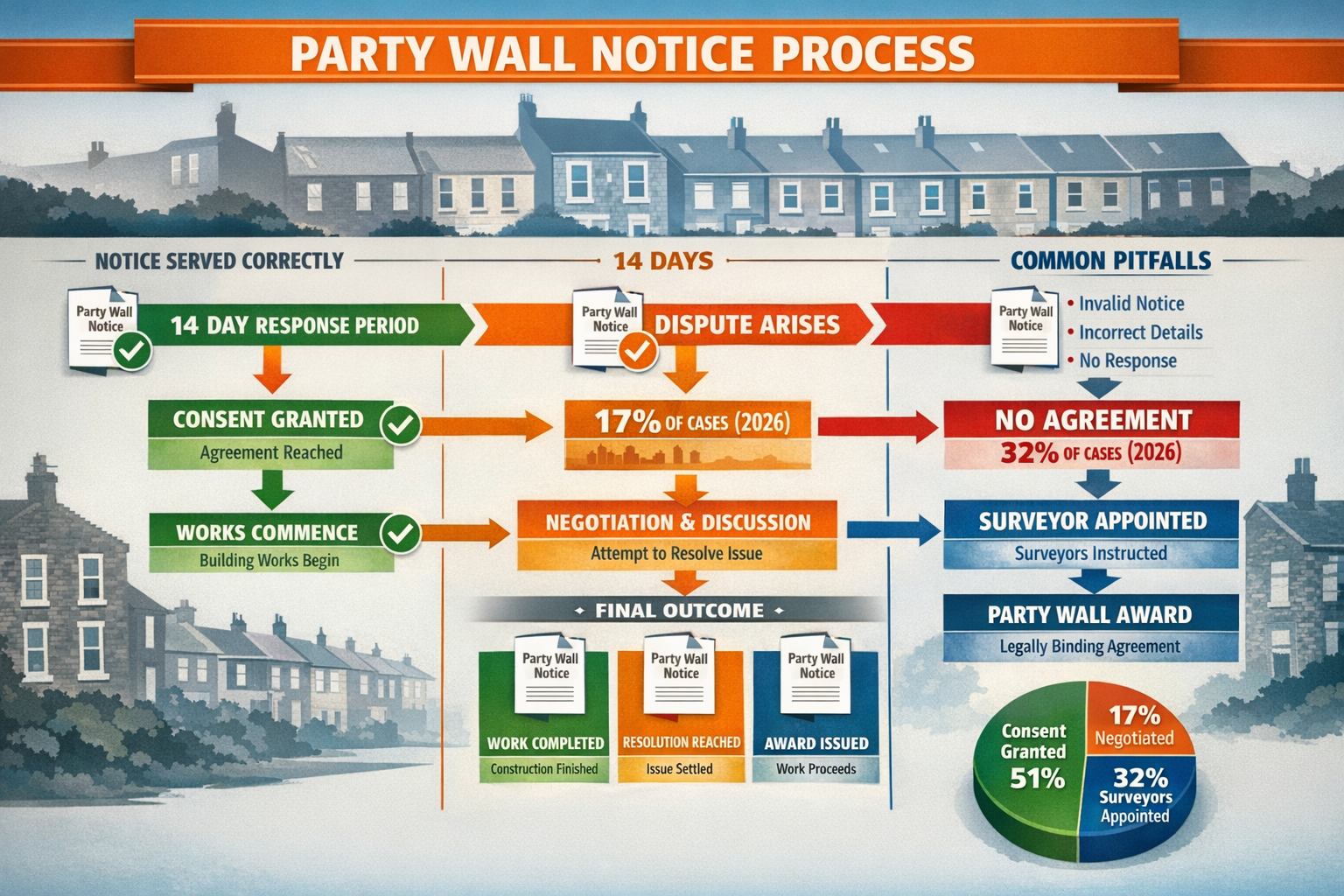
Serving proper party wall notices is the foundation of compliance and dispute prevention. In Northern England's accelerating development environment, timing and accuracy are crucial.
Types of Party Wall Notices
The Party Wall Act requires specific notices depending on work type:
| Notice Type | When Required | Notice Period | Key Details |
|---|---|---|---|
| Party Structure Notice | Work directly to party walls | 2 months | Most common for extensions and conversions |
| Line of Junction Notice | Building new walls on boundaries | 1 month | Required before construction begins |
| Adjacent Excavation Notice | Digging within 3-6m of neighbour's structure | 1 month | Depth-dependent distance requirements |
Strategic Notice Service in Recovery Markets
When development activity accelerates, property owners and developers face pressure to move quickly. However, rushing the notice process creates significant risks:
Best practices for 2026 include:
- Early surveyor consultation before finalizing project timelines
- Detailed notice preparation with accurate descriptions and drawings
- Proper service methods using recorded delivery or hand delivery with acknowledgment
- Buffer time allowances for potential disputes or clarifications
- Neighbour communication before formal notices to establish goodwill
"In recovery markets, the temptation to skip or rush party wall procedures increases as developers compete for opportunities. This is precisely when professional guidance becomes most valuable—preventing costly delays and disputes that can derail projects entirely."
What Happens After Notice Service?
Once a party wall notice is served, the adjoining owner has 14 days to respond. Three outcomes are possible:
✅ Consent – The neighbour agrees in writing, allowing work to proceed under the notice terms
⚠️ Qualified consent – The neighbour agrees with specific conditions or modifications
❌ Dissent or no response – A dispute is deemed to exist, requiring surveyor appointment
Understanding what to do when a neighbour refuses party wall works is essential for navigating the dissent scenario effectively.
Common Notice Mistakes in High-Volume Markets
Recovery markets create conditions where notice errors become more frequent:
- Insufficient detail in work descriptions
- Incorrect addresses or owner identification
- Premature notice service before designs are finalized
- Missing drawings or technical specifications
- Inadequate notice periods due to project pressure
Each error can trigger disputes or delays, undermining the efficiency gains developers seek. Professional party wall services help avoid these pitfalls through systematic notice preparation and service.
Managing Party Wall Disputes as Development Pressure Increases
Disputes are an inevitable aspect of party wall work, particularly in recovery markets where development activity creates friction between neighbours. Understanding dispute management and associated costs is crucial for Party Wall Surveys in Recovery Markets: Managing Notices and Disputes as Development Activity Accelerates in Northern England.
Party Wall Surveyor Costs in 2026
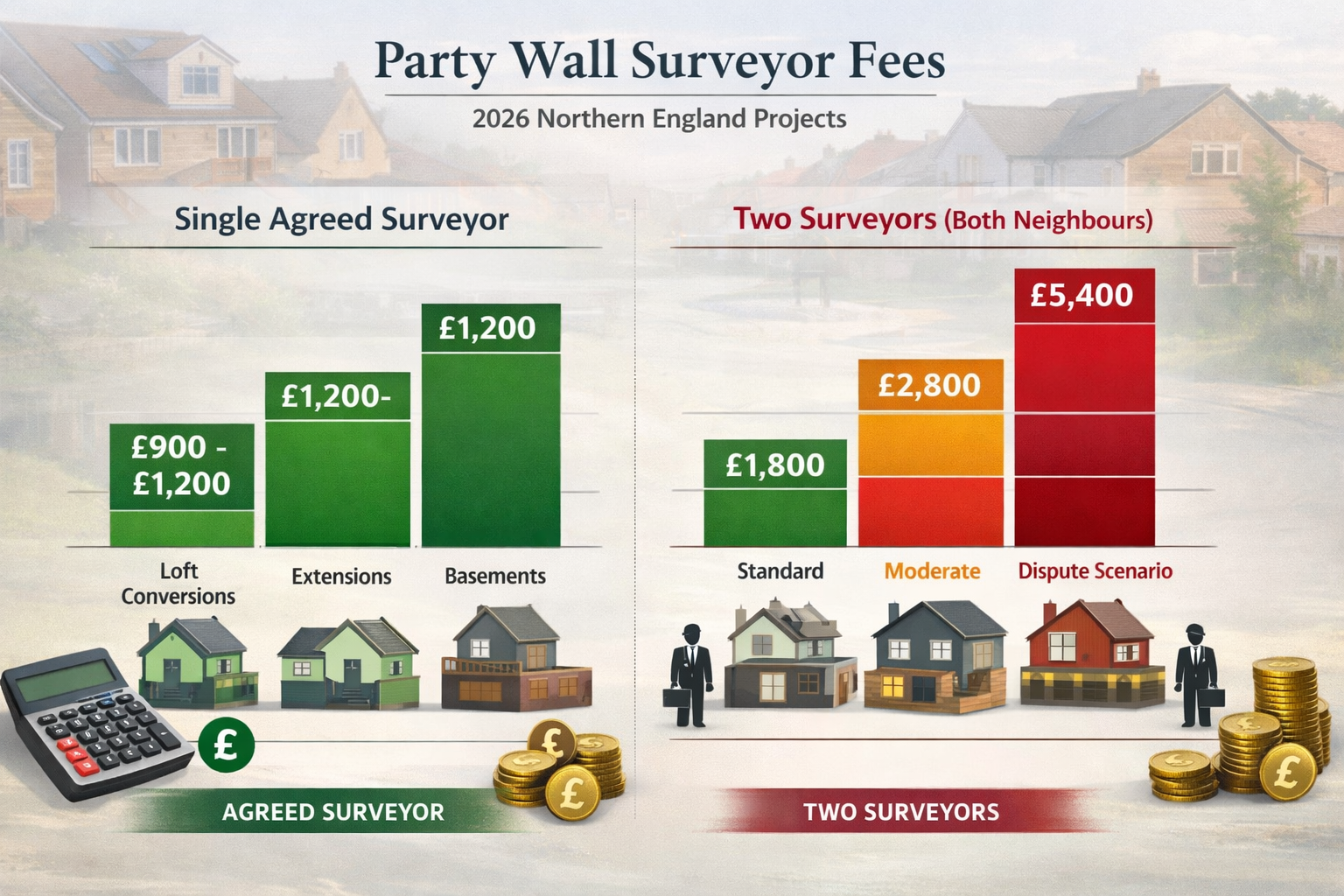
Standard party wall surveyor costs vary significantly based on project complexity and dispute status. For 2026, typical fee ranges include[1]:
Single Agreed Surveyor Appointments:
- Loft conversions: £900-£1,200
- Single or two-storey extensions: £1,200-£1,500
- Basement excavations: £1,800-£2,700
These costs apply when both parties agree to appoint a single surveyor to act impartially for both sides—the most cost-effective approach.
Dual Surveyor Appointments (Dispute Scenarios):
When neighbours cannot agree and each appoints their own surveyor, costs escalate significantly[1]:
- Total costs: £1,800-£5,400 depending on complexity
- Building owner pays both surveyors in most circumstances
- Additional third surveyor fees if appointed to resolve surveyor disagreements
Understanding the cost of party wall agreements helps property owners budget appropriately and make informed decisions about dispute resolution strategies.
The Role of the Agreed Surveyor
The most efficient dispute resolution path involves appointing an agreed surveyor—a single professional who acts impartially for both parties. This approach offers several advantages:
- Lower overall costs compared to dual appointments
- Faster resolution with single point of coordination
- Reduced conflict through neutral professional guidance
- Streamlined documentation and award preparation
Learn more about this approach through our complete guide to agreed surveyor roles and benefits.
Dispute Resolution Hierarchy in Northern England
When disputes arise in recovery markets, a structured approach is essential:
Level 1: Direct Negotiation
- Building owner and adjoining owner communicate directly
- Often facilitated by surveyors or solicitors
- Most cost-effective when successful
- Appropriate for minor disagreements
Level 2: Surveyor Mediation
- Appointed surveyors negotiate award terms
- Technical expertise applied to contentious issues
- Formal but collaborative process
- Results in legally binding Party Wall Award
Level 3: Third Surveyor Appointment
- Required when appointed surveyors cannot agree
- Acts as arbitrator on disputed matters
- Adds significant cost and time
- Decision is final and binding
Level 4: Legal Action
- Rare but possible for award enforcement
- Significantly expensive
- Court involvement for non-compliance
- Should be last resort
Managing Neighbour Relations During Development Booms
Recovery markets create unique neighbour dynamics. Development activity that was rare for years suddenly becomes commonplace, sometimes overwhelming residents in established neighbourhoods. Effective strategies include:
🤝 Pre-notice communication – Informal discussions before formal notices
📋 Transparent information sharing – Detailed project explanations and timelines
🏗️ Considerate construction practices – Minimizing disruption and maintaining site cleanliness
📞 Accessible contact points – Clear channels for concerns and questions
🔍 Regular updates – Keeping neighbours informed of progress and changes
Understanding your party wall rights empowers both building owners and adjoining owners to navigate these situations confidently.
Regional Factors Affecting Party Wall Surveys in Northern England
Northern England's property landscape presents distinct characteristics that influence party wall matters in 2026.
Victorian and Edwardian Terraced Housing
Much of Northern England's housing stock consists of Victorian and Edwardian terraced properties with shared party walls. These structures present specific challenges:
- Solid brick party walls without cavity construction
- Aging materials requiring careful assessment
- Previous undocumented alterations creating uncertainty
- Chimney breast removals affecting structural integrity
- Foundation variations between properties
Thorough condition surveys before party wall work helps identify these issues early.
Commercial and Mixed-Use Development
Northern cities are experiencing significant commercial development, including:
- Office conversions to residential use
- Retail space redevelopment in urban cores
- Data centre construction driven by AI demand[6]
- Industrial regeneration projects
- Mixed-use developments combining residential and commercial
These projects often involve more complex party wall scenarios with multiple adjoining owners, commercial lease considerations, and higher-value stakes.
Infrastructure and Regeneration Projects
Government and private investment in Northern England infrastructure creates additional party wall considerations:
- Transport improvements affecting adjacent properties
- Urban regeneration schemes with multiple stakeholders
- Heritage property restoration requiring specialist approaches
- Brownfield site development with contamination concerns
Market Recovery Timing Considerations
The 2026 recovery phase creates specific timing pressures:
Property owners may face:
- Compressed project schedules to capitalize on market momentum
- Multiple concurrent projects in neighbourhoods
- Surveyor capacity constraints during peak periods
- Material and contractor availability affecting timelines
Surveyors must balance:
- Thorough assessment requirements with efficiency demands
- Multiple instruction management without quality compromise
- Professional standards maintenance during high-volume periods
- Client communication when demand exceeds capacity
Best Practices for Party Wall Surveys in Recovery Markets
Successfully navigating Party Wall Surveys in Recovery Markets: Managing Notices and Disputes as Development Activity Accelerates in Northern England requires adherence to proven best practices.
For Building Owners and Developers
Planning Phase:
- Engage surveyors early in project development
- Budget appropriately for party wall costs including potential disputes
- Review designs for party wall implications before finalization
- Identify all adjoining owners including leaseholders and freeholders
- Consider top party wall agreement factors for renovations
Notice Phase:
- Prepare comprehensive notices with detailed drawings
- Serve notices with adequate lead time before planned start dates
- Use proper service methods with proof of delivery
- Maintain communication with neighbours throughout
- Document all correspondence for potential dispute resolution
Construction Phase:
- Comply with award terms precisely
- Conduct required inspections at specified intervals
- Maintain site standards to minimize neighbour disruption
- Address concerns promptly when raised
- Document work progress photographically
For Adjoining Owners
Response Phase:
- Review notices carefully upon receipt
- Seek professional advice before responding
- Understand your rights under the Party Wall Act
- Respond within 14 days to maintain control over surveyor selection
- Consider agreed surveyor option for cost efficiency
Award Negotiation:
- Ensure adequate protection for your property
- Request reasonable conditions for work execution
- Verify insurance coverage requirements
- Establish inspection schedules for your surveyor
- Clarify dispute resolution procedures
During Works:
- Allow reasonable access for inspections
- Document any damage immediately with photographs
- Communicate concerns through proper channels
- Maintain records of all interactions
- Follow award procedures for raising issues
For Party Wall Surveyors
Professional Standards:
- Maintain RICS compliance in all instructions
- Manage conflicts of interest transparently
- Provide clear fee structures upfront
- Document all decisions thoroughly
- Consider checking engineers' party wall qualifications
Capacity Management:
- Set realistic instruction limits during peak periods
- Maintain quality standards regardless of volume
- Communicate timelines clearly to clients
- Collaborate with other surveyors when beneficial
- Invest in systems for efficient workflow management
Regional Expertise:
- Understand local building stock characteristics
- Build relationships with local contractors and specialists
- Stay informed on regional market conditions
- Network with peers for complex matters
- Develop area-specific knowledge of common issues
Emerging Trends Affecting Party Wall Matters in Northern England
AI and Data Centre Development
The explosive growth in artificial intelligence is driving unprecedented data centre development across the UK, including Northern England[6]. These projects present unique party wall challenges:
- Large-scale excavations affecting multiple properties
- Vibration concerns from heavy machinery and ongoing operations
- Complex ownership structures with commercial and residential neighbours
- High-value stakes increasing dispute sensitivity
- Accelerated timelines due to commercial pressures
Sustainability and Retrofit Projects
The push toward net-zero carbon is generating new types of party wall work:
- External wall insulation affecting party wall lines
- Heat pump installations with structural implications
- Solar panel arrays on shared roofs
- Ventilation system upgrades requiring party wall penetrations
- Whole-building retrofit programs in terraced housing
Technology in Party Wall Practice
Modern surveying technology is transforming party wall work:
- Digital condition surveys using photography and videography
- Drone inspections for roof and high-level assessments
- 3D scanning for precise existing condition documentation
- Digital award preparation and distribution
- Online dispute resolution platforms for efficiency
Regulatory Evolution
Party wall practice continues to evolve through:
- Case law development refining Act interpretation
- Professional guidance updates from RICS and FPWS
- Building regulation changes affecting party wall work
- Insurance requirements for party wall surveyors
- Consumer protection considerations
Conclusion
Party Wall Surveys in Recovery Markets: Managing Notices and Disputes as Development Activity Accelerates in Northern England represents a critical competency for property professionals in 2026. The region's market recovery, confirmed by RICS data showing upward price trajectories, is translating directly into increased development activity and heightened demand for party wall services.
Success in this environment requires a balanced approach: maintaining professional standards and thoroughness while adapting to the efficiency demands of recovery markets. Building owners must recognize that proper party wall procedures, though sometimes perceived as obstacles, actually protect their projects from costly delays and disputes. Adjoining owners benefit from understanding their rights and engaging professionally with the process rather than defaulting to opposition.
The cost implications are significant—ranging from £900 for straightforward loft conversions to potentially £5,400 or more when disputes escalate—making early professional guidance a sound investment. As Northern England's development boom continues, those who master party wall notice procedures, dispute resolution strategies, and neighbour relations will find themselves best positioned for project success.
Actionable Next Steps
For property owners planning development:
- Consult a qualified party wall surveyor before finalizing project designs
- Budget appropriately for party wall costs in your project planning
- Serve notices with adequate lead time to avoid project delays
- Consider professional party wall services for comprehensive guidance
- Maintain open communication with neighbours throughout the process
For adjoining owners who receive notices:
- Seek professional advice within the 14-day response period
- Understand your rights under the Party Wall Act
- Consider the agreed surveyor option for cost-effective protection
- Document your property's condition before works commence
- Engage constructively with the process rather than defaulting to opposition
For surveyors managing increased instruction volumes:
- Invest in efficient systems for workflow management
- Maintain professional standards regardless of market pressures
- Develop regional expertise in Northern England building stock
- Build collaborative relationships with other professionals
- Stay informed on market trends and regulatory developments
The Northern England property market's recovery phase presents both opportunities and challenges. By understanding party wall obligations, managing notices effectively, and approaching disputes professionally, all parties can navigate this dynamic environment successfully. The key is recognizing that party wall procedures, properly executed, protect everyone's interests and enable development to proceed with confidence.
References
[1] Party Wall Surveyor Cost – hoa.org.uk
[5] Uk Residential Market Survey January 2026 – rics.org
[6] Party Wall Agreements In Data Centre Developments 2026 Compliance Amid Ai Driven Uk Demand – nottinghillsurveyors.com