

The construction boom of 2026 has brought unprecedented demand for party wall services across the UK. With thousands of homeowners undertaking loft conversions, basement excavations, and structural alterations, the need for legally enforceable party wall awards has never been more critical. Understanding the Evergreen Essentials: Drafting Enforceable Party Wall Awards Under Latest RICS Guidelines ensures that building owners, surveyors, and adjoining owners navigate these complex procedures with confidence and compliance.
Party wall awards serve as the cornerstone of dispute prevention, establishing clear boundaries, responsibilities, and protections for all parties involved. Yet poorly drafted awards continue to fuel costly litigation and project delays. This comprehensive guide explores the step-by-step protocols for notices, surveys, and dispute resolution that define best practice in 2026.
Key Takeaways
- Party wall awards must follow strict RICS professional standards to ensure legal enforceability and protect all parties' interests
- Proper notice procedures are mandatory under the Party Wall etc. Act 1996, with specific timeframes that cannot be shortened
- Comprehensive schedules of condition form the evidential backbone of any enforceable award, documenting pre-work property status
- Award documentation must include detailed drawings, method statements, and timing restrictions to prevent future disputes
- Understanding the 14-day appeal window is crucial for both building owners and adjoining owners to protect their rights
Understanding Party Wall Awards in 2026
What Makes a Party Wall Award Legally Enforceable?
A party wall award represents a legally binding determination made by appointed surveyors under the Party Wall etc. Act 1996. For an award to be enforceable, it must meet specific criteria that courts will uphold if challenged.
The essential elements include:
- Proper appointment of surveyors following statutory procedures
- Valid service of notices with correct information and adequate timeframes
- Comprehensive documentation of existing conditions
- Clear specifications of proposed works
- Reasonable provisions for access, working hours, and protective measures
- Signatures of all appointed surveyors with dates
In 2026, courts have shown increasing scrutiny of awards that lack thoroughness. Recent cases demonstrate that vague or incomplete awards face challenges when disputes arise months or years after completion.
The Role of RICS Guidelines
The Royal Institution of Chartered Surveyors (RICS) provides professional standards that elevate party wall practice beyond mere statutory compliance. While the Party Wall Act establishes the legal framework, RICS guidelines offer:
✅ Best practice methodologies for inspections and documentation
✅ Ethical standards for surveyor conduct and impartiality
✅ Technical guidance on complex structural scenarios
✅ Templates and checklists ensuring consistency
✅ Professional development requirements for accredited surveyors
Adhering to these guidelines protects surveyors from negligence claims and provides building owners with awards that withstand legal scrutiny. For those wondering about party wall rights and responsibilities, understanding these professional standards is essential.
Common Scenarios Requiring Party Wall Awards
Party wall procedures apply to three main categories of work under the Act:
| Work Type | Section | Common Examples |
|---|---|---|
| Work directly to party walls | Section 2 | Cutting into walls, inserting beams, raising walls, underpinning |
| New walls at boundaries | Section 1 | Building on boundary line, new garden walls |
| Excavations near boundaries | Section 6 | Basement extensions, foundation work within 3-6 meters |
The 2026 surge in loft conversions requiring party wall agreements has particularly highlighted the importance of proper procedures. Steel beam insertions for open-plan living spaces frequently trigger Section 2 requirements, while basement excavations in urban areas activate Section 6 provisions.
Step-by-Step Protocol for Notices and Surveys
Serving Valid Party Wall Notices
The notice stage represents the critical foundation of any party wall procedure. Mistakes here can invalidate the entire process, causing costly delays.
Notice Requirements and Timeframes
Section 1 and Section 2 notices must be served at least two months before work commences. These notices must include:
- Full names and addresses of building and adjoining owners
- Clear description of proposed works
- Date when work will begin
- Drawings showing the work's nature and location
Section 6 notices (excavation) require one month's notice and must specify:
- Depth and position of excavation
- Plans and sections of proposed foundations
- Details of underpinning if applicable
📋 Pro Tip: Always serve notices by recorded delivery or hand delivery with a signed receipt. Email service remains contentious and should include follow-up confirmation.
Conducting Comprehensive Property Surveys
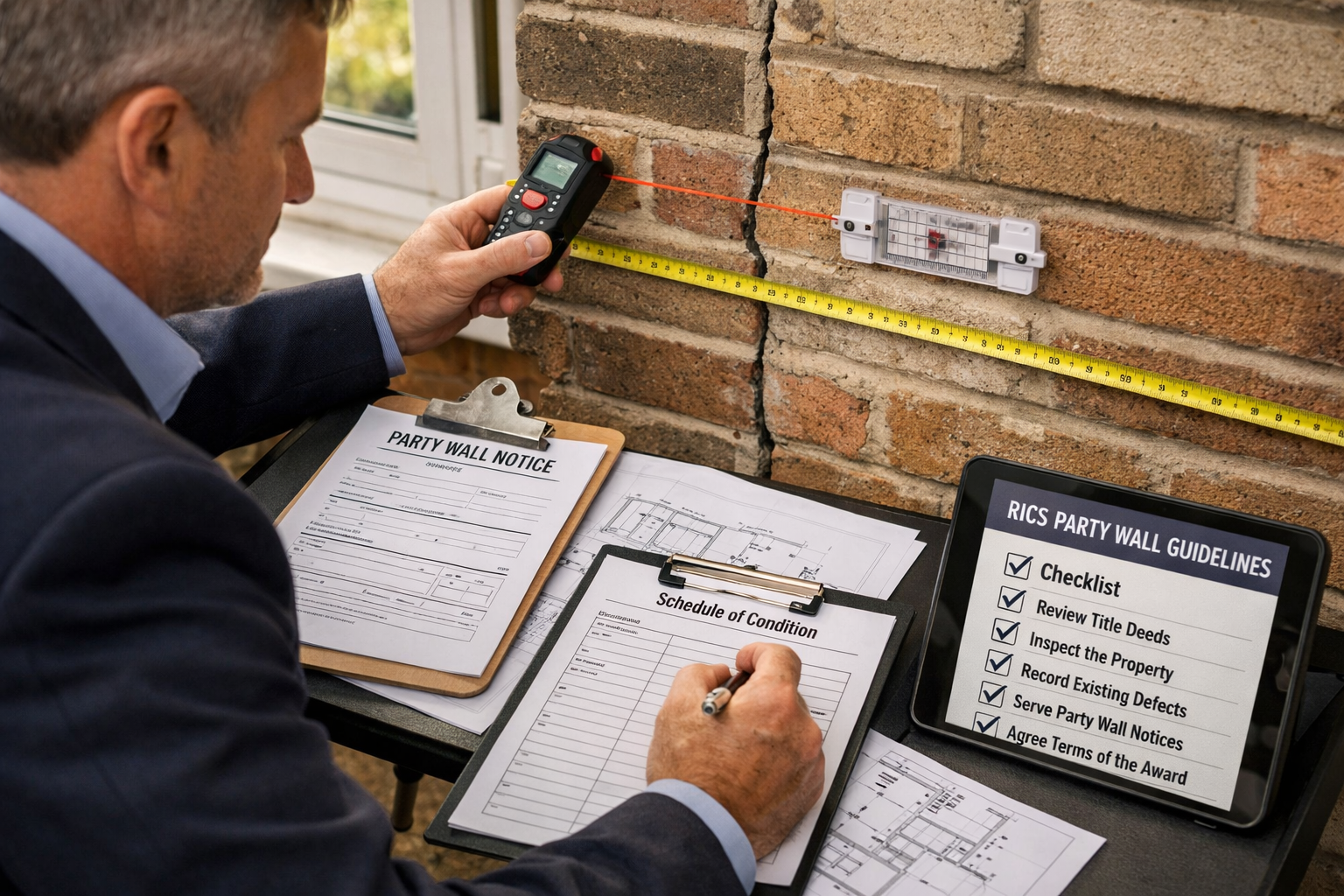
Once surveyors are appointed, the schedule of condition becomes paramount. This document provides the evidential baseline against which any damage claims are assessed.
A thorough survey should include:
Interior Inspection:
- Room-by-room photographic record
- Crack mapping with measurements
- Floor level readings
- Ceiling and wall plaster condition
- Door and window operation
Exterior Inspection:
- Elevation photography
- Render and brickwork condition
- Drainage systems
- Boundary features
- Adjacent structures
Modern practice in 2026 increasingly incorporates digital tools including laser scanning, photogrammetry, and crack monitoring sensors. These technologies provide irrefutable evidence of pre-existing conditions. Professional party wall drawings enhance clarity and reduce ambiguity.
Negotiating Award Terms
The negotiation phase requires surveyors to balance the building owner's right to carry out work against the adjoining owner's right to protection. Key negotiation points include:
Working Hours: Typically 8:00 AM to 6:00 PM Monday-Friday, with restrictions on weekends and bank holidays.
Access Arrangements: Reasonable notice periods (usually 14 days) for inspections, with specific entry points identified.
Protective Measures: Requirements for scaffolding, dust sheets, vibration monitoring, or temporary supports.
Security for Expenses: Whether the adjoining owner can require a deposit to cover potential damage costs.
The cost of party wall agreements often becomes a negotiation point, though the Act clearly states the building owner bears these expenses.
Drafting the Award: Essential Components
Mandatory Sections and Clauses
An enforceable party wall award must contain specific sections that courts recognize as complete:
1. Preamble and Parties
- Full identification of all owners
- Property addresses with Land Registry titles
- Surveyor appointments and dates
- Reference to relevant notices
2. Description of Works
- Detailed specification referencing drawings
- Materials and methods
- Structural calculations if applicable
- Phasing and sequencing
3. Rights Granted
- Specific permissions under the Act
- Access rights with conditions
- Working hours and restrictions
- Noise and vibration limits
4. Protective Provisions
- Required protective measures
- Monitoring requirements
- Insurance provisions
- Emergency procedures
5. Schedule of Condition
- Comprehensive photographic record
- Written descriptions
- Plans showing crack locations
- Date and surveyor signatures
6. Dispute Resolution
- Process for raising concerns
- Surveyor inspection protocols
- Variation procedures
- Appeal rights explanation
Technical Drawings and Specifications
Drawings form an integral part of the award, not mere attachments. They must show:
- Existing party wall construction
- Proposed alterations with dimensions
- Structural support details
- Temporary works if required
- Section views through critical junctions
Specifications should reference British Standards and building regulations, ensuring work quality meets professional standards. Vague descriptions like "careful workmanship" provide no enforceable standard.
Timing and Access Provisions
Clear timing provisions prevent disputes and ensure project progression:
Commencement Notice: Require the building owner to give written notice (typically 7-14 days) before starting work.
Completion Deadline: While not always appropriate, complex works may benefit from reasonable completion timeframes.
Access for Inspections: Specify how much notice the appointed surveyor requires to inspect works in progress (typically 48 hours).
Final Inspection Rights: Establish the timeframe for post-completion inspections (usually within 2 months of completion).
These provisions protect both parties while maintaining project momentum. Understanding when party wall disputes arise often traces back to inadequate timing provisions.
Dispute Resolution and Appeals Under 2026 Standards
Understanding the 14-Day Appeal Window
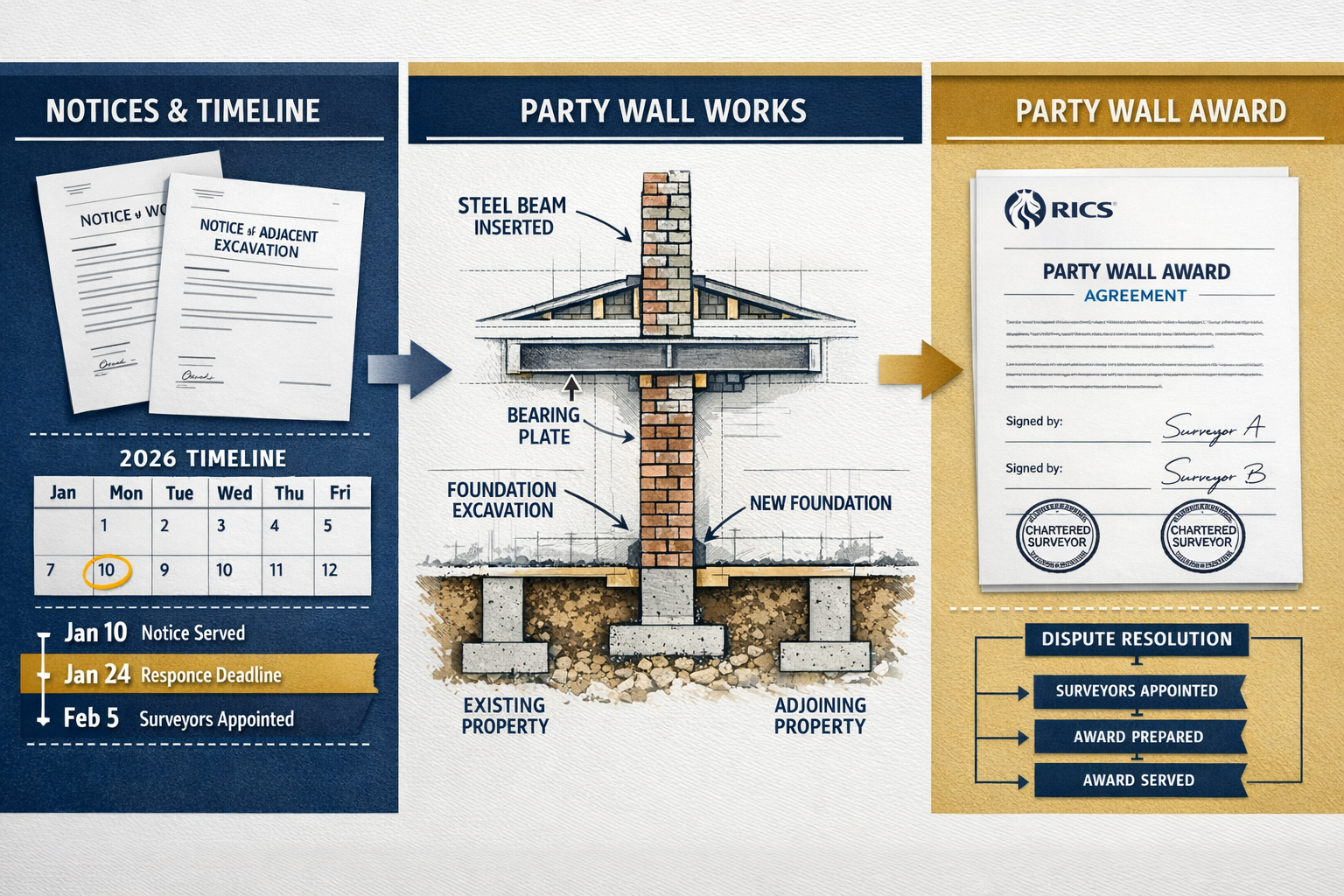
The Party Wall Act provides a 14-day period from award service for either party to appeal to the County Court. This tight timeframe demands immediate attention when awards are received.
Grounds for appeal typically include:
- Procedural irregularities (invalid notices, improper surveyor appointments)
- Unreasonable provisions that exceed statutory powers
- Bias or conflict of interest by appointed surveyors
- Factual errors in property descriptions or conditions
- Inadequate consideration of objections raised
🚨 Critical Warning: The 14-day window is absolute. Courts rarely grant extensions, even for compelling reasons. Adjoining owners must seek legal advice immediately upon receiving an award if concerns exist.
Common Award Challenges and Solutions
Experience from 2026 cases reveals recurring issues that undermine award enforceability:
Challenge: Insufficient Schedule of Condition
- Problem: Generic descriptions without photographic evidence
- Solution: Comprehensive digital documentation with timestamped images, video walkthroughs, and detailed written descriptions
Challenge: Vague Work Descriptions
- Problem: Awards stating "structural alterations as necessary"
- Solution: Specific drawings with dimensions, materials specified, and method statements attached
Challenge: Unreasonable Restrictions
- Problem: Working hour limitations that prevent any meaningful work
- Solution: Balanced provisions considering both parties' needs, with exceptions for emergency works
Challenge: Inadequate Security Provisions
- Problem: No financial protection for potential damage
- Solution: Clear procedures for claiming expenses, with reasonable security deposits where appropriate
Third Surveyor Determinations
When appointed surveyors cannot agree, the third surveyor provides binding resolution. This mechanism prevents deadlock but requires careful selection.
Third surveyor involvement typically addresses:
- Disputes over award terms between the two appointed surveyors
- Allegations of surveyor misconduct or bias
- Technical disagreements on structural adequacy
- Cost apportionment disputes
The third surveyor's determination carries the same weight as an agreed award, with identical appeal rights. Selection should prioritize experience, RICS accreditation, and specific expertise in the disputed matter.
Best Practices for Surveyors in 2026
Professional Standards and Ethics
RICS professional standards demand impartiality even when appointed by one party. Key ethical principles include:
Transparency: Clear communication about fees, processes, and potential outcomes to all parties.
Competence: Only accepting instructions within areas of expertise, with continuing professional development maintained.
Independence: Avoiding conflicts of interest and disclosing any prior relationships with parties.
Diligence: Thorough inspections, accurate records, and timely communications.
Surveyors must balance their appointing owner's interests with statutory duties to act fairly. This dual role requires careful navigation, particularly when chartered surveyors in London handle high-value properties where stakes are elevated.
Documentation and Record-Keeping
Meticulous records protect surveyors from negligence claims and provide evidence if disputes arise:
Essential Records:
- All correspondence with dates and delivery methods
- Inspection notes with timestamps
- Photographic and video evidence with metadata
- Calculations and technical assessments
- Fee agreements and invoices
- Variations and amendments with approval dates
Digital systems with cloud backup ensure records remain accessible for the statutory limitation period (typically six years, but twelve for awards executed as deeds).
Managing Complex Scenarios
Modern construction presents challenges beyond traditional party wall work:
Basement Excavations: Require sophisticated temporary works design, with underpinning specifications that protect adjoining foundations while enabling the building owner's development.
Heritage Properties: Demand specialized knowledge of traditional construction, with monitoring protocols that detect movement at sensitive thresholds.
Multiple Adjoining Owners: Necessitate coordination across several awards, ensuring consistency while addressing each property's unique conditions.
Commercial Properties: Involve business interruption considerations, with working hours and access provisions that minimize operational impact.
These scenarios benefit from specialist expertise and often justify higher fees reflecting the complexity involved.
Conclusion: Ensuring Award Enforceability in 2026
The Evergreen Essentials: Drafting Enforceable Party Wall Awards Under Latest RICS Guidelines represent more than technical compliance—they embody the professional standards that protect property rights, prevent disputes, and enable development. As construction activity surges in 2026, the demand for rigorous, well-drafted awards has never been greater.
Building owners must recognize that proper party wall procedures, while sometimes perceived as bureaucratic obstacles, ultimately protect their projects from costly litigation and delays. Adjoining owners gain peace of mind through comprehensive schedules of condition and clear protective provisions. Surveyors uphold professional standards that maintain public confidence in the party wall system.
Actionable Next Steps
For Building Owners:
- Engage a qualified party wall surveyor before serving notices
- Allow adequate time for the full process (minimum 3-4 months)
- Budget appropriately for surveyor fees and potential protective works
- Maintain open communication with neighbors throughout
For Adjoining Owners:
- Respond promptly to any notices received (within 14 days)
- Consider appointing your own surveyor rather than consenting
- Request a thorough schedule of condition before work begins
- Document any concerns immediately in writing
For Surveyors:
- Maintain current knowledge of RICS guidance and case law developments
- Invest in digital documentation tools for comprehensive records
- Establish clear fee agreements before commencing work
- Consider professional indemnity insurance with adequate limits
The party wall framework balances competing interests through structured procedures and professional expertise. By adhering to the Evergreen Essentials: Drafting Enforceable Party Wall Awards Under Latest RICS Guidelines, all parties contribute to a system that facilitates development while protecting property rights—a balance essential for thriving communities in 2026 and beyond.