

The UK's data centre boom is transforming industrial landscapes across the nation, but beneath the gleaming server halls and cutting-edge cooling systems lies a complex web of boundary challenges that can derail even the most carefully planned projects. As UK data usage is predicted to double by 2026, with nearly 100 GW of new data centre capacity scheduled globally between 2026 and 2030[1][2], surveyors face unprecedented challenges navigating Party Wall Disputes in Data Centre Developments: Surveyor Strategies for High-Density UK Sites. The convergence of AI-driven demand, high-density urban locations, and specialised infrastructure requirements creates a perfect storm for party wall complications that demand expert intervention.
Key Takeaways
- Data centre developments in 2026 face unique party wall challenges due to deep foundations, heavy vibration from cooling systems, and 24/7 operational requirements that impact neighbouring properties
- Proactive surveyor strategies including early neighbour engagement, comprehensive condition surveys, and detailed vibration monitoring protocols can prevent costly disputes in high-density sites
- Multiple contract structures increasingly used in data centre projects require careful coordination of party wall obligations across phased construction programmes
- AI and cloud computing growth is driving rapid expansion into urban areas where party wall considerations are most complex, requiring specialist surveyor expertise
- Community and regulatory pressures following recent protest actions demand transparent communication and robust party wall agreements to maintain project timelines
Understanding the Unique Challenges of Party Wall Disputes in Data Centre Developments
Data centre construction presents fundamentally different challenges compared to traditional commercial or residential developments. The specialised nature of these facilities creates party wall scenarios that standard approaches often fail to address adequately.
Deep Foundations and Excavation Risks
Data centres require substantial foundations to support heavy equipment loads, often extending significantly deeper than adjacent structures. This creates heightened risks of:
- Underpinning requirements for neighbouring properties
- Ground movement affecting adjoining foundations
- Dewatering impacts on surrounding soil stability
- Excavation-induced settlement in adjacent buildings
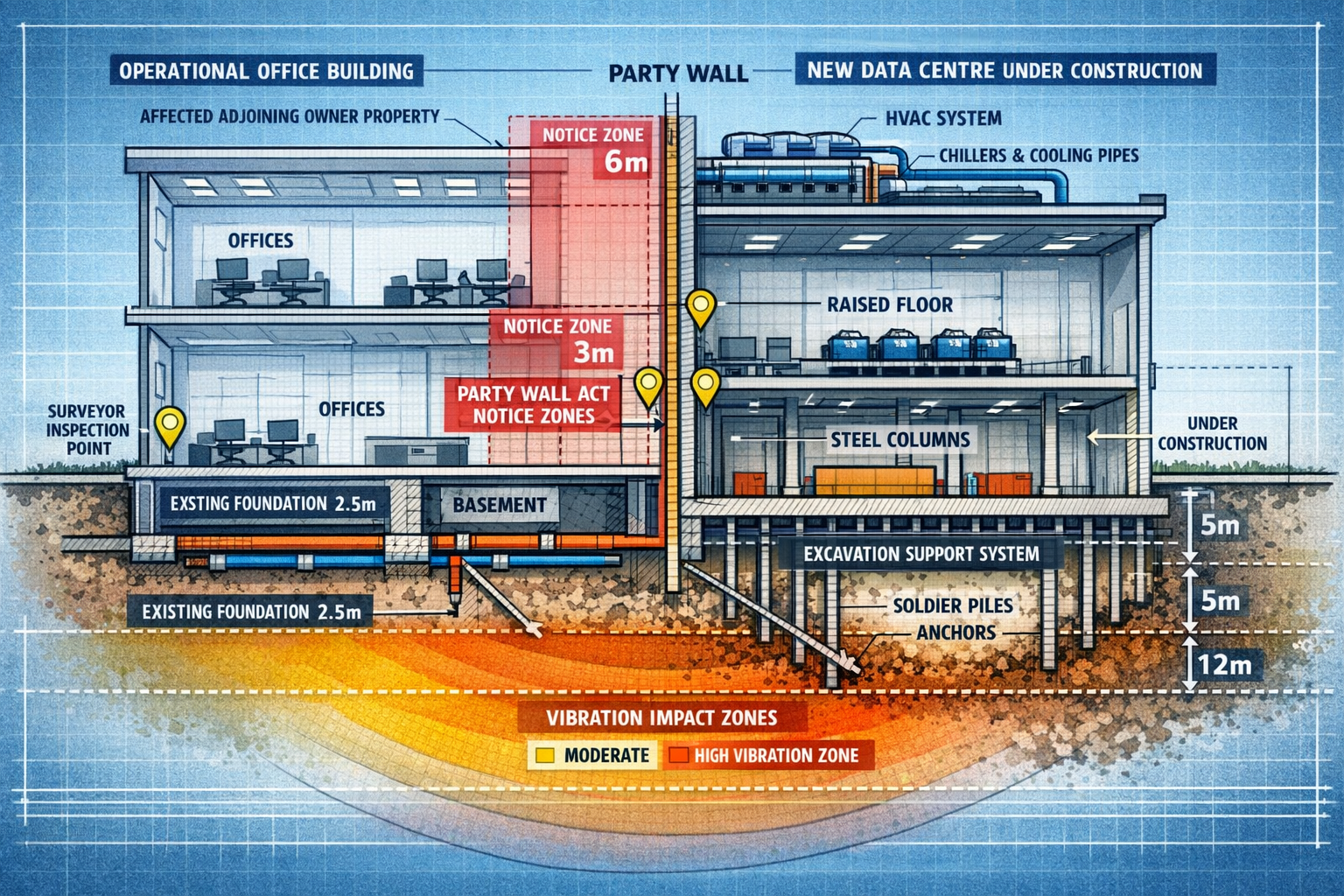
The Party Wall Act 1996 provisions for excavation work become particularly critical in these scenarios. Surveyors must carefully assess whether works fall under Section 6 (excavation within three or six metres of neighbouring structures) and prepare comprehensive awards that address foundation depth disparities.
Vibration and Operational Impact Considerations
Unlike typical construction projects that generate temporary disturbance, data centres create permanent operational impacts that neighbouring property owners must understand before consenting to works:
🔊 Continuous cooling system vibration from industrial-scale HVAC equipment
⚡ Electrical infrastructure hum from transformer stations and backup generators
🌡️ Heat discharge affecting adjacent building thermal environments
📡 Electromagnetic interference concerns for sensitive neighbouring uses
These ongoing impacts extend beyond the construction phase covered by traditional party wall awards. Savvy surveyors incorporate operational baseline conditions and future monitoring provisions into their agreements, protecting both building owners and adjoining owners from unforeseen complications.
Supply Chain Complexity and Timeline Pressures
The highly specialised components required for data centre construction create unique project pressures. With limited supplier options for critical cooling and power systems[1], delays cascade rapidly through construction programmes. This urgency can tempt developers to rush party wall procedures—a dangerous approach that experienced surveyors must resist.
Understanding these consequences of ignoring the Party Wall Act becomes essential when project teams pressure surveyors to expedite processes. The costs of subsequent disputes far exceed any time saved through procedural shortcuts.

Surveyor Strategies for Preventing Party Wall Disputes in Data Centre Developments
Effective dispute prevention requires surveyors to adopt proactive, specialised approaches tailored to data centre development characteristics. The following strategies have proven successful across 2026 projects in high-density UK locations.
Early Engagement and Comprehensive Neighbour Communication
The foundation of successful party wall management begins months before formal notices are served. For data centre developments, this early engagement phase should include:
Pre-Notice Consultation Activities:
- Informal meetings with adjoining owners to explain project scope
- Visual presentations showing construction phasing and boundary impacts
- Preliminary condition surveys to establish baseline property states
- Discussion of vibration monitoring and protection measures
This approach mirrors best practices outlined in our guide to agreed surveyor party wall roles, where collaborative relationships between surveyors prevent adversarial dynamics from developing.
Detailed Condition Surveys with Technology Enhancement
Standard photographic condition surveys prove insufficient for data centre party wall scenarios. Enhanced documentation should incorporate:
| Survey Element | Standard Approach | Data Centre Enhancement |
|---|---|---|
| Photography | General room views | High-resolution images of all finishes, utilities, structural elements |
| Structural Assessment | Visual crack mapping | Laser scanning for precise baseline measurements |
| Vibration Baseline | Not typically included | Multi-point accelerometer readings establishing pre-construction levels |
| Thermal Imaging | Rarely used | Infrared surveys documenting existing heat patterns |
| Underground Utilities | Basic location notes | GPR scanning and detailed mapping of services near boundaries |
These enhanced surveys create irrefutable baseline records that protect all parties when post-construction condition disputes arise. The modest additional cost proves invaluable when claims emerge months or years after project completion.
Vibration Monitoring Protocols and Threshold Agreements
Given the continuous vibration concerns inherent in data centre operations, surveyors must establish clear monitoring frameworks within party wall awards:
Construction Phase Monitoring:
- Real-time vibration sensors at critical boundary locations
- Automated alerts when thresholds approach concerning levels
- Daily reporting to adjoining owners during high-impact works
- Defined trigger levels requiring work suspension and remediation
Operational Phase Provisions:
- Baseline vibration measurements from completed cooling systems
- Quarterly monitoring for first year of operations
- Defined complaint investigation procedures
- Remediation obligations if operational vibration exceeds agreed thresholds
These provisions address the unique permanent impact nature of data centre developments, extending party wall protections beyond traditional construction-only frameworks.
Phased Construction and Multiple Contract Coordination
The increasing trend toward multiple contract structures for data centre projects[1] creates coordination challenges for party wall compliance. Developers may separately procure:
- Shell construction (foundations, structure, envelope)
- MEP installations (cooling, power, data infrastructure)
- Fit-out works (server installations, internal systems)
Surveyors must ensure party wall awards comprehensively cover all phases while maintaining flexibility for scope adjustments driven by rapid technological changes. Award schedules should clearly delineate:
- Which contract phase each party wall work element falls under
- Responsibility for ongoing monitoring across phase transitions
- Notification requirements if subsequent phases introduce new boundary impacts
- Mechanisms for award amendments without full re-service of notices
This structured approach prevents gaps in party wall coverage when different contractors assume responsibility for various project elements.
Navigating Regulatory Pressures and Community Concerns in High-Density Sites
The 2026 landscape for data centre development includes heightened scrutiny from environmental groups and local communities. Global Action Plan UK coordinated protest actions against hyperscale data centre expansions in February 2026[4], reflecting growing concerns about energy consumption, environmental impact, and community disruption.
Addressing Community Relations Through Party Wall Processes
While party wall procedures focus on immediate neighbours, surveyors can leverage these processes to demonstrate responsible development practices to broader communities:
Transparency Measures:
- Publishing anonymised party wall award summaries showing protective measures
- Community presentations explaining vibration monitoring and safeguards
- Regular construction impact reports shared with local councils
- Accessible complaint procedures for non-adjoining neighbours
These transparency efforts can defuse broader opposition by demonstrating that immediate neighbours receive robust protections through formal party wall processes.
Integrating Environmental Considerations
Modern party wall awards for data centre developments should address environmental impacts that traditional agreements overlook:
🌱 Construction phase considerations:
- Dust suppression measures protecting neighbouring properties
- Noise limitation schedules respecting residential adjacencies
- Construction traffic routing minimising community disruption
- Waste management protocols for specialised materials
🔋 Operational phase provisions:
- Heat discharge management preventing thermal impacts on neighbours
- Acoustic barriers for cooling system noise containment
- Lighting controls preventing light pollution to adjacent properties
- Emergency generator testing schedules minimising disturbance
Managing Scope Changes and Technological Evolution
Data centre projects face particular vulnerability to scope changes as rapid technological evolution can render facilities outdated during construction[1]. These changes frequently impact party wall obligations:
Common Mid-Project Modifications:
- Increased cooling capacity requiring larger equipment foundations
- Additional power infrastructure necessitating deeper cable routes
- Enhanced security measures affecting boundary treatments
- Expanded floor loading requiring structural modifications
Surveyors must draft awards with built-in flexibility while protecting adjoining owners from unlimited scope creep. Recommended provisions include:
- Defined thresholds triggering re-notification requirements
- Pre-agreed processes for minor variations not requiring new notices
- Escalation procedures when proposed changes exceed award scope
- Cost responsibility frameworks for variation-induced monitoring extensions
Understanding common misconceptions about party wall agreements helps surveyors educate clients about the importance of maintaining procedural compliance even when project pressures mount.
Practical Award Drafting for Data Centre Party Wall Scenarios
Effective party wall awards for data centre developments require specialist provisions beyond standard templates. The following elements prove essential for comprehensive protection.
Foundation and Excavation Specifications
Awards must provide precise technical specifications for foundation works, including:
Required Detail Level:
- Exact excavation depths at boundary locations
- Temporary support system specifications (sheet piling, soldier piles, etc.)
- Dewatering methodologies and groundwater recharge provisions
- Foundation underpinning requirements for adjacent structures
- Monitoring point locations for settlement observation
Protection Measures:
- Maximum allowable settlement thresholds for neighbouring foundations
- Contingency procedures if monitoring indicates excessive movement
- Structural engineer certification requirements for temporary works
- Insurance provisions covering excavation-related damage
These specifications transform vague "reasonable care" obligations into measurable, enforceable standards that protect all parties.
Equipment Installation and Operational Provisions
Unlike residential extensions or office fit-outs, data centre equipment installations create permanent boundary impacts requiring special award provisions:
Cooling System Specifications:
- Equipment locations relative to party walls and boundaries
- Vibration isolation specifications for all major plant
- Acoustic enclosure requirements for noise-generating equipment
- Maintenance access arrangements preventing boundary encroachment
Power Infrastructure Details:
- Cable route specifications through or near party walls
- Electromagnetic shielding requirements for sensitive adjacent uses
- Emergency generator locations and acoustic treatments
- Backup power testing schedules and neighbour notification protocols
Monitoring and Reporting Frameworks
Comprehensive monitoring provisions form the backbone of enforceable awards in data centre contexts:
Construction Phase Monitoring:
| Monitoring Type | Frequency | Reporting | Action Thresholds |
|---|---|---|---|
| Vibration | Continuous during high-impact works | Daily summaries to adjoining owners | Amber: 5mm/s PPV, Red: 10mm/s PPV |
| Settlement | Weekly readings at monitoring points | Fortnightly reports with trend analysis | Amber: 5mm movement, Red: 10mm movement |
| Crack Monitoring | Monthly inspections | Quarterly reports with photography | Any new cracking or existing crack widening >2mm |
| Noise | Spot checks during equipment testing | Within 48 hours of testing events | Exceeding BS 5228 guidance levels |
Post-Construction Monitoring:
- Baseline operational measurements within one month of commissioning
- Quarterly monitoring for first year of operations
- Annual monitoring for subsequent four years
- Defined procedures for investigating neighbour complaints
These frameworks create objective evidence bases that prevent disputes from escalating into costly litigation.
Cost and Compensation Provisions
Data centre party wall awards should address financial arrangements with greater specificity than standard agreements:
Surveyor Fee Arrangements:
- Clear statements of fee responsibility (typically building owner pays all)
- Estimated fee ranges for different dispute scenarios
- Provisions for additional fees if scope changes require award variations
- Payment timelines and dispute resolution for fee disagreements
Reviewing typical costs of party wall surveyors helps set realistic expectations, though data centre projects typically involve higher fees due to technical complexity.
Compensation Frameworks:
- Defined compensation for temporary loss of amenity during construction
- Rental reduction provisions if operational noise impacts residential tenancies
- Property value protection guarantees for permanent operational impacts
- Dispute resolution mechanisms for compensation disagreements
Handling Neighbour Objections and Dispute Resolution
Even with optimal surveyor strategies, some adjoining owners will object to data centre developments. Effective dispute resolution requires structured approaches tailored to the specific concerns these projects generate.
Common Objection Patterns in Data Centre Contexts
Analysis of 2026 data centre projects reveals recurring objection themes[3]:
Technical Concerns:
- 🏗️ Foundation depth and excavation risks to neighbouring structures
- 📳 Vibration from cooling systems affecting residential amenity
- 🔊 Noise from backup generators and HVAC equipment
- 🌡️ Heat discharge impacts on adjacent building environments
Operational Concerns:
- ⏰ 24/7 operations creating permanent disturbance
- 🚛 Increased traffic from maintenance and equipment deliveries
- 💡 Light pollution from security and operational lighting
- 🔒 Security measures affecting neighbouring access or views
Property Value Concerns:
- 📉 Perceived devaluation from industrial adjacency
- 🏠 Reduced residential desirability near data centre facilities
- 🏢 Commercial tenant concerns about electromagnetic interference
- 💷 Long-term marketability impacts
Structured Response Strategies
When neighbours raise objections, surveyors should employ systematic response frameworks:
Step 1: Detailed Concern Documentation
Record specific objections in writing, distinguishing between:
- Matters within party wall award scope (foundation safety, vibration, structural protection)
- Planning considerations outside party wall jurisdiction (land use, traffic, general amenity)
- Misconceptions requiring education about party wall protections
Step 2: Technical Mitigation Proposals
Develop specific responses to valid party wall concerns:
- Enhanced vibration isolation specifications
- Additional structural monitoring points
- Upgraded temporary works for excavation support
- Extended post-construction monitoring periods
Step 3: Award Enhancement Negotiations
Incorporate reasonable protections into awards while maintaining project viability:
- Stricter operational noise thresholds
- More frequent monitoring and reporting
- Enhanced compensation for temporary impacts
- Defined remediation obligations if thresholds are exceeded
Understanding what to do when neighbours refuse party wall works provides essential context for managing objections effectively.
Alternative Dispute Resolution for Complex Cases
When standard negotiation fails to resolve objections, alternative dispute resolution (ADR) mechanisms offer valuable middle ground before expensive litigation:
Mediation Benefits:
- Neutral third party facilitates communication
- Creative solutions beyond rigid award frameworks
- Preserves working relationships for ongoing neighbourly relations
- Significantly lower costs than litigation
Expert Determination:
- Independent technical expert resolves specific disputes
- Binding decisions on technical matters (vibration thresholds, monitoring protocols)
- Faster resolution than court proceedings
- Maintains privacy compared to public litigation
Adjudication:
- Rapid decisions (typically 28 days) on urgent matters
- Binding pending final resolution through other means
- Particularly useful when construction timelines face disruption
- Lower costs than full litigation
Regional Considerations for High-Density UK Data Centre Sites
The UK's data centre development concentrates in specific high-density regions where party wall challenges intensify. Surveyors must adapt strategies to regional characteristics.
London and Southeast England Hotspots
The Southeast remains the dominant data centre region due to connectivity infrastructure and proximity to financial services users. Party wall challenges in these areas include:
Urban Density Factors:
- Multiple adjoining owners on all boundaries
- Historic buildings requiring enhanced protection
- Restricted site access complicating construction logistics
- High property values amplifying compensation expectations
Regulatory Complexity:
- Conservation area restrictions affecting construction methods
- Listed building adjacencies requiring specialist approaches
- London Borough-specific planning conditions
- Thames Water and utilities coordination for deep excavations
Surveyors working in areas covered by our chartered surveyors in Surrey or chartered surveyors in Hammersmith face these intensified challenges regularly.
Emerging Regional Data Centre Hubs
As London capacity constraints drive development to regional locations, new party wall dynamics emerge:
Northern Powerhouse Locations:
- Manchester and Leeds data centre clusters
- Lower property values but higher community sensitivity
- Industrial heritage buildings requiring careful assessment
- Emerging precedents for party wall approaches
Midlands Expansion:
- Birmingham and Nottingham growth corridors
- Mixed industrial-residential boundaries creating complex scenarios
- Regional surveyor capacity challenges
- Varying local authority attitudes toward data centre development
Future-Proofing Party Wall Awards for Technological Evolution
The rapid pace of data centre technology evolution demands forward-looking award provisions that remain relevant throughout facility lifecycles.
Scalability and Upgrade Provisions
Modern data centres undergo continuous technological upgrades to maintain competitiveness. Awards should anticipate:
Permitted Development Provisions:
- Pre-agreed parameters for equipment upgrades not requiring new notices
- Defined thresholds triggering re-notification (e.g., 20% increase in cooling capacity)
- Streamlined variation procedures for minor modifications
- Ongoing monitoring obligations regardless of upgrade timing
Decommissioning Considerations:
- Obligations for structural restoration if facility closes
- Party wall reinstatement requirements
- Long-term monitoring for settlement stabilisation
- Financial security provisions ensuring compliance capacity
Sustainability and Environmental Technology Integration
The 2026 focus on data centre sustainability introduces new party wall considerations:
Green Technology Impacts:
- Solar panel installations on shared roofs or boundaries
- Ground source heat pump boreholes near party walls
- Rainwater harvesting affecting drainage patterns
- Battery storage systems with fire safety implications
Awards should address these technologies proactively, establishing frameworks for sustainable upgrades that protect neighbouring properties while enabling environmental improvements.
Conclusion: Mastering Party Wall Disputes in Data Centre Developments
The explosive growth of data centre construction across the UK in 2026 creates unprecedented challenges for party wall surveyors, but also opportunities for those who develop specialist expertise in this complex intersection of technology infrastructure and property law. Success in navigating Party Wall Disputes in Data Centre Developments: Surveyor Strategies for High-Density UK Sites requires moving beyond template approaches to embrace comprehensive, technology-aware strategies.
The most effective surveyors recognise that data centre party wall work demands:
✅ Early engagement with neighbours months before formal notices, building collaborative relationships that prevent adversarial disputes
✅ Enhanced condition surveys incorporating laser scanning, vibration baselines, and thermal imaging to create irrefutable baseline records
✅ Specialist monitoring protocols addressing both construction impacts and permanent operational effects from cooling systems and power infrastructure
✅ Flexible award frameworks that accommodate technological evolution while protecting adjoining owners from unlimited scope creep
✅ Community-aware approaches that recognise broader environmental concerns while maintaining focus on party wall statutory obligations
Actionable Next Steps for Surveyors
For surveyors preparing to work on data centre party wall matters:
- Invest in technical education about data centre construction methods, cooling systems, and power infrastructure to speak credibly with project teams
- Develop monitoring technology partnerships with vibration specialists and structural engineers who understand high-density site challenges
- Build template award schedules specifically for data centre scenarios, incorporating the enhanced provisions outlined in this guide
- Establish relationships with specialist insurers who understand data centre party wall risks and can provide appropriate coverage
- Create client education materials explaining why data centre party wall work requires enhanced approaches compared to standard commercial projects
The 2026 investment surge in UK data centre capacity shows no signs of slowing, with AI and cloud computing driving continued expansion into high-density urban sites where party wall challenges are most acute. Surveyors who develop deep expertise in this specialised field will find themselves invaluable to developers, neighbouring property owners, and the broader construction industry navigating this complex landscape.
By implementing the strategies outlined in this guide—from comprehensive vibration monitoring to phased construction coordination—surveyors can transform potential disputes into smoothly managed processes that protect all parties while enabling the critical infrastructure development that modern digital economies demand.
For those seeking specialist support with complex party wall scenarios, particularly in basement excavations common to data centre developments, our guide to basements and party wall surveyors in Surrey provides additional insights into deep excavation challenges.
References
[1] Data Centres – https://www.brownejacobson.com/insights/2026-horizon-scanning-in-construction/data-centres
[2] Party Wall Surveys For Data Centre Expansions Navigating Agreements In The 2026 Investment Surge – https://nottinghillsurveyors.com/blog/party-wall-surveys-for-data-centre-expansions-navigating-agreements-in-the-2026-investment-surge
[3] Party Wall Surveys For Data Centre Expansions In The Uk Ai Boom Rics Guidance And Case Studies From 2026 Projects – https://nottinghillsurveyors.com/blog/party-wall-surveys-for-data-centre-expansions-in-the-uk-ai-boom-rics-guidance-and-case-studies-from-2026-projects
[4] Hyperscale Data Centre Protests – https://theecologist.org/2026/feb/27/hyperscale-data-centre-protests