

Dilapidations assessments are essential for landlords and tenants to identify property condition breaches under lease agreements. Here’s what you need to know:
- Purpose: They determine repair, decoration, statutory compliance, and reinstatement obligations.
- Who Needs It: Landlords use it to recover costs and maintain property value. Tenants benefit by understanding liabilities and avoiding inflated claims.
- Legal Framework: Governed by UK laws like the Landlord and Tenant Act 1927 and the Dilapidations Protocol, which set limits and procedures for claims.
- Preparation: Review lease terms, gather documents like maintenance logs and schedules, and identify key deadlines (e.g., lease termination or break clauses).
- Inspection: Focus on internal/external features, building services, and grounds. Document findings with photos, videos, and detailed schedules.
- Resolution: Use a Schedule of Dilapidations to outline breaches, costs, and remedies. Engage in negotiations, mediation, or alternative dispute resolution to avoid litigation.
Start planning 12 months before lease expiry to reduce disputes and liabilities.
How we undertake a dilapidations assessment.
sbb-itb-b9291f4
Pre-Assessment Preparation
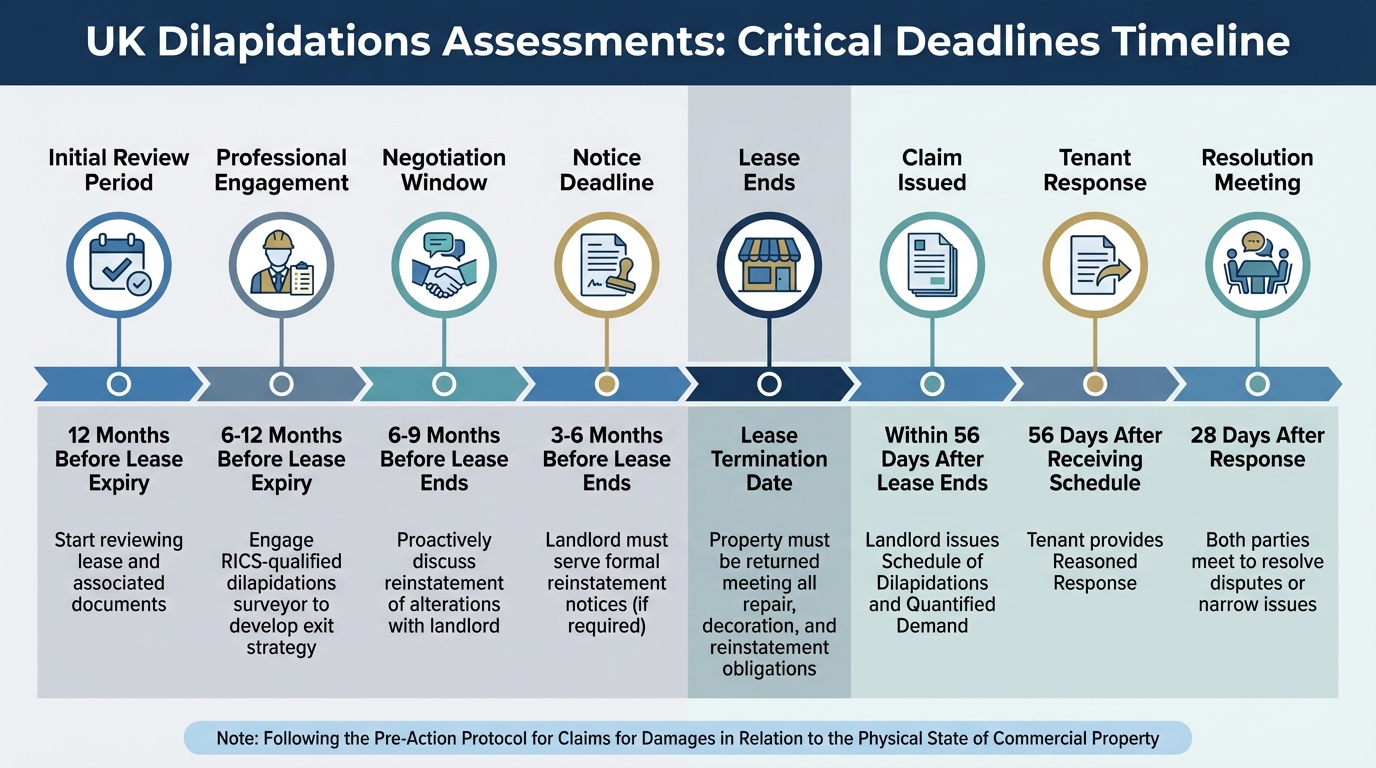
Dilapidations Assessment Timeline: Key Deadlines from 12 Months Before Lease Expiry
Getting ready for a dilapidations assessment requires careful groundwork to ensure the report is accurate and complies with legal obligations.
Review Lease Agreements and Related Documents
The lease agreement is your foundation. It outlines the “demise” – the physical areas the tenant is responsible for – and specifies obligations around repair, decoration, and reinstatement. As Anstey Horne puts it:
Liability is contractual. What your lease says – and any Schedule of Condition it incorporates – sets your starting position.
In addition to the lease, gather supporting documents. A Schedule of Condition (if included) establishes the property’s condition at the start of the tenancy and limits the tenant’s liability to restoring the property to that recorded state. Licences for Alterations document tenant modifications and clarify if these need to be removed when the lease ends. Deeds of Variation and Side Letters may amend the lease terms, potentially altering repair responsibilities or extending the lease term, which can directly affect dilapidations claims.
Also, collect maintenance records and test certificates. These include Planned Preventative Maintenance (PPM) schedules, operation and maintenance manuals, and fire or electrical safety certificates, all of which help demonstrate whether the tenant has upheld repair and compliance duties. Property plans and drawings, such as as-built and lease plans, are crucial for defining boundaries, particularly in multi-let buildings where responsibilities for shared or structural elements can be unclear.
| Document Type | Key Information to Extract | Importance for Assessment |
|---|---|---|
| Lease Agreement | Repair, decoration, and yield-up clauses; the “demise” description | Defines the legal standard and scope of work required |
| Schedule of Condition | Photos and descriptions of pre-existing defects | Shields tenants from liability for prior damage |
| Licence for Alterations | Reinstatement requirements for tenant modifications | Determines if tenants must remove fit-outs |
| Maintenance Logs | Servicing history for M&E, lifts, and fire systems | Verifies compliance with repair and statutory obligations |
| Lease Plans | Red-line boundaries of the leased area | Clarifies tenant responsibility for structural/external elements |
Once all documents are assembled, prioritise identifying key dates and deadlines outlined in the lease.
Identify Key Dates and Deadlines
Timing is everything. The lease termination date is the primary deadline, as tenants must return the property in line with repair, decoration, and reinstatement clauses by this date. If the tenant has a break clause, meeting dilapidations obligations by the break date is critical – failure to do so could void the break entirely.
Landlords often need to serve formal reinstatement notices within a specific timeframe, such as three or six months before the lease’s end, if they want tenants to remove alterations. Missing this deadline could weaken the landlord’s position, even if a settlement is later negotiated. Leases may also stipulate redecoration cycles, requiring periodic work (e.g., every five years) or within the final year of the term.
The Dilapidations Protocol sets further procedural timelines. Landlords should issue a Schedule of Dilapidations and Quantified Demand within 56 days of the lease ending, and tenants have 56 days to provide a “Reasoned Response”. After the response, both parties are encouraged to meet within 28 days to resolve disputes or narrow the issues.
To avoid last-minute disputes, start reviewing the lease and associated documents 12 months before expiry. Proactively discuss reinstatement of alterations with the landlord 6–9 months before the lease ends, ensuring that all deadlines, such as reinstatement notices and decoration cycles, are met.
Engage Professionals and Confirm Scope
The right professionals can make all the difference. Here’s who to involve:
- Chartered Dilapidations Surveyors: They inspect the property, identify breaches, prepare or respond to Schedules of Dilapidations, negotiate settlements, and provide expert evidence in court.
- Specialist Valuers: These experts produce “diminution valuations”, which calculate how much the property’s market value has been affected by disrepair. This valuation caps the landlord’s claim.
- Legal Professionals: Solicitors and barristers review lease terms, clarify the “demise”, and serve formal notices like reinstatement notices.
- Technical Specialists: For specific building elements like lifts, HVAC systems, cladding, or land contamination, these experts provide detailed assessments.
- Project Managers and Cost Consultants: If tenants choose to carry out remedial work themselves, these professionals ensure the work meets required standards before the lease expires.
Engage a RICS-qualified dilapidations surveyor 6–12 months before lease expiry to develop an exit strategy and minimise liabilities. RICS-qualified surveyors adhere to professional standards and the Dilapidations Protocol. Before starting the assessment, confirm the “demise” with legal advisors to avoid assessing areas outside the tenant’s responsibility.
Conducting the On-Site Inspection
With the lease documents reviewed and the team briefed, the next step is to carry out a thorough on-site inspection. Use the findings from the document review as a foundation, ensuring that every aspect of the inspection aligns with the lease’s outlined responsibilities.
Inspect Internal and External Property Features
Start with the building’s exterior. Look for leaks, blockages, or structural cracks. Pay attention to the roof, gutters, downpipes, and brickwork. Windows and doors also need a close inspection – check for cracked glass, timber rot, or faulty seals. Drainage systems should be examined for any signs of blockages or damage.
Inside the property, assess walls, floors, and ceilings for damp patches, stains, holes, or signs of poor maintenance. Be mindful of issues like cracked or lifted floor screed. Inspect joinery elements such as skirting boards, doors, and built-in fittings for wear and tear. Your inspection checklist should cover property details, external elements (roof, windows, doors, drainage), internal elements (walls, floors, ceilings, fittings), building services (plumbing, electrics, heating systems), and external areas like gardens or car parks.
Building services need either visual inspections or functional testing. This includes plumbing, electrics, heating systems, fire alarms, and emergency lighting. Ensure that key documentation, such as the Asbestos Register, gas appliance certifications, and electrical testing records, is up to date and accessible. If you suspect issues with mechanical or electrical systems, arrange for specialist testing. While the absence of testing doesn’t confirm disrepair, any identified faults could leave tenants liable for both testing and repair costs.
Don’t forget to inspect external grounds, including gardens, car parks, driveways, pathways, fences, gates, and signage. Look for potholes, overgrown vegetation, damaged fencing, or accumulated debris. For factory-finished surfaces like powder-coated shop fronts, check for chips or scratches. While these may not require redecoration, they could still be classified as disrepair.
Finally, verify that any breaches correspond with the demised areas as outlined in the lease plan.
Document Findings with Evidence
Use geo-tagged, high-resolution photographs to record any damage you find. Video footage can be particularly useful for capturing complex issues or covering larger areas.
Take precise metric measurements and note the condition of each element in detail. These measurements help quantify damage and provide a basis for cost estimates. Compare your findings with the Schedule of Condition to identify any new damage since the lease began.
Organise your findings into a Scott Schedule. This table should list each breach, the relevant lease clause, the nature of the issue, the proposed remedy, and an estimated cost. The Dilapidations Protocol offers a standardised format (Annex B or C), including columns for Item Number, Clause Number, Breach Complained of, Remedial Works Required, and Costings. Share the schedule electronically so the opposing party can add their comments directly into the document for negotiation.
Once the documentation is complete, categorise the issues to streamline negotiations and planning.
Check for Common Dilapidation Issues
Most dilapidation issues fall into one of four categories:
- Repair: Includes problems like roof leaks, spalled brickwork, cracked glazing, damaged floor screed, or drainage issues.
- Decoration: Covers the need for internal and external redecoration of all previously treated surfaces.
- Statutory Compliance: Involves meeting legal standards for electrical safety, fire precautions, gas certification, and asbestos management.
- Reinstatement: Relates to removing tenant alterations such as partitions, mezzanines, signage, or mechanical and electrical systems.
Check the lease for any redecoration cycles or “yield up” clauses that specify how the property should be handed back, such as a “white box” condition (e.g., partitions removed and walls painted plain white). Confirm whether the landlord served any reinstatement notice within the required timeframe. If they missed the deadline, the tenant may not be responsible for removing alterations.
“Liability is contractual. What your lease says – and any Schedule of Condition it incorporates – sets your starting position”.
Throughout the process, ensure all findings are aligned with the lease obligations to strengthen your position for negotiations and remediation planning.
Preparing the Schedule of Dilapidations
After completing your inspection and documenting the findings, the next step is to compile a Schedule of Dilapidations. This document outlines breaches of lease obligations, the remedial work required, and associated costs. It serves as the foundation for any claims and ensures adherence to the Pre-Action Protocol for Claims for Damages in Relation to the Physical State of Commercial Property at Termination of a Tenancy.
Detail Breaches and Required Works
The schedule should follow the Scott Schedule format, as recommended in Annex B or C of the Dilapidations Protocol. This table-based structure typically includes columns for:
- Item number
- The exact lease clause (quoted verbatim)
- Description of the breach
- Required remedial works
- Landlord’s costings
Each breach must directly reference a specific clause in the lease to establish the tenant’s contractual liability.
Organise the breaches into distinct categories for clarity:
- Repair: Issues such as roof leaks, cracked glazing, or other fabric defects.
- Decoration: Internal and external redecoration requirements.
- Reinstatement: Removal of tenant alterations, like partitions or mezzanines.
- Statutory Compliance: Issues related to fire safety, electrical testing, or gas certification.
It’s important to separate reinstatement from repair. While reinstatement involves undoing tenant alterations, repair focuses on addressing defects in the original structure.
The schedule should be endorsed by a chartered surveyor, confirming that the works are reasonable and the costings reflect fair market rates. Additionally, providing the schedule electronically allows the tenant to comment on individual items, facilitating a line-by-line negotiation process.
Calculate Costs and Include Section 18(1) Valuations
When calculating costs, include estimates for direct works, preliminaries, access requirements, testing, professional fees, and contingencies. After the tenant vacates, tender the repair contract to multiple contractors to replace estimates with actual market quotations.
Under Section 18(1) of the Landlord and Tenant Act 1927, the damages recoverable for breaches of repairing covenants are capped at the “diminution in value” of the landlord’s interest caused by the disrepair. For instance, if the cost of remedial works is £300,000 but expert valuation shows the property’s value has only decreased by £120,000 due to the breaches, the landlord’s recovery would be limited to £120,000.
“The figures set out in the Quantified Demand should be restricted to the landlord’s likely loss. This is not necessarily the same as the cost of works to remedy the breaches.”
Exclude costs for works that are rendered unnecessary by planned supersession – such as demolition, refurbishment, or redevelopment. Tenants should keep an eye on planning applications and tender activity to identify potential supersession arguments. Engaging a Section 18(1) valuer early is critical, as their assessment of diminution often becomes a decisive factor in negotiations.
Once the cost estimates are finalised, the focus shifts to formalising the claim and preparing for discussions with the tenant.
Prepare for Tenant Negotiations
The Schedule of Dilapidations and the accompanying Quantified Demand should be served within 56 days of the lease’s termination. The Quantified Demand must detail the monetary damages sought, supported by invoices or thorough estimates. These damages can include:
- Direct repair costs
- Lost rent
- Service charge shortfalls
- Business rates
- Professional fees
Tenants are generally expected to provide a reasoned Endorsed Response within 56 days of receiving the claim. Both parties are encouraged to meet on a “without prejudice” basis within 28 days of the tenant’s response to resolve disputed issues.
Start negotiations by addressing straightforward items to establish goodwill, and then tackle more complex matters like scope of works, rates, and other heads of claim. Courts also expect both parties to explore Alternative Dispute Resolution (ADR) options – such as mediation, arbitration, or expert determination – before initiating litigation. Refusing to engage in ADR without a valid reason could result in cost penalties.
Post-Assessment Actions and Dispute Resolution
Once the Schedule of Dilapidations and Quantified Demand have been issued, the focus shifts to resolving the claim without involving the courts. The Pre-Action Protocol for Claims for Damages in Relation to the Physical State of Commercial Property provides a structured approach for exchanging information early and encourages both parties to explore settlement options before considering litigation. This process sets the groundwork for negotiation and remediation.
Engage in Negotiations and Mediation
Negotiation between surveyors is the most common way to resolve dilapidations disputes. Typically, surveyors representing the landlord and tenant meet on-site to review the schedule, addressing each item individually. The aim is to reduce disagreements and work towards a settlement that satisfies both parties. Starting with simpler, lower-cost items often helps establish goodwill before tackling more complex matters, such as detailed costs, the scope of works, or any additional losses like lost rent or service charge shortfalls.
If negotiations stall, mediation can offer another path forward. In mediation, a neutral third party helps facilitate discussions between the landlord, tenant, and their advisors, aiming to reach a settlement that works for everyone. While agreements made during mediation are non-binding until formalised, courts expect serious engagement with Alternative Dispute Resolution (ADR). Refusing to participate in ADR without valid reasons can lead to cost penalties.
In cases where some issues are resolved through negotiation or mediation, the next step involves ensuring that any agreed-upon works meet the required standards.
Ensure Compliance with Repair Obligations
When tenants opt to carry out repair works instead of settling with a financial payment, it’s vital to ensure that the repairs align with the lease’s requirements and the agreed scope. Appointing a qualified surveyor to oversee the project can help confirm compliance. It’s also important to gather multiple contractor quotes and maintain thorough records – such as photos, invoices, and completion certificates – to demonstrate that the repairs meet the lease obligations.
Landlords should carefully inspect any tenant-completed works to ensure they meet the agreed standard before accepting them as settlement. If the tenant has vacated and a cash settlement is agreed upon instead, it’s essential to document the agreement as “full and final” and clearly outline the VAT position to avoid future misunderstandings. Properly executed repairs or settlements are key to concluding the dilapidations process.
Address Disputes Through Alternative Resolution Methods
Other ADR methods can help resolve disputes efficiently. Expert determination involves appointing a single, qualified surveyor to review the evidence and make a binding decision. This approach is particularly useful for resolving technical disputes that require quick resolution. Another option is arbitration, which provides a private, formal hearing process governed by the Arbitration Act. Arbitration leads to a binding decision without the public exposure associated with court cases.
Before escalating to formal proceedings, both parties should review their positions and evidence to narrow down the issues or avoid court action altogether. While the Protocol generally expects actions to progress within 56 days at each stage, the legal right to make a claim can extend up to 6 or 12 years after the lease expires, depending on how the lease was executed. Acting promptly and showing a genuine commitment to ADR processes is viewed positively by the courts.
Conclusion
Handling dilapidations assessments effectively requires thorough preparation, detailed documentation, and a clear approach to negotiation. The foundation of any assessment lies in the lease terms. Your lease, along with any attached Schedule of Condition, defines the scope of liabilities and sets the stage for discussions. Accurate baseline documentation is essential to resolve disputes fairly.
Timing is another crucial factor. Begin planning well ahead of the lease’s end date to allow enough time for repairs or to negotiate settlements. This proactive approach can make the entire process smoother and more efficient.
Comprehensive records are your strongest ally. Keeping detailed tenancy documentation strengthens your case, ensuring evidence-based discussions. Tools like Scott Schedules can simplify negotiations by breaking down disputes item-by-item, allowing quicker resolutions for simpler issues before tackling more complex disagreements over technical details or costs .
Following the Pre-Action Protocol and considering Alternative Dispute Resolution (ADR) can significantly reduce settlement amounts. In some cases, expert negotiation has led to settlements over 90% lower than the initial claims.
Whether you’re a landlord safeguarding your property or a tenant fulfilling lease obligations, professionalism, clear communication, and expert advice are essential. These steps not only help you manage dilapidations efficiently but also minimise the risk of expensive disputes and litigation.
FAQs
What are the key deadlines to follow in a dilapidations assessment?
The dilapidations process in the UK comes with specific timelines that landlords and tenants need to follow closely. According to the Dilapidations Protocol, landlords are required to serve a Schedule of Dilapidations and a Quantified Demand within 56 days of the lease ending. If this is done before the lease expires, the schedule must be updated to reflect the actual lease end date. Additionally, some leases may include custom notice periods, so it’s essential to review the contract for any specific terms.
Even if these deadlines are missed, landlords can still make a claim within the statutory limitation period. Typically, this is six years from the lease termination date, or twelve years for leases signed before 1 April 1995.
Here are the key steps in the process:
- Pre-expiry notice: Landlords usually notify tenants of the lease end 6–12 months in advance.
- Schedule of Dilapidations and Quantified Demand: This must be issued within 56 days after the lease ends (or earlier if the lease specifies).
- Tenant response: Tenants generally have about 30 days to reply to the schedule.
- Limitation period: Landlords must file claims before the statutory deadline of 6 or 12 years, depending on the lease.
Following these timelines not only helps maintain compliance with UK property laws but also reduces the risk of disputes between landlords and tenants.
What role does the Schedule of Dilapidations play in lease-end negotiations?
The Schedule of Dilapidations plays a crucial role in lease-end negotiations. It details any breaches of the tenant’s repair obligations and includes cost estimates for addressing these issues. Essentially, it acts as the starting point for discussions between the landlord and tenant, shaping decisions around settlements, cost-sharing, or payment agreements.
By clearly listing areas needing repair along with the associated costs, this document provides a transparent framework for negotiation. This transparency helps minimise disputes and makes it easier for both parties to reach a resolution.
What is the role of a chartered dilapidations surveyor in an assessment?
Chartered dilapidations surveyors are specialists who manage the detailed assessment of lease agreements. They pinpoint any breaches, suggest the necessary steps for repair or compliance, and create the Schedule of Dilapidations – a key document for resolving claims or negotiations between landlords and tenants.
Beyond their technical expertise, these surveyors often serve as neutral advisers during disputes, aiming to help both sides reach fair agreements without resorting to expensive legal action. Their chartered status guarantees that their advice adheres to the UK dilapidations protocol and the unique terms of each lease, ensuring clarity and professionalism every step of the way.
Related Blog Posts
- Party Wall Agreement: 7 Things You Must Know
- How to Spot Property Defects Before Buying
- Building Survey Cost: What to Expect in 2026
- 10 Common Questions About RICS Building Surveys
How Prince Surveyors can help: explore our dilapidations surveys and schedules or learn about our expert witness reports.