

Construction disputes in 2026 increasingly hinge on carbon performance claims—and surveyors unprepared to quantify whole life carbon (WLC) risk losing credibility in court. With the RICS Whole Life Carbon Assessment 2nd Edition becoming fully effective on July 1, 2024, and PAS 2080:2023 establishing the UK's management framework, expert witnesses now face a dual mandate: deliver defensible carbon calculations while demonstrating robust governance processes. This convergence transforms how valuation disputes, defect claims, and contractual disagreements are resolved in the built environment.
Understanding Whole Life Carbon in Expert Witness Reports: Integrating RICS 2nd Edition and PAS 2080:2023 in Disputes is no longer optional for surveyors providing expert testimony. Courts expect carbon assessments to meet international standards, use verified methodologies, and withstand cross-examination. This article provides surveyors with court-ready templates, reporting frameworks, and practical guidance for incorporating WLC assessments into expert witness reports.
Key Takeaways
- RICS WLCA 2nd Edition provides the calculation methodology while PAS 2080:2023 establishes the management framework—expert witnesses must integrate both for defensible testimony 📊
- Standardized boundaries and data hierarchies enable like-for-like comparisons across projects, essential for dispute resolution and comparative analysis
- Expert reports must document data quality, assumptions, and governance processes to withstand cross-examination and meet admissibility standards
- Carbon assessments now influence property valuations, defect claims, and contractual disputes, requiring surveyors to quantify carbon performance gaps
- Court-ready templates should include lifecycle stage breakdowns (A1-D), sensitivity analyses, and compliance matrices aligned with both frameworks
Understanding the Dual Framework: RICS 2nd Edition and PAS 2080:2023
The relationship between RICS WLCA 2nd Edition and PAS 2080:2023 forms the foundation for credible expert witness testimony. These standards work in tandem rather than competition, each serving distinct but complementary purposes.
RICS WLCA 2nd Edition: The Calculation Standard
The RICS Whole Life Carbon Assessment 2nd Edition establishes a global methodology for measuring whole-life carbon across buildings and infrastructure projects throughout their lifecycle.[1] Effective from July 1, 2024, this standard provides surveyors with consistent calculation methods, reporting structures, and boundary definitions.[2]
Key features for expert witnesses include:
- Standardized lifecycle stages: A1-A5 (product and construction), B1-B7 (use stage), C1-C4 (end of life), and D (beyond lifecycle benefits)
- Data hierarchy requirements: Prioritizing specific product data over generic databases
- Consistent boundary definitions: Enabling like-for-like comparisons across different packages and projects[2]
- International applicability: Designed as a global standard with methodology applicable internationally, though numerical assumptions are based on UK locations[5]
The standard supports defensible reporting by establishing clear methodologies that can withstand technical scrutiny during cross-examination. For surveyors preparing expert reports, this means calculations follow a recognized international framework rather than bespoke approaches.
PAS 2080:2023: The Management Framework
While RICS WLCA provides the "how to calculate," PAS 2080:2023 establishes the "how to manage." This UK specification for managing whole-life carbon emphasizes governance, target-setting, data quality, and supply-chain collaboration.[2][4]
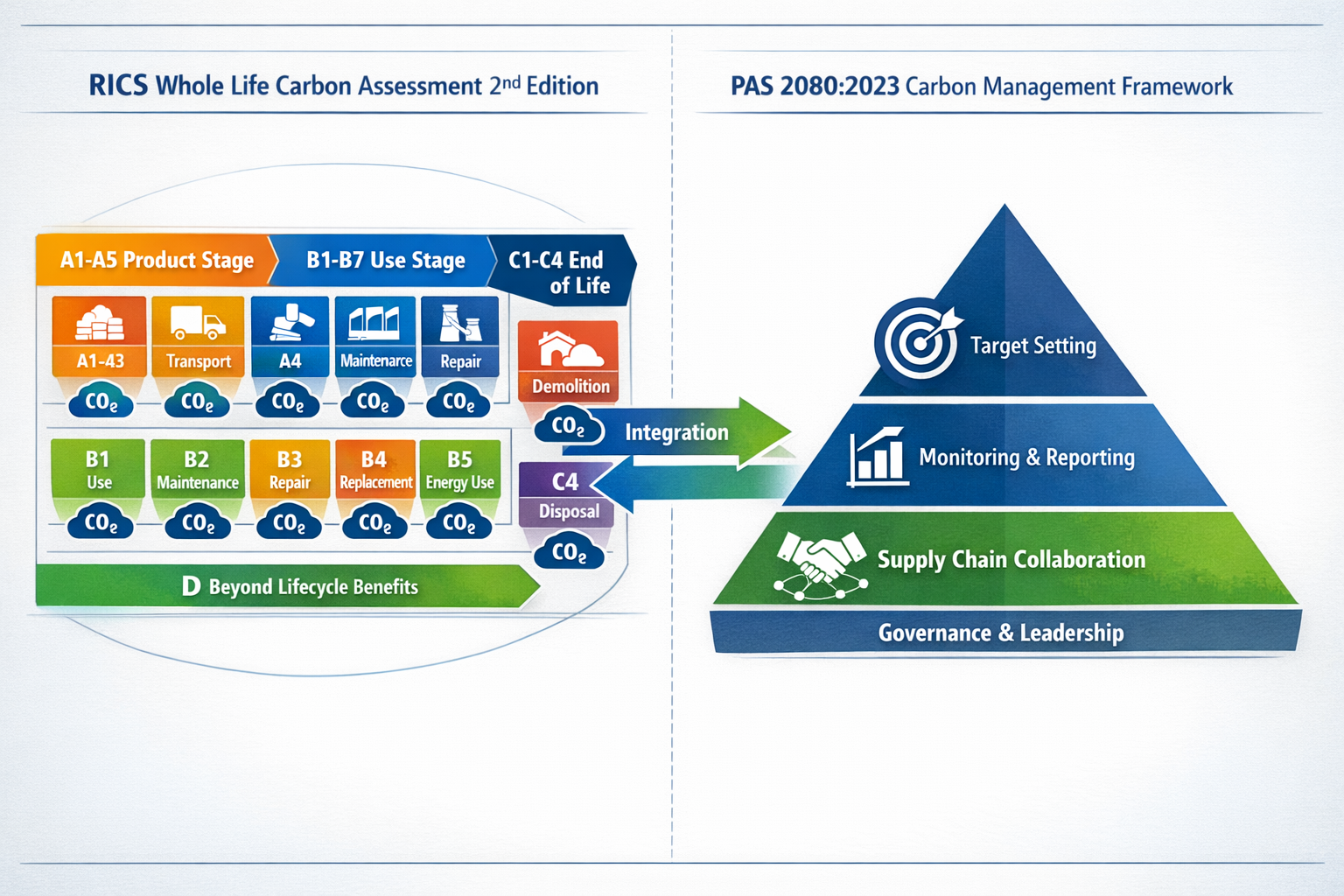
Critical elements for expert witness work include:
✅ Governance structures: Demonstrating organizational commitment to carbon management
✅ Target-setting protocols: Establishing baseline and reduction targets
✅ Decision-making frameworks: Documenting how carbon considerations influenced project choices
✅ Monitoring and reporting: Tracking actual versus predicted performance
✅ Supply chain engagement: Demonstrating collaboration and data verification processes[4]
PAS 2080 functions as the management framework (governance, targets, decision-making, monitoring and reporting), while RICS WLCA provides the calculation and reporting method for consistent measurement.[4] Expert witnesses must demonstrate both accurate calculations and proper management processes to provide comprehensive testimony.
Integration in Dispute Contexts
In disputes involving carbon performance, courts require evidence of both accurate measurement and proper governance. A property developer claiming compliance with carbon targets must demonstrate:
- Accurate calculations using RICS WLCA methodology
- Documented governance following PAS 2080 principles
- Verified data quality with clear hierarchies and assumptions
- Monitoring evidence showing actual versus predicted performance
This dual framework approach strengthens expert testimony by providing both technical rigor and management accountability. Surveyors conducting building defects surveys must now incorporate carbon performance assessments alongside traditional defect analysis.
Whole Life Carbon in Expert Witness Reports: Reporting Requirements and Templates
Creating court-ready expert witness reports requires structured templates that integrate both RICS WLCA 2nd Edition calculations and PAS 2080:2023 governance evidence. The following framework provides surveyors with a defensible reporting structure.
Essential Report Components
Expert witness reports addressing Whole Life Carbon in Expert Witness Reports: Integrating RICS 2nd Edition and PAS 2080:2023 in Disputes should include these core sections:
1. Executive Summary and Instructions
- Clear statement of instructions received
- Summary of key findings and carbon performance gaps
- Materiality assessment of carbon-related disputes
- Compliance statement with RICS Practice Statement and Guidance Note
2. Methodology and Standards Compliance
- Explicit reference to RICS WLCA 2nd Edition methodology[1]
- Confirmation of PAS 2080:2023 governance principles applied
- Boundary definitions and system completeness
- Data quality hierarchy and sources used
- Assumptions register with sensitivity analysis
3. Lifecycle Stage Breakdown
| Lifecycle Stage | Description | Carbon Impact (kgCO2e/m²) | Data Quality |
|---|---|---|---|
| A1-A3 Product Stage | Materials extraction and manufacturing | [Calculated value] | Specific/Generic |
| A4-A5 Construction | Transport and construction process | [Calculated value] | Specific/Generic |
| B1-B7 Use Stage | Operations, maintenance, replacement | [Calculated value] | Specific/Generic |
| C1-C4 End of Life | Deconstruction, transport, disposal | [Calculated value] | Specific/Generic |
| D Beyond Lifecycle | Reuse, recycling benefits | [Calculated value] | Specific/Generic |
This table format enables like-for-like comparisons essential for dispute resolution, showing where carbon performance deviates from contractual requirements or industry benchmarks.[2]

4. Governance and Management Evidence
- Documentation of target-setting processes per PAS 2080
- Evidence of supply chain collaboration and data verification
- Monitoring and reporting procedures implemented
- Decision-making frameworks for carbon-critical choices
- Quality assurance processes and third-party verification
5. Comparative Analysis and Gap Assessment
- Comparison between predicted and actual carbon performance
- Benchmarking against industry standards or contractual targets
- Quantification of carbon performance gaps
- Financial implications of carbon shortfalls or exceedances
- Remediation options and associated costs
Data Quality and Assumptions Documentation
Courts scrutinize the reliability of underlying data more intensely than the calculations themselves. Expert witnesses must document:
📋 Data hierarchy position: Whether data is specific product EPDs, manufacturer averages, or generic database values
📋 Assumption justifications: Why particular assumptions were necessary and reasonable
📋 Sensitivity ranges: How variations in key assumptions affect results
📋 Verification methods: Third-party checks, peer reviews, or audit trails
📋 Limitations and uncertainties: Clear statement of confidence levels and data gaps
The RICS standard emphasizes data quality hierarchies that prioritize specific product data over generic databases.[1] Expert reports must explicitly state where data falls within this hierarchy and justify any use of lower-quality data sources.
Court-Ready Presentation Formats
Effective expert witness reports balance technical rigor with accessibility. Consider these presentation strategies:
Visual aids: Carbon lifecycle diagrams, comparison charts, and sensitivity graphs make complex data comprehensible to non-technical audiences.
Plain language summaries: Technical sections should be accompanied by clear explanations suitable for legal professionals and judges without engineering backgrounds.
Compliance matrices: Tables showing point-by-point compliance with RICS WLCA 2nd Edition and PAS 2080:2023 requirements demonstrate methodological rigor.
Scenario modeling: Presenting multiple scenarios (best case, worst case, most likely) helps courts understand uncertainty ranges and decision impacts.
Surveyors familiar with RICS Building Surveys will recognize parallels in reporting structure—both require clear methodology statements, evidence-based findings, and accessible presentation for non-specialist audiences.
Practical Application: Whole Life Carbon in Expert Witness Reports for Common Disputes
The integration of Whole Life Carbon in Expert Witness Reports: Integrating RICS 2nd Edition and PAS 2080:2023 in Disputes manifests differently across various dispute types. Understanding these applications helps surveyors prepare targeted, relevant testimony.
Valuation Disputes and Carbon Performance
Property valuations increasingly reflect carbon performance, creating new grounds for disputes. When carbon assessments influence purchase prices or investment decisions, expert witnesses must:
- Quantify the value impact of carbon performance gaps
- Compare actual versus represented carbon metrics at transaction time
- Assess materiality of carbon discrepancies on valuation conclusions
- Consider market expectations for carbon performance in specific property sectors
For example, a commercial building marketed as "net-zero ready" but failing to meet RICS WLCA benchmarks may face valuation adjustments. Expert witnesses must demonstrate how carbon shortfalls translate to financial impacts—through increased operational costs, regulatory non-compliance risks, or reduced marketability.
The property valuation process now extends beyond traditional considerations to include embodied and operational carbon assessments, requiring surveyors to quantify carbon-related value adjustments.
Defect Claims and Carbon Performance Failures
Construction defects increasingly include carbon performance failures—where buildings fail to achieve specified carbon targets. Expert witnesses addressing these claims must:
✅ Establish the baseline carbon target from contract documents or planning conditions
✅ Calculate actual carbon performance using RICS WLCA methodology
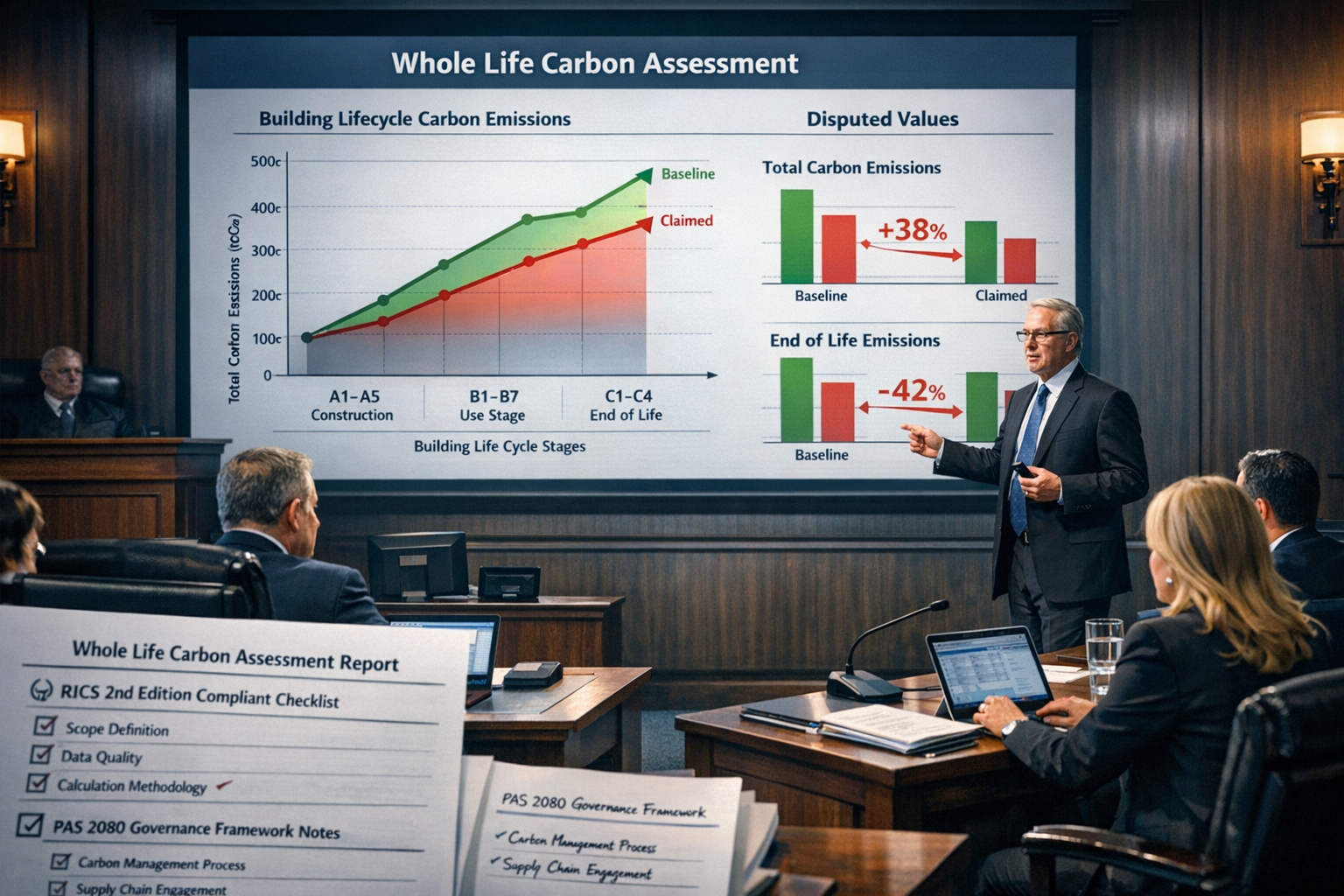
✅ Quantify the performance gap and attribute causes
✅ Assess remediation options and associated costs
✅ Determine liability allocation among design team, contractors, and suppliers
Carbon performance failures often stem from:
- Specification deviations: Substituted materials with higher embodied carbon
- Construction process changes: Modified methods increasing A4-A5 stage emissions
- Operational system failures: HVAC or energy systems underperforming predictions
- Data quality issues: Inaccurate EPDs or calculation errors
Expert reports must trace the chain of causation from specific decisions or actions to carbon performance shortfalls, supported by documentary evidence and calculation verification.
Contractual Disputes Over Carbon Compliance
Many construction contracts now include carbon performance obligations, creating potential breach claims when targets are missed. Expert witnesses must interpret:
- Contractual language: Whether carbon targets are warranties, performance specifications, or aspirational goals
- Measurement timing: Whether assessments occur at design, completion, or operational stages
- Tolerance ranges: Acceptable deviations from stated targets
- Verification requirements: Third-party certification or self-certification sufficiency
PAS 2080:2023's emphasis on governance and monitoring becomes critical in these disputes.[4] Expert witnesses must demonstrate whether parties followed agreed management frameworks, conducted proper monitoring, and took corrective actions when performance deviated from targets.
Planning and Regulatory Disputes
Planning authorities increasingly impose carbon performance conditions on development approvals. Disputes arise when:
- Developers claim conditions are unachievable or unreasonable
- Authorities allege non-compliance with approved carbon assessments
- Third parties challenge inadequate carbon impact assessments
- Post-completion monitoring reveals significant performance gaps
Expert witnesses must assess whether carbon performance claims were reasonable at submission time, whether conditions are technically achievable, and whether actual performance meets regulatory requirements.
The statutory considerations that surveyors traditionally address now extend to carbon performance obligations under building regulations and planning conditions.
Professional Negligence Claims
Surveyors, architects, and engineers face professional negligence claims for inadequate carbon assessments or advice. Expert witnesses evaluating these claims must determine:
- Whether the professional's carbon assessment met applicable standards (RICS WLCA, PAS 2080) at the time
- Whether advice reflected reasonable professional competence for carbon matters
- Whether carbon assessment errors caused quantifiable losses
- Whether the professional had sufficient expertise to undertake carbon assessments
The rapid evolution of carbon standards creates complexity—what constituted reasonable practice in 2023 differs from expectations in 2026. Expert witnesses must carefully consider the temporal context of professional actions and the standards applicable at that time.[5]
Supply Chain and Procurement Disputes
PAS 2080:2023's emphasis on supply chain collaboration creates new dispute dimensions when suppliers provide inaccurate carbon data or fail to meet specified carbon performance.[4] Expert witnesses must:
- Verify data quality and accuracy of supplier-provided EPDs
- Assess reasonableness of carbon specifications in procurement documents
- Determine liability for data inaccuracies between manufacturers, suppliers, and contractors
- Evaluate alternative product options and associated cost implications
These disputes often involve technical questions about data verification methods, the reliability of industry databases versus specific product EPDs, and reasonable expectations for data quality at different project stages.
Best Practices for Surveyors Preparing Expert Witness Reports
Successfully integrating Whole Life Carbon in Expert Witness Reports: Integrating RICS 2nd Edition and PAS 2080:2023 in Disputes requires surveyors to adopt specific best practices that enhance credibility and withstand scrutiny.
Maintain Professional Independence
Expert witnesses owe duties to the court, not the instructing party. When preparing carbon assessments:
⚖️ Apply consistent methodologies regardless of which party benefits
⚖️ Disclose all assumptions and limitations transparently
⚖️ Acknowledge uncertainty ranges rather than presenting false precision
⚖️ Consider alternative interpretations of ambiguous data
⚖️ Update opinions if new evidence emerges
The RICS Practice Statement emphasizes that expert witnesses must provide objective, unbiased opinions based on expertise rather than advocacy for instructing parties.
Document Everything
Carbon assessments involve numerous assumptions, data sources, and calculation steps. Comprehensive documentation includes:
- Calculation workbooks with clear formulas and data sources
- Data source verification with copies of EPDs, manufacturer specifications, or database references
- Assumption registers explaining why each assumption was necessary and reasonable
- Correspondence records showing data requests, responses, and verification attempts
- Peer review evidence demonstrating quality assurance processes
This documentation trail enables replication and verification by opposing experts and helps courts understand the basis for conclusions.
Engage Early in Disputes
Carbon performance disputes benefit from early expert involvement to:
- Identify critical data before it's lost or destroyed
- Preserve evidence of as-built conditions and material specifications
- Conduct contemporaneous monitoring rather than retrospective estimation
- Advise on proportionate investigation scope
- Facilitate early settlement discussions based on realistic carbon performance assessments
Early engagement often reveals that apparent carbon performance disputes actually reflect measurement methodology differences rather than genuine performance gaps—issues that can be resolved without litigation.
Stay Current with Evolving Standards
The carbon assessment landscape evolves rapidly. Expert witnesses must:
📚 Monitor standard updates: RICS and BSI regularly update guidance documents
📚 Participate in professional development: CPD courses on carbon assessment methodologies
📚 Engage with industry working groups: Contributing to standard development and interpretation
📚 Track case law developments: Understanding how courts interpret carbon obligations
📚 Review technical literature: Staying informed about data quality improvements and calculation refinements
The transition from RICS WLCA 1st Edition to 2nd Edition illustrates how standards evolve—expert witnesses must clearly state which version applied to the project under dispute and whether retrospective application of newer standards is appropriate.
Collaborate with Multidisciplinary Teams
Carbon assessments often require multidisciplinary expertise:
- Structural engineers for embodied carbon in structural systems
- MEP engineers for operational energy and carbon
- Quantity surveyors for cost implications of carbon performance gaps
- Environmental consultants for broader sustainability context
- Legal advisors for contractual interpretation
Expert witnesses should acknowledge the limits of their expertise and recommend additional specialists when disputes involve technical areas beyond their competence. This approach strengthens rather than weakens expert credibility.
Surveyors familiar with structural engineering services understand the importance of multidisciplinary collaboration—carbon assessment disputes require similar integrated approaches.
Use Sensitivity Analysis Extensively
Carbon calculations involve inherent uncertainties. Sensitivity analysis demonstrates how results change with different assumptions:
- Data quality variations: How results differ using specific EPDs versus generic data
- Operational assumptions: Impact of different usage patterns on B-stage emissions
- End-of-life scenarios: Effects of different disposal or recycling assumptions
- Temporal factors: How future grid decarbonization affects operational carbon
Presenting sensitivity ranges helps courts understand that carbon assessments involve judgment and uncertainty rather than absolute precision. This transparency enhances expert credibility and helps parties assess settlement positions realistically.
Prepare for Cross-Examination
Expert witnesses must withstand rigorous cross-examination. Preparation includes:
✓ Reviewing all source documents thoroughly, not just summaries
✓ Understanding opposing expert positions and preparing responses
✓ Practicing explanations of technical concepts in plain language
✓ Anticipating challenges to assumptions, data quality, and methodology
✓ Preparing visual aids that clarify complex technical points
The most effective expert witnesses explain carbon assessment concepts clearly to non-technical audiences while maintaining technical rigor when challenged on methodology details.
Conclusion
The integration of Whole Life Carbon in Expert Witness Reports: Integrating RICS 2nd Edition and PAS 2080:2023 in Disputes represents a fundamental shift in how construction and property disputes are resolved in 2026. Surveyors providing expert testimony must now demonstrate competence in both carbon calculation methodologies and management frameworks, delivering reports that withstand technical scrutiny while remaining accessible to legal audiences.
The dual framework of RICS WLCA 2nd Edition for calculations and PAS 2080:2023 for governance provides surveyors with robust, defensible methodologies that courts increasingly expect in carbon-related disputes. From valuation disagreements to defect claims, contractual breaches to professional negligence allegations, carbon performance now influences dispute outcomes across the built environment sector.
Actionable Next Steps
For surveyors preparing to incorporate whole life carbon assessments into expert witness work:
- Obtain formal training in RICS WLCA 2nd Edition and PAS 2080:2023 methodologies through accredited CPD courses
- Develop standardized templates for carbon assessment reports that integrate both frameworks systematically
- Build multidisciplinary networks with engineers, environmental consultants, and legal advisors experienced in carbon disputes
- Create comprehensive documentation systems that capture assumptions, data sources, and calculation trails for future disputes
- Participate in professional working groups to stay current with evolving standards and case law developments
- Review existing expert witness procedures to incorporate carbon assessment requirements alongside traditional survey work
The convergence of carbon performance obligations, standardized assessment methodologies, and increasing litigation creates both challenges and opportunities for surveying professionals. Those who master these frameworks position themselves as essential experts in an expanding dispute resolution landscape.
As carbon performance becomes increasingly central to property value, construction quality, and regulatory compliance, the demand for expert witnesses capable of delivering credible, court-ready carbon assessments will only intensify. The time to develop these capabilities is now—before the next dispute lands on your desk.
For surveyors seeking to expand their expertise, consider how building regulation compliance testing and construction law advice intersect with carbon performance obligations, creating integrated service offerings that address the full spectrum of modern construction disputes.
References
[1] Whole Life Carbon Assessment Ps Sept23 – rics.org
[2] Pas 2080 Carbon Management For Energy Infrastructure One Click Lca – oneclicklca.com
[4] Pas 2080 Suppliers Subcontractors Bids Delivery – seedling.earth
[5] Whole Life Carbon Assessment – rics.org